HOMEOSTASIS
Chapter 7
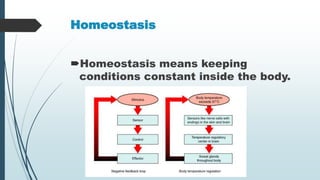
Homeostasis
Homeostasis means keeping
conditions constant inside the body.
Homeostasis
Why is it important for our body
to maintain steady state?
Chemical reactions in our body
are controlled by enzymes and
enzymes need optimum
temperature and pH to function.
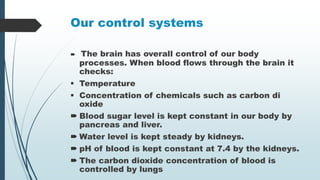
Our control systems
 The brain has overall control of our body
processes. When blood flows through the brain it
checks:
 Temperature
 Concentration of chemicals such as carbon di
oxide
 Blood sugar level is kept constant in our body by
pancreas and liver.
 Water level is kept steady by kidneys.
 pH of blood is kept constant at 7.4 by the kidneys.
 The carbon dioxide concentration of blood is
controlled by lungs
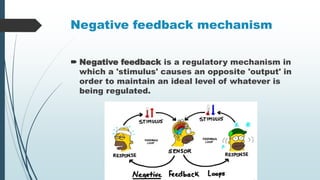
Negative feedback mechanism
 Negative feedback is a regulatory mechanism in
which a 'stimulus' causes an opposite 'output' in
order to maintain an ideal level of whatever is
being regulated.
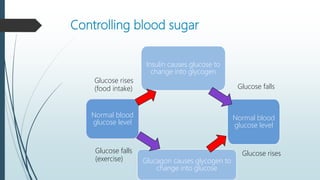
Controlling blood sugar
Insulin causes glucose to
change into glycogen
Normal blood
glucose level
Glucagon causes glycogen to
change into glucose
Normal blood
glucose level
Glucose rises
(food intake)
Glucose falls
(exercise)
Glucose falls
Glucose rises
Controlling blood sugar
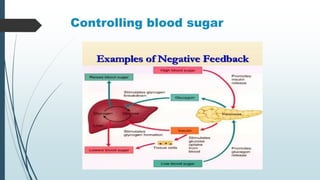
 Blood sugar level is controlled by the pancreas.
 As a result of the negative feedback it gets, it
eithers:
 Makes insulin to decrease blood sugar
 Makes glucagon to increase blood sugar
Controlling blood sugar
Diabetes
 Disease that occurs due to deficiency of insulin
or development of resistance to insulin.
 Symptoms:
o Increased urination
o Increased eating
o Increased thirst
 Reason why glucose is found in the urine of the
diabetic patient is because kidneys can not
reabsorb the excess glucose present in the blood.

 One of the complication of diabetes is cataract-
Lens in the eye becomes cloudy
Structure of skin
Skin has 3 layers:
• 1. Epidermis
• 2. Dermis
• 3. Subcutaneous layer
Structure of skin
Structure of skin
Structure of skin
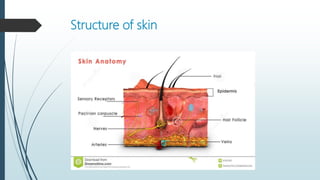
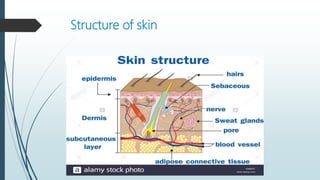
1. Epidermis: The epidermis is composed
of the outermost layers of the skin. It
forms a protective barrier over the body's
surface, responsible for keeping water in
the body and preventing pathogens from
entering.
2. Dermis: Consists of connective tissue. It
has the sensory receptors for touch and
temperature, blood vessels, hair follicles,
sweat glands and sebaceous glands.
3. Subcutaneous layer: Contains fat
(adipose tissue).
Functions of skin:
 Protects body from damage
 Stops pathogens from getting in
 Stops too much water loss
 Lets you feel touch,pain,temperature and
pressure
 Helps to keep your temperature constant
Hot or cold?
 Humans are homiothermic (warm blooded). This
means we can maintain our body temperature
constant all the time. The optimum temperature
is 37 degrees centigrade. This is the best
temperature the enzymes work.
 Ectothermic (cold blooded) lizards can not do
this.
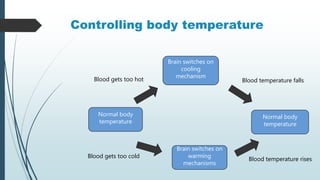
Controlling body temperature
Brain switches on
cooling
mechanism
Normal body
temperature
Normal body
temperature
Brain switches on
warming
mechanisms
Blood gets too hot
Blood gets too cold
Blood temperature falls
Blood temperature rises
Controlling body temperature
 Optimum body temperature is 37
degree centigrade.
 Cooling mechanism:
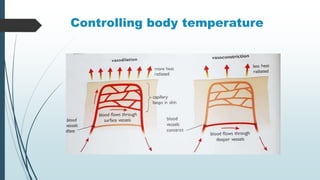
• Blood vessels in the skin dilate-
vasodilation
• This allows more blood to flow to the
surface so more heat is lost by
radiation.
• Sweat glands in skin makes more
sweat. Sweat evaporates and cools you
down.
Controlling body temperature
 Warming mechanism:
• Blood vessels constricts (narrows) –
vasoconstriction.
• So less heat is lost by radiation.
• Sweat glands stop making sweat.
• Shivering- muscles contracts and therefore
produces extra heat.
Controlling body temperature
Excretion
Excretion: Removing waste made by our cells is
called excretion.
Eg. Of waste produced in our body- carbondioxide,
urea
Excretory organs of our body:
Skin
Lungs: excrete carbondioxide
Kidneys: Excrete urea and other salts
Liver: excretes chemical wastes in bile
Deamination
Excess amino acids are converted into
urea by liver. This is called deamination.
Then this urea is excreted by the
kidneys.
Structure of kidney
Our body has one pair of kidneys situated in the
back of our body.
Kidneys have two areas:
1. outer cortex
2. inner medulla
The functional part of the kidney is called nephron.
Nephron are tubular in structure. Filtration occurs in
the cortex area.
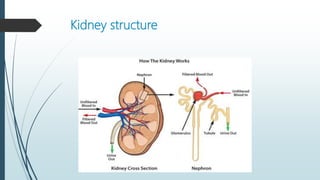
Kidney structure
Parts of nephron
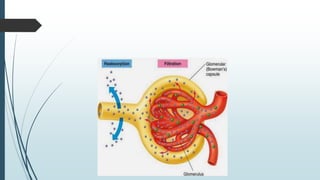
Glomerulus: Tuft of capillaries present
Bowman’s capsule
Proximal convoluted tubule
Loop of Henle
Distal convoluted tubule
Collecting tubule
How kidney works
 Renal artery brings blood containing the waste (eg.urea) to the
kidneys
 Renal artery forms branches which ends into a bunch of
capillaries called glomerulus
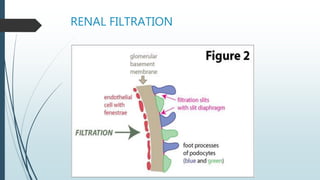
As blood passes through the glomerulus it is filtered. Large
molecules like blood proteins stay back. Small molecules like urea,
glucose, salt and water passes into the Bowman’s capsule from the
glomerulus.
 All the glucose, some salt and water are needed by the body so
they are reabsorbed back into the blood. This occurs against
the concentration gradient with the help of active transport.
How the kidney works
The remaining fluid in the nephron contains urea and
some salts dissolved in water- this forms the urine.
This urine passes out of the kidneys into the bladder
via ureter.
The cleaned blood leaves the kidneys via renal vein
Pituitary gland
Pituitary gland is present in the base of the brain.
It is known as the master gland as it helps to control
other glands.
Antidiuretic hormone is secreted by the pituitary
gland.
ADH (Antidiuretic hormone)
ADH (Antidiuretic hormone ) is secreted
by the pituitary gland, which is present
at the base of our brain.
Function of ADH: It helps in
reabsorption of water.
RENAL FILTRATION
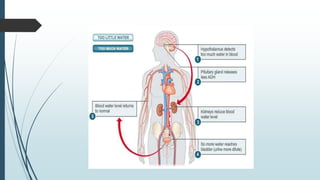
Controlling body water
When our blood becomes dilute:
1. No ADH is produced
2. the kidneys don’t reabsorb much
water, from the nephrons back into the
blood
3. dilute urine is produced
Controlling body water
When blood becomes concentrated:
1. ADH is produced
2. it tells the kidneys to absorb most
water from the nephrons back into the
blood
3. concentrated urine is produced
Kidney dialysis
Kidney dialysis is required in patients with renal
failure (when kidneys can’t function properly)
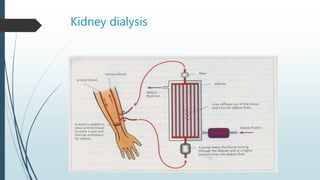
First a tube is connected to one of the patient’s vein.
The blood flows along the tube into the machine
3.Inside the machine the fluid passes over the
surface of a dialysis membrane. This separates the
patient’s blood from the dialysis fluid.
Urea diffuses out of the blood across the dialysis
membrane into the dialysis fluid.
KIDNEY DIALYSIS
The dialysis fluid already has sugar and salts so these
will not diffuse from the blood into the fluid.
Urea and other wastes leave the machine in the
dialysis fluid.
The patient’s cleaner blood passes back into the vein.
Kidney dialysis
Kidney transplant
 A person with failed kidneys may have a kidney transplant. This involves replacing
the diseased kidneys with a healthy one from donor.
 To prevent transplant rejection sometimes the kidneys are taken from close
relatives or patients are first treated with immunosuppressive drugs.
THANK YOU!

Homeostasis

  • 1.
  • 2.
  • 3.
    Homeostasis Why is itimportant for our body to maintain steady state? Chemical reactions in our body are controlled by enzymes and enzymes need optimum temperature and pH to function.
  • 4.
    Our control systems The brain has overall control of our body processes. When blood flows through the brain it checks:  Temperature  Concentration of chemicals such as carbon di oxide  Blood sugar level is kept constant in our body by pancreas and liver.  Water level is kept steady by kidneys.  pH of blood is kept constant at 7.4 by the kidneys.  The carbon dioxide concentration of blood is controlled by lungs
  • 5.
    Negative feedback mechanism Negative feedback is a regulatory mechanism in which a 'stimulus' causes an opposite 'output' in order to maintain an ideal level of whatever is being regulated.
  • 6.
    Controlling blood sugar Insulincauses glucose to change into glycogen Normal blood glucose level Glucagon causes glycogen to change into glucose Normal blood glucose level Glucose rises (food intake) Glucose falls (exercise) Glucose falls Glucose rises
  • 7.
    Controlling blood sugar Blood sugar level is controlled by the pancreas.  As a result of the negative feedback it gets, it eithers:  Makes insulin to decrease blood sugar  Makes glucagon to increase blood sugar
  • 8.
  • 9.
    Diabetes  Disease thatoccurs due to deficiency of insulin or development of resistance to insulin.  Symptoms: o Increased urination o Increased eating o Increased thirst  Reason why glucose is found in the urine of the diabetic patient is because kidneys can not reabsorb the excess glucose present in the blood.  One of the complication of diabetes is cataract- Lens in the eye becomes cloudy
  • 10.
    Structure of skin Skinhas 3 layers: • 1. Epidermis • 2. Dermis • 3. Subcutaneous layer
  • 11.
  • 12.
  • 13.
    Structure of skin 1.Epidermis: The epidermis is composed of the outermost layers of the skin. It forms a protective barrier over the body's surface, responsible for keeping water in the body and preventing pathogens from entering. 2. Dermis: Consists of connective tissue. It has the sensory receptors for touch and temperature, blood vessels, hair follicles, sweat glands and sebaceous glands. 3. Subcutaneous layer: Contains fat (adipose tissue).
  • 14.
    Functions of skin: Protects body from damage  Stops pathogens from getting in  Stops too much water loss  Lets you feel touch,pain,temperature and pressure  Helps to keep your temperature constant
  • 15.
    Hot or cold? Humans are homiothermic (warm blooded). This means we can maintain our body temperature constant all the time. The optimum temperature is 37 degrees centigrade. This is the best temperature the enzymes work.  Ectothermic (cold blooded) lizards can not do this.
  • 16.
    Controlling body temperature Brainswitches on cooling mechanism Normal body temperature Normal body temperature Brain switches on warming mechanisms Blood gets too hot Blood gets too cold Blood temperature falls Blood temperature rises
  • 17.
    Controlling body temperature Optimum body temperature is 37 degree centigrade.  Cooling mechanism: • Blood vessels in the skin dilate- vasodilation • This allows more blood to flow to the surface so more heat is lost by radiation. • Sweat glands in skin makes more sweat. Sweat evaporates and cools you down.
  • 18.
    Controlling body temperature Warming mechanism: • Blood vessels constricts (narrows) – vasoconstriction. • So less heat is lost by radiation. • Sweat glands stop making sweat. • Shivering- muscles contracts and therefore produces extra heat.
  • 19.
  • 20.
    Excretion Excretion: Removing wastemade by our cells is called excretion. Eg. Of waste produced in our body- carbondioxide, urea Excretory organs of our body: Skin Lungs: excrete carbondioxide Kidneys: Excrete urea and other salts Liver: excretes chemical wastes in bile
  • 21.
    Deamination Excess amino acidsare converted into urea by liver. This is called deamination. Then this urea is excreted by the kidneys.
  • 22.
    Structure of kidney Ourbody has one pair of kidneys situated in the back of our body. Kidneys have two areas: 1. outer cortex 2. inner medulla The functional part of the kidney is called nephron. Nephron are tubular in structure. Filtration occurs in the cortex area.
  • 23.
  • 24.
    Parts of nephron Glomerulus:Tuft of capillaries present Bowman’s capsule Proximal convoluted tubule Loop of Henle Distal convoluted tubule Collecting tubule
  • 25.
    How kidney works Renal artery brings blood containing the waste (eg.urea) to the kidneys  Renal artery forms branches which ends into a bunch of capillaries called glomerulus As blood passes through the glomerulus it is filtered. Large molecules like blood proteins stay back. Small molecules like urea, glucose, salt and water passes into the Bowman’s capsule from the glomerulus.  All the glucose, some salt and water are needed by the body so they are reabsorbed back into the blood. This occurs against the concentration gradient with the help of active transport.
  • 26.
    How the kidneyworks The remaining fluid in the nephron contains urea and some salts dissolved in water- this forms the urine. This urine passes out of the kidneys into the bladder via ureter. The cleaned blood leaves the kidneys via renal vein
  • 27.
    Pituitary gland Pituitary glandis present in the base of the brain. It is known as the master gland as it helps to control other glands. Antidiuretic hormone is secreted by the pituitary gland.
  • 28.
    ADH (Antidiuretic hormone) ADH(Antidiuretic hormone ) is secreted by the pituitary gland, which is present at the base of our brain. Function of ADH: It helps in reabsorption of water.
  • 31.
  • 32.
    Controlling body water Whenour blood becomes dilute: 1. No ADH is produced 2. the kidneys don’t reabsorb much water, from the nephrons back into the blood 3. dilute urine is produced
  • 33.
    Controlling body water Whenblood becomes concentrated: 1. ADH is produced 2. it tells the kidneys to absorb most water from the nephrons back into the blood 3. concentrated urine is produced
  • 34.
    Kidney dialysis Kidney dialysisis required in patients with renal failure (when kidneys can’t function properly) First a tube is connected to one of the patient’s vein. The blood flows along the tube into the machine 3.Inside the machine the fluid passes over the surface of a dialysis membrane. This separates the patient’s blood from the dialysis fluid. Urea diffuses out of the blood across the dialysis membrane into the dialysis fluid.
  • 35.
    KIDNEY DIALYSIS The dialysisfluid already has sugar and salts so these will not diffuse from the blood into the fluid. Urea and other wastes leave the machine in the dialysis fluid. The patient’s cleaner blood passes back into the vein.
  • 36.
  • 37.
    Kidney transplant  Aperson with failed kidneys may have a kidney transplant. This involves replacing the diseased kidneys with a healthy one from donor.  To prevent transplant rejection sometimes the kidneys are taken from close relatives or patients are first treated with immunosuppressive drugs.
  • 38.