Mr. Abhijeet M. Mahale.
Asistant Professor.
INTRODUCTION
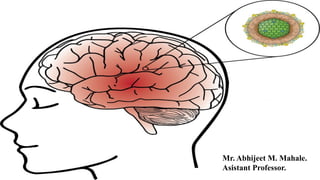
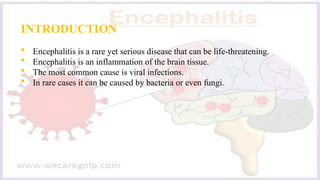
 Encephalitis is a rare yet serious disease that can be life-threatening.
 Encephalitis is an inflammation of the brain tissue.
 The most common cause is viral infections.
 In rare cases it can be caused by bacteria or even fungi.
DEFINITION
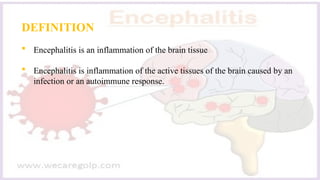
 Encephalitis is an inflammation of the brain tissue
 Encephalitis is inflammation of the active tissues of the brain caused by an
infection or an autoimmune response.
TYPES
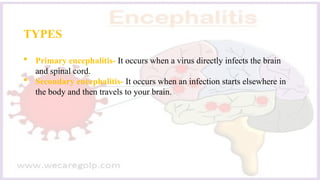
 Primary encephalitis- It occurs when a virus directly infects the brain
and spinal cord.
 Secondary encephalitis- It occurs when an infection starts elsewhere in
the body and then travels to your brain.
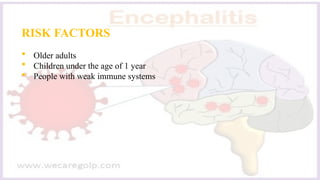
RISK FACTORS
 Older adults
 Children under the age of 1 year
 People with weak immune systems
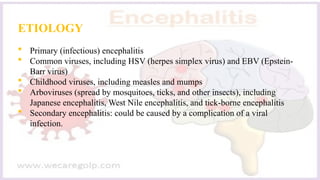
ETIOLOGY
 Primary (infectious) encephalitis
 Common viruses, including HSV (herpes simplex virus) and EBV (Epstein-
Barr virus)
 Childhood viruses, including measles and mumps
 Arboviruses (spread by mosquitoes, ticks, and other insects), including
Japanese encephalitis, West Nile encephalitis, and tick-borne encephalitis
 Secondary encephalitis: could be caused by a complication of a viral
infection.
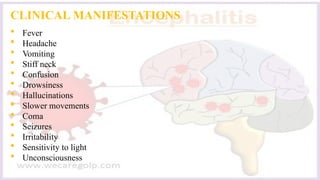
CLINICAL MANIFESTATIONS
 Fever
 Headache
 Vomiting
 Stiff neck
 Confusion
 Drowsiness
 Hallucinations
 Slower movements
 Coma
 Seizures
 Irritability
 Sensitivity to light
 Unconsciousness
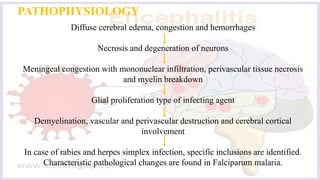
PATHOPHYSIOLOGY
Diffuse cerebral edema, congestion and hemorrhages
Necrosis and degeneration of neurons
Meningeal congestion with mononuclear infiltration, perivascular tissue necrosis
and myelin breakdown
Glial proliferation type of infecting agent
Demyelination, vascular and perivascular destruction and cerebral cortical
involvement
In case of rabies and herpes simplex infection, specific inclusions are identified.
Characteristic pathological changes are found in Falciparum malaria.
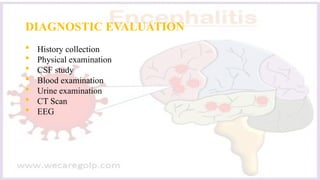
DIAGNOSTIC EVALUATION
 History collection
 Physical examination
 CSF study
 Blood examination
 Urine examination
 CT Scan
 EEG
MANAGEMENT
A. MEDICAL MANAGEMENT
I. PHARMACOLOGICAL MANAGEMENT
 Anti-inflammatory drugs & antipyretics - acetaminophen (Tylenol, others),
ibuprofen (Advil, Motrin IB, others) and naproxen sodium (Aleve) — to
relieve headaches and fever
 Antiviral drugs
Acyclovir (Zovirax)
Ganciclovir (Cytovene)
Cont. . .
 Mannitol or glycerol may be needed to reduce ICP.
 Corticosteroid (dexamethasone)
 Antibiotics
 Vitamin and mineral supplementation
 IV fluid therapy and dopamine to be given to treat shock and fluid-
electrolyte imbalance.
 Anticonvulsive drugs
Thank You

encephaliitis ( UNIT - VI ), AHN - II.pptx

  • 1.
    Mr. Abhijeet M.Mahale. Asistant Professor.
  • 2.
    INTRODUCTION  Encephalitis isa rare yet serious disease that can be life-threatening.  Encephalitis is an inflammation of the brain tissue.  The most common cause is viral infections.  In rare cases it can be caused by bacteria or even fungi.
  • 3.
    DEFINITION  Encephalitis isan inflammation of the brain tissue  Encephalitis is inflammation of the active tissues of the brain caused by an infection or an autoimmune response.
  • 4.
    TYPES  Primary encephalitis-It occurs when a virus directly infects the brain and spinal cord.  Secondary encephalitis- It occurs when an infection starts elsewhere in the body and then travels to your brain.
  • 5.
    RISK FACTORS  Olderadults  Children under the age of 1 year  People with weak immune systems
  • 6.
    ETIOLOGY  Primary (infectious)encephalitis  Common viruses, including HSV (herpes simplex virus) and EBV (Epstein- Barr virus)  Childhood viruses, including measles and mumps  Arboviruses (spread by mosquitoes, ticks, and other insects), including Japanese encephalitis, West Nile encephalitis, and tick-borne encephalitis  Secondary encephalitis: could be caused by a complication of a viral infection.
  • 7.
    CLINICAL MANIFESTATIONS  Fever Headache  Vomiting  Stiff neck  Confusion  Drowsiness  Hallucinations  Slower movements  Coma  Seizures  Irritability  Sensitivity to light  Unconsciousness
  • 8.
    PATHOPHYSIOLOGY Diffuse cerebral edema,congestion and hemorrhages Necrosis and degeneration of neurons Meningeal congestion with mononuclear infiltration, perivascular tissue necrosis and myelin breakdown Glial proliferation type of infecting agent Demyelination, vascular and perivascular destruction and cerebral cortical involvement In case of rabies and herpes simplex infection, specific inclusions are identified. Characteristic pathological changes are found in Falciparum malaria.
  • 9.
    DIAGNOSTIC EVALUATION  Historycollection  Physical examination  CSF study  Blood examination  Urine examination  CT Scan  EEG
  • 10.
    MANAGEMENT A. MEDICAL MANAGEMENT I.PHARMACOLOGICAL MANAGEMENT  Anti-inflammatory drugs & antipyretics - acetaminophen (Tylenol, others), ibuprofen (Advil, Motrin IB, others) and naproxen sodium (Aleve) — to relieve headaches and fever  Antiviral drugs Acyclovir (Zovirax) Ganciclovir (Cytovene)
  • 11.
    Cont. . . Mannitol or glycerol may be needed to reduce ICP.  Corticosteroid (dexamethasone)  Antibiotics  Vitamin and mineral supplementation  IV fluid therapy and dopamine to be given to treat shock and fluid- electrolyte imbalance.  Anticonvulsive drugs
  • 12.