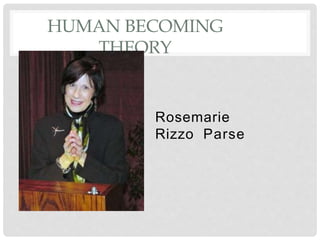
HUMAN BECOMING
THEORY
Rosemarie
Rizzo Parse
BACKGROU
ND
 Graduated from Duquesne University in
Pittsburgh, where she later served as the
dean of nursing.
 Master’s and Doctorate from the University
of Pittsburgh.
 Professor and Coordinator of the Center for
Nursing Research at Hunter College of the City
of New York (1983-1993)
 Professor and Niehoff Chair at Loyola
University Chicago (1993-2006).
 “Parse is an articulate, courageous, and
vibrant leader with a strong vision and a
deliberate
determination to advance the discipline of nursing
. .
. With a perspective that focuses on quality of
life and human dignity from the perspective of
PUBLISHED
AUTHOR
 Published 9books
 Over 150 articles
 Renowned speaker on Nursing Education, Theory to
over 300 local, national and international venues
in 30 different countries on 5 continents
Human becoming Hermeneutic Method and Parse
Method
 Published multiple qualitative research studies
about lived experiences of health and quality of
life (such as hope, laughing, joy-sorrow, feeling
respected, contentment, feeling very tired and
quality of life with Alzheimers disease)
AWAR
DS
 Lifetime Achievement Awards from:
 Nursing Research Society
 Asian American Pacific Islander Nursesa
 Rosemarie Rizzo Parse Scholarship endowed
in her name at the Henderson State College of
Nursing
 Society of Rogerian Scholars honored her by
awarding the Martha E. Rogers:
Golden SlinkyAward
 2008 New York Times Nurse Educator of the Year
Award
CURRENTLY .
. .
 Consultant and Visiting Scholar at the New
York University College of Nursing
 Founder and current Editor of Nursing Science
Quarterly
 President of Discovery International, inc.
 As editor of science quarterly she organized a
venue for nursing scholars to meet and debate
matters of nursing theory and research
development
 Founder of the Institute of Human becoming
ORIGIN OF THE HUMAN
BECOMING
THEORY
 Originally Published in 1981 and was entitled “Man-
living- health”
 Renamed in 1992 to remove the word “man” which
was formerly in the dictionary as human kind.
 Developed as a human science nursing theory in
the tradition of Dilthey, Heidegger, Sartre, Merleau-
Ponty and Gadamer.
 Assumptions were synthesized from works of
European philosophers: Heidegger, Sartre,
Merleau-Ponty
 Along with the works of American nurse theorist
Martha Rogers.
 Called a “School of Thought” because it
encompasses: otology, epistemology and
methodology
ASSUMPTIO
NS
 The human is:
 C-oexisting while co-constituting rhythmical
patterns.
 Open, freely choosing meaning with situation,
bearing responsibility for decisions.
 Becoming is:
 Human-living-health
 Rhythmically co constituting human universe
 Human’s value priority patterns
 Transcending withpossible
 Human’s emerging
 Humans are experts on their own health and
quality of life
 Humans live all at once in freely choosing
meanings that
arise with illimitable experiences Assumptions
synthesis
BASIS FOR
ASSUMPTIONS
 Roger’s three major principle:
 Helicy
 Integrality
 Resonancy
 Roger’s four major
concepts:
 Energy field
 Openness
 Pattern
 organization
 Tenets and concepts of existential
phenomenological thought:
 Intentionality
 Human subjectivity
 Co constitution
 Coexistence
 Situated freedom
ASSUMPTIO
NS
 The human is coexisting while co constituting
rhythmical patternswith the universe.
 The human is open, freely choosing meaning in
situation, bearing responsibility for decisions.
 The human is unitary continuously co
constituting patterns of relating.
 The human is transcending multidimensionality
with the possible.
 Becoming is unitary human living-health.
 Becoming is a rhythmically co constituting
process of the human universe process.
 Becoming is the human’s pattern of relating
value priorities.
 Becoming is an intersubjective process of
transcending with the possibles.
 Becoming is unitary human’s emerging.
BASIC CONCEPTS OF THE HUMAN
BECOMING THEORY
 Meaning
 Rhythmicity
 Transcendence
 “Nurses live the art of human becoming in true
presence with the unfolding of illuminating
meaning, synchronizing rhythms, and
mobilizing transcendence.”
 (Cody and Bournes, 2010)
MEANI
NG
 “Structuring meaning is the imaging and
valuing of languaging” (Cody and Bournes,
2010)
 People coparticipate in creating what is real for
them through self-expression in living their
values a chosen way.
RHYTHMIC
ITY
 Configuring rhythmical patterns of relating is the
revealing-concealing and enabling-limiting of
connecting- separating.
 Translation: Living moment to moment one shows
and does not show self as opportunities and
limitations emerge in moving with and apart from
others
TRANSCENDE
NCE
 “Co-transcending with possibles is the powering
and originating of transforming”
 Translation:Moving beyond the “now” moment is
forging a unique personal path for oneself in the
midst of ambiguity and continuous change.
PRINCIPL
ES
 Structuring meaning is the imaging and
valuing of languaging.
 Configuring rhythmical patterns is the
revealing- concealing and enabling-
limiting of connecting- separating.
 Contransceding with possibles is the powering
and originating of transforming.
FOUR
POSTULATES
 Illimitability
 “Indivisible unbounded knowing extended to infinity,
the
all-at-once remembering and prospecting with
the moment.” (Parse, 2007)
 Paradox
 “an intricate rhythm expressed as a pattern
preference”
Paradoxes are not “opposites to be reconciled or
dilemmas to be overcome but, rather, lived
rhythms” (Parse, 2007)
 Freedom
 “contextually construed liberation” Humansare free
and
continuously choose ways of being with their
situations. (Parse, 2007)
 Mystery
 “unexplainable, that which cannot be completely
known”
PARADOX
ES
 Imaging: explicit-tacit; reflective-prereflective
 Valuing: Confirming-notconfirming
 Revealing-Concealing: disclosing-not
disclosing
 Connecting-Separating: attending-distancing
 Powering: pushing-resisting; affirming-not
affirming; being-nonbeing
 Originating: certainty-uncertainty; conforming-
not conforming
 Transforming: familiar-unfamiliar
 Paradoxes along with concepts are described
as the human universe, presented as
apparent opposites- further specifying the
uniqueness of the human becoming
language. They are not
opposites or problems to be solved but rather
are ways humans live their chosen meanings
 Imaging-the symphony is a unique story of
the human as mystery emerging with the
explicit tacit knowing
 Connecting-separating- is being with and apart
from others, ideas, objects and situations all at
once
 Powering- humans are ever-changing, moving
on with the possibilities of their intended
hopes and dreams. A changing diversity
unfolds as humans affirm and do not affirm in
the pushing and resisting of powering.
 Originating to be like others and unique all at
once
 Transforming- changing diversity occurs here
NURSING PARADIGMS AND
PARSE’S THEORY
 Person
 Open being who is more than and different
from the sum of the parts
 Environment
 Everything in the person and his experiences
 Inseparable, complimentary to and evolving
with
 Health
 Open process of being and becoming,
involves synthesis of values.
 Health is not static but, rather, is ever-
changing as humans choose ways of living.
 Nursing
 A human science and art that uses an
abstract boy of knowledge to serve people.
A LITTLE MORE ON
PARSE AND
NURSING
 Nursing is both a profession and a discipline.
 The goal of a discipline is to expand knowledge
about human experiences through creative
conceptualization and research.
 The goal of a profession is to provide
service to humankind through living art of
science.
“Members of the nursing profession are responsible
for regulating the standards of practice and
education based
on disciplinary knowledge that reflects safe
health service to society in all
settings”
-Parse, 1999
SYMBOL OF HUMAN
BECOMING
THEORY
 Black and White
 Opposite paradox significant to ontology
of human becoming
 Green
 Hope
 Center Joined
 Co Created mutual human universe
process at the ontological level & nurse
person process
 Green and Black Swirls Intertwining
 Human-Universe co creation as an
ongoing process of becoming
THEORY OVERVIEW:
PARSE SCHOLARS
BELIEFS
 Quality of Life from patient’s perspective
 Diagnostic practice fails to respect humankind
 Standardized nursing interventions disregard
human dignity
 Understanding human experience= individual
freedom
 Humans are change with the process of living
 Inherent freedom is to be honored by nurses
THEORY OVERVIEW:
REAL WORLD
EXAMPLE
 Chronic Pain
 Nurses should ask patient to describe pain in
detail
 Physiological, psychological, situational
factors
 Nurses should be aware of patient’s life
situation
 By listening to patients, pain can be improved
 Treatment plan can be developed
 Patients feel closer to nurses who listen
CRITIQU
E
 CLARITY
 The relationships are clear and flow with logical
precision from the assumptions, to the principles, to
the theoretical structures, to the practice
dimensions, and to the research methodology.
 Concepts and relationships become more clear to
the reader as one’s familiarity with the terminology
increases.
SIMPLICI
TY
 The theory is a complex theory. Parse differentiated
the totality and simultaneity paradigms in nursing.
She then synthesizes tenets, principles and
concepts to create her nine assumptions.
 The principles of the theory of human becoming
are derived from the assumptions, with each
principles relating three concepts to each other.
GENERA
L
 Parse’s theoryof human becoming focuses on
the lived experiences of unitary human beings
and therefore is applicable to all individuals,
families and communities at all times and in all
contexts.
IMPERICAL
PRECISION
•
• This theory is based on the work of nurse
scientist, MarthaRogers(1970),and existential
phenomenology.
In synthesizing Roger’s principles of
helicy,integrality and resonance and her four
concepts of openness, energy field, pattern and
organization, and four-dimensionality with the
tenets of existential-phenomenological thought.
DERIVABLE
CONSEQUENCE
 Critical thinking used by the nurse in true presence
with the person is thinking that
guides,illuminates, synchronizes rhythms, and
mobilizes transcendence togetherwith the
person.
 It is never judgement or direction that nurse gives
to or requires of the person.
PARSE AND
RESEARCH
 Strengths:
 Provides Research Methodologies
 Enhances understanding of human lived
experience, health, quality of life and quality of
nursing practice.
 Expands the theory of human becoming
 Builds new nursing knowledge about universal
lived
experiences which may ultimately contribute to
health and quality of life.
 Weaknesses:
 “closed circle”
 Rarely quantifiable results
 Difficult to compare to other research studies
 Differentiates nursing from other disciplines &
not applicable in other disciplines
EXAMPLE OF RESEARCH
USING
HUMAN BECOMING
THEORY Human becoming 80/20 Model
 80% of time in direct patient care practicing
human becoming
 20% of time learning about human becoming
SUMMAR
Y
 Motivation for developing the model
Career
Contribution
Awards
 Influencethe author’s philosophy
 Symbol of human becoming theory
 Three major assumptions of human becoming
theory
Meaning
Rhythmicity
Transcendence
 Relationship of Nursing concepts and theory
themes
Huma
n
Environme
nt
Healt
h
Nurs
eRhythmicit
y
NURSES ABOUT PARSE’S
THEORY
 Parse’s theory has taught us about nursing not
medicine, it is about feelings, love, honesty, not
looking at the patients religion or the colour of their
skins.
 You are a person and that’s what nursing all about
 Parse’s make us feel like a professional rather
then a worker
 More open to the person
Don’t categorize
Don’t have thelimitation
Ideas and feelings and goals as priority
over what they are in the hospital.
CONCLUSIO
N
•It provides a foundation for understanding holistic
nursing practice
 It creates the opportunity to reach profound dimensions of
the human experience to participate in multidimensional
healing
 It promotes “Doing with” people rather than “Doing to” or
“Doing for” them.
 It makes a difference to human health and quality of life
 It views nursing science as a signification process of
dealing with the experience of people

 It based on an interpretive analysis of the
Author's, nursing practice experiences
REFERENC
ES Cody, W. Bournes, D., Parse’s Human becoming
School of Thought. May 2010. Retrieved
electronically from: www. humanbecoming.org
 Parse, R. R.,The Human becoming School of Thought in
2050. Nursing Science Quarterly, 2007, 20, pp 307-311.
Retrieved from:
http://www.discoveryinternationalonline.com/site/ontology.
html
 Nursing Theories; ACompanion to nursing theories and
models: Rosemarie Rizzo Parse. Updated October 27,
2011. Retrieved from:
http://currentnursing.com/nursing_theory/
Rosemary_Pars_Human_Becoming_Theory.html
 Parker, M E., Smith, M C., Nursing Theories and
Nursing Practice 3rd Ed.
Chapter 16: Rosemarie Rizzo Parse’s
Humanbecoming School of Thought. Pp 277-287.2010
F.A. Davis Company, Philadelphia, PA.
QUESTIONS
?
THANK
YOU

Human becomming theory

  • 1.
  • 2.
    BACKGROU ND  Graduated fromDuquesne University in Pittsburgh, where she later served as the dean of nursing.  Master’s and Doctorate from the University of Pittsburgh.  Professor and Coordinator of the Center for Nursing Research at Hunter College of the City of New York (1983-1993)  Professor and Niehoff Chair at Loyola University Chicago (1993-2006).  “Parse is an articulate, courageous, and vibrant leader with a strong vision and a deliberate determination to advance the discipline of nursing . . . With a perspective that focuses on quality of life and human dignity from the perspective of
  • 3.
    PUBLISHED AUTHOR  Published 9books Over 150 articles  Renowned speaker on Nursing Education, Theory to over 300 local, national and international venues in 30 different countries on 5 continents Human becoming Hermeneutic Method and Parse Method  Published multiple qualitative research studies about lived experiences of health and quality of life (such as hope, laughing, joy-sorrow, feeling respected, contentment, feeling very tired and quality of life with Alzheimers disease)
  • 4.
    AWAR DS  Lifetime AchievementAwards from:  Nursing Research Society  Asian American Pacific Islander Nursesa  Rosemarie Rizzo Parse Scholarship endowed in her name at the Henderson State College of Nursing  Society of Rogerian Scholars honored her by awarding the Martha E. Rogers: Golden SlinkyAward  2008 New York Times Nurse Educator of the Year Award
  • 5.
    CURRENTLY . . . Consultant and Visiting Scholar at the New York University College of Nursing  Founder and current Editor of Nursing Science Quarterly  President of Discovery International, inc.  As editor of science quarterly she organized a venue for nursing scholars to meet and debate matters of nursing theory and research development  Founder of the Institute of Human becoming
  • 6.
    ORIGIN OF THEHUMAN BECOMING THEORY  Originally Published in 1981 and was entitled “Man- living- health”  Renamed in 1992 to remove the word “man” which was formerly in the dictionary as human kind.  Developed as a human science nursing theory in the tradition of Dilthey, Heidegger, Sartre, Merleau- Ponty and Gadamer.  Assumptions were synthesized from works of European philosophers: Heidegger, Sartre, Merleau-Ponty  Along with the works of American nurse theorist Martha Rogers.  Called a “School of Thought” because it encompasses: otology, epistemology and methodology
  • 7.
    ASSUMPTIO NS  The humanis:  C-oexisting while co-constituting rhythmical patterns.  Open, freely choosing meaning with situation, bearing responsibility for decisions.  Becoming is:  Human-living-health  Rhythmically co constituting human universe  Human’s value priority patterns  Transcending withpossible  Human’s emerging  Humans are experts on their own health and quality of life  Humans live all at once in freely choosing meanings that arise with illimitable experiences Assumptions synthesis
  • 8.
    BASIS FOR ASSUMPTIONS  Roger’sthree major principle:  Helicy  Integrality  Resonancy  Roger’s four major concepts:  Energy field  Openness  Pattern  organization
  • 9.
     Tenets andconcepts of existential phenomenological thought:  Intentionality  Human subjectivity  Co constitution  Coexistence  Situated freedom
  • 10.
    ASSUMPTIO NS  The humanis coexisting while co constituting rhythmical patternswith the universe.  The human is open, freely choosing meaning in situation, bearing responsibility for decisions.  The human is unitary continuously co constituting patterns of relating.  The human is transcending multidimensionality with the possible.  Becoming is unitary human living-health.  Becoming is a rhythmically co constituting process of the human universe process.
  • 11.
     Becoming isthe human’s pattern of relating value priorities.  Becoming is an intersubjective process of transcending with the possibles.  Becoming is unitary human’s emerging.
  • 12.
    BASIC CONCEPTS OFTHE HUMAN BECOMING THEORY  Meaning  Rhythmicity  Transcendence  “Nurses live the art of human becoming in true presence with the unfolding of illuminating meaning, synchronizing rhythms, and mobilizing transcendence.”  (Cody and Bournes, 2010)
  • 13.
    MEANI NG  “Structuring meaningis the imaging and valuing of languaging” (Cody and Bournes, 2010)  People coparticipate in creating what is real for them through self-expression in living their values a chosen way.
  • 14.
    RHYTHMIC ITY  Configuring rhythmicalpatterns of relating is the revealing-concealing and enabling-limiting of connecting- separating.  Translation: Living moment to moment one shows and does not show self as opportunities and limitations emerge in moving with and apart from others
  • 15.
    TRANSCENDE NCE  “Co-transcending withpossibles is the powering and originating of transforming”  Translation:Moving beyond the “now” moment is forging a unique personal path for oneself in the midst of ambiguity and continuous change.
  • 16.
    PRINCIPL ES  Structuring meaningis the imaging and valuing of languaging.  Configuring rhythmical patterns is the revealing- concealing and enabling- limiting of connecting- separating.  Contransceding with possibles is the powering and originating of transforming.
  • 17.
    FOUR POSTULATES  Illimitability  “Indivisibleunbounded knowing extended to infinity, the all-at-once remembering and prospecting with the moment.” (Parse, 2007)  Paradox  “an intricate rhythm expressed as a pattern preference” Paradoxes are not “opposites to be reconciled or dilemmas to be overcome but, rather, lived rhythms” (Parse, 2007)  Freedom  “contextually construed liberation” Humansare free and continuously choose ways of being with their situations. (Parse, 2007)  Mystery  “unexplainable, that which cannot be completely known”
  • 18.
    PARADOX ES  Imaging: explicit-tacit;reflective-prereflective  Valuing: Confirming-notconfirming  Revealing-Concealing: disclosing-not disclosing  Connecting-Separating: attending-distancing  Powering: pushing-resisting; affirming-not affirming; being-nonbeing  Originating: certainty-uncertainty; conforming- not conforming  Transforming: familiar-unfamiliar
  • 19.
     Paradoxes alongwith concepts are described as the human universe, presented as apparent opposites- further specifying the uniqueness of the human becoming language. They are not opposites or problems to be solved but rather are ways humans live their chosen meanings  Imaging-the symphony is a unique story of the human as mystery emerging with the explicit tacit knowing  Connecting-separating- is being with and apart from others, ideas, objects and situations all at once
  • 20.
     Powering- humansare ever-changing, moving on with the possibilities of their intended hopes and dreams. A changing diversity unfolds as humans affirm and do not affirm in the pushing and resisting of powering.  Originating to be like others and unique all at once  Transforming- changing diversity occurs here
  • 21.
    NURSING PARADIGMS AND PARSE’STHEORY  Person  Open being who is more than and different from the sum of the parts  Environment  Everything in the person and his experiences  Inseparable, complimentary to and evolving with  Health  Open process of being and becoming, involves synthesis of values.  Health is not static but, rather, is ever- changing as humans choose ways of living.  Nursing  A human science and art that uses an abstract boy of knowledge to serve people.
  • 22.
    A LITTLE MOREON PARSE AND NURSING  Nursing is both a profession and a discipline.  The goal of a discipline is to expand knowledge about human experiences through creative conceptualization and research.  The goal of a profession is to provide service to humankind through living art of science. “Members of the nursing profession are responsible for regulating the standards of practice and education based on disciplinary knowledge that reflects safe health service to society in all settings” -Parse, 1999
  • 23.
    SYMBOL OF HUMAN BECOMING THEORY Black and White  Opposite paradox significant to ontology of human becoming  Green  Hope  Center Joined  Co Created mutual human universe process at the ontological level & nurse person process  Green and Black Swirls Intertwining  Human-Universe co creation as an ongoing process of becoming
  • 24.
    THEORY OVERVIEW: PARSE SCHOLARS BELIEFS Quality of Life from patient’s perspective  Diagnostic practice fails to respect humankind  Standardized nursing interventions disregard human dignity  Understanding human experience= individual freedom  Humans are change with the process of living  Inherent freedom is to be honored by nurses
  • 25.
    THEORY OVERVIEW: REAL WORLD EXAMPLE Chronic Pain  Nurses should ask patient to describe pain in detail  Physiological, psychological, situational factors  Nurses should be aware of patient’s life situation  By listening to patients, pain can be improved  Treatment plan can be developed  Patients feel closer to nurses who listen
  • 26.
    CRITIQU E  CLARITY  Therelationships are clear and flow with logical precision from the assumptions, to the principles, to the theoretical structures, to the practice dimensions, and to the research methodology.  Concepts and relationships become more clear to the reader as one’s familiarity with the terminology increases.
  • 27.
    SIMPLICI TY  The theoryis a complex theory. Parse differentiated the totality and simultaneity paradigms in nursing. She then synthesizes tenets, principles and concepts to create her nine assumptions.  The principles of the theory of human becoming are derived from the assumptions, with each principles relating three concepts to each other.
  • 28.
    GENERA L  Parse’s theoryofhuman becoming focuses on the lived experiences of unitary human beings and therefore is applicable to all individuals, families and communities at all times and in all contexts.
  • 29.
    IMPERICAL PRECISION • • This theoryis based on the work of nurse scientist, MarthaRogers(1970),and existential phenomenology. In synthesizing Roger’s principles of helicy,integrality and resonance and her four concepts of openness, energy field, pattern and organization, and four-dimensionality with the tenets of existential-phenomenological thought.
  • 30.
    DERIVABLE CONSEQUENCE  Critical thinkingused by the nurse in true presence with the person is thinking that guides,illuminates, synchronizes rhythms, and mobilizes transcendence togetherwith the person.  It is never judgement or direction that nurse gives to or requires of the person.
  • 31.
    PARSE AND RESEARCH  Strengths: Provides Research Methodologies  Enhances understanding of human lived experience, health, quality of life and quality of nursing practice.  Expands the theory of human becoming  Builds new nursing knowledge about universal lived experiences which may ultimately contribute to health and quality of life.  Weaknesses:  “closed circle”  Rarely quantifiable results  Difficult to compare to other research studies  Differentiates nursing from other disciplines & not applicable in other disciplines
  • 32.
    EXAMPLE OF RESEARCH USING HUMANBECOMING THEORY Human becoming 80/20 Model  80% of time in direct patient care practicing human becoming  20% of time learning about human becoming
  • 33.
    SUMMAR Y  Motivation fordeveloping the model Career Contribution Awards  Influencethe author’s philosophy  Symbol of human becoming theory  Three major assumptions of human becoming theory Meaning Rhythmicity Transcendence
  • 34.
     Relationship ofNursing concepts and theory themes Huma n Environme nt Healt h Nurs eRhythmicit y
  • 35.
    NURSES ABOUT PARSE’S THEORY Parse’s theory has taught us about nursing not medicine, it is about feelings, love, honesty, not looking at the patients religion or the colour of their skins.  You are a person and that’s what nursing all about  Parse’s make us feel like a professional rather then a worker  More open to the person Don’t categorize Don’t have thelimitation Ideas and feelings and goals as priority over what they are in the hospital.
  • 36.
    CONCLUSIO N •It provides afoundation for understanding holistic nursing practice  It creates the opportunity to reach profound dimensions of the human experience to participate in multidimensional healing  It promotes “Doing with” people rather than “Doing to” or “Doing for” them.  It makes a difference to human health and quality of life  It views nursing science as a signification process of dealing with the experience of people   It based on an interpretive analysis of the Author's, nursing practice experiences
  • 37.
    REFERENC ES Cody, W.Bournes, D., Parse’s Human becoming School of Thought. May 2010. Retrieved electronically from: www. humanbecoming.org  Parse, R. R.,The Human becoming School of Thought in 2050. Nursing Science Quarterly, 2007, 20, pp 307-311. Retrieved from: http://www.discoveryinternationalonline.com/site/ontology. html  Nursing Theories; ACompanion to nursing theories and models: Rosemarie Rizzo Parse. Updated October 27, 2011. Retrieved from: http://currentnursing.com/nursing_theory/ Rosemary_Pars_Human_Becoming_Theory.html  Parker, M E., Smith, M C., Nursing Theories and Nursing Practice 3rd Ed. Chapter 16: Rosemarie Rizzo Parse’s Humanbecoming School of Thought. Pp 277-287.2010 F.A. Davis Company, Philadelphia, PA.
  • 38.
  • 39.