Prepared by
Deepa Manandhar
Lecturer
SMAH
Introduction
• The word ā€œtheoryā€ evolves from the Greek word ā€œTheoriaā€ signifying
a vision.
• Set of interrelated concepts that give a systematic view of a
phenomenon (an observable fact or event) that is explanatory and
predictive
Components of a theory
Concept
• Ideas and mental images that help to describe phenomena
• Concepts are mental formulations of an object or event that come
from individual perceptual experience.
• They help in defining the scope of the theory and in organizing the
various elements it addresses.
definitions
• Convey the general meaning of the concepts
Components of a theory
Assumptions
• Statement that describe concepts
• Eg: nursing is achieved through environmental alteration
(NIGHTINGALE’S ENVIRONMENTAL THEORY)
Phenomena
• Aspects of reality that can be consciously sensed or
experienced
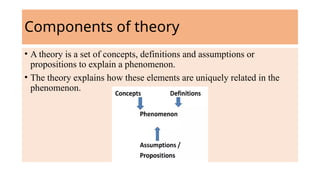
Components of theory
• A theory is a set of concepts, definitions and assumptions or
propositions to explain a phenomenon.
• The theory explains how these elements are uniquely related in the
phenomenon.
Nursing theory
• Nursing theories are organized bodies of knowledge to define what
nursing is, what nurses do, and why do they do it.
• Nursing theories provide a way to define nursing as a unique
discipline that is separate from other disciplines (e.g., medicine).
• It is a framework of concepts and purposes intended to guide the
practice of nursing at a more concrete and specific level.
Defining terms
• Development of nursing theory demands an understanding of selected
terminologies, definitions, and assumptions.
Philosophy: Beliefs and values that define a way of thinking and are
generally known and understood by a group or discipline.
Defining terms
Concept: Concepts are often called the building blocks of theories.
They are primarily the vehicles of thought that involve images.
Models: Models are representations of the interaction among and
between the concepts showing patterns. They present an overview of the
thinking behind the theory and may demonstrate how theory can be
introduced into practice.
Defining terms
Models:
• Representations of the interaction among and between the concepts
showing patterns. They present an overview of the thinking behind the
theory and may demonstrate how theory can be introduced into
practice.
• They help nurses understand complex phenomena, organize
knowledge, and apply evidence-based practice
Defining terms
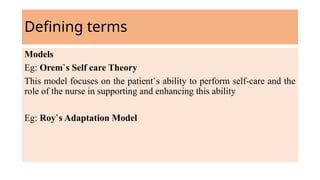
Models
Eg: Orem`s Self care Theory
This model focuses on the patient`s ability to perform self-care and the
role of the nurse in supporting and enhancing this ability
Eg: Roy`s Adaptation Model
Defining terms
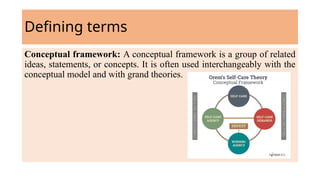
Conceptual framework: A conceptual framework is a group of related
ideas, statements, or concepts. It is often used interchangeably with the
conceptual model and with grand theories.
Defining terms
Proposition: Propositions are statements that describe the relationship
between the concepts.
They help articulate the theory`s claim about how different elements
are connected
Defining terms
Proposition
Eg: Orem`s self care deficit theory
Proposition: when patients are unable to meet their self-care needs,
nursing interventions are necessary to help them achieve and maintain
health.
Explanation: this preposition highlights that a deficit in selfcare
capabilities necessitates nursing support to help patients manage their
health effectively.
Defining terms
Paradigm: A paradigm refers to a pattern of shared understanding and
assumptions about reality and the world; worldview or widely accepted
value system.
Defining terms
Nursing Paradigm: A pattern or model used to show a clear
relationship among the existing theoretical works in nursing.
At present, many theories in nursing are focused on relationship among
four major concepts (metaparadigm)
Defining terms
Metaparadigm:
• Originated from two Greek words meta-meaning ā€œwithā€ and
paradigm-meaning ā€œpatternā€
• Specifies the main or central concepts of nursing.
Defining terms
Metaparadigm:
In the context of nursing and other disciplines, a metaparadigm refers
to a set of overarching concepts or fundamental elements that provide a
broad framework for understanding and organizing knowledge within a
specific field.
• Much of the theoretical work in nursing focused on articulating
relationships among four major concepts: person, environment, health,
and nursing.
Nursing Metaparadigm
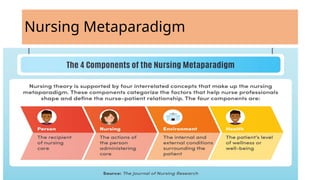
• There are four major concepts that are frequently interrelated and
fundamental to nursing theory: person, environment, health, and
nursing.
• These four are collectively referred to as metaparadigm for nursing.
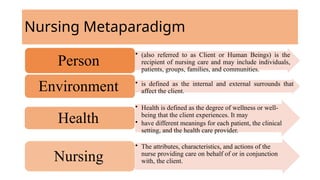
Nursing Metaparadigm
• (also referred to as Client or Human Beings) is the
recipient of nursing care and may include individuals,
patients, groups, families, and communities.
Person
• is defined as the internal and external surrounds that
affect the client.
Environment
• Health is defined as the degree of wellness or well-
being that the client experiences. It may
• have different meanings for each patient, the clinical
setting, and the health care provider.
Health
• The attributes, characteristics, and actions of the
nurse providing care on behalf of or in conjunction
with, the client.
Nursing
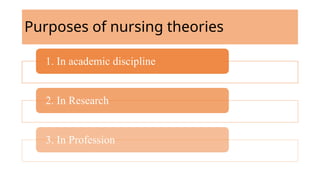
Purposes of nursing theories
• The primary purpose of theory in the profession of nursing is to
improve practice by positively influencing the health and quality of
life of patients.
• Nursing theories are also developed to define and describe nursing
care, guide nursing practice, and provide a basis for clinical decision
making.
Purposes of nursing theories
1. In academic discipline
2. In Research
3. In Profession
1. In academic discipline
• Much of the earlier nursing programs identified the major concepts in
one or two nursing models, organized the concepts and build an entire
nursing curriculum around the created framework.
2. In Research
• Development of theory is fundamental to the research process where it
is necessary to use theory as a framework to provide perspective and
guidance to the research study
• This will help connect the perceived ā€œgapā€ between theory and
practice and promote the theory-guided practice.
3. In Profession
• In a clinical setting, its primary contribution has been the facilitation
of reflecting, questioning, and thinking about what nurses do.
References
Parker E.Marilyn: Nursing Theories and Nursing Pratice,2nd
edition,
Jaypee brothers medical publishers
Perry Potter: Fundamental of Nursing, concepts, process and
pratice;6th
edition
Kozhier’s and ERB’s : Fundamental of Nursing, concept, process and
pratice, 10th
edition
Rai Lalita. Nursing concepts and Theories and principles: Nabin
Kumar Rai publisher. 2nd
edition