EMULSIONS
(Biphasic dosage form)
BY: MUKUL SONDHI
(GGSCOP)
Emulsions are biphasic liquid
dosage form having two
phases one of which is
dispersed phase and another
continuous phase
The phase that is present in form of
droplets is known as “dispersed phase”
The phase in which the droplets are
suspended is known as “continuous
phase”
There are basically two types
of emulsions:
Oil in water (o/w):
Continuous phase is water
and dispersed phase is oil
Water in oil (w/o):
Continuous phase is oil and
dispersed phase is water
Test For Identifying Emulsions
Dilution test
•Emulsions that are stable
on dilution with water
are O/W.
•Emulsions that break on
dilution with water are
W/O.
Dye test
Mix the solution with a
water soluble dye
(amaranth):
•If the continuous phase
show colour than it is
O/W
•If the dispersed phase
globules shows colour
than it is W/O.
Conductivity test
Water is a good
conductor of electricity,
so the we dip a pair of
electrodes in the solution
that are connected to a
bulb :
•On passing current if
bulb glows than it is O/W
•On passing current if
bulb doesn’t glow than it
is W/O
Generally seen from naked eyes both the emulsions types are
same in appearance. So we have some identification tests.
Emulsifying Agents are those substances that are
soluble in both oil and water.
They act by reducing the interfacial tension between the
two phases and thus making both the phases miscible
with each other, forming a stable emulsion
Emulsifying
agents
Natural
Semi-
Synthetic
Synthetic Inorganic Alcohols
Methods for preparation of emulsions
Transfer the
required amount
of oil in a dry
mortar
Add calculated
amount of gum
acacia and
triturate rapidly
Add required
quantity of water
and triturate till
clicking sound is
produced
Add more water
to produce
required volume
Powder the
required quantity
of gum acacia in a
mortar
Add required
amount of water
and triturate
rapidly.
Add required
amount of oil in
small portions and
triturate till clicking
sound produced
Add more water to
produce the
required volume
Add the
required
amount of oil
and gum
acacia into a
large bottle
Shake the
bottle
vigorously,
until they are
properly
mixed
Add
calculated
amount of
water all at
once
Shake
vigorously to
form primary
emulsion
Add more
water to
produce the
required
volume, with
proper
agitation
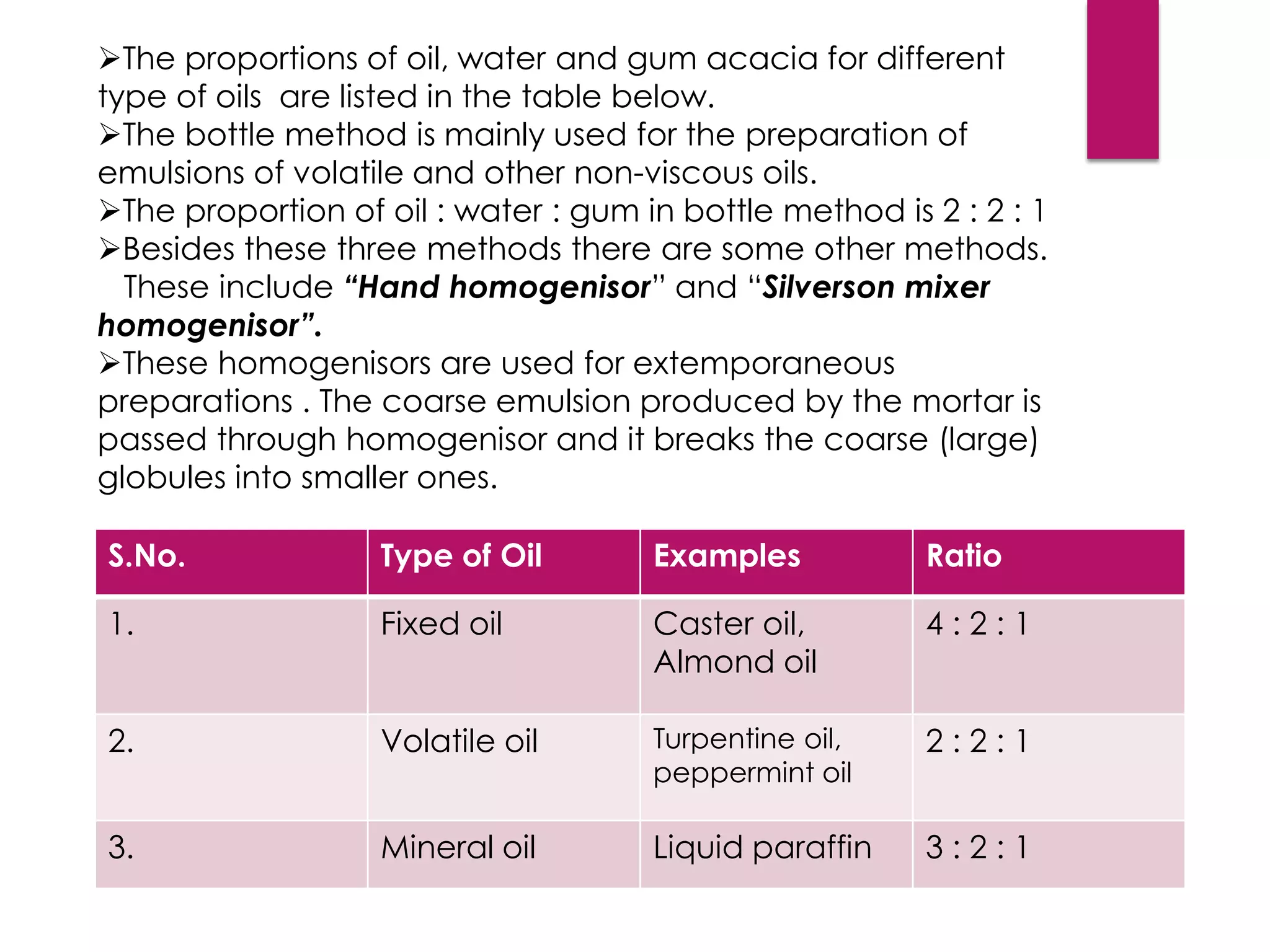
The proportions of oil, water and gum acacia for different
type of oils are listed in the table below.
The bottle method is mainly used for the preparation of
emulsions of volatile and other non-viscous oils.
The proportion of oil : water : gum in bottle method is 2 : 2 : 1
Besides these three methods there are some other methods.
These include “Hand homogenisor” and “Silverson mixer
homogenisor”.
These homogenisors are used for extemporaneous
preparations . The coarse emulsion produced by the mortar is
passed through homogenisor and it breaks the coarse (large)
globules into smaller ones.
S.No. Type of Oil Examples Ratio
1. Fixed oil Caster oil,
Almond oil
4 : 2 : 1
2. Volatile oil Turpentine oil,
peppermint oil
2 : 2 : 1
3. Mineral oil Liquid paraffin 3 : 2 : 1
Stability Of Emulsions
Cracking
It means that the two
phases get separated.
This condition is difficult to
redisperse by shaking.
Creaming
It may be defined as the
upward movement of
dispersed globules to form
a thick layer at the surface
of emulsion.
Phase Inversion
It means the change of
one type of emulsion
into the other, i.e. O/W
to W/O and vice versa.
Stability of emulsions depend upon the distribution of
dispersed phase in the continuous medium
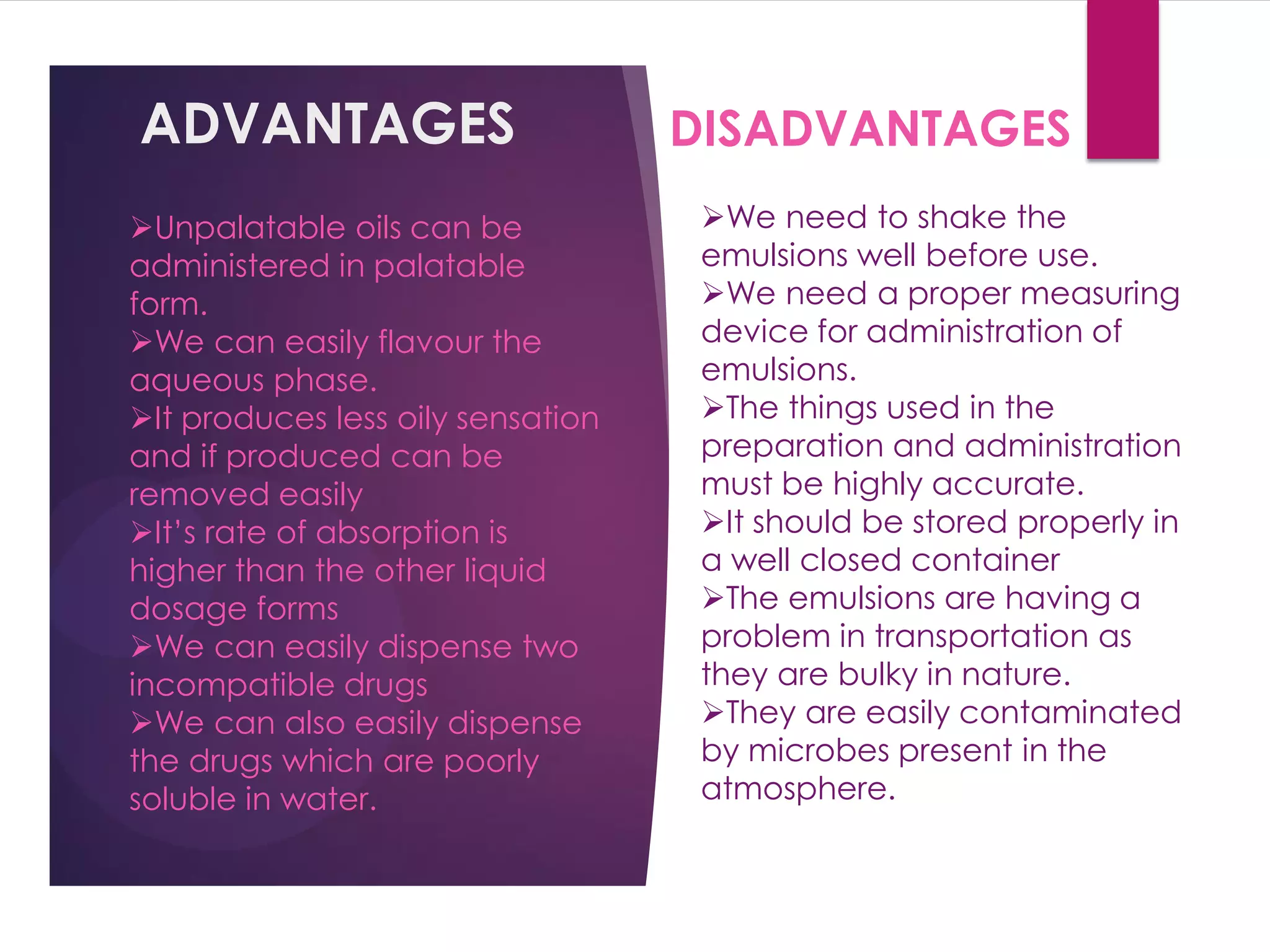
ADVANTAGES DISADVANTAGES
Unpalatable oils can be
administered in palatable
form.
We can easily flavour the
aqueous phase.
It produces less oily sensation
and if produced can be
removed easily
It’s rate of absorption is
higher than the other liquid
dosage forms
We can easily dispense two
incompatible drugs
We can also easily dispense
the drugs which are poorly
soluble in water.
We need to shake the
emulsions well before use.
We need a proper measuring
device for administration of
emulsions.
The things used in the
preparation and administration
must be highly accurate.
It should be stored properly in
a well closed container
The emulsions are having a
problem in transportation as
they are bulky in nature.
They are easily contaminated
by microbes present in the
atmosphere.
CLASSIFCATION
Emulsifying Agents Used:
• Emulsions containing gum
• Emulsions containing soaps
• Emulsions containing starch
• Emulsions containing waxes
• Emulsions containing
emulsifying agents like
pectin, egg yolk, gelatin,
etc.
Mode Of Administration:
• Emulsions for oral
administration
• Emulsions for external use
• Emulsions for parental use
• Emulsions for rectal use
Emulsions are basically classified into two types:
(i) Type of emulsifying agent used
(ii) Mode of administration
Marketed Emulsions
S.No
.
Name and
Manufactured by
Name
Manufacturer
Use
1.
Biafine
Valeant Pharmaceuticals
Interna-tional
Rochester, NY 14609 USA
For dressing and
management of
wounds
2.
Voltaren
Novartis Consumer Health,
Inc
For relieving pain
associated with muscles
and joints
3.
Dolowhite
Dr. JRK„s Research and
Pharmaceuticals Pvt Ltd
To relieve muscle
stiffness
4.
Cleviprex
Chiesi Farmaceutici S.p.A To lower blood pressure

Emulsions

  • 1.
  • 2.
    Emulsions are biphasicliquid dosage form having two phases one of which is dispersed phase and another continuous phase The phase that is present in form of droplets is known as “dispersed phase” The phase in which the droplets are suspended is known as “continuous phase” There are basically two types of emulsions: Oil in water (o/w): Continuous phase is water and dispersed phase is oil Water in oil (w/o): Continuous phase is oil and dispersed phase is water
  • 3.
    Test For IdentifyingEmulsions Dilution test •Emulsions that are stable on dilution with water are O/W. •Emulsions that break on dilution with water are W/O. Dye test Mix the solution with a water soluble dye (amaranth): •If the continuous phase show colour than it is O/W •If the dispersed phase globules shows colour than it is W/O. Conductivity test Water is a good conductor of electricity, so the we dip a pair of electrodes in the solution that are connected to a bulb : •On passing current if bulb glows than it is O/W •On passing current if bulb doesn’t glow than it is W/O Generally seen from naked eyes both the emulsions types are same in appearance. So we have some identification tests.
  • 4.
    Emulsifying Agents arethose substances that are soluble in both oil and water. They act by reducing the interfacial tension between the two phases and thus making both the phases miscible with each other, forming a stable emulsion Emulsifying agents Natural Semi- Synthetic Synthetic Inorganic Alcohols
  • 5.
    Methods for preparationof emulsions Transfer the required amount of oil in a dry mortar Add calculated amount of gum acacia and triturate rapidly Add required quantity of water and triturate till clicking sound is produced Add more water to produce required volume Powder the required quantity of gum acacia in a mortar Add required amount of water and triturate rapidly. Add required amount of oil in small portions and triturate till clicking sound produced Add more water to produce the required volume Add the required amount of oil and gum acacia into a large bottle Shake the bottle vigorously, until they are properly mixed Add calculated amount of water all at once Shake vigorously to form primary emulsion Add more water to produce the required volume, with proper agitation
  • 6.
    The proportions ofoil, water and gum acacia for different type of oils are listed in the table below. The bottle method is mainly used for the preparation of emulsions of volatile and other non-viscous oils. The proportion of oil : water : gum in bottle method is 2 : 2 : 1 Besides these three methods there are some other methods. These include “Hand homogenisor” and “Silverson mixer homogenisor”. These homogenisors are used for extemporaneous preparations . The coarse emulsion produced by the mortar is passed through homogenisor and it breaks the coarse (large) globules into smaller ones. S.No. Type of Oil Examples Ratio 1. Fixed oil Caster oil, Almond oil 4 : 2 : 1 2. Volatile oil Turpentine oil, peppermint oil 2 : 2 : 1 3. Mineral oil Liquid paraffin 3 : 2 : 1
  • 7.
    Stability Of Emulsions Cracking Itmeans that the two phases get separated. This condition is difficult to redisperse by shaking. Creaming It may be defined as the upward movement of dispersed globules to form a thick layer at the surface of emulsion. Phase Inversion It means the change of one type of emulsion into the other, i.e. O/W to W/O and vice versa. Stability of emulsions depend upon the distribution of dispersed phase in the continuous medium
  • 8.
    ADVANTAGES DISADVANTAGES Unpalatable oilscan be administered in palatable form. We can easily flavour the aqueous phase. It produces less oily sensation and if produced can be removed easily It’s rate of absorption is higher than the other liquid dosage forms We can easily dispense two incompatible drugs We can also easily dispense the drugs which are poorly soluble in water. We need to shake the emulsions well before use. We need a proper measuring device for administration of emulsions. The things used in the preparation and administration must be highly accurate. It should be stored properly in a well closed container The emulsions are having a problem in transportation as they are bulky in nature. They are easily contaminated by microbes present in the atmosphere.
  • 9.
    CLASSIFCATION Emulsifying Agents Used: •Emulsions containing gum • Emulsions containing soaps • Emulsions containing starch • Emulsions containing waxes • Emulsions containing emulsifying agents like pectin, egg yolk, gelatin, etc. Mode Of Administration: • Emulsions for oral administration • Emulsions for external use • Emulsions for parental use • Emulsions for rectal use Emulsions are basically classified into two types: (i) Type of emulsifying agent used (ii) Mode of administration
  • 10.
    Marketed Emulsions S.No . Name and Manufacturedby Name Manufacturer Use 1. Biafine Valeant Pharmaceuticals Interna-tional Rochester, NY 14609 USA For dressing and management of wounds 2. Voltaren Novartis Consumer Health, Inc For relieving pain associated with muscles and joints 3. Dolowhite Dr. JRK„s Research and Pharmaceuticals Pvt Ltd To relieve muscle stiffness 4. Cleviprex Chiesi Farmaceutici S.p.A To lower blood pressure