by Traya Roy Chowdhury
Introduction
 An economic theory or system in which the means of
production, distribution, and exchange are owned by the
community collectively, usually through the state.
 It is characterized by production for use rather than profit, by
equality of individual wealth, by the absence of competitive
economic activity.
 In this economy, government determination of investment,
prices, and production levels and distribution of goods are
controlled substantially by the government rather than by
private enterprise.
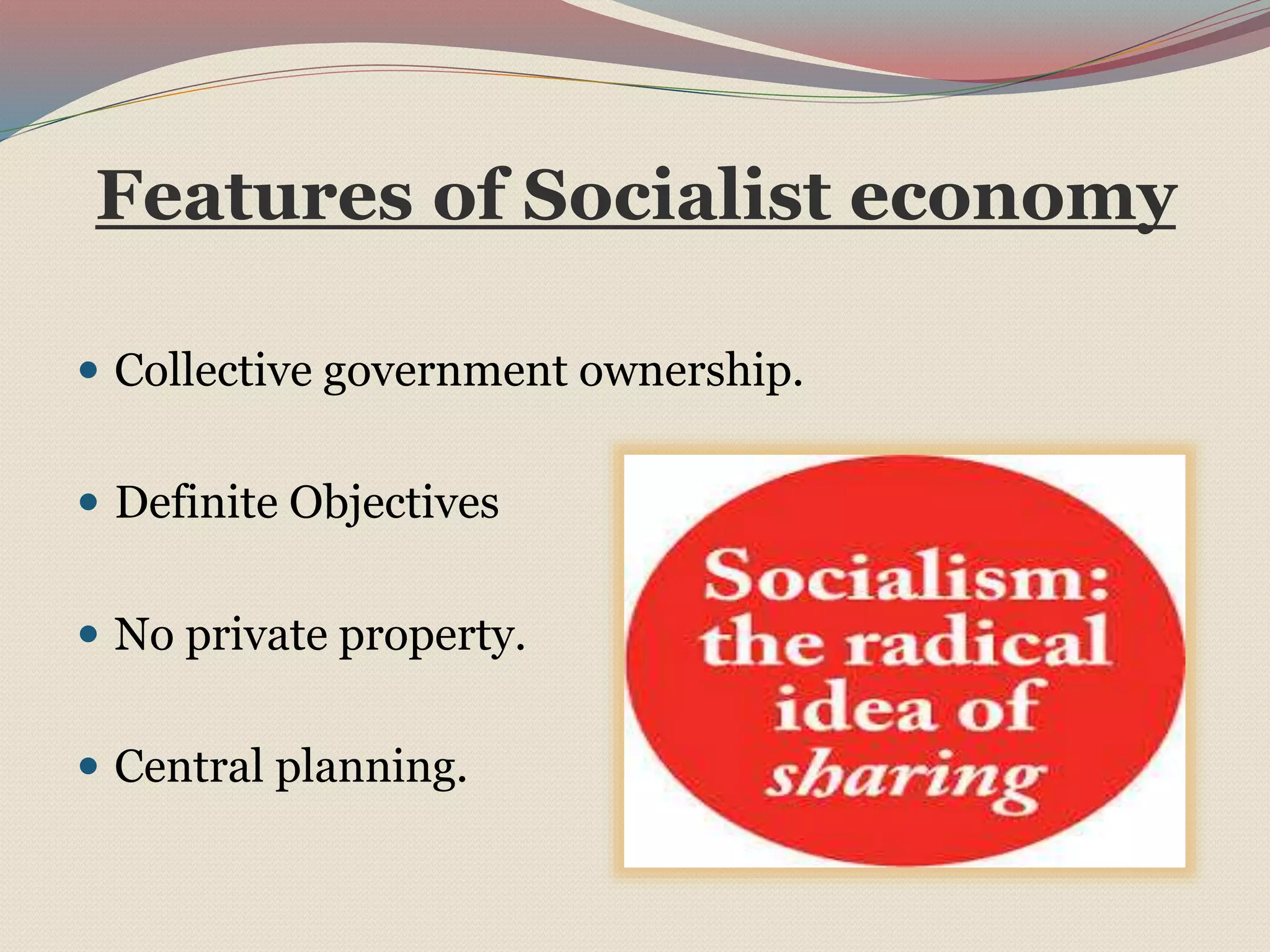
Features of Socialist economy
 Collective government ownership.
 Definite Objectives
 No private property.
 Central planning.
Cont.
 Achieving a common welfare state.
 Little importance of price mechanism.
 People co-operation.
 Lack of competition
 Equality of income distribution
Socialist Ideologies
Utopian socialism
 First currents of modern socialism.
 Henri de Saint-Simon, Charles Fourier, and Robert
Owen.
 Socialists who lived in the first quarter of the
19th century .
 They were labeled ‘utopian’.
Marxist communism
 Based upon common
ownership of the means
of production .
 abolish all leadership,
and govern with a
commune.
 Class struggle plays a
central role in Marxism
 Marxism-Leninism
 Stalinism
 Council and Left
communism
Anarchism
 advocates stateless societies based on non-
hierarchical free associations.
 working-class movement
 In 21st century, anarchism grew in popularity and
influence as part of the anti-war, anti-capitalist, and
anti-globalization movements
 Anarchist communism
 Anarcho-syndicalism
Social democracy Liberal socialism
 Can be divided into
classic and modern
strands
 Classic social democracy
was a political philosophy
 Modern social democracy
advocates welfare state.
 Includes liberal
principles
 supports a mixed
economy that includes
both public and private
property.
 Liberty and equality are
mutually needed to
achieve greater
economic equality
 Non-hierarchical, non-bureaucratic society without
private property in the means of production.
 Every person would have free, equal access to tools
of information and production.
 This would be achieved through the abolition of
authoritarian institutions and private property.
Libertarian socialism
Capitalism vs. Socialism
 Capitalism and Socialism are opposing schools of thought.
 The arguments is about economic equality and the role of
government.
 The U.S. is widely considered the bastion of capitalism.
 Scandinavia and Western Europe are considered socialist
democracies.
Difference b/w capitalism and socialism
Socialism Capitalism
 organization based on the
holding of most property in
common, with actual
ownership ascribed to the
workers.
 Production may variously be
coordinated through either
economic planning or
markets.
 organization based on the
free market and
privatization in which
ownership is ascribed to
the individual persons.
 Market-based economy
combined with private or
corporate ownership of the
means of production.
Cont
Socialism Capitalism
 Class distinctions are
diminished.
 Goods and services are for use.
 Production for use.
 The means of production are
socially-owned with the surplus
value produced accruing to
either all of society.
 Classes exist based on their
relationship to the means of
production.
 goods and services are
produced to make a profit,
 Production for profit.
 The means of production
are privately-owned and
operated for a private profit.
Socialism Vs. Communism
 Both promote equality and seek to eliminate social
classes.
 communism is an extreme form of socialism.
 communism is a political system, socialism is
primarily an economic system
Difference b/w socialism &communism
socialism communism
 From each according to his
ability, to each according to his
contribution
 Freedom of religion, but
usually promotes secularism.
 Class distinctions are
diminished
 the means of producing and
distributing goods is owned
collectively or by a centralized
government
 From each according to his
ability, to each according to his
needs.
 Abolished - all religious and
metaphysics is rejected.
 All class distinctions are
eliminated.
 there is no centralized
government - there is a
collective ownership of
property and the organization
of labor for the common
advantage of all members.
cont
Socialism Communism
 All individuals should have
access to basic articles of
consumption and public goods
to allow for self-actualization.
 All choices, including
education, religion,
employment and marriage, are
up to the individual.
 Union of Soviet Socialist
Republics (USSR
 All people are the same and
therefore classes make no
sense. The government should
own all means of production
and land and also everything
else
 Either the collective "vote" or
the state's rulers make
economic and political
decisions for everyone else.
 Examples 0f Communist states
are the erstwhile Soviet Union,
Cuba and North Korea.
Merits of Socialism
(1) Greater Economic Efficiency.
(2) Greater Welfare due to Less Inequality of Income.
(3)Absence of Monopolistic Practices.
(4)Absence of Business Fluctuations.
(5) Freedom of Consumption
Demerits of Socialism
 Loss of Consumers’ Sovereignty.
 No Freedom of Occupation
 Malallocation of Resources
 Bureaucratic
 Expenditure on Planning
 Rigid Economy
The fall Of Soviet Union
 The Russian model of socialism and its
shortcomings.
 Revolutionary rather than evolutionary in its
approach.
 Undermining the process of natural evolution.
 Tendency towards dictatorship.
Conclusion
 Socialism is basically a form of government that
places the needs of society above the individual.
 Capitalism cannot guarantee democracy to many
millions in backward countries.
 They will introduce reforms within the democratic
system by altering Governmental policies;
introducing new laws, new ideas and nationalism as
some of the core services.
 It is disliked for the loss of political, economic and
personal freedoms.
Thank you.

Socialism

  • 1.
    by Traya RoyChowdhury
  • 2.
    Introduction  An economictheory or system in which the means of production, distribution, and exchange are owned by the community collectively, usually through the state.  It is characterized by production for use rather than profit, by equality of individual wealth, by the absence of competitive economic activity.  In this economy, government determination of investment, prices, and production levels and distribution of goods are controlled substantially by the government rather than by private enterprise.
  • 3.
    Features of Socialisteconomy  Collective government ownership.  Definite Objectives  No private property.  Central planning.
  • 4.
    Cont.  Achieving acommon welfare state.  Little importance of price mechanism.  People co-operation.  Lack of competition  Equality of income distribution
  • 5.
    Socialist Ideologies Utopian socialism First currents of modern socialism.  Henri de Saint-Simon, Charles Fourier, and Robert Owen.  Socialists who lived in the first quarter of the 19th century .  They were labeled ‘utopian’.
  • 6.
    Marxist communism  Basedupon common ownership of the means of production .  abolish all leadership, and govern with a commune.  Class struggle plays a central role in Marxism  Marxism-Leninism  Stalinism  Council and Left communism
  • 7.
    Anarchism  advocates statelesssocieties based on non- hierarchical free associations.  working-class movement  In 21st century, anarchism grew in popularity and influence as part of the anti-war, anti-capitalist, and anti-globalization movements  Anarchist communism  Anarcho-syndicalism
  • 8.
    Social democracy Liberalsocialism  Can be divided into classic and modern strands  Classic social democracy was a political philosophy  Modern social democracy advocates welfare state.  Includes liberal principles  supports a mixed economy that includes both public and private property.  Liberty and equality are mutually needed to achieve greater economic equality
  • 9.
     Non-hierarchical, non-bureaucraticsociety without private property in the means of production.  Every person would have free, equal access to tools of information and production.  This would be achieved through the abolition of authoritarian institutions and private property. Libertarian socialism
  • 10.
    Capitalism vs. Socialism Capitalism and Socialism are opposing schools of thought.  The arguments is about economic equality and the role of government.  The U.S. is widely considered the bastion of capitalism.  Scandinavia and Western Europe are considered socialist democracies.
  • 11.
    Difference b/w capitalismand socialism Socialism Capitalism  organization based on the holding of most property in common, with actual ownership ascribed to the workers.  Production may variously be coordinated through either economic planning or markets.  organization based on the free market and privatization in which ownership is ascribed to the individual persons.  Market-based economy combined with private or corporate ownership of the means of production.
  • 12.
    Cont Socialism Capitalism  Classdistinctions are diminished.  Goods and services are for use.  Production for use.  The means of production are socially-owned with the surplus value produced accruing to either all of society.  Classes exist based on their relationship to the means of production.  goods and services are produced to make a profit,  Production for profit.  The means of production are privately-owned and operated for a private profit.
  • 13.
    Socialism Vs. Communism Both promote equality and seek to eliminate social classes.  communism is an extreme form of socialism.  communism is a political system, socialism is primarily an economic system
  • 14.
    Difference b/w socialism&communism socialism communism  From each according to his ability, to each according to his contribution  Freedom of religion, but usually promotes secularism.  Class distinctions are diminished  the means of producing and distributing goods is owned collectively or by a centralized government  From each according to his ability, to each according to his needs.  Abolished - all religious and metaphysics is rejected.  All class distinctions are eliminated.  there is no centralized government - there is a collective ownership of property and the organization of labor for the common advantage of all members.
  • 15.
    cont Socialism Communism  Allindividuals should have access to basic articles of consumption and public goods to allow for self-actualization.  All choices, including education, religion, employment and marriage, are up to the individual.  Union of Soviet Socialist Republics (USSR  All people are the same and therefore classes make no sense. The government should own all means of production and land and also everything else  Either the collective "vote" or the state's rulers make economic and political decisions for everyone else.  Examples 0f Communist states are the erstwhile Soviet Union, Cuba and North Korea.
  • 16.
    Merits of Socialism (1)Greater Economic Efficiency. (2) Greater Welfare due to Less Inequality of Income. (3)Absence of Monopolistic Practices. (4)Absence of Business Fluctuations. (5) Freedom of Consumption
  • 17.
    Demerits of Socialism Loss of Consumers’ Sovereignty.  No Freedom of Occupation  Malallocation of Resources  Bureaucratic  Expenditure on Planning  Rigid Economy
  • 18.
    The fall OfSoviet Union  The Russian model of socialism and its shortcomings.  Revolutionary rather than evolutionary in its approach.  Undermining the process of natural evolution.  Tendency towards dictatorship.
  • 19.
    Conclusion  Socialism isbasically a form of government that places the needs of society above the individual.  Capitalism cannot guarantee democracy to many millions in backward countries.  They will introduce reforms within the democratic system by altering Governmental policies; introducing new laws, new ideas and nationalism as some of the core services.  It is disliked for the loss of political, economic and personal freedoms.
  • 21.