Engaging students
with digital tools
Marcus Leaning
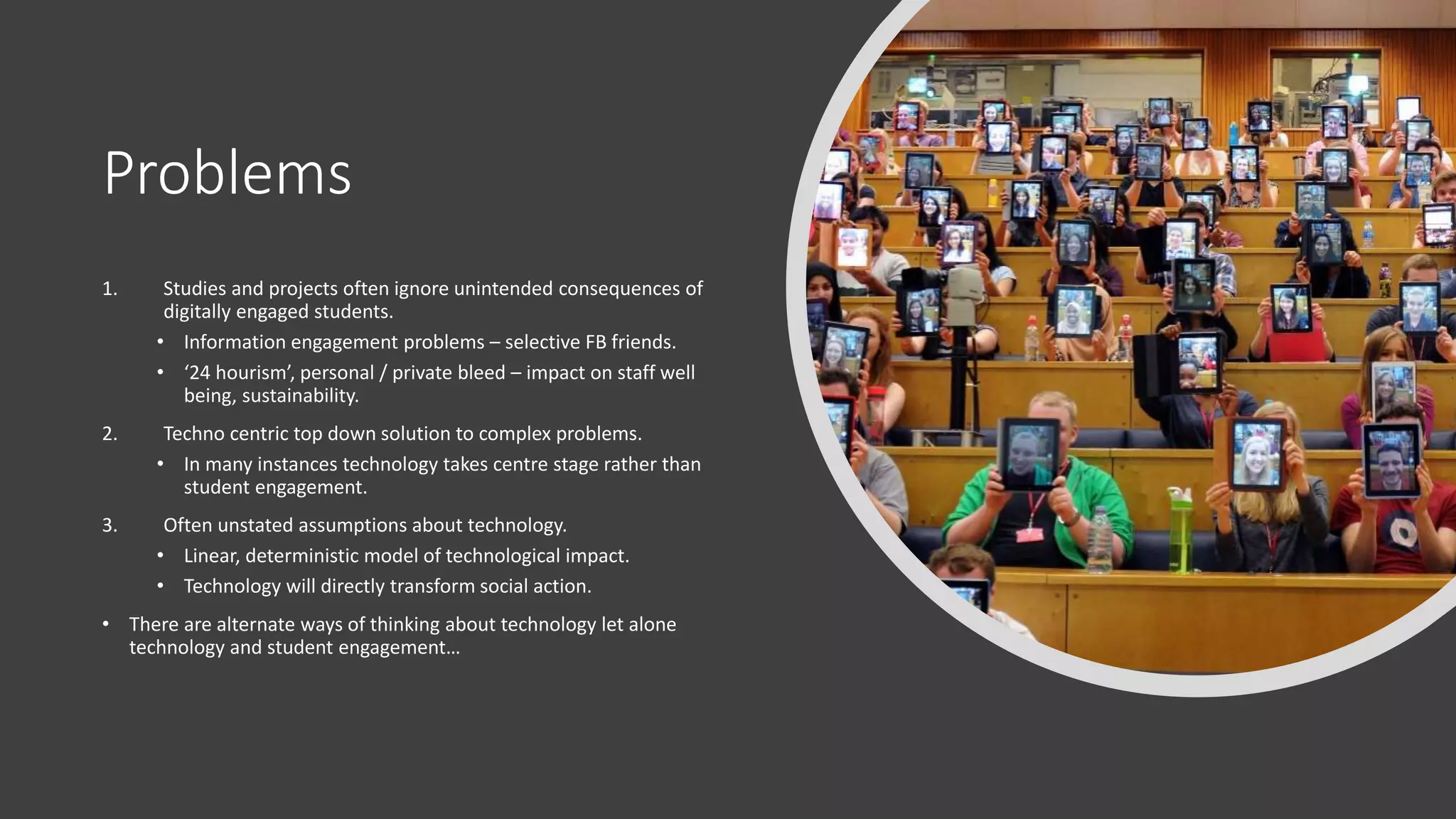
Ipad projects
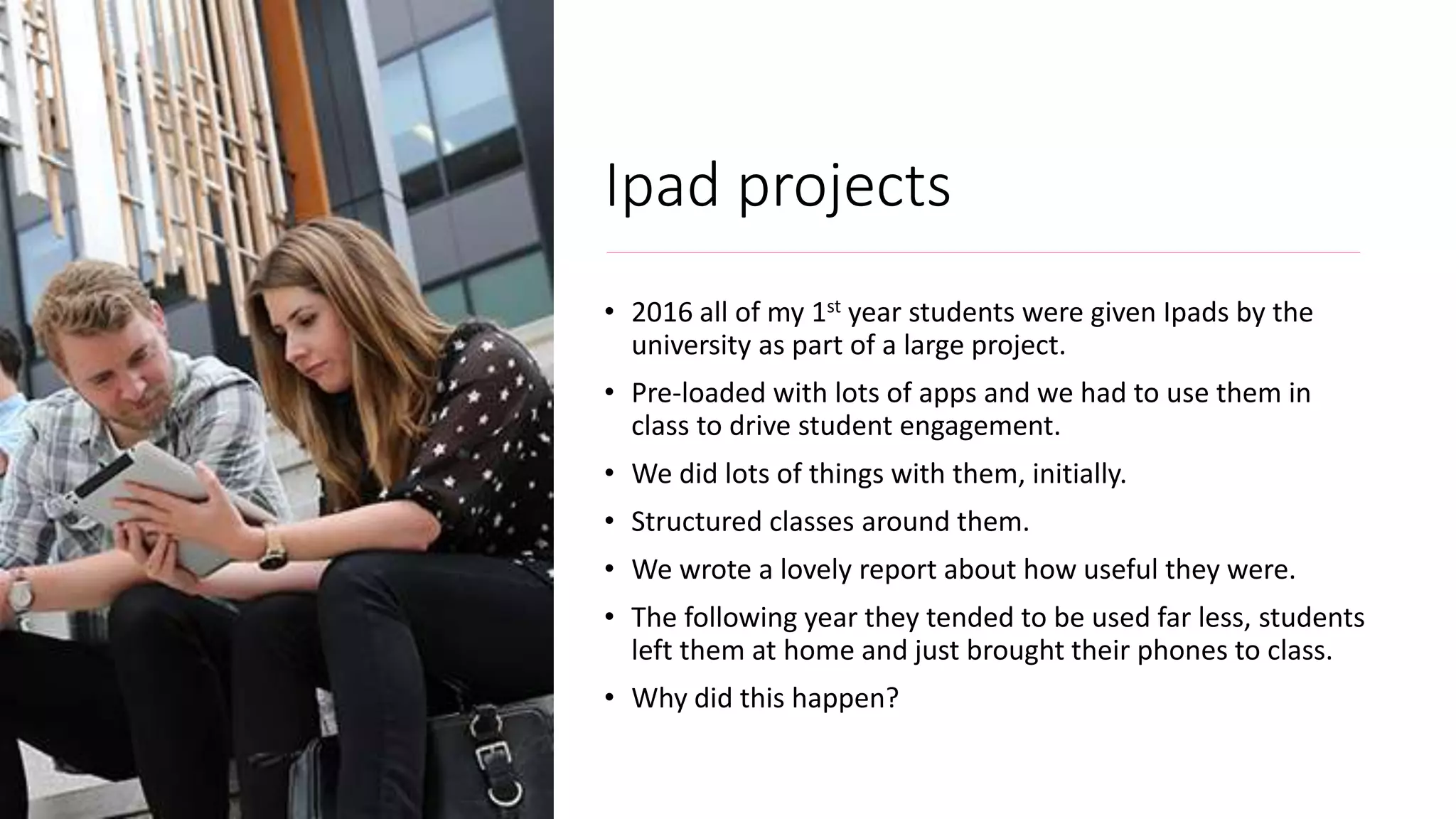
• 2016 all of my 1st year students were given Ipads by the
university as part of a large project.
• Pre-loaded with lots of apps and we had to use them in
class to drive student engagement.
• We did lots of things with them, initially.
• Structured classes around them.
• We wrote a lovely report about how useful they were.
• The following year they tended to be used far less, students
left them at home and just brought their phones to class.
• Why did this happen?
Introduction
• Questions:
• What do we mean by engagement
• what do students engage with?
• How can we think about digital tools and
the impact such tools have on SE?
• Is there a better way forward?
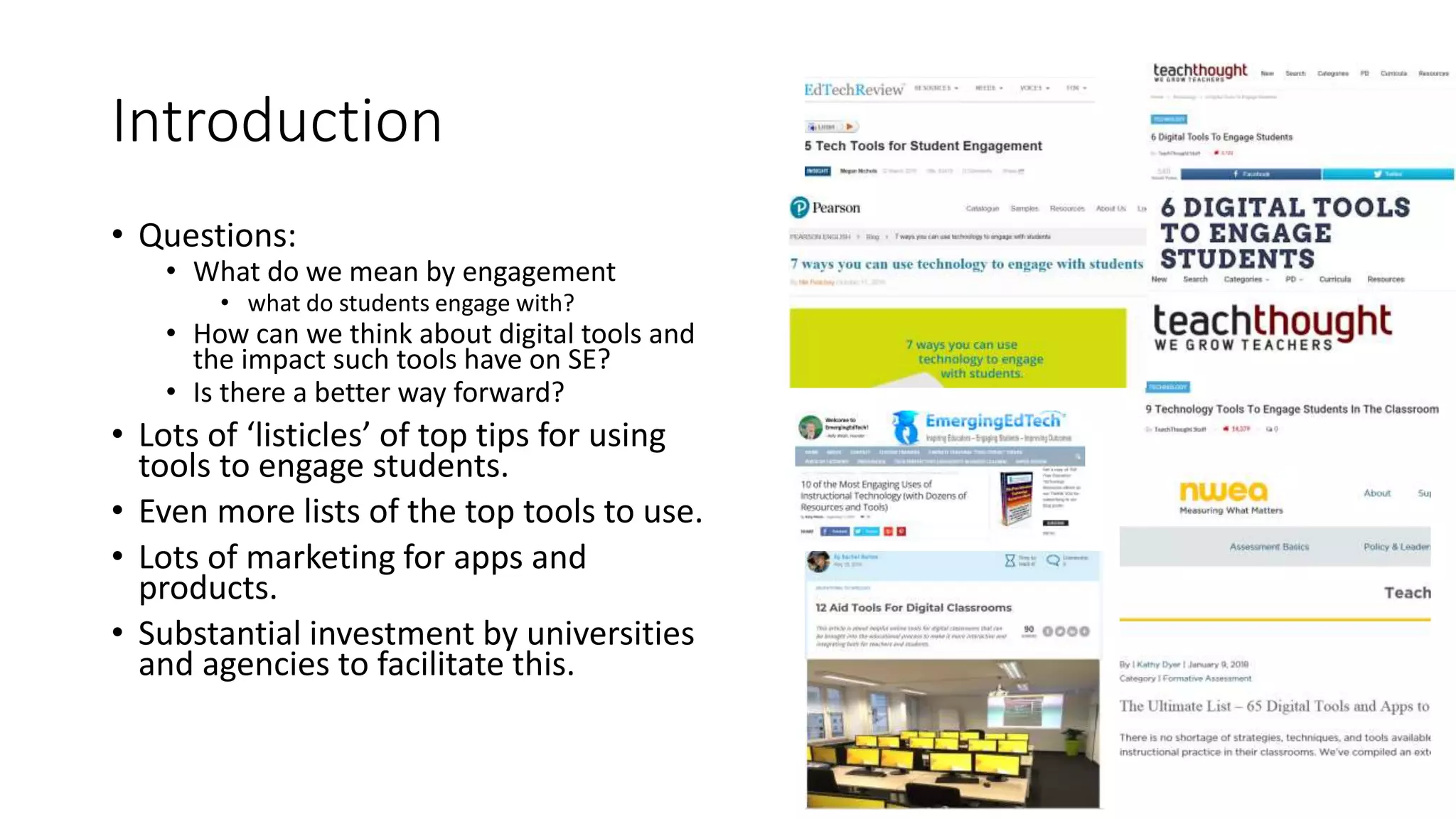
• Lots of ‘listicles’ of top tips for using
tools to engage students.
• Even more lists of the top tools to use.
• Lots of marketing for apps and
products.
• Substantial investment by universities
and agencies to facilitate this.
Student engagement – an odd construct
• A heavily theorised concept.
• “What students do in their studies rather
than what is done to them”. (Mantz Yorke).
• Has roots in Dewey (1897) – ‘involvement’.
• Implicit model of active learning.
• Literature starts in 1960s.
• A number of different perspectives emerge:
• SE towards qualification;
• Student centred;
• Institutional management (UK);
• ‘Being’ and ‘becoming’ (French).
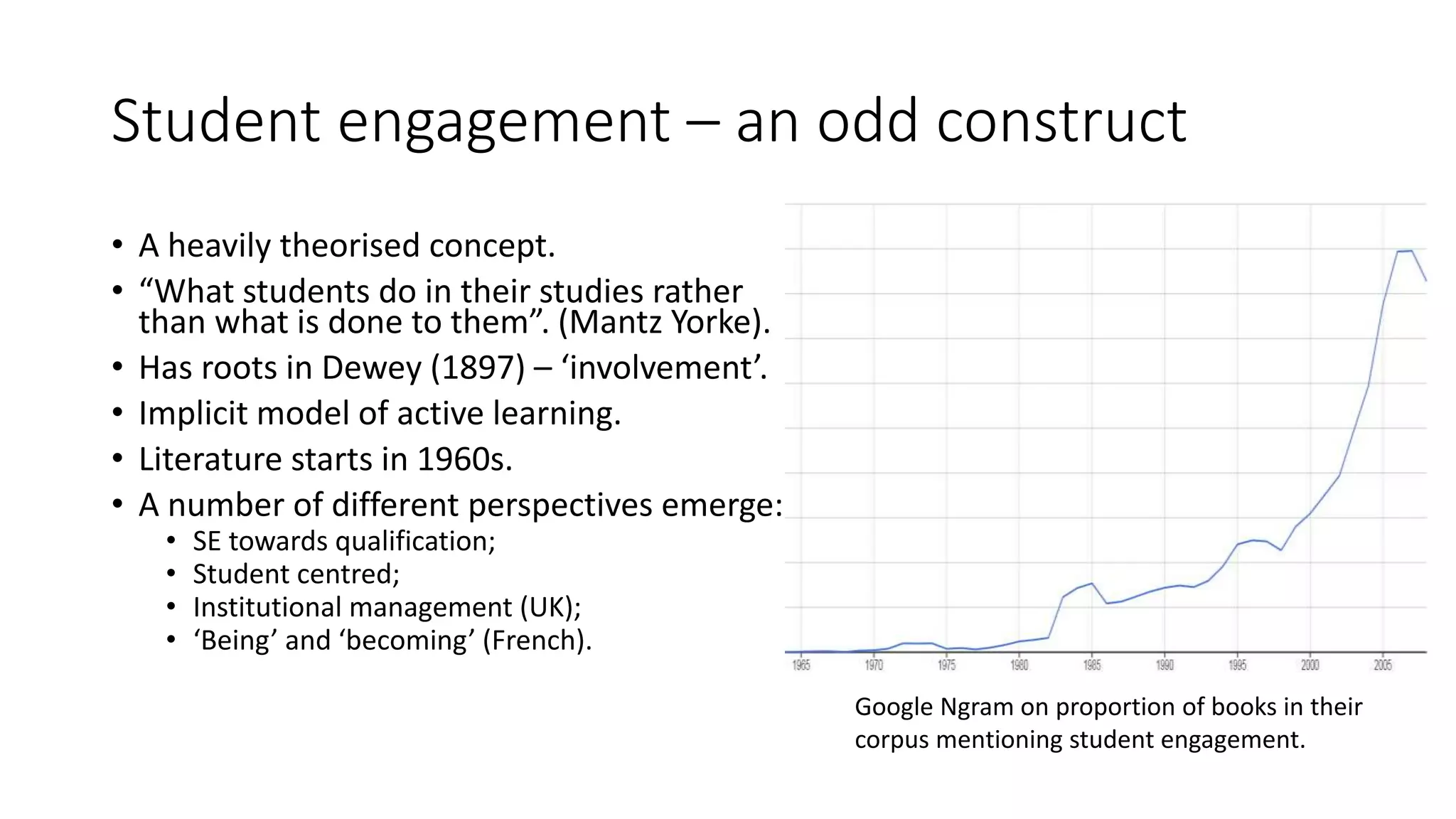
Google Ngram on proportion of books in their
corpus mentioning student engagement.
Student engagement towards qualification
• Focus upon what the institution does - Becker (1961) and
Newcomb (1969) first studies looking at impact of institution
upon students.
• Relates to the university facilitates a student’s experience –
what can the uni do (and how well they do it) to get the
student to learn?
• SE is:
• “Students’ involvement in activities and conditions that
are linked with quality learning” Kuh (2001).
• Uni’s role is to encourage the student to engage in activities
that inspire them to learn.
• A ‘Pull’ model.
• A lack of agency on the part of the student.
• Dominant model - Big in US (high college drop out) and
Australia, also used in UK and NZ and increasingly China.
A student centred
approach
• What do students want form a university education and their experience?
(Bryson, 2012; Leach and Zepke, 2012).
• Engagement should be about the student and the things they want such as:
• Barriers;
• Control over their workload;
• Autonomy;
• Community with other students;
• Ownership of their own studies.
• University role is to facilitate the student’s own journey.
• Development of student qualities that they value.
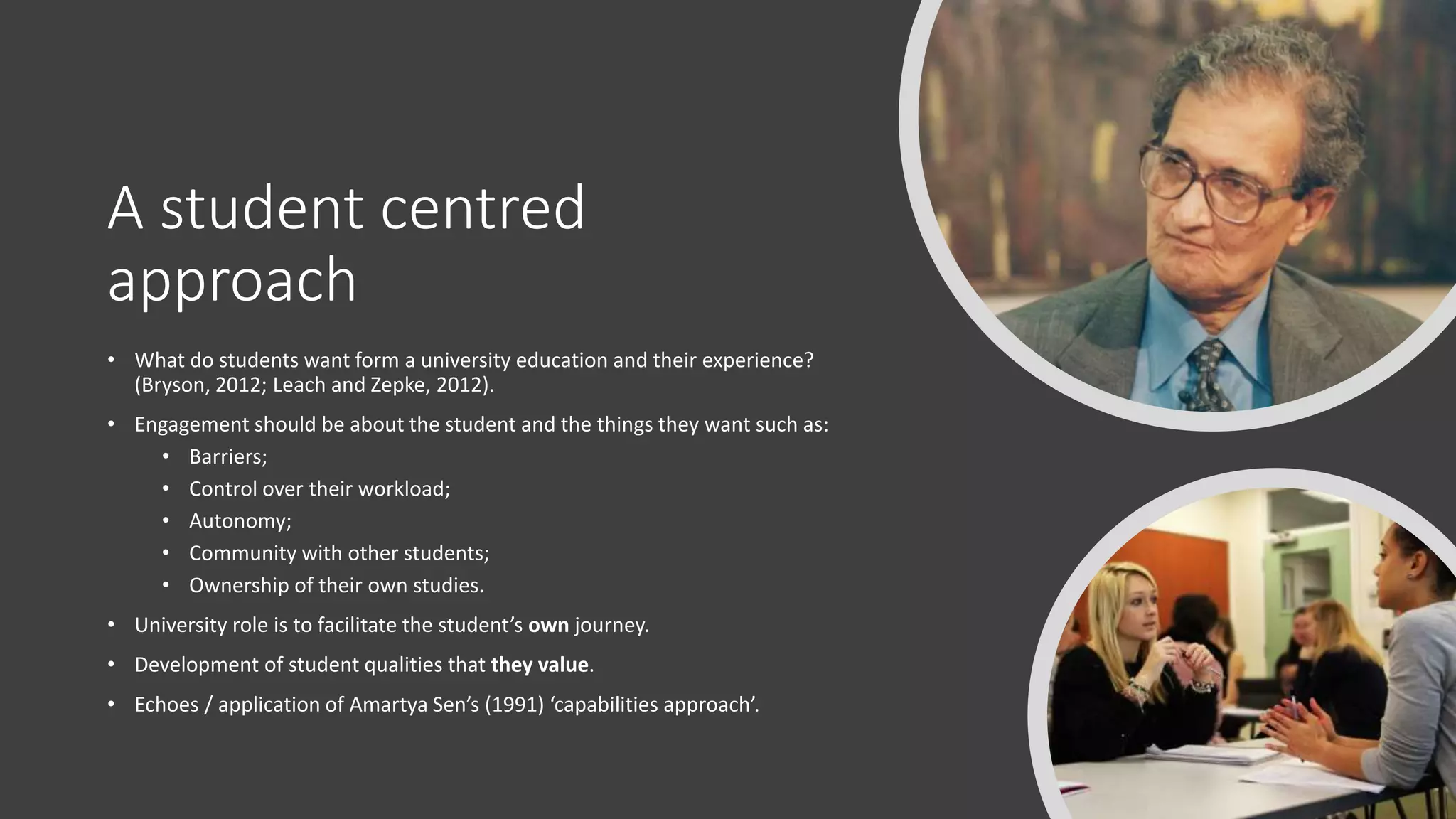
• Echoes / application of Amartya Sen’s (1991) ‘capabilities approach’.
Institutional
management
• UK makes use of large surveys to measure engagement
and satisfaction - NSS.
• Additionally, centrally funded initiative to have students
involved in the management of universities.
• Student involvement with:
• running of courses,
• programme development,
• senior quality aspects,
• Governance,
• Business functions.
• A white-washing aspect of the neo-liberal university?
‘Being’ and ‘Becoming’
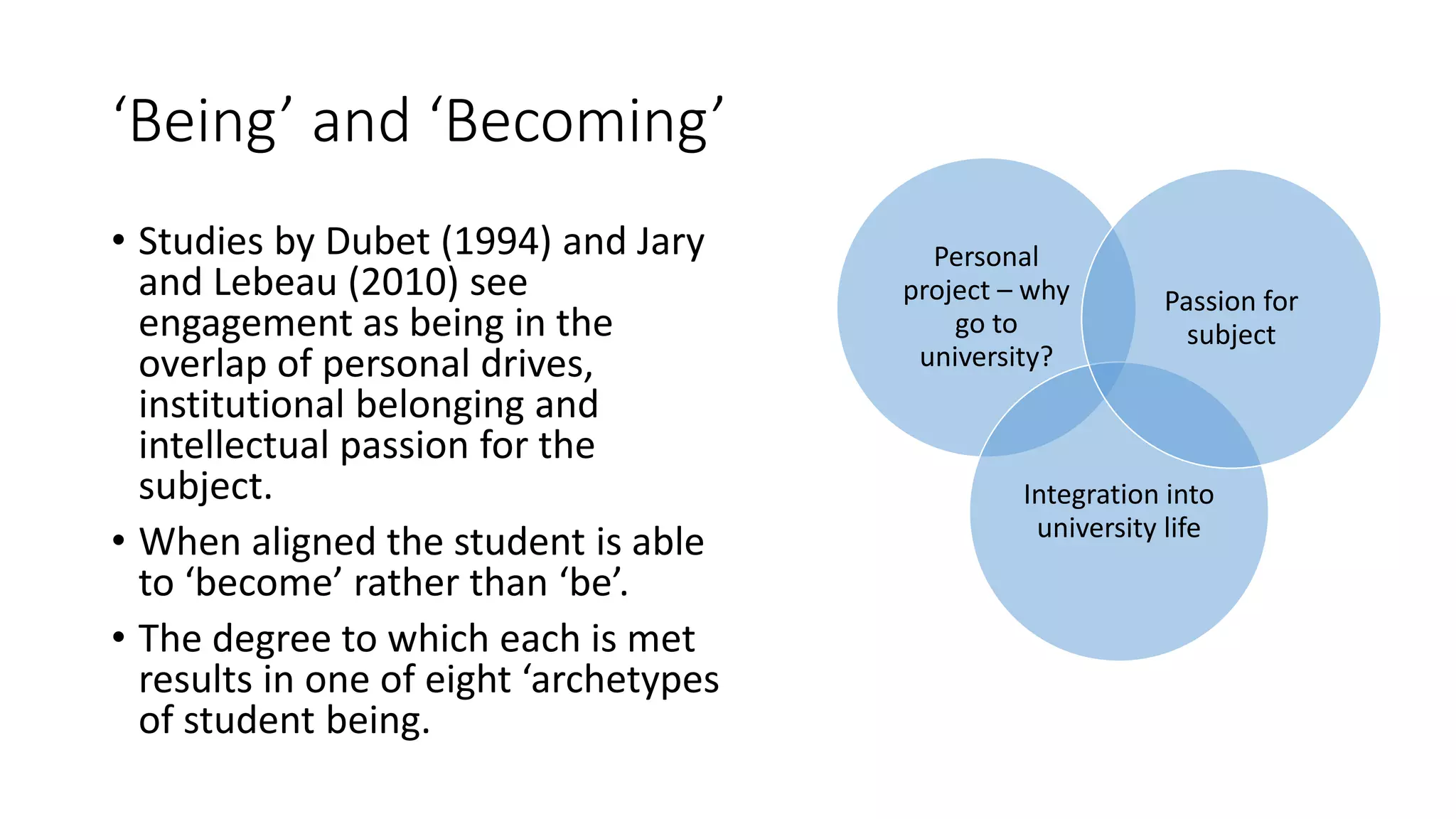
• Studies by Dubet (1994) and Jary
and Lebeau (2010) see
engagement as being in the
overlap of personal drives,
institutional belonging and
intellectual passion for the
subject.
• When aligned the student is able
to ‘become’ rather than ‘be’.
• The degree to which each is met
results in one of eight ‘archetypes
of student being.
Personal
project – why
go to
university?
Integration into
university life
Passion for
subject
‘Location’ of engagement
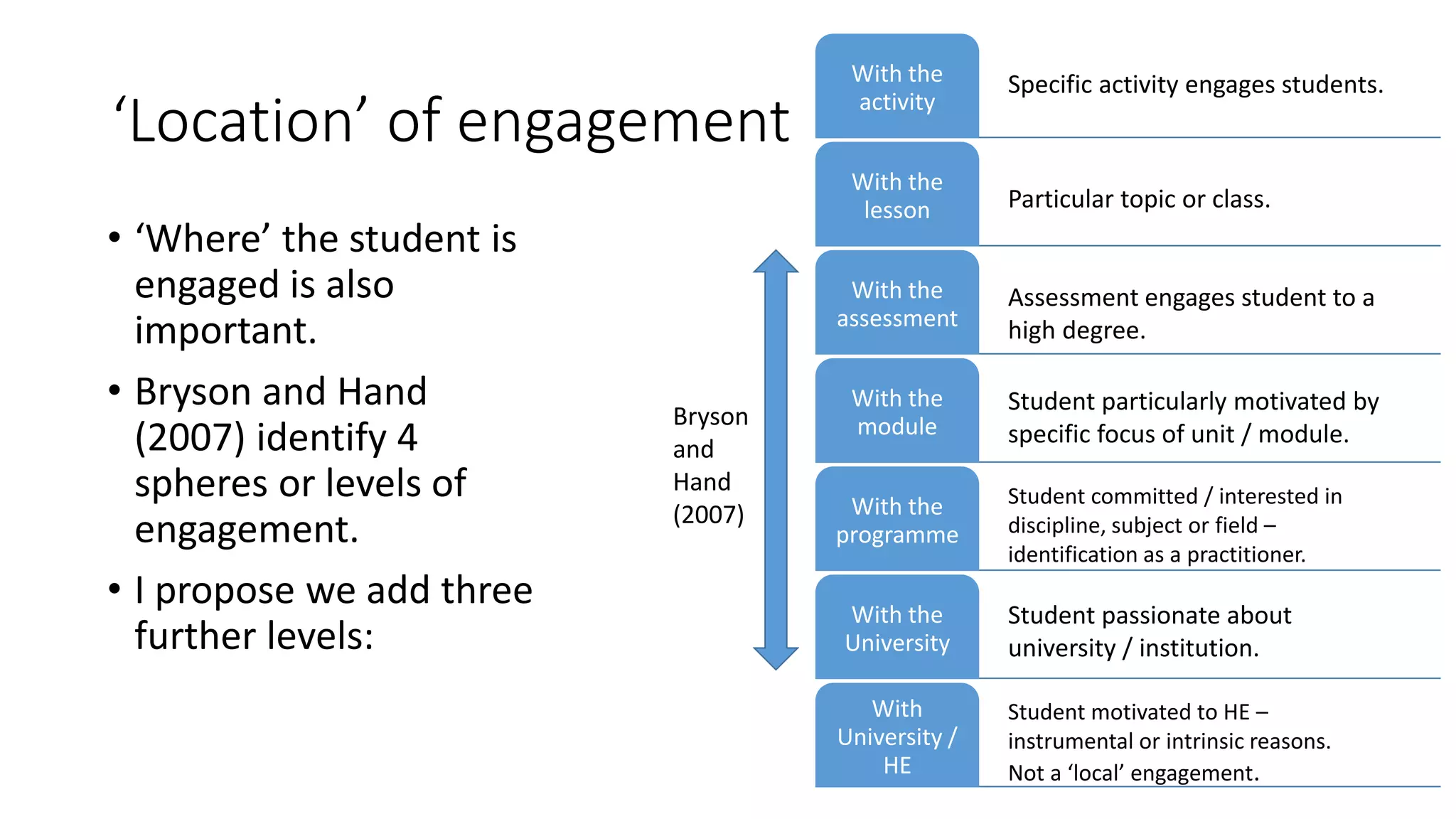
• ‘Where’ the student is
engaged is also
important.
• Bryson and Hand
(2007) identify 4
spheres or levels of
engagement.
• I propose we add three
further levels:
With the
activity
With the
lesson
With the
assessment
With the
module
With the
programme
With the
University
With
University /
HE
Bryson
and
Hand
(2007)
Student committed / interested in
discipline, subject or field –
identification as a practitioner.
Student passionate about
university / institution.
Student particularly motivated by
specific focus of unit / module.
Assessment engages student to a
high degree.
Particular topic or class.
Specific activity engages students.
Student motivated to HE –
instrumental or intrinsic reasons.
Not a ‘local’ engagement.
Using digital tools for student engagement
• Lots of optimistic marketing of digital tools and it is
a large and well resourced area of research.
• In academic studies the emphasis very much on
what the tools ‘do’ to engagement.
• Experimental studies on the use of digital and social
media to improve engagement.
• Digital tool introduced into an environment and
engagement measured before and after.
• E.G. Junco, Heiberger and Loken (2011) looked at how
Twitter use increased scores in nationally calibrated
studies.
The technology for student
engagement ‘industry’
• Significant grants given to research the area
and universities conducting studies:
• Government and sector agencies:
• UK JISC – FASTECH.
• Private sector grants:
• Adobe,
• Microsoft,
• Facebook and others
all fund research identifying benefits to SE
of technology (specifically their technology).
Problems
1. Studies and projects often ignore unintended consequences of
digitally engaged students.
• Information engagement problems – selective FB friends.
• ‘24 hourism’, personal / private bleed – impact on staff well
being, sustainability.
2. Techno centric top down solution to complex problems.
• In many instances technology takes centre stage rather than
student engagement.
3. Often unstated assumptions about technology.
• Linear, deterministic model of technological impact.
• Technology will directly transform social action.
• There are alternate ways of thinking about technology let alone
technology and student engagement…
Technological impact
• Technology (and especially digital technology) has escaped critical examination
(Escobar, 1994).
• Feenberg (1999, 2005) provides a useful typology of theories of technology:
• Instrumentalism – We are in control of technology and it has no values.
• Determinism – Technology causes change but has no values.
• Substantivism – Technology causes changes and has values.
• Critical Theory of Technology – We are in control but technology has values and
potency.
• CTT allows us to think of the ‘Affordances’ of technology to being used in a education-
led approach to the use of technology in education.
Critical Theory of Technological
affordances for building student
engagement.
• Developing a CTT approach looks to the act of
engagement first prior to the application of
technology.
• Involves careful consideration of educational eco-
system – there may be places where technology is
very useful but there are also places where it is not
and can actually be more problematic than helpful.
• Sometime inserting technology does not build
engagement.
• But determining where requires a lot of effort.
Questions to ask before deployment.
• What form of engagement are we seeking?
• SE towards qualification - the pull model?
• Student centred – what the students value?
• Institutional management – being a better academic citizen?
• Where do we want engagement –
• University, programme, module, assignment, class or activity.
• What actual actions do we want to address?
• Do we want something new to occur?
• Something to stop?
• Something to be produced?
The technological
• Once we know:
• what we want to build; ,
• where we want to build it.
• We move to identify the actions to do so.
• We want students to share ideas outside of class in a non - assessed space,
• Students desire a way to produce, store and share their understanding of a
difficult idea;
• Students want to be able to access and amend lecture notes in multiple
formats.
Tools to afford action
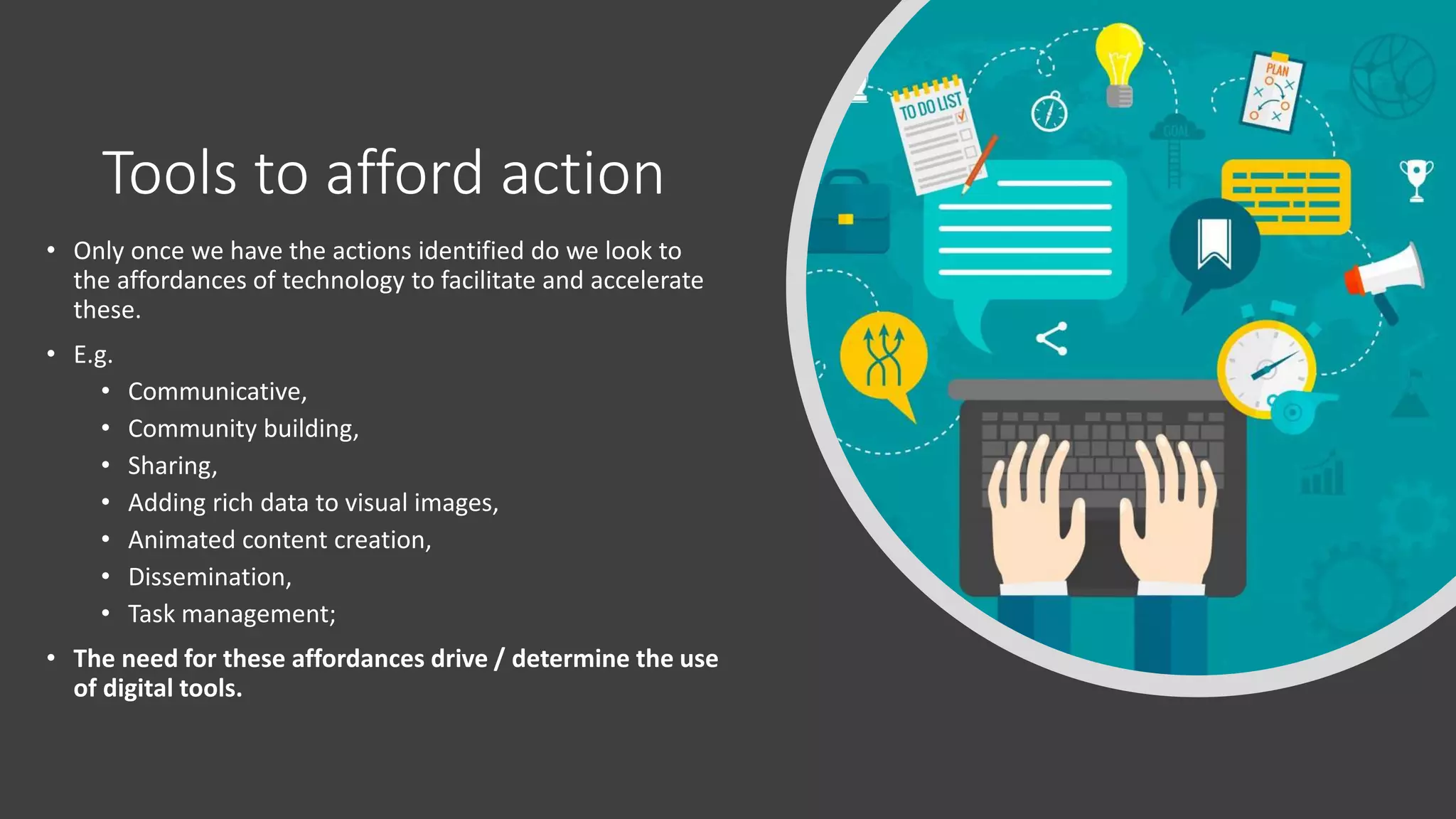
• Only once we have the actions identified do we look to
the affordances of technology to facilitate and accelerate
these.
• E.g.
• Communicative,
• Community building,
• Sharing,
• Adding rich data to visual images,
• Animated content creation,
• Dissemination,
• Task management;
• The need for these affordances drive / determine the use
of digital tools.
Conclusion
• Suggest we start with the social action we desire rather than
the tool.
• Identify:
• the action,
• the affordance that will facilitate it,
• the tool to do this.
• Deploy the digital tool.
Questions?

Engaging students with digital tools

  • 1.
    Engaging students with digitaltools Marcus Leaning
  • 2.
    Ipad projects • 2016all of my 1st year students were given Ipads by the university as part of a large project. • Pre-loaded with lots of apps and we had to use them in class to drive student engagement. • We did lots of things with them, initially. • Structured classes around them. • We wrote a lovely report about how useful they were. • The following year they tended to be used far less, students left them at home and just brought their phones to class. • Why did this happen?
  • 3.
    Introduction • Questions: • Whatdo we mean by engagement • what do students engage with? • How can we think about digital tools and the impact such tools have on SE? • Is there a better way forward? • Lots of ‘listicles’ of top tips for using tools to engage students. • Even more lists of the top tools to use. • Lots of marketing for apps and products. • Substantial investment by universities and agencies to facilitate this.
  • 4.
    Student engagement –an odd construct • A heavily theorised concept. • “What students do in their studies rather than what is done to them”. (Mantz Yorke). • Has roots in Dewey (1897) – ‘involvement’. • Implicit model of active learning. • Literature starts in 1960s. • A number of different perspectives emerge: • SE towards qualification; • Student centred; • Institutional management (UK); • ‘Being’ and ‘becoming’ (French). Google Ngram on proportion of books in their corpus mentioning student engagement.
  • 5.
    Student engagement towardsqualification • Focus upon what the institution does - Becker (1961) and Newcomb (1969) first studies looking at impact of institution upon students. • Relates to the university facilitates a student’s experience – what can the uni do (and how well they do it) to get the student to learn? • SE is: • “Students’ involvement in activities and conditions that are linked with quality learning” Kuh (2001). • Uni’s role is to encourage the student to engage in activities that inspire them to learn. • A ‘Pull’ model. • A lack of agency on the part of the student. • Dominant model - Big in US (high college drop out) and Australia, also used in UK and NZ and increasingly China.
  • 6.
    A student centred approach •What do students want form a university education and their experience? (Bryson, 2012; Leach and Zepke, 2012). • Engagement should be about the student and the things they want such as: • Barriers; • Control over their workload; • Autonomy; • Community with other students; • Ownership of their own studies. • University role is to facilitate the student’s own journey. • Development of student qualities that they value. • Echoes / application of Amartya Sen’s (1991) ‘capabilities approach’.
  • 7.
    Institutional management • UK makesuse of large surveys to measure engagement and satisfaction - NSS. • Additionally, centrally funded initiative to have students involved in the management of universities. • Student involvement with: • running of courses, • programme development, • senior quality aspects, • Governance, • Business functions. • A white-washing aspect of the neo-liberal university?
  • 8.
    ‘Being’ and ‘Becoming’ •Studies by Dubet (1994) and Jary and Lebeau (2010) see engagement as being in the overlap of personal drives, institutional belonging and intellectual passion for the subject. • When aligned the student is able to ‘become’ rather than ‘be’. • The degree to which each is met results in one of eight ‘archetypes of student being. Personal project – why go to university? Integration into university life Passion for subject
  • 9.
    ‘Location’ of engagement •‘Where’ the student is engaged is also important. • Bryson and Hand (2007) identify 4 spheres or levels of engagement. • I propose we add three further levels: With the activity With the lesson With the assessment With the module With the programme With the University With University / HE Bryson and Hand (2007) Student committed / interested in discipline, subject or field – identification as a practitioner. Student passionate about university / institution. Student particularly motivated by specific focus of unit / module. Assessment engages student to a high degree. Particular topic or class. Specific activity engages students. Student motivated to HE – instrumental or intrinsic reasons. Not a ‘local’ engagement.
  • 10.
    Using digital toolsfor student engagement • Lots of optimistic marketing of digital tools and it is a large and well resourced area of research. • In academic studies the emphasis very much on what the tools ‘do’ to engagement. • Experimental studies on the use of digital and social media to improve engagement. • Digital tool introduced into an environment and engagement measured before and after. • E.G. Junco, Heiberger and Loken (2011) looked at how Twitter use increased scores in nationally calibrated studies.
  • 11.
    The technology forstudent engagement ‘industry’ • Significant grants given to research the area and universities conducting studies: • Government and sector agencies: • UK JISC – FASTECH. • Private sector grants: • Adobe, • Microsoft, • Facebook and others all fund research identifying benefits to SE of technology (specifically their technology).
  • 12.
    Problems 1. Studies andprojects often ignore unintended consequences of digitally engaged students. • Information engagement problems – selective FB friends. • ‘24 hourism’, personal / private bleed – impact on staff well being, sustainability. 2. Techno centric top down solution to complex problems. • In many instances technology takes centre stage rather than student engagement. 3. Often unstated assumptions about technology. • Linear, deterministic model of technological impact. • Technology will directly transform social action. • There are alternate ways of thinking about technology let alone technology and student engagement…
  • 13.
    Technological impact • Technology(and especially digital technology) has escaped critical examination (Escobar, 1994). • Feenberg (1999, 2005) provides a useful typology of theories of technology: • Instrumentalism – We are in control of technology and it has no values. • Determinism – Technology causes change but has no values. • Substantivism – Technology causes changes and has values. • Critical Theory of Technology – We are in control but technology has values and potency. • CTT allows us to think of the ‘Affordances’ of technology to being used in a education- led approach to the use of technology in education.
  • 14.
    Critical Theory ofTechnological affordances for building student engagement. • Developing a CTT approach looks to the act of engagement first prior to the application of technology. • Involves careful consideration of educational eco- system – there may be places where technology is very useful but there are also places where it is not and can actually be more problematic than helpful. • Sometime inserting technology does not build engagement. • But determining where requires a lot of effort.
  • 15.
    Questions to askbefore deployment. • What form of engagement are we seeking? • SE towards qualification - the pull model? • Student centred – what the students value? • Institutional management – being a better academic citizen? • Where do we want engagement – • University, programme, module, assignment, class or activity. • What actual actions do we want to address? • Do we want something new to occur? • Something to stop? • Something to be produced?
  • 16.
    The technological • Oncewe know: • what we want to build; , • where we want to build it. • We move to identify the actions to do so. • We want students to share ideas outside of class in a non - assessed space, • Students desire a way to produce, store and share their understanding of a difficult idea; • Students want to be able to access and amend lecture notes in multiple formats.
  • 17.
    Tools to affordaction • Only once we have the actions identified do we look to the affordances of technology to facilitate and accelerate these. • E.g. • Communicative, • Community building, • Sharing, • Adding rich data to visual images, • Animated content creation, • Dissemination, • Task management; • The need for these affordances drive / determine the use of digital tools.
  • 18.
    Conclusion • Suggest westart with the social action we desire rather than the tool. • Identify: • the action, • the affordance that will facilitate it, • the tool to do this. • Deploy the digital tool.
  • 19.