IDEOLOGICAL STATE APPARATUS/MEDIA
Ideology
 Ideology generally refers to the
  promoted ‘ideals’ for which society feels
  the need to conform to.
 These ideals are influenced by a
  number of different social institutions.
 One of these is the mass media.
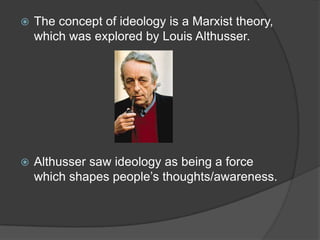
   The concept of ideology is a Marxist theory,
    which was explored by Louis Althusser.


   Althusser saw ideology as being a force
    which shapes people’s thoughts/awareness.
 The ‘ideals’ ideology refers to are
  expressed through the media in a fair
  number of different ways.
 One of these is how the media can be
  seen as dictating the ideal lifestyle to its
  audience.
Media Influence
 If we take a look at the offerings on
  television we can see that there are
  definite ‘ideals’ being communicated.
 An example of this is how the media
  presents family units.
   Regardless of the programme you
    watch, there is a good chance that the
    lead character’s family is a nuclear unit.
 Often this is because the nuclear unit is
  typically believed to be the most
  common family structure.
 Writers will take note of the fact people
  are likely to have interest in characters
  that could be seen as representing
  them.
 By putting characters into a ‘common’
  nuclear family unit, they will reach a
  large audience.
 This leads to programming consisting
  mostly of nuclear family units, given
  them the most media exposure.
 This exposure promotes the idea of the
  nuclear family unit as being ideal to the
  audience.
 This cycle continues, which ensures that
  the common belief of ideals is
  strengthened more and more.
 As we’ve seen now, the media industry
  uses the ideals it has already created as
  a basis for marketing products.
 Over time the industry has helped shape
  ideal lifestyles; which gives them a
  chance to sell products on the basis that
  they conform to said ideals.

Ideology & The Media

  • 1.
  • 2.
    Ideology  Ideology generallyrefers to the promoted ‘ideals’ for which society feels the need to conform to.  These ideals are influenced by a number of different social institutions.  One of these is the mass media.
  • 3.
    The concept of ideology is a Marxist theory, which was explored by Louis Althusser.  Althusser saw ideology as being a force which shapes people’s thoughts/awareness.
  • 4.
     The ‘ideals’ideology refers to are expressed through the media in a fair number of different ways.  One of these is how the media can be seen as dictating the ideal lifestyle to its audience.
  • 5.
    Media Influence  Ifwe take a look at the offerings on television we can see that there are definite ‘ideals’ being communicated.  An example of this is how the media presents family units.
  • 6.
    Regardless of the programme you watch, there is a good chance that the lead character’s family is a nuclear unit.
  • 7.
     Often thisis because the nuclear unit is typically believed to be the most common family structure.  Writers will take note of the fact people are likely to have interest in characters that could be seen as representing them.  By putting characters into a ‘common’ nuclear family unit, they will reach a large audience.
  • 8.
     This leadsto programming consisting mostly of nuclear family units, given them the most media exposure.  This exposure promotes the idea of the nuclear family unit as being ideal to the audience.  This cycle continues, which ensures that the common belief of ideals is strengthened more and more.
  • 9.
     As we’veseen now, the media industry uses the ideals it has already created as a basis for marketing products.  Over time the industry has helped shape ideal lifestyles; which gives them a chance to sell products on the basis that they conform to said ideals.