Introducing
  Marxist
   Media
  Theory
 A2 Media
  Studies
Media Issues,
Debates and
 Theories-
Objectives:
• Define and explain selected ideas from
  within Marxist theory.


• Demonstrate how these ideas can be
  used to help analyse media texts.
Background:
• Marx was an economic theorist who
  wrote during the 19th Century.

• His ideas deal with social and economic
  power relationships and have been
  influential in economics, politics and
  sociology and can be very useful for
  media students.
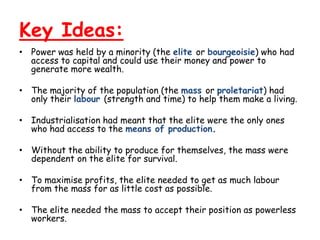
Key Ideas:
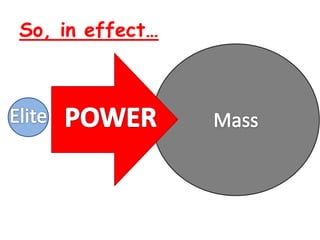
• Power was held by a minority (the elite or bourgeoisie) who had
  access to capital and could use their money and power to
  generate more wealth.

• The majority of the population (the mass or proletariat) had
  only their labour (strength and time) to help them make a living.

• Industrialisation had meant that the elite were the only ones
  who had access to the means of production.

• Without the ability to produce for themselves, the mass were
  dependent on the elite for survival.

• To maximise profits, the elite needed to get as much labour
  from the mass for as little cost as possible.

• The elite needed the mass to accept their position as powerless
  workers.
So, in effect…
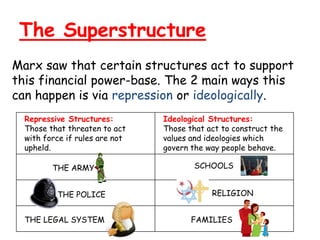
The Superstructure
Marx saw that certain structures act to support
this financial power-base. The 2 main ways this
can happen is via repression or ideologically.
  Repressive Structures:        Ideological Structures:
  Those that threaten to act    Those that act to construct the
  with force if rules are not   values and ideologies which
  upheld.                       govern the way people behave.

         THE ARMY                       SCHOOLS


          THE POLICE                        RELIGION


  THE LEGAL SYSTEM                     FAMILIES
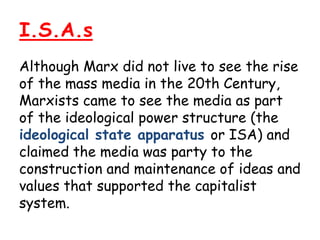
I.S.A.s
Although Marx did not live to see the rise
of the mass media in the 20th Century,
Marxists came to see the media as part
of the ideological power structure (the
ideological state apparatus or ISA) and
claimed the media was party to the
construction and maintenance of ideas and
values that supported the capitalist
system.
False Consciousness
The ISA can work in a number of ways to
create false consciousness - the belief in
ideas and values as truths when in fact
they are constructed ideologies which
support the power base.
Exam Hint:
Theory is only useful if it is used to analyse
media texts. Never simply describe theory -
always relate the ideas of a theory to examples
from texts to show how the theory helps to
explain the meanings created by media texts.
Case Study: The Apprentice
(2005-present: BBC)

• The Apprentice is a prolonged job interview where
  contestants compete against each other to be chosen
  for a job working for the entrepreneur Lord Alan
  Sugar.

• The fact that Sugar has all the power reinforces the
  ‘superior’ position of the capitalist elite.

• He has power as he has used the system to create
  wealth and he is shown using this power to provide a
  livelihood for the winner of the competition.
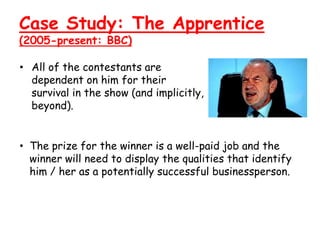
Case Study: The Apprentice
(2005-present: BBC)

• All of the contestants are
  dependent on him for their
  survival in the show (and implicitly,
  beyond).


• The prize for the winner is a well-paid job and the
  winner will need to display the qualities that identify
  him / her as a potentially successful businessperson.
Case Study: The Apprentice
(2005-present: BBC)
Through the tasks and the judgements offered
afterwards some clear values are identified:

Successful people need to be outgoing but not too
extrovert. They must be adventurous in business terms
but not reckless; confident but not arrogant and be
both good leaders and team players.
These qualities are the ones that are rewarded by
success within the show and can be seen to be part of
the construction of a false consciousness regarding the
personality types of people who are valued within the
capitalist system. The creative, individual or introvert
are not seen as ‘acceptable’ neither are those who
challenge authority or who work outside team
structures. People who do not conform to these norms
are ‘fired’.
Case Study: The Apprentice
(2005-present: BBC)
Given the media’s position as part of the superstructure of the
capitalist system, texts can be analysed in terms of how they act to
construct these values in their representations.

Introducing marxist media theory

  • 1.
    Introducing Marxist Media Theory A2 Media Studies Media Issues, Debates and Theories-
  • 2.
    Objectives: • Define andexplain selected ideas from within Marxist theory. • Demonstrate how these ideas can be used to help analyse media texts.
  • 3.
    Background: • Marx wasan economic theorist who wrote during the 19th Century. • His ideas deal with social and economic power relationships and have been influential in economics, politics and sociology and can be very useful for media students.
  • 4.
    Key Ideas: • Powerwas held by a minority (the elite or bourgeoisie) who had access to capital and could use their money and power to generate more wealth. • The majority of the population (the mass or proletariat) had only their labour (strength and time) to help them make a living. • Industrialisation had meant that the elite were the only ones who had access to the means of production. • Without the ability to produce for themselves, the mass were dependent on the elite for survival. • To maximise profits, the elite needed to get as much labour from the mass for as little cost as possible. • The elite needed the mass to accept their position as powerless workers.
  • 5.
  • 6.
    The Superstructure Marx sawthat certain structures act to support this financial power-base. The 2 main ways this can happen is via repression or ideologically. Repressive Structures: Ideological Structures: Those that threaten to act Those that act to construct the with force if rules are not values and ideologies which upheld. govern the way people behave. THE ARMY SCHOOLS THE POLICE RELIGION THE LEGAL SYSTEM FAMILIES
  • 7.
    I.S.A.s Although Marx didnot live to see the rise of the mass media in the 20th Century, Marxists came to see the media as part of the ideological power structure (the ideological state apparatus or ISA) and claimed the media was party to the construction and maintenance of ideas and values that supported the capitalist system.
  • 8.
    False Consciousness The ISAcan work in a number of ways to create false consciousness - the belief in ideas and values as truths when in fact they are constructed ideologies which support the power base.
  • 9.
    Exam Hint: Theory isonly useful if it is used to analyse media texts. Never simply describe theory - always relate the ideas of a theory to examples from texts to show how the theory helps to explain the meanings created by media texts.
  • 10.
    Case Study: TheApprentice (2005-present: BBC) • The Apprentice is a prolonged job interview where contestants compete against each other to be chosen for a job working for the entrepreneur Lord Alan Sugar. • The fact that Sugar has all the power reinforces the ‘superior’ position of the capitalist elite. • He has power as he has used the system to create wealth and he is shown using this power to provide a livelihood for the winner of the competition.
  • 11.
    Case Study: TheApprentice (2005-present: BBC) • All of the contestants are dependent on him for their survival in the show (and implicitly, beyond). • The prize for the winner is a well-paid job and the winner will need to display the qualities that identify him / her as a potentially successful businessperson.
  • 12.
    Case Study: TheApprentice (2005-present: BBC) Through the tasks and the judgements offered afterwards some clear values are identified: Successful people need to be outgoing but not too extrovert. They must be adventurous in business terms but not reckless; confident but not arrogant and be both good leaders and team players. These qualities are the ones that are rewarded by success within the show and can be seen to be part of the construction of a false consciousness regarding the personality types of people who are valued within the capitalist system. The creative, individual or introvert are not seen as ‘acceptable’ neither are those who challenge authority or who work outside team structures. People who do not conform to these norms are ‘fired’.
  • 13.
    Case Study: TheApprentice (2005-present: BBC) Given the media’s position as part of the superstructure of the capitalist system, texts can be analysed in terms of how they act to construct these values in their representations.