Studying the Media
Key Concepts - Ideology
What is Ideology?
 Simply put, Ideology is the idea(s) behind the
media text.
 It is the secret (or sometimes not so secret)
agenda of it’s producers.

 It is important to identify different ideological
discourses that are present in an apparently
simple photograph.
 So, ideology is a body of ideas or a set of beliefs
that underpins an institution and leads to social
relations.
What is Ideology?
 These sets of beliefs are those held by groups
within society
 The prevalent ones are those held by the ruling/
dominant groups.

 This is usually done by those in a position of
wealth.
Dominant ideology or hegemony?

 What is dominant ideology?

 Held by the majority group (Ruling Class)
 Keeps other ideas (Minority) hidden
 Uses hegemony

 What is hegemony?
 Occurs when a majority decide to 'fit in' with the
cultural values and ideas of their time and place
and the minority keep their objections quiet.
Dominant ideology or hegemony?

 Dominant ideology Christianity is the main
historical example.
 Think of how many legal systems take Christian
moral values as their basis.
 What about a modern day equivalent?

 Football currently has a hegemonic status in the
UK.
 Glance through the sports pages and see what
coverage other sports get?

 Everyone is expected to understand and accept
its national importance.
Hegemony

 Hegemony is not a forced political movement.

 For example, no one is forced to watch/listen
to/read about football.
 It just seems like sometimes there are few
alternatives.
 This is how hegemonies take hold.
 A majority decide to ‘fit in’ with the cultural
values and ideas of their time and place and the
minority keep their objections quiet.
 Hegemony is about constant…Us and Them
What part does the media have to
play in developing and maintaining
hegemony?

Institutions, language, news/information, regulating
output, representations, ownership, authorship
What part does the media have to play
in opposing/altering the hegemony?

Challenging all of the previous examples by
presenting the alternatives in a positive light.
Ideological discourse
 These are the issues/attitudes debated over in
the media which form part of the everyday
ideological discourse in our society.
 The views on these subjects form the basis of our
social rules and practice.

 What subjects do you think are
covered by this?
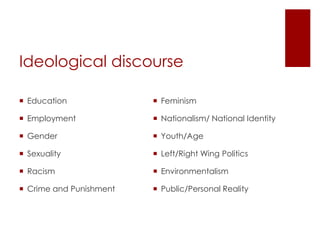
Ideological discourse
 Education

 Feminism

 Employment

 Nationalism/ National Identity

 Gender

 Youth/Age

 Sexuality

 Left/Right Wing Politics

 Racism

 Environmentalism

 Crime and Punishment

 Public/Personal Reality
Preferred Reading
 Producers of media text design it with a certain
meaning in mind
 They hope that audiences will decode their text
in a certain way
 Preferred reading are those which tie in with
hegemonic beliefs…

 For example…The idea of beauty and the ‘ideal’
female shape propounded in western
magazines.
 It is accepted as ‘natural’ that models in
magazines should be young and drastically
underweight.
Preferred Reading

 Since the 1960’s the preferred reading has been
that these women are beautiful
 However, recently there are signs that the
hegemonic belief has adapted to the concerns
of many that this body shape is actually
unhealthy.
 Preferred reading starts to shift.
 For example. Editors of magazines such as Marie
Claire spoke out about the actors of Ally McBeal
for their overly gaunt appearance.

Ideology in the Media

  • 1.
    Studying the Media KeyConcepts - Ideology
  • 2.
    What is Ideology? Simply put, Ideology is the idea(s) behind the media text.  It is the secret (or sometimes not so secret) agenda of it’s producers.  It is important to identify different ideological discourses that are present in an apparently simple photograph.  So, ideology is a body of ideas or a set of beliefs that underpins an institution and leads to social relations.
  • 3.
    What is Ideology? These sets of beliefs are those held by groups within society  The prevalent ones are those held by the ruling/ dominant groups.  This is usually done by those in a position of wealth.
  • 4.
    Dominant ideology orhegemony?  What is dominant ideology?  Held by the majority group (Ruling Class)  Keeps other ideas (Minority) hidden  Uses hegemony  What is hegemony?  Occurs when a majority decide to 'fit in' with the cultural values and ideas of their time and place and the minority keep their objections quiet.
  • 5.
    Dominant ideology orhegemony?  Dominant ideology Christianity is the main historical example.  Think of how many legal systems take Christian moral values as their basis.  What about a modern day equivalent?  Football currently has a hegemonic status in the UK.  Glance through the sports pages and see what coverage other sports get?  Everyone is expected to understand and accept its national importance.
  • 6.
    Hegemony  Hegemony isnot a forced political movement.  For example, no one is forced to watch/listen to/read about football.  It just seems like sometimes there are few alternatives.  This is how hegemonies take hold.  A majority decide to ‘fit in’ with the cultural values and ideas of their time and place and the minority keep their objections quiet.  Hegemony is about constant…Us and Them
  • 7.
    What part doesthe media have to play in developing and maintaining hegemony? Institutions, language, news/information, regulating output, representations, ownership, authorship
  • 8.
    What part doesthe media have to play in opposing/altering the hegemony? Challenging all of the previous examples by presenting the alternatives in a positive light.
  • 9.
    Ideological discourse  Theseare the issues/attitudes debated over in the media which form part of the everyday ideological discourse in our society.  The views on these subjects form the basis of our social rules and practice.  What subjects do you think are covered by this?
  • 10.
    Ideological discourse  Education Feminism  Employment  Nationalism/ National Identity  Gender  Youth/Age  Sexuality  Left/Right Wing Politics  Racism  Environmentalism  Crime and Punishment  Public/Personal Reality
  • 11.
    Preferred Reading  Producersof media text design it with a certain meaning in mind  They hope that audiences will decode their text in a certain way  Preferred reading are those which tie in with hegemonic beliefs…  For example…The idea of beauty and the ‘ideal’ female shape propounded in western magazines.  It is accepted as ‘natural’ that models in magazines should be young and drastically underweight.
  • 12.
    Preferred Reading  Sincethe 1960’s the preferred reading has been that these women are beautiful  However, recently there are signs that the hegemonic belief has adapted to the concerns of many that this body shape is actually unhealthy.  Preferred reading starts to shift.  For example. Editors of magazines such as Marie Claire spoke out about the actors of Ally McBeal for their overly gaunt appearance.