“Media for the benefit of Public”
• The social responsibility theory of the press is an
outgrowth of libertarian theory.
• The theory based on the concern that, although
the press may be free from interference by the
government, the press can still be controlled by
corporate interests.
• If the press is not sufficiently vigilant, it is the duty
of some representative of the public to force it
be responsible.
Press must provide the
following social functions:
• Provide information needed for
political system
• Give public information needed
for self-governance
• Serve as a government
watchdog.
• Bring together buyers and
• Provide entertainment
• Be profitable enough to avoid
outside pressures
Essentially advocates
non-authoritarian media
controls.
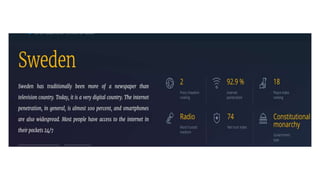
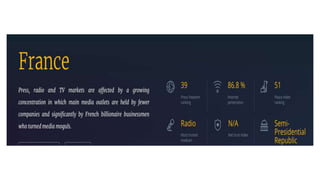
France, Israel and
Sweden all operate
under some form of
social responsibility
controls.
Response to Hutchins
Commission report of
the late 1940s
Norms for the Press in the
Twenty-First Century
An addition: Development Theory
Developing nations may need to implement press controls in
order to promote industry, national identity, and partnerships
with neighboring nations.
Do these controls differ from authoritarian
controls?
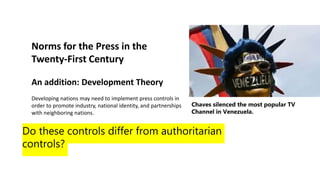
Chaves silenced the most popular TV
Channel in Venezuela.
The internet in the
Twenty-First Century
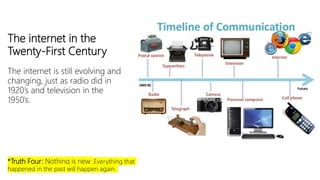
The internet is still evolving and
changing, just as radio did in
1920’s and television in the
1950’s.
*Truth Four: Nothing is new: Everything that
happened in the past will happen again.
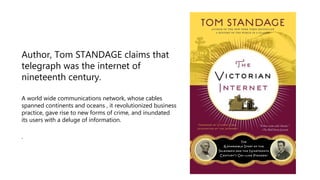
Author, Tom STANDAGE claims that
telegraph was the internet of
nineteenth century.
A world wide communications network, whose cables
spanned continents and oceans , it revolutionized business
practice, gave rise to new forms of crime, and inundated
its users with a deluge of information.
.
But we have to remember that!
The internet was the only medium that incorporates
elements of interpersonal, group and mass
communication.
The unique nature of the Internet, especially in a global
context, poses new moral dilemmas concerning national
boundaries, corporate control, freedom of the
press, and the rights of individuals.

Socialresponsibilitytheory

  • 1.
    “Media for thebenefit of Public” • The social responsibility theory of the press is an outgrowth of libertarian theory. • The theory based on the concern that, although the press may be free from interference by the government, the press can still be controlled by corporate interests. • If the press is not sufficiently vigilant, it is the duty of some representative of the public to force it be responsible.
  • 2.
    Press must providethe following social functions: • Provide information needed for political system • Give public information needed for self-governance • Serve as a government watchdog. • Bring together buyers and • Provide entertainment • Be profitable enough to avoid outside pressures
  • 3.
    Essentially advocates non-authoritarian media controls. France,Israel and Sweden all operate under some form of social responsibility controls. Response to Hutchins Commission report of the late 1940s
  • 10.
    Norms for thePress in the Twenty-First Century An addition: Development Theory Developing nations may need to implement press controls in order to promote industry, national identity, and partnerships with neighboring nations. Do these controls differ from authoritarian controls? Chaves silenced the most popular TV Channel in Venezuela.
  • 11.
    The internet inthe Twenty-First Century The internet is still evolving and changing, just as radio did in 1920’s and television in the 1950’s. *Truth Four: Nothing is new: Everything that happened in the past will happen again.
  • 12.
    Author, Tom STANDAGEclaims that telegraph was the internet of nineteenth century. A world wide communications network, whose cables spanned continents and oceans , it revolutionized business practice, gave rise to new forms of crime, and inundated its users with a deluge of information. .
  • 13.
    But we haveto remember that! The internet was the only medium that incorporates elements of interpersonal, group and mass communication. The unique nature of the Internet, especially in a global context, poses new moral dilemmas concerning national boundaries, corporate control, freedom of the press, and the rights of individuals.