SKILL MAXIFY
1
Employee
Motivation &
Rewarding
What is Motivation ?
Motivation is generally defined as the force that compels us to action, It
drives us to work hard and pushes us to succeed. Motivation influences
our behaviors and our ability to accomplish goals.
Motivation is the driving force behind behavior. This is key to
understanding why it is important for business.
As manager / owners we need to drive behavior of our employees,
understanding what their motivation is and how to tap into it.
3
Types of motivation
1
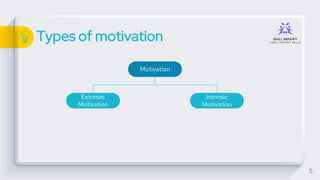
Types of motivation
5
Motivation
Intrinsic
Motivation
Extrinsic
Motivation
Types of Motivation?
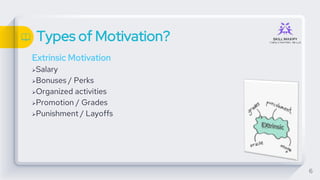
Extrinsic Motivation
Salary
Bonuses / Perks
Organized activities
Promotion / Grades
Punishment / Layoffs
6
Types of Motivation?
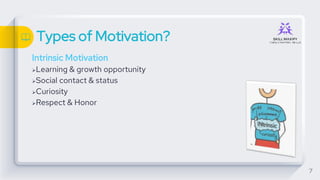
Intrinsic Motivation
Learning & growth opportunity
Social contact & status
Curiosity
Respect & Honor
7
Psychological Theories
of Motivation
2
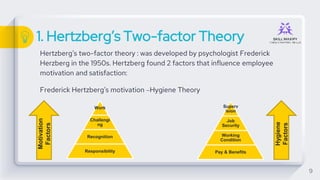
1. Hertzberg’s Two-factor Theory
Hertzberg’s two-factor theory : was developed by psychologist Frederick
Herzberg in the 1950s. Hertzberg found 2 factors that influence employee
motivation and satisfaction:
Frederick Hertzberg’s motivation –Hygiene Theory
9
Work
Challengi
ng
Recognition
Responsibility
Superv
ision
Job
Security
Working
Condition
Pay & Benefits
Motivation
Factors
Hygiene
Factors
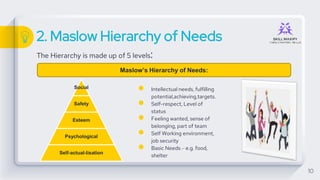
2. Maslow Hierarchy of Needs
● Intellectual needs, fulfilling
potential,achieving,targets.
● Self-respect, Level of
status
● Feeling wanted, sense of
belonging, part of team
● Self Working environment,
job security
● Basic Needs – e.g. food,
shelter
10
The Hierarchy is made up of 5 levels:
Maslow’s Hierarchy of Needs:
Social
Safety
Esteem
Psychological
Self-actual-lisation
Hawthorne Effect: A tendency for some people to work harder and
perform better when they were being observed by researchers.
1. Expectancy: The belief that your effort will results in your desired goal.
2. Instrumentality: The belief that you will recieve a reward if you meet
performance expectations.
3. Valence: The value you place on the reward.
11
Expectancy Theory: Proposes that people will choose how to behave
depending on the outcomes they expect as a result of their behavior.
Expectancy theory is based on three elements:
● Focus
● Personalities
● Communication
● Expectations
● Coasts
● Environment
● Low-self – confidence
● Low Expectation for
success
● Lack of interest in
subject matter
● Achievement Anxiety
● Fear of failures
12
Challenges of motivating Employees
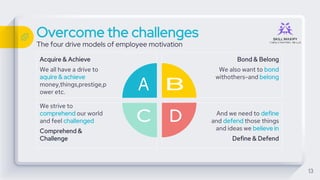
Overcome the challenges
The four drive models of employee motivation
13
Acquire & Achieve
We all have a drive to
aquire & achieve
money,things,prestige,p
ower etc.
Bond & Belong
We also want to bond
withothers-and belong
We strive to
comprehend our world
and feel challenged
Comprehend &
Challenge
And we need to define
and defend those things
and ideas we believe in
Define & Defend
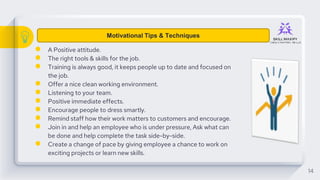
● A Positive attitude.
● The right tools & skills for the job.
● Training is always good, it keeps people up to date and focused on
the job.
● Offer a nice clean working environment.
● Listening to your team.
● Positive immediate effects.
● Encourage people to dress smartly.
● Remind staff how their work matters to customers and encourage.
● Join in and help an employee who is under pressure, Ask what can
be done and help complete the task side-by-side.
● Create a change of pace by giving employee a chance to work on
exciting projects or learn new skills.
14
Motivational Tips & Techniques
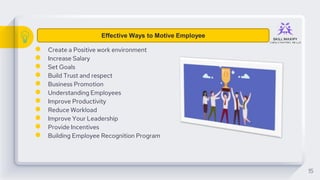
● Create a Positive work environment
● Increase Salary
● Set Goals
● Build Trust and respect
● Business Promotion
● Understanding Employees
● Improve Productivity
● Reduce Workload
● Improve Your Leadership
● Provide Incentives
● Building Employee Recognition Program
15
Effective Ways to Motive Employee
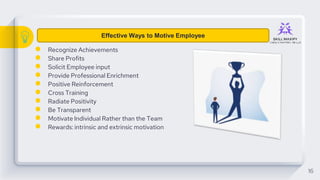
● Recognize Achievements
● Share Profits
● Solicit Employee input
● Provide Professional Enrichment
● Positive Reinforcement
● Cross Training
● Radiate Positivity
● Be Transparent
● Motivate Individual Rather than the Team
● Rewards: intrinsic and extrinsic motivation
16
Effective Ways to Motive Employee
Thank You 😊 !

Employee Training & Motivation

  • 1.
  • 2.
  • 3.
    What is Motivation? Motivation is generally defined as the force that compels us to action, It drives us to work hard and pushes us to succeed. Motivation influences our behaviors and our ability to accomplish goals. Motivation is the driving force behind behavior. This is key to understanding why it is important for business. As manager / owners we need to drive behavior of our employees, understanding what their motivation is and how to tap into it. 3
  • 4.
  • 5.
  • 6.
    Types of Motivation? ExtrinsicMotivation Salary Bonuses / Perks Organized activities Promotion / Grades Punishment / Layoffs 6
  • 7.
    Types of Motivation? IntrinsicMotivation Learning & growth opportunity Social contact & status Curiosity Respect & Honor 7
  • 8.
  • 9.
    1. Hertzberg’s Two-factorTheory Hertzberg’s two-factor theory : was developed by psychologist Frederick Herzberg in the 1950s. Hertzberg found 2 factors that influence employee motivation and satisfaction: Frederick Hertzberg’s motivation –Hygiene Theory 9 Work Challengi ng Recognition Responsibility Superv ision Job Security Working Condition Pay & Benefits Motivation Factors Hygiene Factors
  • 10.
    2. Maslow Hierarchyof Needs ● Intellectual needs, fulfilling potential,achieving,targets. ● Self-respect, Level of status ● Feeling wanted, sense of belonging, part of team ● Self Working environment, job security ● Basic Needs – e.g. food, shelter 10 The Hierarchy is made up of 5 levels: Maslow’s Hierarchy of Needs: Social Safety Esteem Psychological Self-actual-lisation
  • 11.
    Hawthorne Effect: Atendency for some people to work harder and perform better when they were being observed by researchers. 1. Expectancy: The belief that your effort will results in your desired goal. 2. Instrumentality: The belief that you will recieve a reward if you meet performance expectations. 3. Valence: The value you place on the reward. 11 Expectancy Theory: Proposes that people will choose how to behave depending on the outcomes they expect as a result of their behavior. Expectancy theory is based on three elements:
  • 12.
    ● Focus ● Personalities ●Communication ● Expectations ● Coasts ● Environment ● Low-self – confidence ● Low Expectation for success ● Lack of interest in subject matter ● Achievement Anxiety ● Fear of failures 12 Challenges of motivating Employees
  • 13.
    Overcome the challenges Thefour drive models of employee motivation 13 Acquire & Achieve We all have a drive to aquire & achieve money,things,prestige,p ower etc. Bond & Belong We also want to bond withothers-and belong We strive to comprehend our world and feel challenged Comprehend & Challenge And we need to define and defend those things and ideas we believe in Define & Defend
  • 14.
    ● A Positiveattitude. ● The right tools & skills for the job. ● Training is always good, it keeps people up to date and focused on the job. ● Offer a nice clean working environment. ● Listening to your team. ● Positive immediate effects. ● Encourage people to dress smartly. ● Remind staff how their work matters to customers and encourage. ● Join in and help an employee who is under pressure, Ask what can be done and help complete the task side-by-side. ● Create a change of pace by giving employee a chance to work on exciting projects or learn new skills. 14 Motivational Tips & Techniques
  • 15.
    ● Create aPositive work environment ● Increase Salary ● Set Goals ● Build Trust and respect ● Business Promotion ● Understanding Employees ● Improve Productivity ● Reduce Workload ● Improve Your Leadership ● Provide Incentives ● Building Employee Recognition Program 15 Effective Ways to Motive Employee
  • 16.
    ● Recognize Achievements ●Share Profits ● Solicit Employee input ● Provide Professional Enrichment ● Positive Reinforcement ● Cross Training ● Radiate Positivity ● Be Transparent ● Motivate Individual Rather than the Team ● Rewards: intrinsic and extrinsic motivation 16 Effective Ways to Motive Employee
  • 17.