JOHN MARWA,
MOSHI-TANZANIA
2018
Learning Outcomes
• The concept of IPC
• Importance of IPC
• Goals of IPC
• Common terminologies
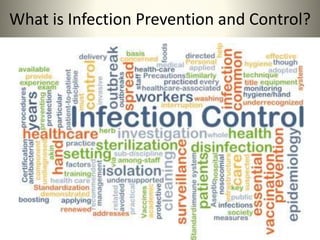
What is Infection Prevention and Control?
Infection prevention and control
Abbreviation  IPC
A scientific approach and practical solution designed to
prevent harm caused by infection to patients and health
workers.
(WHO, 2018)
The discipline concerned with preventing nosocomial
or healthcare-associated infections
Focuses on evidence-based practices and procedures that can prevent or reduce the
risk of transmission of microorganisms to:
– Health care providers,
– Patients
– Residents and
– Visitors
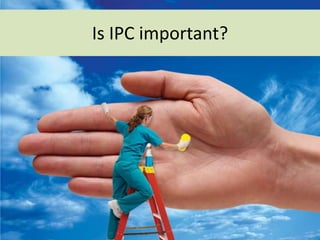
Is IPC important?
Why is IPC
Important?
• Infections are a leading cause of morbidity and mortality in
healthcare settings
• Infections can cause pain, suffering and often, permanent
scarring
• Infections cause prolonged hospital stays which has an
impact on costs
Infection control programme (1)
Components of the infection control programme
are:
– Basic measures for infection control, i.e. standard
and additional precautions,
– Education and training of health care workers
– Protection of health care workers, e.g.
immunization
– Identification of hazards and minimizing risks;
Infection control programme (2)
• Routine practices essential to infection control such
as:
– aseptic techniques,
– use of single use devices,
– reprocessing of instruments and equipment,
– antibiotic usage,
– management of blood/body fluid exposure,
– handling and use of blood and blood products,
– sound management of medical waste
Infection control programme (3)
• Effective work practices and procedures, such as:
• Environmental management practices including
management of hospital/clinical waste, support
services (e.g., food, linen); use of therapeutic
devices
• surveillance
• incident monitoring
• outbreak investigation
• infection control in specific situations and
• research.
of IPC
To prevent the spread of infections from
– patient-to-patient
– patients to health care providers
– health care providers to patients
– health care providers to health care providers and to
visitors and others in the health care environment
• Hand hygiene
• Prevention of surgical site
infections
• IPC to combat antimicrobial
resistance
• Injection safety
• Burden of health care-
associated infections
• Ebola response and recovery
• IPC country capacity-building
• Prevention of sepsis and
catheter-associated
bloodstream infections
• Prevention of catheter-
associated urinary tract
infections.
2015-2017
Definition of Terms (1)
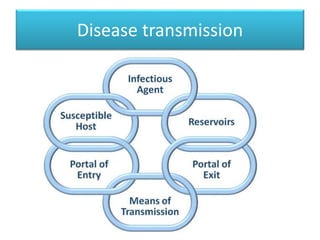
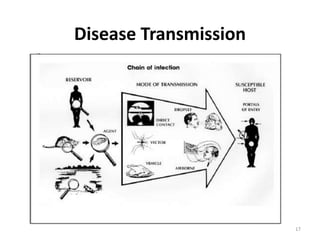
Host: living animal or plant
Agent: something that produces or is capable of producing an
effect, i.e. infection
Vector: an organism (as an insect) that transmits an agent from
one organism or source to another
Vehicle: inanimate object (food, water, etc) that can carry an
agent from one organism to another
Definition of Terms (2)
Disease: impairment of normal functioning, manifested by signs and
symptoms
Infection: the state produced by the establishment of an infective
agent in or on a suitable host , host may or may not have
signs or symptoms
Carrier: individual harbors the agent but does not have symptoms.
Person can infect others.
Reservoir: habitat (man, animal, etc.) in which the agent normally lives,
grows, and multiplies
Disease transmission
Disease Transmission
17
Mode of Transmission
Route Example Disease
Direct contact Kissing, sexual contact, skin-to-skin contact STDs, skin infections, scabies
Droplet Organism on large respiratory droplets that
people sneeze, cough, drip, or exhale. Disease
spread when people are close to each other
(usually <3 feet) and inhale droplet.
Mumps, pertussis (whooping cough),
common cold, ‘strep throat’,
meningitis
Indirect contact Contact with contaminated surfaces, clothing,
etc
Skin infections, diarrheal disease
Vector Bite from disease-carrying ticks, fleas,
mosquitoes
Lyme disease, LaCrosse encephalitis
Vehicle Eat/drink contaminated food/beverage,
transfuse infected blood, fomites (bedding,
infected tatoo needle)
Some diarrheal disease, hepatitis b/c
Airborne Organism on dust particles or small respiratory
droplets that may become aerosolized when
people sneeze, cough, laugh, or exhale
Chickenpox, Tuberculosis,
Smallpox, SARS,
Anthrax (inhalational)
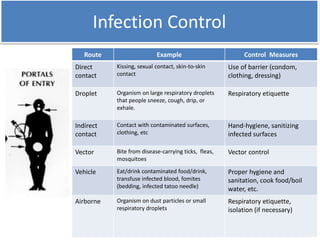
Infection Control
Route Example Control Measures
Direct
contact
Kissing, sexual contact, skin-to-skin
contact
Use of barrier (condom,
clothing, dressing)
Droplet Organism on large respiratory droplets
that people sneeze, cough, drip, or
exhale.
Respiratory etiquette
Indirect
contact
Contact with contaminated surfaces,
clothing, etc
Hand-hygiene, sanitizing
infected surfaces
Vector Bite from disease-carrying ticks, fleas,
mosquitoes
Vector control
Vehicle Eat/drink contaminated food/drink,
transfuse infected blood, fomites
(bedding, infected tatoo needle)
Proper hygiene and
sanitation, cook food/boil
water, etc.
Airborne Organism on dust particles or small
respiratory droplets
Respiratory etiquette,
isolation (if necessary)
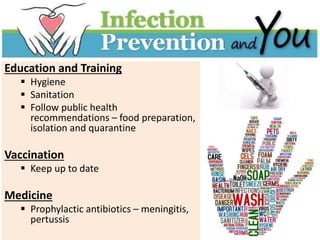
Education and Training
 Hygiene
 Sanitation
 Follow public health
recommendations – food preparation,
isolation and quarantine
Vaccination
 Keep up to date
Medicine
 Prophylactic antibiotics – meningitis,
pertussis
SUMMARY

Infection prevention and control

  • 1.
  • 2.
    Learning Outcomes • Theconcept of IPC • Importance of IPC • Goals of IPC • Common terminologies
  • 3.
    What is InfectionPrevention and Control?
  • 4.
    Infection prevention andcontrol Abbreviation  IPC A scientific approach and practical solution designed to prevent harm caused by infection to patients and health workers. (WHO, 2018)
  • 5.
    The discipline concernedwith preventing nosocomial or healthcare-associated infections
  • 6.
    Focuses on evidence-basedpractices and procedures that can prevent or reduce the risk of transmission of microorganisms to: – Health care providers, – Patients – Residents and – Visitors
  • 7.
  • 8.
    Why is IPC Important? •Infections are a leading cause of morbidity and mortality in healthcare settings • Infections can cause pain, suffering and often, permanent scarring • Infections cause prolonged hospital stays which has an impact on costs
  • 9.
    Infection control programme(1) Components of the infection control programme are: – Basic measures for infection control, i.e. standard and additional precautions, – Education and training of health care workers – Protection of health care workers, e.g. immunization – Identification of hazards and minimizing risks;
  • 10.
    Infection control programme(2) • Routine practices essential to infection control such as: – aseptic techniques, – use of single use devices, – reprocessing of instruments and equipment, – antibiotic usage, – management of blood/body fluid exposure, – handling and use of blood and blood products, – sound management of medical waste
  • 11.
    Infection control programme(3) • Effective work practices and procedures, such as: • Environmental management practices including management of hospital/clinical waste, support services (e.g., food, linen); use of therapeutic devices • surveillance • incident monitoring • outbreak investigation • infection control in specific situations and • research.
  • 12.
    of IPC To preventthe spread of infections from – patient-to-patient – patients to health care providers – health care providers to patients – health care providers to health care providers and to visitors and others in the health care environment
  • 13.
    • Hand hygiene •Prevention of surgical site infections • IPC to combat antimicrobial resistance • Injection safety • Burden of health care- associated infections • Ebola response and recovery • IPC country capacity-building • Prevention of sepsis and catheter-associated bloodstream infections • Prevention of catheter- associated urinary tract infections. 2015-2017
  • 14.
    Definition of Terms(1) Host: living animal or plant Agent: something that produces or is capable of producing an effect, i.e. infection Vector: an organism (as an insect) that transmits an agent from one organism or source to another Vehicle: inanimate object (food, water, etc) that can carry an agent from one organism to another
  • 15.
    Definition of Terms(2) Disease: impairment of normal functioning, manifested by signs and symptoms Infection: the state produced by the establishment of an infective agent in or on a suitable host , host may or may not have signs or symptoms Carrier: individual harbors the agent but does not have symptoms. Person can infect others. Reservoir: habitat (man, animal, etc.) in which the agent normally lives, grows, and multiplies
  • 16.
  • 17.
  • 18.
    Mode of Transmission RouteExample Disease Direct contact Kissing, sexual contact, skin-to-skin contact STDs, skin infections, scabies Droplet Organism on large respiratory droplets that people sneeze, cough, drip, or exhale. Disease spread when people are close to each other (usually <3 feet) and inhale droplet. Mumps, pertussis (whooping cough), common cold, ‘strep throat’, meningitis Indirect contact Contact with contaminated surfaces, clothing, etc Skin infections, diarrheal disease Vector Bite from disease-carrying ticks, fleas, mosquitoes Lyme disease, LaCrosse encephalitis Vehicle Eat/drink contaminated food/beverage, transfuse infected blood, fomites (bedding, infected tatoo needle) Some diarrheal disease, hepatitis b/c Airborne Organism on dust particles or small respiratory droplets that may become aerosolized when people sneeze, cough, laugh, or exhale Chickenpox, Tuberculosis, Smallpox, SARS, Anthrax (inhalational)
  • 19.
    Infection Control Route ExampleControl Measures Direct contact Kissing, sexual contact, skin-to-skin contact Use of barrier (condom, clothing, dressing) Droplet Organism on large respiratory droplets that people sneeze, cough, drip, or exhale. Respiratory etiquette Indirect contact Contact with contaminated surfaces, clothing, etc Hand-hygiene, sanitizing infected surfaces Vector Bite from disease-carrying ticks, fleas, mosquitoes Vector control Vehicle Eat/drink contaminated food/drink, transfuse infected blood, fomites (bedding, infected tatoo needle) Proper hygiene and sanitation, cook food/boil water, etc. Airborne Organism on dust particles or small respiratory droplets Respiratory etiquette, isolation (if necessary)
  • 20.
    Education and Training Hygiene  Sanitation  Follow public health recommendations – food preparation, isolation and quarantine Vaccination  Keep up to date Medicine  Prophylactic antibiotics – meningitis, pertussis
  • 21.

Editor's Notes

  • #21 Hygiene – do NOT share personal items Handwashing Cover your mouth when you cough or sneeze.