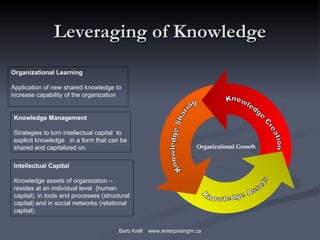
The document discusses the shift from industrial to knowledge-based organizational models. It provides examples of how knowledge-based organizations operate with more flexible policies, transparency, decentralized decision-making, and emphasis on systems thinking compared to rule-based industrial models. It also discusses the costs of poor knowledge management for organizations and defines knowledge management as the creation, sharing, and leveraging of knowledge to improve organizational performance. Finally, it provides a knowledge diagnostic model and KM process improvement model.