Work Ethos, Purpose, and Productivity
   in the Enterprise

                             RAWN SHAH
                             Blogs.Forbes.com/rawnshah
 Enterprise 2.0
 SUMMIT 2013
                             http://linkedin.com/in/rawnshah
Paris, March 20 – 21, 2013
                             http://twitter.com/rawn @rawn
 www.e20summit.com


                                 © 2013 Rawn Shah. All Rights
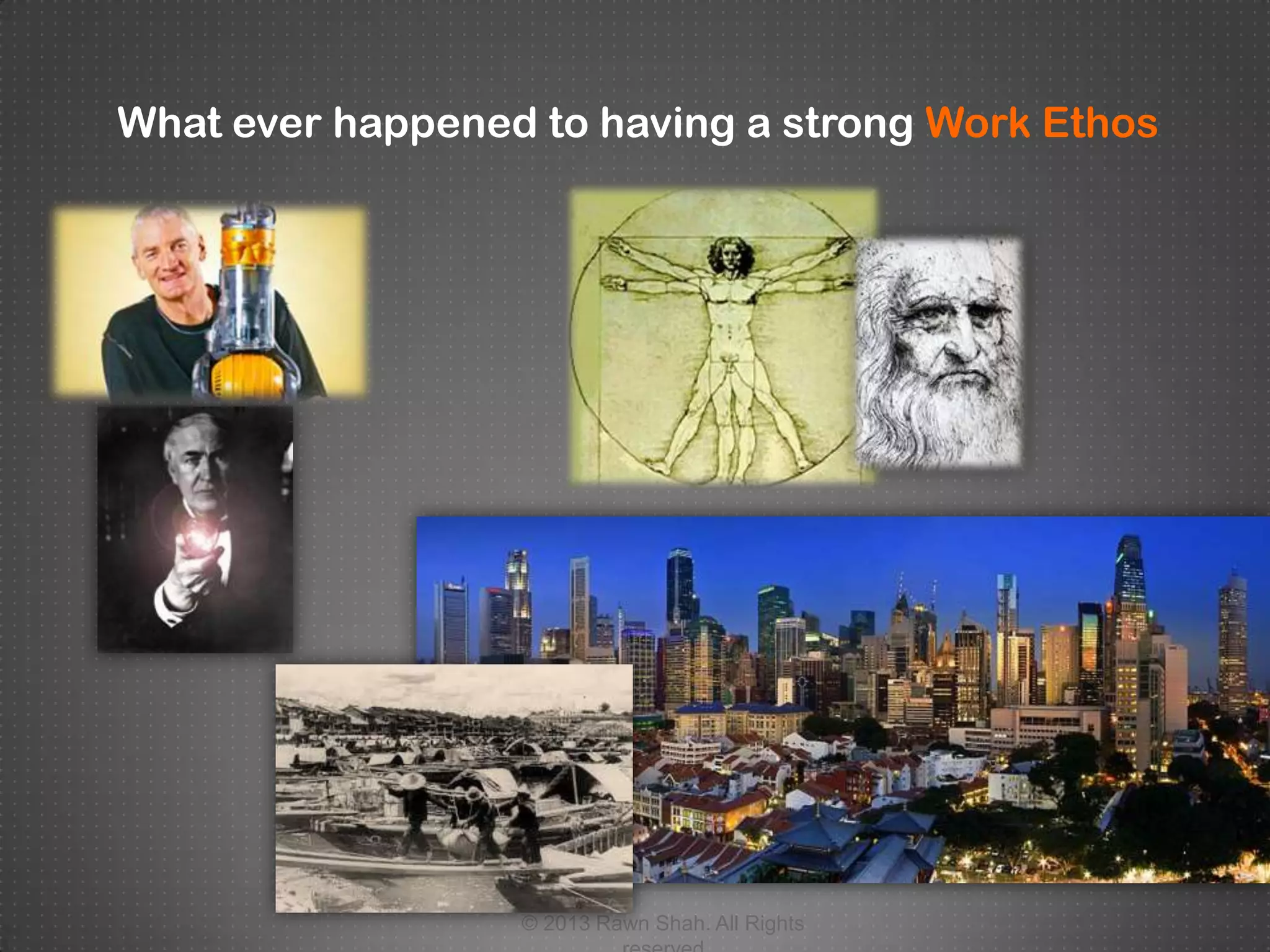
What ever happened to having a strong Work Ethos


                  © 2013 Rawn Shah. All Rights
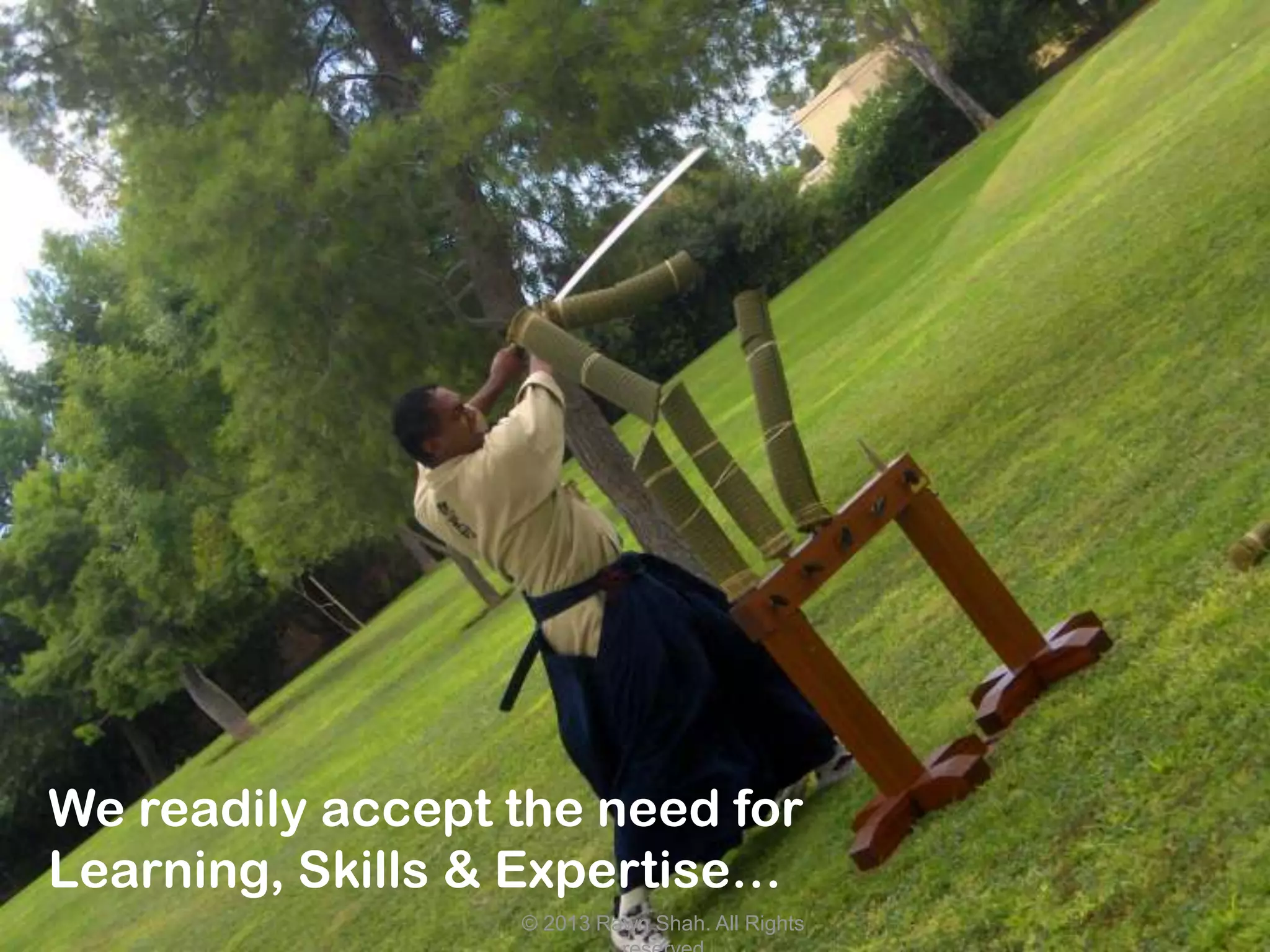
We readily accept the need for
Learning, Skills & Expertise…
                  © 2013 Rawn Shah. All Rights
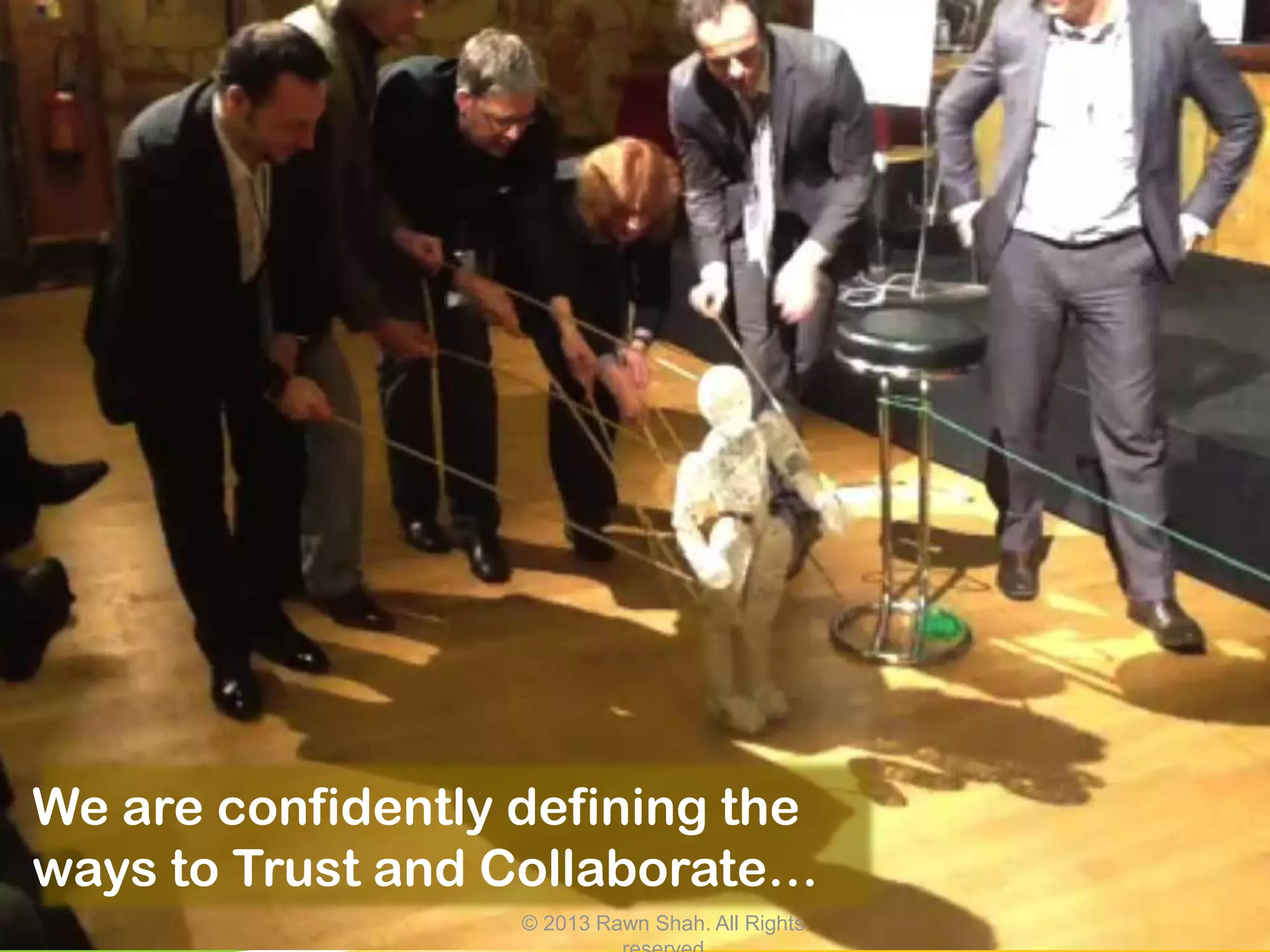
We are confidently defining the
ways to Trust and Collaborate…
                   © 2013 Rawn Shah. All Rights
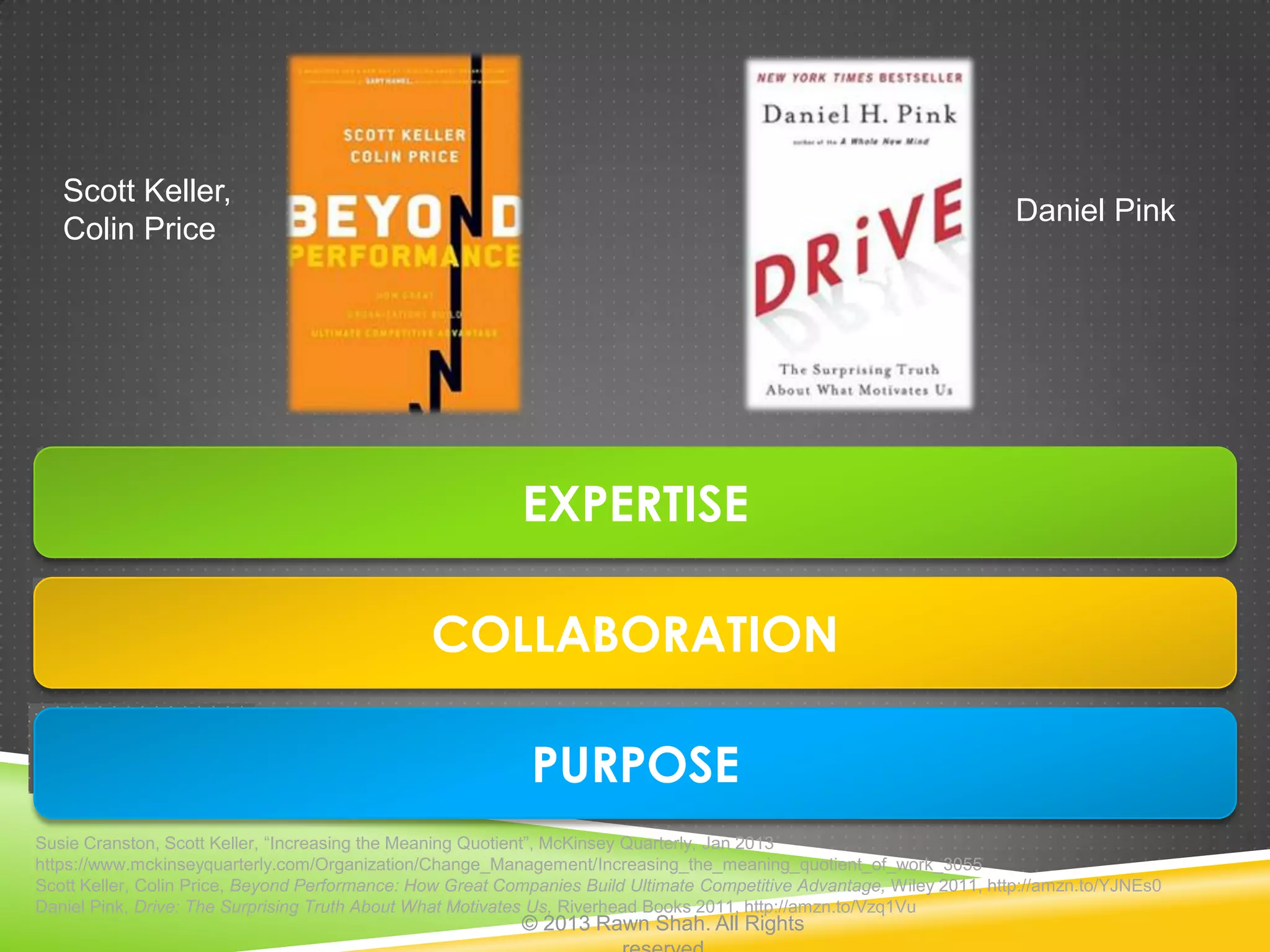
Scott Keller,
                                                                                                                        Daniel Pink
   Colin Price


 Intelligence                    Do clearly understand objectives and have
                                 the knowledge EXPERTISE get it done?
                                                                                                                       Mastery
 Quotient (IQ)                                  and expertise to

  Emotional                      Do you have the trust to be able to do the work
 Quotient (EQ)                           COLLABORATION
                                 by yourself or with others?
                                                                                                                       Autonomy


  Meaning                        Are you doing something that you personally
Quotient (MQ)                                   PURPOSE
                                 consider important?
                                                                                                                       Purpose

Susie Cranston, Scott Keller, “Increasing the Meaning Quotient”, McKinsey Quarterly, Jan 2013
https://www.mckinseyquarterly.com/Organization/Change_Management/Increasing_the_meaning_quotient_of_work_3055
Scott Keller, Colin Price, Beyond Performance: How Great Companies Build Ultimate Competitive Advantage, Wiley 2011, http://amzn.to/YJNEs0
Daniel Pink, Drive: The Surprising Truth About What Motivates Us, Riverhead Books 2011, http://amzn.to/Vzq1Vu
                                                           © 2013 Rawn Shah. All Rights
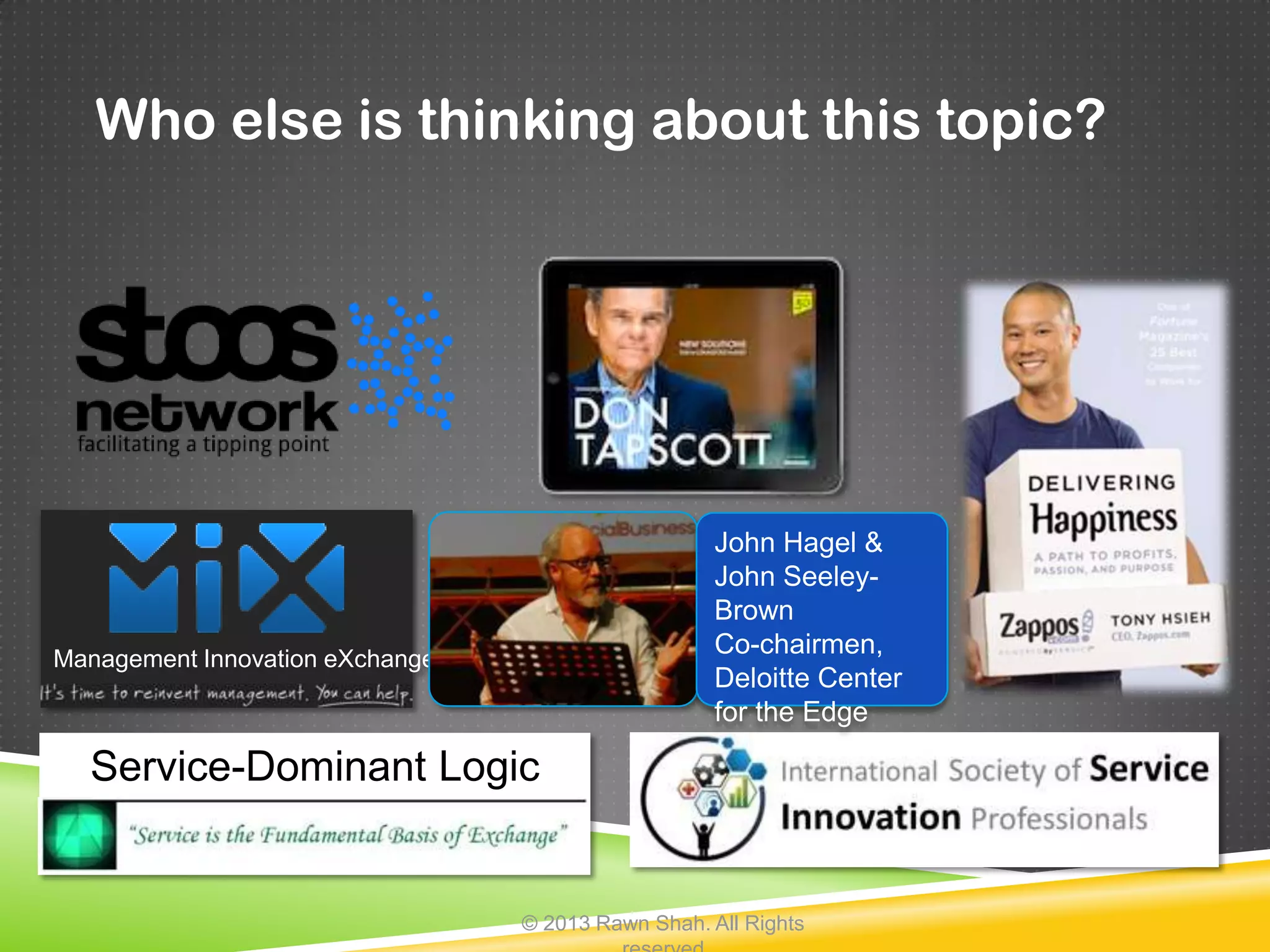
Who else is thinking about this topic?


                                                    John Hagel &
                                                    John Seeley-
                                                    Brown
Management Innovation eXchange
                                                    Co-chairmen,
                                                    Deloitte Center
                                                    for the Edge

  Service-Dominant Logic


                                 © 2013 Rawn Shah. All Rights
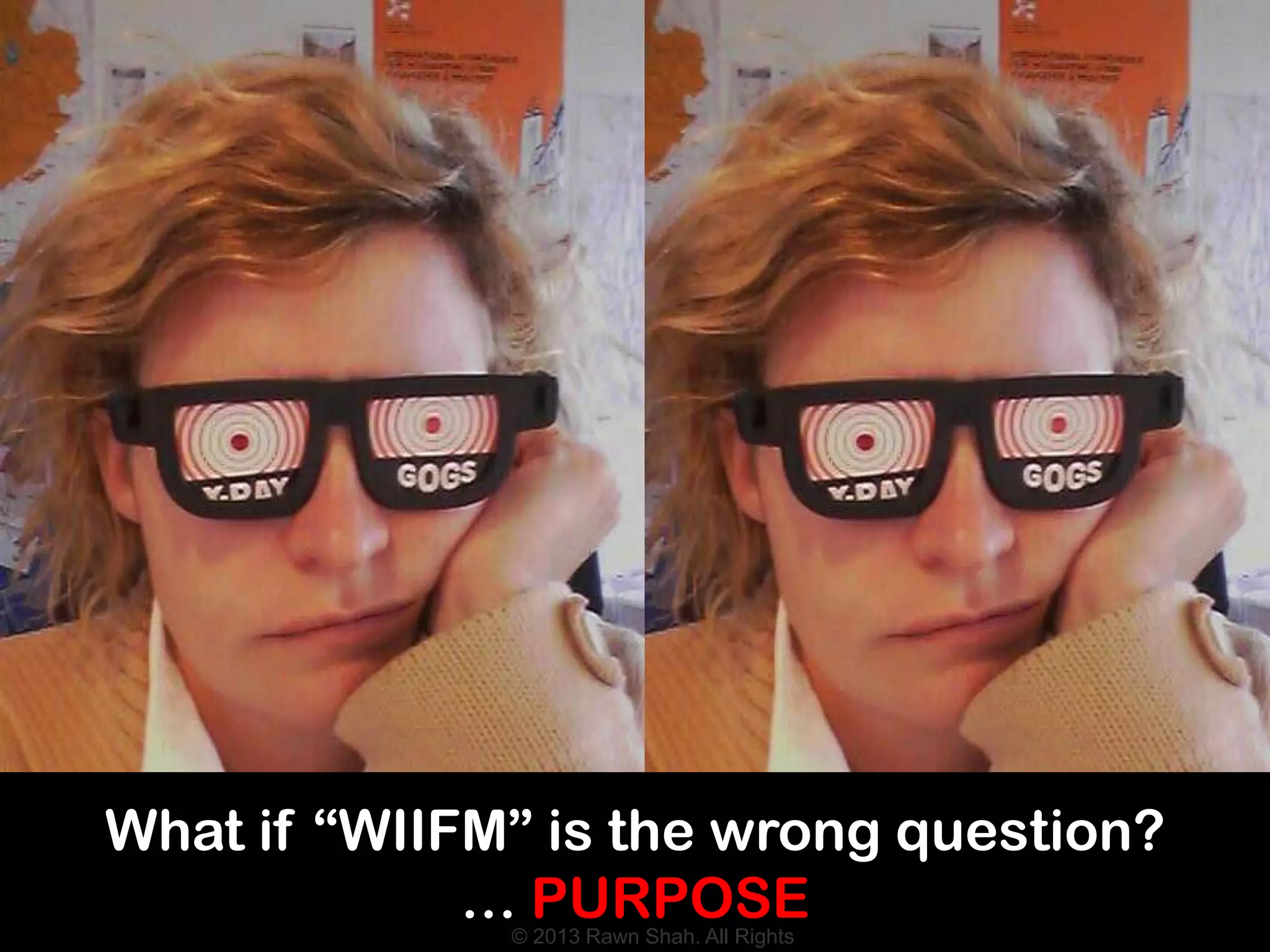
What if “WIIFM” is the wrong question?
             … PURPOSE
               © 2013 Rawn Shah. All Rights
              © 2013 Rawn Shah. All Rights
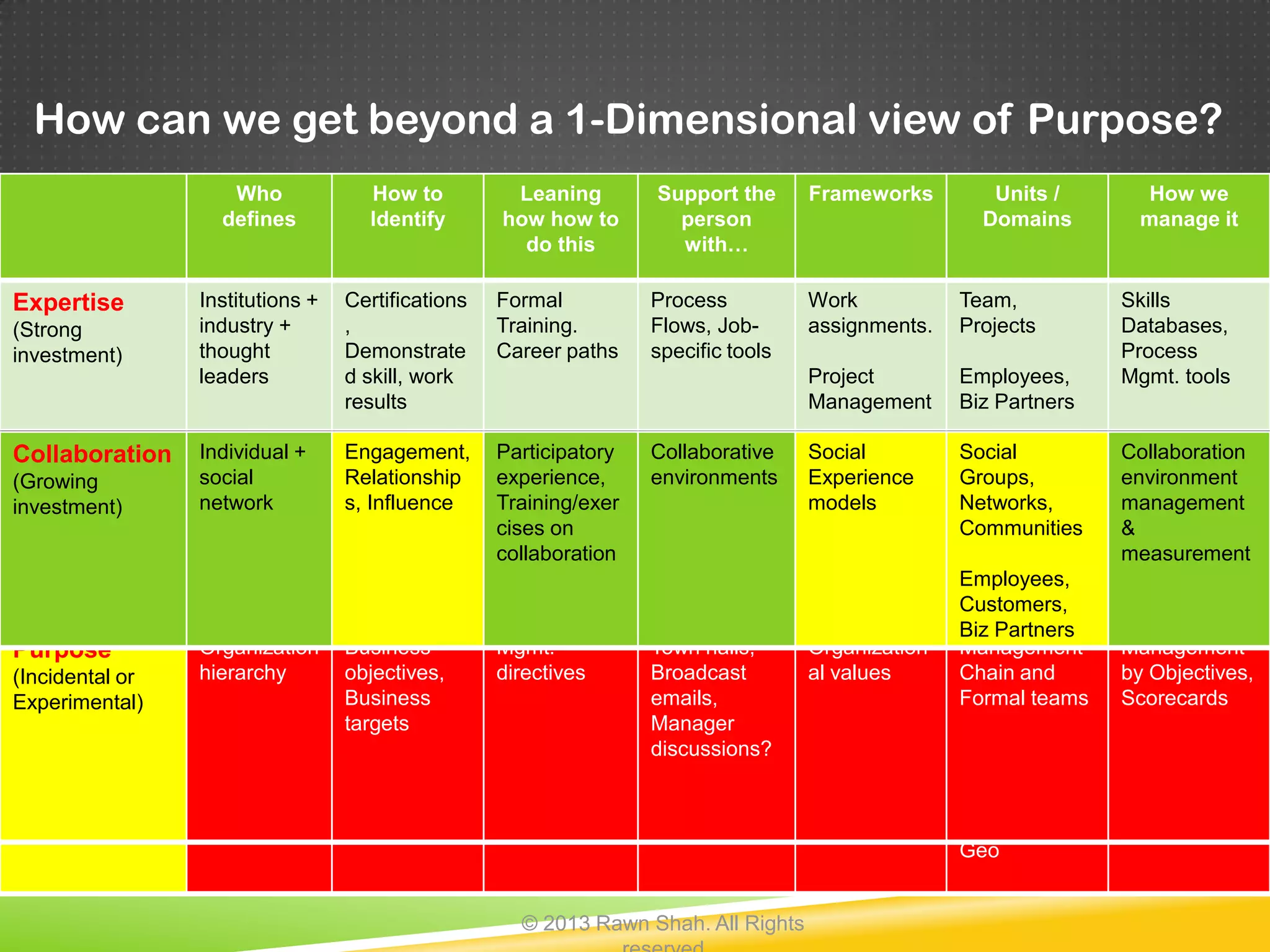
How can we get beyond a 1-Dimensional view of Purpose?
                    Who             How to          Leaning        Support the      Frameworks        Units /        How we
                   defines          Identify       how how to        person                          Domains        manage it
                                                     do this         with…

Expertise        Institutions +   Certifications   Formal          Process          Work           Team,           Skills
(Strong          industry +       ,                Training.       Flows, Job-      assignments.   Projects        Databases,
investment)      thought          Demonstrate      Career paths    specific tools                                  Process
                 leaders          d skill, work                                     Project        Employees,      Mgmt. tools
                                  results                                           Management     Biz Partners

Collaboration    Individual +     Engagement,      Participatory   Collaborative    Social         Social          Collaboration
(Growing         social           Relationship     experience,     environments     Experience     Groups,         environment
investment)      network          s, Influence     Training/exer                    models         Networks,       management
                                                   cises on                                        Communities     &
                                                   collaboration                                                   measurement
                                                                                                   Employees,
                                                                                                   Customers,
                                                                                                   Biz Partners
Purpose          Organization
                 Should be        Business         Mgmt.
                                                   Sharing         Town
                                                                   Goalshalls,      Organization
                                                                                    ?              Management
                                                                                                   Social          Management
                                                                                                                   ?
(Incidental or   hierarchy
                 individuals +    objectives,      directives
                                                   interests,      Broadcast
                                                                   brainstorming    al values      Chain and
                                                                                                   Groups,         by Objectives,
Experimental)    organization     Business         Debate &        emails,                         Formal teams
                                                                                                   Networks,       Scorecards
                 s + groups       targets          discussion,     Manager                         Communities
                                                   Mentoring       discussions?
                                                                                                   Employees,
                                                                                                   Customers,
                                                                                                   Biz Partners,
                                                                                                   Geo


                                                     © 2013 Rawn Shah. All Rights
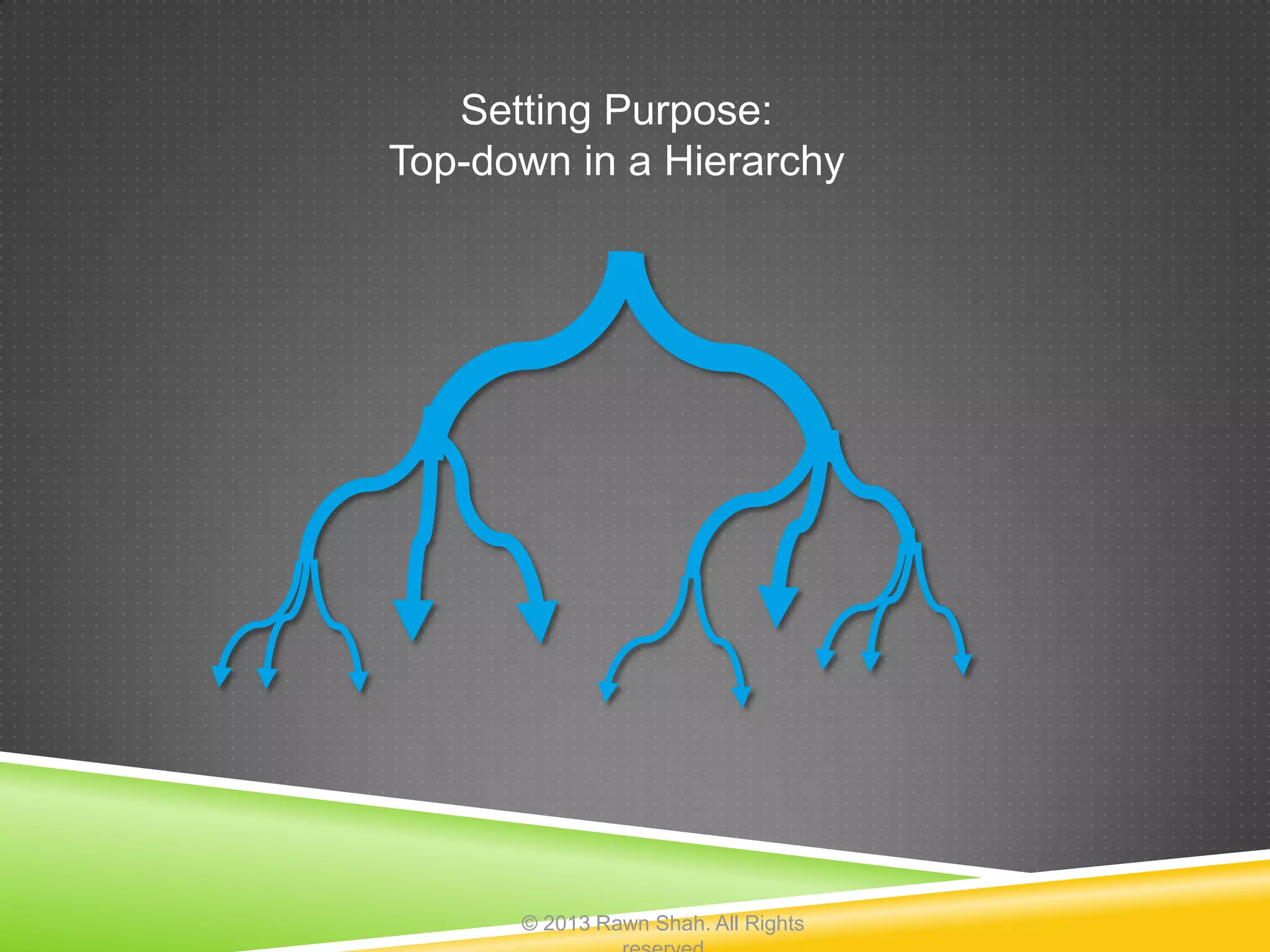
Setting Purpose:
Top-down in a Hierarchy


      © 2013 Rawn Shah. All Rights
© 2013 Rawn Shah. All Rights
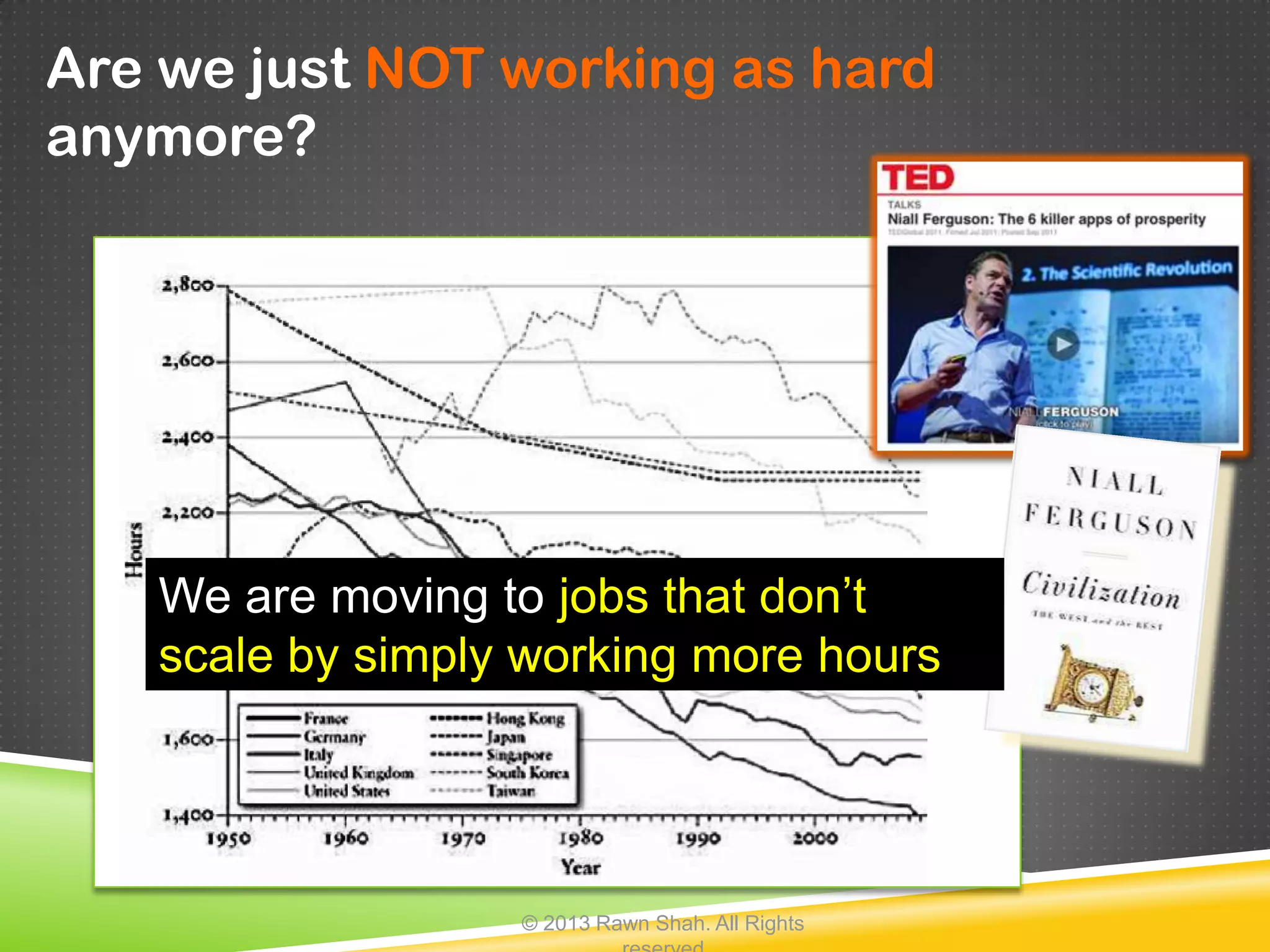
Are we just NOT working as hard
anymore?


   We are moving to jobs that don’t
   scale by simply working more hours


                  © 2013 Rawn Shah. All Rights
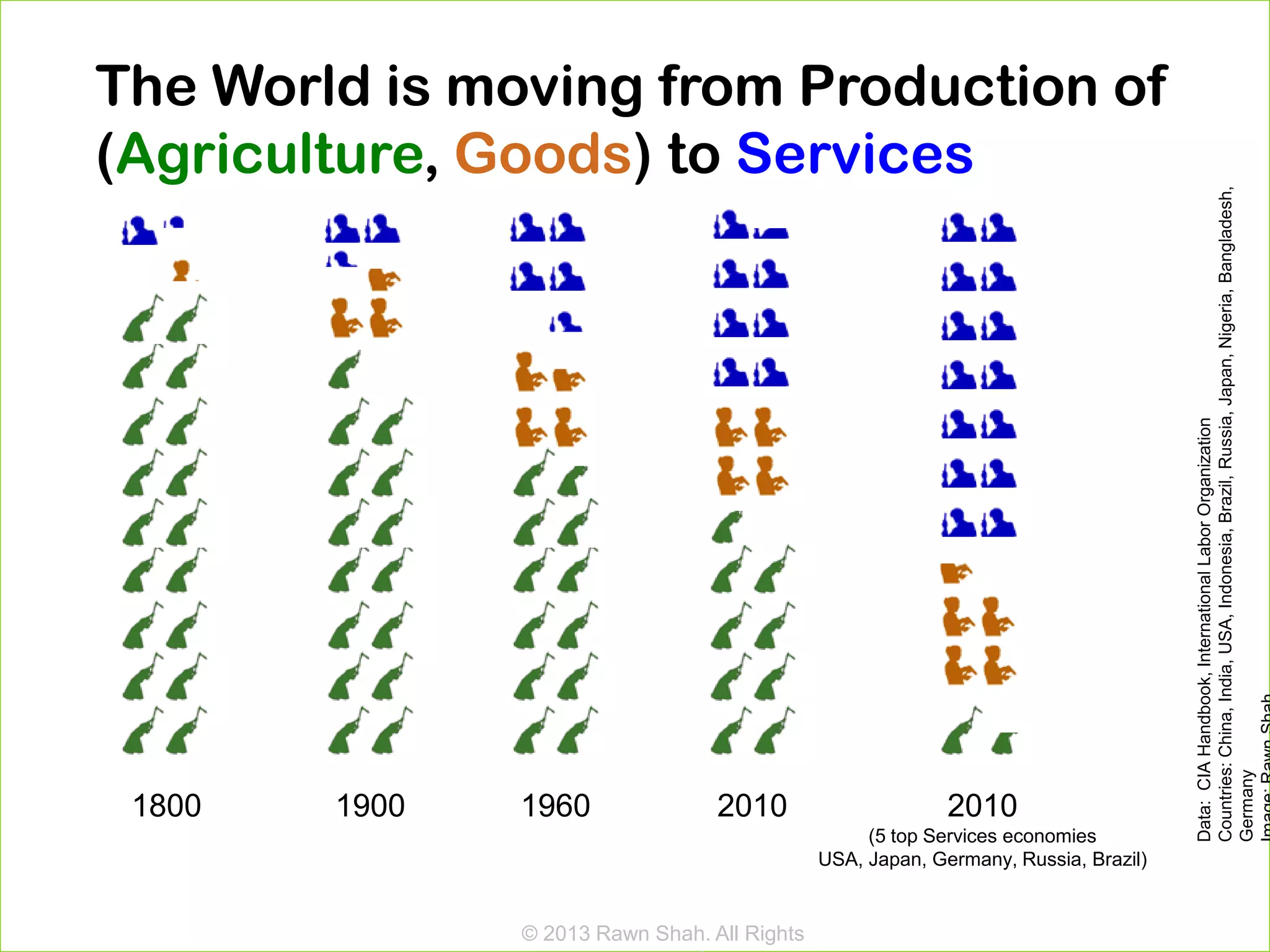
The World is moving from Production of
(Agriculture, Goods) to Services


                                                                                     Countries: China, India, USA, Indonesia, Brazil, Russia, Japan, Nigeria, Bangladesh,
                                                                                     Data: CIA Handbook, International Labor Organization

                                                                                     Germany
 1800   1900   1960               2010                      2010
                                                   (5 top Services economies
                                              USA, Japan, Germany, Russia, Brazil)


               © 2013 Rawn Shah. All Rights
               © 2013 Rawn Shah. All Rights
Our Jobs have changed but…

                                                                       e.g., Entrepreneurs
           Orderly / On Schedule
                                                                            Opportunistic
 Time & Resource-
      saving           Repeatable                                      Creativity     Self-Esteem
                          Skill
 Uniform                                                           Communicators      Perseverance
              Safety &
 Quality    Risk-aversion                                                Tolerance for Risk
                                                                           / Uncertainty


                                                                    e.g., Customer Service
     Production                       Service
     Workforce                       Workforce                         Consistency     Dynamic
                                                                       Empathy       Responsiveness
                                                                   Communicators     Customer’s POV
…the Work ethos we                                                         Partnering /
                                                                           Collaborative
encourage or enforce                © 2013 Rawn Shah. All Rights
                                    © 2013 Rawn Shah. All Rights
Our Work-minds are moving towards
Creativity

     15
                                                              Expertise
                                                                                        Advanced
     10
                                                                                        Cognitive, Social,
                                                               Complex                  Interactive work
       5                                                                                on the rise
                                                             Communication

       0                                                              Routine Manual


                                                                 Non-routine Manual
      -5                                                                                Technology is
                                                                    Routine Cognitive   taking over
    -10                                                                                 routine manual,
            1969 1974 1979 1984 1989 1994 1999                                          cognitive,
                                                                                        transactional
                                                                                        work
  Levy, F, & Murnane, R. J. (2004). The New Division of Labor: How
  Computers Are Creating the Next Job Market. Princeton University Press.
                                                       © 2013 Rawn Shah. All Rights
Is this your Employee?


Heuristic Thinking                           Algorithmic Thinking

     Expertise                                       Routine Manual

                                                    Non-routine Manual
     Complex
   Communication
                                                    Routine Cognitive


                     © 2013 Rawn Shah. All Rights
Is this your Employee?


Heuristic Thinking                           Algorithmic Thinking

     Expertise                                       Routine Manual

                                                    Non-routine Manual
     Complex
   Communication
                                                    Routine Cognitive


                     © 2013 Rawn Shah. All Rights
Purpose:                            Purpose:                        Purpose:
     Hierarchical                         Socialized                      Anarchic


“Our way or the Highway”          “Are you going my way?”              “Only my own way”


                      Active Communications     Negotiating Responsibility
                                                                        Higher Risk
           Creative                                       Tacit
                        Decision making                                 Tolerance
           mindset                          Active     Knowledge
                           methods         Networking


                                     © 2013 Rawn Shah. All Rights
What Can You Do?

 D iscover

 R efine

 W eigh

 H elp

 O ffer


              © 2013 Rawn Shah. All Rights
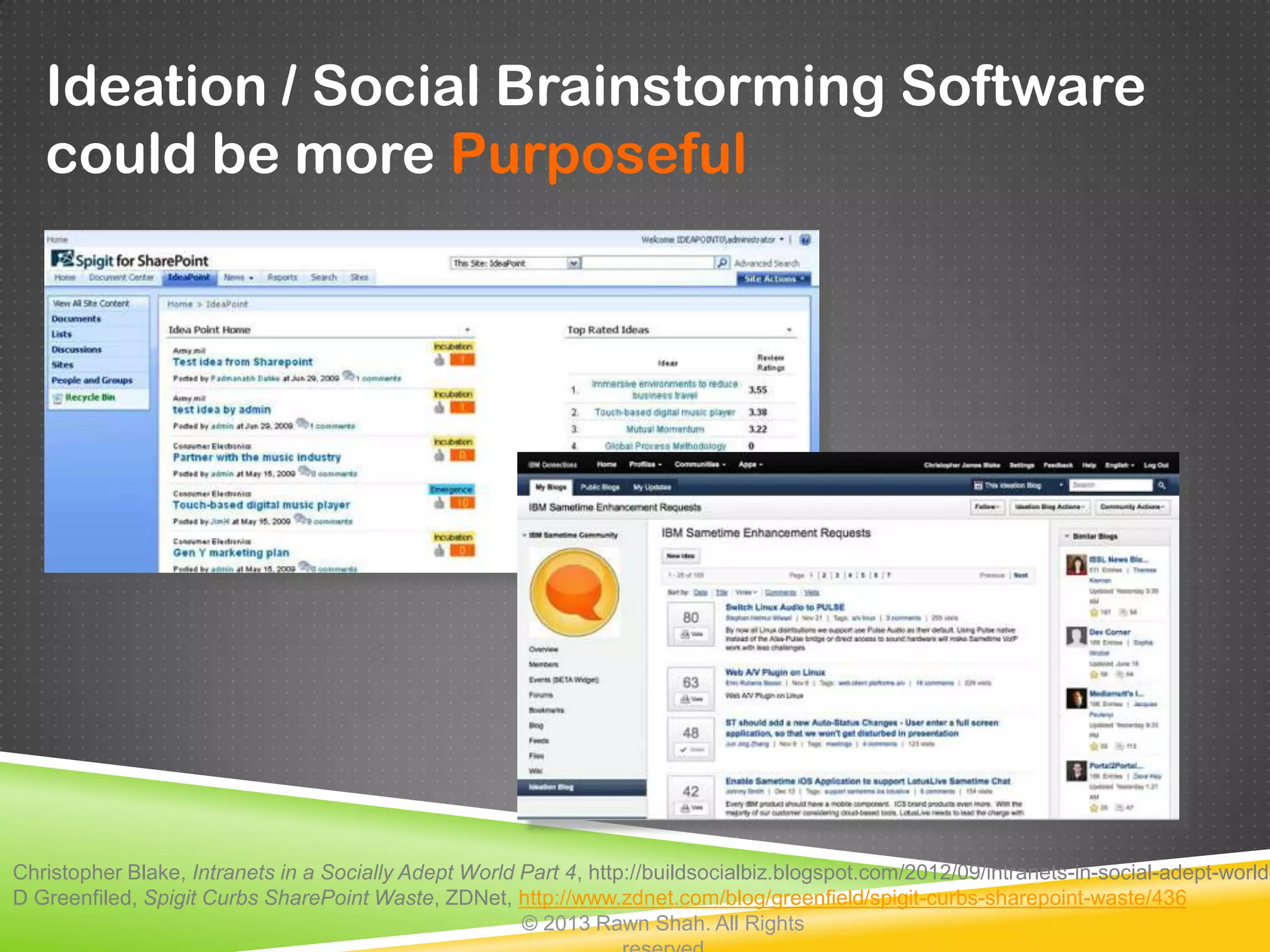
Ideation / Social Brainstorming Software
   could be more Purposeful


Christopher Blake, Intranets in a Socially Adept World Part 4, http://buildsocialbiz.blogspot.com/2012/09/intranets-in-social-adept-world-
D Greenfiled, Spigit Curbs SharePoint Waste, ZDNet, http://www.zdnet.com/blog/greenfield/spigit-curbs-sharepoint-waste/436
                                                       © 2013 Rawn Shah. All Rights
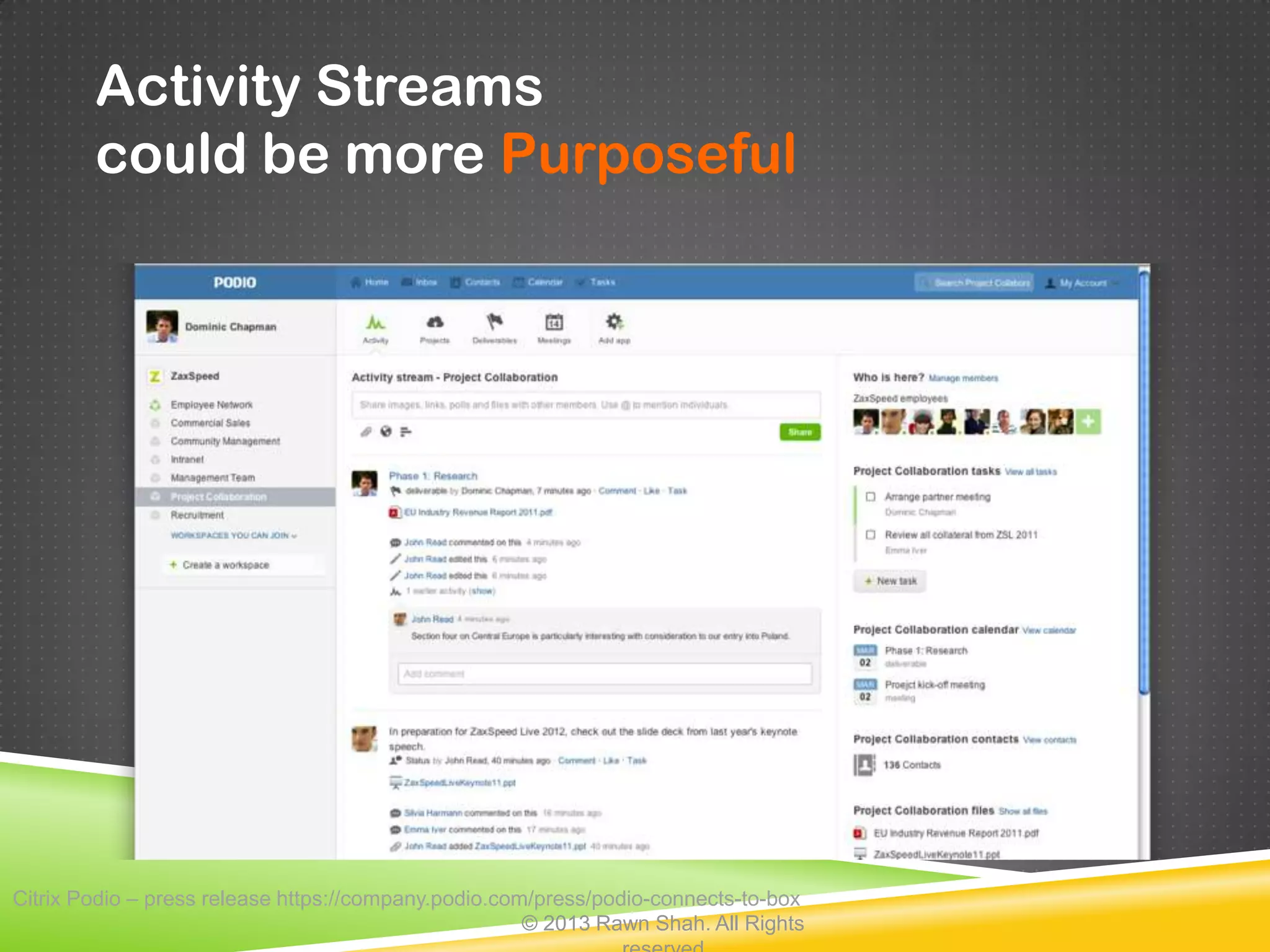
Activity Streams
        could be more Purposeful


Citrix Podio – press release https://company.podio.com/press/podio-connects-to-box
                                                      © 2013 Rawn Shah. All Rights
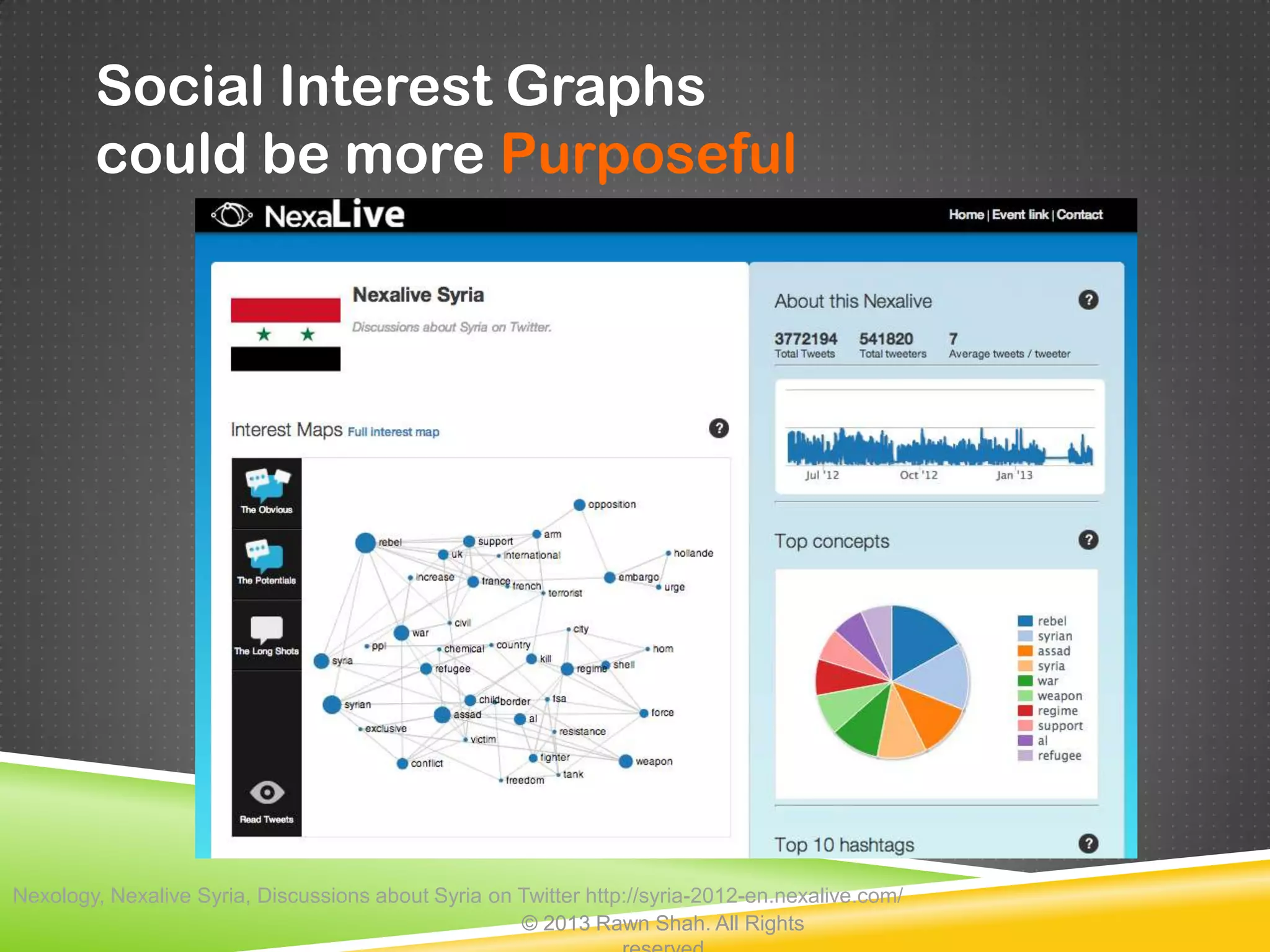
Social Interest Graphs
        could be more Purposeful


Nexology, Nexalive Syria, Discussions about Syria on Twitter http://syria-2012-en.nexalive.com/
                                                     © 2013 Rawn Shah. All Rights
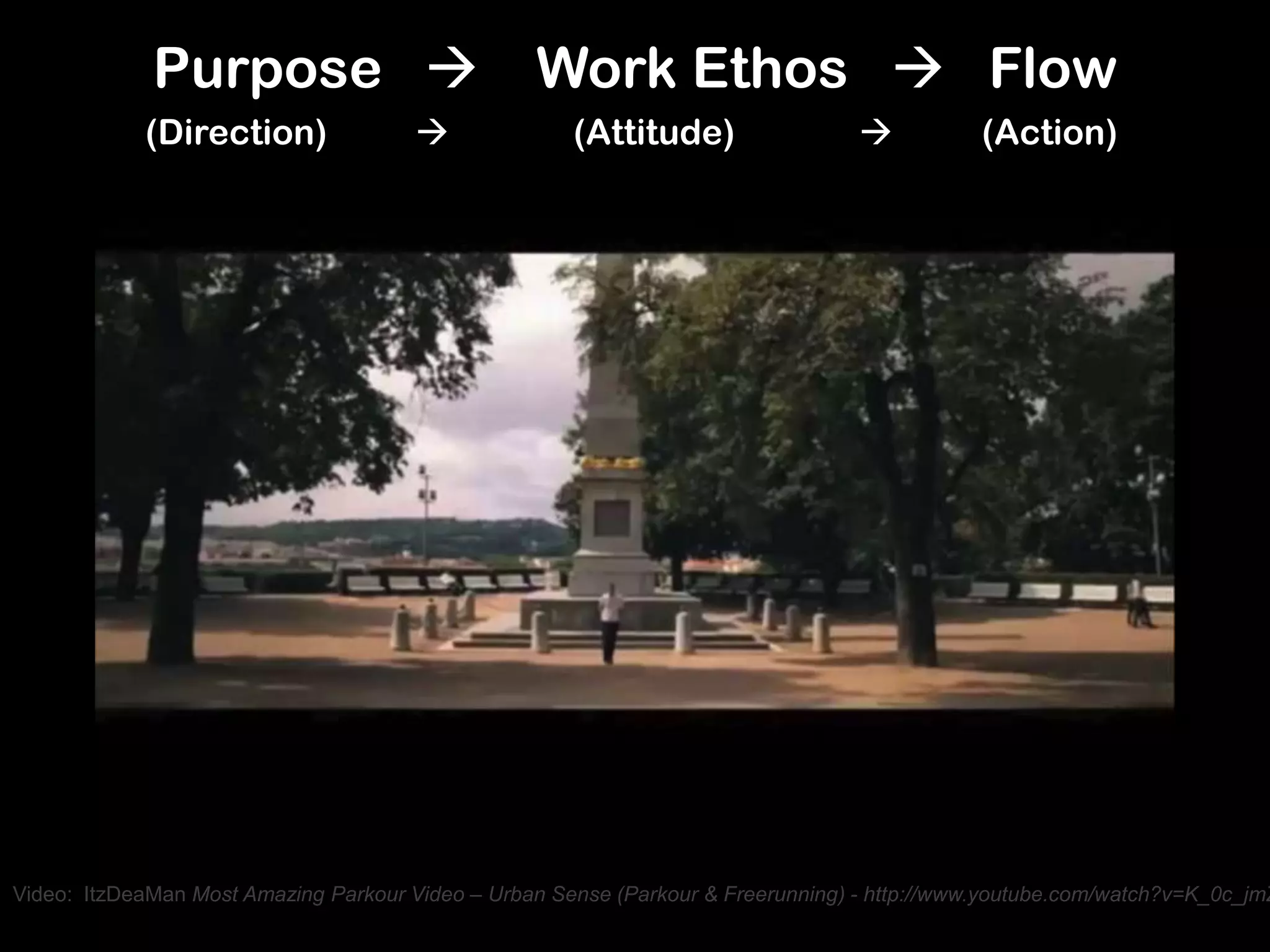
Purpose  Work Ethos  Flow
            (Direction)                              (Attitude)                             (Action)


Video: ItzDeaMan Most Amazing Parkour Video – Urban Sense (Parkour & Freerunning) - http://www.youtube.com/watch?v=K_0c_jmZ
                                                 © 2013 Rawn Shah. All Rights

Work Ethos, Purpose, and Productivity

  • 1.
    Work Ethos, Purpose,and Productivity in the Enterprise RAWN SHAH Blogs.Forbes.com/rawnshah Enterprise 2.0 SUMMIT 2013 http://linkedin.com/in/rawnshah Paris, March 20 – 21, 2013 http://twitter.com/rawn @rawn www.e20summit.com © 2013 Rawn Shah. All Rights
  • 2.
    What ever happenedto having a strong Work Ethos © 2013 Rawn Shah. All Rights
  • 3.
    We readily acceptthe need for Learning, Skills & Expertise… © 2013 Rawn Shah. All Rights
  • 4.
    We are confidentlydefining the ways to Trust and Collaborate… © 2013 Rawn Shah. All Rights
  • 5.
    Scott Keller, Daniel Pink Colin Price Intelligence Do clearly understand objectives and have the knowledge EXPERTISE get it done? Mastery Quotient (IQ) and expertise to Emotional Do you have the trust to be able to do the work Quotient (EQ) COLLABORATION by yourself or with others? Autonomy Meaning Are you doing something that you personally Quotient (MQ) PURPOSE consider important? Purpose Susie Cranston, Scott Keller, “Increasing the Meaning Quotient”, McKinsey Quarterly, Jan 2013 https://www.mckinseyquarterly.com/Organization/Change_Management/Increasing_the_meaning_quotient_of_work_3055 Scott Keller, Colin Price, Beyond Performance: How Great Companies Build Ultimate Competitive Advantage, Wiley 2011, http://amzn.to/YJNEs0 Daniel Pink, Drive: The Surprising Truth About What Motivates Us, Riverhead Books 2011, http://amzn.to/Vzq1Vu © 2013 Rawn Shah. All Rights
  • 6.
    Who else isthinking about this topic? John Hagel & John Seeley- Brown Management Innovation eXchange Co-chairmen, Deloitte Center for the Edge Service-Dominant Logic © 2013 Rawn Shah. All Rights
  • 7.
    What if “WIIFM”is the wrong question? … PURPOSE © 2013 Rawn Shah. All Rights © 2013 Rawn Shah. All Rights
  • 8.
    How can weget beyond a 1-Dimensional view of Purpose? Who How to Leaning Support the Frameworks Units / How we defines Identify how how to person Domains manage it do this with… Expertise Institutions + Certifications Formal Process Work Team, Skills (Strong industry + , Training. Flows, Job- assignments. Projects Databases, investment) thought Demonstrate Career paths specific tools Process leaders d skill, work Project Employees, Mgmt. tools results Management Biz Partners Collaboration Individual + Engagement, Participatory Collaborative Social Social Collaboration (Growing social Relationship experience, environments Experience Groups, environment investment) network s, Influence Training/exer models Networks, management cises on Communities & collaboration measurement Employees, Customers, Biz Partners Purpose Organization Should be Business Mgmt. Sharing Town Goalshalls, Organization ? Management Social Management ? (Incidental or hierarchy individuals + objectives, directives interests, Broadcast brainstorming al values Chain and Groups, by Objectives, Experimental) organization Business Debate & emails, Formal teams Networks, Scorecards s + groups targets discussion, Manager Communities Mentoring discussions? Employees, Customers, Biz Partners, Geo © 2013 Rawn Shah. All Rights
  • 9.
    Setting Purpose: Top-down ina Hierarchy © 2013 Rawn Shah. All Rights
  • 10.
    © 2013 RawnShah. All Rights
  • 11.
    Are we justNOT working as hard anymore? We are moving to jobs that don’t scale by simply working more hours © 2013 Rawn Shah. All Rights
  • 12.
    The World ismoving from Production of (Agriculture, Goods) to Services Countries: China, India, USA, Indonesia, Brazil, Russia, Japan, Nigeria, Bangladesh, Data: CIA Handbook, International Labor Organization Germany 1800 1900 1960 2010 2010 (5 top Services economies USA, Japan, Germany, Russia, Brazil) © 2013 Rawn Shah. All Rights © 2013 Rawn Shah. All Rights
  • 13.
    Our Jobs havechanged but… e.g., Entrepreneurs Orderly / On Schedule Opportunistic Time & Resource- saving Repeatable Creativity Self-Esteem Skill Uniform Communicators Perseverance Safety & Quality Risk-aversion Tolerance for Risk / Uncertainty e.g., Customer Service Production Service Workforce Workforce Consistency Dynamic Empathy Responsiveness Communicators Customer’s POV …the Work ethos we Partnering / Collaborative encourage or enforce © 2013 Rawn Shah. All Rights © 2013 Rawn Shah. All Rights
  • 14.
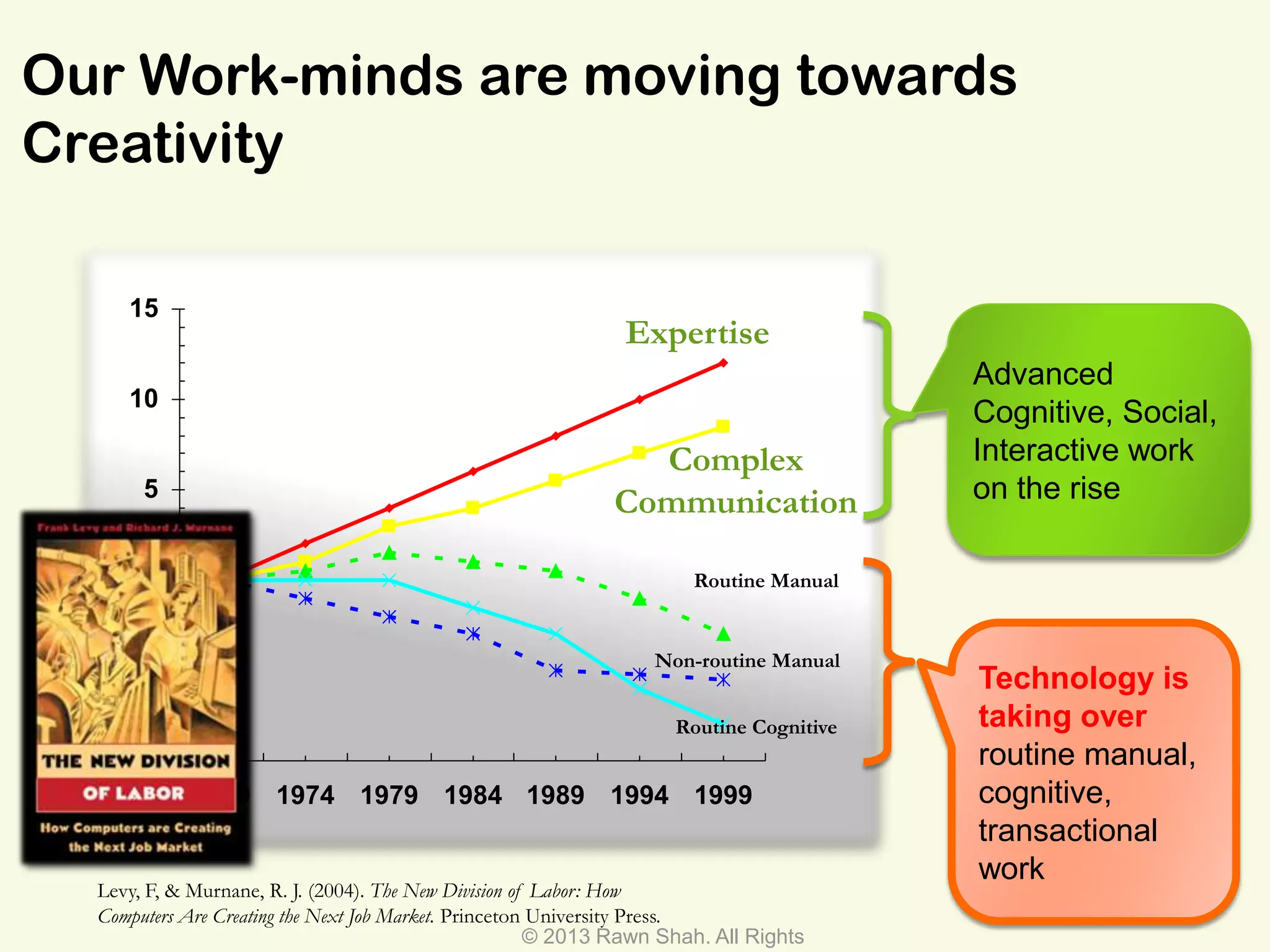
    Our Work-minds aremoving towards Creativity 15 Expertise Advanced 10 Cognitive, Social, Complex Interactive work 5 on the rise Communication 0 Routine Manual Non-routine Manual -5 Technology is Routine Cognitive taking over -10 routine manual, 1969 1974 1979 1984 1989 1994 1999 cognitive, transactional work Levy, F, & Murnane, R. J. (2004). The New Division of Labor: How Computers Are Creating the Next Job Market. Princeton University Press. © 2013 Rawn Shah. All Rights
  • 15.
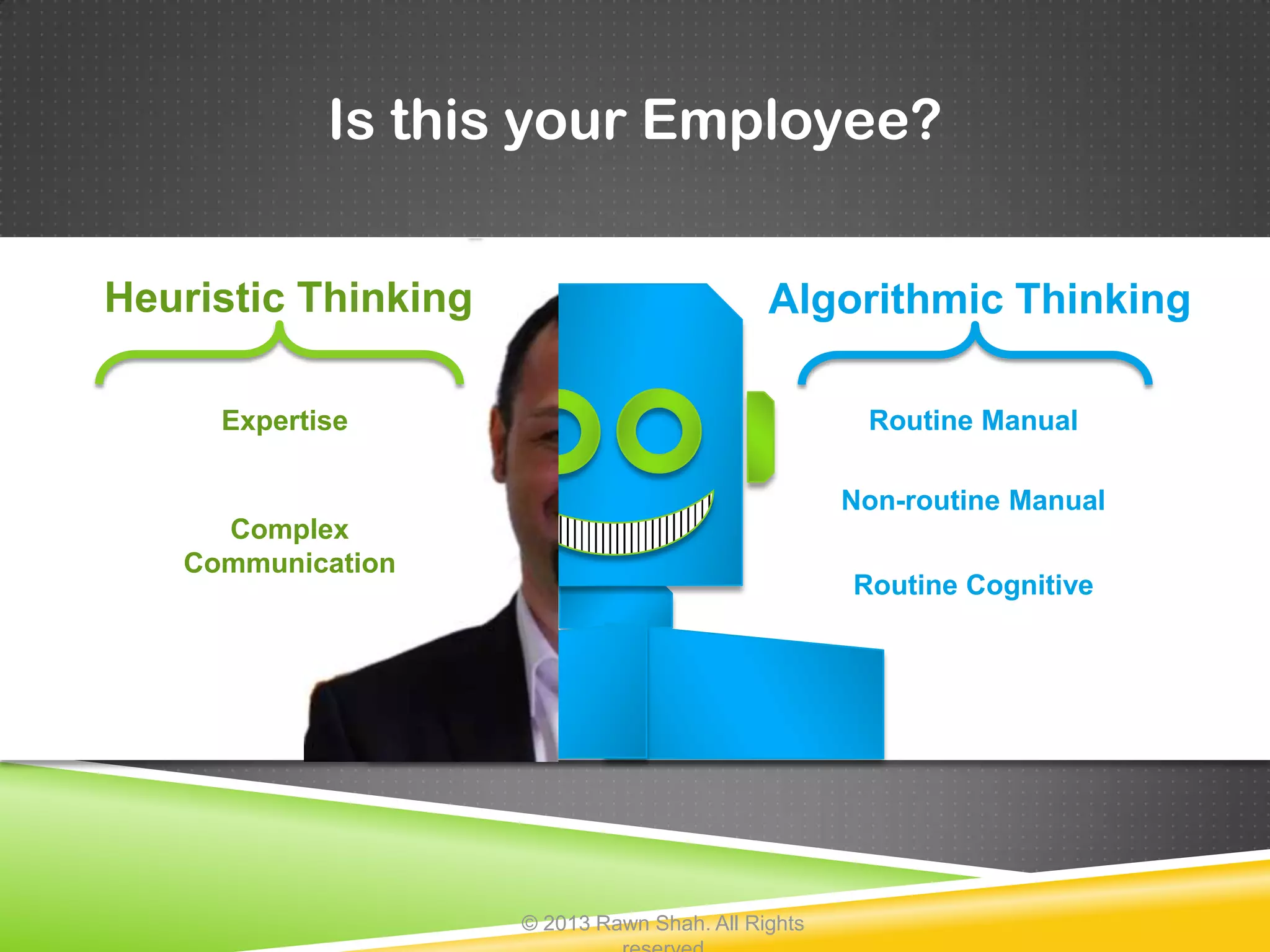
    Is this yourEmployee? Heuristic Thinking Algorithmic Thinking Expertise Routine Manual Non-routine Manual Complex Communication Routine Cognitive © 2013 Rawn Shah. All Rights
  • 16.
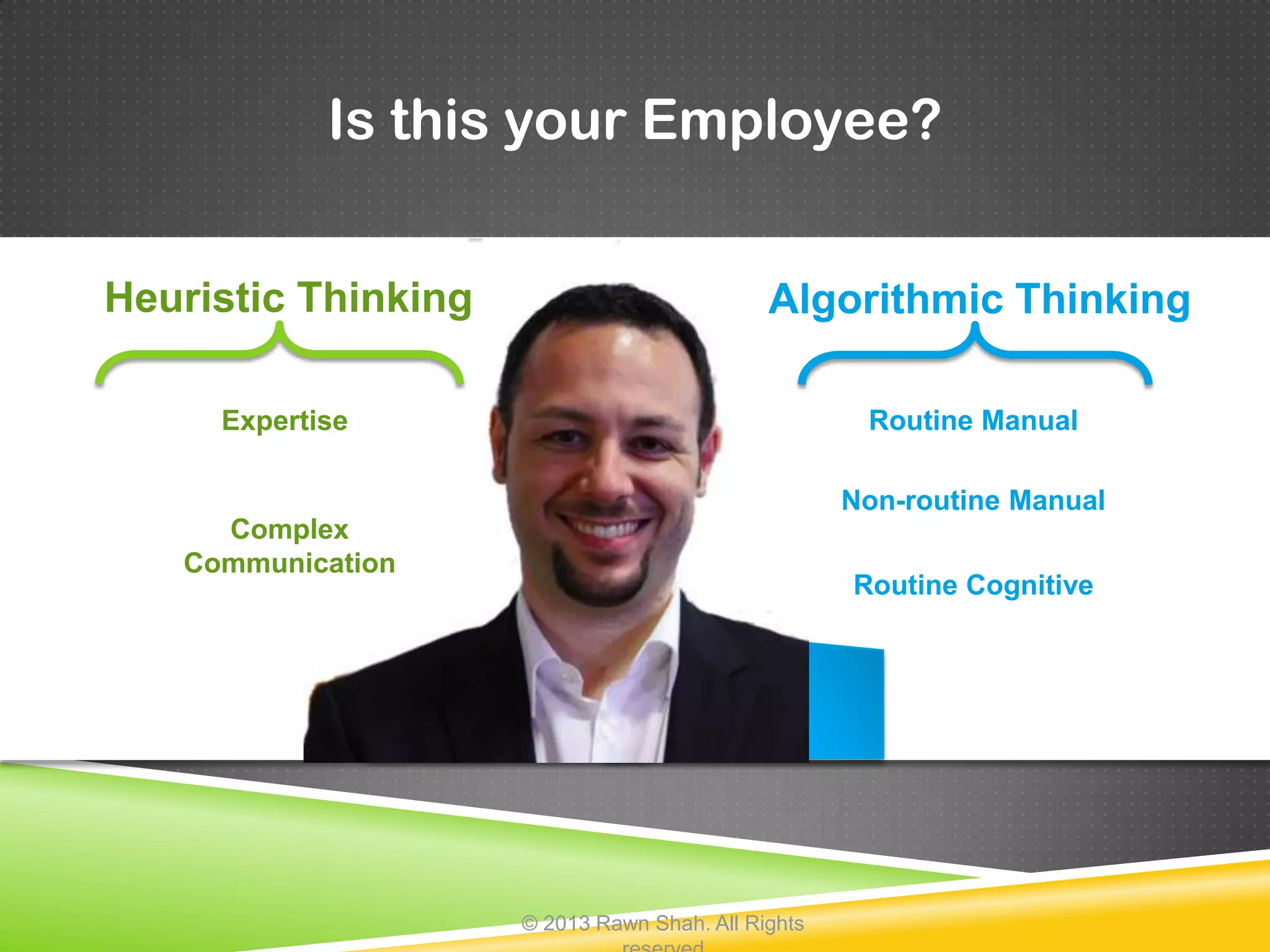
    Is this yourEmployee? Heuristic Thinking Algorithmic Thinking Expertise Routine Manual Non-routine Manual Complex Communication Routine Cognitive © 2013 Rawn Shah. All Rights
  • 17.
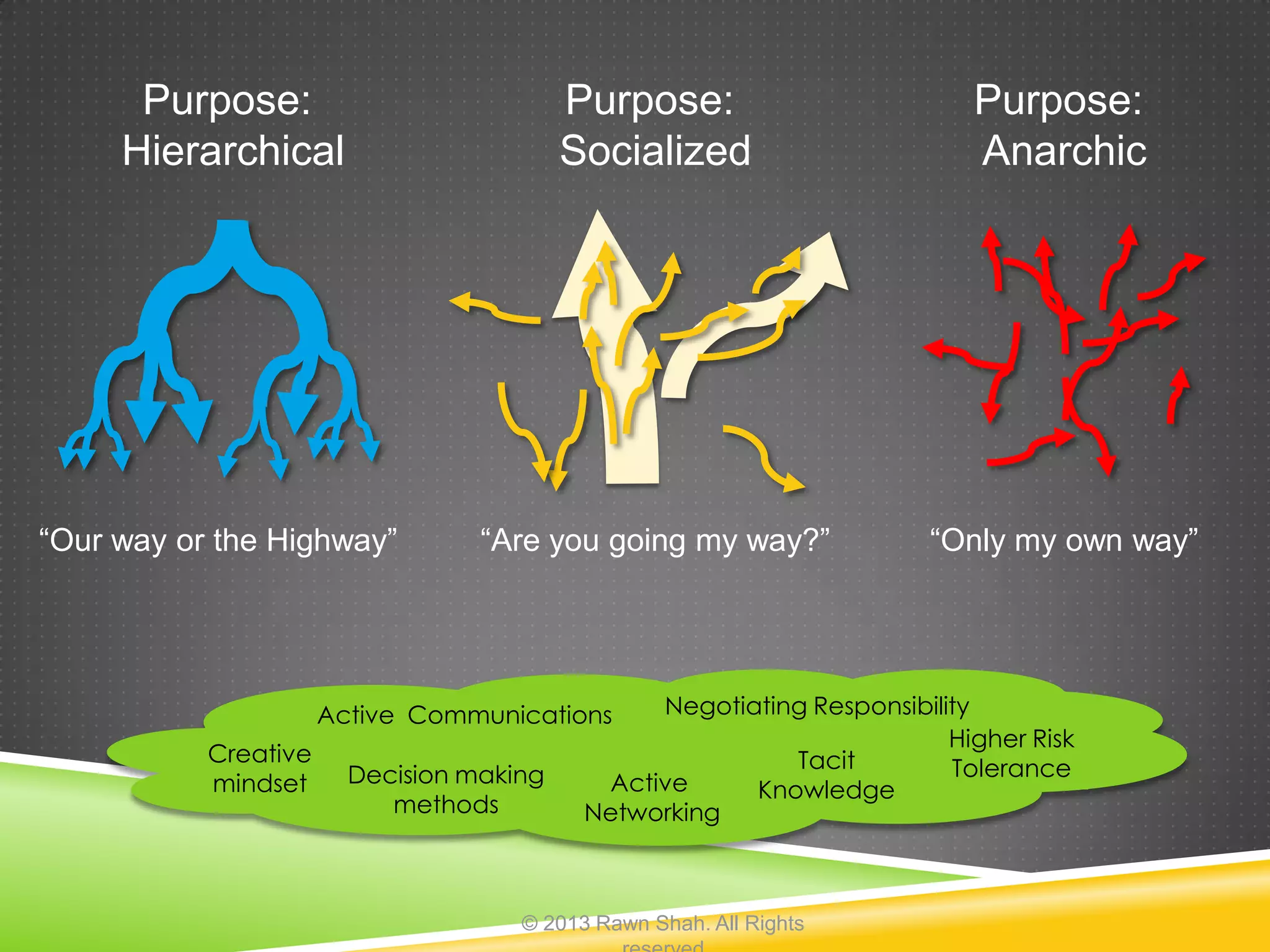
    Purpose: Purpose: Purpose: Hierarchical Socialized Anarchic “Our way or the Highway” “Are you going my way?” “Only my own way” Active Communications Negotiating Responsibility Higher Risk Creative Tacit Decision making Tolerance mindset Active Knowledge methods Networking © 2013 Rawn Shah. All Rights
  • 18.
    What Can YouDo?  D iscover  R efine  W eigh  H elp  O ffer © 2013 Rawn Shah. All Rights
  • 19.
    Ideation / SocialBrainstorming Software could be more Purposeful Christopher Blake, Intranets in a Socially Adept World Part 4, http://buildsocialbiz.blogspot.com/2012/09/intranets-in-social-adept-world- D Greenfiled, Spigit Curbs SharePoint Waste, ZDNet, http://www.zdnet.com/blog/greenfield/spigit-curbs-sharepoint-waste/436 © 2013 Rawn Shah. All Rights
  • 20.
    Activity Streams could be more Purposeful Citrix Podio – press release https://company.podio.com/press/podio-connects-to-box © 2013 Rawn Shah. All Rights
  • 21.
    Social Interest Graphs could be more Purposeful Nexology, Nexalive Syria, Discussions about Syria on Twitter http://syria-2012-en.nexalive.com/ © 2013 Rawn Shah. All Rights
  • 22.
    Purpose  WorkEthos  Flow (Direction)  (Attitude)  (Action) Video: ItzDeaMan Most Amazing Parkour Video – Urban Sense (Parkour & Freerunning) - http://www.youtube.com/watch?v=K_0c_jmZ © 2013 Rawn Shah. All Rights

Editor's Notes

  • #2 I’m going to talk about the past, present andfuture of work. What we have in place, what we are still improving, and in particular what is looming ahead of us yet to address.At its heart, this talk is about why we work and how we approach our work.
  • #3 WHAT HAPPENED to the Work EthosWhat happened to the multi-disciplinary man of the Renaissance What happened to the inventors who would keep trying to work on a problem thousands of times over and again until they figure it out?What is behind that drive, that attitude that helped to turn a small fishing port into Modern-day Singapore?We know it as the drive, the passion, the commitment, that sense of purpose that helped people to achieve such greatness.Work Ethos - Characteristicsand Attitudes that a person considers of importance and merit to theirwork Work ethos is part of the secret to greatness. In Greek, ethikos and ethos are very different meanings, but unfortunately in English it has become one word. So I use the word EthosThis isn’t the same as ethics – which is used to describe how we make moral decisions. Those with a strong work ethic place a positive value on doing the job well. They consider it as having intrinsic value of its own.============ADD: Driving High performance…
  • #4 As a concept, we accept the need for Learning, Skills and Expertise quite extensively. We have many approaches to them but the systems to develop, detect, and apply skill and learning have been in place for quite a while. In software, we have employee records, knowledge and expertise management systems. The recent past has exploded with social expertise management and sharing systems. We are still struggling with understanding tacit knowledge, compared to the solidity of explicit codifed knowledge, -- knowledge is growing at a rate faster than can be codified -- but most of us understand and accept that we need such systems for organizations to function.We continue to develop and evolve our understanding of expertise but it is a recognized and accepted part of the work environment in almost every organization today
  • #5 Where we are at the present is our collective attempts to understand and support collaboration. Far more companies have skills databases and employee records out of sheer necessity, but collaboration is a newer aspect of organizations.Following technological innovation, collaboration has moved into the software realm and we now haveDigital Workplaces with social networks, mobile devices, digital business cards, collaborative spaces, and moreAccording the recent 2013 NetJMC survey, 97% of organizations observed are at least thinking about the Digital Workplace, And 33% have already begun implementing this. The momentum is there to make it part of the average organization. There is still much to do in this area. While we are getting the technologies in place, we know what we need are the cognitive frameworks, And how to guide people and communities to collaborate in this medium
  • #6 McKinsey Quarterly recently published an article “Increasing the ‘meaning quotient’ of work” where the authors describe their analysis of a questionAsked to 5000 executives over a decade what creates peak productivity and flow of work, and their answers were consistently in three groupsClear understanding of objectives, Knowledge & Resources to get it donein other words, Learning and Skills masteryUnderstanding each other, Trust, Respect, Constructiveness, Humor, Getting Along, Collaborative Drive in other words, CollaborationMaking a difference, Every individual matters, Personally challenged or PurposeWhen they asked the executives where the bottlenecks to peak performance lies, more than 90% said is was in area of PurposeThis is also very similar to Daniel Pink’s findings on what motivates us: Mastery, Autonomy, Purpose
  • #7 Stoos Network – www.stoosnetwork.orgSteve Denning, Daniel Pink + 1000s of participantsTapscott Group – www.dontapscott.comDon Tapscott + consultantsManagement Innovation Exchange - www.managementexchange.comGary Hamel, Polly Lebarre + 30,000 participantsInternational Society of Service Innovation Professionals - www.issip.orgUniversities worldwide, IBM, Cisco, HPService-Dominant Logic – www.sdlogic.netUniversities in USA & EuropeGlobal Drucker Forum – www.druckerforum.org
  • #8 But we are still quite in a fog about PurposeI am not talking about company missions, organization goals, or business targets, but purpose first on a human and individual level,And how organizations guide, understand and deliver purpose. More than that, what creates that sense of purpose that generates the Work Ethos I spoke of earlier? that level of intensity, commitment, execution, and constant striving in the face of challenge. ============ADD: Productivity hit
  • #19 Discover – ask people to describe 3-5 things that drive them and give them purpose, even things they can’t do yet or unrelated to their jobRefine – ask if their past/present working peers can affirm their passions Weigh – map readiness to work on their purpose and where it may fitHelp – Pair people of similar purpose as mentors or mentees to get them to readinessOffer – Make offers to move to a new role, or even offers to leave entirely
  • #22 What about:-- sharing Interest Maps – what are people interested in , explicit and inferred-- GTD and Personal activities, activity groups – --
  • #23 Hungarian Psychologist, Mihaly Csikzentsmihalyi pioneered the study of this state of mind and attitude. …when you become fully immersed, energized, and enjoying the process of the activityHe described this as being in a state of Flowintense and focused concentration on the present momentmerging of action and awarenessa loss of self-consciousness or worry about what people think of what you think or are doinga sense of personal control or agency over the situation or activitya distortion of temporal experience, one's subjective experience of time is alteredexperience of the activity as intrinsically rewarding, also referred to as autotelic experienceIn Zen philosophy, and in martial arts, you become the action, ultimately do not have to think about the steps needed to achieve it. Csikzenktsmihayli observed the same state of mind whether in athletic sports, art, or work activities