

Nida Sehar MS (Pharmacology) & MBA (Finance)
nidasehar19@yahoo.com
 Congestive heart failure is a syndrome that can be caused by a variety of
abnormalities
 Coronary artery disease
 Heart attack
 Cardiac myopathy
 Conditions that overwork the heart
 Hypertension
 Valve disease
 Thyroid disease
 Kidney disease
 Congenital birth defects
 Diabetes
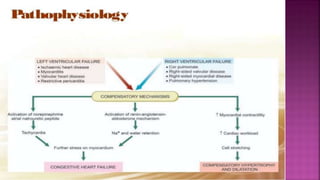
 In the usual form of heart failure, the heart muscle has reduced contractility.
This produces a reduction in cardiac output, which then becomes inadequate to
meet the peripheral demands of the body.
OF CHF
 Aldosterone is produced in excess in the adrenal gland in edematous states.
 It is not simply a biomarker of disease activity, but a potent mediator of
ventricular and vascular remodeling and disease progression.
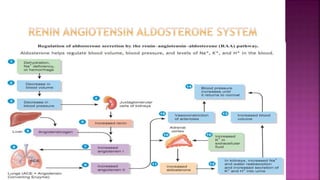
 In HF major triggers of aldosterone release include angiotensin II, serum
potassium concentration, and corticotropin.
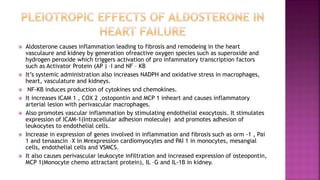
 Aldosterone causes inflammation leading to fibrosis and remodeing in the heart
vasculaure and kidney by generation ofreactive oxygen species such as superoxide and
hydrogen peroxide which triggers activation of pro infammatory transcription factors
such as Activator Protein (AP ) –I and NF – KB
 It’s systemic administration also increases NADPH and oxidative stress in macrophages,
heart, vasculature and kidneys.
 NF-KB induces production of cytokines snd chemokines.
 It increases ICAM 1 , COX 2 ,ostopontin and MCP 1 inheart and causes inflammatory
arterial lesion with perivascular macrophages.
 Also promotes vascular inflammation by stimulating endothelial exocytosis. It stimulates
expression of ICAM-1(Intracellular adhesion molecule) and promotes adhesion of
leukocytes to endothelial cells.
 Increase in expression of genes involved in inflammation and fibrosis such as orm -1 , Pai
1 and tenaascin –X in Mrexpression cardiomyocytes and PAI 1 in monocytes, mesangial
cells, endothelial cells and VSMCS.
 It also causes perivascular leukocyte infiltration and increased expression of osteopontin,
MCP 1(Monocyte chemo attractant protein), IL –G and IL-1B in kidney.
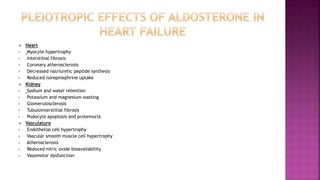
 Heart
 Myocyte hypertrophy
 Interstitial fibrosis
 Coronary atherosclerosis
 Decreased natriuretic peptide synthesis
 Reduced norepinephrine uptake
 Kidney
 Sodium and water retention
 Potassium and magnesium wasting
 Glomerulosclerosis
 Tubulointerstitial fibrosis
 Podocyte apoptosis and proteinuria
 Vasculature
 Endothelial cell hypertrophy
 Vascular smooth muscle cell hypertrophy
 Atherosclerosis
 Reduced nitric oxide bioavailability
 Vasomotor dysfunction
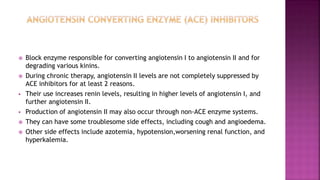
 Block enzyme responsible for converting angiotensin I to angiotensin II and for
degrading various kinins.
 During chronic therapy, angiotensin II levels are not completely suppressed by
ACE inhibitors for at least 2 reasons.
 Their use increases renin levels, resulting in higher levels of angiotensin I, and
further angiotensin II.
 Production of angiotensin II may also occur through non-ACE enzyme systems.
 They can have some troublesome side effects, including cough and angioedema.
 Other side effects include azotemia, hypotension,worsening renal function, and
hyperkalemia.
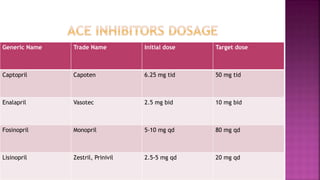
Generic Name Trade Name Initial dose Target dose
Captopril Capoten 6.25 mg tid 50 mg tid
Enalapril Vasotec 2.5 mg bid 10 mg bid
Fosinopril Monopril 5-10 mg qd 80 mg qd
Lisinopril Zestril, Prinivil 2.5-5 mg qd 20 mg qd
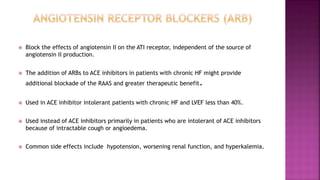
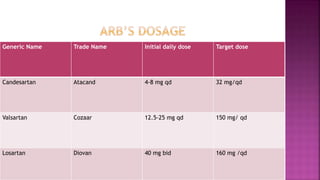
 Block the effects of angiotensin II on the ATI receptor, independent of the source of
angiotensin II production.
 The addition of ARBs to ACE inhibitors in patients with chronic HF might provide
additional blockade of the RAAS and greater therapeutic benefit.
 Used in ACE inhibitor intolerant patients with chronic HF and LVEF less than 40%.
 Used instead of ACE inhibitors primarily in patients who are intolerant of ACE inhibitors
because of intractable cough or angioedema.
 Common side effects include hypotension, worsening renal function, and hyperkalemia.
Generic Name Trade Name Initial daily dose Target dose
Candesartan Atacand 4-8 mg qd 32 mg/qd
Valsartan Cozaar 12.5-25 mg qd 150 mg/ qd
Losartan Diovan 40 mg bid 160 mg /qd
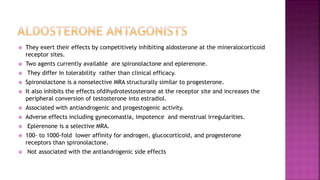
 They exert their effects by competitively inhibiting aldosterone at the mineralocorticoid
receptor sites.
 Two agents currently available are spironolactone and eplerenone.
 They differ in tolerability rather than clinical efficacy.
 Spironolactone is a nonselective MRA structurally similar to progesterone.
 It also inhibits the effects ofdihydrotestosterone at the receptor site and increases the
peripheral conversion of testosterone into estradiol.
 Associated with antiandrogenic and progestogenic activity.
 Adverse effects including gynecomastia, impotence and menstrual irregularities.
 Eplerenone is a selective MRA.
 100- to 1000-fold lower affinity for androgen, glucocorticoid, and progesterone
receptors than spironolactone.
 Not associated with the antiandrogenic side effects
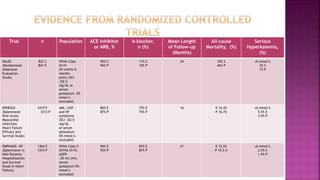
Trial n Population ACE inhibitor
or ARB, %
b-blocker,
n (%)
Mean Length
of Follow-up
(Months)
All-cause
Mortality, (%)
Serious
Hyperkalemia,
(%)
RALES
(Randomized
Aldactone
Evaluation
Study)
822 S
841 P
NYHA Class
III/IV
(IV within 6
months
prior) (SCr
›O2.5
mg/dL or
serum
potassium› O5
mmol/L
excluded)
95% S
94% P
11% S
10% P
24 35% S
46% P
≥6 mmol/L
2% S
1% P
EPHESUS
(Eplerenone
Post-Acute
Myocardial
Infarction
Heart Failure
Efficacy and
Survival Study)
3319 E
3313 P
AMI, LVEF ,
and HF
symptoms
(SCr ›O2.5
mg/dL
or serum
potassium›
O5 mmol/L
excluded)
86% E
87% P
75% E
75% P
16 E 14.4%
P 16.7%
≥6 mmol/L
5.5% E
3.9% P
EMPHASIS –HF
(Eplerenone in
Mild Patients
Hospitalization
and Survival
Study in Heart
Failure)
1364 E
1373 P
NYHA Class II
(NYHA III/IV,
eGFR
‹30 mL/min,
serum
potassium O5›
mmol/L
excluded)
94% E
93% P
87% E
87% P
21 E 12.5%
P 15.5 %
≥6 mmol/L
2.5% S
1.9% P
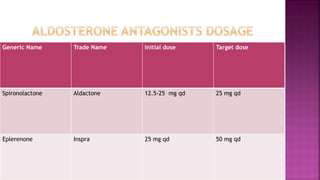
Generic Name Trade Name Initial dose Target dose
Spironolactone Aldactone 12.5-25 mg qd 25 mg qd
Eplerenone Inspra 25 mg qd 50 mg qd
 It is a combination of angiotensin receptor blocker Valsartan and neprilysin inhibitor sacubitril.
(Entresto)
 Valsartan blocks the AT1 receptor for Angiotensin II resulting in vasodilation and reduction of ECF
volume.
 Sacubitril is a prodrug.It’s activated form is Sacubitrilat which inhibits the enzyme neprilysin, a
neutral endopeptidase that degrades vasoactive peptides including bradykinin, natriuretic
peptides and adrenomedullin.
 Increases level of peptides results in vasodilation and reduction of ECF volume via Na excretion.
 Adverse effects
 cough
 hyperkalemia (which can be caused by valsartan)
 kidney dysfunction
 hypotension (low blood pressure, a common side effect of vasodilators and ECF volume reducers)
 The wholesale cost for a year of valsartan/sacubitril is $4,560 per person . Similar class generic
drugs without sacubitril, such as valsartan alone, cost approximately $48 a year.
 It was approved under the FDA's priority review process on July 7, 2015 as a result of Phase III trial PARADIGM-HF
trial .
 The Paradigm-HF trial compared treatment with valsartan/sacubitril to treatment with enalapril.
 Participants were mainly white (66%), male (78%), middle aged with NYHA stage II (71.6%) or stage III (23.1%)
heart failure.
 The trial was stopped early after a prespecified interim analysis revealed reduction in the primary endpoint of
cardiovascular death or heart failure in the valsartan/sacubitril group relative to those treated with enalapril.
 Relative to enalapril, valsartan-sacubitril provided reductions in
 the composite endpoint of cardiovascular death or hospitalization for heart failure by nearly 5 %
 cardiovascular death by nearly 3.2 %
 first hospitalization for worsening heart failure by nearly 2.8%
 all cause mortality by 2.8 %
 Limitations of the trial include limited representation of important subgroups, such as blacks and those with
implantable pacemakers, and lack of data regarding those with NYHA heart failure stages other than II or III
Dosage Form and Strengths
Sacubitril/Valsartan
Film coated tablet
 24 mg/26 mg
 49 mg/ 51 mg
 97 mg/ 103 mg
Dose:
 Initial dose 49 mg/ 51 mg PO BID
 Target Mantainence dose after 2-4 weeks 97 mg/103 mg PO BID as tolerated.
 Adjustment required in severe renal and moderate hepatic impairment.
 Contrindicated in severe hepatic impairment.
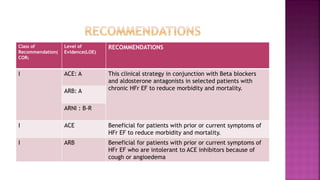
2016 ACC/AHA/HFSA Recommendations for Renin Angiotensin System
Inhibition with
Class of
Recommendation(
COR)
Level of
Evidence(LOE)
RECOMMENDATIONS
I ACE: A This clinical strategy in conjunction with Beta blockers
and aldosterone antagonists in selected patients with
chronic HFr EF to reduce morbidity and mortality.ARB: A
ARNI : B-R
I ACE Beneficial for patients with prior or current symptoms of
HFr EF to reduce morbidity and mortality.
I ARB Beneficial for patients with prior or current symptoms of
HFr EF who are intolerant to ACE inhibitors because of
cough or angioedema
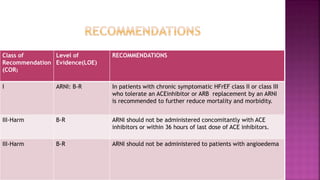
Class of
Recommendation
(COR)
Level of
Evidence(LOE)
RECOMMENDATIONS
I ARNI: B-R In patients with chronic symptomatic HFrEF class II or class III
who tolerate an ACEinhibitor or ARB replacement by an ARNI
is recommended to further reduce mortality and morbidity.
III-Harm B-R ARNI should not be administered concomitantly with ACE
inhibitors or within 36 hours of last dose of ACE inhibitors.
III-Harm B-R ARNI should not be administered to patients with angioedema
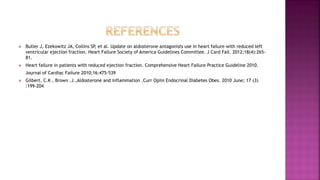
 Butler J, Ezekowitz JA, Collins SP, et al. Update on aldosterone antagonists use in heart failure with reduced left
ventricular ejection fraction. Heart Failure Society of America Guidelines Committee. J Card Fail. 2012;18(4):265-
81.
 Heart failure in patients with reduced ejection fraction. Comprehensive Heart Failure Practice Guideline 2010.
Journal of Cardiac Failure 2010;16:475-539
 Gilbert. C.K , Brown .J.,Aldosterone and inflammation .Curr Opiin Endocrinal Diabetes Obes. 2010 June; 17 (3)
:199-204
Endo ppt

Endo ppt

  • 1.
    Nida Sehar MS(Pharmacology) & MBA (Finance) nidasehar19@yahoo.com
  • 3.
     Congestive heartfailure is a syndrome that can be caused by a variety of abnormalities  Coronary artery disease  Heart attack  Cardiac myopathy  Conditions that overwork the heart  Hypertension  Valve disease  Thyroid disease  Kidney disease  Congenital birth defects  Diabetes  In the usual form of heart failure, the heart muscle has reduced contractility. This produces a reduction in cardiac output, which then becomes inadequate to meet the peripheral demands of the body.
  • 6.
  • 10.
     Aldosterone isproduced in excess in the adrenal gland in edematous states.  It is not simply a biomarker of disease activity, but a potent mediator of ventricular and vascular remodeling and disease progression.  In HF major triggers of aldosterone release include angiotensin II, serum potassium concentration, and corticotropin.
  • 12.
     Aldosterone causesinflammation leading to fibrosis and remodeing in the heart vasculaure and kidney by generation ofreactive oxygen species such as superoxide and hydrogen peroxide which triggers activation of pro infammatory transcription factors such as Activator Protein (AP ) –I and NF – KB  It’s systemic administration also increases NADPH and oxidative stress in macrophages, heart, vasculature and kidneys.  NF-KB induces production of cytokines snd chemokines.  It increases ICAM 1 , COX 2 ,ostopontin and MCP 1 inheart and causes inflammatory arterial lesion with perivascular macrophages.  Also promotes vascular inflammation by stimulating endothelial exocytosis. It stimulates expression of ICAM-1(Intracellular adhesion molecule) and promotes adhesion of leukocytes to endothelial cells.  Increase in expression of genes involved in inflammation and fibrosis such as orm -1 , Pai 1 and tenaascin –X in Mrexpression cardiomyocytes and PAI 1 in monocytes, mesangial cells, endothelial cells and VSMCS.  It also causes perivascular leukocyte infiltration and increased expression of osteopontin, MCP 1(Monocyte chemo attractant protein), IL –G and IL-1B in kidney.
  • 13.
     Heart  Myocytehypertrophy  Interstitial fibrosis  Coronary atherosclerosis  Decreased natriuretic peptide synthesis  Reduced norepinephrine uptake  Kidney  Sodium and water retention  Potassium and magnesium wasting  Glomerulosclerosis  Tubulointerstitial fibrosis  Podocyte apoptosis and proteinuria  Vasculature  Endothelial cell hypertrophy  Vascular smooth muscle cell hypertrophy  Atherosclerosis  Reduced nitric oxide bioavailability  Vasomotor dysfunction
  • 15.
     Block enzymeresponsible for converting angiotensin I to angiotensin II and for degrading various kinins.  During chronic therapy, angiotensin II levels are not completely suppressed by ACE inhibitors for at least 2 reasons.  Their use increases renin levels, resulting in higher levels of angiotensin I, and further angiotensin II.  Production of angiotensin II may also occur through non-ACE enzyme systems.  They can have some troublesome side effects, including cough and angioedema.  Other side effects include azotemia, hypotension,worsening renal function, and hyperkalemia.
  • 16.
    Generic Name TradeName Initial dose Target dose Captopril Capoten 6.25 mg tid 50 mg tid Enalapril Vasotec 2.5 mg bid 10 mg bid Fosinopril Monopril 5-10 mg qd 80 mg qd Lisinopril Zestril, Prinivil 2.5-5 mg qd 20 mg qd
  • 17.
     Block theeffects of angiotensin II on the ATI receptor, independent of the source of angiotensin II production.  The addition of ARBs to ACE inhibitors in patients with chronic HF might provide additional blockade of the RAAS and greater therapeutic benefit.  Used in ACE inhibitor intolerant patients with chronic HF and LVEF less than 40%.  Used instead of ACE inhibitors primarily in patients who are intolerant of ACE inhibitors because of intractable cough or angioedema.  Common side effects include hypotension, worsening renal function, and hyperkalemia.
  • 18.
    Generic Name TradeName Initial daily dose Target dose Candesartan Atacand 4-8 mg qd 32 mg/qd Valsartan Cozaar 12.5-25 mg qd 150 mg/ qd Losartan Diovan 40 mg bid 160 mg /qd
  • 19.
     They exerttheir effects by competitively inhibiting aldosterone at the mineralocorticoid receptor sites.  Two agents currently available are spironolactone and eplerenone.  They differ in tolerability rather than clinical efficacy.  Spironolactone is a nonselective MRA structurally similar to progesterone.  It also inhibits the effects ofdihydrotestosterone at the receptor site and increases the peripheral conversion of testosterone into estradiol.  Associated with antiandrogenic and progestogenic activity.  Adverse effects including gynecomastia, impotence and menstrual irregularities.  Eplerenone is a selective MRA.  100- to 1000-fold lower affinity for androgen, glucocorticoid, and progesterone receptors than spironolactone.  Not associated with the antiandrogenic side effects
  • 20.
    Trial n PopulationACE inhibitor or ARB, % b-blocker, n (%) Mean Length of Follow-up (Months) All-cause Mortality, (%) Serious Hyperkalemia, (%) RALES (Randomized Aldactone Evaluation Study) 822 S 841 P NYHA Class III/IV (IV within 6 months prior) (SCr ›O2.5 mg/dL or serum potassium› O5 mmol/L excluded) 95% S 94% P 11% S 10% P 24 35% S 46% P ≥6 mmol/L 2% S 1% P EPHESUS (Eplerenone Post-Acute Myocardial Infarction Heart Failure Efficacy and Survival Study) 3319 E 3313 P AMI, LVEF , and HF symptoms (SCr ›O2.5 mg/dL or serum potassium› O5 mmol/L excluded) 86% E 87% P 75% E 75% P 16 E 14.4% P 16.7% ≥6 mmol/L 5.5% E 3.9% P EMPHASIS –HF (Eplerenone in Mild Patients Hospitalization and Survival Study in Heart Failure) 1364 E 1373 P NYHA Class II (NYHA III/IV, eGFR ‹30 mL/min, serum potassium O5› mmol/L excluded) 94% E 93% P 87% E 87% P 21 E 12.5% P 15.5 % ≥6 mmol/L 2.5% S 1.9% P
  • 21.
    Generic Name TradeName Initial dose Target dose Spironolactone Aldactone 12.5-25 mg qd 25 mg qd Eplerenone Inspra 25 mg qd 50 mg qd
  • 22.
     It isa combination of angiotensin receptor blocker Valsartan and neprilysin inhibitor sacubitril. (Entresto)  Valsartan blocks the AT1 receptor for Angiotensin II resulting in vasodilation and reduction of ECF volume.  Sacubitril is a prodrug.It’s activated form is Sacubitrilat which inhibits the enzyme neprilysin, a neutral endopeptidase that degrades vasoactive peptides including bradykinin, natriuretic peptides and adrenomedullin.  Increases level of peptides results in vasodilation and reduction of ECF volume via Na excretion.  Adverse effects  cough  hyperkalemia (which can be caused by valsartan)  kidney dysfunction  hypotension (low blood pressure, a common side effect of vasodilators and ECF volume reducers)  The wholesale cost for a year of valsartan/sacubitril is $4,560 per person . Similar class generic drugs without sacubitril, such as valsartan alone, cost approximately $48 a year.
  • 23.
     It wasapproved under the FDA's priority review process on July 7, 2015 as a result of Phase III trial PARADIGM-HF trial .  The Paradigm-HF trial compared treatment with valsartan/sacubitril to treatment with enalapril.  Participants were mainly white (66%), male (78%), middle aged with NYHA stage II (71.6%) or stage III (23.1%) heart failure.  The trial was stopped early after a prespecified interim analysis revealed reduction in the primary endpoint of cardiovascular death or heart failure in the valsartan/sacubitril group relative to those treated with enalapril.  Relative to enalapril, valsartan-sacubitril provided reductions in  the composite endpoint of cardiovascular death or hospitalization for heart failure by nearly 5 %  cardiovascular death by nearly 3.2 %  first hospitalization for worsening heart failure by nearly 2.8%  all cause mortality by 2.8 %  Limitations of the trial include limited representation of important subgroups, such as blacks and those with implantable pacemakers, and lack of data regarding those with NYHA heart failure stages other than II or III
  • 24.
    Dosage Form andStrengths Sacubitril/Valsartan Film coated tablet  24 mg/26 mg  49 mg/ 51 mg  97 mg/ 103 mg Dose:  Initial dose 49 mg/ 51 mg PO BID  Target Mantainence dose after 2-4 weeks 97 mg/103 mg PO BID as tolerated.  Adjustment required in severe renal and moderate hepatic impairment.  Contrindicated in severe hepatic impairment.
  • 25.
    2016 ACC/AHA/HFSA Recommendationsfor Renin Angiotensin System Inhibition with
  • 26.
    Class of Recommendation( COR) Level of Evidence(LOE) RECOMMENDATIONS IACE: A This clinical strategy in conjunction with Beta blockers and aldosterone antagonists in selected patients with chronic HFr EF to reduce morbidity and mortality.ARB: A ARNI : B-R I ACE Beneficial for patients with prior or current symptoms of HFr EF to reduce morbidity and mortality. I ARB Beneficial for patients with prior or current symptoms of HFr EF who are intolerant to ACE inhibitors because of cough or angioedema
  • 27.
    Class of Recommendation (COR) Level of Evidence(LOE) RECOMMENDATIONS IARNI: B-R In patients with chronic symptomatic HFrEF class II or class III who tolerate an ACEinhibitor or ARB replacement by an ARNI is recommended to further reduce mortality and morbidity. III-Harm B-R ARNI should not be administered concomitantly with ACE inhibitors or within 36 hours of last dose of ACE inhibitors. III-Harm B-R ARNI should not be administered to patients with angioedema
  • 28.
     Butler J,Ezekowitz JA, Collins SP, et al. Update on aldosterone antagonists use in heart failure with reduced left ventricular ejection fraction. Heart Failure Society of America Guidelines Committee. J Card Fail. 2012;18(4):265- 81.  Heart failure in patients with reduced ejection fraction. Comprehensive Heart Failure Practice Guideline 2010. Journal of Cardiac Failure 2010;16:475-539  Gilbert. C.K , Brown .J.,Aldosterone and inflammation .Curr Opiin Endocrinal Diabetes Obes. 2010 June; 17 (3) :199-204