Emotion
Lecturer: Saira Farooq
Introduction
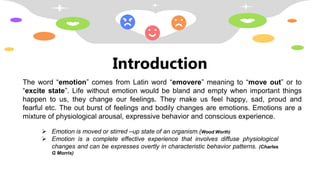
The word “emotion” comes from Latin word “emovere” meaning to “move out” or to
“excite state”. Life without emotion would be bland and empty when important things
happen to us, they change our feelings. They make us feel happy, sad, proud and
fearful etc. The out burst of feelings and bodily changes are emotions. Emotions are a
mixture of physiological arousal, expressive behavior and conscious experience.
 Emotion is moved or stirred –up state of an organism.(Wood Worth)
 Emotion is a complete effective experience that involves diffuse physiological
changes and can be expresses overtly in characteristic behavior patterns. (Charles
G Morris)
Physiology of Emotion
Emotional changes can be physiological, behavioural and cognitive. These changes include neural,
hormonal (glandular) and muscular. The systems involved in changes are following:
Autonomic Nervous System Glandular System Limbic System
Emotional Change
In normal life, when we experience an intense emotion, such as fear or anger, we become
aware of many bodily changes which include rapid heart beat and breathing, dryness of the
throat and mouth.
Sympathetic Nervous System
Role of Autonomic Nervous System
ANS is the part of peripheral nervous system that carries information
between the brain and all organs of the body. The ANS affects all of the
organs such as the heart and blood vessels, the digestive system and so
on. The autonomic nerous system is responsible for most of the
physiological changes that accompany emtional reaction.
Autonomic Nervous System has two divisions;
Parasympathetic Nervous System
Sympathetic Nervous System
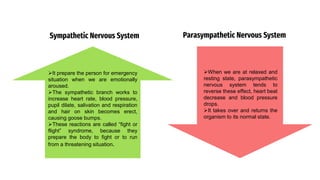
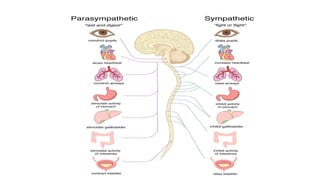
It prepare the person for emergency
situation when we are emotionally
aroused.
The sympathetic branch works to
increase heart rate, blood pressure,
pupil dilate, salivation and respiration
and hair on skin becomes erect,
causing goose bumps.
These reactions are called “fight or
flight” syndrome, because they
prepare the body to fight or to run
from a threatening situation.
Parasympathetic Nervous System
When we are at relaxed and
resting state, parasympathetic
nervous system tends to
reverse these effect, heart beat
decrease and blood pressure
drops.
It takes over and returns the
organism to its normal state.
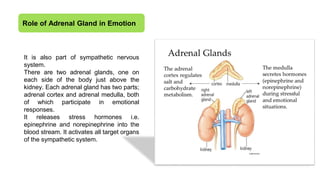
Role of Adrenal Gland in Emotion
It is also part of sympathetic nervous
system.
There are two adrenal glands, one on
each side of the body just above the
kidney. Each adrenal gland has two parts;
adrenal cortex and adrenal medulla, both
of which participate in emotional
responses.
It releases stress hormones i.e.
epinephrine and norepinephrine into the
blood stream. It activates all target organs
of the sympathetic system.
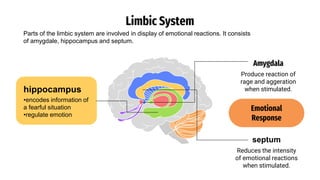
Limbic System
hippocampus
•encodes information of
a fearful situation
•regulate emotion
septum
Reduces the intensity
of emotional reactions
when stimulated.
Amygdala
Produce reaction of
rage and aggeration
when stimulated.
Emotional
Response
Parts of the limbic system are involved in display of emotional reactions. It consists
of amygdale, hippocampus and septum.
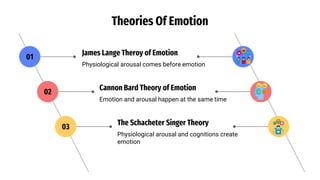
Theories Of Emotion
James Lange Theroy of Emotion
Physiological arousal comes before emotion
01
Cannon Bard Theory of Emotion
Emotion and arousal happen at the same time
02
The Schacheter Singer Theory
Physiological arousal and cognitions create
emotion
03
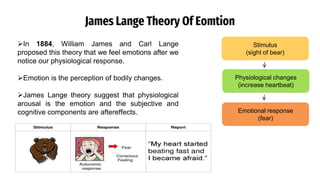
James Lange Theory Of Eomtion
In 1884, William James and Carl Lange
proposed this theory that we feel emotions after we
notice our physiological response.
Emotion is the perception of bodily changes.
James Lange theory suggest that physiological
arousal is the emotion and the subjective and
cognitive components are aftereffects.
Stimulus
(sight of bear)
Physiological changes
(increase heartbeat)
Emotional response
(fear)
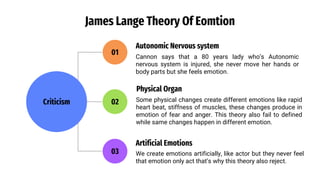
James Lange Theory Of Eomtion
Autonomic Nervous system
Cannon says that a 80 years lady who’s Autonomic
nervous system is injured, she never move her hands or
body parts but she feels emotion.
01
Artificial Emotions
We create emotions artificially, like actor but they never feel
that emotion only act that’s why this theory also reject.
02
Physical Organ
Some physical changes create different emotions like rapid
heart beat, stiffness of muscles, these changes produce in
emotion of fear and anger. This theory also fail to defined
while same changes happen in different emotion.
03
Criticism
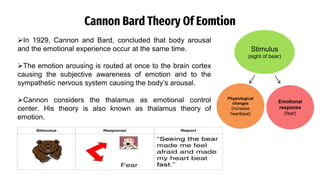
Cannon Bard Theory Of Eomtion
In 1929, Cannon and Bard, concluded that body arousal
and the emotional experience occur at the same time.
The emotion arousing is routed at once to the brain cortex
causing the subjective awareness of emotion and to the
sympathetic nervous system causing the body’s arousal.
Cannon considers the thalamus as emotional control
center. His theory is also known as thalamus theory of
emotion.
Stimulus
(sight of bear)
Physiological
changes
(increase
heartbeat)
Emotional
response
(fear)
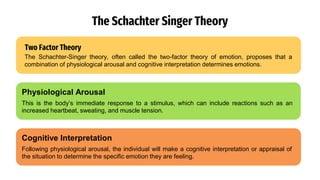
The Schachter Singer Theory
Physiological Arousal
This is the body’s immediate response to a stimulus, which can include reactions such as an
increased heartbeat, sweating, and muscle tension.
Cognitive Interpretation
Following physiological arousal, the individual will make a cognitive interpretation or appraisal of
the situation to determine the specific emotion they are feeling.
The Schachter-Singer theory, often called the two-factor theory of emotion, proposes that a
combination of physiological arousal and cognitive interpretation determines emotions.
Two Factor Theory
Stimulus
(sight of bear)
Cognitive Label
(I m’ scared)
Emotional response
(fear)
Physiological changes
(increase heartbeat)
The Schachter Singer Theory
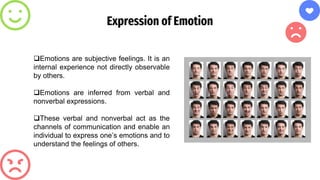
Expression of Emotion
Emotions are subjective feelings. It is an
internal experience not directly observable
by others.
Emotions are inferred from verbal and
nonverbal expressions.
These verbal and nonverbal act as the
channels of communication and enable an
individual to express one’s emotions and to
understand the feelings of others.
The Verbal channel of communication is composed
spoken words as well as other vocal features of speech
like pitch and loudness of the voice.
Other Non- verbal channels includes facial
expression, kinetic (gesture, posture, movement of
body) and proximal (physical distance during face-to-
face interaction) behavior.
Facial expression is the most common channel of
emotional communication.
Facial expression can convey the intensity as well as
the pleasant or unpleasant of the individual’ emotional
state.
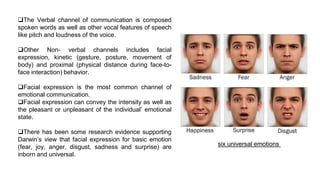
There has been some research evidence supporting
Darwin’s view that facial expression for basic emotion
(fear, joy, anger, disgust, sadness and surprise) are
inborn and universal.
six universal emotions

emotions phsiology presentation university level.pdf

  • 1.
  • 2.
    Introduction The word “emotion”comes from Latin word “emovere” meaning to “move out” or to “excite state”. Life without emotion would be bland and empty when important things happen to us, they change our feelings. They make us feel happy, sad, proud and fearful etc. The out burst of feelings and bodily changes are emotions. Emotions are a mixture of physiological arousal, expressive behavior and conscious experience.  Emotion is moved or stirred –up state of an organism.(Wood Worth)  Emotion is a complete effective experience that involves diffuse physiological changes and can be expresses overtly in characteristic behavior patterns. (Charles G Morris)
  • 3.
    Physiology of Emotion Emotionalchanges can be physiological, behavioural and cognitive. These changes include neural, hormonal (glandular) and muscular. The systems involved in changes are following: Autonomic Nervous System Glandular System Limbic System Emotional Change In normal life, when we experience an intense emotion, such as fear or anger, we become aware of many bodily changes which include rapid heart beat and breathing, dryness of the throat and mouth.
  • 4.
    Sympathetic Nervous System Roleof Autonomic Nervous System ANS is the part of peripheral nervous system that carries information between the brain and all organs of the body. The ANS affects all of the organs such as the heart and blood vessels, the digestive system and so on. The autonomic nerous system is responsible for most of the physiological changes that accompany emtional reaction. Autonomic Nervous System has two divisions; Parasympathetic Nervous System
  • 5.
    Sympathetic Nervous System Itprepare the person for emergency situation when we are emotionally aroused. The sympathetic branch works to increase heart rate, blood pressure, pupil dilate, salivation and respiration and hair on skin becomes erect, causing goose bumps. These reactions are called “fight or flight” syndrome, because they prepare the body to fight or to run from a threatening situation. Parasympathetic Nervous System When we are at relaxed and resting state, parasympathetic nervous system tends to reverse these effect, heart beat decrease and blood pressure drops. It takes over and returns the organism to its normal state.
  • 7.
    Role of AdrenalGland in Emotion It is also part of sympathetic nervous system. There are two adrenal glands, one on each side of the body just above the kidney. Each adrenal gland has two parts; adrenal cortex and adrenal medulla, both of which participate in emotional responses. It releases stress hormones i.e. epinephrine and norepinephrine into the blood stream. It activates all target organs of the sympathetic system.
  • 8.
    Limbic System hippocampus •encodes informationof a fearful situation •regulate emotion septum Reduces the intensity of emotional reactions when stimulated. Amygdala Produce reaction of rage and aggeration when stimulated. Emotional Response Parts of the limbic system are involved in display of emotional reactions. It consists of amygdale, hippocampus and septum.
  • 9.
    Theories Of Emotion JamesLange Theroy of Emotion Physiological arousal comes before emotion 01 Cannon Bard Theory of Emotion Emotion and arousal happen at the same time 02 The Schacheter Singer Theory Physiological arousal and cognitions create emotion 03
  • 10.
    James Lange TheoryOf Eomtion In 1884, William James and Carl Lange proposed this theory that we feel emotions after we notice our physiological response. Emotion is the perception of bodily changes. James Lange theory suggest that physiological arousal is the emotion and the subjective and cognitive components are aftereffects. Stimulus (sight of bear) Physiological changes (increase heartbeat) Emotional response (fear)
  • 11.
    James Lange TheoryOf Eomtion Autonomic Nervous system Cannon says that a 80 years lady who’s Autonomic nervous system is injured, she never move her hands or body parts but she feels emotion. 01 Artificial Emotions We create emotions artificially, like actor but they never feel that emotion only act that’s why this theory also reject. 02 Physical Organ Some physical changes create different emotions like rapid heart beat, stiffness of muscles, these changes produce in emotion of fear and anger. This theory also fail to defined while same changes happen in different emotion. 03 Criticism
  • 12.
    Cannon Bard TheoryOf Eomtion In 1929, Cannon and Bard, concluded that body arousal and the emotional experience occur at the same time. The emotion arousing is routed at once to the brain cortex causing the subjective awareness of emotion and to the sympathetic nervous system causing the body’s arousal. Cannon considers the thalamus as emotional control center. His theory is also known as thalamus theory of emotion. Stimulus (sight of bear) Physiological changes (increase heartbeat) Emotional response (fear)
  • 13.
    The Schachter SingerTheory Physiological Arousal This is the body’s immediate response to a stimulus, which can include reactions such as an increased heartbeat, sweating, and muscle tension. Cognitive Interpretation Following physiological arousal, the individual will make a cognitive interpretation or appraisal of the situation to determine the specific emotion they are feeling. The Schachter-Singer theory, often called the two-factor theory of emotion, proposes that a combination of physiological arousal and cognitive interpretation determines emotions. Two Factor Theory
  • 14.
    Stimulus (sight of bear) CognitiveLabel (I m’ scared) Emotional response (fear) Physiological changes (increase heartbeat) The Schachter Singer Theory
  • 16.
    Expression of Emotion Emotionsare subjective feelings. It is an internal experience not directly observable by others. Emotions are inferred from verbal and nonverbal expressions. These verbal and nonverbal act as the channels of communication and enable an individual to express one’s emotions and to understand the feelings of others.
  • 17.
    The Verbal channelof communication is composed spoken words as well as other vocal features of speech like pitch and loudness of the voice. Other Non- verbal channels includes facial expression, kinetic (gesture, posture, movement of body) and proximal (physical distance during face-to- face interaction) behavior. Facial expression is the most common channel of emotional communication. Facial expression can convey the intensity as well as the pleasant or unpleasant of the individual’ emotional state. There has been some research evidence supporting Darwin’s view that facial expression for basic emotion (fear, joy, anger, disgust, sadness and surprise) are inborn and universal. six universal emotions