EMOTIONAL QUOTIENT
WHAT IS EMOTIONAL QUOTIENT ?
Derived from
Latin word
“movere” which
means to move
or feel
ability to sense,
understand and
effectively apply
the power of
emotions
often
represented by
person's
emotional
intelligence
TRADITIONAL VS MODERN TIMES
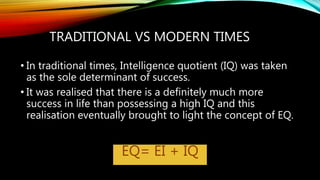
• In traditional times, Intelligence quotient (IQ) was taken
as the sole determinant of success.
• It was realised that there is a definitely much more
success in life than possessing a high IQ and this
realisation eventually brought to light the concept of EQ.
EQ= EI + IQ
ELEMENTS OF EMOTIONAL QUOTIENT
RELATIONSHIP
MANAGEMENT
SELF-
MANAGEMANT
SOCIAL
AWARENESS
SELF-
AWARENESS
EI
Emotional
intelligence
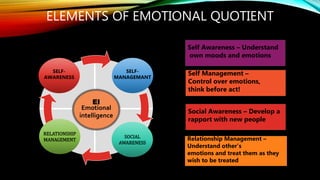
Self Awareness – Understand
own moods and emotions
Social Awareness – Develop a
rapport with new people
Relationship Management –
Understand other’s
emotions and treat them as they
wish to be treated
Self Management –
Control over emotions,
think before act!
How Your
Emotions
Influence Your Life
at Work and at
Home?
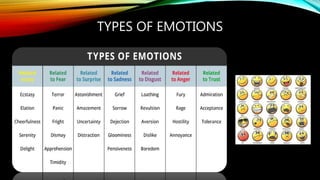
TYPES OF EMOTIONS
FLEXITIME
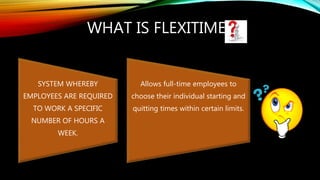
WHAT IS FLEXITIME?
SYSTEM WHEREBY
EMPLOYEES ARE REQUIRED
TO WORK A SPECIFIC
NUMBER OF HOURS A
WEEK.
Allows full-time employees to
choose their individual starting and
quitting times within certain limits.
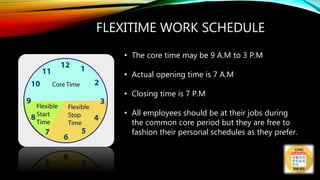
FLEXITIME WORK SCHEDULE
• The core time may be 9 A.M to 3 P.M
• Actual opening time is 7 A.M
• Closing time is 7 P.M
• All employees should be at their jobs during
the common core period but they are free to
fashion their personal schedules as they prefer.
ADVANTAGES OF FLEXITIME
• Better productivity and morale
• Reduced absenteeism
• Boost employees morale
• Reduced employee turnover
• No late coming
• Less overtime pay
• Free to choose duty timings
DISADVANTAGES OF FLEXITIME
• Increase in cost because the plant is opened for
longer period of time
• Difficulties in recording time
• Confusion to suppliers and customers who are
not used to flexitime
• Longer supervision
• A communication may not reach all the
employees which can result in communication
gap.
• Scheduling of delivery may be affected.
THANK YOU

Emotional quotient

  • 1.
  • 2.
    WHAT IS EMOTIONALQUOTIENT ? Derived from Latin word “movere” which means to move or feel ability to sense, understand and effectively apply the power of emotions often represented by person's emotional intelligence
  • 3.
    TRADITIONAL VS MODERNTIMES • In traditional times, Intelligence quotient (IQ) was taken as the sole determinant of success. • It was realised that there is a definitely much more success in life than possessing a high IQ and this realisation eventually brought to light the concept of EQ. EQ= EI + IQ
  • 4.
    ELEMENTS OF EMOTIONALQUOTIENT RELATIONSHIP MANAGEMENT SELF- MANAGEMANT SOCIAL AWARENESS SELF- AWARENESS EI Emotional intelligence Self Awareness – Understand own moods and emotions Social Awareness – Develop a rapport with new people Relationship Management – Understand other’s emotions and treat them as they wish to be treated Self Management – Control over emotions, think before act!
  • 5.
    How Your Emotions Influence YourLife at Work and at Home?
  • 6.
  • 7.
  • 8.
    WHAT IS FLEXITIME? SYSTEMWHEREBY EMPLOYEES ARE REQUIRED TO WORK A SPECIFIC NUMBER OF HOURS A WEEK. Allows full-time employees to choose their individual starting and quitting times within certain limits.
  • 9.
    FLEXITIME WORK SCHEDULE •The core time may be 9 A.M to 3 P.M • Actual opening time is 7 A.M • Closing time is 7 P.M • All employees should be at their jobs during the common core period but they are free to fashion their personal schedules as they prefer.
  • 10.
    ADVANTAGES OF FLEXITIME •Better productivity and morale • Reduced absenteeism • Boost employees morale • Reduced employee turnover • No late coming • Less overtime pay • Free to choose duty timings
  • 11.
    DISADVANTAGES OF FLEXITIME •Increase in cost because the plant is opened for longer period of time • Difficulties in recording time • Confusion to suppliers and customers who are not used to flexitime • Longer supervision • A communication may not reach all the employees which can result in communication gap. • Scheduling of delivery may be affected.
  • 12.