Need
Emotional Intelligence is very important for
managers as it is one of the important
deciding factor for relationship
management resulting in motivation,
retention , self management & managing
others.
Emotional Intelligence
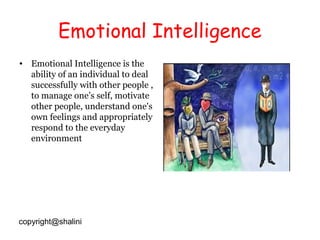
• Emotional Intelligence is the
ability of an individual to deal
successfully with other people ,
to manage one’s self, motivate
other people, understand one's
own feelings and appropriately
respond to the everyday
environment

copyright@shalini
Emotional Intelligence
• In Working with Emotional
Intelligence, author Daniel
Goleman defines EI in the
workplace as the ability of
employees to recognise:
• Their own feelings
• The feelings of others
• What motivates them
• How to manage their
emotions, both in themselves
and in relationships with
others
copyright@shalini
Emotional Intelligence
• Emotional Intelligence doesn't mean being soft – it
means being intelligent about emotions – a different way
of being smart. Emotional intelligence is your ability to
acquire and apply knowledge from your emotions and
the emotions of others in order to be more successful and
lead a more fulfilling life.

copyright@shalini
Need
• When Managers Fail, It is
Usually Due To Poor
Emotional Intelligence
by Freda
Turner

copyright@shalini
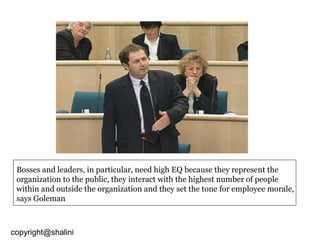
Bosses and leaders, in particular, need high EQ because they represent the
organization to the public, they interact with the highest number of people
within and outside the organization and they set the tone for employee morale,
says Goleman

copyright@shalini
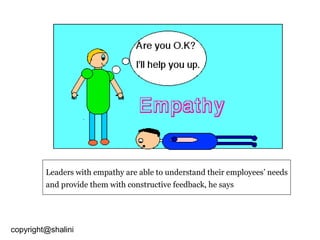
Leaders with empathy are able to understand their employees’ needs
and provide them with constructive feedback, he says

copyright@shalini
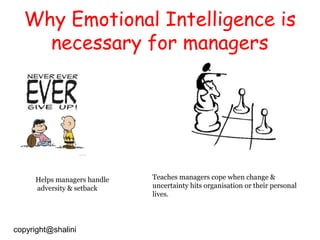
Why Emotional Intelligence is
necessary for managers

Helps managers handle
adversity & setback

copyright@shalini

Teaches managers cope when change &
uncertainty hits organisation or their personal
lives.
Why Emotional Intelligence is
necessary for managers

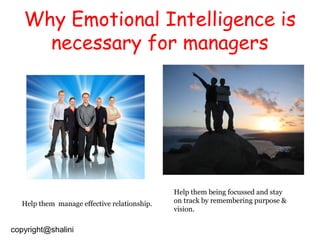
Help them manage effective relationship.

copyright@shalini

Help them being focussed and stay
on track by remembering purpose &
vision.
EQ & Managers
• Emotional Intelligence is very important for managers as
their behaviour & treatment of their people determine
turnover and retention of the company.Managers &
supervisors are the direct line of contact for the
employees.They interact daily with individuals who have
distinct needs, wants & expectations.They significantly
influence the attitudes, performance & satisfaction of
employees within their departments & other
departments.

copyright@shalini
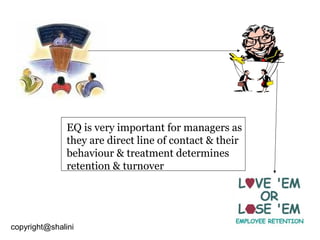
EQ is very important for managers as
they are direct line of contact & their
behaviour & treatment determines
retention & turnover

copyright@shalini
EQ & Managers
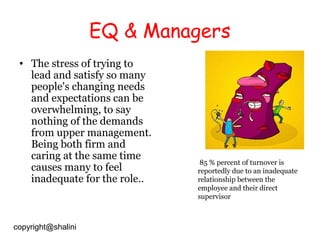
• The stress of trying to
lead and satisfy so many
people's changing needs
and expectations can be
overwhelming, to say
nothing of the demands
from upper management.
Being both firm and
caring at the same time
causes many to feel
inadequate for the role..

copyright@shalini

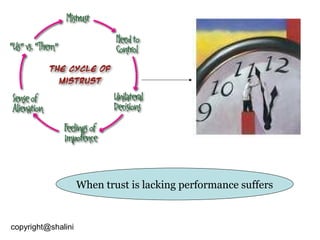
85 % percent of turnover is
reportedly due to an inadequate
relationship between the
employee and their direct
supervisor
When trust is lacking performance suffers

copyright@shalini
EQ & Managers

copyright@shalini
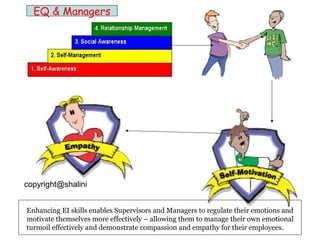
Enhancing EI skills enables Supervisors and Managers to regulate their emotions and
motivate themselves more effectively – allowing them to manage their own emotional
turmoil effectively and demonstrate compassion and empathy for their employees.
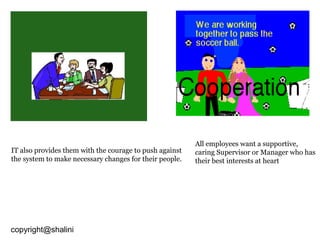
IT also provides them with the courage to push against
the system to make necessary changes for their people.

copyright@shalini

All employees want a supportive,
caring Supervisor or Manager who has
their best interests at heart
EQ & Managers
Knowing this, the
employee will be
more likely to
turndown offers from
other companies to
work for such a
person.

copyright@shalini
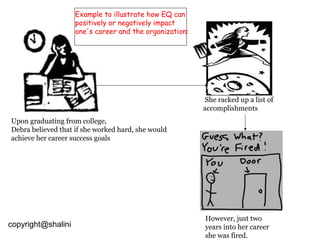
Example to illustrate how EQ can
positively or negatively impact
one's career and the organization:

She racked up a list of
accomplishments
Upon graduating from college,
Debra believed that if she worked hard, she would
achieve her career success goals

copyright@shalini

However, just two
years into her career
she was fired.
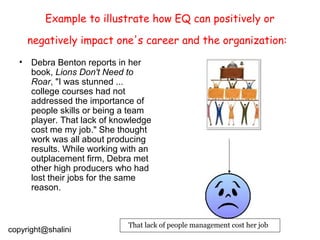
Example to illustrate how EQ can positively or
negatively impact one's career and the organization:
•

Debra Benton reports in her
book, Lions Don't Need to
Roar, "I was stunned ...
college courses had not
addressed the importance of
people skills or being a team
player. That lack of knowledge
cost me my job." She thought
work was all about producing
results. While working with an
outplacement firm, Debra met
other high producers who had
lost their jobs for the same
reason.

copyright@shalini

That lack of people management cost her job
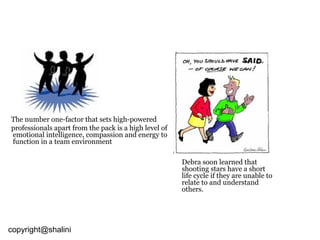
The number one-factor that sets high-powered
professionals apart from the pack is a high level of
emotional intelligence, compassion and energy to
function in a team environment
Debra soon learned that
shooting stars have a short
life cycle if they are unable to
relate to and understand
others.

copyright@shalini
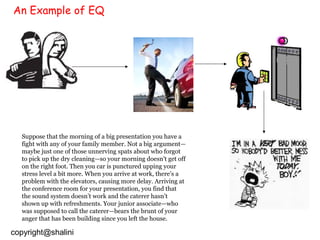
An Example of EQ

Suppose that the morning of a big presentation you have a
fight with any of your family member. Not a big argument—
maybe just one of those unnerving spats about who forgot
to pick up the dry cleaning—so your morning doesn’t get off
on the right foot. Then you car is punctured upping your
stress level a bit more. When you arrive at work, there’s a
problem with the elevators, causing more delay. Arriving at
the conference room for your presentation, you find that
the sound system doesn’t work and the caterer hasn’t
shown up with refreshments. Your junior associate—who
was supposed to call the caterer—bears the brunt of your
anger that has been building since you left the house.

copyright@shalini
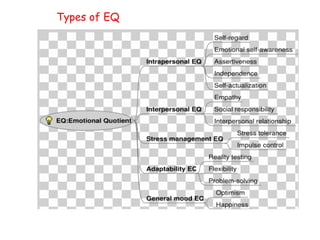
Types of EQ
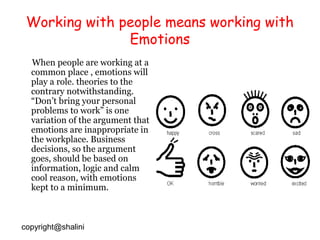
Working with people means working with
Emotions
When people are working at a
common place , emotions will
play a role. theories to the
contrary notwithstanding.
“Don’t bring your personal
problems to work” is one
variation of the argument that
emotions are inappropriate in
the workplace. Business
decisions, so the argument
goes, should be based on
information, logic and calm
cool reason, with emotions
kept to a minimum.

copyright@shalini
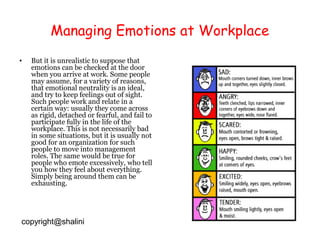
Managing Emotions at Workplace
•

But it is unrealistic to suppose that
emotions can be checked at the door
when you arrive at work. Some people
may assume, for a variety of reasons,
that emotional neutrality is an ideal,
and try to keep feelings out of sight.
Such people work and relate in a
certain way: usually they come across
as rigid, detached or fearful, and fail to
participate fully in the life of the
workplace. This is not necessarily bad
in some situations, but it is usually not
good for an organization for such
people to move into management
roles. The same would be true for
people who emote excessively, who tell
you how they feel about everything.
Simply being around them can be
exhausting.

copyright@shalini
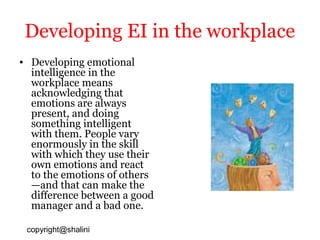
Developing EI in the workplace
• Developing emotional
intelligence in the
workplace means
acknowledging that
emotions are always
present, and doing
something intelligent
with them. People vary
enormously in the skill
with which they use their
own emotions and react
to the emotions of others
—and that can make the
difference between a good
manager and a bad one.
copyright@shalini
It’s not overly egalitarian to suggest that most
professionals, managers and executives are fairly
smart people (of course there can be glaring
exceptions), but there can be a huge difference
in how well they handle people. That is, the
department manager may be a genius in
technical, product or service knowledge—and get
failing marks in terms of people skills.

copyright@shalini
copyright@shalini
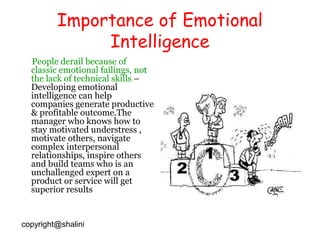
Importance of Emotional
Intelligence
People derail because of
classic emotional failings, not
the lack of technical skills –
Developing emotional
intelligence can help
companies generate productive
& profitable outcome.The
manager who knows how to
stay motivated understress ,
motivate others, navigate
complex interpersonal
relationships, inspire others
and build teams who is an
unchallenged expert on a
product or service will get
superior results

copyright@shalini
Components of Emotional
Intelligence
• There are five parts to it. One is knowing
what you're feeling. The second is
managing your feelings, especially
distressing feelings. The third is selfmotivation, the fourth is empathy and the
fifth is managing relationships

copyright@shalini
Probabilities of not having an Good Emotional
Intelligence and their consequences
While people have shown they can produce better results
at workplace, many of us lack emotional intelligence.We
simply don’t know how to perceive, understand,express
and manage our emotions effectively.There are adverse
consequences to have low emotional intelligence.These
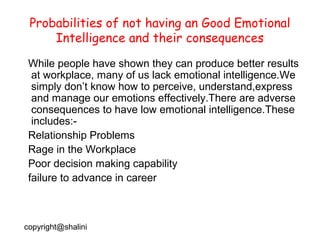
includes:Relationship Problems
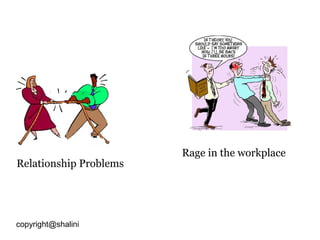
Rage in the Workplace
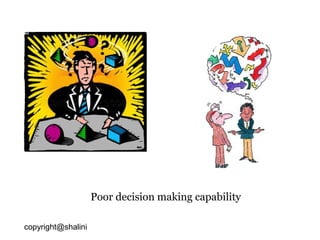
Poor decision making capability
failure to advance in career

copyright@shalini
Relationship Problems

copyright@shalini

Rage in the workplace
Poor decision making capability
copyright@shalini
failure to advance in career
copyright@shalini
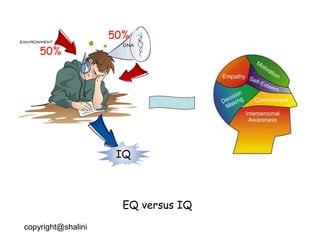
How EQ succedes IQ
• Emotional Intelligence explains why inspite of equal
intellectual capacity, educational background,training or
experience some people excel while others of same
caliber and high educational degree lag behind.
• Emotional Intelligence is the dimension of intelligence
responsible for our ability to manage ourselves and our
relationship with others.

copyright@shalini
EQ versus IQ
copyright@shalini
EQ verses IQ
• In the business world so much of emphasis has
been placed on intellect.Intellect has proven
invaluable invaluable to drive our success in
business.Process and procedures based on
analysis,logic,strategies are critically important
• However to get the higher level of competence in
business we must blend the progress that we
have made in using intellect & IQ with the
invaluable competencies of EQ.

copyright@shalini

Eq

  • 1.
    Need Emotional Intelligence isvery important for managers as it is one of the important deciding factor for relationship management resulting in motivation, retention , self management & managing others.
  • 2.
    Emotional Intelligence • EmotionalIntelligence is the ability of an individual to deal successfully with other people , to manage one’s self, motivate other people, understand one's own feelings and appropriately respond to the everyday environment copyright@shalini
  • 3.
    Emotional Intelligence • InWorking with Emotional Intelligence, author Daniel Goleman defines EI in the workplace as the ability of employees to recognise: • Their own feelings • The feelings of others • What motivates them • How to manage their emotions, both in themselves and in relationships with others copyright@shalini
  • 4.
    Emotional Intelligence • EmotionalIntelligence doesn't mean being soft – it means being intelligent about emotions – a different way of being smart. Emotional intelligence is your ability to acquire and apply knowledge from your emotions and the emotions of others in order to be more successful and lead a more fulfilling life. copyright@shalini
  • 5.
    Need • When ManagersFail, It is Usually Due To Poor Emotional Intelligence by Freda Turner copyright@shalini
  • 6.
    Bosses and leaders,in particular, need high EQ because they represent the organization to the public, they interact with the highest number of people within and outside the organization and they set the tone for employee morale, says Goleman copyright@shalini
  • 7.
    Leaders with empathyare able to understand their employees’ needs and provide them with constructive feedback, he says copyright@shalini
  • 8.
    Why Emotional Intelligenceis necessary for managers Helps managers handle adversity & setback copyright@shalini Teaches managers cope when change & uncertainty hits organisation or their personal lives.
  • 9.
    Why Emotional Intelligenceis necessary for managers Help them manage effective relationship. copyright@shalini Help them being focussed and stay on track by remembering purpose & vision.
  • 10.
    EQ & Managers •Emotional Intelligence is very important for managers as their behaviour & treatment of their people determine turnover and retention of the company.Managers & supervisors are the direct line of contact for the employees.They interact daily with individuals who have distinct needs, wants & expectations.They significantly influence the attitudes, performance & satisfaction of employees within their departments & other departments. copyright@shalini
  • 11.
    EQ is veryimportant for managers as they are direct line of contact & their behaviour & treatment determines retention & turnover copyright@shalini
  • 12.
    EQ & Managers •The stress of trying to lead and satisfy so many people's changing needs and expectations can be overwhelming, to say nothing of the demands from upper management. Being both firm and caring at the same time causes many to feel inadequate for the role.. copyright@shalini 85 % percent of turnover is reportedly due to an inadequate relationship between the employee and their direct supervisor
  • 13.
    When trust islacking performance suffers copyright@shalini
  • 14.
    EQ & Managers copyright@shalini EnhancingEI skills enables Supervisors and Managers to regulate their emotions and motivate themselves more effectively – allowing them to manage their own emotional turmoil effectively and demonstrate compassion and empathy for their employees.
  • 15.
    IT also providesthem with the courage to push against the system to make necessary changes for their people. copyright@shalini All employees want a supportive, caring Supervisor or Manager who has their best interests at heart
  • 16.
    EQ & Managers Knowingthis, the employee will be more likely to turndown offers from other companies to work for such a person. copyright@shalini
  • 17.
    Example to illustratehow EQ can positively or negatively impact one's career and the organization: She racked up a list of accomplishments Upon graduating from college, Debra believed that if she worked hard, she would achieve her career success goals copyright@shalini However, just two years into her career she was fired.
  • 18.
    Example to illustratehow EQ can positively or negatively impact one's career and the organization: • Debra Benton reports in her book, Lions Don't Need to Roar, "I was stunned ... college courses had not addressed the importance of people skills or being a team player. That lack of knowledge cost me my job." She thought work was all about producing results. While working with an outplacement firm, Debra met other high producers who had lost their jobs for the same reason. copyright@shalini That lack of people management cost her job
  • 19.
    The number one-factorthat sets high-powered professionals apart from the pack is a high level of emotional intelligence, compassion and energy to function in a team environment Debra soon learned that shooting stars have a short life cycle if they are unable to relate to and understand others. copyright@shalini
  • 20.
    An Example ofEQ Suppose that the morning of a big presentation you have a fight with any of your family member. Not a big argument— maybe just one of those unnerving spats about who forgot to pick up the dry cleaning—so your morning doesn’t get off on the right foot. Then you car is punctured upping your stress level a bit more. When you arrive at work, there’s a problem with the elevators, causing more delay. Arriving at the conference room for your presentation, you find that the sound system doesn’t work and the caterer hasn’t shown up with refreshments. Your junior associate—who was supposed to call the caterer—bears the brunt of your anger that has been building since you left the house. copyright@shalini
  • 21.
  • 22.
    Working with peoplemeans working with Emotions When people are working at a common place , emotions will play a role. theories to the contrary notwithstanding. “Don’t bring your personal problems to work” is one variation of the argument that emotions are inappropriate in the workplace. Business decisions, so the argument goes, should be based on information, logic and calm cool reason, with emotions kept to a minimum. copyright@shalini
  • 23.
    Managing Emotions atWorkplace • But it is unrealistic to suppose that emotions can be checked at the door when you arrive at work. Some people may assume, for a variety of reasons, that emotional neutrality is an ideal, and try to keep feelings out of sight. Such people work and relate in a certain way: usually they come across as rigid, detached or fearful, and fail to participate fully in the life of the workplace. This is not necessarily bad in some situations, but it is usually not good for an organization for such people to move into management roles. The same would be true for people who emote excessively, who tell you how they feel about everything. Simply being around them can be exhausting. copyright@shalini
  • 24.
    Developing EI inthe workplace • Developing emotional intelligence in the workplace means acknowledging that emotions are always present, and doing something intelligent with them. People vary enormously in the skill with which they use their own emotions and react to the emotions of others —and that can make the difference between a good manager and a bad one. copyright@shalini
  • 25.
    It’s not overlyegalitarian to suggest that most professionals, managers and executives are fairly smart people (of course there can be glaring exceptions), but there can be a huge difference in how well they handle people. That is, the department manager may be a genius in technical, product or service knowledge—and get failing marks in terms of people skills. copyright@shalini
  • 26.
  • 27.
    Importance of Emotional Intelligence Peoplederail because of classic emotional failings, not the lack of technical skills – Developing emotional intelligence can help companies generate productive & profitable outcome.The manager who knows how to stay motivated understress , motivate others, navigate complex interpersonal relationships, inspire others and build teams who is an unchallenged expert on a product or service will get superior results copyright@shalini
  • 28.
    Components of Emotional Intelligence •There are five parts to it. One is knowing what you're feeling. The second is managing your feelings, especially distressing feelings. The third is selfmotivation, the fourth is empathy and the fifth is managing relationships copyright@shalini
  • 29.
    Probabilities of nothaving an Good Emotional Intelligence and their consequences While people have shown they can produce better results at workplace, many of us lack emotional intelligence.We simply don’t know how to perceive, understand,express and manage our emotions effectively.There are adverse consequences to have low emotional intelligence.These includes:Relationship Problems Rage in the Workplace Poor decision making capability failure to advance in career copyright@shalini
  • 30.
  • 31.
    Poor decision makingcapability copyright@shalini
  • 32.
    failure to advancein career copyright@shalini
  • 33.
    How EQ succedesIQ • Emotional Intelligence explains why inspite of equal intellectual capacity, educational background,training or experience some people excel while others of same caliber and high educational degree lag behind. • Emotional Intelligence is the dimension of intelligence responsible for our ability to manage ourselves and our relationship with others. copyright@shalini
  • 34.
  • 35.
    EQ verses IQ •In the business world so much of emphasis has been placed on intellect.Intellect has proven invaluable invaluable to drive our success in business.Process and procedures based on analysis,logic,strategies are critically important • However to get the higher level of competence in business we must blend the progress that we have made in using intellect & IQ with the invaluable competencies of EQ. copyright@shalini