EMOTIONAL INTELLIGENCE
What are
emotions?
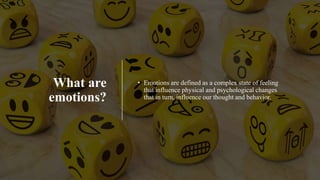
• Emotions are defined as a complex state of feeling
that influence physical and psychological changes
that in turn, influence our thought and behavior.
Why is it
important to
understand
emotions?
• Emotional awareness helps us know what we need
or want.
• They help us relate to other people.
• They help us keep healthy relationships with our
friends and family members.
• They improve our quality of life.
• They help us get more successful.
What is emotional
intelligence?
• The ability to identify, assess,
perceive, and process
emotional information and
use it in reasoning and other
cognitive activities.
• The level of an individual’s
emotional intelligence is
represented as a standardized
score on a test, known as the
emotional quotient (EQ).
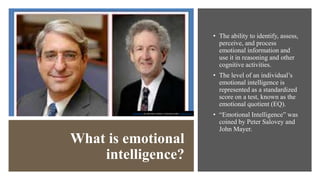
• “Emotional Intelligence” was
coined by Peter Salovey and
John Mayer.
This Photo by Unknown Author is licensed under CC BY-SA-NC
Salovey-Mayer
model of EI
• According to Salovey and Mayer, Emotional
Intelligence is the ability to process
information about your own emotions and
other people’s.
• For a person to be classified as emotionally
intelligent, he must possess four abilities.
Correct
perception of
emotions
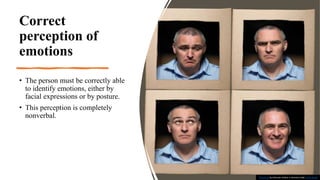
• The person must be correctly able
to identify emotions, either by
facial expressions or by posture.
• This perception is completely
nonverbal.
This Photo by Unknown Author is licensed under CC BY-SA-NC
Emotional facilitation
of thinking
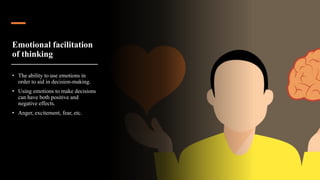
• The ability to use emotions in
order to aid in decision-making.
• Using emotions to make decisions
can have both positive and
negative effects.
• Anger, excitement, fear, etc.
Understanding
emotions
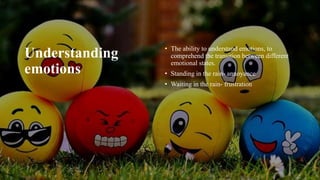
• The ability to understand emotions, to
comprehend the transition between different
emotional states.
• Standing in the rain- annoyance
• Waiting in the rain- frustration
Management
of emotions
The ability to manage emotions
effectively in order to complete a
task or achieve a goal.
This Photo by Unknown Author is licensed under CC BY-SA-NC
Importance of
Emotional Intelligence
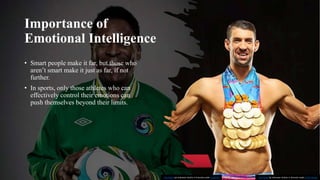
• Smart people make it far, but those who
aren’t smart make it just as far, if not
further.
• In sports, only those athletes who can
effectively control their emotions can
push themselves beyond their limits.
This Photo by Unknown Author is licensed under CC BY-NC-ND
This Photo by Unknown Author is licensed under CC BY-NC
Importance of
Emotional
Intelligence
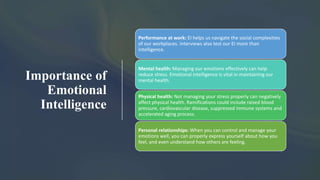
Performance at work: EI helps us navigate the social complexities
of our workplaces. Interviews also test our EI more than
intelligence.
Mental health: Managing our emotions effectively can help
reduce stress. Emotional intelligence is vital in maintaining our
mental health.
Physical health: Not managing your stress properly can negatively
affect physical health. Ramifications could include raised blood
pressure, cardiovascular disease, suppressed immune systems and
accelerated aging process.
Personal relationships: When you can control and manage your
emotions well, you can properly express yourself about how you
feel, and even understand how others are feeling.
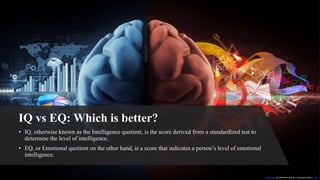
IQ vs EQ: Which is better?
• IQ, otherwise known as the Intelligence quotient, is the score derived from a standardized test to
determine the level of intelligence.
• EQ, or Emotional quotient on the other hand, is a score that indicates a person’s level of emotional
intelligence.
This Photo by Unknown Author is licensed under CC BY
IQ vs EQ: Which is better?
• Both are equally important to a person in life. IQ measures
our intelligence, our capacity for problem-solving and
logical reasoning, whereas EQ measures our ability to
comprehend emotions, empathy, self-awareness, and our
ability to interact with other people.
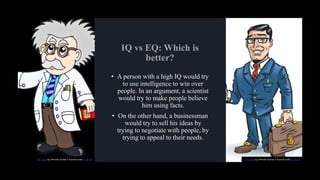
• A person with a high IQ would try
to use intelligence to win over
people. In an argument, a scientist
would try to make people believe
him using facts.
• On the other hand, a businessman
would try to sell his ideas by
trying to negotiate with people, by
trying to appeal to their needs.
This Photo by Unknown Author is licensed under CC BY-NC This Photo by Unknown Author is licensed under CC BY-SA
IQ vs EQ: Which is better?
• The Harvard Business Review calls emotional intelligence as one of the most influential business
ideas of the decade.
• Research done by Carnegie Institute of Technology reveals that 85% of the financial success is due
to how well a person can communicate their ideas, negotiate, and lead.
IQ vs EQ: Which is better?
• Nobel laureate Daniel Kahneman quotes:
People would rather do business with a person they like and trust,
rather than someone they don’t, even if the likeable person is offering a
lower quality product at a higher price.
This Photo by Unknown Author is licensed under CC BY-SA
IQ vs EQ: Which is better?
Neither is better, but both are necessary.
How to improve
EI?
• There are 5 key skills that must be practiced in order to improve upon your emotional
intelligence:
Reduce stress of the moment
Don’t let your emotions overwhelm you
Connect with others on an emotional level using nonverbal communication
The ability to use humor and play to deal with challenges
Relax and re-energize
This Photo by Unknown Author is licensed under CC BY-NC

Emotional intelligence: Salovey-Mayer model

  • 1.
  • 2.
    What are emotions? • Emotionsare defined as a complex state of feeling that influence physical and psychological changes that in turn, influence our thought and behavior.
  • 3.
    Why is it importantto understand emotions? • Emotional awareness helps us know what we need or want. • They help us relate to other people. • They help us keep healthy relationships with our friends and family members. • They improve our quality of life. • They help us get more successful.
  • 4.
    What is emotional intelligence? •The ability to identify, assess, perceive, and process emotional information and use it in reasoning and other cognitive activities. • The level of an individual’s emotional intelligence is represented as a standardized score on a test, known as the emotional quotient (EQ). • “Emotional Intelligence” was coined by Peter Salovey and John Mayer. This Photo by Unknown Author is licensed under CC BY-SA-NC
  • 5.
    Salovey-Mayer model of EI •According to Salovey and Mayer, Emotional Intelligence is the ability to process information about your own emotions and other people’s. • For a person to be classified as emotionally intelligent, he must possess four abilities.
  • 6.
    Correct perception of emotions • Theperson must be correctly able to identify emotions, either by facial expressions or by posture. • This perception is completely nonverbal. This Photo by Unknown Author is licensed under CC BY-SA-NC
  • 7.
    Emotional facilitation of thinking •The ability to use emotions in order to aid in decision-making. • Using emotions to make decisions can have both positive and negative effects. • Anger, excitement, fear, etc.
  • 8.
    Understanding emotions • The abilityto understand emotions, to comprehend the transition between different emotional states. • Standing in the rain- annoyance • Waiting in the rain- frustration
  • 9.
    Management of emotions The abilityto manage emotions effectively in order to complete a task or achieve a goal. This Photo by Unknown Author is licensed under CC BY-SA-NC
  • 10.
    Importance of Emotional Intelligence •Smart people make it far, but those who aren’t smart make it just as far, if not further. • In sports, only those athletes who can effectively control their emotions can push themselves beyond their limits. This Photo by Unknown Author is licensed under CC BY-NC-ND This Photo by Unknown Author is licensed under CC BY-NC
  • 11.
    Importance of Emotional Intelligence Performance atwork: EI helps us navigate the social complexities of our workplaces. Interviews also test our EI more than intelligence. Mental health: Managing our emotions effectively can help reduce stress. Emotional intelligence is vital in maintaining our mental health. Physical health: Not managing your stress properly can negatively affect physical health. Ramifications could include raised blood pressure, cardiovascular disease, suppressed immune systems and accelerated aging process. Personal relationships: When you can control and manage your emotions well, you can properly express yourself about how you feel, and even understand how others are feeling.
  • 12.
    IQ vs EQ:Which is better? • IQ, otherwise known as the Intelligence quotient, is the score derived from a standardized test to determine the level of intelligence. • EQ, or Emotional quotient on the other hand, is a score that indicates a person’s level of emotional intelligence. This Photo by Unknown Author is licensed under CC BY
  • 13.
    IQ vs EQ:Which is better? • Both are equally important to a person in life. IQ measures our intelligence, our capacity for problem-solving and logical reasoning, whereas EQ measures our ability to comprehend emotions, empathy, self-awareness, and our ability to interact with other people.
  • 14.
    • A personwith a high IQ would try to use intelligence to win over people. In an argument, a scientist would try to make people believe him using facts. • On the other hand, a businessman would try to sell his ideas by trying to negotiate with people, by trying to appeal to their needs. This Photo by Unknown Author is licensed under CC BY-NC This Photo by Unknown Author is licensed under CC BY-SA
  • 15.
    IQ vs EQ:Which is better? • The Harvard Business Review calls emotional intelligence as one of the most influential business ideas of the decade. • Research done by Carnegie Institute of Technology reveals that 85% of the financial success is due to how well a person can communicate their ideas, negotiate, and lead.
  • 16.
    IQ vs EQ:Which is better? • Nobel laureate Daniel Kahneman quotes: People would rather do business with a person they like and trust, rather than someone they don’t, even if the likeable person is offering a lower quality product at a higher price. This Photo by Unknown Author is licensed under CC BY-SA
  • 17.
    IQ vs EQ:Which is better? Neither is better, but both are necessary.
  • 18.
    How to improve EI? •There are 5 key skills that must be practiced in order to improve upon your emotional intelligence: Reduce stress of the moment Don’t let your emotions overwhelm you Connect with others on an emotional level using nonverbal communication The ability to use humor and play to deal with challenges Relax and re-energize
  • 19.
    This Photo byUnknown Author is licensed under CC BY-NC