Presented by:-
Anima Singh Dhabal
Content
• Artificial intelligence
• Machine learning
• Data science
• Deep learning
• How deep learning works
• Deep learning requirements
• Difference between AI, ML, DL
• ML Vs. DL
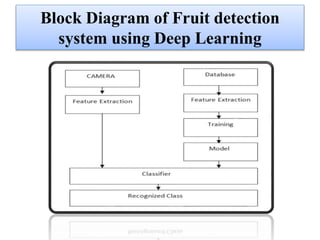
• Fruit detection system using deep neural network
• Block diagram of fruit detection system using deep learning
• Conclusion
Is Artificial Intelligence,
Machine Learning and
Deep Learning the same
thing?
Artificial Intelligence
• AI is any technique, code or algorithm that enables machine to
develop, demonstrate and mimic human cognitive behaviour or
intelligence and hence the name “Artificial Intelligence”.
• AI doesn’t mean that everything machines will be doing, rather AI can
be better represented as “Augmented Intelligence” i.e., Man-Machine
to solve business problems better and faster.
• AI won’t replace managers, but managers who use AI will replace
those who don’t.
• Some of the most successful applications of AI around us can be seen in
robotics, computer vision, virtual reality, speech recognition,
automation, gaming and so on..
Machine Learning
• Machine Learning is the sub field of AI, which gives machines the
ability to improve its performance over time without explicit
intervention or help from the human being.
• In this approach, machines are shown thousands or millions of
examples and trained how to correctly solve a problem.
• Most of the current applications of the machine learning leverage
supervised learning.
• Other usage of ML can be broadly classified between unsupervised
learning and reinforced learning.
Data Science
• Data Science is a field which intersects AI, Machine Learning and
Deep Learning and enables statistically driven decision making.
• Data Science is the art and science of drawing actionable insights from
the data.
• Data Science + Business Knowledge + Impact/Value creation for the
Business.
• Generally speaking, Data Scientists and analytics professionals try to
answer following questions via their analysis:
• Descriptive analytics( what has happened?)
• Diagnostic analytics(why it has happened?)
• Predictive analytics(what may happen in future?)
Deep Learning
• Deep learning is a subfield of machine learning that very closely tries
to mimic human brain’s working using neurons.
• These techniques focus on building artificial neural networks(ANN)
using several hidden layers.
• There are variety of deep learning networks such as multilayer
perceptron(MLP), Auto encoders(AE), Convolution neural
network(CNN), recurrent neural network(RNN).
Deep Learning is the fastest
growing technology of AI
How Deep Learning Works
• If I give you images of horses, you recognize them as horses,
even if you’ve never seen that image before. And it doesn’t
matter if the horse is lying on a sofa, or dressed up for
Halloween as a hippo. You can recognize a horse because you
know about the various elements that define a horse: shape of its
muzzle, number and placement of legs, and so on.
• Deep learning can do this. And it’s important for many things
including autonomous vehicles. Before a car can determine its
next action, it needs to know what’s around it. It must be able to
recognize people, bikes, other vehicles, road signs, and more.
And do so in challenging visual circumstances. Standard
machine learning techniques can’t do that.
Deep Learning Requirements
• Over the period of time, more drive for automation, AI( e.g..
Autonomous Car).
• Some problem cannot be mathematically programmed exclusively,
instead making machines learning by itself. e.g..Face recognition.
• Over the period, percentage of unstructured data has grown to about
90% of total data. E.g.. Pictures, YouTube videos, twitter chats,
Watsapp logs etc. Deep Learning is well suited for picture, audio and
speech/language processing etc.
• Highly non linear models can be fitted on Big Data without much issue
of over fitting.
• High capacity computational power for cheap makes the tedious
calculations very possible to implement.
Difference between AI, Machine
Learning, Deep Learning
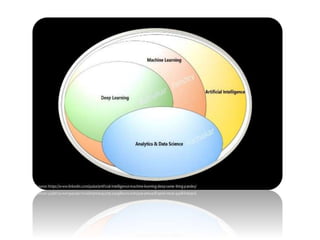
• The easiest way to think of their relationship is to visualize them as
concentric circles with AI — the idea that came first — the largest,
then machine learning — which blossomed later, and finally deep
learning — which is driving today’s AI explosion — fitting inside both.
• “Machine Learning is a technique of parsing data, learn from that
data and then apply what they have learned to make an informed
decision.”
“Deep learning is actually a subset of machine learning. It technically
is machine learning and functions in the same way but it has different
capabilities.”
“AI is a ability of computer program to function like a human brain.”
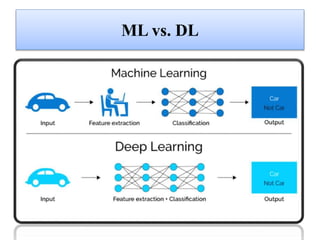
• The main difference between deep and machine learning
is, machine learning models become better progressively
but the model still needs some guidance. If a machine
learning model returns an inaccurate prediction then the
programmer needs to fix that problem explicitly but in the
case of deep learning, the model does it by himself.
Automatic car driving system is a good example of deep
learning.
• Let’s understand it with the help of a figure:-
ML vs. DL
Fruit Detection System Using Deep
Neural Networks
• Fruit detection system is a system for automatic harvesting of fruits.
The system was implemented to detect the matured strawberry fruits
from the plants , so that the robots could plug the fruits from the plants
and collect on the tray. This image processing system used matlab for
image processing. We have used deep neural networks for training
.The proposed algorithm works well and compared with other
algorithms in terms of accuracy.
Block Diagram of Fruit detection
system using Deep Learning
Conclusion
Deep Learning gets its name from how it’s used to analyze
“unstructured” data, or data that hasn’t been previously labelled by
another source and may need definition. That requires careful analysis
of what the data is, and repeated tests of that data to end up with a
final, usable conclusion. Computers are not traditionally good at
analyzing unstructured data like this.
THANK YOU

Deep learning

  • 1.
  • 2.
    Content • Artificial intelligence •Machine learning • Data science • Deep learning • How deep learning works • Deep learning requirements • Difference between AI, ML, DL • ML Vs. DL • Fruit detection system using deep neural network • Block diagram of fruit detection system using deep learning • Conclusion
  • 3.
    Is Artificial Intelligence, MachineLearning and Deep Learning the same thing?
  • 5.
    Artificial Intelligence • AIis any technique, code or algorithm that enables machine to develop, demonstrate and mimic human cognitive behaviour or intelligence and hence the name “Artificial Intelligence”. • AI doesn’t mean that everything machines will be doing, rather AI can be better represented as “Augmented Intelligence” i.e., Man-Machine to solve business problems better and faster. • AI won’t replace managers, but managers who use AI will replace those who don’t. • Some of the most successful applications of AI around us can be seen in robotics, computer vision, virtual reality, speech recognition, automation, gaming and so on..
  • 6.
    Machine Learning • MachineLearning is the sub field of AI, which gives machines the ability to improve its performance over time without explicit intervention or help from the human being. • In this approach, machines are shown thousands or millions of examples and trained how to correctly solve a problem. • Most of the current applications of the machine learning leverage supervised learning. • Other usage of ML can be broadly classified between unsupervised learning and reinforced learning.
  • 7.
    Data Science • DataScience is a field which intersects AI, Machine Learning and Deep Learning and enables statistically driven decision making. • Data Science is the art and science of drawing actionable insights from the data. • Data Science + Business Knowledge + Impact/Value creation for the Business. • Generally speaking, Data Scientists and analytics professionals try to answer following questions via their analysis: • Descriptive analytics( what has happened?) • Diagnostic analytics(why it has happened?) • Predictive analytics(what may happen in future?)
  • 8.
    Deep Learning • Deeplearning is a subfield of machine learning that very closely tries to mimic human brain’s working using neurons. • These techniques focus on building artificial neural networks(ANN) using several hidden layers. • There are variety of deep learning networks such as multilayer perceptron(MLP), Auto encoders(AE), Convolution neural network(CNN), recurrent neural network(RNN).
  • 9.
    Deep Learning isthe fastest growing technology of AI
  • 10.
    How Deep LearningWorks • If I give you images of horses, you recognize them as horses, even if you’ve never seen that image before. And it doesn’t matter if the horse is lying on a sofa, or dressed up for Halloween as a hippo. You can recognize a horse because you know about the various elements that define a horse: shape of its muzzle, number and placement of legs, and so on. • Deep learning can do this. And it’s important for many things including autonomous vehicles. Before a car can determine its next action, it needs to know what’s around it. It must be able to recognize people, bikes, other vehicles, road signs, and more. And do so in challenging visual circumstances. Standard machine learning techniques can’t do that.
  • 11.
    Deep Learning Requirements •Over the period of time, more drive for automation, AI( e.g.. Autonomous Car). • Some problem cannot be mathematically programmed exclusively, instead making machines learning by itself. e.g..Face recognition. • Over the period, percentage of unstructured data has grown to about 90% of total data. E.g.. Pictures, YouTube videos, twitter chats, Watsapp logs etc. Deep Learning is well suited for picture, audio and speech/language processing etc. • Highly non linear models can be fitted on Big Data without much issue of over fitting. • High capacity computational power for cheap makes the tedious calculations very possible to implement.
  • 12.
    Difference between AI,Machine Learning, Deep Learning • The easiest way to think of their relationship is to visualize them as concentric circles with AI — the idea that came first — the largest, then machine learning — which blossomed later, and finally deep learning — which is driving today’s AI explosion — fitting inside both. • “Machine Learning is a technique of parsing data, learn from that data and then apply what they have learned to make an informed decision.” “Deep learning is actually a subset of machine learning. It technically is machine learning and functions in the same way but it has different capabilities.” “AI is a ability of computer program to function like a human brain.”
  • 13.
    • The maindifference between deep and machine learning is, machine learning models become better progressively but the model still needs some guidance. If a machine learning model returns an inaccurate prediction then the programmer needs to fix that problem explicitly but in the case of deep learning, the model does it by himself. Automatic car driving system is a good example of deep learning. • Let’s understand it with the help of a figure:-
  • 14.
  • 15.
    Fruit Detection SystemUsing Deep Neural Networks • Fruit detection system is a system for automatic harvesting of fruits. The system was implemented to detect the matured strawberry fruits from the plants , so that the robots could plug the fruits from the plants and collect on the tray. This image processing system used matlab for image processing. We have used deep neural networks for training .The proposed algorithm works well and compared with other algorithms in terms of accuracy.
  • 16.
    Block Diagram ofFruit detection system using Deep Learning
  • 17.
    Conclusion Deep Learning getsits name from how it’s used to analyze “unstructured” data, or data that hasn’t been previously labelled by another source and may need definition. That requires careful analysis of what the data is, and repeated tests of that data to end up with a final, usable conclusion. Computers are not traditionally good at analyzing unstructured data like this.
  • 18.