
Emission
Standards
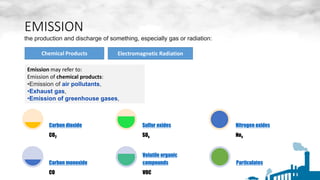
EMISSION
the production and discharge of something, especially gas or radiation:
Emission may refer to:
Emission of chemical products:
•Emission of air pollutants,
•Exhaust gas,
•Emission of greenhouse gases,
Chemical Products Electromagnetic Radiation
CO2
Carbon dioxide
SOx
Sulfur oxides
Nox
Nitrogen oxides
CO
Carbon monoxide
VOC
Volatile organic
compounds Particulates
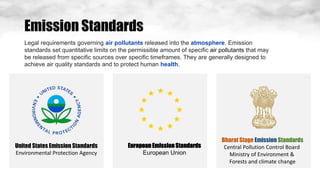
Emission Standards
Legal requirements governing air pollutants released into the atmosphere. Emission
standards set quantitative limits on the permissible amount of specific air pollutants that may
be released from specific sources over specific timeframes. They are generally designed to
achieve air quality standards and to protect human health.
United States Emission Standards
Environmental Protection Agency
EuropeanEmissionStandards
European Union
Bharat Stage Emission Standards
Central Pollution Control Board
Ministry of Environment &
Forests and climate change
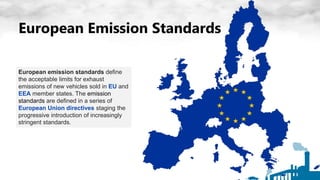
European Emission Standards
European emission standards define
the acceptable limits for exhaust
emissions of new vehicles sold in EU and
EEA member states. The emission
standards are defined in a series of
European Union directives staging the
progressive introduction of increasingly
stringent standards.
Bharat Stage Emission Standards
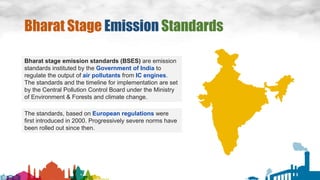
Bharat stage emission standards (BSES) are emission
standards instituted by the Government of India to
regulate the output of air pollutants from IC engines.
The standards and the timeline for implementation are set
by the Central Pollution Control Board under the Ministry
of Environment & Forests and climate change.
The standards, based on European regulations were
first introduced in 2000. Progressively severe norms have
been rolled out since then.
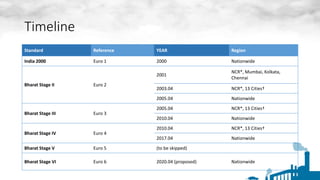
Standard Reference YEAR Region
India 2000 Euro 1 2000 Nationwide
Bharat Stage II Euro 2
2001
NCR*, Mumbai, Kolkata,
Chennai
2003.04 NCR*, 13 Cities†
2005.04 Nationwide
Bharat Stage III Euro 3
2005.04 NCR*, 13 Cities†
2010.04 Nationwide
Bharat Stage IV Euro 4
2010.04 NCR*, 13 Cities†
2017.04 Nationwide
Bharat Stage V Euro 5 (to be skipped)
Bharat Stage VI Euro 6 2020.04 (proposed) Nationwide
Timeline
India 2000
Standard Reference YEAR Region
India 2000 Euro 1 2000 Nationwide
The first European legislation on exhaust emissions was
introduced in 1970, but the first European-wide standard,
called Euro 1, didn’t arrive until 1992. Approved in July 1992
and registration from 1993.
The first emission norms were introduced in India in 1991 for
petrol and 1992 for diesel vehicles.
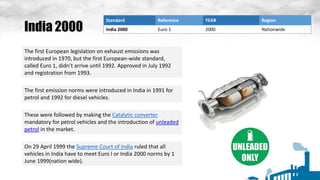
These were followed by making the Catalytic converter
mandatory for petrol vehicles and the introduction of unleaded
petrol in the market.
On 29 April 1999 the Supreme Court of India ruled that all
vehicles in India have to meet Euro I or India 2000 norms by 1
June 1999(nation wide).
Bharat Stage II
Standard Reference YEAR Region
Bharat Stage II Euro 2 2005 Nationwide
Bharat Stage III
Standard Reference YEAR Region
Bharat Stage III Euro 3 2010 Nationwide
BS 2 standards introduced different
emissions limits for petrol and diesel
engines and reduced the acceptable
levels of all four major emissions
across the board.
Main reason for the reduction in the
emission limits is because of
increase in the number of vehicles.
Introduced separate limits for
hydrocarbons and nitrogen oxide
emissions for petrol engines, and a
separate nitrogen oxide limit for
diesel engines.
Exhaust emissions from diesel
power vehicles have comparatively
low carbon monoxide and unburned
hydrocarbons while nitrogen oxide is
present in high concentrations.
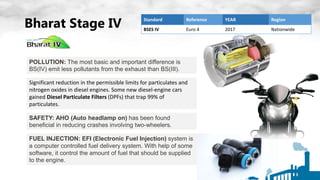
Bharat Stage IV Standard Reference YEAR Region
BSES IV Euro 4 2017 Nationwide
Significant reduction in the permissible limits for particulates and
nitrogen oxides in diesel engines. Some new diesel-engine cars
gained Diesel Particulate Filters (DPFs) that trap 99% of
particulates.
POLLUTION: The most basic and important difference is
BS(IV) emit less pollutants from the exhaust than BS(III).
SAFETY: AHO (Auto headlamp on) has been found
beneficial in reducing crashes involving two-wheelers.
FUEL INJECTION: EFI (Electronic Fuel Injection) system is
a computer controlled fuel delivery system. With help of some
software, it control the amount of fuel that should be supplied
to the engine.
Bharat Stage VI
Standard Reference YEAR Region
BSES VI Euro 6 2020 Nationwide
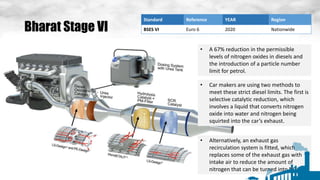
• A 67% reduction in the permissible
levels of nitrogen oxides in diesels and
the introduction of a particle number
limit for petrol.
• Car makers are using two methods to
meet these strict diesel limits. The first is
selective catalytic reduction, which
involves a liquid that converts nitrogen
oxide into water and nitrogen being
squirted into the car’s exhaust.
• Alternatively, an exhaust gas
recirculation system is fitted, which
replaces some of the exhaust gas with
intake air to reduce the amount of
nitrogen that can be turned into NOx.
India To Skip BS-V
"Most car manufacturers in India are making Euro 6 compliant engines in India and exporting them.
They have the technology available and time till 2020," said transport minister Nitin Gadkari.
Bharat Stage-VI is equivalent to Euro 6 emission norms.
The Oil Ministry has assured the supply of Bharat Stage-
VI fuel to meet this promise. For this, two-thirds of
India's state-owned refineries will need upgradation and
the government says it will cost them ₹ 60,000 crores.
According to the Centre for Science and Environment,
the move to Bharat Stage-VI will bring down NOx
emissions from diesel cars by 68% and 25% from petrol
engine cars. Cancer causing particulate matter
emissions from diesel engine cars will also come down
by a phenomenal 80%.
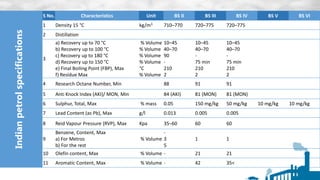
Indianpetrolspecifications S No. Characteristics Unit BS II BS III BS IV BS V BS VI
1 Density 15 °C kg/m3 710–770 720–775 720–775
2 Distillation
3
a) Recovery up to 70 °C
b) Recovery up to 100 °C
c) Recovery up to 180 °C
d) Recovery up to 150 °C
e) Final Boiling Point (FBP), Max
f) Residue Max
% Volume
% Volume
% Volume
% Volume
°C
% Volume
10–45
40–70
90
-
210
2
10–45
40–70
-
75 min
210
2
10–45
40–70
-
75 min
210
2
4 Research Octane Number, Min 88 91 91
5 Anti Knock Index (AKI)/ MON, Min 84 (AKI) 81 (MON) 81 (MON)
6 Sulphur, Total, Max % mass 0.05 150 mg/kg 50 mg/kg 10 mg/kg 10 mg/kg
7 Lead Content (as Pb), Max g/l 0.013 0.005 0.005
8 Reid Vapour Pressure (RVP), Max Kpa 35–60 60 60
9
Benzene, Content, Max
a) For Metros
b) For the rest
% Volume
-
3
5
1 1
10 Olefin content, Max % Volume - 21 21
11 Aromatic Content, Max % Volume - 42 35<
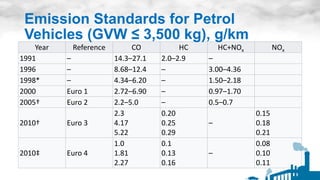
Year Reference CO HC HC+NOx NOx
1991 – 14.3–27.1 2.0–2.9 –
1996 – 8.68–12.4 – 3.00–4.36
1998* – 4.34–6.20 – 1.50–2.18
2000 Euro 1 2.72–6.90 – 0.97–1.70
2005† Euro 2 2.2–5.0 – 0.5–0.7
2010† Euro 3
2.3
4.17
5.22
0.20
0.25
0.29
–
0.15
0.18
0.21
2010‡ Euro 4
1.0
1.81
2.27
0.1
0.13
0.16
–
0.08
0.10
0.11
Emission Standards for Petrol
Vehicles (GVW ≤ 3,500 kg), g/km
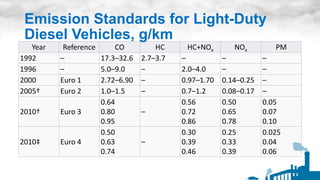
Year Reference CO HC HC+NOx NOx PM
1992 – 17.3–32.6 2.7–3.7 – – –
1996 – 5.0–9.0 – 2.0–4.0 – –
2000 Euro 1 2.72–6.90 – 0.97–1.70 0.14–0.25 –
2005† Euro 2 1.0–1.5 – 0.7–1.2 0.08–0.17 –
2010† Euro 3
0.64
0.80
0.95
–
0.56
0.72
0.86
0.50
0.65
0.78
0.05
0.07
0.10
2010‡ Euro 4
0.50
0.63
0.74
–
0.30
0.39
0.46
0.25
0.33
0.39
0.025
0.04
0.06
Emission Standards for Light-Duty
Diesel Vehicles, g/km
Thank You

Emission Standards

  • 1.
  • 2.
    EMISSION the production anddischarge of something, especially gas or radiation: Emission may refer to: Emission of chemical products: •Emission of air pollutants, •Exhaust gas, •Emission of greenhouse gases, Chemical Products Electromagnetic Radiation CO2 Carbon dioxide SOx Sulfur oxides Nox Nitrogen oxides CO Carbon monoxide VOC Volatile organic compounds Particulates
  • 3.
    Emission Standards Legal requirementsgoverning air pollutants released into the atmosphere. Emission standards set quantitative limits on the permissible amount of specific air pollutants that may be released from specific sources over specific timeframes. They are generally designed to achieve air quality standards and to protect human health. United States Emission Standards Environmental Protection Agency EuropeanEmissionStandards European Union Bharat Stage Emission Standards Central Pollution Control Board Ministry of Environment & Forests and climate change
  • 4.
    European Emission Standards Europeanemission standards define the acceptable limits for exhaust emissions of new vehicles sold in EU and EEA member states. The emission standards are defined in a series of European Union directives staging the progressive introduction of increasingly stringent standards.
  • 5.
    Bharat Stage EmissionStandards Bharat stage emission standards (BSES) are emission standards instituted by the Government of India to regulate the output of air pollutants from IC engines. The standards and the timeline for implementation are set by the Central Pollution Control Board under the Ministry of Environment & Forests and climate change. The standards, based on European regulations were first introduced in 2000. Progressively severe norms have been rolled out since then.
  • 6.
    Standard Reference YEARRegion India 2000 Euro 1 2000 Nationwide Bharat Stage II Euro 2 2001 NCR*, Mumbai, Kolkata, Chennai 2003.04 NCR*, 13 Cities† 2005.04 Nationwide Bharat Stage III Euro 3 2005.04 NCR*, 13 Cities† 2010.04 Nationwide Bharat Stage IV Euro 4 2010.04 NCR*, 13 Cities† 2017.04 Nationwide Bharat Stage V Euro 5 (to be skipped) Bharat Stage VI Euro 6 2020.04 (proposed) Nationwide Timeline
  • 7.
    India 2000 Standard ReferenceYEAR Region India 2000 Euro 1 2000 Nationwide The first European legislation on exhaust emissions was introduced in 1970, but the first European-wide standard, called Euro 1, didn’t arrive until 1992. Approved in July 1992 and registration from 1993. The first emission norms were introduced in India in 1991 for petrol and 1992 for diesel vehicles. These were followed by making the Catalytic converter mandatory for petrol vehicles and the introduction of unleaded petrol in the market. On 29 April 1999 the Supreme Court of India ruled that all vehicles in India have to meet Euro I or India 2000 norms by 1 June 1999(nation wide).
  • 8.
    Bharat Stage II StandardReference YEAR Region Bharat Stage II Euro 2 2005 Nationwide Bharat Stage III Standard Reference YEAR Region Bharat Stage III Euro 3 2010 Nationwide BS 2 standards introduced different emissions limits for petrol and diesel engines and reduced the acceptable levels of all four major emissions across the board. Main reason for the reduction in the emission limits is because of increase in the number of vehicles. Introduced separate limits for hydrocarbons and nitrogen oxide emissions for petrol engines, and a separate nitrogen oxide limit for diesel engines. Exhaust emissions from diesel power vehicles have comparatively low carbon monoxide and unburned hydrocarbons while nitrogen oxide is present in high concentrations.
  • 9.
    Bharat Stage IVStandard Reference YEAR Region BSES IV Euro 4 2017 Nationwide Significant reduction in the permissible limits for particulates and nitrogen oxides in diesel engines. Some new diesel-engine cars gained Diesel Particulate Filters (DPFs) that trap 99% of particulates. POLLUTION: The most basic and important difference is BS(IV) emit less pollutants from the exhaust than BS(III). SAFETY: AHO (Auto headlamp on) has been found beneficial in reducing crashes involving two-wheelers. FUEL INJECTION: EFI (Electronic Fuel Injection) system is a computer controlled fuel delivery system. With help of some software, it control the amount of fuel that should be supplied to the engine.
  • 10.
    Bharat Stage VI StandardReference YEAR Region BSES VI Euro 6 2020 Nationwide • A 67% reduction in the permissible levels of nitrogen oxides in diesels and the introduction of a particle number limit for petrol. • Car makers are using two methods to meet these strict diesel limits. The first is selective catalytic reduction, which involves a liquid that converts nitrogen oxide into water and nitrogen being squirted into the car’s exhaust. • Alternatively, an exhaust gas recirculation system is fitted, which replaces some of the exhaust gas with intake air to reduce the amount of nitrogen that can be turned into NOx.
  • 11.
    India To SkipBS-V "Most car manufacturers in India are making Euro 6 compliant engines in India and exporting them. They have the technology available and time till 2020," said transport minister Nitin Gadkari. Bharat Stage-VI is equivalent to Euro 6 emission norms. The Oil Ministry has assured the supply of Bharat Stage- VI fuel to meet this promise. For this, two-thirds of India's state-owned refineries will need upgradation and the government says it will cost them ₹ 60,000 crores. According to the Centre for Science and Environment, the move to Bharat Stage-VI will bring down NOx emissions from diesel cars by 68% and 25% from petrol engine cars. Cancer causing particulate matter emissions from diesel engine cars will also come down by a phenomenal 80%.
  • 12.
    Indianpetrolspecifications S No.Characteristics Unit BS II BS III BS IV BS V BS VI 1 Density 15 °C kg/m3 710–770 720–775 720–775 2 Distillation 3 a) Recovery up to 70 °C b) Recovery up to 100 °C c) Recovery up to 180 °C d) Recovery up to 150 °C e) Final Boiling Point (FBP), Max f) Residue Max % Volume % Volume % Volume % Volume °C % Volume 10–45 40–70 90 - 210 2 10–45 40–70 - 75 min 210 2 10–45 40–70 - 75 min 210 2 4 Research Octane Number, Min 88 91 91 5 Anti Knock Index (AKI)/ MON, Min 84 (AKI) 81 (MON) 81 (MON) 6 Sulphur, Total, Max % mass 0.05 150 mg/kg 50 mg/kg 10 mg/kg 10 mg/kg 7 Lead Content (as Pb), Max g/l 0.013 0.005 0.005 8 Reid Vapour Pressure (RVP), Max Kpa 35–60 60 60 9 Benzene, Content, Max a) For Metros b) For the rest % Volume - 3 5 1 1 10 Olefin content, Max % Volume - 21 21 11 Aromatic Content, Max % Volume - 42 35<
  • 13.
    Year Reference COHC HC+NOx NOx 1991 – 14.3–27.1 2.0–2.9 – 1996 – 8.68–12.4 – 3.00–4.36 1998* – 4.34–6.20 – 1.50–2.18 2000 Euro 1 2.72–6.90 – 0.97–1.70 2005† Euro 2 2.2–5.0 – 0.5–0.7 2010† Euro 3 2.3 4.17 5.22 0.20 0.25 0.29 – 0.15 0.18 0.21 2010‡ Euro 4 1.0 1.81 2.27 0.1 0.13 0.16 – 0.08 0.10 0.11 Emission Standards for Petrol Vehicles (GVW ≤ 3,500 kg), g/km
  • 14.
    Year Reference COHC HC+NOx NOx PM 1992 – 17.3–32.6 2.7–3.7 – – – 1996 – 5.0–9.0 – 2.0–4.0 – – 2000 Euro 1 2.72–6.90 – 0.97–1.70 0.14–0.25 – 2005† Euro 2 1.0–1.5 – 0.7–1.2 0.08–0.17 – 2010† Euro 3 0.64 0.80 0.95 – 0.56 0.72 0.86 0.50 0.65 0.78 0.05 0.07 0.10 2010‡ Euro 4 0.50 0.63 0.74 – 0.30 0.39 0.46 0.25 0.33 0.39 0.025 0.04 0.06 Emission Standards for Light-Duty Diesel Vehicles, g/km
  • 15.