N A M E : W A N S U K L A N G
K H O N G J I
S E C : F
BS-4 INDUSTRIES
INTRODUCTION
 India has the most polluted cities in the world. 30 Indian cities figure in the Top 100
Most Polluted Global Cities (in terms of particulate matter PM10) as per data
published by World Health Organization in May 2016. Air pollution is the fifth
leading cause of death in India.
 India has traditionally been a laggard in terms of enforcing and implementing
emission norms for the manufacturing sector. Indian auto industry is not an
exception to this either. For instance in the capital city of Delhi, vehicles contribute
59%, 50% and 18% of the overall emissions of carbon monoxide, hydrocarbons and
nitrous oxides respectively.
 There is a strong opinion emerging among policy makers and environmental groups
in India that stricter emission standards need to be implemented for all kind of
vehicles in the country.
 Story of vehicle emission controls began in India when mass emission norms were
enforced for the first time for petrol vehicles in 1991 and for diesel vehicles in 1992.
Emission norms were further tightened in 1996 with the compulsory fitment of
catalytic converters in petrol cars. Bharat Stage emission norms (equivalent to Euro
norms for four-wheeled vehicles) were first introduced in 2000. These norms
specify the maximum permissible emission limit for carbon monoxide (CO),
hydrocarbons (HC), nitrous oxides (NOx) and particulate matter (PM).
WHAT IS BS4?
 BS is basically the emission standards given by
Government of India to regulate the air pollutants
coming from internal combustion engine. BS stands for
Bharat Stage and are set by the central pollution control
board. BS standard is generally applicable to all the
vehicles that are running in the country.
 You may have heard of other standards like Euro… in
Europe and Tier 1, Tier 2, used in USA.
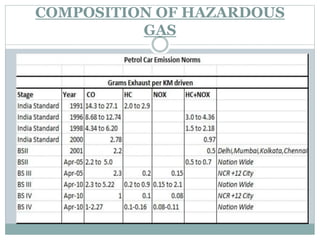
 More the number assigned, less air polluting the engine
or less pollutants, the engine is releasing. In India, the BS
4 Engines are applied for the NCR and some other cities
while, BS 3 Engines are applied nation wide. Although, in
coming years the BS4 engines will be applied nationwide
i.e. the manufacturing of BS3 engines will stop.
COMPOSITION OF HAZARDOUS
GAS
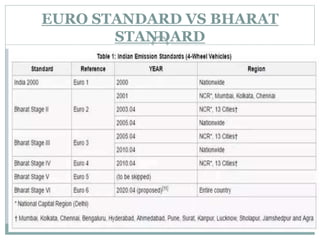
EURO STANDARD VS BHARAT
STANDARD
EFFECTS ON AUTO INDUSTRY
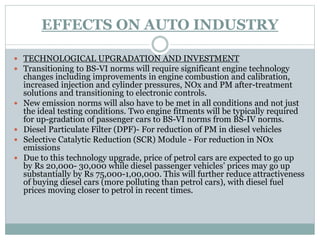
 TECHNOLOGICAL UPGRADATION AND INVESTMENT
 Transitioning to BS-VI norms will require significant engine technology
changes including improvements in engine combustion and calibration,
increased injection and cylinder pressures, NOx and PM after-treatment
solutions and transitioning to electronic controls.
 New emission norms will also have to be met in all conditions and not just
the ideal testing conditions. Two engine fitments will be typically required
for up-gradation of passenger cars to BS-VI norms from BS-IV norms.
 Diesel Particulate Filter (DPF)- For reduction of PM in diesel vehicles
 Selective Catalytic Reduction (SCR) Module - For reduction in NOx
emissions
 Due to this technology upgrade, price of petrol cars are expected to go up
by Rs 20,000- 30,000 while diesel passenger vehicles’ prices may go up
substantially by Rs 75,000-1,00,000. This will further reduce attractiveness
of buying diesel cars (more polluting than petrol cars), with diesel fuel
prices moving closer to petrol in recent times.
EFFECTS ON AUTO INDUSTRY
More Complex, Electronic Vehicles
A lot of changes in engine electronics will also be required. ECUs will be
required for monitoring the increasing complexity in the engine and measuring
the emissions on a real-time basis.
For achieving the specified emissions targets, all reactions will have to be
controlled by microprocessors. Increased electronic content per car is good
news for domestic and MNC auto electronics players. Testing & measurement
vendors providing capabilities like ECU testing, emission testing and fuel
systems testing are also likely to benefit a lot.
Addition of new engine and exhaust parts are making cars increasingly
complex, making serviceability a big challenge. Neighbourhood service
workshops will no longer have the sophisticated skills required to repair the
cars of tomorrow and will likely go out of business.
WHAT WILL HAPPEN TO THE PRICE?
 Given the quantum jump in fuel emission technology, the direct
impact of this regulatory change is that vehicle prices will increase by
10-12 percent. This is largely because the powertrain will see major
changes and truck operators will have to buy AdBlue and urea dose
from time to time for maintenance
 .Usage of SCR (Selective Catalytic Reduction) requires urea to be filled
after certain intervals and this will see operating costs rise by up to 2
percent. To avoid this, fleet owners will try to prepone buying in the last
quarter of this fiscal year. This may lead to a jump in volume in Q4
FY2017 and a decline in next-year volumes in the range of 10-15
percent.
 In the near-term, aftersales service and maintenance will see higher
cost in BS IV-compliant vehicles as the electronics content in them will
be higher and the ability of independent mechanics to service such
vehicles will drop initially
.
STEPS TAKEN FOR BS4
 . OEMs have been working on this front to avoid an inefficient
customer response in the event of vehicle failure. For example,
Tata Motors – along with its engine partner Cummins – has
already started intensive training programmes in over 1,000
locations across the country to train service technicians of its
dealers and service network
 OBD enables diagnosis and repair of complex electronic
engine controls, keeps emissions low by early identification of
controls that needs repair, and is a life-long solution for the
vehicle. Also, in a bid to be prepared for better aftersales and
service experience, OEMs are equipping and training roadside
mechanics to conduct primary diagnostics so that a truck can
travel to the nearest service station where it can get
comprehensive service
WHAT SHOULD BE EXPECTED IN FUTURE?
 As of now, BS IV will be implemented from April 1, 2017.
Those looking to purchase a vehicle will have to spend a
higher amount than before to own one.
 But, the larger aim for the automotive sector as a whole is
to implement BS VI emission regulation by the year 2020
in India. Yes, BS VI and yes, BS V will be skipped.
This will require a huge amount of investments to make the
oil refineries capable of producing a better quality of fuel
and also investments in the infrastructure to make that fuel
available across the country.
WHAT SHOULD BE EXPECTED IN FUTURE?
 Then, the automakers will have to make investments
on their end too in order to speed up the research and
development process and improve their own
infrastructure – like the manufacturing plants – to
make their offering BS VI compliant.
 This, eventually, will make owning an internal
combustion engine powered car more expensive to
own, and maintain.
 To sum it up, India is making an effort to reach the
global standards and hence, a lot of changes in the
trends, sales and choices made by customers are
expected in the coming years.
THANK YOU

Bs 4 industries

  • 1.
    N A ME : W A N S U K L A N G K H O N G J I S E C : F BS-4 INDUSTRIES
  • 2.
    INTRODUCTION  India hasthe most polluted cities in the world. 30 Indian cities figure in the Top 100 Most Polluted Global Cities (in terms of particulate matter PM10) as per data published by World Health Organization in May 2016. Air pollution is the fifth leading cause of death in India.  India has traditionally been a laggard in terms of enforcing and implementing emission norms for the manufacturing sector. Indian auto industry is not an exception to this either. For instance in the capital city of Delhi, vehicles contribute 59%, 50% and 18% of the overall emissions of carbon monoxide, hydrocarbons and nitrous oxides respectively.  There is a strong opinion emerging among policy makers and environmental groups in India that stricter emission standards need to be implemented for all kind of vehicles in the country.  Story of vehicle emission controls began in India when mass emission norms were enforced for the first time for petrol vehicles in 1991 and for diesel vehicles in 1992. Emission norms were further tightened in 1996 with the compulsory fitment of catalytic converters in petrol cars. Bharat Stage emission norms (equivalent to Euro norms for four-wheeled vehicles) were first introduced in 2000. These norms specify the maximum permissible emission limit for carbon monoxide (CO), hydrocarbons (HC), nitrous oxides (NOx) and particulate matter (PM).
  • 3.
    WHAT IS BS4? BS is basically the emission standards given by Government of India to regulate the air pollutants coming from internal combustion engine. BS stands for Bharat Stage and are set by the central pollution control board. BS standard is generally applicable to all the vehicles that are running in the country.  You may have heard of other standards like Euro… in Europe and Tier 1, Tier 2, used in USA.  More the number assigned, less air polluting the engine or less pollutants, the engine is releasing. In India, the BS 4 Engines are applied for the NCR and some other cities while, BS 3 Engines are applied nation wide. Although, in coming years the BS4 engines will be applied nationwide i.e. the manufacturing of BS3 engines will stop.
  • 4.
  • 5.
    EURO STANDARD VSBHARAT STANDARD
  • 6.
    EFFECTS ON AUTOINDUSTRY  TECHNOLOGICAL UPGRADATION AND INVESTMENT  Transitioning to BS-VI norms will require significant engine technology changes including improvements in engine combustion and calibration, increased injection and cylinder pressures, NOx and PM after-treatment solutions and transitioning to electronic controls.  New emission norms will also have to be met in all conditions and not just the ideal testing conditions. Two engine fitments will be typically required for up-gradation of passenger cars to BS-VI norms from BS-IV norms.  Diesel Particulate Filter (DPF)- For reduction of PM in diesel vehicles  Selective Catalytic Reduction (SCR) Module - For reduction in NOx emissions  Due to this technology upgrade, price of petrol cars are expected to go up by Rs 20,000- 30,000 while diesel passenger vehicles’ prices may go up substantially by Rs 75,000-1,00,000. This will further reduce attractiveness of buying diesel cars (more polluting than petrol cars), with diesel fuel prices moving closer to petrol in recent times.
  • 7.
    EFFECTS ON AUTOINDUSTRY More Complex, Electronic Vehicles A lot of changes in engine electronics will also be required. ECUs will be required for monitoring the increasing complexity in the engine and measuring the emissions on a real-time basis. For achieving the specified emissions targets, all reactions will have to be controlled by microprocessors. Increased electronic content per car is good news for domestic and MNC auto electronics players. Testing & measurement vendors providing capabilities like ECU testing, emission testing and fuel systems testing are also likely to benefit a lot. Addition of new engine and exhaust parts are making cars increasingly complex, making serviceability a big challenge. Neighbourhood service workshops will no longer have the sophisticated skills required to repair the cars of tomorrow and will likely go out of business.
  • 8.
    WHAT WILL HAPPENTO THE PRICE?  Given the quantum jump in fuel emission technology, the direct impact of this regulatory change is that vehicle prices will increase by 10-12 percent. This is largely because the powertrain will see major changes and truck operators will have to buy AdBlue and urea dose from time to time for maintenance  .Usage of SCR (Selective Catalytic Reduction) requires urea to be filled after certain intervals and this will see operating costs rise by up to 2 percent. To avoid this, fleet owners will try to prepone buying in the last quarter of this fiscal year. This may lead to a jump in volume in Q4 FY2017 and a decline in next-year volumes in the range of 10-15 percent.  In the near-term, aftersales service and maintenance will see higher cost in BS IV-compliant vehicles as the electronics content in them will be higher and the ability of independent mechanics to service such vehicles will drop initially .
  • 9.
    STEPS TAKEN FORBS4  . OEMs have been working on this front to avoid an inefficient customer response in the event of vehicle failure. For example, Tata Motors – along with its engine partner Cummins – has already started intensive training programmes in over 1,000 locations across the country to train service technicians of its dealers and service network  OBD enables diagnosis and repair of complex electronic engine controls, keeps emissions low by early identification of controls that needs repair, and is a life-long solution for the vehicle. Also, in a bid to be prepared for better aftersales and service experience, OEMs are equipping and training roadside mechanics to conduct primary diagnostics so that a truck can travel to the nearest service station where it can get comprehensive service
  • 10.
    WHAT SHOULD BEEXPECTED IN FUTURE?  As of now, BS IV will be implemented from April 1, 2017. Those looking to purchase a vehicle will have to spend a higher amount than before to own one.  But, the larger aim for the automotive sector as a whole is to implement BS VI emission regulation by the year 2020 in India. Yes, BS VI and yes, BS V will be skipped. This will require a huge amount of investments to make the oil refineries capable of producing a better quality of fuel and also investments in the infrastructure to make that fuel available across the country.
  • 11.
    WHAT SHOULD BEEXPECTED IN FUTURE?  Then, the automakers will have to make investments on their end too in order to speed up the research and development process and improve their own infrastructure – like the manufacturing plants – to make their offering BS VI compliant.  This, eventually, will make owning an internal combustion engine powered car more expensive to own, and maintain.  To sum it up, India is making an effort to reach the global standards and hence, a lot of changes in the trends, sales and choices made by customers are expected in the coming years.
  • 12.