





INTERNSHIP TRAINING
PROGRAM REPORT
(INDUSRTIAL AWARENESS PROGRAM)
By
Mr SATYAJEET MALLA 4VP13ME088
VIVEKANANDA COLLEGE OF ENGINEERING &
TECHNOLOGY
Nehru Nagar, Puttur, Dakshina Kannada, Karnataka, 574203. INDIA
Phone: +91-8251-235955 Fax: +91-8251–236444 Mobile: +91-8251-234555
http://www.vcetputtur.ac.in
FOR
HMT Machine Tools Limited,
हिन्दुस्तान मशीन टू ल्स हिहमटेड
Bangalore Complex,
Jalahalli, HMT P.O., Bangalore 560 013 Karnataka INDIA
INTERNSHIP TRAINING PROGRAM REPORT(INDUSRTIAL AWARENESSPROGRAM) January 25, 2018
2HMT Machine Tools Limited, हिन्दुस्तान मशीन टू ल्स हिहमटेड
ABSTRACT
HMT Limited, formerly Hindustan Machine Tools Limited, is a state-owned manufacturing company
under the Ministry of Heavy Industries and Public Enterprises in India. The company mainly
manufactures industrial machines and tools with a work force of around 2,500 under its six
manufacturing units situated at Bangalore (Mother unit), Kochi, Hyderabad (2 units), Pinjore and
Ajmer. To back up sales and service HMT Machine Tool marketing is spread across India serving
Defence, Government, Private manufacturing Industries and Educational Institutions.
INTERNSHIP TRAINING PROGRAM REPORT(INDUSRTIAL AWARENESSPROGRAM) January 25, 2018
3HMT Machine Tools Limited, हिन्दुस्तान मशीन टू ल्स हिहमटेड
ACKNOWLEDGEMENT
The internship opportunity I had with HMT Machine Tools Limited was a great chance for
learning and professional development. Therefore, I consider myself as very lucky individual
as I was provided with an opportunity to be a part of it. I am also grateful for having a chance
to meet so many wonderful people and professionals who led me though this internship period.
Bearing in mind previous I use this opportunity to express our deepest gratitude and special
thanks to the HR of HMT Machine Tools Limited who in spite of being extraordinarily busy
with his duties, took time out to hear, guide and keep me on the correct path and allowing me
to carry out training at their esteemed organization.
I express my deepest thanks to Manager of Training Institute for taking part in useful decision
& giving necessary advices and guidance and arranged all facilities to make life easier. I choose
this moment to acknowledge his contribution gratefully.
It is my radiant sentiment to place on record my best regards, deepest sense of gratitude to In
charge of all the departments for their careful and precious guidance which were extremely
valuable for my study both theoretically and practically.
HMT Machine Tools Limited perceive as this opportunity as a big milestone in my career
development. I will strive to use gained skills and knowledge in the best possible way, and I
will continue to work on their improvement, in order to attain desired career objectives. Hope
to continue cooperation with all of you in the future,
Sincerely,
Satyajeet Malla
INTERNSHIP TRAINING PROGRAM REPORT(INDUSRTIAL AWARENESSPROGRAM) January 25, 2018
4HMT Machine Tools Limited, हिन्दुस्तान मशीन टू ल्स हिहमटेड
CONTENTS
ABSTRACT............................................................................................................................... 2
ACKNOWLEDGEMENT.............................................................................................................. 3
HMT Machine Tools Limited.....................................................................................................8
Evolution.......................................................................................................................... 8
1953 - 2000:.............................................................................................................. 8
The New Millennium..................................................................................................8
Corporate Structure..........................................................................................................9
Organization..................................................................................................................... 9
Vision & Mission............................................................................................................... 9
Corporate Vision:.......................................................................................................9
Corporate Mission:....................................................................................................9
Objectives & Goals.......................................................................................................... 10
Corporate Objectives:.............................................................................................. 10
Corporate Goals:..................................................................................................... 10
Quality Policy:................................................................................................................. 10
Corporate Strength......................................................................................................... 11
BRIEF INTRODUCTION............................................................................................................ 12
MANUFACTURING UNITS ....................................................................................................... 13
HMT Machine Tools........................................................................................................ 13
Major Manufacturing Facilities................................................................................. 13
Technology and R&D ............................................................................................... 14
Manufacturing Network........................................................................................... 15
BANGALORE COMPLEX.......................................................................................................... 16
PLANT LAYOUT...................................................................................................................... 25
SCHEDULE OF INTERNSHIP PROGRAM..................................................................................... 26
PatternAnalysis..................................................................................................................... 27
Function of pattern......................................................................................................... 27
Some Important design patterns material ........................................................................ 27
1. Shrinkage Allowance......................................................................................... 28
2. Draft or taper allowance ................................................................................... 28
3. Distortion allowance......................................................................................... 29
4. Finishing or machining allowance ...................................................................... 29
5. Shaking or rapping allowance............................................................................ 30
FOUNDRY.............................................................................................................................. 31
Moulding........................................................................................................................ 31
INTERNSHIP TRAINING PROGRAM REPORT(INDUSRTIAL AWARENESSPROGRAM) January 25, 2018
5HMT Machine Tools Limited, हिन्दुस्तान मशीन टू ल्स हिहमटेड
Green Sand ............................................................................................................. 31
Furan Sand.............................................................................................................. 32
Melting.......................................................................................................................... 33
Induction Furnace.................................................................................................... 33
Fettling........................................................................................................................... 33
Shot-Blast Operation ............................................................................................... 33
BSD Production...................................................................................................................... 34
Ball Screw Spindle........................................................................................................... 34
Housing.......................................................................................................................... 35
Ball Nut.......................................................................................................................... 35
Wipers........................................................................................................................... 36
Deflectors....................................................................................................................... 36
Steel Balls....................................................................................................................... 36
Advantages & Disadvantages........................................................................................... 36
Disadvantages......................................................................................................... 36
Advantages............................................................................................................. 37
Salient Features....................................................................................................... 37
PSB Assembly ........................................................................................................................ 38
Salient Features of Horizontal Machining Centre .............................................................. 38
Servo Manipulator.......................................................................................................... 39
Features......................................................................................................................... 39
Motion transmission....................................................................................................... 39
Inspection, Calibration of cutting tool/tool room..................................................................... 40
Inspection ...................................................................................................................... 40
Objective ................................................................................................................ 40
Instruments............................................................................................................. 40
Calibration...................................................................................................................... 43
Gear Hobber Assembly........................................................................................................... 43
Hob ........................................................................................................................ 43
Heat Treatment..................................................................................................................... 45
Hardening...................................................................................................................... 46
Tempering...................................................................................................................... 46
Annealing....................................................................................................................... 46
Normalizing.................................................................................................................... 46
Carburization.................................................................................................................. 46
Surface Hardening.......................................................................................................... 46
INTERNSHIP TRAINING PROGRAM REPORT(INDUSRTIAL AWARENESSPROGRAM) January 25, 2018
6HMT Machine Tools Limited, हिन्दुस्तान मशीन टू ल्स हिहमटेड
Material Testing..................................................................................................................... 47
Mechanical Testing.................................................................................................. 47
Static tension and compression tests........................................................................ 47
Static shear and Bending tests.................................................................................. 48
Impact test.............................................................................................................. 49
Fracture toughness tests.......................................................................................... 49
Creep test............................................................................................................... 49
Inspection ............................................................................................................................. 50
Radial Drilling Machine Assembly............................................................................................ 51
Types of drilling machines ............................................................................................... 51
1) Portable drilling machine................................................................................... 51
2) Sensitive drilling machine.................................................................................. 52
3) Upright drilling machine.................................................................................... 52
4) Radial drilling machine...................................................................................... 52
Construction of Radial Drilling Machine............................................................................ 53
L-45 Assembly ....................................................................................................................... 55
Centre lathe /engine lathe / bench lathe......................................................................... 56
Tool roomlathe.............................................................................................................. 56
Turret lathe and capstan lathe......................................................................................... 57
Gang-tool lathe............................................................................................................... 57
Heavy Duty Lathe L45...................................................................................................... 57
Rounds & Non Rounds ........................................................................................................... 59
Rounds........................................................................................................................... 59
Headstock............................................................................................................... 59
Beds....................................................................................................................... 59
Feed and lead screws............................................................................................... 60
Carriage.................................................................................................................. 60
Cross-slide............................................................................................................... 60
Compound rest........................................................................................................ 61
Toolpost.................................................................................................................. 61
Tailstock.................................................................................................................. 61
Non-Rounds............................................................................................................ 61
Knee type milling machine............................................................................................... 62
Shaping Machine ............................................................................................................ 63
Working principle of Shaper..................................................................................... 63
Types...................................................................................................................... 63
INTERNSHIP TRAINING PROGRAM REPORT(INDUSRTIAL AWARENESSPROGRAM) January 25, 2018
7HMT Machine Tools Limited, हिन्दुस्तान मशीन टू ल्स हिहमटेड
Uses........................................................................................................................ 63
Spindles ................................................................................................................................ 64
Design................................................................................................................................... 64
The steps of the engineering design process are to:.......................................................... 65
Factors affecting Design.................................................................................................. 66
CONCLUSIONS......................................................................................................... 67
INTERNSHIP TRAINING PROGRAM REPORT(INDUSRTIAL AWARENESSPROGRAM) January 25, 2018
8HMT Machine Tools Limited, हिन्दुस्तान मशीन टू ल्स हिहमटेड
HMT MACHINE TOOLS LIMITED
Evolution
Our first Prime Minister, Pandit Jawaharlal Nehru’s dream to build modern India paved the way for
setting up of various Public sectorundertakings in different industrial sectors.This initiative led to rapid
industrialization of the country and he acknowledged the same as "Temples of Modern India".
Hindustan Machine Tools Ltd. in the year 1953 was established with the same thought and was termed
as "Jewel of Nation".
Machine Tools industry, being the mother industry, has strategic importance and is a major support for
growth of various other industries. Initially it started with an objective of producing a limited range of
machine tools, required for building an industrial edifice for the country. Thus, Hindustan Machine
Tools Limited, or HMT began in a small way to meet a big commitment -"To manufacture mother
machines to build modern industrial India".
1953 - 2000:
With the success achieved in the initial years in absorbing the technology and in attaining production
competence far ahead of the original plans, the Company launched a bold plan of diversification and
expansion which resulted in the duplication of the Bangalore Unit and the setting up of new units at
Pinjore, Kalamassery and Hyderabad.
In 1967, recession struck the Indian Engineering Industry and the consumption of machine tools dipped
drastically. The traumatic years of recession did indeed serve to bring to the fore two latent strengths of
HMT, namely, the urge to survive and the confidence to innovate. With these strengths at full play, the
Company emerged from the recession - with the world's widest range of machine tools and associated
services under a single corporate entity.
With action plans firmly launched for diversification into Presses and Press Brakes,Printing Machines,
Die Casting and Plastic Injection Moulding Machines, that were considered to have economic cycles
that are different from those of machine tools, with export markets of enormous potential under active
development.
During 1970s, HMT took over Machine Tool Corporation at Ajmer as its sixth machine tool unit.
Consequent to the wide diversification, in September,1978, the company dropped the name Hindustan
Machine Tools Limited and instead adopted the acronym "HMT" itself as its name, and thus the
company came to be known as HMT Limited.
During the"1980s, HMT, as a part of vertical integration efforts, launched units to manufacture:
 CNC Systems at Bangalore
 Ball screws at Bangalore
The"1990s witnessed the formation of Central Reconditioning Division at Bangalore, and formation of
the Machine Tool Business Group as part of business reorganization, along with other groups such as
Watches, Tractors and Industrial Machinery within the company, HMT Limited.
The New Millennium
In the year 2000, the various diversified businesses of the Company were reorganized into separate
subsidiaries and thus in April,2000 HMT Machine Tools Limited was born as a wholly-owned
subsidiary of the holding company, HMT Limited along with other subsidiaries i.e. HMT Watches
Limited, HMT Chinar Watches Limited, HMT International Limited, HMT Bearings Limited.
The holding company, HMT Limited, retains and directly operates the Tractors Business.
INTERNSHIP TRAINING PROGRAM REPORT(INDUSRTIAL AWARENESSPROGRAM) January 25, 2018
9HMT Machine Tools Limited, हिन्दुस्तान मशीन टू ल्स हिहमटेड
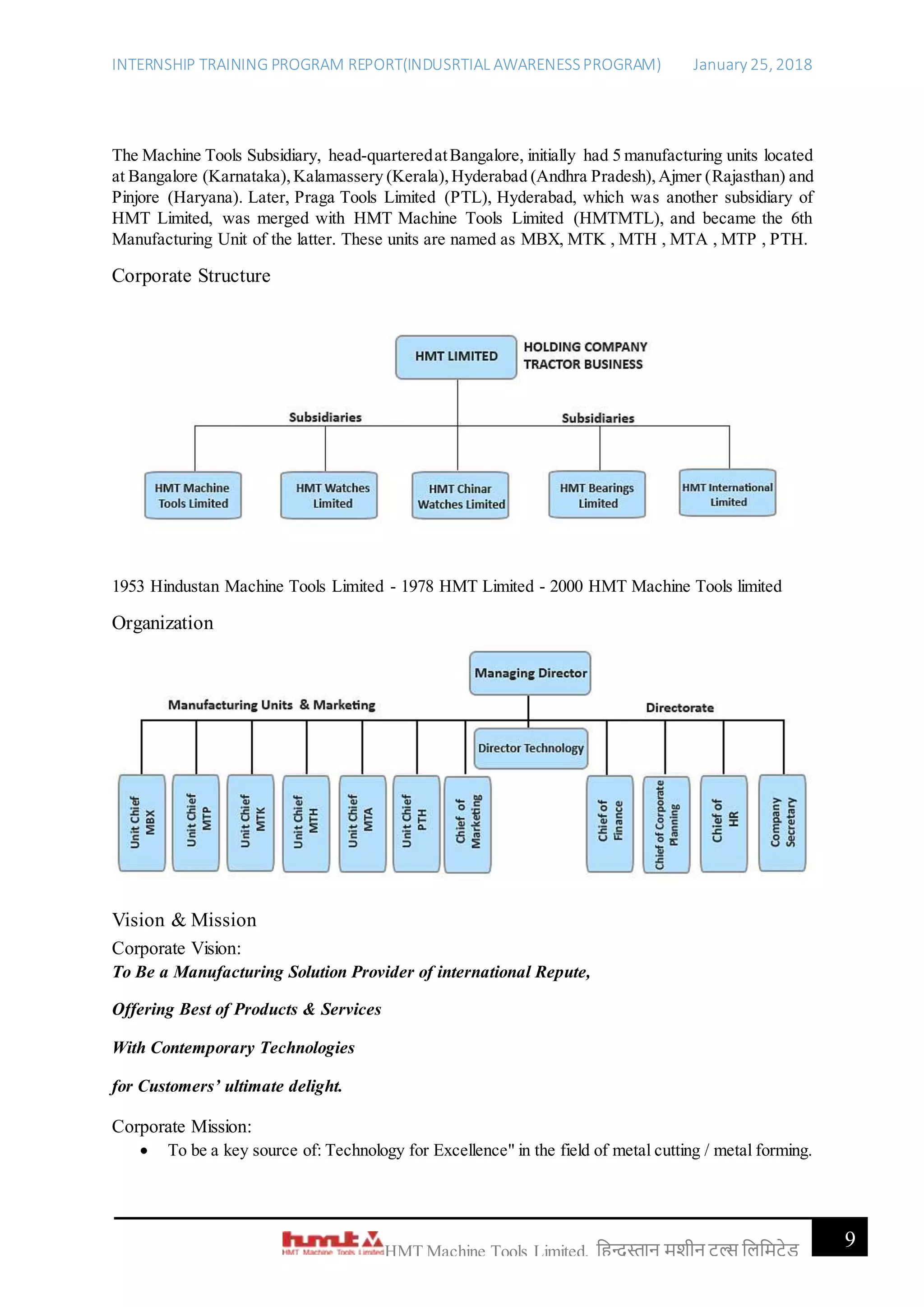
The Machine Tools Subsidiary, head-quarteredatBangalore, initially had 5 manufacturing units located
at Bangalore (Karnataka),Kalamassery (Kerala),Hyderabad (Andhra Pradesh),Ajmer (Rajasthan) and
Pinjore (Haryana). Later, Praga Tools Limited (PTL), Hyderabad, which was another subsidiary of
HMT Limited, was merged with HMT Machine Tools Limited (HMTMTL), and became the 6th
Manufacturing Unit of the latter. These units are named as MBX, MTK , MTH , MTA , MTP , PTH.
Corporate Structure
1953 Hindustan Machine Tools Limited - 1978 HMT Limited - 2000 HMT Machine Tools limited
Organization
Vision & Mission
Corporate Vision:
To Be a Manufacturing Solution Provider of international Repute,
Offering Best of Products & Services
With Contemporary Technologies
for Customers’ ultimate delight.
Corporate Mission:
 To be a key source of: Technology for Excellence" in the field of metal cutting / metal forming.
INTERNSHIP TRAINING PROGRAM REPORT(INDUSRTIAL AWARENESSPROGRAM) January 25, 2018
10HMT Machine Tools Limited, हिन्दुस्तान मशीन टू ल्स हिहमटेड
 To provide 'High quality cost competitive solution' for entire manufacturing Industry on 'One
stop shop' basis.
 To provide sustained support to all of strategic sectors.
 To exceed customers’ expectations through continuous innovation.
 To provide leadership & direction in the manufacturing sector for the overall industrial growth
of nation.
Objectives & Goals
Corporate Objectives:
 To achieve a growth percentage above the industrial average of machine tool sectors with in 5
years.
 Focus and aim for achieving positive gross margin in year 2013-14.
 To achieve sustained growth in the earnings of the company on behalf of shareholders.
 Focus on to achieve 80% capacity utilisation of facilities and resourcesby 2017-18 from present
level of 61%.
 Introduce at least one new product by each unit every year with contemporary technologies
through In-house R & D, Joint Partnerships, Sourcing and Acquisitions.
 Achieve higher productivity through upgradation modernization, reduction in rejection &
rework, value engineering, waste elimination, developing alternative source and Effective
Financial Planning and Control.
 To achieve a sales turnover of per employee from Rs 6.67 L (2011-12) to Rs 26 L by 2017-18.
Corporate Goals:
 To be a Rs 1000 Cr. Company by 2020 with Miniratna status.
Quality Policy:
 To maintain quality leadership in all our products & services.
 Total Customer Satisfaction through Quality Goods and Services.
 Commitment of management to Quality.
 To create a culture amongst all employees towards total quality concepts.
 Total quality through Performance Leadership.
INTERNSHIP TRAINING PROGRAM REPORT(INDUSRTIAL AWARENESSPROGRAM) January 25, 2018
11HMT Machine Tools Limited, हिन्दुस्तान मशीन टू ल्स हिहमटेड
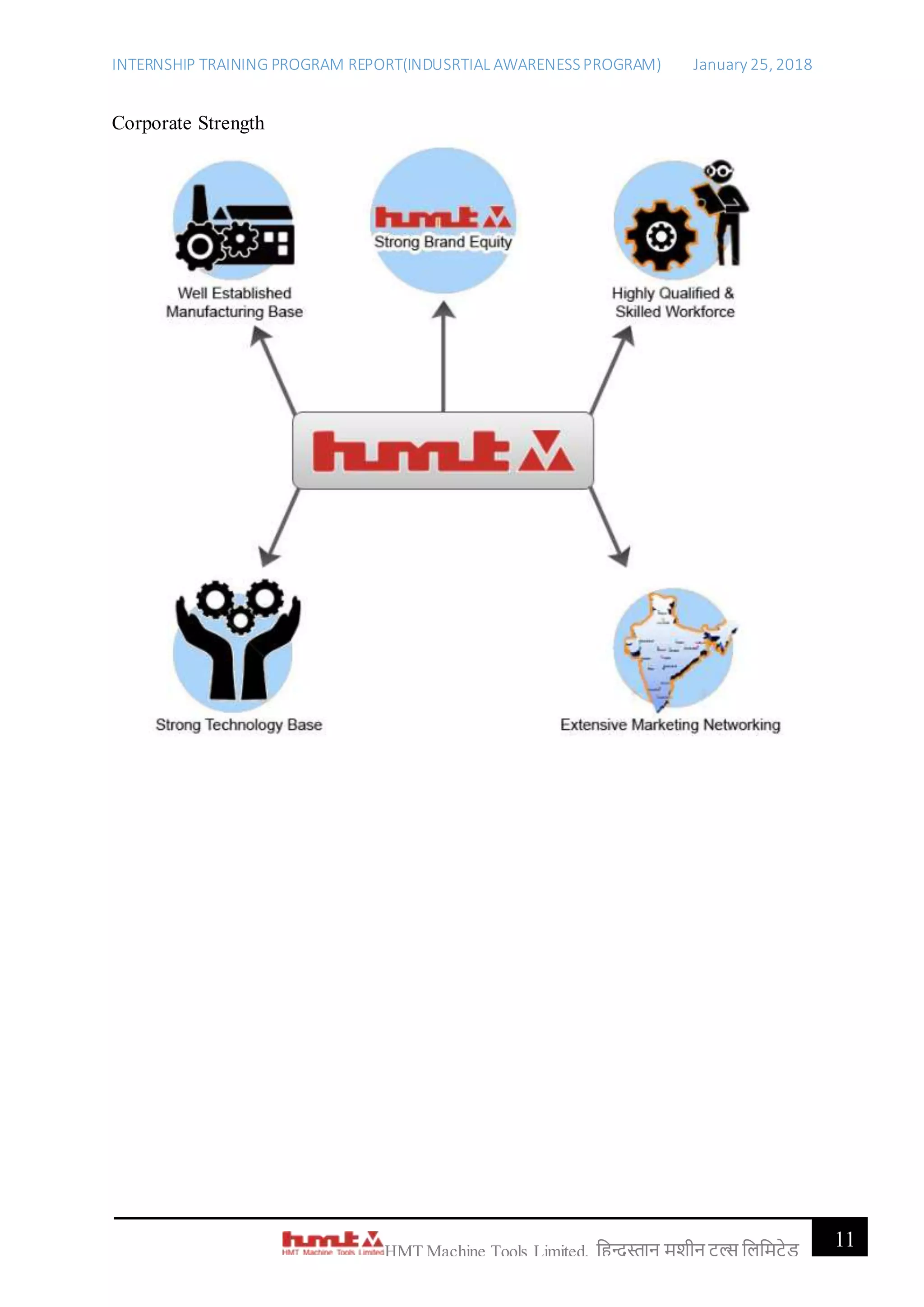
Corporate Strength
INTERNSHIP TRAINING PROGRAM REPORT(INDUSRTIAL AWARENESSPROGRAM) January 25, 2018
12HMT Machine Tools Limited, हिन्दुस्तान मशीन टू ल्स हिहमटेड
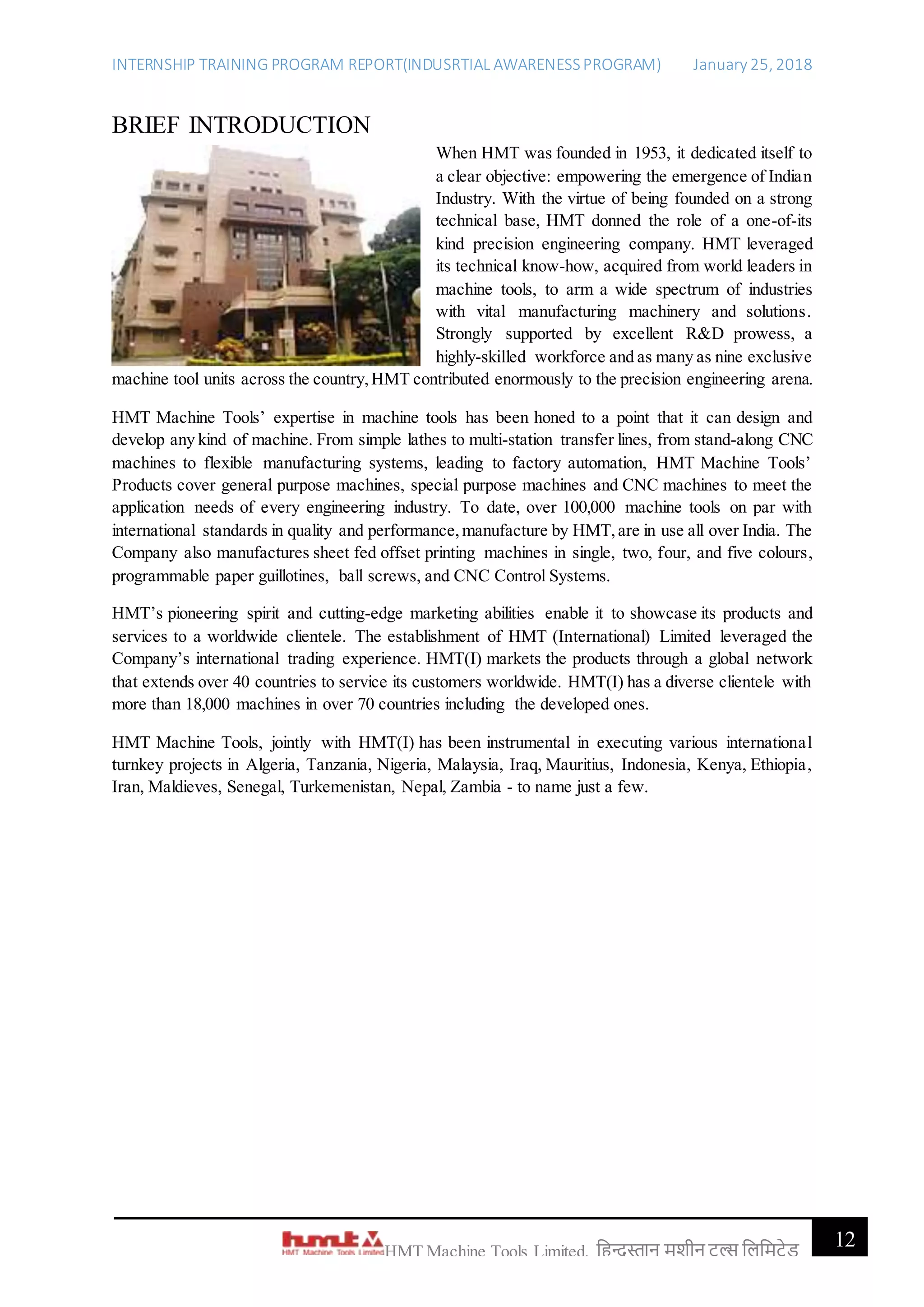
BRIEF INTRODUCTION
When HMT was founded in 1953, it dedicated itself to
a clear objective: empowering the emergence of Indian
Industry. With the virtue of being founded on a strong
technical base, HMT donned the role of a one-of-its
kind precision engineering company. HMT leveraged
its technical know-how, acquired from world leaders in
machine tools, to arm a wide spectrum of industries
with vital manufacturing machinery and solutions.
Strongly supported by excellent R&D prowess, a
highly-skilled workforce and as many as nine exclusive
machine tool units across the country,HMT contributed enormously to the precision engineering arena.
HMT Machine Tools’ expertise in machine tools has been honed to a point that it can design and
develop any kind of machine. From simple lathes to multi-station transfer lines, from stand-along CNC
machines to flexible manufacturing systems, leading to factory automation, HMT Machine Tools’
Products cover general purpose machines, special purpose machines and CNC machines to meet the
application needs of every engineering industry. To date, over 100,000 machine tools on par with
international standards in quality and performance,manufacture by HMT,are in use all over India. The
Company also manufactures sheet fed offset printing machines in single, two, four, and five colours,
programmable paper guillotines, ball screws, and CNC Control Systems.
HMT’s pioneering spirit and cutting-edge marketing abilities enable it to showcase its products and
services to a worldwide clientele. The establishment of HMT (International) Limited leveraged the
Company’s international trading experience. HMT(I) markets the products through a global network
that extends over 40 countries to service its customers worldwide. HMT(I) has a diverse clientele with
more than 18,000 machines in over 70 countries including the developed ones.
HMT Machine Tools, jointly with HMT(I) has been instrumental in executing various international
turnkey projects in Algeria, Tanzania, Nigeria, Malaysia, Iraq, Mauritius, Indonesia, Kenya, Ethiopia,
Iran, Maldieves, Senegal, Turkemenistan, Nepal, Zambia - to name just a few.
INTERNSHIP TRAINING PROGRAM REPORT(INDUSRTIAL AWARENESSPROGRAM) January 25, 2018
13HMT Machine Tools Limited, हिन्दुस्तान मशीन टू ल्स हिहमटेड
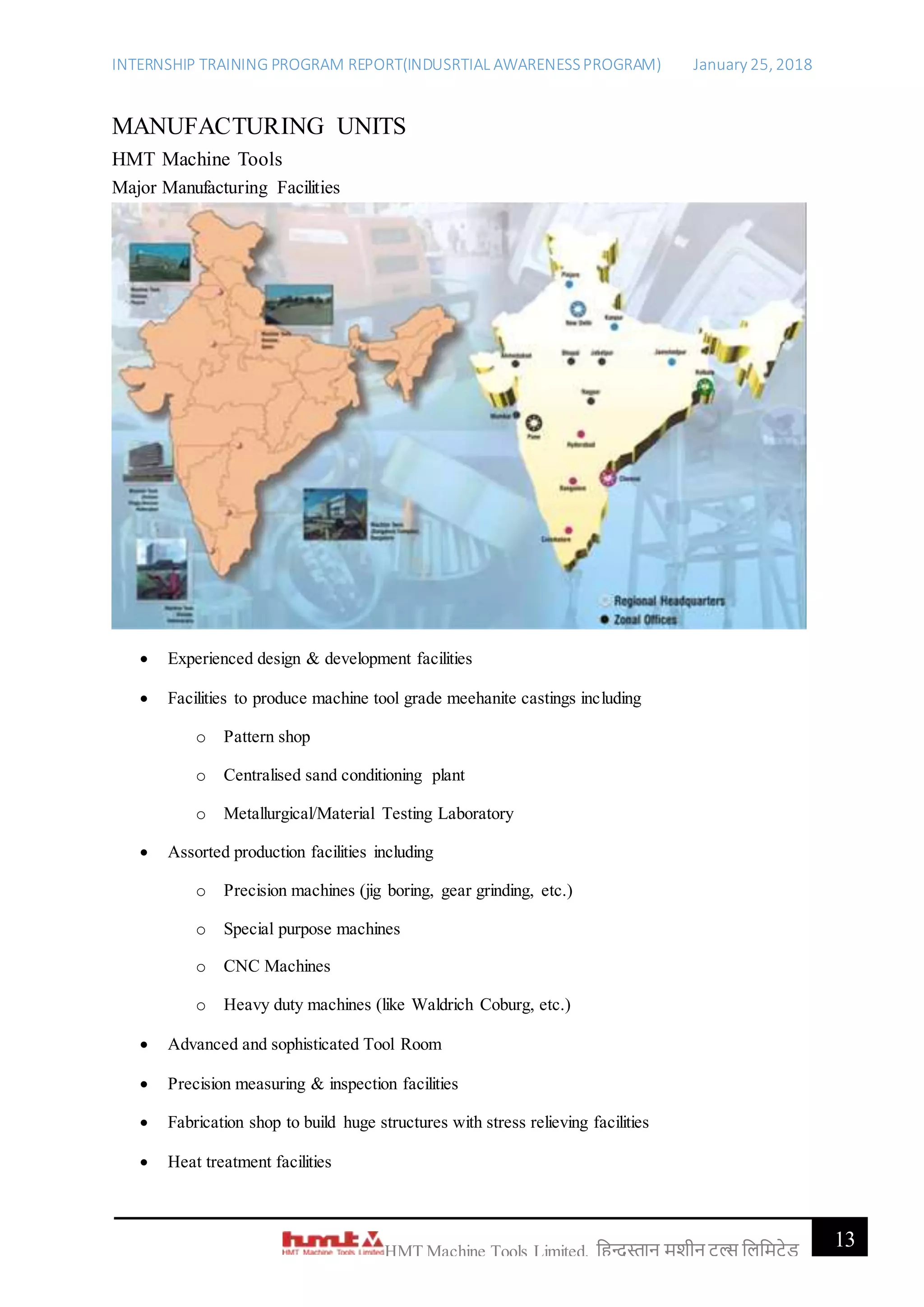
MANUFACTURING UNITS
HMT Machine Tools
Major Manufacturing Facilities
 Experienced design & development facilities
 Facilities to produce machine tool grade meehanite castings including
o Pattern shop
o Centralised sand conditioning plant
o Metallurgical/Material Testing Laboratory
 Assorted production facilities including
o Precision machines (jig boring, gear grinding, etc.)
o Special purpose machines
o CNC Machines
o Heavy duty machines (like Waldrich Coburg, etc.)
 Advanced and sophisticated Tool Room
 Precision measuring & inspection facilities
 Fabrication shop to build huge structures with stress relieving facilities
 Heat treatment facilities
INTERNSHIP TRAINING PROGRAM REPORT(INDUSRTIAL AWARENESSPROGRAM) January 25, 2018
14HMT Machine Tools Limited, हिन्दुस्तान मशीन टू ल्स हिहमटेड
 Material testing laboratory
 Facilities for calibration of measuring & testing equipment’s
 Skilled assembly work force and established assembly practices
Technology and R&D
HMT Machine Tools has imbibed a wide range of technologies as a result of its diversification
strategies, to be a truly multi-technology company. The list includes, though not limited to, the
following technologies:
 High Speed Machining
 Hard Parts Turning
 Precision Machining
 Computer Numeric Controls
 Computer Integrated Manufacture
 Flexible Manufacturing Systems/ Modules/Cells
 Metal Forming including Die casting & Plastic processing
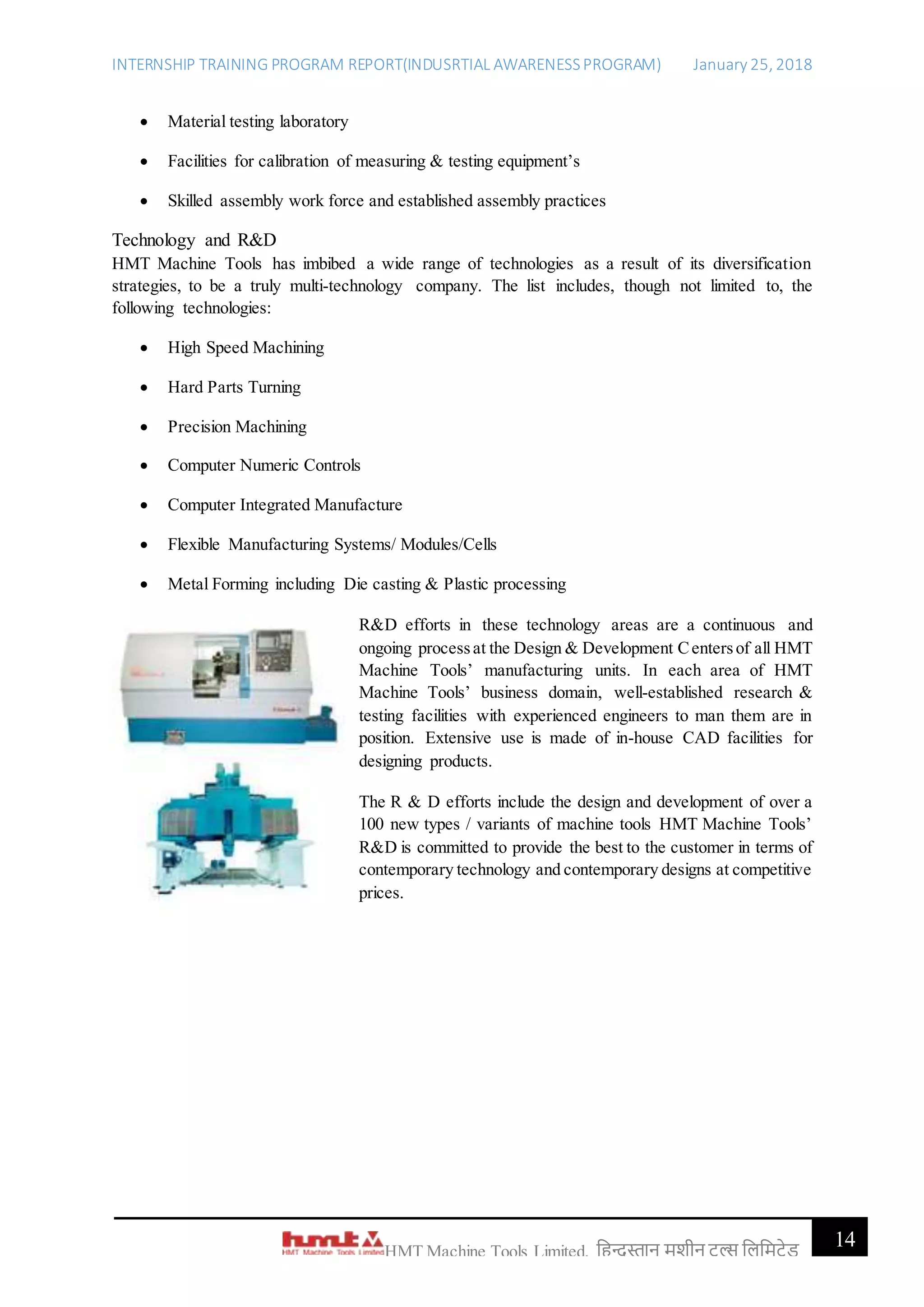
R&D efforts in these technology areas are a continuous and
ongoing processat the Design & Development Centersof all HMT
Machine Tools’ manufacturing units. In each area of HMT
Machine Tools’ business domain, well-established research &
testing facilities with experienced engineers to man them are in
position. Extensive use is made of in-house CAD facilities for
designing products.
The R & D efforts include the design and development of over a
100 new types / variants of machine tools HMT Machine Tools’
R&D is committed to provide the best to the customer in terms of
contemporary technology and contemporary designs at competitive
prices.
INTERNSHIP TRAINING PROGRAM REPORT(INDUSRTIAL AWARENESSPROGRAM) January 25, 2018
15HMT Machine Tools Limited, हिन्दुस्तान मशीन टू ल्स हिहमटेड
Manufacturing Network
INTERNSHIP TRAINING PROGRAM REPORT(INDUSRTIAL AWARENESSPROGRAM) January 25, 2018
16HMT Machine Tools Limited, हिन्दुस्तान मशीन टू ल्स हिहमटेड
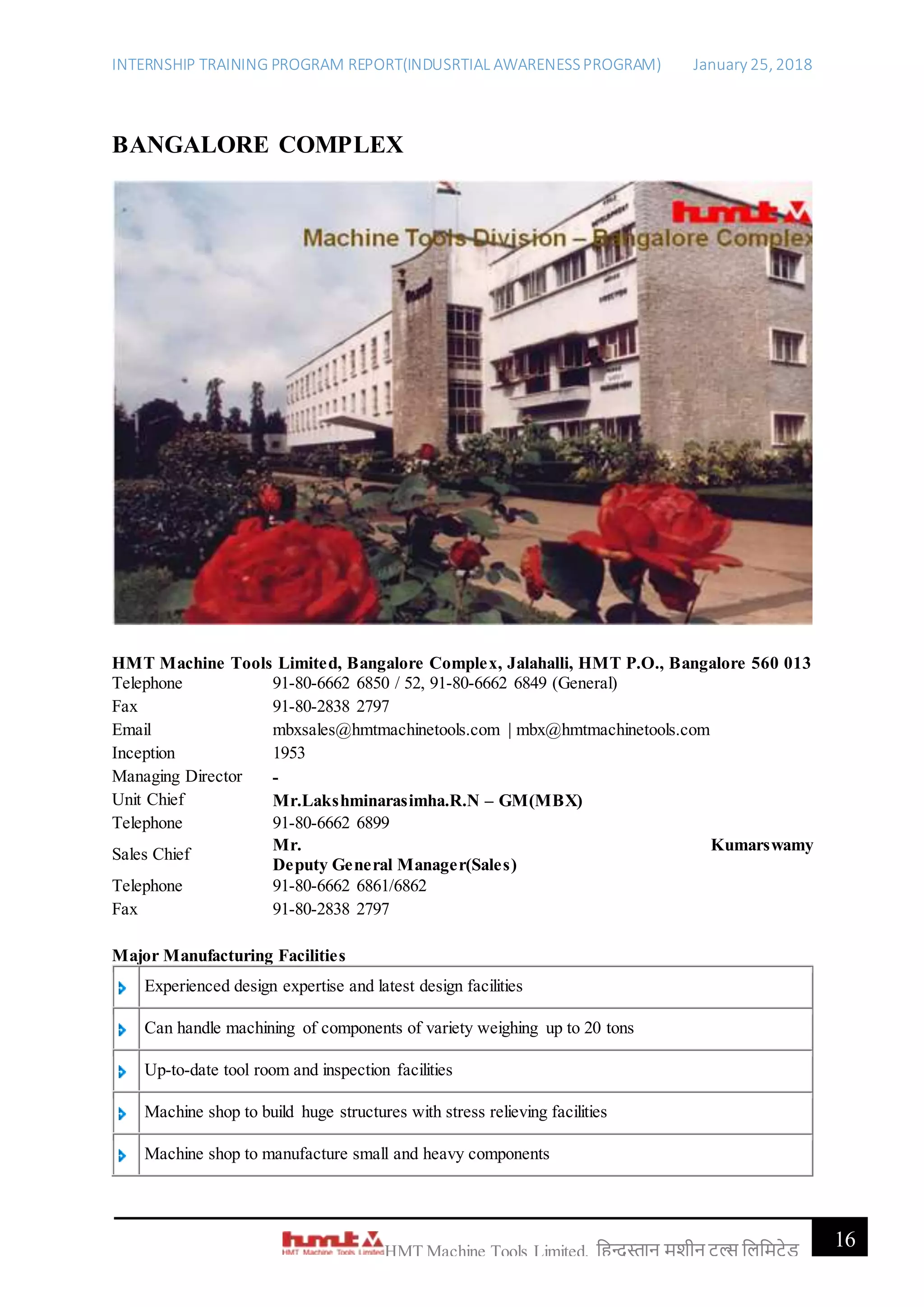
BANGALORE COMPLEX
HMT Machine Tools Limited, Bangalore Complex, Jalahalli, HMT P.O., Bangalore 560 013
Telephone 91-80-6662 6850 / 52, 91-80-6662 6849 (General)
Fax 91-80-2838 2797
Email mbxsales@hmtmachinetools.com | mbx@hmtmachinetools.com
Inception 1953
Managing Director -
Unit Chief Mr.Lakshminarasimha.R.N – GM(MBX)
Telephone 91-80-6662 6899
Sales Chief
Mr. Kumarswamy
Deputy General Manager(Sales)
Telephone 91-80-6662 6861/6862
Fax 91-80-2838 2797
Major Manufacturing Facilities
Experienced design expertise and latest design facilities
Can handle machining of components of variety weighing up to 20 tons
Up-to-date tool room and inspection facilities
Machine shop to build huge structures with stress relieving facilities
Machine shop to manufacture small and heavy components
INTERNSHIP TRAINING PROGRAM REPORT(INDUSRTIAL AWARENESSPROGRAM) January 25, 2018
17HMT Machine Tools Limited, हिन्दुस्तान मशीन टू ल्स हिहमटेड
Facilities for assembly and retrofitting of heavy machine tools
Heat treatment facilities
Foundry with facilities to produce heavy, small and medium castings of ferrous metals with
facilities like pattern shop and fettering shop
Captive foundry of capacity 1500 MT per annum – Size of Grey Cast Iron casting up to 9MT &
S.G. Iron up to 5 MT
Can handle machining of components & assemblies of tool room class precision machine tools.
Measurement & inspection facilities with precision machines viz., Coordinate Measuring
Machine
Material testing laboratory
All facilities required for plated through hole ( PTH ) PCB assembly like preparation / insertion /
assembly & component soldering.
Facilities for cleaning of electronic PC Bs
Wave soldering machine
Desoldering Machine
Component Insertion Machine
PCB Drilling Machine
Trimming machine
HMT-NUM
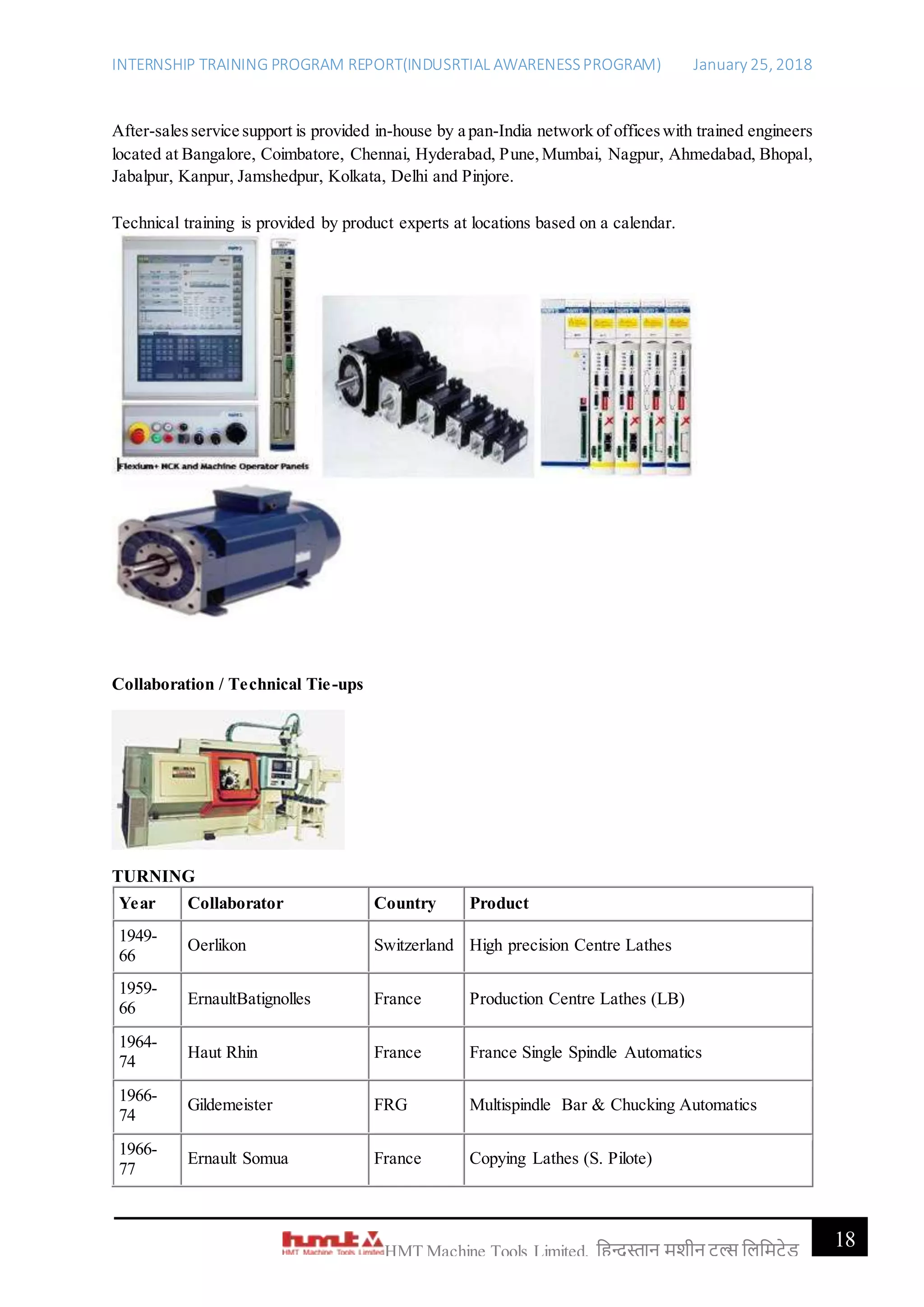
HMT-NUM is a CNC system package manufactured by CNC Systems Division, HMT Machine Tools
Limited in Bangalore under technical collaboration with NUM AG of Switzerland. The legendary
design and manufacturing capability of HMT coupled with cutting-edge CNC technology of NUM
creates a synergy which offers high value products to the manufacturing community.
The HMT-NUM CNC is available in three variants (Flexium+ 6, Flexium+ 8 and Flexium + 68) and
caters to the entire range of machining requirements; be it for metal cutting, power motion control,
special purpose machines and a whole lot of other applications required to meet today's manufacturing
demands. A wide range of servo motors and drive packages are available to meet every need of the
industry. Extremely reliable hardware supported by industry-leading software products makes a
powerful combination and supports all shop-floor operational requirements.
Engineering support is made available right through the machine development cycle from concept stage
to assembly, interfacing and proving-out to provide a "Complete CNC Machine Automation Solution".
INTERNSHIP TRAINING PROGRAM REPORT(INDUSRTIAL AWARENESSPROGRAM) January 25, 2018
18HMT Machine Tools Limited, हिन्दुस्तान मशीन टू ल्स हिहमटेड
After-salesservice support is provided in-house by a pan-India network of officeswith trained engineers
located at Bangalore, Coimbatore, Chennai, Hyderabad, Pune,Mumbai, Nagpur, Ahmedabad, Bhopal,
Jabalpur, Kanpur, Jamshedpur, Kolkata, Delhi and Pinjore.
Technical training is provided by product experts at locations based on a calendar.
Collaboration / Technical Tie-ups
TURNING
Year Collaborator Country Product
1949-
66
Oerlikon Switzerland High precision Centre Lathes
1959-
66
ErnaultBatignolles France Production Centre Lathes (LB)
1964-
74
Haut Rhin France France Single Spindle Automatics
1966-
74
Gildemeister FRG Multispindle Bar & Chucking Automatics
1966-
77
Ernault Somua France Copying Lathes (S. Pilote)
INTERNSHIP TRAINING PROGRAM REPORT(INDUSRTIAL AWARENESSPROGRAM) January 25, 2018
19HMT Machine Tools Limited, हिन्दुस्तान मशीन टू ल्स हिहमटेड
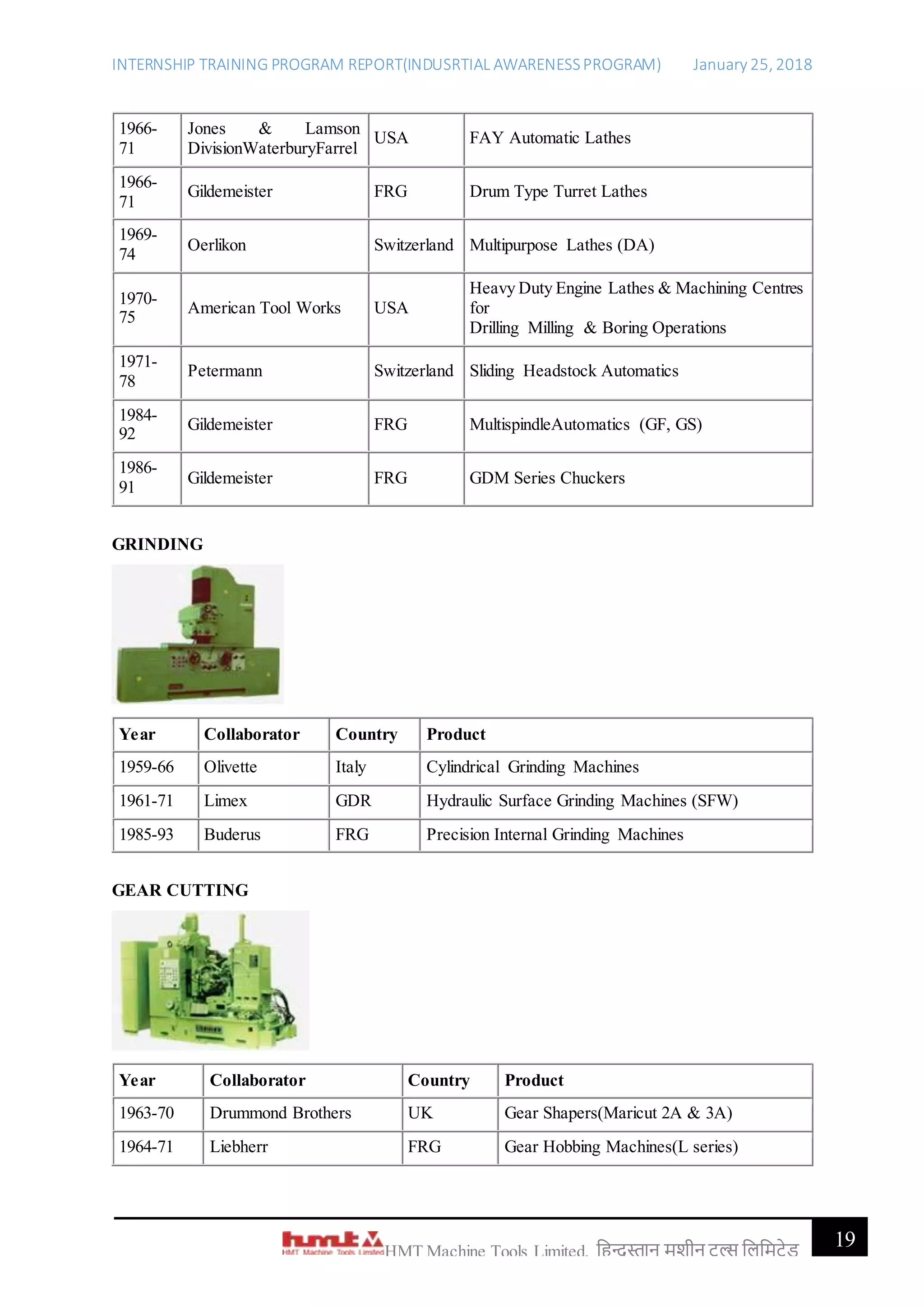
1966-
71
Jones & Lamson
DivisionWaterburyFarrel
USA FAY Automatic Lathes
1966-
71
Gildemeister FRG Drum Type Turret Lathes
1969-
74
Oerlikon Switzerland Multipurpose Lathes (DA)
1970-
75
American Tool Works USA
Heavy Duty Engine Lathes & Machining Centres
for
Drilling Milling & Boring Operations
1971-
78
Petermann Switzerland Sliding Headstock Automatics
1984-
92
Gildemeister FRG MultispindleAutomatics (GF, GS)
1986-
91
Gildemeister FRG GDM Series Chuckers
GRINDING
Year Collaborator Country Product
1959-66 Olivette Italy Cylindrical Grinding Machines
1961-71 Limex GDR Hydraulic Surface Grinding Machines (SFW)
1985-93 Buderus FRG Precision Internal Grinding Machines
GEAR CUTTING
Year Collaborator Country Product
1963-70 Drummond Brothers UK Gear Shapers(Maricut 2A & 3A)
1964-71 Liebherr FRG Gear Hobbing Machines(L series)
INTERNSHIP TRAINING PROGRAM REPORT(INDUSRTIAL AWARENESSPROGRAM) January 25, 2018
20HMT Machine Tools Limited, हिन्दुस्तान मशीन टू ल्स हिहमटेड
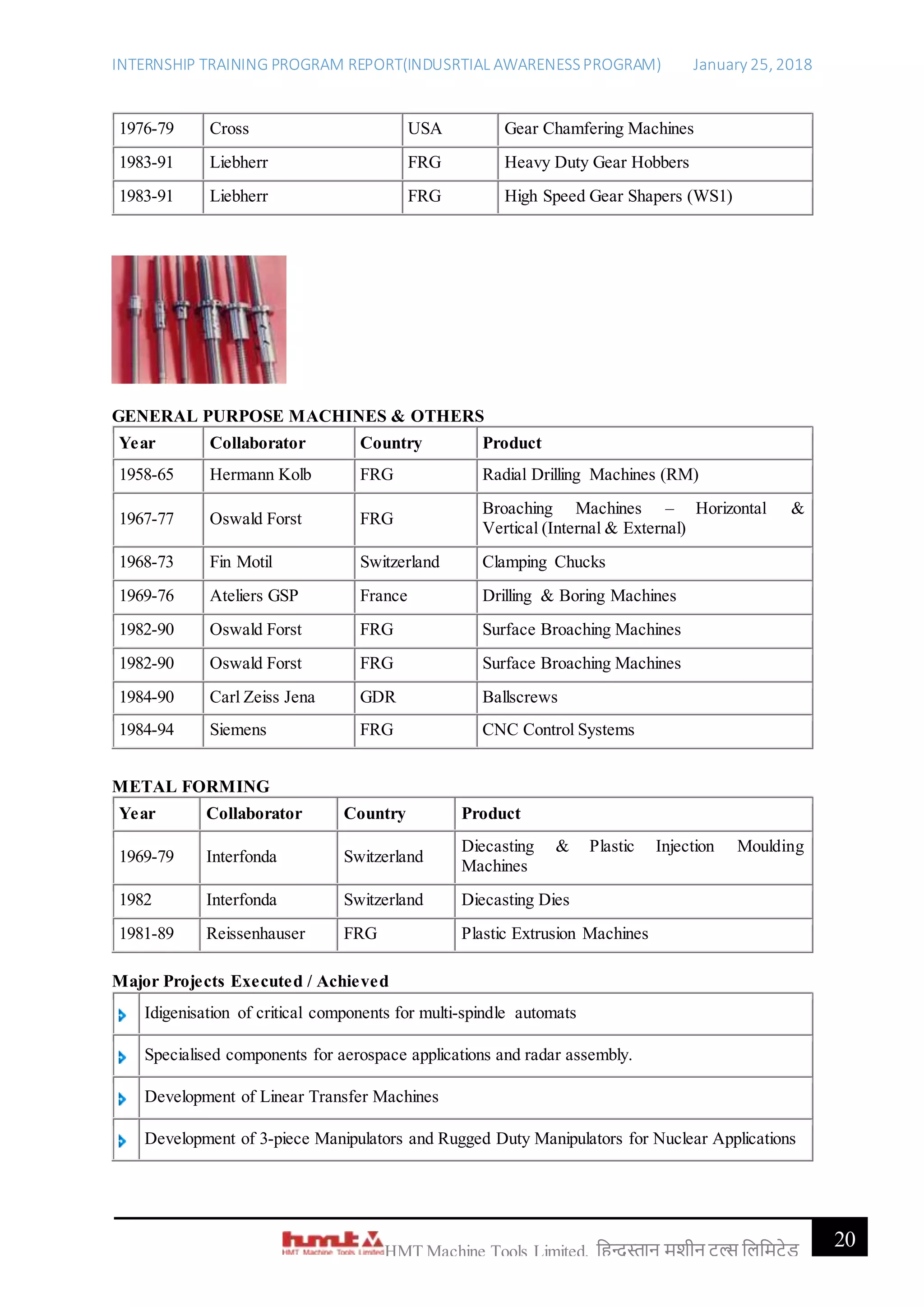
1976-79 Cross USA Gear Chamfering Machines
1983-91 Liebherr FRG Heavy Duty Gear Hobbers
1983-91 Liebherr FRG High Speed Gear Shapers (WS1)
GENERAL PURPOSE MACHINES & OTHERS
Year Collaborator Country Product
1958-65 Hermann Kolb FRG Radial Drilling Machines (RM)
1967-77 Oswald Forst FRG
Broaching Machines – Horizontal &
Vertical (Internal & External)
1968-73 Fin Motil Switzerland Clamping Chucks
1969-76 Ateliers GSP France Drilling & Boring Machines
1982-90 Oswald Forst FRG Surface Broaching Machines
1984-90 Carl Zeiss Jena GDR Ballscrews
1984-94 Siemens FRG CNC Control Systems
METAL FORMING
Year Collaborator Country Product
1969-79 Interfonda Switzerland
Diecasting & Plastic Injection Moulding
Machines
1982 Interfonda Switzerland Diecasting Dies
1981-89 Reissenhauser FRG Plastic Extrusion Machines
Major Projects Executed / Achieved
Idigenisation of critical components for multi-spindle automats
Specialised components for aerospace applications and radar assembly.
Development of Linear Transfer Machines
Development of 3-piece Manipulators and Rugged Duty Manipulators for Nuclear Applications
INTERNSHIP TRAINING PROGRAM REPORT(INDUSRTIAL AWARENESSPROGRAM) January 25, 2018
21HMT Machine Tools Limited, हिन्दुस्तान मशीन टू ल्स हिहमटेड
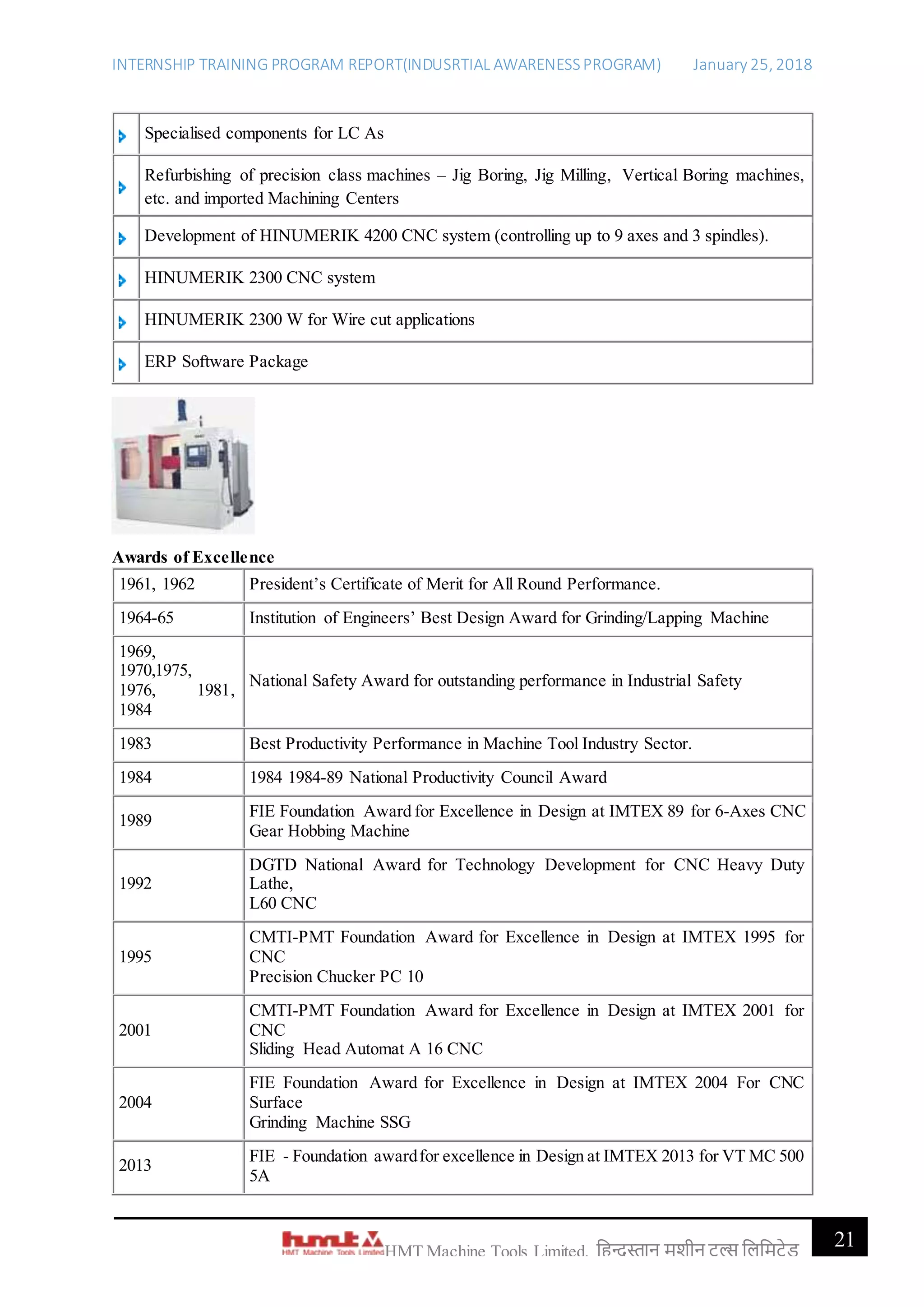
Specialised components for LC As
Refurbishing of precision class machines – Jig Boring, Jig Milling, Vertical Boring machines,
etc. and imported Machining Centers
Development of HINUMERIK 4200 CNC system (controlling up to 9 axes and 3 spindles).
HINUMERIK 2300 CNC system
HINUMERIK 2300 W for Wire cut applications
ERP Software Package
Awards of Excellence
1961, 1962 President’s Certificate of Merit for All Round Performance.
1964-65 Institution of Engineers’ Best Design Award for Grinding/Lapping Machine
1969,
1970,1975,
1976, 1981,
1984
National Safety Award for outstanding performance in Industrial Safety
1983 Best Productivity Performance in Machine Tool Industry Sector.
1984 1984 1984-89 National Productivity Council Award
1989
FIE Foundation Award for Excellence in Design at IMTEX 89 for 6-Axes CNC
Gear Hobbing Machine
1992
DGTD National Award for Technology Development for CNC Heavy Duty
Lathe,
L60 CNC
1995
CMTI-PMT Foundation Award for Excellence in Design at IMTEX 1995 for
CNC
Precision Chucker PC 10
2001
CMTI-PMT Foundation Award for Excellence in Design at IMTEX 2001 for
CNC
Sliding Head Automat A 16 CNC
2004
FIE Foundation Award for Excellence in Design at IMTEX 2004 For CNC
Surface
Grinding Machine SSG
2013
FIE - Foundation awardfor excellence in Design at IMTEX 2013 for VT MC 500
5A
INTERNSHIP TRAINING PROGRAM REPORT(INDUSRTIAL AWARENESSPROGRAM) January 25, 2018
22HMT Machine Tools Limited, हिन्दुस्तान मशीन टू ल्स हिहमटेड
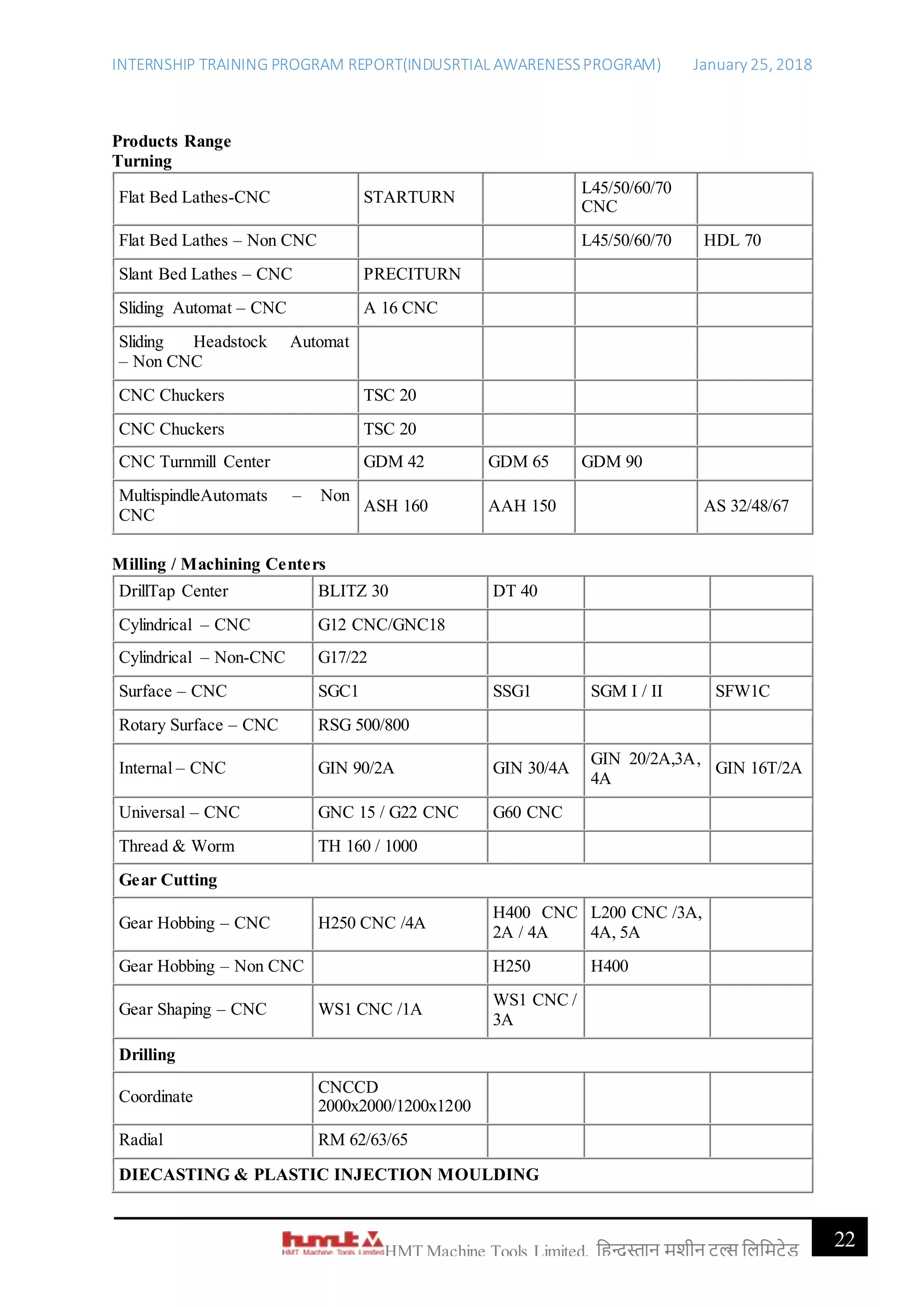
Products Range
Turning
Flat Bed Lathes-CNC STARTURN
L45/50/60/70
CNC
Flat Bed Lathes – Non CNC L45/50/60/70 HDL 70
Slant Bed Lathes – CNC PRECITURN
Sliding Automat – CNC A 16 CNC
Sliding Headstock Automat
– Non CNC
CNC Chuckers TSC 20
CNC Chuckers TSC 20
CNC Turnmill Center GDM 42 GDM 65 GDM 90
MultispindleAutomats – Non
CNC
ASH 160 AAH 150 AS 32/48/67
Milling / Machining Centers
DrillTap Center BLITZ 30 DT 40
Cylindrical – CNC G12 CNC/GNC18
Cylindrical – Non-CNC G17/22
Surface – CNC SGC1 SSG1 SGM I / II SFW1C
Rotary Surface – CNC RSG 500/800
Internal – CNC GIN 90/2A GIN 30/4A
GIN 20/2A,3A,
4A
GIN 16T/2A
Universal – CNC GNC 15 / G22 CNC G60 CNC
Thread & Worm TH 160 / 1000
Gear Cutting
Gear Hobbing – CNC H250 CNC /4A
H400 CNC
2A / 4A
L200 CNC /3A,
4A, 5A
Gear Hobbing – Non CNC H250 H400
Gear Shaping – CNC WS1 CNC /1A
WS1 CNC /
3A
Drilling
Coordinate
CNCCD
2000x2000/1200x1200
Radial RM 62/63/65
DIECASTING & PLASTIC INJECTION MOULDING
INTERNSHIP TRAINING PROGRAM REPORT(INDUSRTIAL AWARENESSPROGRAM) January 25, 2018
23HMT Machine Tools Limited, हिन्दुस्तान मशीन टू ल्स हिहमटेड
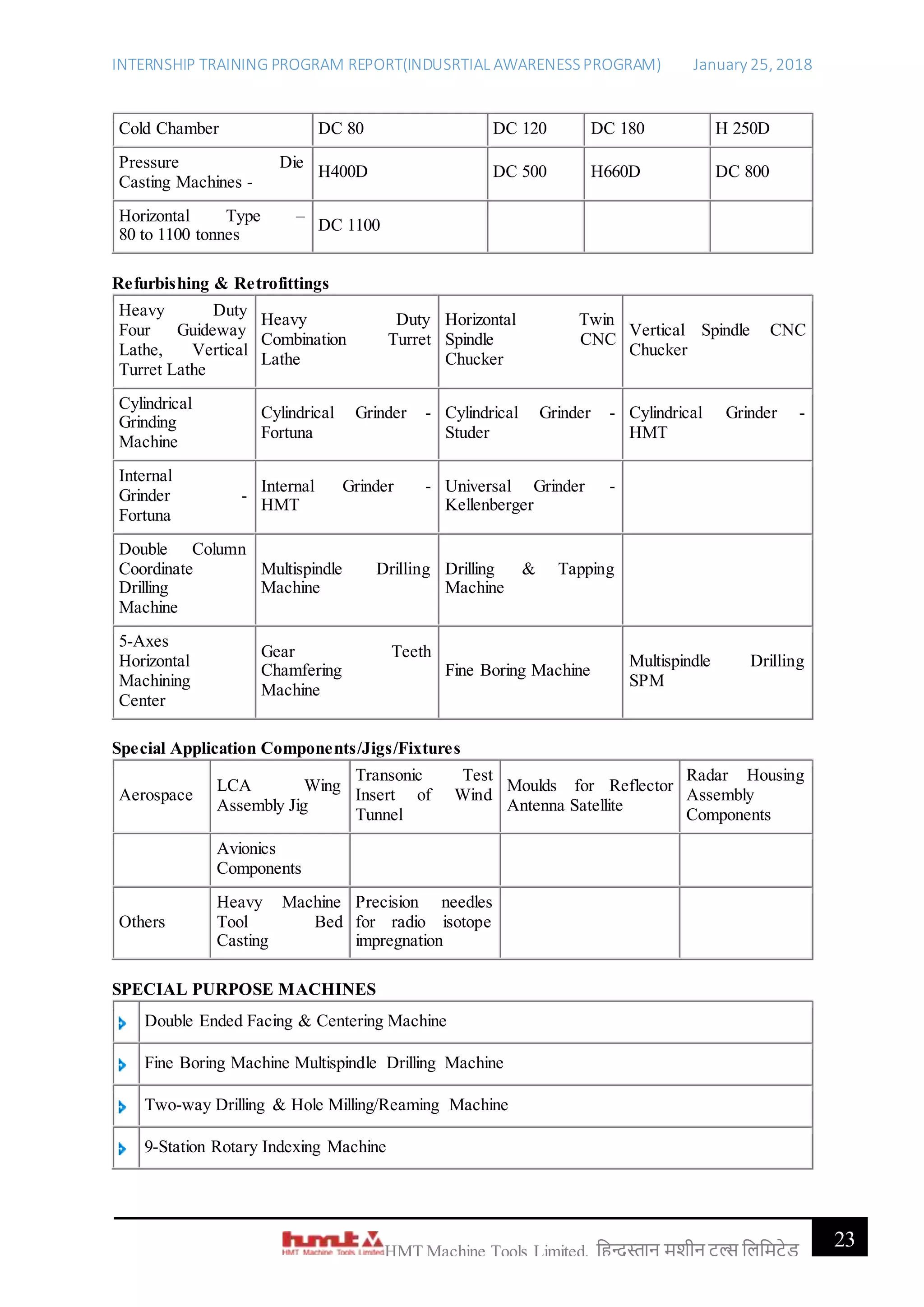
Cold Chamber DC 80 DC 120 DC 180 H 250D
Pressure Die
Casting Machines -
H400D DC 500 H660D DC 800
Horizontal Type –
80 to 1100 tonnes
DC 1100
Refurbishing & Retrofittings
Heavy Duty
Four Guideway
Lathe, Vertical
Turret Lathe
Heavy Duty
Combination Turret
Lathe
Horizontal Twin
Spindle CNC
Chucker
Vertical Spindle CNC
Chucker
Cylindrical
Grinding
Machine
Cylindrical Grinder -
Fortuna
Cylindrical Grinder -
Studer
Cylindrical Grinder -
HMT
Internal
Grinder -
Fortuna
Internal Grinder -
HMT
Universal Grinder -
Kellenberger
Double Column
Coordinate
Drilling
Machine
Multispindle Drilling
Machine
Drilling & Tapping
Machine
5-Axes
Horizontal
Machining
Center
Gear Teeth
Chamfering
Machine
Fine Boring Machine
Multispindle Drilling
SPM
Special Application Components/Jigs/Fixtures
Aerospace
LCA Wing
Assembly Jig
Transonic Test
Insert of Wind
Tunnel
Moulds for Reflector
Antenna Satellite
Radar Housing
Assembly
Components
Avionics
Components
Others
Heavy Machine
Tool Bed
Casting
Precision needles
for radio isotope
impregnation
SPECIAL PURPOSE MACHINES
Double Ended Facing & Centering Machine
Fine Boring Machine Multispindle Drilling Machine
Two-way Drilling & Hole Milling/Reaming Machine
9-Station Rotary Indexing Machine
INTERNSHIP TRAINING PROGRAM REPORT(INDUSRTIAL AWARENESSPROGRAM) January 25, 2018
24HMT Machine Tools Limited, हिन्दुस्तान मशीन टू ल्स हिहमटेड
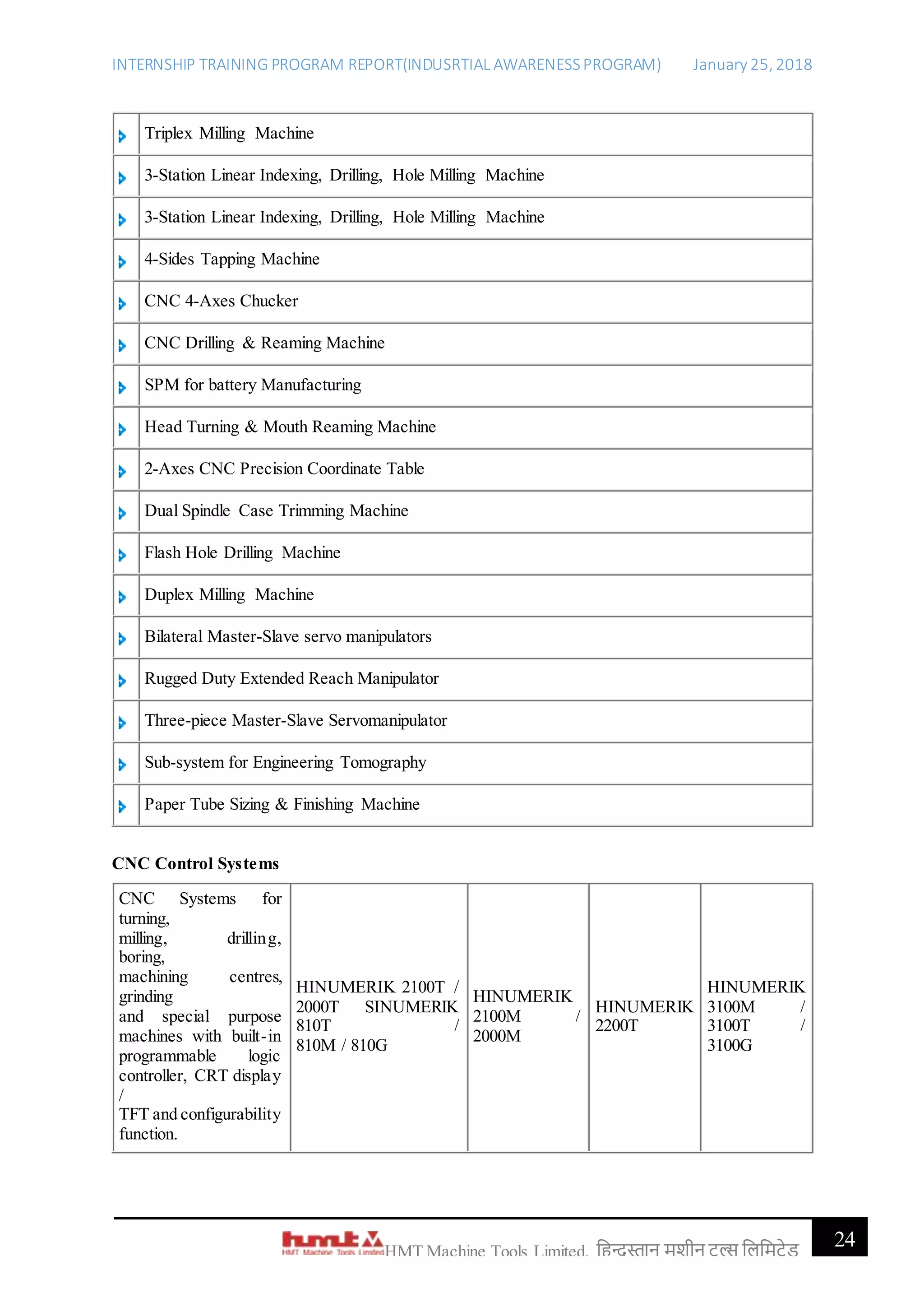
Triplex Milling Machine
3-Station Linear Indexing, Drilling, Hole Milling Machine
4-Sides Tapping Machine
CNC 4-Axes Chucker
CNC Drilling & Reaming Machine
SPM for battery Manufacturing
Head Turning & Mouth Reaming Machine
2-Axes CNC Precision Coordinate Table
Dual Spindle Case Trimming Machine
Flash Hole Drilling Machine
Duplex Milling Machine
Bilateral Master-Slave servo manipulators
Rugged Duty Extended Reach Manipulator
Three-piece Master-Slave Servomanipulator
Sub-system for Engineering Tomography
Paper Tube Sizing & Finishing Machine
CNC Control Systems
CNC Systems for
turning,
milling, drilling,
boring,
machining centres,
grinding
and special purpose
machines with built-in
programmable logic
controller, CRT display
/
TFT and configurability
function.
HINUMERIK 2100T /
2000T SINUMERIK
810T /
810M / 810G
HINUMERIK
2100M /
2000M
HINUMERIK
2200T
HINUMERIK
3100M /
3100T /
3100G
INTERNSHIP TRAINING PROGRAM REPORT(INDUSRTIAL AWARENESSPROGRAM) January 25, 2018
25HMT Machine Tools Limited, हिन्दुस्तान मशीन टू ल्स हिहमटेड
PLANT LAYOUT
Plant layout showing different departments visited during internship program.
INTERNSHIP TRAINING PROGRAM REPORT(INDUSRTIAL AWARENESSPROGRAM) January 25, 2018
26HMT Machine Tools Limited, हिन्दुस्तान मशीन टू ल्स हिहमटेड
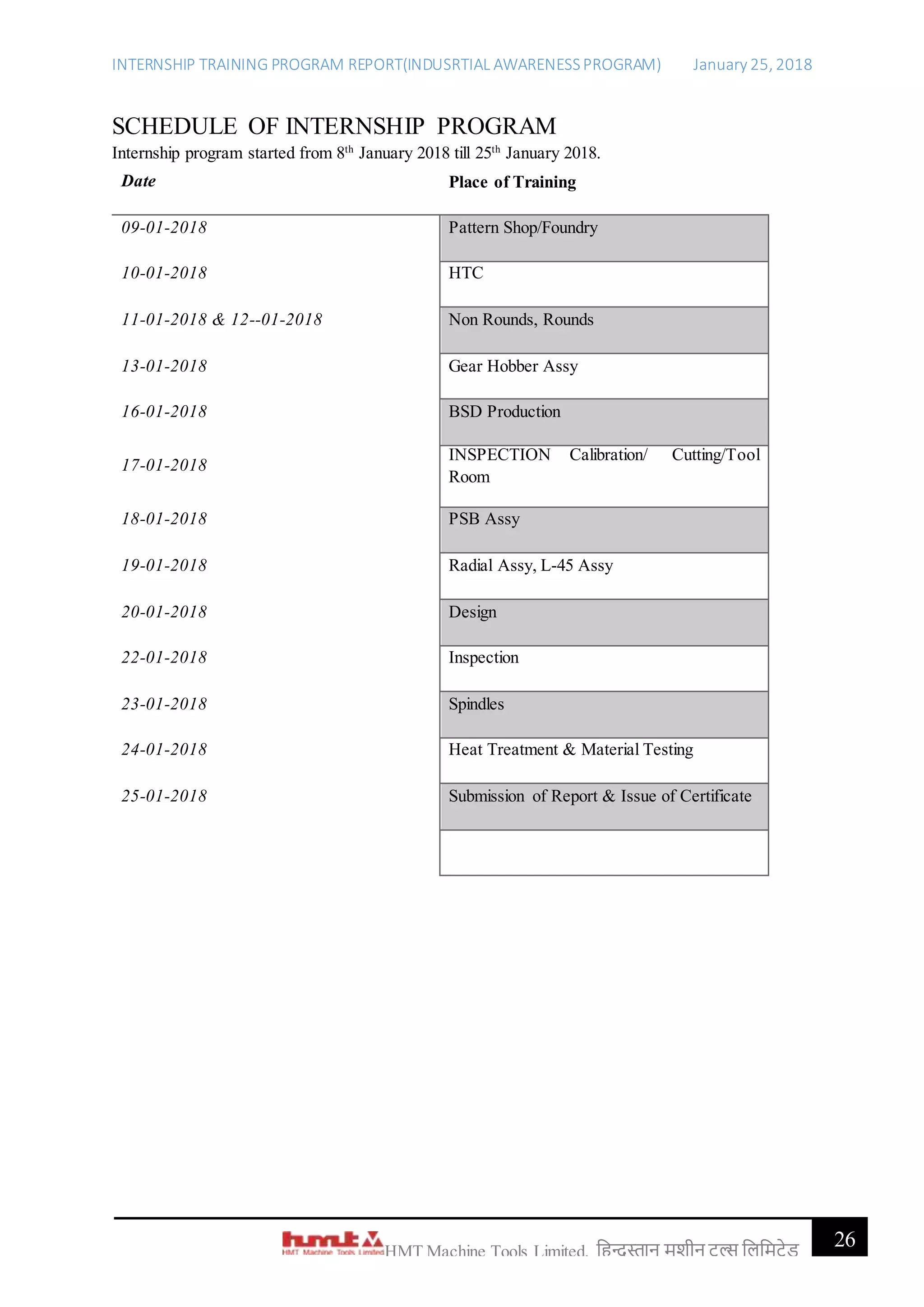
SCHEDULE OF INTERNSHIP PROGRAM
Internship program started from 8th
January 2018 till 25th
January 2018.
Date Place of Training
09-01-2018 Pattern Shop/Foundry
10-01-2018 HTC
11-01-2018 & 12--01-2018 Non Rounds, Rounds
13-01-2018 Gear Hobber Assy
16-01-2018 BSD Production
17-01-2018
INSPECTION Calibration/ Cutting/Tool
Room
18-01-2018 PSB Assy
19-01-2018 Radial Assy, L-45 Assy
20-01-2018 Design
22-01-2018 Inspection
23-01-2018 Spindles
24-01-2018 Heat Treatment & Material Testing
25-01-2018 Submission of Report & Issue of Certificate
INTERNSHIP TRAINING PROGRAM REPORT(INDUSRTIAL AWARENESSPROGRAM) January 25, 2018
27HMT Machine Tools Limited, हिन्दुस्तान मशीन टू ल्स हिहमटेड
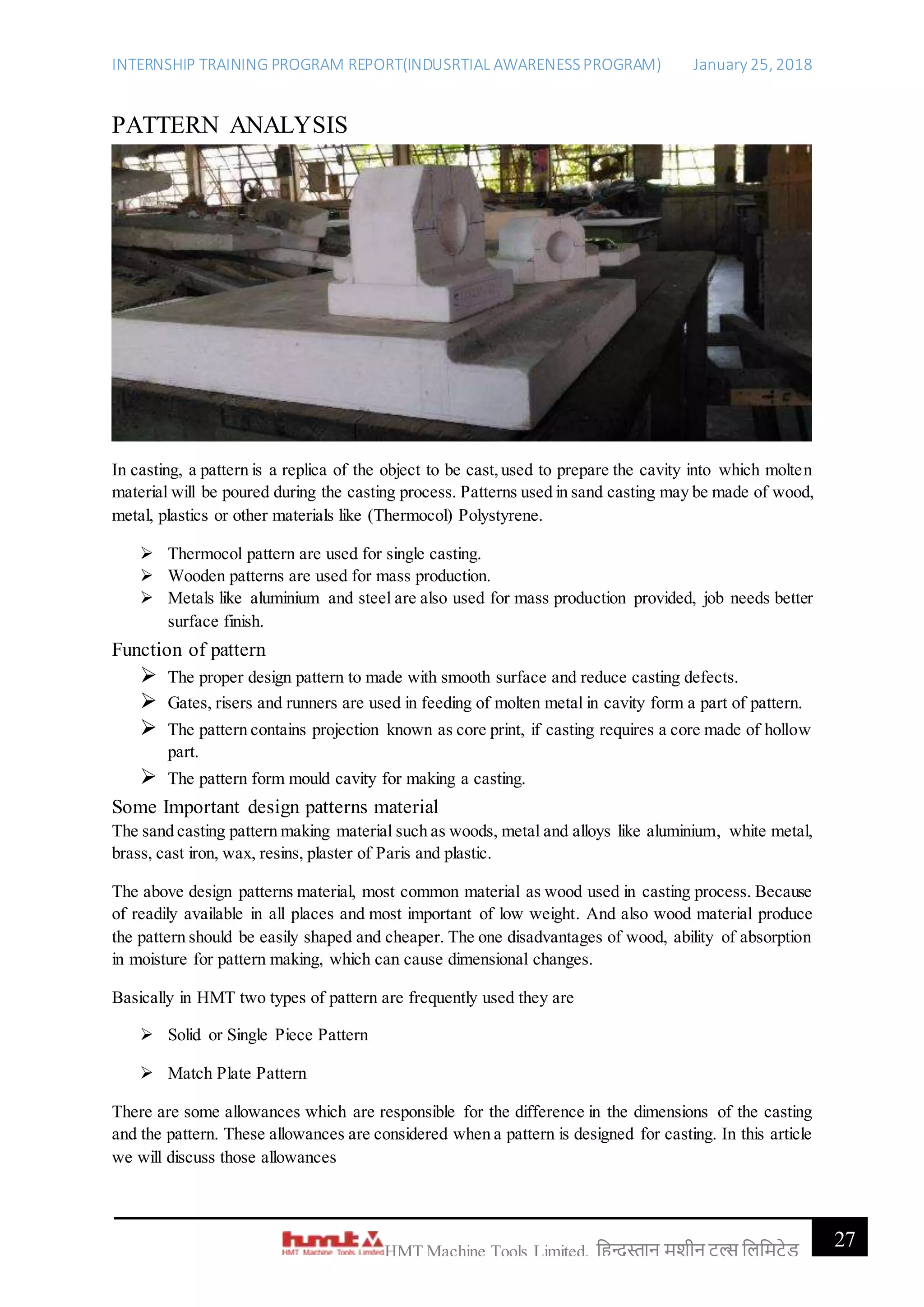
PATTERN ANALYSIS
In casting, a pattern is a replica of the object to be cast,used to prepare the cavity into which molten
material will be poured during the casting process. Patterns used in sand casting may be made of wood,
metal, plastics or other materials like (Thermocol) Polystyrene.
 Thermocol pattern are used for single casting.
 Wooden patterns are used for mass production.
 Metals like aluminium and steel are also used for mass production provided, job needs better
surface finish.
Function of pattern
 The proper design pattern to made with smooth surface and reduce casting defects.
 Gates, risers and runners are used in feeding of molten metal in cavity form a part of pattern.
 The pattern contains projection known as core print, if casting requires a core made of hollow
part.
 The pattern form mould cavity for making a casting.
Some Important design patterns material
The sand casting pattern making material such as woods, metal and alloys like aluminium, white metal,
brass, cast iron, wax, resins, plaster of Paris and plastic.
The above design patterns material, most common material as wood used in casting process. Because
of readily available in all places and most important of low weight. And also wood material produce
the pattern should be easily shaped and cheaper. The one disadvantages of wood, ability of absorption
in moisture for pattern making, which can cause dimensional changes.
Basically in HMT two types of pattern are frequently used they are
 Solid or Single Piece Pattern
 Match Plate Pattern
There are some allowances which are responsible for the difference in the dimensions of the casting
and the pattern. These allowances are considered when a pattern is designed for casting. In this article
we will discuss those allowances
INTERNSHIP TRAINING PROGRAM REPORT(INDUSRTIAL AWARENESSPROGRAM) January 25, 2018
28HMT Machine Tools Limited, हिन्दुस्तान मशीन टू ल्स हिहमटेड
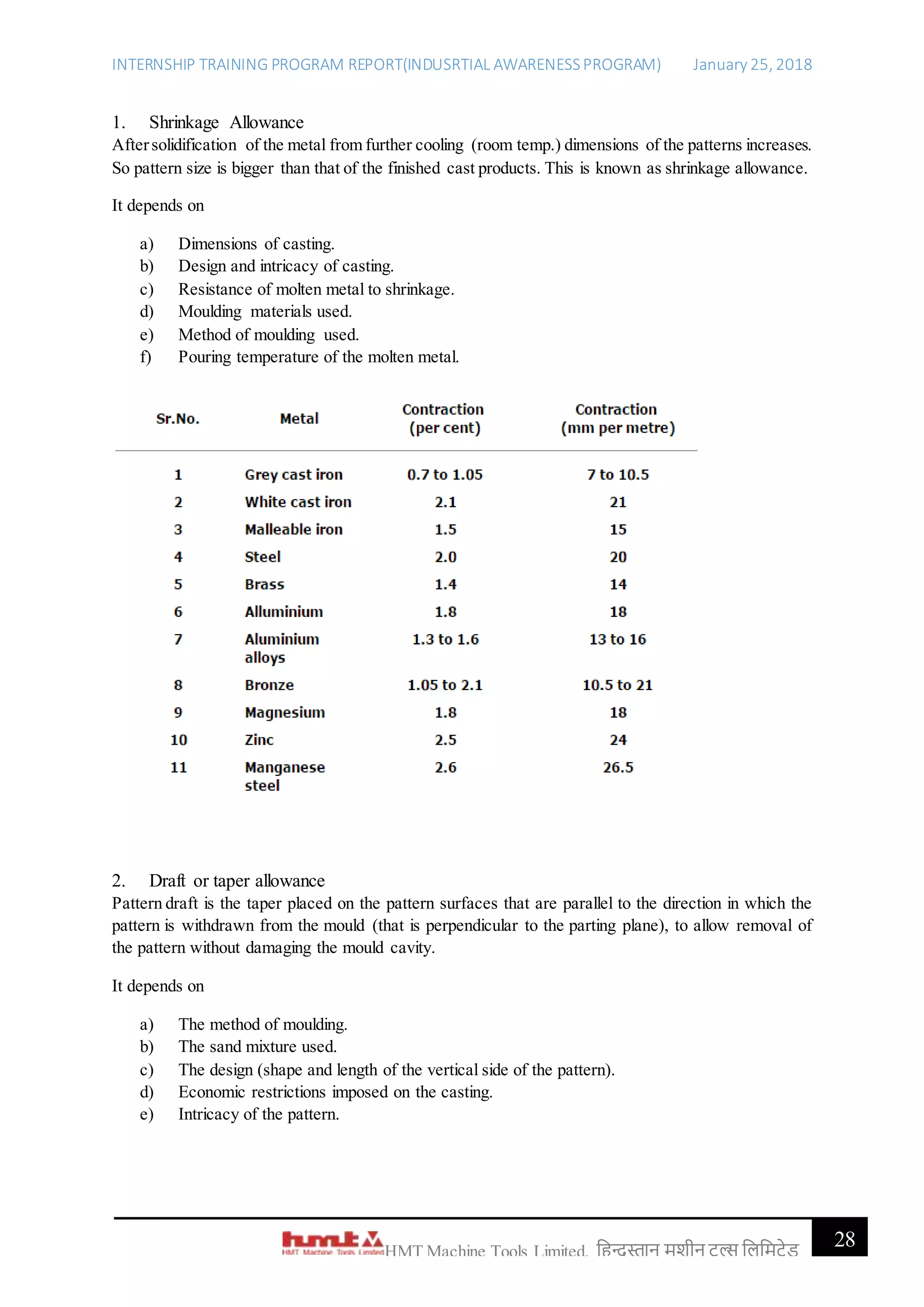
1. Shrinkage Allowance
Aftersolidification of the metal from further cooling (room temp.) dimensions of the patterns increases.
So pattern size is bigger than that of the finished cast products. This is known as shrinkage allowance.
It depends on
a) Dimensions of casting.
b) Design and intricacy of casting.
c) Resistance of molten metal to shrinkage.
d) Moulding materials used.
e) Method of moulding used.
f) Pouring temperature of the molten metal.
2. Draft or taper allowance
Pattern draft is the taper placed on the pattern surfaces that are parallel to the direction in which the
pattern is withdrawn from the mould (that is perpendicular to the parting plane), to allow removal of
the pattern without damaging the mould cavity.
It depends on
a) The method of moulding.
b) The sand mixture used.
c) The design (shape and length of the vertical side of the pattern).
d) Economic restrictions imposed on the casting.
e) Intricacy of the pattern.
INTERNSHIP TRAINING PROGRAM REPORT(INDUSRTIAL AWARENESSPROGRAM) January 25, 2018
29HMT Machine Tools Limited, हिन्दुस्तान मशीन टू ल्स हिहमटेड
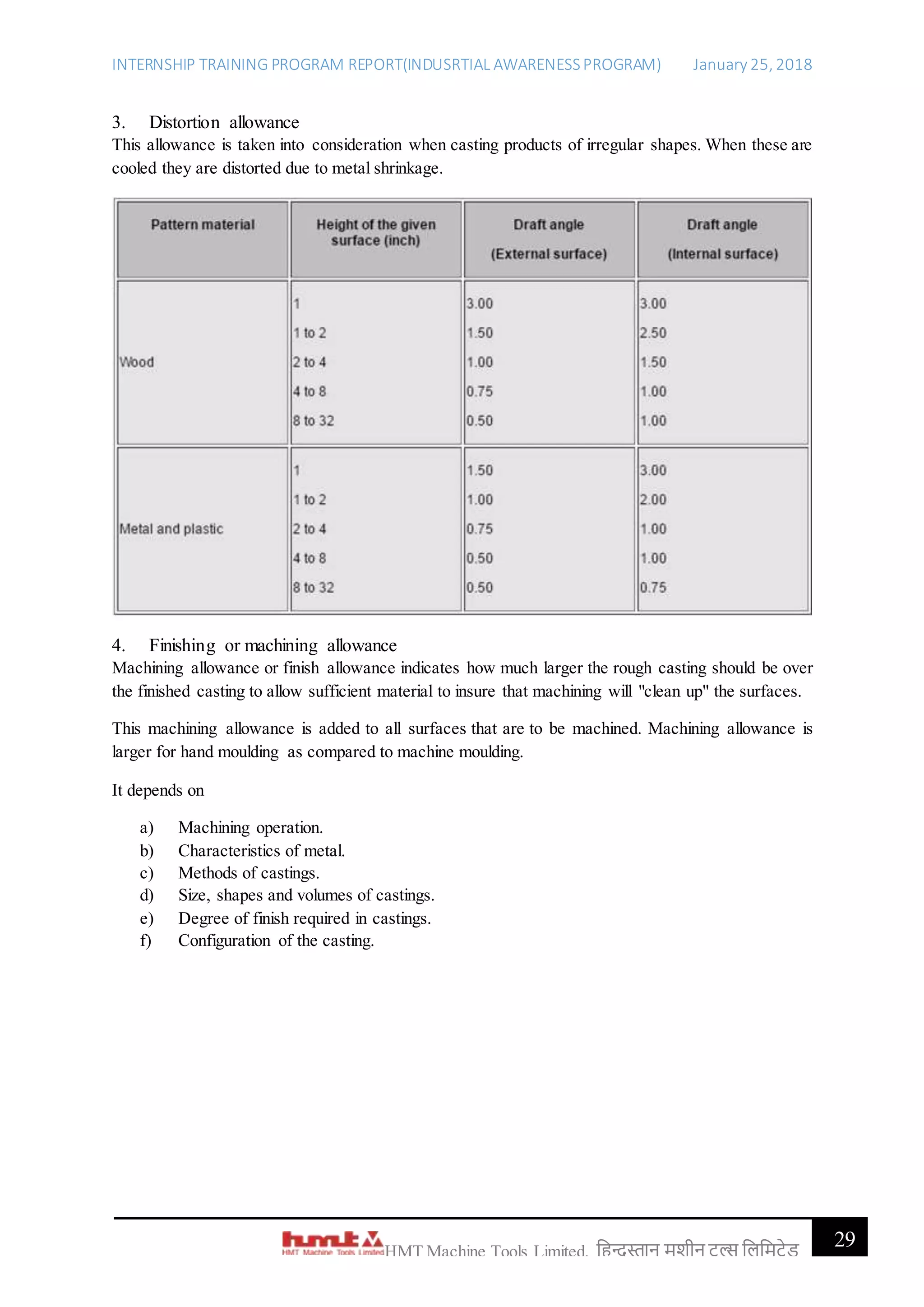
3. Distortion allowance
This allowance is taken into consideration when casting products of irregular shapes. When these are
cooled they are distorted due to metal shrinkage.
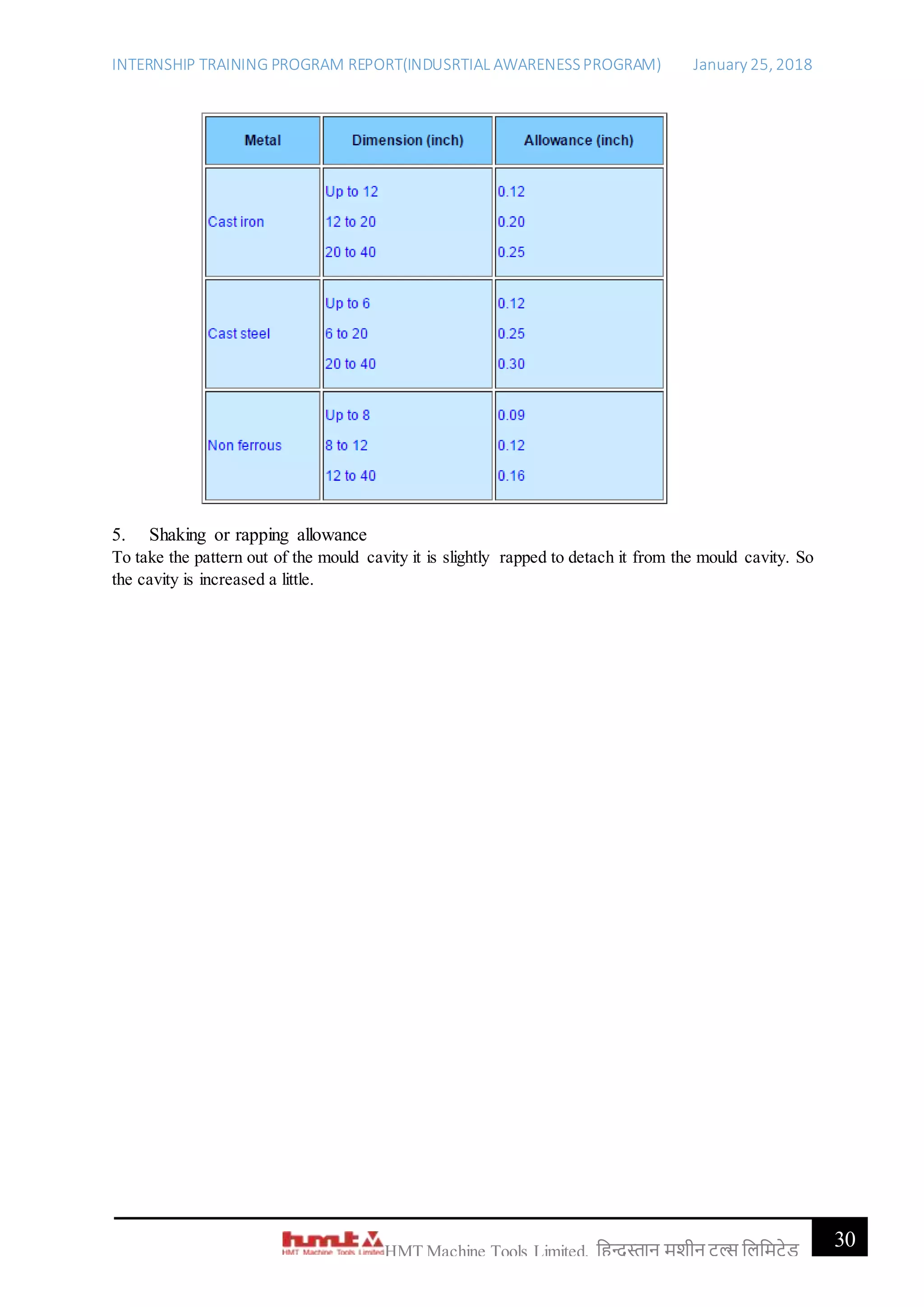
4. Finishing or machining allowance
Machining allowance or finish allowance indicates how much larger the rough casting should be over
the finished casting to allow sufficient material to insure that machining will "clean up" the surfaces.
This machining allowance is added to all surfaces that are to be machined. Machining allowance is
larger for hand moulding as compared to machine moulding.
It depends on
a) Machining operation.
b) Characteristics of metal.
c) Methods of castings.
d) Size, shapes and volumes of castings.
e) Degree of finish required in castings.
f) Configuration of the casting.
INTERNSHIP TRAINING PROGRAM REPORT(INDUSRTIAL AWARENESSPROGRAM) January 25, 2018
30HMT Machine Tools Limited, हिन्दुस्तान मशीन टू ल्स हिहमटेड
5. Shaking or rapping allowance
To take the pattern out of the mould cavity it is slightly rapped to detach it from the mould cavity. So
the cavity is increased a little.
INTERNSHIP TRAINING PROGRAM REPORT(INDUSRTIAL AWARENESSPROGRAM) January 25, 2018
31HMT Machine Tools Limited, हिन्दुस्तान मशीन टू ल्स हिहमटेड
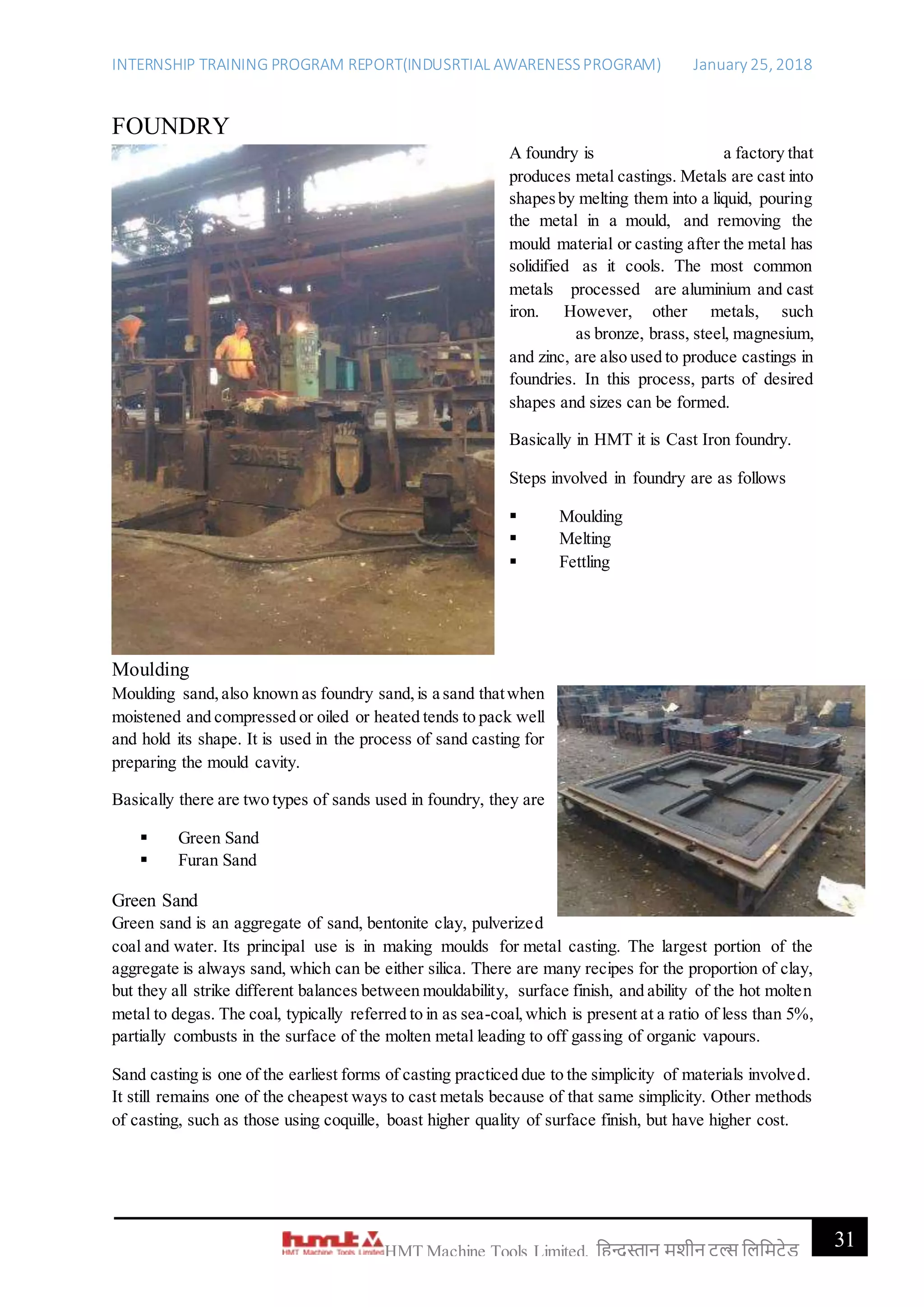
FOUNDRY
A foundry is a factory that
produces metal castings. Metals are cast into
shapesby melting them into a liquid, pouring
the metal in a mould, and removing the
mould material or casting after the metal has
solidified as it cools. The most common
metals processed are aluminium and cast
iron. However, other metals, such
as bronze, brass, steel, magnesium,
and zinc, are also used to produce castings in
foundries. In this process, parts of desired
shapes and sizes can be formed.
Basically in HMT it is Cast Iron foundry.
Steps involved in foundry are as follows
 Moulding
 Melting
 Fettling
Moulding
Moulding sand,also known as foundry sand,is a sand thatwhen
moistened and compressed or oiled or heated tends to pack well
and hold its shape. It is used in the process of sand casting for
preparing the mould cavity.
Basically there are two types of sands used in foundry, they are
 Green Sand
 Furan Sand
Green Sand
Green sand is an aggregate of sand, bentonite clay, pulverized
coal and water. Its principal use is in making moulds for metal casting. The largest portion of the
aggregate is always sand, which can be either silica. There are many recipes for the proportion of clay,
but they all strike different balances between mouldability, surface finish, and ability of the hot molten
metal to degas. The coal, typically referred to in as sea-coal,which is present at a ratio of less than 5%,
partially combusts in the surface of the molten metal leading to off gassing of organic vapours.
Sand casting is one of the earliest forms of casting practiced due to the simplicity of materials involved.
It still remains one of the cheapest ways to cast metals because of that same simplicity. Other methods
of casting, such as those using coquille, boast higher quality of surface finish, but have higher cost.
INTERNSHIP TRAINING PROGRAM REPORT(INDUSRTIAL AWARENESSPROGRAM) January 25, 2018
32HMT Machine Tools Limited, हिन्दुस्तान मशीन टू ल्स हिहमटेड
Green sand (like other casting sands) is usually housed in what casters refer to as "flask", which are
nothing other than boxes without a bottom or lid. The box is split into two halves which are stacked
together in use. The halves are referred to as the top and bottom flask respectively.
Not all Green sand is green in colour. But considered "green" as in the sense that it is used in a wet state
(akin to green wood). According to the Cast Metals Federation website, an alternative casting method
is to heat-dry the moulded sand before pouring the molten metal. This dry sand casting process results
in a more rigid mould better suited to heavier castings.
Furan Sand
Furan resin self-hardening sand named from furan no-bake process,it takes furan resin as adhesion
agent and mixes with catalyser to produce sand moulds, the sand moulds can concrete under room
temperature.
The advantages offuran resin sand
1. The sizes of metals castings are accurate,the outline of the metal castings is clear, the surface of the
metal castings is smooth, the appearance quality is good and the micro-structure is compact.
2. The sand moulds do not need to be oven dry, so it shortens the period of production and save energy.
3. Because there is no oven dry, so the sand moulds are compact,and reduce the intensity of labor.
The disadvantages offuran resin sand
1. High requirement for the quality of the raw materials.
2. There is stimulating gas during moulding and pouring.
3. The cost of resin sand is high, and should be considered comprehensively.
The production processes offuran resin sand
1. The choice ofraw materials
A. The requires of sand. The content of SiO2 should be high, the content of mud and the value of acid
should be low.
B. Furan resin. The casting foundries should choose the resin with few or without nitrogen based on the
technique demand and the structures of the metal castings.
C. Solidification agent. Generally, we should use organic sulphuric acid solution.
D. Annexing agent. Adding some annexing agents can improve the property furan resin self-
hardening sand; increase the intensity of resin sand.
2. The reuse offuran resin self-hardening sand
The old sand can be used again; it can control the volume of sand and increase the quality of resin
sand castings, we can take the following measures to acquire high quality regeneration sand.
INTERNSHIP TRAINING PROGRAM REPORT(INDUSRTIAL AWARENESSPROGRAM) January 25, 2018
33HMT Machine Tools Limited, हिन्दुस्तान मशीन टू ल्स हिहमटेड
Melting
In HMT, molten metal is prepared using induction furnace.
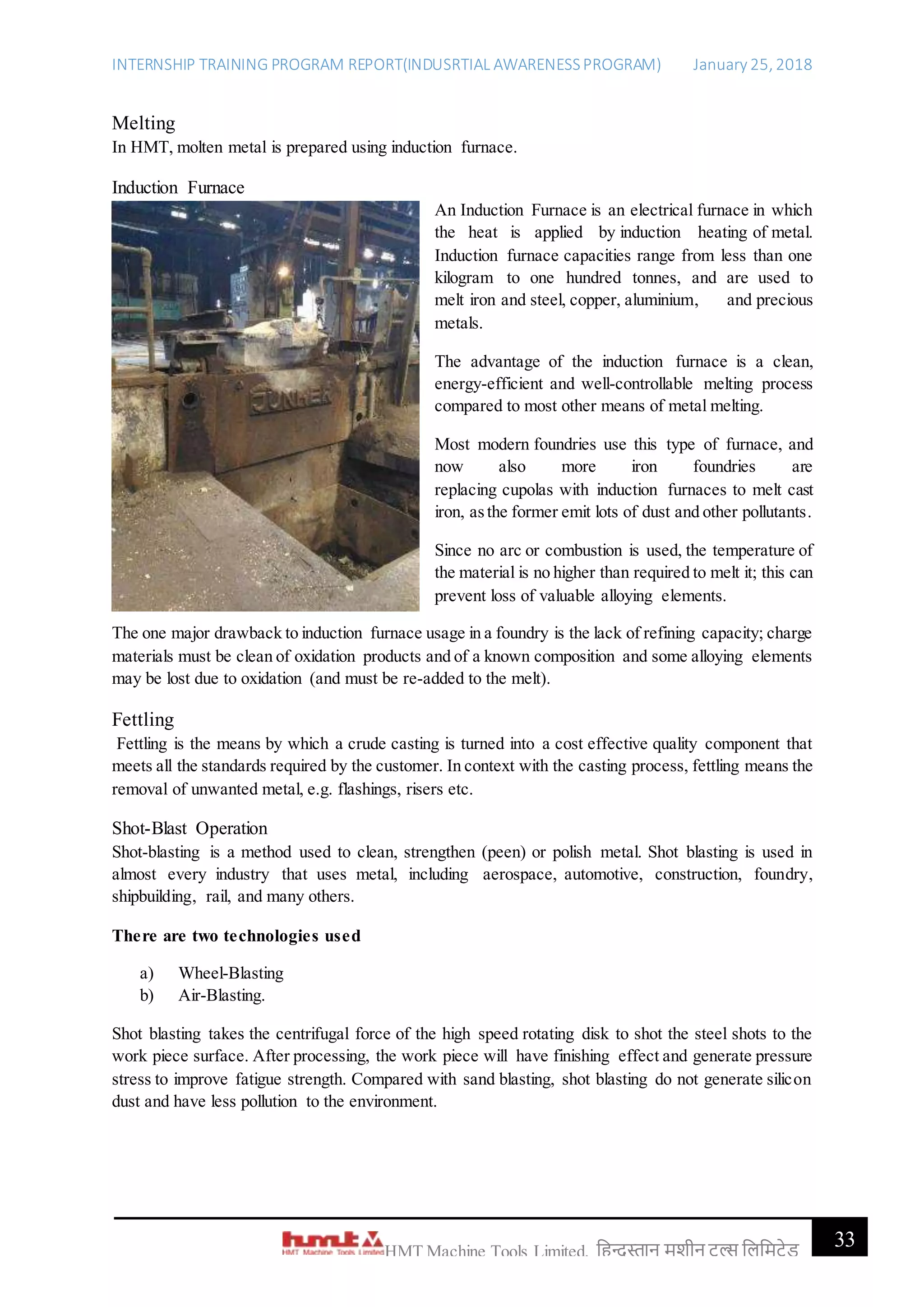
Induction Furnace
An Induction Furnace is an electrical furnace in which
the heat is applied by induction heating of metal.
Induction furnace capacities range from less than one
kilogram to one hundred tonnes, and are used to
melt iron and steel, copper, aluminium, and precious
metals.
The advantage of the induction furnace is a clean,
energy-efficient and well-controllable melting process
compared to most other means of metal melting.
Most modern foundries use this type of furnace, and
now also more iron foundries are
replacing cupolas with induction furnaces to melt cast
iron, asthe former emit lots of dust and other pollutants.
Since no arc or combustion is used, the temperature of
the material is no higher than required to melt it; this can
prevent loss of valuable alloying elements.
The one major drawback to induction furnace usage in a foundry is the lack of refining capacity; charge
materials must be clean of oxidation products and of a known composition and some alloying elements
may be lost due to oxidation (and must be re-added to the melt).
Fettling
Fettling is the means by which a crude casting is turned into a cost effective quality component that
meets all the standards required by the customer. In context with the casting process, fettling means the
removal of unwanted metal, e.g. flashings, risers etc.
Shot-Blast Operation
Shot-blasting is a method used to clean, strengthen (peen) or polish metal. Shot blasting is used in
almost every industry that uses metal, including aerospace, automotive, construction, foundry,
shipbuilding, rail, and many others.
There are two technologies used
a) Wheel-Blasting
b) Air-Blasting.
Shot blasting takes the centrifugal force of the high speed rotating disk to shot the steel shots to the
work piece surface. After processing, the work piece will have finishing effect and generate pressure
stress to improve fatigue strength. Compared with sand blasting, shot blasting do not generate silicon
dust and have less pollution to the environment.
INTERNSHIP TRAINING PROGRAM REPORT(INDUSRTIAL AWARENESSPROGRAM) January 25, 2018
34HMT Machine Tools Limited, हिन्दुस्तान मशीन टू ल्स हिहमटेड
BSD PRODUCTION
A ball screw is a mechanical linear actuator that translates rotational motion to linear motion with
little friction. A threaded shaft provides a helical raceway for ball bearings which act as a precision
screw. As well as being able to apply or withstand high thrust loads, they can do so with minimum
internal friction. They are made to close tolerances and are therefore suitable for use in situations in
which high precision is necessary. The ball assembly acts as the nut while the threaded shaft is the
screw. In contrast to conventional lead-screws,ball-screws tend to be rather bulky, due to the need to
have a mechanism to re-circulate the balls.
Another form of linear actuator based on a rotating rod is the thread less, a.k.a. "rolling ring drive". In
this design, three (or more) rolling-ring bearings are arranged symmetrically in a housing surrounding
a smooth (thread-less) actuator rod or shaft. The bearings are set at an angle to the rod, and this angle
determines the direction and rate of linear motion per revolution of the rod. An advantage of this design
over the conventional balls-crew or lead-screw is the practical elimination of backlash and loading
caused by preload nuts.
Components used in Ball Screw Assembly are
a) Ball Screw Spindle
b) Housing
c) Z-nuts
d) Wipers
e) Deflectors
f) Steel balls
There are approximately 21 operations that are to be performed on complete production of ball screw.
Few operations are,
Ball Screw Spindle
Carl Zena was the first to manufacture ball screw using the material CF53 (Carbon Ferocious). The
component is supposed to have tensile and retract ability property.
Ball screw materials are imported from countries such as Russia. In HMT ball screw material is
imported from Vishakapattanam, Bhadravati steel plant, etc.
INTERNSHIP TRAINING PROGRAM REPORT(INDUSRTIAL AWARENESSPROGRAM) January 25, 2018
35HMT Machine Tools Limited, हिन्दुस्तान मशीन टू ल्स हिहमटेड
Housing
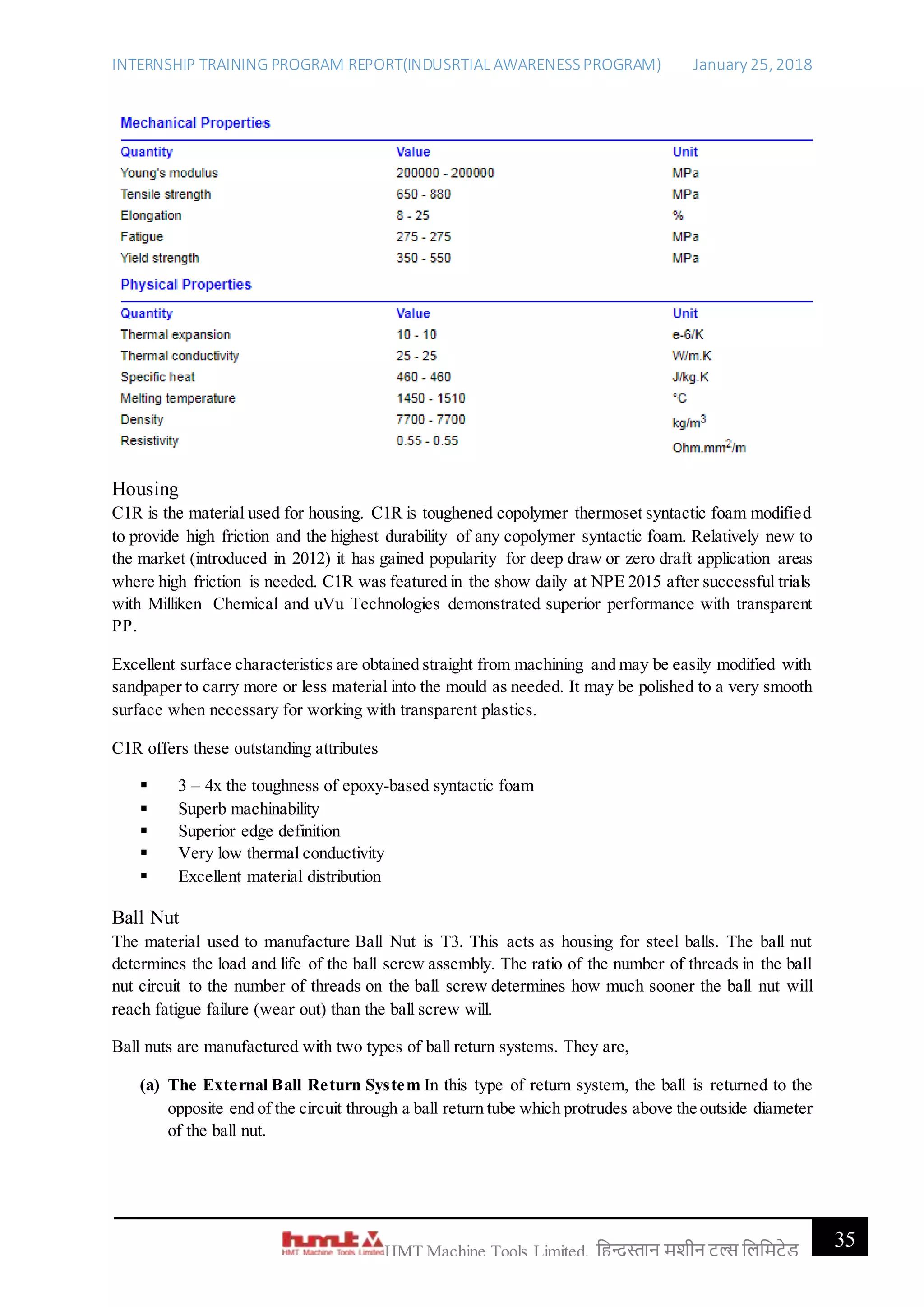
C1R is the material used for housing. C1R is toughened copolymer thermoset syntactic foam modified
to provide high friction and the highest durability of any copolymer syntactic foam. Relatively new to
the market (introduced in 2012) it has gained popularity for deep draw or zero draft application areas
where high friction is needed. C1R was featured in the show daily at NPE 2015 after successful trials
with Milliken Chemical and uVu Technologies demonstrated superior performance with transparent
PP.
Excellent surface characteristics are obtained straight from machining and may be easily modified with
sandpaper to carry more or less material into the mould as needed. It may be polished to a very smooth
surface when necessary for working with transparent plastics.
C1R offers these outstanding attributes
 3 – 4x the toughness of epoxy-based syntactic foam
 Superb machinability
 Superior edge definition
 Very low thermal conductivity
 Excellent material distribution
Ball Nut
The material used to manufacture Ball Nut is T3. This acts as housing for steel balls. The ball nut
determines the load and life of the ball screw assembly. The ratio of the number of threads in the ball
nut circuit to the number of threads on the ball screw determines how much sooner the ball nut will
reach fatigue failure (wear out) than the ball screw will.
Ball nuts are manufactured with two types of ball return systems. They are,
(a) The External Ball Return System In this type of return system, the ball is returned to the
opposite end of the circuit through a ball return tube which protrudes above the outside diameter
of the ball nut.
INTERNSHIP TRAINING PROGRAM REPORT(INDUSRTIAL AWARENESSPROGRAM) January 25, 2018
36HMT Machine Tools Limited, हिन्दुस्तान मशीन टू ल्स हिहमटेड
(b) The Internal Ball Return System (There are several variations of this type of return system)
the ball is returned through or along the nut wall, but below the outside diameter.
In HMT internal type ball returning system is used.
Wipers
The material used to manufacture wipers is Teflon. This prevents dust particles from entering the
assembly.
Deflectors
The material used to manufacture deflectors is C2R. A ball deflector for a recirculating ball screw and
nut assembly provides a plurality of adjustable semi-spherical locator bosses along an elongated body
portion thereof for enhancing fitment of said deflector within a segment of the nut groove during
assembly. In a preferred form, the bosses are disposed in adjacent quadrants on an upper body portion
of the elongated deflector body, and are arrangedin pairs, eachdisposed at opposite ends of the deflector
body and located adjacent the ends of the deflector. The bosses are adjusted by a grinder or other metal
removal device to compensate for tolerance variations.
Steel Balls
Steel balls are chrome alloy coated. They are used to reduce friction between ball screw and ball nuts.
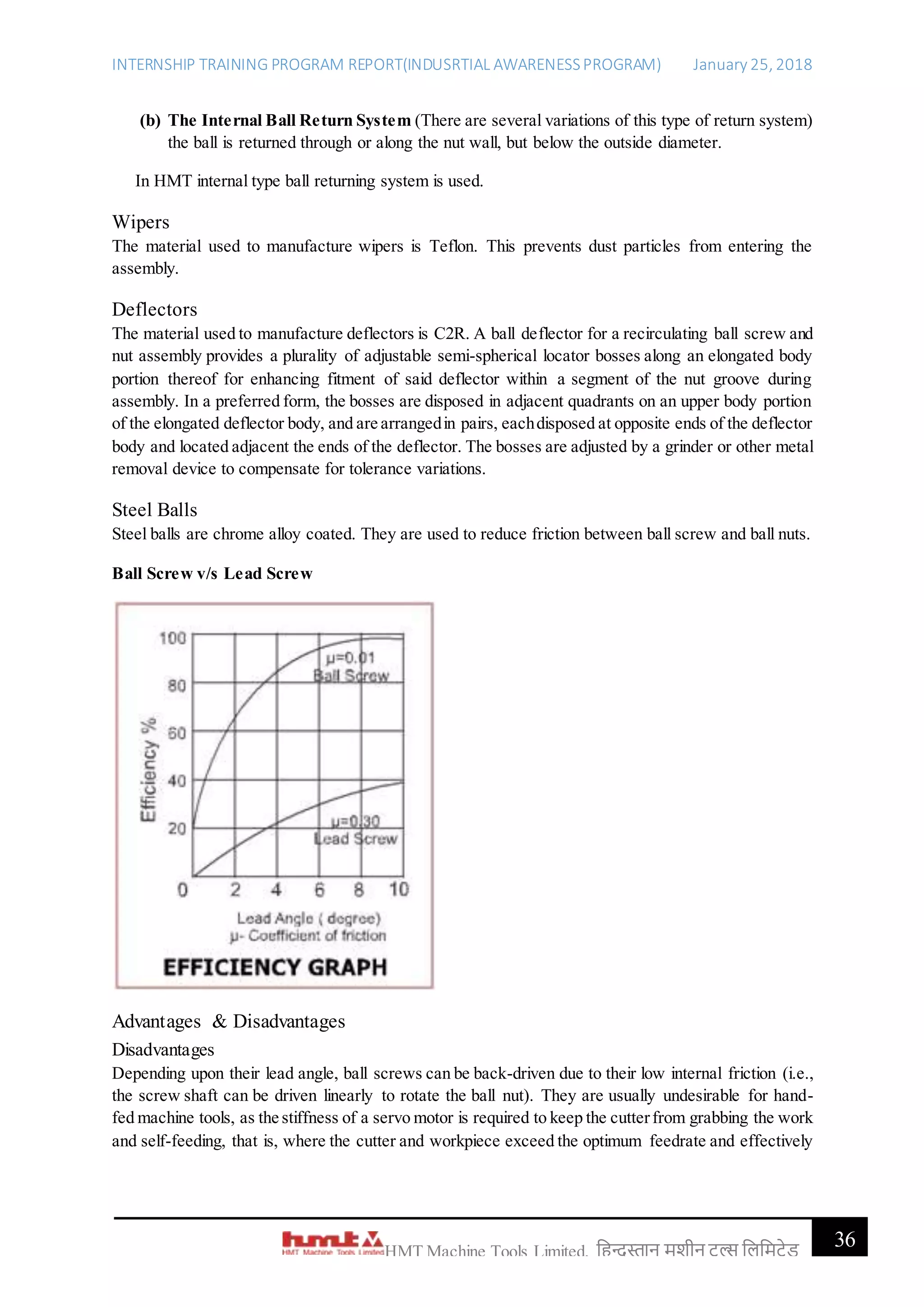
Ball Screw v/s Lead Screw
Advantages & Disadvantages
Disadvantages
Depending upon their lead angle, ball screws can be back-driven due to their low internal friction (i.e.,
the screw shaft can be driven linearly to rotate the ball nut). They are usually undesirable for hand-
fed machine tools, as the stiffness of a servo motor is required to keep the cutterfrom grabbing the work
and self-feeding, that is, where the cutter and workpiece exceed the optimum feedrate and effectively
INTERNSHIP TRAINING PROGRAM REPORT(INDUSRTIAL AWARENESSPROGRAM) January 25, 2018
37HMT Machine Tools Limited, हिन्दुस्तान मशीन टू ल्स हिहमटेड
jam or crash together, ruining the cutter and workpiece. Cost is also a major factor as Acme screws are
cheaper to manufacture.
Advantages
Low friction in ball screws yields high mechanical efficiency compared to alternatives. A typical ball
screw may be 90 percent efficient, versus 20 to 25 percent efficiency of an Acme lead screw of equal
size. Lack of sliding friction between the nut and screw lends itself to extended lifespan of the screw
assembly (especially in no-backlash systems), reducing downtime for maintenance and parts
replacement, while also decreasing demand for lubrication. This is combined with their overall
performance benefits and reduced power requirements, may offset the initial costs of using ball screws.
Ball screws may also reduce or eliminate backlash common in lead screw and nut combinations. The
balls may be preloaded so that there is no "wiggle" between the ball screw and ball nut. This is
particularly desirable in applications where the load on the screw varies quickly, such as machining
tools.
HMT, a pioneer in the field of machine tools with more than 50 years of expertise, also manufactures
High Precision Recirculating Ball Screws of various sizes to meet Customers’ requirements.
Recirculating ball screws have to be converted into rotary motions or vice versa.
Ball screws have a high mechanical efficiency, superior positioning accuracy coupled with low wear
and long life, and are widely used in various industrial machines & equipments, especially in numerical
controlled machines as mechanical feed elements.
Salient Features
 Higher Efficiency
Since sliding friction is replaced by rolling friction, efficiency is greater than 90% and
the driving torque is less than onethird of that of conventional screws.
 Lesser Heat Generation
Even high load causes minimum heating up which means an improvement of positioning
accuracy.
 No Stick-slip
Substituting a rolling contact for the sliding metal to-metal contact minimizes starting
friction and eliminates the stick-slip tendency when a slow , linear motion is required in
machine tool slide applications thus resulting in a tremendous increase in tool life.
 Higher Service Life
Due to the rolling of balls in hardened grooves very little wear occurs over the life of
Ball Screws.
 High Precision & Rellability
All HMT Precision Ball Screws are ground and assembled and inspected under a strict
process and temperature control.
 Precise Positioning
High Positioning accuracy is possible even at low speeds .Maximum Axial Stiffness,
Ball Screws can easily be adjusted backlash-free and pre-loaded for increasing the axial
stiffness, response and repeatability of positioning.
INTERNSHIP TRAINING PROGRAM REPORT(INDUSRTIAL AWARENESSPROGRAM) January 25, 2018
38HMT Machine Tools Limited, हिन्दुस्तान मशीन टू ल्स हिहमटेड
 High Power Transmission
Transmission of greater forces of maximum driving power with low loss at minimum
mounting dimensions.
Ball ScrewManufacturing Range in HMT
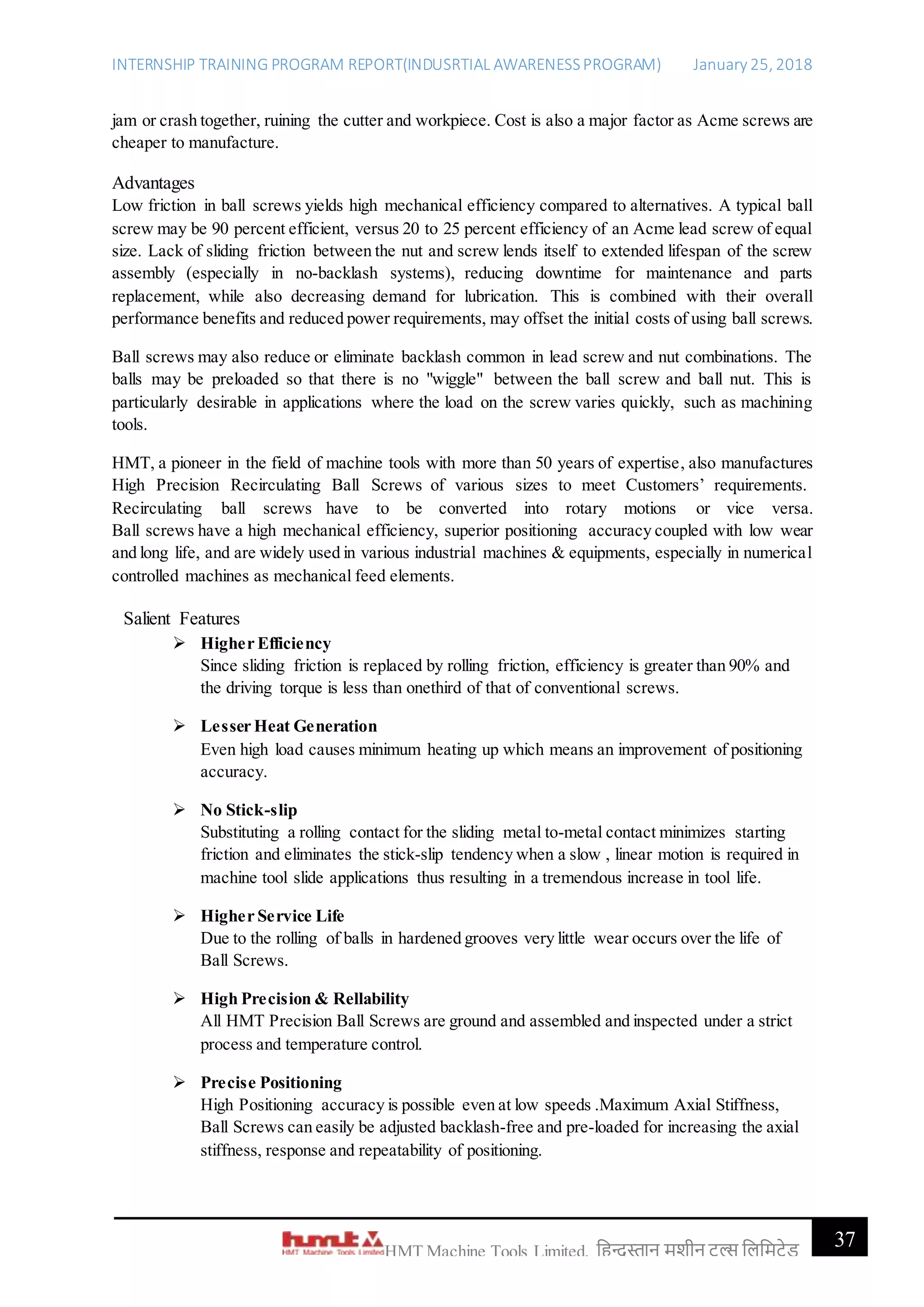
The manufacturing range covers Precision ground
Ballscrews in the standard range of diameters 16-80 mm
with standard leads of 3, 4, 5, 5.08, 6, 6.35, 8, 10, 12, 12.7,
16, 19, and 20 mm. Maximum length offered up to 3500mm
depending on size. Number of turns in nuts 2, 3, 4, 5, 6 and
8 depending on size.
Patented Design ofHMT on Ball Screw
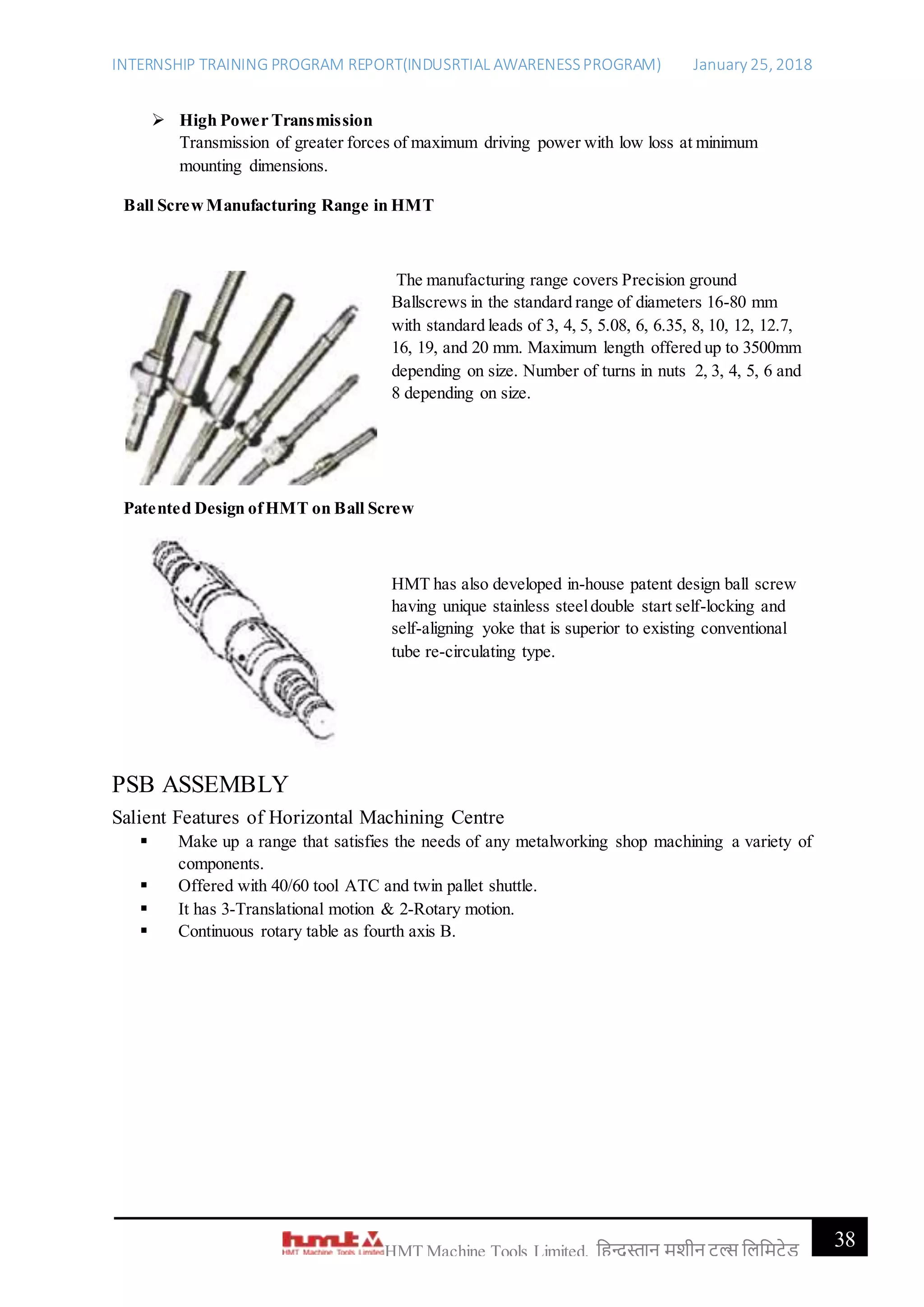
HMT has also developed in-house patent design ball screw
having unique stainless steeldouble start self-locking and
self-aligning yoke that is superior to existing conventional
tube re-circulating type.
PSB ASSEMBLY
Salient Features of Horizontal Machining Centre
 Make up a range that satisfies the needs of any metalworking shop machining a variety of
components.
 Offered with 40/60 tool ATC and twin pallet shuttle.
 It has 3-Translational motion & 2-Rotary motion.
 Continuous rotary table as fourth axis B.
INTERNSHIP TRAINING PROGRAM REPORT(INDUSRTIAL AWARENESSPROGRAM) January 25, 2018
39HMT Machine Tools Limited, हिन्दुस्तान मशीन टू ल्स हिहमटेड
Servo Manipulator
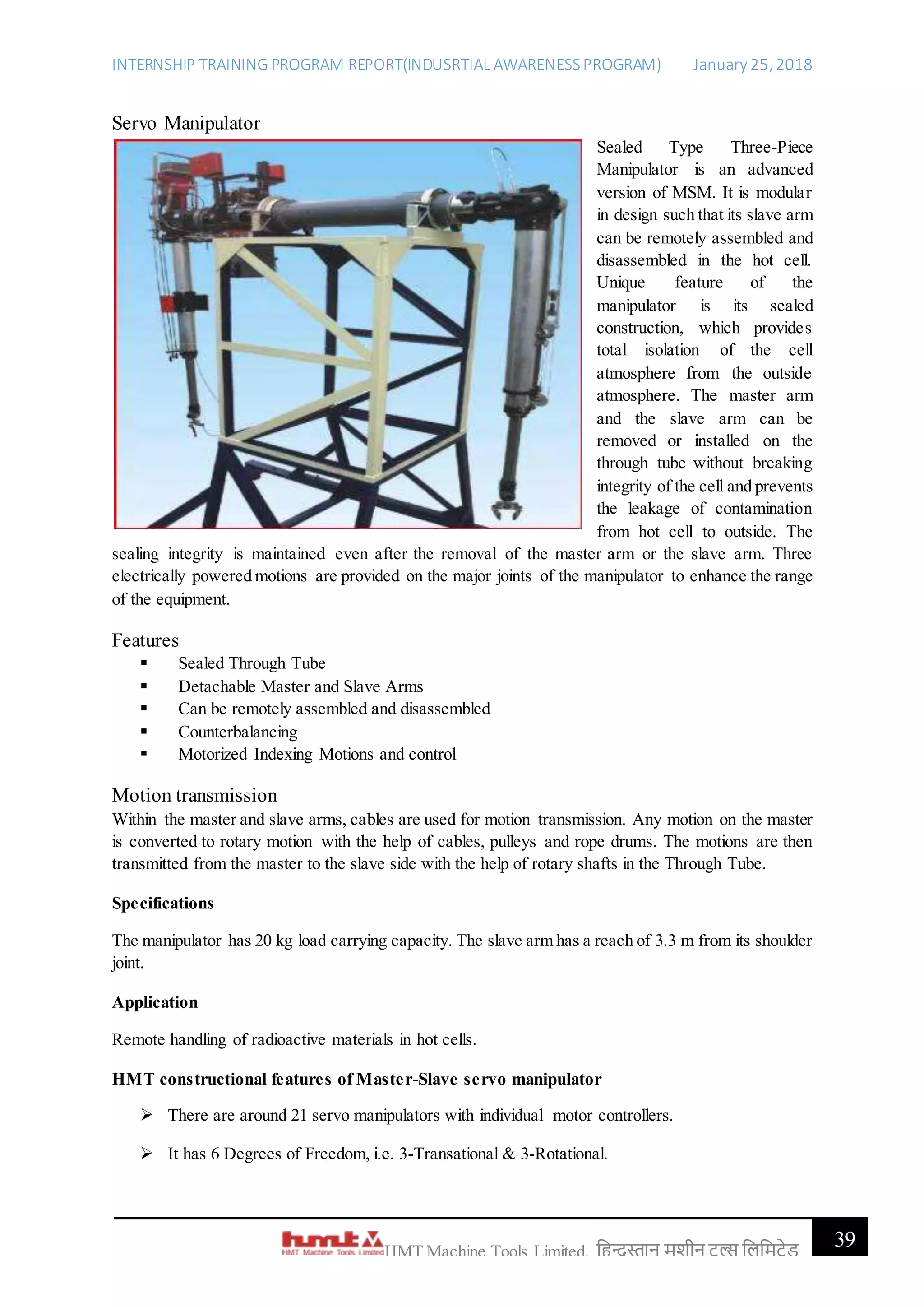
Sealed Type Three-Piece
Manipulator is an advanced
version of MSM. It is modular
in design such that its slave arm
can be remotely assembled and
disassembled in the hot cell.
Unique feature of the
manipulator is its sealed
construction, which provides
total isolation of the cell
atmosphere from the outside
atmosphere. The master arm
and the slave arm can be
removed or installed on the
through tube without breaking
integrity of the cell and prevents
the leakage of contamination
from hot cell to outside. The
sealing integrity is maintained even after the removal of the master arm or the slave arm. Three
electrically powered motions are provided on the major joints of the manipulator to enhance the range
of the equipment.
Features
 Sealed Through Tube
 Detachable Master and Slave Arms
 Can be remotely assembled and disassembled
 Counterbalancing
 Motorized Indexing Motions and control
Motion transmission
Within the master and slave arms, cables are used for motion transmission. Any motion on the master
is converted to rotary motion with the help of cables, pulleys and rope drums. The motions are then
transmitted from the master to the slave side with the help of rotary shafts in the Through Tube.
Specifications
The manipulator has 20 kg load carrying capacity. The slave arm has a reach of 3.3 m from its shoulder
joint.
Application
Remote handling of radioactive materials in hot cells.
HMT constructional features of Master-Slave servo manipulator
 There are around 21 servo manipulators with individual motor controllers.
 It has 6 Degrees of Freedom, i.e. 3-Transational & 3-Rotational.
INTERNSHIP TRAINING PROGRAM REPORT(INDUSRTIAL AWARENESSPROGRAM) January 25, 2018
40HMT Machine Tools Limited, हिन्दुस्तान मशीन टू ल्स हिहमटेड
 It is provided with polyurethane booting to slave arm.
INSPECTION, CALIBRATION OF CUTTING TOOL/TOOL ROOM
Inspection
Inspection is the process of comparing completed product against standards.
Objective
 Assess conformity with design specifications.
 Improve product quality and reliability.
Instruments
Few of the instruments used to inspect finished components in HMT are
 Vernier Callipers
 Micrometre
 Internal Micrometre
 Plug Gauges
 Ring Gauges
 Bore Comparator
 Sine Bar
 Sine Centre
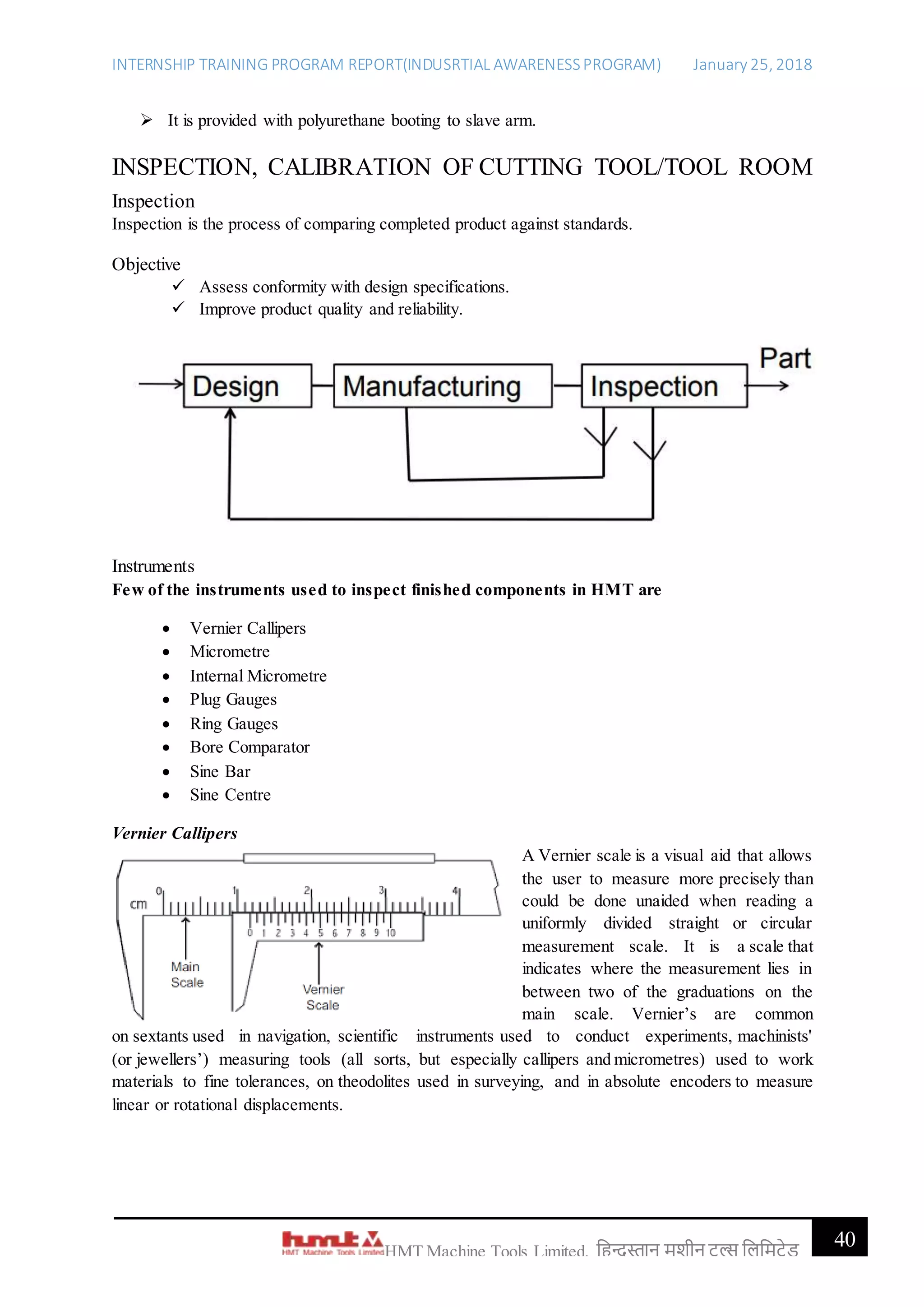
Vernier Callipers
A Vernier scale is a visual aid that allows
the user to measure more precisely than
could be done unaided when reading a
uniformly divided straight or circular
measurement scale. It is a scale that
indicates where the measurement lies in
between two of the graduations on the
main scale. Vernier’s are common
on sextants used in navigation, scientific instruments used to conduct experiments, machinists'
(or jewellers’) measuring tools (all sorts, but especially callipers and micrometres) used to work
materials to fine tolerances, on theodolites used in surveying, and in absolute encoders to measure
linear or rotational displacements.
INTERNSHIP TRAINING PROGRAM REPORT(INDUSRTIAL AWARENESSPROGRAM) January 25, 2018
41HMT Machine Tools Limited, हिन्दुस्तान मशीन टू ल्स हिहमटेड
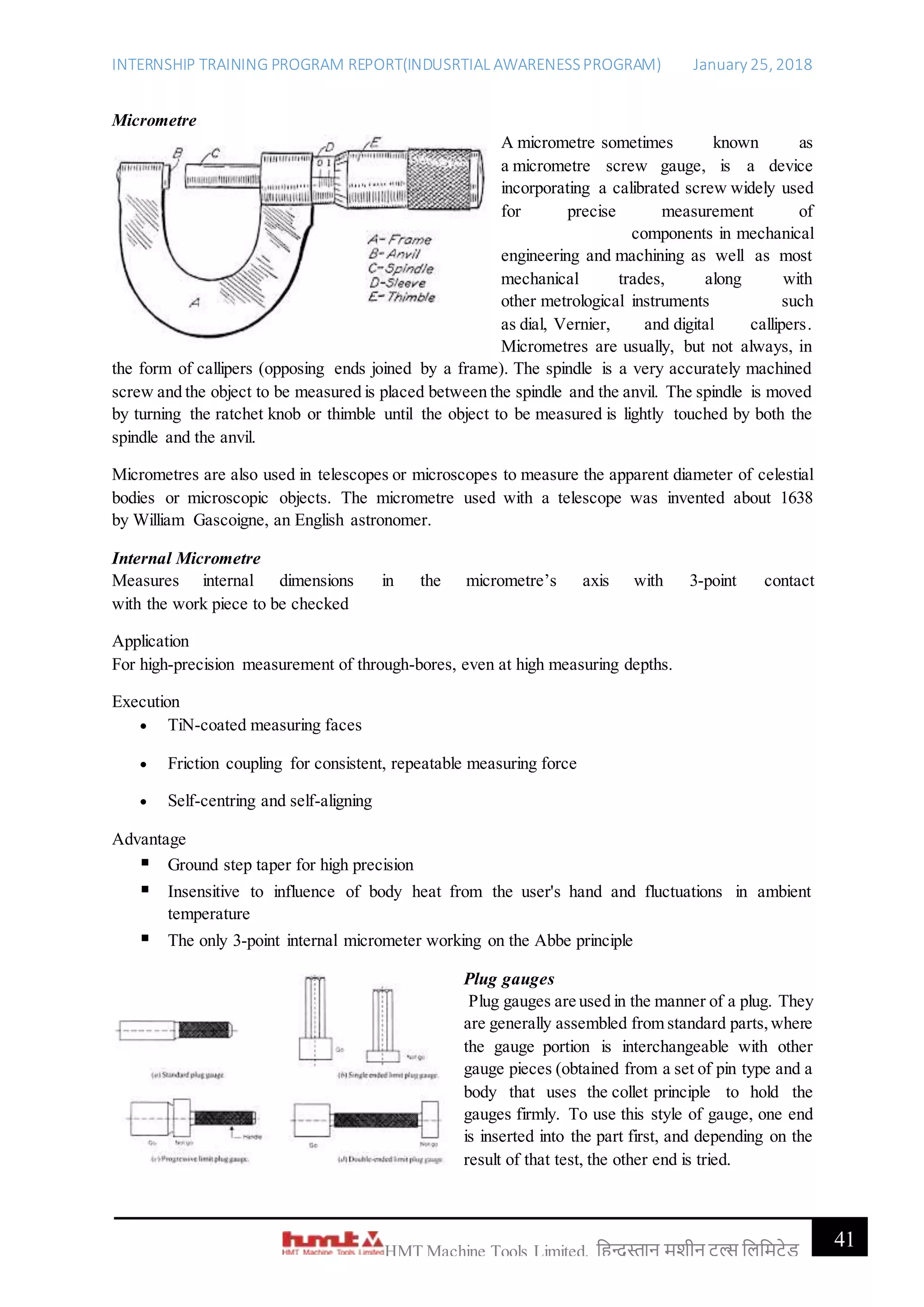
Micrometre
A micrometre sometimes known as
a micrometre screw gauge, is a device
incorporating a calibrated screw widely used
for precise measurement of
components in mechanical
engineering and machining as well as most
mechanical trades, along with
other metrological instruments such
as dial, Vernier, and digital callipers.
Micrometres are usually, but not always, in
the form of callipers (opposing ends joined by a frame). The spindle is a very accurately machined
screw and the object to be measured is placed between the spindle and the anvil. The spindle is moved
by turning the ratchet knob or thimble until the object to be measured is lightly touched by both the
spindle and the anvil.
Micrometres are also used in telescopes or microscopes to measure the apparent diameter of celestial
bodies or microscopic objects. The micrometre used with a telescope was invented about 1638
by William Gascoigne, an English astronomer.
Internal Micrometre
Measures internal dimensions in the micrometre’s axis with 3-point contact
with the work piece to be checked
Application
For high-precision measurement of through-bores, even at high measuring depths.
Execution
 TiN-coated measuring faces
 Friction coupling for consistent, repeatable measuring force
 Self-centring and self-aligning
Advantage
 Ground step taper for high precision
 Insensitive to influence of body heat from the user's hand and fluctuations in ambient
temperature
 The only 3-point internal micrometer working on the Abbe principle
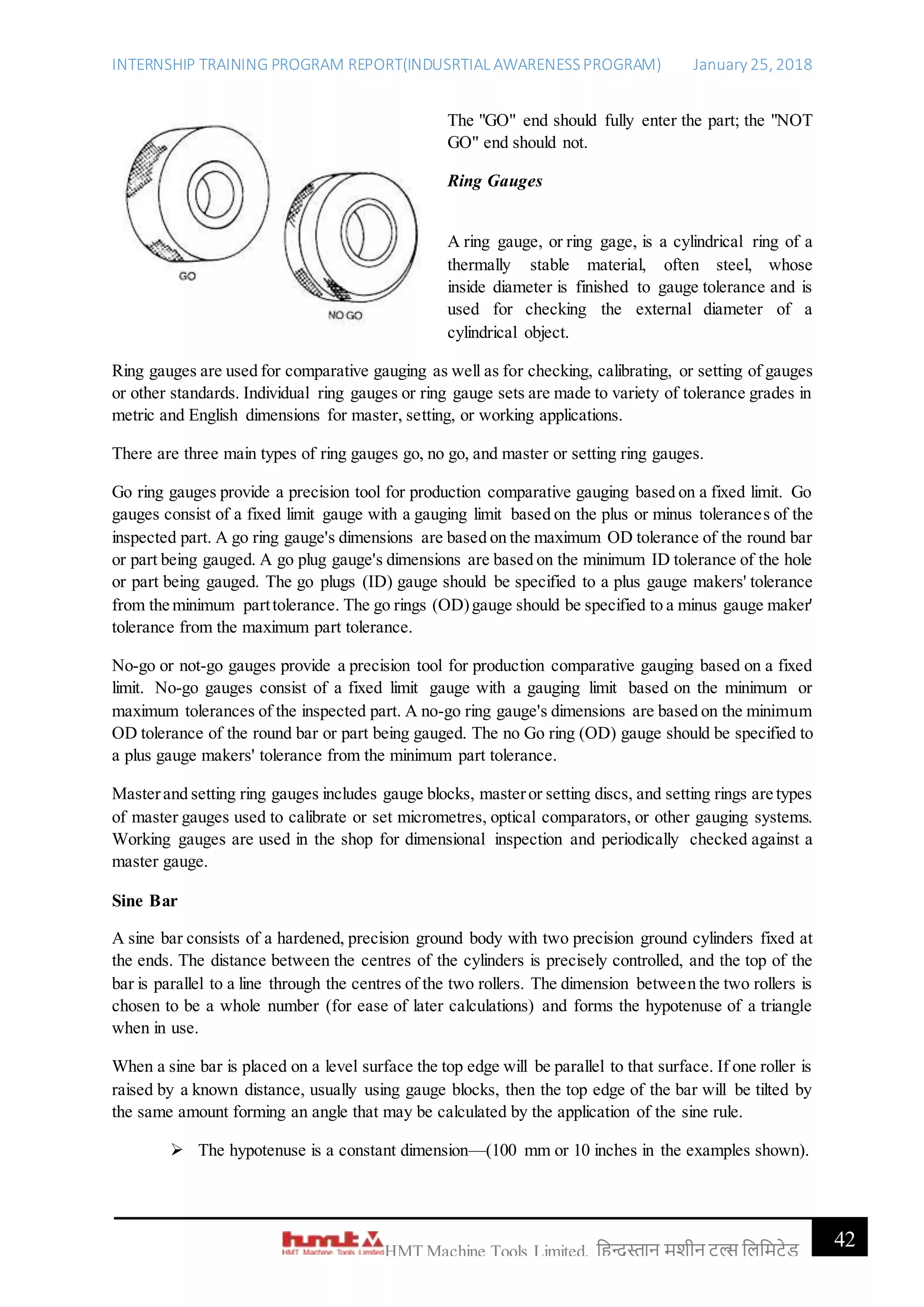
Plug gauges
Plug gauges are used in the manner of a plug. They
are generally assembled from standard parts,where
the gauge portion is interchangeable with other
gauge pieces (obtained from a set of pin type and a
body that uses the collet principle to hold the
gauges firmly. To use this style of gauge, one end
is inserted into the part first, and depending on the
result of that test, the other end is tried.
INTERNSHIP TRAINING PROGRAM REPORT(INDUSRTIAL AWARENESSPROGRAM) January 25, 2018
42HMT Machine Tools Limited, हिन्दुस्तान मशीन टू ल्स हिहमटेड
The "GO" end should fully enter the part; the "NOT
GO" end should not.
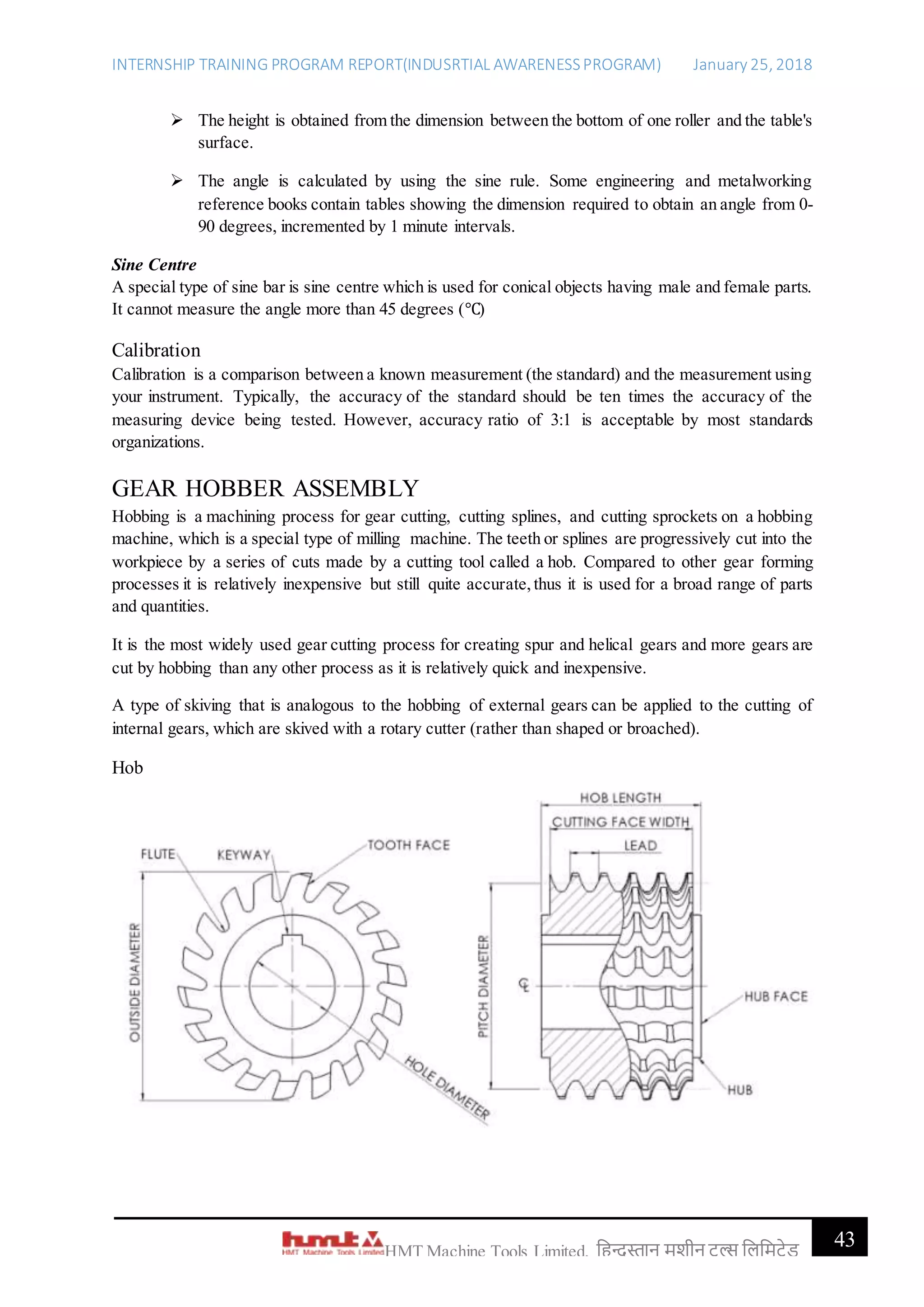
Ring Gauges
A ring gauge, or ring gage, is a cylindrical ring of a
thermally stable material, often steel, whose
inside diameter is finished to gauge tolerance and is
used for checking the external diameter of a
cylindrical object.
Ring gauges are used for comparative gauging as well as for checking, calibrating, or setting of gauges
or other standards. Individual ring gauges or ring gauge sets are made to variety of tolerance grades in
metric and English dimensions for master, setting, or working applications.
There are three main types of ring gauges go, no go, and master or setting ring gauges.
Go ring gauges provide a precision tool for production comparative gauging based on a fixed limit. Go
gauges consist of a fixed limit gauge with a gauging limit based on the plus or minus tolerances of the
inspected part. A go ring gauge's dimensions are based on the maximum OD tolerance of the round bar
or part being gauged. A go plug gauge's dimensions are based on the minimum ID tolerance of the hole
or part being gauged. The go plugs (ID) gauge should be specified to a plus gauge makers' tolerance
from the minimum parttolerance. The go rings (OD)gauge should be specified to a minus gauge maker'
tolerance from the maximum part tolerance.
No-go or not-go gauges provide a precision tool for production comparative gauging based on a fixed
limit. No-go gauges consist of a fixed limit gauge with a gauging limit based on the minimum or
maximum tolerances of the inspected part. A no-go ring gauge's dimensions are based on the minimum
OD tolerance of the round bar or part being gauged. The no Go ring (OD) gauge should be specified to
a plus gauge makers' tolerance from the minimum part tolerance.
Masterand setting ring gauges includes gauge blocks, masteror setting discs, and setting rings are types
of master gauges used to calibrate or set micrometres, optical comparators, or other gauging systems.
Working gauges are used in the shop for dimensional inspection and periodically checked against a
master gauge.
Sine Bar
A sine bar consists of a hardened, precision ground body with two precision ground cylinders fixed at
the ends. The distance between the centres of the cylinders is precisely controlled, and the top of the
bar is parallel to a line through the centres of the two rollers. The dimension between the two rollers is
chosen to be a whole number (for ease of later calculations) and forms the hypotenuse of a triangle
when in use.
When a sine bar is placed on a level surface the top edge will be parallel to that surface. If one roller is
raised by a known distance, usually using gauge blocks, then the top edge of the bar will be tilted by
the same amount forming an angle that may be calculated by the application of the sine rule.
 The hypotenuse is a constant dimension—(100 mm or 10 inches in the examples shown).
INTERNSHIP TRAINING PROGRAM REPORT(INDUSRTIAL AWARENESSPROGRAM) January 25, 2018
43HMT Machine Tools Limited, हिन्दुस्तान मशीन टू ल्स हिहमटेड
 The height is obtained from the dimension between the bottom of one roller and the table's
surface.
 The angle is calculated by using the sine rule. Some engineering and metalworking
reference books contain tables showing the dimension required to obtain an angle from 0-
90 degrees, incremented by 1 minute intervals.
Sine Centre
A special type of sine bar is sine centre which is used for conical objects having male and female parts.
It cannot measure the angle more than 45 degrees (℃)
Calibration
Calibration is a comparison between a known measurement (the standard) and the measurement using
your instrument. Typically, the accuracy of the standard should be ten times the accuracy of the
measuring device being tested. However, accuracy ratio of 3:1 is acceptable by most standards
organizations.
GEAR HOBBER ASSEMBLY
Hobbing is a machining process for gear cutting, cutting splines, and cutting sprockets on a hobbing
machine, which is a special type of milling machine. The teeth or splines are progressively cut into the
workpiece by a series of cuts made by a cutting tool called a hob. Compared to other gear forming
processes it is relatively inexpensive but still quite accurate,thus it is used for a broad range of parts
and quantities.
It is the most widely used gear cutting process for creating spur and helical gears and more gears are
cut by hobbing than any other process as it is relatively quick and inexpensive.
A type of skiving that is analogous to the hobbing of external gears can be applied to the cutting of
internal gears, which are skived with a rotary cutter (rather than shaped or broached).
Hob
INTERNSHIP TRAINING PROGRAM REPORT(INDUSRTIAL AWARENESSPROGRAM) January 25, 2018
44HMT Machine Tools Limited, हिन्दुस्तान मशीन टू ल्स हिहमटेड
The hob is a cutting tool used to cut the teeth into the workpiece. It is cylindrical in shape with helical
cutting teeth. These teeth have grooves that run the length of the hob, which aid in cutting and chip
removal. There are also special hobs designed for special gears such as the spline and sprocket gears.
The cross-sectionalshape of the hob teeth are almost the same shape as teeth of a rack gear that would
be used with the finished product. There are slight changes to the shape for generating purposes, such
as extending the hob's tooth length to create a clearance in the gear's roots. Each hob tooth is relieved
on the back side to reduce friction.
Most hobs are single-thread hobs, but double-, and triple-thread hobs increase production rates. The
downside is that they are not as accurate as single-thread hobs. Depending on type of gear teeth to be
cut, there are custom made hobs and general purpose hobs. Custom made hobs are different from other
hobs as they are suited to make gears with modified tooth profile. The tooth profile is modified to add
strength and reduce size and gear noise.
This list outlines types of hobs
 Roller chain sprocket hobs
 Worm wheel hobs
 Spline hobs
 Chamfer hobs
 Spur and helical gear hobs
 Straight side spline hobs
 Involute spline hobs
 Serration hobs
 Semi topping gear hobs
Gear Hobbing machine used in HMT is High Speed CNC Gear Hobber L200 CNC 3A / 6A
High Speed CNC Gear Hobber L200 CNC 3A / 6A
For high productivity with flexibility. Ideal for medium and large production.
Salient Features
 Outstanding static & dynamic rigidity.
 Powerful main motor.
 Duplex work & worm wheel for work table drive.
 Antifriction bearings for work table
 Two-start special duplex index table drive.
 Shifting hob head with CNC axis for hob shifting
 Main drive with infinitely variable hob speeds via variable speed AC motor.
 Differential mechanism.
 Steady column with hydraulically operated tailstock.
 Electronic synchronisation between hob and table rotation (No index and differential change
gears).
 Hobbing of spur, helical, crown, taper and gears having different no. of teeth, module and helix
angles in the same set-up.
 Hobbing of worm gears using both cylindrical and conical hobs.
INTERNSHIP TRAINING PROGRAM REPORT(INDUSRTIAL AWARENESSPROGRAM) January 25, 2018
45HMT Machine Tools Limited, हिन्दुस्तान मशीन टू ल्स हिहमटेड
 Automatic working cycle.
HEAT TREATMENT
Heat treatment is a combination of heating & cooling operation timed & applied to a metal or alloy in
the solid state in a way that will produce desired properties without altering their shape and dimensions.
Heat treatment is often associated with increasing the strength of material. It can also be used to obtain
certain manufacturing objectives like,
 To improve machining & formability.
 To restore ductility.
 To recover grain size etc.
Types of Heat Treatment
 Annealing
 Normalising
 Tempering
 Hardening
 Surface Hardening
 Case Hardening
INTERNSHIP TRAINING PROGRAM REPORT(INDUSRTIAL AWARENESSPROGRAM) January 25, 2018
46HMT Machine Tools Limited, हिन्दुस्तान मशीन टू ल्स हिहमटेड
Hardening
Hardening involves heating of steel, keeping it at an appropriate temperature until all pearlite is
transformed into austenite, and then quenching it rapidly in water or oil. The temperature at which
austentizing rapidly takes place depends upon the carbon content in the steel used. The heating time
should be increased ensuring that the core will also be fully transformed into austenite. The
microstructure of a hardened steel part is ferrite, martensite, or cementite.
Tempering
Tempering involves heating steel that has been quenched and hardened for an adequate period of time
so that the metal can be equilibrated. The hardness and strength obtained depend upon the temperature
at which tempering is carried out. Higher temperatures will result into high ductility, but low strength
and hardness. Low tempering temperatures will produce low ductility, but high strength and hardness.
In practice, appropriate tempering temperatures are selected that will produce the desired level of
hardnessand strength. This operation is performed on all carbon steelsthat have beenhardened, in order
to reduce their brittleness, so that they can be used effectively in desired applications.
Annealing
Annealing involves treating steel up to a high temperature, and then cooling it very slowly to room
temperature, so that the resulting microstructure will possess high ductility and toughness, but low
hardness. Annealing is performed by heating a component to the appropriate temperature,soaking it at
that temperature,and then shutting off the furnace while the piece is in it. Steelis annealed before being
processed by cold forming, to reduce the requirements of load and energy, and to enable the metal to
undergo large strains without failure.
Normalizing
Normalizing involves heating steel, and then keeping it at that temperature for a period of time, and
then cooling it in air. The resulting microstructure is a mixture of ferrite and cementite which has a
higher strength and hardness,but lower ductility. Normalizing is performed on structures and structural
components that will be subjected to machining, because it improves the machinability of carbon steels.
Carburization
It is a heat treatment process in which steel or iron is heated to a temperature,below the melting point,
in the presence of a liquid, solid, or gaseous material
which decomposes so as to release carbon when heated
to the temperature used. The outer case or surface will
have higher carbon content than the primary material.
When the steel or iron is rapidly cooled by quenching,
the higher carbon content on the outer surface becomes
hard, while the core remains tough and soft.
Surface Hardening
In many engineering applications, it is necessarytohave
the surface of the component hard enough to resist wear
and erosion, while maintaining ductility and toughness,
to withstand impact and shock loading. This can be
achieved by local austentitizing and quenching, and
INTERNSHIP TRAINING PROGRAM REPORT(INDUSRTIAL AWARENESSPROGRAM) January 25, 2018
47HMT Machine Tools Limited, हिन्दुस्तान मशीन टू ल्स हिहमटेड
diffusion of hardening elements like carbon or nitrogen into the surface. Processes involved for this
purpose are known as flame hardening, induction hardening, nitriding and carbonitriding.
MATERIAL TESTING
Materials testing are a well-established technique used to determine the physical and mechanical
properties of raw materials and components from a human hair to steel, composite materials and
ceramics.
Materials testing, measurement of the characteristics and behaviour of such substances as
metals, ceramics,or plastics under various conditions. The data thus obtained can be used in specifying
the suitability of materials for various applications—e.g., building or aircraft construction, machinery,
or packaging. A full- or small-scale model of a proposed machine or structure may be tested.
Alternatively, investigators may construct mathematical models that utilize known material
characteristics and behaviour to predict capabilities of the structure.
Materials testing breaks down into five major categories mechanical testing; testing for thermal
properties; testing for electrical properties; testing for resistance to corrosion, radiation, and biological
deterioration; and non-destructive testing. Standard test methods have been established by such national
and international bodies as the International Organization for Standardization (ISO),with headquarters
in Geneva, and the American Society for Testing and Materials (ASTM), Philadelphia.
Mechanical Testing
Structures and machines, or their components, fail because of fracture or excessive deformation. In
attempting to prevent such failure, the designer estimates how much stress (load per unit area) can be
anticipated, and specifies materials that can withstand expected stresses. A stress analysis,
accomplished either experimentally or by means of a mathematical model, indicates expected areas of
high stress in a machine or structure. Mechanical property tests, carried out experimentally, indicate
which materials may safely be employed
Static tension and compression tests
When subjected to tension (pulling apart), a material elongates and eventually breaks. A simple static
tension test determines the breaking point of the material and its elongation, designated
as strain (change in length per unit length). If a 100-millimetre steelbar elongates 1 millimetre under a
given load, for example, strain is (101–100)/100 = 1/100 = 1 percent.
INTERNSHIP TRAINING PROGRAM REPORT(INDUSRTIAL AWARENESSPROGRAM) January 25, 2018
48HMT Machine Tools Limited, हिन्दुस्तान मशीन टू ल्स हिहमटेड
A static tension test requires (1) a test piece, usually cylindrical, or with a middle section of smaller
diameter than the ends; (2) a test machine that applies, measures,and records various loads; and (3) an
appropriate set of grips to grasp the test piece. In the static tension test, the test machine uniformly
stretches a small part (the test section) of the test piece. The length of the test section (called the gauge
length) is measured at different loads with a device called an extensometer; these measurements are
used to compute strain.
Conventional testing machines are of the constant load, constant load-rate, and constant displacement-
rate types. Constant load types employ weights directly both to apply load and to measure it. Constant
load-rate test machines employ separate load and measurement units; loads are generally applied by
means of a hydraulic ram into which oil is pumped at a constant rate. Constant displacement-rate testing
machines are generally driven by gear-screws.
Test machine grips are designed to transfer load smoothly into the test piece without producing local
stressconcentrations.The ends of the testpiece are often slightly enlarged so thatif slight concentrations
of stress are present these will be directed to the gauge section, and failures will occur only where
measurements are being taken. Clamps, pins, threading, or bonding are employed to hold the test
piece. Eccentric (nonuniform) loading causesbending of the sample in addition to tension, which means
that stress in the sample will not be uniform. To avoid this, most gripping devices incorporate one or
two swivel joints in the linkage that carries the load to the test piece. Air bearings help to correct
horizontal misalignment, which can be troublesome with such brittle materials as ceramics.
Static compression tests determine a material’s response to crushing, or support-type loading (such as
in the beams of a house). Testing machines and extensometers for compression tests resemble those
used for tension tests. Specimens are generally simpler, however, because gripping is not usually a
problem. Furthermore, specimens may have a constant cross-sectional area throughout their full length.
The gauge length of a sample in a compression test is its full length. A serious problem in compression
testing is the possibility that the sample or load chain may buckle (form bulges or bend) prior to material
failure. To prevent this, specimens are kept short and stubby.
Static shear and Bending tests
In plane sheartests indicate the deformation response of a material to forcesapplied tangentially. These
tests are applied primarily to thin sheet materials, either metals or composites, such as fibreglass
reinforced plastic.
A homogeneous material such as untreated steelcasting reacts in a different way under stress than does
a grained material such as wood or an adhesively bonded joint. These anisotropic materials are said to
have preferential planes of weakness; they resist stress better in some planes than in others, and
consequently must undergo a different type of shear test.
Shear strength of rivets and other fasteners also can be measured. Though the state of stress of such
items is generally quite complicated, a simple sheartest,providing only limited information, is adequate
for most purposes.
Tensile testing is difficult to perform directly upon certain brittle materials such as glass and ceramics.
In such cases,a measure of the tensile strength of the material may be obtained by performing a bend
test, in which tensile (stretching) stresses develop on one side of the bent member and corresponding
compressive stresses develop on the opposite side. If the material is substantially stronger in
compression than tension, failure initiates on the tensile side of the member and, hence, provides the
required information on the material tensile strength. Because it is necessary to know the exact
INTERNSHIP TRAINING PROGRAM REPORT(INDUSRTIAL AWARENESSPROGRAM) January 25, 2018
49HMT Machine Tools Limited, हिन्दुस्तान मशीन टू ल्स हिहमटेड
magnitude of the tensile stress at failure in order to establish the strength of the material, however, the
bending test method is applicable to only a very restricted class of materials and conditions.
Impact test
Many materials, sensitive to the presence of flaws, cracks,and notches, fail suddenly under impact. The
most common impact tests (Charpy and Izod) employ a swinging pendulum to strike a notched bar;
heights before and after impact are used to compute the energy required to fracture the bar and,
consequently, the bar’s impact strength. In the Charpy test, the test piece is held horizontally between
two vertical bars, much like the lintel over a door. In the Izod test, the specimen stands erect, like a
fence post. Shape and size of the specimen, mode of support, notch shape and geometry, and velocities
at impact are all varied to produce specific test conditions. Nonmetals such as wood may be tested as
supported beams, similar to the Charpy test. In nonmetal tests, however, the striking hammer falls
vertically in a guide column, and the test is repeated from increasing heights until failure occurs.
Some materials vary in impact strength at different temperatures, becoming very brittle when cold.
Tests have shown that the decrease in material strength and elasticity is often quite abrupt at a certain
temperature, which is called the transition temperature for that material. Designers always specify a
material that possesses a transition temperature well below the range of heat and cold to which the
structure or machine is exposed. Thus, even a building in the tropics, which will doubtless never be
exposed to freezing weather, employs materials with transition temperatures slightly below freezing.
Fracture toughness tests
The stringent materials-reliability requirements of the space programs undertaken since the early 1960s
brought about substantial changes in design philosophy. Designers asked materials engineers to devise
quantitative tests capable of measuring the propensity of a material to propagate a crack. Conventional
methods of stress analysis and materials-property tests were retained, but interpretation of results
changed.The criterion for failure became sudden propagation of a crackratherthan fracture.Testshave
shown that cracks occur by opening, when two pieces of material part in vertical plane, one piece going
up, the other down; by edge sliding, where the material splits in horizontal plane, one piece moving left,
the other right; and by tearing, where the material splits with one piece moving diagonally upward to
the left, the other moving diagonally downward to the right.
Creep test
Creep is the slow change in the dimensions of a material due to prolonged stress; most common metals
exhibit creep behaviour. In the creep test, loads below those necessary to cause instantaneous fracture
are applied to the material, and the deformation over a period of time (creep strain) under constant load
is measured, usually with an extensometer or strain gauge. In the same test, time to failure is also
measured against level of stress; the resulting curve is called stress rupture or creep rupture. Once creep
strain versus time is plotted, a variety of mathematical techniques is available for extrapolating creep
behaviour of materials beyond the test times so that designers can utilize thousand-hour test data, for
example, to predict ten-thousand-hour behaviour.
A material that yields continually under stress and then returns to its original shape when the stress is
released is said to be viscoelastic; this type of response is measured by the stress-relaxation test. A
prescribed displacement or strain is induced in the specimen and the load drop-off as a function of time
is measured. Various viscoelastic theories are available that permit the translation of stress-relaxation
test data into predictions about the creep behaviour of the material.
INTERNSHIP TRAINING PROGRAM REPORT(INDUSRTIAL AWARENESSPROGRAM) January 25, 2018
50HMT Machine Tools Limited, हिन्दुस्तान मशीन टू ल्स हिहमटेड
INSPECTION
An inspection is, most generally, an organized examination or formal evaluation exercise. In
engineering activities inspection involves the measurements, tests, and gauges applied to certain
characteristics in regard to an object or activity. The results are usually compared to
specified requirements and standards for determining whether the item or activity is in line with these
targets, often with a Standard Inspection Procedure in place to ensure consistent checking. Inspections
are usually non-destructive.
Inspections may be a visual inspection or involve sensing technologies such as ultrasonic testing,
accomplished with a direct physical presence or remotely such as a remote visual inspection, and
manually or automatically such as an automated optical inspection. Non-contact optical
measurement and Photogrammetry have become common NDT methods for inspection of
manufactured components and design optimisation.
All quality inspection services are not adapted to the same situation
1. A pre-production inspection tells the buyer which kind of raw materials (or components) will be
used. Factoriesare often suspectedof lowering their costs by purchasing substandard materials, and this
can be disastrous for the buyer (e.g. the wrong kind of chip in an electronic device).
The pre-production inspection can also focus on the processesfollowed as production starts.Sometimes
this can also be critical, as Chinese factories very often cut corners and do not respect the buyer’s
blueprints (e.g. patterns for cutting fabric are received from the buyer, and they are modified to make
the process easier and faster).
2. A during production inspection (often called “DUPRO” in the industry) allows the buyer to have
an idea of average product quality, early in the production cycle. It is the most useful and the most
under-rated tool at the disposal of importers, who often only rely on final inspections.
It usually takesplace once some finished products have come out of the lines. If quality issues are found,
what is already produced might be re-workable, and corrective actions can be taken for the rest of the
job. It gives buyers the time to plan ahead, and even to avoid delays (repairs and re-inspections take
much more time when problems are noticed after all production is finished).
3. The final random inspection (also called “pre-shipment inspection”) is by far the most common
type of QC check. It takes place once 100% of shipment quantity is finished and at least 80% is packed,
so it can be a realrandom inspection (this is not exactly the case if quality is checked earlier) and
suppliers cannot play games.
It puts pressure on suppliers and gives power to buyers. Its objective is really to confirm a shipment’s
quality, rather than catching issues early. Therefore, I usually advise my clients to complement final
inspections with a DUPRO, to avoid finding disasters at the last minute.
4. The container loading inspection, like the pre-production inspection, it is seldom used. But it can
be a worthwhile option in some specific cases.
It can be useful if the buyer has a precise loading plan and needs it to be respected very precisely (e.g.
some cartons are too fragile to be placed at the bottom), or if the packaging is not conventional (e.g.
some garments hung on bars, with no carton protection).
INTERNSHIP TRAINING PROGRAM REPORT(INDUSRTIAL AWARENESSPROGRAM) January 25, 2018
51HMT Machine Tools Limited, हिन्दुस्तान मशीन टू ल्स हिहमटेड
It can also ensure that the right kind of products is shipped out in the right quantity, when the importer
places no trust in his supplier or when several suppliers bring their products for consolidation.
Only the most sensitive projects require all four types of inspection. Generally, only one or two of these
tools are used, depending on the risks identified by the buyer.
These quality inspection services are used mostly for consumer goods involving little customization.
Different approaches are often chosen for ensuring that industrial products are up to specs (much more
attention is spent during development and early production).
RADIAL DRILLING MACHINE ASSEMBLY
Drilling is a cutting process that uses a drill bit to cut a hole of circular cross-section in solid materials.
The drill bit is usually a rotary cutting tool, often multi-point. The bit is pressed against the work-piece
and rotated at rates from hundreds to thousands of revolutions per minute. This forces the cutting edge
against the work-piece, cutting off chips from the hole as it is drilled.
Drilling machine is the machine which is used to drill holes. Drilling machine plays an important role
in work shop. It is placed next to lathe in terms of lathe in a workshop. Drilling machine can basically
have employed for drilling holes. Other than this it can also perform all the operations performed by a
lathe but with little difficulty. Drilling of holes can be done very easily, effectively and at low cost and
high speed by drilling operation. All the present day metal cutting drilling machines are originated from
bow drills used by Egyptians in the year of 1200 B.C
Types of drilling machines
Drilling machines are of various types depending on size, speed of cut , depth of cut and jobs on
which machining operation is being performed.
The different types of drilling machines are
1. Portable drilling machine
2. Sensitive drilling machine
a. Bench mounting
b. Floor mounting
3. Upright drilling machine
a. Round column section
b. Box column section
4. Radial drilling machine
a. Plain radial drilling machine
b. Semi-universal radial drilling machine
c. Universal radial drilling machine
5. Multiple drilling machine
6. Gang drilling machine
7. Automatic drilling machine
a. Vertical drilling machine
b. Deep hole drilling machine
1) Portable drilling machine
Portable drilling machines are those which can be used very easily and can drill holes anywhere in
the workshop. This type of drilling machine is used for drilling holes on the objects which cannot
be moved. Portable drilling machines are operated either by hand power or by engaging a separate
motor. All the parts of this drilling machine are small and compact. The motor used here is of
INTERNSHIP TRAINING PROGRAM REPORT(INDUSRTIAL AWARENESSPROGRAM) January 25, 2018
52HMT Machine Tools Limited, हिन्दुस्तान मशीन टू ल्स हिहमटेड
universal type that means it can be given either D.C power or A.C. The depth of holes which can
be obtained by a portable drilling machine are of range 12mm to 18mm. The width of hole which
is obtained through the portable driller is very small in size. High speeds are employed and small
drill bits are used. In some cases, these drilling machines may also work on pneumatic power.
2) Sensitive drilling machine
These drilling machines are used in general for drilling small holes at high speeds on light jobs.
The base of machine is either mounted on a bench (or) on a floor. Various parts of sensitive
drilling machine are
a) Vertical column
b) Horizontal table
c) Motor supporting head
d) Drilling mechanism
e) Vertical spindle
In a sensitive drilling machine all the feed should be given through hand as there is no special provision
for automatic feed. The holes are drilled by hand only. This has many advantages. Hand feed helps the
operator to feel (or) sense the progress of drill if there arises any jam (or) block the drill can be easily
released thus preventing drill from wreck (or) breakage. Sensitive drilling machine can be used for
drilling small holes using high speeds by hand feed. The diameters obtained through a sensitive drilling
machine are of range 1.5 to 15.5 mm. even smaller holes ranging as small as 0.35mm can be easily
obtained by super sensitive drilling machines. The speeds employed for this operation may be as high
as 20,000 rpm.
3) Upright drilling machine
Upright drilling machine looks similar in construction when compared with sensitive drilling
machine. This machine also has a verticalcolumn mounted over a base. But the construction is more
robust. It contains a power feed mechanism and also have a excellent table for work loading. Much
number of spindle speeds and feeds are possible through upright drilling machine. This machine is
most suitable for machining medium size jobs. Upright drilling machines are basically of two types.
a. Round column section
b. Pillar drilling machine
4) Radial drilling machine
Radial drilling machine can be used to drill pieces of medium to large size. Radial drilling machine
has a larger circular base over which a heavy round column is mounted. A radial arm which is
allowed to move freely over the length of column is placed. Drill head mechanism is mounted over
this arm. This drill head mechanism is free to move throughout the length of the arm. Not only these
two but the radial arm can swung 3600. So due to these three features radial drilling machine can
drill large jobs also. If the job is small it can be mounted over the table and if the job is large it can
be drilled by keeping it on the floor. There are three types of radial drilling machines
a. Plain drilling machine
b. Semi universal drilling machine
c. Universal drilling machine
a) Plain drilling machine
In this machine provisions are made for
a. Horizontal movement of drill head
b. Vertical adjustment arm
INTERNSHIP TRAINING PROGRAM REPORT(INDUSRTIAL AWARENESSPROGRAM) January 25, 2018
53HMT Machine Tools Limited, हिन्दुस्तान मशीन टू ल्स हिहमटेड
c. Horizontal movement of drill head along the arm
d. Circular movement of horizontal arm about vertical column.
b) Semi-universal drilling machine
In these machines along the all the functions of plain drilling machine drill head can swing
along the horizontal plane perpendicular to the arm. Due to this motion holes can be drilled on
the work piece many angles other than normal drilling.
c) Universal drilling machine
In addition to all the features in semi-universal drilling machine the arm on which drill head is
mounted can be rotated horizontal axes, this property enables machine to drill a hole at any
angle
5) Gang drilling machine
In this type number of single spindle drilling machine columns is paced side by side but having a
common bas, and common work table. This type of machine is called gang drilling machine. In some
cases any adjustments cannot be done as they are fixed permanently but most of machines were able to
change the feed and speed of each spindle and even the spindle can be moved. This type of drilling
machines is used for production work. These have the flexibility of changing tools also.
6) Multiple spindle drilling machine
In this machine number of spindles is connected to a single motor and is driven. This drilling machine
is highly used for production work. In these machines feeding motion is generally obtained by lifting
up the table. The job can be even securely done by moving the drill head down. The spindles are
constructed in such a way that the center distance between each spindle can be adjusted. The spindle is
generally mounted with a drill bit. The main disadvantage is speed cannot be controlled for a single
spindle. All the spindles are generally connected to the main drive by using universal joint to facilitate
adjustment of center distance between spindles.
7) Automatic drilling machines
In this method the whole processis automatic starting from loading of work till the unloading of finished
product is done without any manual requirement. This machine is most commonly used for production
purposes. Other than drilling other operations like shaping, milling, honing, tapping can also be
performed.
8) Deep hole drilling machines
This type of drilling machines is basically used for drilling deep holes. This type of machine is generally
employed in drilling gun barrels, crank shafts, long shafts etc. In general, these machines used at high
speed and low feeds. The cutting fluids is strictly employed to cool the edges of tool and to remove the
chips from the place of cut. The long job is naturally supported by many supports to prevent any
deflection in the work. Rotation of work and drill is done to obtain accuracy. These machines may be
horizontal (or) vertical and are employed in such a way that the tool is made to reciprocate from the
point of cut to outside the body this helps in removal of the chips.
Construction of Radial Drilling Machine
A radial drilling machine or radial arm press is a geared drill head that is mounted on an arm assembly
that can be moved around to the extent of its arm reach. The most important components are the arm,
column, and the drill head. The drill head of the radial drilling machine can be moved, adjusted in
INTERNSHIP TRAINING PROGRAM REPORT(INDUSRTIAL AWARENESSPROGRAM) January 25, 2018
54HMT Machine Tools Limited, हिन्दुस्तान मशीन टू ल्स हिहमटेड
height, and rotated. Aside from its compact design, the radial drill press is capable of positioning its
drill head to the work piece through this radial arm mechanism.
This is probably one of the reasons why more machinists prefer using this type of drilling machine. In
fact, the radial drilling machine is considered the most versatile type of drill press. The tasks that a
radial drilling machine can do include boring holes, countersinking, and grinding off small particles in
masonry works.
Although some drill presses are floor mounted, the most common set-up of radial arm drill presses are
those that are mounted on work benches or tables. With this kind of set-up, it is easier to mount the drill
and the work pieces. There is no need to reposition work pieces because the arm can extend as far as its
length could allow. Moreover, it is easier to maneuver large work pieces with the radial arm drilling
machine. Large work pieces can be mounted on the table by cranes as the arm can be swivelled out of
the way.
Here are some of the major parts of the radial arm drilling machine
Column - is the part of the radial arm drill press which holds the radial arm which canbe moved around
according to its length.
Arm Raise - adjusts the vertical height of the radial arm along the column
On/Off Button - is the switch that activates and deactivates the drill press
Arm Clamp - secures the column and the arm in place
Table - is the area where the work pieces are fed and worked on
Base - is the radial arm drill press part that supports the column and the table
Spindle - is the rotated part of the drill press which holds the drill chuck used in holding the cutting
tool.
Advantages of the Radial Drilling Machines
 Powerful suitable for large-sized workpieces.
 Wide range of potential applications drilling, boring, reaming and thread
cutting.
 Suitable for one-off production, batch production as well as integration in
production lines.
 Extensive adjustment and upgrade capabilities to create a drilling centre.
HMT produces Radial Drilling Machine in large number.
Radial Drilling Machine
INTERNSHIP TRAINING PROGRAM REPORT(INDUSRTIAL AWARENESSPROGRAM) January 25, 2018
55HMT Machine Tools Limited, हिन्दुस्तान मशीन टू ल्स हिहमटेड
Salient Features
 Massive and rigid construction.
 Ergonomically grouped controls for operating convenience.
 Light centring of spindle.
 Precise depth release.
 Electro-hydraulic clamping provided for drill head, arm &
sleeve.
 Shock-free engagement of taps through clutch and spindle
reverse for withdrawals.
 Machine with drilling capacity 80 mm / 100 mm also
available.
L-45 ASSEMBLY
A lathe is a tool that rotates the work piece about an axis of rotation to perform various operations such
as cutting, sanding, knurling, drilling, deformation, facing, turning, with tools that are applied to the
work piece to create an object with symmetry about that axis.
Lathes are used in woodturning, metalworking, metal spinning, thermal spraying, parts reclamation,
and glass-working. Lathescan be used to shape pottery, the best-known design being the potter'swheel.
Most suitably equipped metalworking lathes can also be used to produce most solids of revolution,
plane surfaces and screw threads or helices. Ornamental lathes can produce three-dimensional solids of
incredible complexity. The work piece is usually held in place by either one or two centers,at least one
of which can typically be moved horizontally to accommodate varying work piece lengths. Other work-
INTERNSHIP TRAINING PROGRAM REPORT(INDUSRTIAL AWARENESSPROGRAM) January 25, 2018
56HMT Machine Tools Limited, हिन्दुस्तान मशीन टू ल्स हिहमटेड
holding methods include clamping the work about the axis of rotation using a chuck or collet, or to
a faceplate, using clamps or dogs.
Centre lathe / engine lathe / bench lathe
The terms centre lathe, engine lathe, and bench lathe all refer to a basic type of lathe that may be
considered the archetypical class of metalworking lathe most often used by the general machinist or
machining hobbyist. The name bench lathe implies a version of this class small enough to be mounted
on a workbench (but still full-featured, and larger than mini-lathes or micro-lathes). The construction
of a centerlathe is detailed above, but depending on the yearof manufacture,size, price range or desired
features, even these lathes can vary widely between models.
Engine lathe is the name applied to a traditional late-19th-century or 20th-century lathe with automatic
feed to the cutting tool, as opposed to early lathes which were used with hand-held tools, or lathes with
manual feed only. The usage of "engine" here is in the mechanical-device sense, not the prime-mover
sense, as in the steam engines which were the standard industrial power source for many years. The
works would have one large steam engine which would provide power to all the machines via a line
shaft system of belts. Therefore, early engine lathes were generally 'cone heads', in that the spindle
usually had attachedto it a multi-step pulley called a cone pulley designedto accepta flat belt. Different
spindle speeds could be obtained by moving the flat belt to different steps on the cone pulley. Cone-
head lathes usually had a countershaft (layshaft) on the back side of the cone which could be engaged
to provide a lower set of speeds than was obtainable by direct belt drive. These gears were called back
gears.Largerlathessometimes had two-speedback gearswhich could be shifted to provide a still lower
set of speeds.
When electric motors started to become common in the early 20th century, many cone-headlathes were
converted to electric power. At the same time the state of the art in gear and bearing practice was
advancing to the point that manufacturers began to make fully geared headstocks, using gearboxes
analogous to automobile transmissions to obtain various spindle speeds and feed rates while
transmitting the higher amounts of power needed to take full advantage of high speed steel tools.
Cutting tools evolved once again, with the introduction of manmade carbides, and became widely
introduced to general industry in the 1970s. Early carbides were attached toolholders by brazing them
into a machined 'nest' in the tool holders, later designs allowed tips to be replaceable, and multi faceted,
allowing them to be reused. Carbides tolerate much higher machining speeds without wearing. This has
led to machining times shortening, and therefore production growing. The demand for faster and more
powerful lathes controlled the direction of lathe development.
The availability of inexpensive electronics has again changed the way speed control may be applied by
allowing continuously variable motor speed from the maximum down to almost zero RPM. This had
been tried in the late 19th century but was not found satisfactory at the time. Subsequent improvements
in electric circuitry have made it viable again.
Tool room lathe
A tool room lathe is a lathe optimized for tool room work. It is essentially just a top-of-the-line center
lathe, with all of the best optional features that may be omitted from less expensive models, such as a
collet closer, taper attachment, and others. The bed of a tool room lathe is generally wider than that of
a standard centre lathe. There has also been an implication over the years of selective assembly and
extra fitting, with every care taken in the building of a tool room model to make it the smoothest-
running, most-accurate version of the machine that can be built. However,within one brand, the quality
difference between a regular model and its corresponding tool room model depends on the builder and
INTERNSHIP TRAINING PROGRAM REPORT(INDUSRTIAL AWARENESSPROGRAM) January 25, 2018
57HMT Machine Tools Limited, हिन्दुस्तान मशीन टू ल्स हिहमटेड
in some cases has been partly marketing psychology. For name-brand machine tool builders who made
only high-quality tools, there wasn't necessarily any lack of quality in the base-model product for the
"luxury model" to improve upon. In other cases,especially when comparing different brands, the quality
differential between (1) an entry-level center lathe built to compete on price, and (2) a tool room lathe
meant to compete only on quality and not on price, can be objectively demonstrated by measuring TIR,
vibration, etc. In any case, because of their fully ticked-off option list and (real or implied) higher
quality, tool room lathes are more expensive than entry-level center lathes.
Turret lathe and capstan lathe
Turret lathes and capstan lathes are members of a class of lathes that are used for repetitive production
of duplicate parts (which by the nature of their cutting process are usually interchangeable). It evolved
from earlier lathes with the addition of the turret,which is an indexable toolholder that allows multiple
cutting operations to be performed, each with a different cutting tool, in easy,rapid succession, with no
need for the operator to perform setup tasks in between (such as installing or uninstalling tools) nor to
control the toolpath. (The latter is due to the toolpath's being controlled by the machine, either in jig-
like fashion [via the mechanical limits placed on it by the turret's slide and stops] or via IT-directed
servomechanisms [on computer numerical controlled (CNC) lathes].)
There is a tremendous variety of turret lathe and capstan lathe designs, reflecting the variety of work
that they do.
Gang-tool lathe
A gang-tool lathe is one that has a row of tools set up on its cross-slide, which is long and flat and is
similar to a milling machine table. The idea is essentially the same as with turret lathes: to set up
multiple tools and then easily index between them for each part-cutting cycle. Instead of being rotary
like a turret, the indexable tool group is linear.
HMT basically concentrates on production of L-45 lathes.
Heavy Duty Lathe L45
Bringing economy, precision and speed into
heavy machine shop.
Salient Features :
 Box type construction of bed with flame hardened bed guideways.
 Main spindle supported by two Timken taper roller bearings in front which dampen
vibrations during heavy cuts and at rear supported by precision NNK bearings.
 All gears in main drive and feed drive of ally steel, case hardened and ground.
INTERNSHIP TRAINING PROGRAM REPORT(INDUSRTIAL AWARENESSPROGRAM) January 25, 2018
58HMT Machine Tools Limited, हिन्दुस्तान मशीन टू ल्स हिहमटेड
INTERNSHIP TRAINING PROGRAM REPORT(INDUSRTIAL AWARENESSPROGRAM) January 25, 2018
59HMT Machine Tools Limited, हिन्दुस्तान मशीन टू ल्स हिहमटेड
ROUNDS & NON ROUNDS
Rounds
Round section consist of
machine tool like lathe, which
machines workpiece with
circular cross-section.Some of
the operations performed on the
lathe are
 Boring
 Turning
 External gear machining
 Internal gear machining
 Rack machining
 Teeth rounding machining
 Bench drilling
 Radial Grinding
Headstock
The headstock (H1) houses the main spindle (H4), speed change mechanism (H2, H3), and change
gears (H10). The headstock is required to be made as robust as possible due to the cutting forces
involved, which can distort a lightly built housing, and induce harmonic vibrations that will transfer
through to the work piece, reducing the quality of the finished work piece.
The main spindle is generally hollow to allow long bars to extend through to the work area.This reduces
preparation and waste of material. The spindle runs in precision bearings and is fitted with some means
of attaching work holding devices such as chucks or faceplates. This end of the spindle usually also has
an included taper, frequently a Morse taper, to allow the insertion of hollow tubular (Morse standard)
tapers to reduce the size of the tapered hole, and permit use of centres. On older machines ('50s) the
spindle was directly driven by a flat belt pulley with lower speeds available by manipulating the bull
gear. Later machines use a gear box driven by a dedicated electric motor. A fully 'geared head' allows
the operator to select suitable speeds entirely through the gearbox.
Beds
The bed is a robust base that connects to the headstock and permits the carriage and tailstock to be
moved parallel with the axis of the spindle. This is facilitated by hardened and ground busways which
restrain the carriage and tailstock in a set track. The carriage travels by means of a rack and
pinion system. The leadscrew of accurate pitch, drives the carriage holding the cutting tool via a
gearbox driven from the headstock.
Types of beds include inverted "V" beds, flat beds, and combination "V" and flat beds. "V" and
combination beds are used for precision and light duty work, while flat beds are used for heavy duty
work.
When a lathe is installed, the first step is to level it, which refers to making sure the bed is not twisted
or bowed. There is no need to make the machine exactly horizontal, but it must be entirely untwisted to
achieve accurate cutting geometry. A precision level is a useful tool for identifying and removing any
twist. It is advisable also to use such a level along the bed to detect bending, in the case of a lathe with
INTERNSHIP TRAINING PROGRAM REPORT(INDUSRTIAL AWARENESSPROGRAM) January 25, 2018
60HMT Machine Tools Limited, हिन्दुस्तान मशीन टू ल्स हिहमटेड
more than four mounting points. In both instances the level is used as a comparator rather than an
absolute reference.
Feed and lead screws
The feeds crew (H8) is a long driveshaft that allows a series of gears to drive the carriage mechanisms.
These gears are located in the apron of the carriage. Both the feeds crew and leadscrew (H7) are driven
by either the change gears (on the quadrant) or an intermediate gearbox known as a quick change
gearbox (H6) or Norton gearbox. These intermediate gears allow the correct ratio and direction to be
setfor cutting threads or worm gears.Tumbler gears(operated by H5) are provided betweenthe spindle
and gear train along with a quadrant plate that enables a gear train of the correct ratio and direction to
be introduced. This provides a constant relationship between the number of turns the spindle makes, to
the number of turns the leadscrew makes. This ratio allows screw threads to be cut on the work piece
without the aid of a die.
Some lathes have only one leadscrewthat servesall carriage-moving purposes. For screwcutting, a half
nut is engaged to be driven by the leadscrew's thread; and for general power feed,a key engages with a
keyway cut into the leadscrew to drive a pinion along a rack that is mounted along the lathe bed.
The leadscrewwill be manufactured to either imperial or metric standardsand will require a conversion
ratio to be introduced to create thread forms from a different family. To accurately convert from one
thread form to the other requires a 127-tooth gear, or on lathes not large enough to mount one, an
approximation may be used. Multiples of 3 and 7 giving a ratio of 63:1 can be used to cut fairly loose
threads. This conversion ratio is often built into the quick change gearboxes.
The precise ratio required to convert a lathe with an Imperial (inch) leadscrew to metric (millimetre)
threading is 100 / 127 = 0.7874.... The best approximation with the fewest total teeth is very often 37 /
47 = 0.7872.... This transposition gives a constant -0.020 percent error over all customary and model-
maker's metric pitches (0.25, 0.30, 0.35, 0.40, 0.45, 0.50, 0.60, 0.70, 0.75, 0.80, 1.00, 1.25, 1.50, 1.75,
2.00, 2.50, 3.00, 3.50, 4.00, 4.50, 5.00, 5.50 and 6.00 mm).
Carriage
In its simplest form the carriage holds the tool bit and moves it longitudinally (turning) or
perpendicularly (facing) under the control of the operator. The operator moves the carriage manually
via the hand wheel (5a) or automatically by engaging the feed shaft with the carriage feed
mechanism (5c). This provides some relief for the operator as the movement of the carriage becomes
power assisted.The hand wheels (2a, 3b, 5a) on the carriage and its related slides are usually calibrated,
both for ease of use and to assist in making reproducible cuts. Calibration marks will measure either the
distance from centre (radius), or the work piece's diameter, so for example, on a diameter machine
where calibration marks are in thousandths of an inch, the radial hand wheel dial will read .0005 inches
of radius per division, or .001 inches of diameter. The carriage typically comprises a top casting, known
as the saddle (4), and a side casting, known as the apron (5).
Cross-slide
The cross-slide (3)rides on the carriage and has a feeds crew that travels at right angles to the main
spindle axis. This permits facing operations to be performed, and the depth of cut to be adjusted. This
feeds crew can be engaged, through a gear train, to the feed shaft (mentioned previously) to provide
automated 'power feed' movement to the cross-slide. On most lathes, only one direction can be engaged
at a time as an interlock mechanism will shut out the second gear train.
INTERNSHIP TRAINING PROGRAM REPORT(INDUSRTIAL AWARENESSPROGRAM) January 25, 2018
61HMT Machine Tools Limited, हिन्दुस्तान मशीन टू ल्स हिहमटेड
Compound rest
The compound rest (or top slide) (2) is usually where the tool post is mounted. It provides a smaller
amount of movement (less than the cross-slide) along its axis via another feeds crew. The compound
rest axis can be adjusted independently of the carriage or cross-slide. It is used for turning tapers, to
control depth of cut when screw cutting or precision facing, or to obtain finer feeds (under manual
control) than the feedshaft permits. Usually, the compound resthas a protractor marked in its base (2b),
enabling the operator to adjust its axis to precise angles.
The slide rest (as the earliest forms of carriage were known) can be traced to the fifteenth century. In
1718 the tool-supporting slide rest with a set of gears was introduced by a Russian inventor Andrey
Nartov and had limited usage in the Russian industry. In the eighteenth century the slide rest was also
used on French ornamental turning lathes. The suite of gun boring mills at the Royal
Arsenal, Woolwich, in the 1780s by the Verbruggan family also had slide rests. The story has long
circulated that Henry Maudslay invented it, but he did not (and never claimed so). The legend that
Maudslay invented the slide rest originated with James Nasmyth, who wrote ambiguously about it in
his Remarks on the Introduction of the Slide Principle, 1841; later writers misunderstood, and
propagated the error. However,Maudslay did help to disseminate the idea widely. It is highly probable
that he saw it when he was working at the Arsenalas a boy. In 1794, whilst he was working for Joseph
Bramah, he made one, and when he had his own workshop used it extensively in the lathes he made
and sold there. Coupled with the network of engineers he trained, this ensured the slide rest became
widely known and copied by other lathe makers, and so diffused throughout British engineering
workshops. A practical and versatile screw-cutting lathe incorporating the trio of leadscrew, change
gears, and slide rest was Maudslay's most important achievement.
Toolpost
The tool bit is mounted in the toolpost (1) whichmaybe of the American lantern style,traditional four-
sided square style, or a quick-change style such as the multifix arrangement pictured. The advantage of
a quick change set-up is to allow an unlimited number of tools to be used (up to the number of holders
available) rather than being limited to one tool with the lantern style, or to four tools with the four-sided
type. Interchangeable tool holders allow all tools to be preset to a center height that does not change,
even if the holder is removed from the machine.
Tailstock
The tailstock is a tool (drill), and centre mount, opposite the headstock. The spindle (T5) does not
rotate but does travel longitudinally under the action of a leadscrew and handwheel (T1). The spindle
includes a taper to hold drill bits, centers and other tooling. The tailstock can be positioned along the
bed and clamped (T6) in position as dictated by the work piece. There is also provision to offset the
tailstock (T4) from the spindles axis, this is useful for turning small tapers, and when re-aligning the
tailstock to the axis of the bed.
The image shows a reduction gear box (T2) between the handwheel and spindle, where large drills may
necessitate the extra leverage. The tool bit is normally made of HSS, cobalt steel or carbide.
Non-Rounds
Non-Round section consists of machine tools which machine non circular or flat workpiece.
Some of the machines used are
 Knee type milling machine
INTERNSHIP TRAINING PROGRAM REPORT(INDUSRTIAL AWARENESSPROGRAM) January 25, 2018
62HMT Machine Tools Limited, हिन्दुस्तान मशीन टू ल्स हिहमटेड
 Radial drilling
 Shaping Machine
 Planning Machine
Knee type milling machine
Salient Features
 Streamlined construction, rugged and vibration free.
 7.5/5l5 kW Motor for heavy stock removal.
 Power operated feeds and rapid traverses in all directions.
 Independent main drive and feed drive motors.
 Wide range of spindle speeds and feeds.
 Instantaneous braking of spindle and table drives through
electromagnetic clutches.
 High rate of rapid traverses.
 Light fingertip push button controls.
 Inching push button for speed and feed drives.
INTERNSHIP TRAINING PROGRAM REPORT(INDUSRTIAL AWARENESSPROGRAM) January 25, 2018
63HMT Machine Tools Limited, हिन्दुस्तान मशीन टू ल्स हिहमटेड
Shaping Machine
A shaper is a type of machine tool that uses linear relative
motion between the workpiece and a single-point cutting
tool to machine a linear toolpath. Its cut is analogous to that of
a lathe, except that it is (archetypally) linear instead of helical.
A wood shaper is a similar woodworking tool, typically with a
powered rotating cutting head and manually fed workpiece,
usually known simply as a shaper in North
America and spindle moulder in the UK.
A metalworking shaper is somewhat analogous to
a metalworking planer, with the cutter riding a ram that moves relative to a stationary workpiece, rather
than the workpiece moving beneath the cutter. The ram is typically actuated by a
mechanical crank inside the column, though hydraulically actuated shapers are increasingly used.
Adding axes of motion to a shaper can yield helical toolpaths, as also done in helical planing.
Working principle of Shaper
A single point cutting tool is rigidly held in the tool holder, which is mounted on the ram. The work
piece is rigidly held in a vice or clamped directly on the table. The table may be supported at the outer
end. The ram reciprocates and thus cutting tool held in tool holder moves forwards and backwards over
the work piece. In a standard shaper, cutting of material takes place during the forward stroke of the
ram the backward stroke remains idle. This is obtained by "Quick Return Mechanism". The depth of
the cut is adjusted by moving the tool downwards towards the workpiece.
Types
Shapers are mainly classified as standard, draw-cut, horizontal, universal, vertical, geared, crank,
hydraulic, contour and traveling head, with a horizontal arrangement most common. Vertical shapers
are generally fitted with a rotary table to enable curved surfaces to be machined (same idea as in helical
planing). The vertical shaper is essentially the same thing as a slotter (slotting machine), although
technically a distinction can be made if one defines a true vertical shaper as a machine whose slide can
be moved from the vertical. A slotter is fixed in the vertical plane.
Uses
The most common use is to machine straight, flat surfaces,but with ingenuity and some accessories a
wide range of work can be done. Other examples of its use are:
 Keyways in the boss of a pulley or gear can be machined without resorting to a
dedicated broaching setup.
 Dovetail slides
 Internal splines and gear teeth.
 Keyway, spline, and gear tooth cutting in blind holes.
 Cam drums with toolpaths of the type that in CNC milling terms would require 4- or 5-axis
contouring or turn-mill cylindrical interpolation
 It is even possible to obviate wire EDM work in some cases.Startingfrom a drilled or cored
hole, a shaperwith a boring-bar type tool cancut internal featuresthatdon't lend themselves
to milling or boring (such as irregularly shaped holes with tight corners).
INTERNSHIP TRAINING PROGRAM REPORT(INDUSRTIAL AWARENESSPROGRAM) January 25, 2018
64HMT Machine Tools Limited, हिन्दुस्तान मशीन टू ल्स हिहमटेड
 Smoothness of a rough surface.
SPINDLES
In machine tools, a spindle is a rotating axis of the machine, which often has a shaft at its heart. The
shaft itself is called a spindle, but also, in shop-floor practice, the word often is used metonymically to
refer to the entire rotary unit, including not only the shaft itself, but its bearings and anything attached
to it (chuck, etc.).
A machine tool may have several spindles, such as the headstock and tailstock spindles on a bench
lathe. The main spindle is usually the biggest one. References to "the spindle" without further
qualification imply the main spindle. Some machine tools that specialize in high-volume mass
production have a group of 4, 6, or even more main spindles. These are called multispindle machines.
For example, gang drills and many screw machines are multispindle machines. Although a bench lathe
has more than one spindle (counting the tailstock), it is not called a multispindle machine; it has one
main spindle.
Examples of spindles include:
 On a lathe (whether wood lathe or metal lathe), the spindle is the heart of the headstock.
 In rotating-cutter woodworking machinery, the spindle is the part on which shaped milling
cutters are mounted for cutting features (such as rebates, beads, and curves)
into mouldings and similar millwork.
 Similarly, in rotating-cutter metalworking machine tools (such as milling
machines and drill presses), the spindle is the shaft to which the tool (such as a drill
bit or milling cutter) is attached (for example, via a chuck).
 Varieties of spindles include grinding spindles, electric spindles, machine tool spindles,
low-speed spindles, high speed spindles, and more.
DESIGN
Design is the creation of a plan or convention for the construction of an object, system or measurable
human interaction (as in architectural blueprints, engineering drawings, business processes, circuit
diagrams, and sewing patterns). Design has different connotations in different fields In some cases,the
direct construction of an object (as in pottery, engineering, management, coding, and graphic design) is
also considered to use design thinking.
Designing often necessitates considering the aesthetic, functional, economic, and socio-political
dimensions of both the design object and design process. It may involve
considerable research, thought, modelling, interactive adjustment, and re-design. Meanwhile, diverse
kinds of objects may be designed, including clothing, graphical user interfaces,
products, skyscrapers, corporate identities, business processes, and even methods or processes of
designing.
INTERNSHIP TRAINING PROGRAM REPORT(INDUSRTIAL AWARENESSPROGRAM) January 25, 2018
65HMT Machine Tools Limited, हिन्दुस्तान मशीन टू ल्स हिहमटेड
The engineering design process is a series of steps that engineers follow to come up with a solution to
a problem. Many times the solution involves designing a product (like a machine or computer code)
that meets certain criteria and/or accomplishes a certain task.
This processis different from the Steps of the Scientific Method, which you may be more familiar with.
If your project involves making observations and doing experiments, you should probably follow the
Scientific Method. If your project involves designing, building, and testing something, you should
probably follow the Engineering Design Process. If you still are not sure which process to follow, you
should read Comparing the Engineering Design Process and the Scientific Method.
The steps of the engineering design process are to:
 Define the Problem
 Do Background Research
 Specify Requirements
 Brainstorm Solutions
 Choose the Best Solution
 Do Development Work
INTERNSHIP TRAINING PROGRAM REPORT(INDUSRTIAL AWARENESSPROGRAM) January 25, 2018
66HMT Machine Tools Limited, हिन्दुस्तान मशीन टू ल्स हिहमटेड
 Build a Prototype
 Test and Redesign
Engineers do not always follow the engineering design process steps in order, one after another. It is
very common to design something, test it, find a problem, and then go back to an earlier step to make a
modification or change to your design.
Factors affecting Design
 Costumer’s requirement
 Company’s reputation
 Product facilities
 Raw materials to be used
 Cost to price ratio
 Quality policy
 Plant and machinery
 Effect on existing product
INTERNSHIP TRAINING PROGRAM REPORT(INDUSRTIAL AWARENESSPROGRAM) January 25, 2018
67HMT Machine Tools Limited, हिन्दुस्तान मशीन टू ल्स हिहमटेड
CONCLUSIONS
HMT Machine Tools Limited was a challenging place for students to do their internship program. By
this internship program, I have gained a wide knowledge of technical works from my superiors,
secretaries and colleagues from other department.
The company provides me with the real working environment. Not only learning the general work
scope here but the practical students also have got the opportunities to implement the work scope with
their own strength and abilities during the internship. It was an advantage for me,where I have boosted
up mine skills and abilities. The conclusion that I can make is that HMT Machine Tools Limited is the
right place for students to do their industrial training.

HMT - Internship training program report

  • 1.
    INTERNSHIP TRAINING PROGRAM REPORT (INDUSRTIALAWARENESS PROGRAM) By Mr SATYAJEET MALLA 4VP13ME088 VIVEKANANDA COLLEGE OF ENGINEERING & TECHNOLOGY Nehru Nagar, Puttur, Dakshina Kannada, Karnataka, 574203. INDIA Phone: +91-8251-235955 Fax: +91-8251–236444 Mobile: +91-8251-234555 http://www.vcetputtur.ac.in FOR HMT Machine Tools Limited, हिन्दुस्तान मशीन टू ल्स हिहमटेड Bangalore Complex, Jalahalli, HMT P.O., Bangalore 560 013 Karnataka INDIA
  • 2.
    INTERNSHIP TRAINING PROGRAMREPORT(INDUSRTIAL AWARENESSPROGRAM) January 25, 2018 2HMT Machine Tools Limited, हिन्दुस्तान मशीन टू ल्स हिहमटेड ABSTRACT HMT Limited, formerly Hindustan Machine Tools Limited, is a state-owned manufacturing company under the Ministry of Heavy Industries and Public Enterprises in India. The company mainly manufactures industrial machines and tools with a work force of around 2,500 under its six manufacturing units situated at Bangalore (Mother unit), Kochi, Hyderabad (2 units), Pinjore and Ajmer. To back up sales and service HMT Machine Tool marketing is spread across India serving Defence, Government, Private manufacturing Industries and Educational Institutions.
  • 3.
    INTERNSHIP TRAINING PROGRAMREPORT(INDUSRTIAL AWARENESSPROGRAM) January 25, 2018 3HMT Machine Tools Limited, हिन्दुस्तान मशीन टू ल्स हिहमटेड ACKNOWLEDGEMENT The internship opportunity I had with HMT Machine Tools Limited was a great chance for learning and professional development. Therefore, I consider myself as very lucky individual as I was provided with an opportunity to be a part of it. I am also grateful for having a chance to meet so many wonderful people and professionals who led me though this internship period. Bearing in mind previous I use this opportunity to express our deepest gratitude and special thanks to the HR of HMT Machine Tools Limited who in spite of being extraordinarily busy with his duties, took time out to hear, guide and keep me on the correct path and allowing me to carry out training at their esteemed organization. I express my deepest thanks to Manager of Training Institute for taking part in useful decision & giving necessary advices and guidance and arranged all facilities to make life easier. I choose this moment to acknowledge his contribution gratefully. It is my radiant sentiment to place on record my best regards, deepest sense of gratitude to In charge of all the departments for their careful and precious guidance which were extremely valuable for my study both theoretically and practically. HMT Machine Tools Limited perceive as this opportunity as a big milestone in my career development. I will strive to use gained skills and knowledge in the best possible way, and I will continue to work on their improvement, in order to attain desired career objectives. Hope to continue cooperation with all of you in the future, Sincerely, Satyajeet Malla
  • 4.
    INTERNSHIP TRAINING PROGRAMREPORT(INDUSRTIAL AWARENESSPROGRAM) January 25, 2018 4HMT Machine Tools Limited, हिन्दुस्तान मशीन टू ल्स हिहमटेड CONTENTS ABSTRACT............................................................................................................................... 2 ACKNOWLEDGEMENT.............................................................................................................. 3 HMT Machine Tools Limited.....................................................................................................8 Evolution.......................................................................................................................... 8 1953 - 2000:.............................................................................................................. 8 The New Millennium..................................................................................................8 Corporate Structure..........................................................................................................9 Organization..................................................................................................................... 9 Vision & Mission............................................................................................................... 9 Corporate Vision:.......................................................................................................9 Corporate Mission:....................................................................................................9 Objectives & Goals.......................................................................................................... 10 Corporate Objectives:.............................................................................................. 10 Corporate Goals:..................................................................................................... 10 Quality Policy:................................................................................................................. 10 Corporate Strength......................................................................................................... 11 BRIEF INTRODUCTION............................................................................................................ 12 MANUFACTURING UNITS ....................................................................................................... 13 HMT Machine Tools........................................................................................................ 13 Major Manufacturing Facilities................................................................................. 13 Technology and R&D ............................................................................................... 14 Manufacturing Network........................................................................................... 15 BANGALORE COMPLEX.......................................................................................................... 16 PLANT LAYOUT...................................................................................................................... 25 SCHEDULE OF INTERNSHIP PROGRAM..................................................................................... 26 PatternAnalysis..................................................................................................................... 27 Function of pattern......................................................................................................... 27 Some Important design patterns material ........................................................................ 27 1. Shrinkage Allowance......................................................................................... 28 2. Draft or taper allowance ................................................................................... 28 3. Distortion allowance......................................................................................... 29 4. Finishing or machining allowance ...................................................................... 29 5. Shaking or rapping allowance............................................................................ 30 FOUNDRY.............................................................................................................................. 31 Moulding........................................................................................................................ 31
  • 5.
    INTERNSHIP TRAINING PROGRAMREPORT(INDUSRTIAL AWARENESSPROGRAM) January 25, 2018 5HMT Machine Tools Limited, हिन्दुस्तान मशीन टू ल्स हिहमटेड Green Sand ............................................................................................................. 31 Furan Sand.............................................................................................................. 32 Melting.......................................................................................................................... 33 Induction Furnace.................................................................................................... 33 Fettling........................................................................................................................... 33 Shot-Blast Operation ............................................................................................... 33 BSD Production...................................................................................................................... 34 Ball Screw Spindle........................................................................................................... 34 Housing.......................................................................................................................... 35 Ball Nut.......................................................................................................................... 35 Wipers........................................................................................................................... 36 Deflectors....................................................................................................................... 36 Steel Balls....................................................................................................................... 36 Advantages & Disadvantages........................................................................................... 36 Disadvantages......................................................................................................... 36 Advantages............................................................................................................. 37 Salient Features....................................................................................................... 37 PSB Assembly ........................................................................................................................ 38 Salient Features of Horizontal Machining Centre .............................................................. 38 Servo Manipulator.......................................................................................................... 39 Features......................................................................................................................... 39 Motion transmission....................................................................................................... 39 Inspection, Calibration of cutting tool/tool room..................................................................... 40 Inspection ...................................................................................................................... 40 Objective ................................................................................................................ 40 Instruments............................................................................................................. 40 Calibration...................................................................................................................... 43 Gear Hobber Assembly........................................................................................................... 43 Hob ........................................................................................................................ 43 Heat Treatment..................................................................................................................... 45 Hardening...................................................................................................................... 46 Tempering...................................................................................................................... 46 Annealing....................................................................................................................... 46 Normalizing.................................................................................................................... 46 Carburization.................................................................................................................. 46 Surface Hardening.......................................................................................................... 46
  • 6.
    INTERNSHIP TRAINING PROGRAMREPORT(INDUSRTIAL AWARENESSPROGRAM) January 25, 2018 6HMT Machine Tools Limited, हिन्दुस्तान मशीन टू ल्स हिहमटेड Material Testing..................................................................................................................... 47 Mechanical Testing.................................................................................................. 47 Static tension and compression tests........................................................................ 47 Static shear and Bending tests.................................................................................. 48 Impact test.............................................................................................................. 49 Fracture toughness tests.......................................................................................... 49 Creep test............................................................................................................... 49 Inspection ............................................................................................................................. 50 Radial Drilling Machine Assembly............................................................................................ 51 Types of drilling machines ............................................................................................... 51 1) Portable drilling machine................................................................................... 51 2) Sensitive drilling machine.................................................................................. 52 3) Upright drilling machine.................................................................................... 52 4) Radial drilling machine...................................................................................... 52 Construction of Radial Drilling Machine............................................................................ 53 L-45 Assembly ....................................................................................................................... 55 Centre lathe /engine lathe / bench lathe......................................................................... 56 Tool roomlathe.............................................................................................................. 56 Turret lathe and capstan lathe......................................................................................... 57 Gang-tool lathe............................................................................................................... 57 Heavy Duty Lathe L45...................................................................................................... 57 Rounds & Non Rounds ........................................................................................................... 59 Rounds........................................................................................................................... 59 Headstock............................................................................................................... 59 Beds....................................................................................................................... 59 Feed and lead screws............................................................................................... 60 Carriage.................................................................................................................. 60 Cross-slide............................................................................................................... 60 Compound rest........................................................................................................ 61 Toolpost.................................................................................................................. 61 Tailstock.................................................................................................................. 61 Non-Rounds............................................................................................................ 61 Knee type milling machine............................................................................................... 62 Shaping Machine ............................................................................................................ 63 Working principle of Shaper..................................................................................... 63 Types...................................................................................................................... 63
  • 7.
    INTERNSHIP TRAINING PROGRAMREPORT(INDUSRTIAL AWARENESSPROGRAM) January 25, 2018 7HMT Machine Tools Limited, हिन्दुस्तान मशीन टू ल्स हिहमटेड Uses........................................................................................................................ 63 Spindles ................................................................................................................................ 64 Design................................................................................................................................... 64 The steps of the engineering design process are to:.......................................................... 65 Factors affecting Design.................................................................................................. 66 CONCLUSIONS......................................................................................................... 67
  • 8.
    INTERNSHIP TRAINING PROGRAMREPORT(INDUSRTIAL AWARENESSPROGRAM) January 25, 2018 8HMT Machine Tools Limited, हिन्दुस्तान मशीन टू ल्स हिहमटेड HMT MACHINE TOOLS LIMITED Evolution Our first Prime Minister, Pandit Jawaharlal Nehru’s dream to build modern India paved the way for setting up of various Public sectorundertakings in different industrial sectors.This initiative led to rapid industrialization of the country and he acknowledged the same as "Temples of Modern India". Hindustan Machine Tools Ltd. in the year 1953 was established with the same thought and was termed as "Jewel of Nation". Machine Tools industry, being the mother industry, has strategic importance and is a major support for growth of various other industries. Initially it started with an objective of producing a limited range of machine tools, required for building an industrial edifice for the country. Thus, Hindustan Machine Tools Limited, or HMT began in a small way to meet a big commitment -"To manufacture mother machines to build modern industrial India". 1953 - 2000: With the success achieved in the initial years in absorbing the technology and in attaining production competence far ahead of the original plans, the Company launched a bold plan of diversification and expansion which resulted in the duplication of the Bangalore Unit and the setting up of new units at Pinjore, Kalamassery and Hyderabad. In 1967, recession struck the Indian Engineering Industry and the consumption of machine tools dipped drastically. The traumatic years of recession did indeed serve to bring to the fore two latent strengths of HMT, namely, the urge to survive and the confidence to innovate. With these strengths at full play, the Company emerged from the recession - with the world's widest range of machine tools and associated services under a single corporate entity. With action plans firmly launched for diversification into Presses and Press Brakes,Printing Machines, Die Casting and Plastic Injection Moulding Machines, that were considered to have economic cycles that are different from those of machine tools, with export markets of enormous potential under active development. During 1970s, HMT took over Machine Tool Corporation at Ajmer as its sixth machine tool unit. Consequent to the wide diversification, in September,1978, the company dropped the name Hindustan Machine Tools Limited and instead adopted the acronym "HMT" itself as its name, and thus the company came to be known as HMT Limited. During the"1980s, HMT, as a part of vertical integration efforts, launched units to manufacture:  CNC Systems at Bangalore  Ball screws at Bangalore The"1990s witnessed the formation of Central Reconditioning Division at Bangalore, and formation of the Machine Tool Business Group as part of business reorganization, along with other groups such as Watches, Tractors and Industrial Machinery within the company, HMT Limited. The New Millennium In the year 2000, the various diversified businesses of the Company were reorganized into separate subsidiaries and thus in April,2000 HMT Machine Tools Limited was born as a wholly-owned subsidiary of the holding company, HMT Limited along with other subsidiaries i.e. HMT Watches Limited, HMT Chinar Watches Limited, HMT International Limited, HMT Bearings Limited. The holding company, HMT Limited, retains and directly operates the Tractors Business.
  • 9.
    INTERNSHIP TRAINING PROGRAMREPORT(INDUSRTIAL AWARENESSPROGRAM) January 25, 2018 9HMT Machine Tools Limited, हिन्दुस्तान मशीन टू ल्स हिहमटेड The Machine Tools Subsidiary, head-quarteredatBangalore, initially had 5 manufacturing units located at Bangalore (Karnataka),Kalamassery (Kerala),Hyderabad (Andhra Pradesh),Ajmer (Rajasthan) and Pinjore (Haryana). Later, Praga Tools Limited (PTL), Hyderabad, which was another subsidiary of HMT Limited, was merged with HMT Machine Tools Limited (HMTMTL), and became the 6th Manufacturing Unit of the latter. These units are named as MBX, MTK , MTH , MTA , MTP , PTH. Corporate Structure 1953 Hindustan Machine Tools Limited - 1978 HMT Limited - 2000 HMT Machine Tools limited Organization Vision & Mission Corporate Vision: To Be a Manufacturing Solution Provider of international Repute, Offering Best of Products & Services With Contemporary Technologies for Customers’ ultimate delight. Corporate Mission:  To be a key source of: Technology for Excellence" in the field of metal cutting / metal forming.
  • 10.
    INTERNSHIP TRAINING PROGRAMREPORT(INDUSRTIAL AWARENESSPROGRAM) January 25, 2018 10HMT Machine Tools Limited, हिन्दुस्तान मशीन टू ल्स हिहमटेड  To provide 'High quality cost competitive solution' for entire manufacturing Industry on 'One stop shop' basis.  To provide sustained support to all of strategic sectors.  To exceed customers’ expectations through continuous innovation.  To provide leadership & direction in the manufacturing sector for the overall industrial growth of nation. Objectives & Goals Corporate Objectives:  To achieve a growth percentage above the industrial average of machine tool sectors with in 5 years.  Focus and aim for achieving positive gross margin in year 2013-14.  To achieve sustained growth in the earnings of the company on behalf of shareholders.  Focus on to achieve 80% capacity utilisation of facilities and resourcesby 2017-18 from present level of 61%.  Introduce at least one new product by each unit every year with contemporary technologies through In-house R & D, Joint Partnerships, Sourcing and Acquisitions.  Achieve higher productivity through upgradation modernization, reduction in rejection & rework, value engineering, waste elimination, developing alternative source and Effective Financial Planning and Control.  To achieve a sales turnover of per employee from Rs 6.67 L (2011-12) to Rs 26 L by 2017-18. Corporate Goals:  To be a Rs 1000 Cr. Company by 2020 with Miniratna status. Quality Policy:  To maintain quality leadership in all our products & services.  Total Customer Satisfaction through Quality Goods and Services.  Commitment of management to Quality.  To create a culture amongst all employees towards total quality concepts.  Total quality through Performance Leadership.
  • 11.
    INTERNSHIP TRAINING PROGRAMREPORT(INDUSRTIAL AWARENESSPROGRAM) January 25, 2018 11HMT Machine Tools Limited, हिन्दुस्तान मशीन टू ल्स हिहमटेड Corporate Strength
  • 12.
    INTERNSHIP TRAINING PROGRAMREPORT(INDUSRTIAL AWARENESSPROGRAM) January 25, 2018 12HMT Machine Tools Limited, हिन्दुस्तान मशीन टू ल्स हिहमटेड BRIEF INTRODUCTION When HMT was founded in 1953, it dedicated itself to a clear objective: empowering the emergence of Indian Industry. With the virtue of being founded on a strong technical base, HMT donned the role of a one-of-its kind precision engineering company. HMT leveraged its technical know-how, acquired from world leaders in machine tools, to arm a wide spectrum of industries with vital manufacturing machinery and solutions. Strongly supported by excellent R&D prowess, a highly-skilled workforce and as many as nine exclusive machine tool units across the country,HMT contributed enormously to the precision engineering arena. HMT Machine Tools’ expertise in machine tools has been honed to a point that it can design and develop any kind of machine. From simple lathes to multi-station transfer lines, from stand-along CNC machines to flexible manufacturing systems, leading to factory automation, HMT Machine Tools’ Products cover general purpose machines, special purpose machines and CNC machines to meet the application needs of every engineering industry. To date, over 100,000 machine tools on par with international standards in quality and performance,manufacture by HMT,are in use all over India. The Company also manufactures sheet fed offset printing machines in single, two, four, and five colours, programmable paper guillotines, ball screws, and CNC Control Systems. HMT’s pioneering spirit and cutting-edge marketing abilities enable it to showcase its products and services to a worldwide clientele. The establishment of HMT (International) Limited leveraged the Company’s international trading experience. HMT(I) markets the products through a global network that extends over 40 countries to service its customers worldwide. HMT(I) has a diverse clientele with more than 18,000 machines in over 70 countries including the developed ones. HMT Machine Tools, jointly with HMT(I) has been instrumental in executing various international turnkey projects in Algeria, Tanzania, Nigeria, Malaysia, Iraq, Mauritius, Indonesia, Kenya, Ethiopia, Iran, Maldieves, Senegal, Turkemenistan, Nepal, Zambia - to name just a few.
  • 13.
    INTERNSHIP TRAINING PROGRAMREPORT(INDUSRTIAL AWARENESSPROGRAM) January 25, 2018 13HMT Machine Tools Limited, हिन्दुस्तान मशीन टू ल्स हिहमटेड MANUFACTURING UNITS HMT Machine Tools Major Manufacturing Facilities  Experienced design & development facilities  Facilities to produce machine tool grade meehanite castings including o Pattern shop o Centralised sand conditioning plant o Metallurgical/Material Testing Laboratory  Assorted production facilities including o Precision machines (jig boring, gear grinding, etc.) o Special purpose machines o CNC Machines o Heavy duty machines (like Waldrich Coburg, etc.)  Advanced and sophisticated Tool Room  Precision measuring & inspection facilities  Fabrication shop to build huge structures with stress relieving facilities  Heat treatment facilities
  • 14.
    INTERNSHIP TRAINING PROGRAMREPORT(INDUSRTIAL AWARENESSPROGRAM) January 25, 2018 14HMT Machine Tools Limited, हिन्दुस्तान मशीन टू ल्स हिहमटेड  Material testing laboratory  Facilities for calibration of measuring & testing equipment’s  Skilled assembly work force and established assembly practices Technology and R&D HMT Machine Tools has imbibed a wide range of technologies as a result of its diversification strategies, to be a truly multi-technology company. The list includes, though not limited to, the following technologies:  High Speed Machining  Hard Parts Turning  Precision Machining  Computer Numeric Controls  Computer Integrated Manufacture  Flexible Manufacturing Systems/ Modules/Cells  Metal Forming including Die casting & Plastic processing R&D efforts in these technology areas are a continuous and ongoing processat the Design & Development Centersof all HMT Machine Tools’ manufacturing units. In each area of HMT Machine Tools’ business domain, well-established research & testing facilities with experienced engineers to man them are in position. Extensive use is made of in-house CAD facilities for designing products. The R & D efforts include the design and development of over a 100 new types / variants of machine tools HMT Machine Tools’ R&D is committed to provide the best to the customer in terms of contemporary technology and contemporary designs at competitive prices.
  • 15.
    INTERNSHIP TRAINING PROGRAMREPORT(INDUSRTIAL AWARENESSPROGRAM) January 25, 2018 15HMT Machine Tools Limited, हिन्दुस्तान मशीन टू ल्स हिहमटेड Manufacturing Network
  • 16.
    INTERNSHIP TRAINING PROGRAMREPORT(INDUSRTIAL AWARENESSPROGRAM) January 25, 2018 16HMT Machine Tools Limited, हिन्दुस्तान मशीन टू ल्स हिहमटेड BANGALORE COMPLEX HMT Machine Tools Limited, Bangalore Complex, Jalahalli, HMT P.O., Bangalore 560 013 Telephone 91-80-6662 6850 / 52, 91-80-6662 6849 (General) Fax 91-80-2838 2797 Email mbxsales@hmtmachinetools.com | mbx@hmtmachinetools.com Inception 1953 Managing Director - Unit Chief Mr.Lakshminarasimha.R.N – GM(MBX) Telephone 91-80-6662 6899 Sales Chief Mr. Kumarswamy Deputy General Manager(Sales) Telephone 91-80-6662 6861/6862 Fax 91-80-2838 2797 Major Manufacturing Facilities Experienced design expertise and latest design facilities Can handle machining of components of variety weighing up to 20 tons Up-to-date tool room and inspection facilities Machine shop to build huge structures with stress relieving facilities Machine shop to manufacture small and heavy components
  • 17.
    INTERNSHIP TRAINING PROGRAMREPORT(INDUSRTIAL AWARENESSPROGRAM) January 25, 2018 17HMT Machine Tools Limited, हिन्दुस्तान मशीन टू ल्स हिहमटेड Facilities for assembly and retrofitting of heavy machine tools Heat treatment facilities Foundry with facilities to produce heavy, small and medium castings of ferrous metals with facilities like pattern shop and fettering shop Captive foundry of capacity 1500 MT per annum – Size of Grey Cast Iron casting up to 9MT & S.G. Iron up to 5 MT Can handle machining of components & assemblies of tool room class precision machine tools. Measurement & inspection facilities with precision machines viz., Coordinate Measuring Machine Material testing laboratory All facilities required for plated through hole ( PTH ) PCB assembly like preparation / insertion / assembly & component soldering. Facilities for cleaning of electronic PC Bs Wave soldering machine Desoldering Machine Component Insertion Machine PCB Drilling Machine Trimming machine HMT-NUM HMT-NUM is a CNC system package manufactured by CNC Systems Division, HMT Machine Tools Limited in Bangalore under technical collaboration with NUM AG of Switzerland. The legendary design and manufacturing capability of HMT coupled with cutting-edge CNC technology of NUM creates a synergy which offers high value products to the manufacturing community. The HMT-NUM CNC is available in three variants (Flexium+ 6, Flexium+ 8 and Flexium + 68) and caters to the entire range of machining requirements; be it for metal cutting, power motion control, special purpose machines and a whole lot of other applications required to meet today's manufacturing demands. A wide range of servo motors and drive packages are available to meet every need of the industry. Extremely reliable hardware supported by industry-leading software products makes a powerful combination and supports all shop-floor operational requirements. Engineering support is made available right through the machine development cycle from concept stage to assembly, interfacing and proving-out to provide a "Complete CNC Machine Automation Solution".
  • 18.
    INTERNSHIP TRAINING PROGRAMREPORT(INDUSRTIAL AWARENESSPROGRAM) January 25, 2018 18HMT Machine Tools Limited, हिन्दुस्तान मशीन टू ल्स हिहमटेड After-salesservice support is provided in-house by a pan-India network of officeswith trained engineers located at Bangalore, Coimbatore, Chennai, Hyderabad, Pune,Mumbai, Nagpur, Ahmedabad, Bhopal, Jabalpur, Kanpur, Jamshedpur, Kolkata, Delhi and Pinjore. Technical training is provided by product experts at locations based on a calendar. Collaboration / Technical Tie-ups TURNING Year Collaborator Country Product 1949- 66 Oerlikon Switzerland High precision Centre Lathes 1959- 66 ErnaultBatignolles France Production Centre Lathes (LB) 1964- 74 Haut Rhin France France Single Spindle Automatics 1966- 74 Gildemeister FRG Multispindle Bar & Chucking Automatics 1966- 77 Ernault Somua France Copying Lathes (S. Pilote)
  • 19.
    INTERNSHIP TRAINING PROGRAMREPORT(INDUSRTIAL AWARENESSPROGRAM) January 25, 2018 19HMT Machine Tools Limited, हिन्दुस्तान मशीन टू ल्स हिहमटेड 1966- 71 Jones & Lamson DivisionWaterburyFarrel USA FAY Automatic Lathes 1966- 71 Gildemeister FRG Drum Type Turret Lathes 1969- 74 Oerlikon Switzerland Multipurpose Lathes (DA) 1970- 75 American Tool Works USA Heavy Duty Engine Lathes & Machining Centres for Drilling Milling & Boring Operations 1971- 78 Petermann Switzerland Sliding Headstock Automatics 1984- 92 Gildemeister FRG MultispindleAutomatics (GF, GS) 1986- 91 Gildemeister FRG GDM Series Chuckers GRINDING Year Collaborator Country Product 1959-66 Olivette Italy Cylindrical Grinding Machines 1961-71 Limex GDR Hydraulic Surface Grinding Machines (SFW) 1985-93 Buderus FRG Precision Internal Grinding Machines GEAR CUTTING Year Collaborator Country Product 1963-70 Drummond Brothers UK Gear Shapers(Maricut 2A & 3A) 1964-71 Liebherr FRG Gear Hobbing Machines(L series)
  • 20.
    INTERNSHIP TRAINING PROGRAMREPORT(INDUSRTIAL AWARENESSPROGRAM) January 25, 2018 20HMT Machine Tools Limited, हिन्दुस्तान मशीन टू ल्स हिहमटेड 1976-79 Cross USA Gear Chamfering Machines 1983-91 Liebherr FRG Heavy Duty Gear Hobbers 1983-91 Liebherr FRG High Speed Gear Shapers (WS1) GENERAL PURPOSE MACHINES & OTHERS Year Collaborator Country Product 1958-65 Hermann Kolb FRG Radial Drilling Machines (RM) 1967-77 Oswald Forst FRG Broaching Machines – Horizontal & Vertical (Internal & External) 1968-73 Fin Motil Switzerland Clamping Chucks 1969-76 Ateliers GSP France Drilling & Boring Machines 1982-90 Oswald Forst FRG Surface Broaching Machines 1982-90 Oswald Forst FRG Surface Broaching Machines 1984-90 Carl Zeiss Jena GDR Ballscrews 1984-94 Siemens FRG CNC Control Systems METAL FORMING Year Collaborator Country Product 1969-79 Interfonda Switzerland Diecasting & Plastic Injection Moulding Machines 1982 Interfonda Switzerland Diecasting Dies 1981-89 Reissenhauser FRG Plastic Extrusion Machines Major Projects Executed / Achieved Idigenisation of critical components for multi-spindle automats Specialised components for aerospace applications and radar assembly. Development of Linear Transfer Machines Development of 3-piece Manipulators and Rugged Duty Manipulators for Nuclear Applications
  • 21.
    INTERNSHIP TRAINING PROGRAMREPORT(INDUSRTIAL AWARENESSPROGRAM) January 25, 2018 21HMT Machine Tools Limited, हिन्दुस्तान मशीन टू ल्स हिहमटेड Specialised components for LC As Refurbishing of precision class machines – Jig Boring, Jig Milling, Vertical Boring machines, etc. and imported Machining Centers Development of HINUMERIK 4200 CNC system (controlling up to 9 axes and 3 spindles). HINUMERIK 2300 CNC system HINUMERIK 2300 W for Wire cut applications ERP Software Package Awards of Excellence 1961, 1962 President’s Certificate of Merit for All Round Performance. 1964-65 Institution of Engineers’ Best Design Award for Grinding/Lapping Machine 1969, 1970,1975, 1976, 1981, 1984 National Safety Award for outstanding performance in Industrial Safety 1983 Best Productivity Performance in Machine Tool Industry Sector. 1984 1984 1984-89 National Productivity Council Award 1989 FIE Foundation Award for Excellence in Design at IMTEX 89 for 6-Axes CNC Gear Hobbing Machine 1992 DGTD National Award for Technology Development for CNC Heavy Duty Lathe, L60 CNC 1995 CMTI-PMT Foundation Award for Excellence in Design at IMTEX 1995 for CNC Precision Chucker PC 10 2001 CMTI-PMT Foundation Award for Excellence in Design at IMTEX 2001 for CNC Sliding Head Automat A 16 CNC 2004 FIE Foundation Award for Excellence in Design at IMTEX 2004 For CNC Surface Grinding Machine SSG 2013 FIE - Foundation awardfor excellence in Design at IMTEX 2013 for VT MC 500 5A
  • 22.
    INTERNSHIP TRAINING PROGRAMREPORT(INDUSRTIAL AWARENESSPROGRAM) January 25, 2018 22HMT Machine Tools Limited, हिन्दुस्तान मशीन टू ल्स हिहमटेड Products Range Turning Flat Bed Lathes-CNC STARTURN L45/50/60/70 CNC Flat Bed Lathes – Non CNC L45/50/60/70 HDL 70 Slant Bed Lathes – CNC PRECITURN Sliding Automat – CNC A 16 CNC Sliding Headstock Automat – Non CNC CNC Chuckers TSC 20 CNC Chuckers TSC 20 CNC Turnmill Center GDM 42 GDM 65 GDM 90 MultispindleAutomats – Non CNC ASH 160 AAH 150 AS 32/48/67 Milling / Machining Centers DrillTap Center BLITZ 30 DT 40 Cylindrical – CNC G12 CNC/GNC18 Cylindrical – Non-CNC G17/22 Surface – CNC SGC1 SSG1 SGM I / II SFW1C Rotary Surface – CNC RSG 500/800 Internal – CNC GIN 90/2A GIN 30/4A GIN 20/2A,3A, 4A GIN 16T/2A Universal – CNC GNC 15 / G22 CNC G60 CNC Thread & Worm TH 160 / 1000 Gear Cutting Gear Hobbing – CNC H250 CNC /4A H400 CNC 2A / 4A L200 CNC /3A, 4A, 5A Gear Hobbing – Non CNC H250 H400 Gear Shaping – CNC WS1 CNC /1A WS1 CNC / 3A Drilling Coordinate CNCCD 2000x2000/1200x1200 Radial RM 62/63/65 DIECASTING & PLASTIC INJECTION MOULDING
  • 23.
    INTERNSHIP TRAINING PROGRAMREPORT(INDUSRTIAL AWARENESSPROGRAM) January 25, 2018 23HMT Machine Tools Limited, हिन्दुस्तान मशीन टू ल्स हिहमटेड Cold Chamber DC 80 DC 120 DC 180 H 250D Pressure Die Casting Machines - H400D DC 500 H660D DC 800 Horizontal Type – 80 to 1100 tonnes DC 1100 Refurbishing & Retrofittings Heavy Duty Four Guideway Lathe, Vertical Turret Lathe Heavy Duty Combination Turret Lathe Horizontal Twin Spindle CNC Chucker Vertical Spindle CNC Chucker Cylindrical Grinding Machine Cylindrical Grinder - Fortuna Cylindrical Grinder - Studer Cylindrical Grinder - HMT Internal Grinder - Fortuna Internal Grinder - HMT Universal Grinder - Kellenberger Double Column Coordinate Drilling Machine Multispindle Drilling Machine Drilling & Tapping Machine 5-Axes Horizontal Machining Center Gear Teeth Chamfering Machine Fine Boring Machine Multispindle Drilling SPM Special Application Components/Jigs/Fixtures Aerospace LCA Wing Assembly Jig Transonic Test Insert of Wind Tunnel Moulds for Reflector Antenna Satellite Radar Housing Assembly Components Avionics Components Others Heavy Machine Tool Bed Casting Precision needles for radio isotope impregnation SPECIAL PURPOSE MACHINES Double Ended Facing & Centering Machine Fine Boring Machine Multispindle Drilling Machine Two-way Drilling & Hole Milling/Reaming Machine 9-Station Rotary Indexing Machine
  • 24.
    INTERNSHIP TRAINING PROGRAMREPORT(INDUSRTIAL AWARENESSPROGRAM) January 25, 2018 24HMT Machine Tools Limited, हिन्दुस्तान मशीन टू ल्स हिहमटेड Triplex Milling Machine 3-Station Linear Indexing, Drilling, Hole Milling Machine 3-Station Linear Indexing, Drilling, Hole Milling Machine 4-Sides Tapping Machine CNC 4-Axes Chucker CNC Drilling & Reaming Machine SPM for battery Manufacturing Head Turning & Mouth Reaming Machine 2-Axes CNC Precision Coordinate Table Dual Spindle Case Trimming Machine Flash Hole Drilling Machine Duplex Milling Machine Bilateral Master-Slave servo manipulators Rugged Duty Extended Reach Manipulator Three-piece Master-Slave Servomanipulator Sub-system for Engineering Tomography Paper Tube Sizing & Finishing Machine CNC Control Systems CNC Systems for turning, milling, drilling, boring, machining centres, grinding and special purpose machines with built-in programmable logic controller, CRT display / TFT and configurability function. HINUMERIK 2100T / 2000T SINUMERIK 810T / 810M / 810G HINUMERIK 2100M / 2000M HINUMERIK 2200T HINUMERIK 3100M / 3100T / 3100G
  • 25.
    INTERNSHIP TRAINING PROGRAMREPORT(INDUSRTIAL AWARENESSPROGRAM) January 25, 2018 25HMT Machine Tools Limited, हिन्दुस्तान मशीन टू ल्स हिहमटेड PLANT LAYOUT Plant layout showing different departments visited during internship program.
  • 26.
    INTERNSHIP TRAINING PROGRAMREPORT(INDUSRTIAL AWARENESSPROGRAM) January 25, 2018 26HMT Machine Tools Limited, हिन्दुस्तान मशीन टू ल्स हिहमटेड SCHEDULE OF INTERNSHIP PROGRAM Internship program started from 8th January 2018 till 25th January 2018. Date Place of Training 09-01-2018 Pattern Shop/Foundry 10-01-2018 HTC 11-01-2018 & 12--01-2018 Non Rounds, Rounds 13-01-2018 Gear Hobber Assy 16-01-2018 BSD Production 17-01-2018 INSPECTION Calibration/ Cutting/Tool Room 18-01-2018 PSB Assy 19-01-2018 Radial Assy, L-45 Assy 20-01-2018 Design 22-01-2018 Inspection 23-01-2018 Spindles 24-01-2018 Heat Treatment & Material Testing 25-01-2018 Submission of Report & Issue of Certificate
  • 27.
    INTERNSHIP TRAINING PROGRAMREPORT(INDUSRTIAL AWARENESSPROGRAM) January 25, 2018 27HMT Machine Tools Limited, हिन्दुस्तान मशीन टू ल्स हिहमटेड PATTERN ANALYSIS In casting, a pattern is a replica of the object to be cast,used to prepare the cavity into which molten material will be poured during the casting process. Patterns used in sand casting may be made of wood, metal, plastics or other materials like (Thermocol) Polystyrene.  Thermocol pattern are used for single casting.  Wooden patterns are used for mass production.  Metals like aluminium and steel are also used for mass production provided, job needs better surface finish. Function of pattern  The proper design pattern to made with smooth surface and reduce casting defects.  Gates, risers and runners are used in feeding of molten metal in cavity form a part of pattern.  The pattern contains projection known as core print, if casting requires a core made of hollow part.  The pattern form mould cavity for making a casting. Some Important design patterns material The sand casting pattern making material such as woods, metal and alloys like aluminium, white metal, brass, cast iron, wax, resins, plaster of Paris and plastic. The above design patterns material, most common material as wood used in casting process. Because of readily available in all places and most important of low weight. And also wood material produce the pattern should be easily shaped and cheaper. The one disadvantages of wood, ability of absorption in moisture for pattern making, which can cause dimensional changes. Basically in HMT two types of pattern are frequently used they are  Solid or Single Piece Pattern  Match Plate Pattern There are some allowances which are responsible for the difference in the dimensions of the casting and the pattern. These allowances are considered when a pattern is designed for casting. In this article we will discuss those allowances
  • 28.
    INTERNSHIP TRAINING PROGRAMREPORT(INDUSRTIAL AWARENESSPROGRAM) January 25, 2018 28HMT Machine Tools Limited, हिन्दुस्तान मशीन टू ल्स हिहमटेड 1. Shrinkage Allowance Aftersolidification of the metal from further cooling (room temp.) dimensions of the patterns increases. So pattern size is bigger than that of the finished cast products. This is known as shrinkage allowance. It depends on a) Dimensions of casting. b) Design and intricacy of casting. c) Resistance of molten metal to shrinkage. d) Moulding materials used. e) Method of moulding used. f) Pouring temperature of the molten metal. 2. Draft or taper allowance Pattern draft is the taper placed on the pattern surfaces that are parallel to the direction in which the pattern is withdrawn from the mould (that is perpendicular to the parting plane), to allow removal of the pattern without damaging the mould cavity. It depends on a) The method of moulding. b) The sand mixture used. c) The design (shape and length of the vertical side of the pattern). d) Economic restrictions imposed on the casting. e) Intricacy of the pattern.
  • 29.
    INTERNSHIP TRAINING PROGRAMREPORT(INDUSRTIAL AWARENESSPROGRAM) January 25, 2018 29HMT Machine Tools Limited, हिन्दुस्तान मशीन टू ल्स हिहमटेड 3. Distortion allowance This allowance is taken into consideration when casting products of irregular shapes. When these are cooled they are distorted due to metal shrinkage. 4. Finishing or machining allowance Machining allowance or finish allowance indicates how much larger the rough casting should be over the finished casting to allow sufficient material to insure that machining will "clean up" the surfaces. This machining allowance is added to all surfaces that are to be machined. Machining allowance is larger for hand moulding as compared to machine moulding. It depends on a) Machining operation. b) Characteristics of metal. c) Methods of castings. d) Size, shapes and volumes of castings. e) Degree of finish required in castings. f) Configuration of the casting.
  • 30.
    INTERNSHIP TRAINING PROGRAMREPORT(INDUSRTIAL AWARENESSPROGRAM) January 25, 2018 30HMT Machine Tools Limited, हिन्दुस्तान मशीन टू ल्स हिहमटेड 5. Shaking or rapping allowance To take the pattern out of the mould cavity it is slightly rapped to detach it from the mould cavity. So the cavity is increased a little.
  • 31.
    INTERNSHIP TRAINING PROGRAMREPORT(INDUSRTIAL AWARENESSPROGRAM) January 25, 2018 31HMT Machine Tools Limited, हिन्दुस्तान मशीन टू ल्स हिहमटेड FOUNDRY A foundry is a factory that produces metal castings. Metals are cast into shapesby melting them into a liquid, pouring the metal in a mould, and removing the mould material or casting after the metal has solidified as it cools. The most common metals processed are aluminium and cast iron. However, other metals, such as bronze, brass, steel, magnesium, and zinc, are also used to produce castings in foundries. In this process, parts of desired shapes and sizes can be formed. Basically in HMT it is Cast Iron foundry. Steps involved in foundry are as follows  Moulding  Melting  Fettling Moulding Moulding sand,also known as foundry sand,is a sand thatwhen moistened and compressed or oiled or heated tends to pack well and hold its shape. It is used in the process of sand casting for preparing the mould cavity. Basically there are two types of sands used in foundry, they are  Green Sand  Furan Sand Green Sand Green sand is an aggregate of sand, bentonite clay, pulverized coal and water. Its principal use is in making moulds for metal casting. The largest portion of the aggregate is always sand, which can be either silica. There are many recipes for the proportion of clay, but they all strike different balances between mouldability, surface finish, and ability of the hot molten metal to degas. The coal, typically referred to in as sea-coal,which is present at a ratio of less than 5%, partially combusts in the surface of the molten metal leading to off gassing of organic vapours. Sand casting is one of the earliest forms of casting practiced due to the simplicity of materials involved. It still remains one of the cheapest ways to cast metals because of that same simplicity. Other methods of casting, such as those using coquille, boast higher quality of surface finish, but have higher cost.
  • 32.
    INTERNSHIP TRAINING PROGRAMREPORT(INDUSRTIAL AWARENESSPROGRAM) January 25, 2018 32HMT Machine Tools Limited, हिन्दुस्तान मशीन टू ल्स हिहमटेड Green sand (like other casting sands) is usually housed in what casters refer to as "flask", which are nothing other than boxes without a bottom or lid. The box is split into two halves which are stacked together in use. The halves are referred to as the top and bottom flask respectively. Not all Green sand is green in colour. But considered "green" as in the sense that it is used in a wet state (akin to green wood). According to the Cast Metals Federation website, an alternative casting method is to heat-dry the moulded sand before pouring the molten metal. This dry sand casting process results in a more rigid mould better suited to heavier castings. Furan Sand Furan resin self-hardening sand named from furan no-bake process,it takes furan resin as adhesion agent and mixes with catalyser to produce sand moulds, the sand moulds can concrete under room temperature. The advantages offuran resin sand 1. The sizes of metals castings are accurate,the outline of the metal castings is clear, the surface of the metal castings is smooth, the appearance quality is good and the micro-structure is compact. 2. The sand moulds do not need to be oven dry, so it shortens the period of production and save energy. 3. Because there is no oven dry, so the sand moulds are compact,and reduce the intensity of labor. The disadvantages offuran resin sand 1. High requirement for the quality of the raw materials. 2. There is stimulating gas during moulding and pouring. 3. The cost of resin sand is high, and should be considered comprehensively. The production processes offuran resin sand 1. The choice ofraw materials A. The requires of sand. The content of SiO2 should be high, the content of mud and the value of acid should be low. B. Furan resin. The casting foundries should choose the resin with few or without nitrogen based on the technique demand and the structures of the metal castings. C. Solidification agent. Generally, we should use organic sulphuric acid solution. D. Annexing agent. Adding some annexing agents can improve the property furan resin self- hardening sand; increase the intensity of resin sand. 2. The reuse offuran resin self-hardening sand The old sand can be used again; it can control the volume of sand and increase the quality of resin sand castings, we can take the following measures to acquire high quality regeneration sand.
  • 33.
    INTERNSHIP TRAINING PROGRAMREPORT(INDUSRTIAL AWARENESSPROGRAM) January 25, 2018 33HMT Machine Tools Limited, हिन्दुस्तान मशीन टू ल्स हिहमटेड Melting In HMT, molten metal is prepared using induction furnace. Induction Furnace An Induction Furnace is an electrical furnace in which the heat is applied by induction heating of metal. Induction furnace capacities range from less than one kilogram to one hundred tonnes, and are used to melt iron and steel, copper, aluminium, and precious metals. The advantage of the induction furnace is a clean, energy-efficient and well-controllable melting process compared to most other means of metal melting. Most modern foundries use this type of furnace, and now also more iron foundries are replacing cupolas with induction furnaces to melt cast iron, asthe former emit lots of dust and other pollutants. Since no arc or combustion is used, the temperature of the material is no higher than required to melt it; this can prevent loss of valuable alloying elements. The one major drawback to induction furnace usage in a foundry is the lack of refining capacity; charge materials must be clean of oxidation products and of a known composition and some alloying elements may be lost due to oxidation (and must be re-added to the melt). Fettling Fettling is the means by which a crude casting is turned into a cost effective quality component that meets all the standards required by the customer. In context with the casting process, fettling means the removal of unwanted metal, e.g. flashings, risers etc. Shot-Blast Operation Shot-blasting is a method used to clean, strengthen (peen) or polish metal. Shot blasting is used in almost every industry that uses metal, including aerospace, automotive, construction, foundry, shipbuilding, rail, and many others. There are two technologies used a) Wheel-Blasting b) Air-Blasting. Shot blasting takes the centrifugal force of the high speed rotating disk to shot the steel shots to the work piece surface. After processing, the work piece will have finishing effect and generate pressure stress to improve fatigue strength. Compared with sand blasting, shot blasting do not generate silicon dust and have less pollution to the environment.
  • 34.
    INTERNSHIP TRAINING PROGRAMREPORT(INDUSRTIAL AWARENESSPROGRAM) January 25, 2018 34HMT Machine Tools Limited, हिन्दुस्तान मशीन टू ल्स हिहमटेड BSD PRODUCTION A ball screw is a mechanical linear actuator that translates rotational motion to linear motion with little friction. A threaded shaft provides a helical raceway for ball bearings which act as a precision screw. As well as being able to apply or withstand high thrust loads, they can do so with minimum internal friction. They are made to close tolerances and are therefore suitable for use in situations in which high precision is necessary. The ball assembly acts as the nut while the threaded shaft is the screw. In contrast to conventional lead-screws,ball-screws tend to be rather bulky, due to the need to have a mechanism to re-circulate the balls. Another form of linear actuator based on a rotating rod is the thread less, a.k.a. "rolling ring drive". In this design, three (or more) rolling-ring bearings are arranged symmetrically in a housing surrounding a smooth (thread-less) actuator rod or shaft. The bearings are set at an angle to the rod, and this angle determines the direction and rate of linear motion per revolution of the rod. An advantage of this design over the conventional balls-crew or lead-screw is the practical elimination of backlash and loading caused by preload nuts. Components used in Ball Screw Assembly are a) Ball Screw Spindle b) Housing c) Z-nuts d) Wipers e) Deflectors f) Steel balls There are approximately 21 operations that are to be performed on complete production of ball screw. Few operations are, Ball Screw Spindle Carl Zena was the first to manufacture ball screw using the material CF53 (Carbon Ferocious). The component is supposed to have tensile and retract ability property. Ball screw materials are imported from countries such as Russia. In HMT ball screw material is imported from Vishakapattanam, Bhadravati steel plant, etc.
  • 35.
    INTERNSHIP TRAINING PROGRAMREPORT(INDUSRTIAL AWARENESSPROGRAM) January 25, 2018 35HMT Machine Tools Limited, हिन्दुस्तान मशीन टू ल्स हिहमटेड Housing C1R is the material used for housing. C1R is toughened copolymer thermoset syntactic foam modified to provide high friction and the highest durability of any copolymer syntactic foam. Relatively new to the market (introduced in 2012) it has gained popularity for deep draw or zero draft application areas where high friction is needed. C1R was featured in the show daily at NPE 2015 after successful trials with Milliken Chemical and uVu Technologies demonstrated superior performance with transparent PP. Excellent surface characteristics are obtained straight from machining and may be easily modified with sandpaper to carry more or less material into the mould as needed. It may be polished to a very smooth surface when necessary for working with transparent plastics. C1R offers these outstanding attributes  3 – 4x the toughness of epoxy-based syntactic foam  Superb machinability  Superior edge definition  Very low thermal conductivity  Excellent material distribution Ball Nut The material used to manufacture Ball Nut is T3. This acts as housing for steel balls. The ball nut determines the load and life of the ball screw assembly. The ratio of the number of threads in the ball nut circuit to the number of threads on the ball screw determines how much sooner the ball nut will reach fatigue failure (wear out) than the ball screw will. Ball nuts are manufactured with two types of ball return systems. They are, (a) The External Ball Return System In this type of return system, the ball is returned to the opposite end of the circuit through a ball return tube which protrudes above the outside diameter of the ball nut.
  • 36.
    INTERNSHIP TRAINING PROGRAMREPORT(INDUSRTIAL AWARENESSPROGRAM) January 25, 2018 36HMT Machine Tools Limited, हिन्दुस्तान मशीन टू ल्स हिहमटेड (b) The Internal Ball Return System (There are several variations of this type of return system) the ball is returned through or along the nut wall, but below the outside diameter. In HMT internal type ball returning system is used. Wipers The material used to manufacture wipers is Teflon. This prevents dust particles from entering the assembly. Deflectors The material used to manufacture deflectors is C2R. A ball deflector for a recirculating ball screw and nut assembly provides a plurality of adjustable semi-spherical locator bosses along an elongated body portion thereof for enhancing fitment of said deflector within a segment of the nut groove during assembly. In a preferred form, the bosses are disposed in adjacent quadrants on an upper body portion of the elongated deflector body, and are arrangedin pairs, eachdisposed at opposite ends of the deflector body and located adjacent the ends of the deflector. The bosses are adjusted by a grinder or other metal removal device to compensate for tolerance variations. Steel Balls Steel balls are chrome alloy coated. They are used to reduce friction between ball screw and ball nuts. Ball Screw v/s Lead Screw Advantages & Disadvantages Disadvantages Depending upon their lead angle, ball screws can be back-driven due to their low internal friction (i.e., the screw shaft can be driven linearly to rotate the ball nut). They are usually undesirable for hand- fed machine tools, as the stiffness of a servo motor is required to keep the cutterfrom grabbing the work and self-feeding, that is, where the cutter and workpiece exceed the optimum feedrate and effectively
  • 37.
    INTERNSHIP TRAINING PROGRAMREPORT(INDUSRTIAL AWARENESSPROGRAM) January 25, 2018 37HMT Machine Tools Limited, हिन्दुस्तान मशीन टू ल्स हिहमटेड jam or crash together, ruining the cutter and workpiece. Cost is also a major factor as Acme screws are cheaper to manufacture. Advantages Low friction in ball screws yields high mechanical efficiency compared to alternatives. A typical ball screw may be 90 percent efficient, versus 20 to 25 percent efficiency of an Acme lead screw of equal size. Lack of sliding friction between the nut and screw lends itself to extended lifespan of the screw assembly (especially in no-backlash systems), reducing downtime for maintenance and parts replacement, while also decreasing demand for lubrication. This is combined with their overall performance benefits and reduced power requirements, may offset the initial costs of using ball screws. Ball screws may also reduce or eliminate backlash common in lead screw and nut combinations. The balls may be preloaded so that there is no "wiggle" between the ball screw and ball nut. This is particularly desirable in applications where the load on the screw varies quickly, such as machining tools. HMT, a pioneer in the field of machine tools with more than 50 years of expertise, also manufactures High Precision Recirculating Ball Screws of various sizes to meet Customers’ requirements. Recirculating ball screws have to be converted into rotary motions or vice versa. Ball screws have a high mechanical efficiency, superior positioning accuracy coupled with low wear and long life, and are widely used in various industrial machines & equipments, especially in numerical controlled machines as mechanical feed elements. Salient Features  Higher Efficiency Since sliding friction is replaced by rolling friction, efficiency is greater than 90% and the driving torque is less than onethird of that of conventional screws.  Lesser Heat Generation Even high load causes minimum heating up which means an improvement of positioning accuracy.  No Stick-slip Substituting a rolling contact for the sliding metal to-metal contact minimizes starting friction and eliminates the stick-slip tendency when a slow , linear motion is required in machine tool slide applications thus resulting in a tremendous increase in tool life.  Higher Service Life Due to the rolling of balls in hardened grooves very little wear occurs over the life of Ball Screws.  High Precision & Rellability All HMT Precision Ball Screws are ground and assembled and inspected under a strict process and temperature control.  Precise Positioning High Positioning accuracy is possible even at low speeds .Maximum Axial Stiffness, Ball Screws can easily be adjusted backlash-free and pre-loaded for increasing the axial stiffness, response and repeatability of positioning.
  • 38.
    INTERNSHIP TRAINING PROGRAMREPORT(INDUSRTIAL AWARENESSPROGRAM) January 25, 2018 38HMT Machine Tools Limited, हिन्दुस्तान मशीन टू ल्स हिहमटेड  High Power Transmission Transmission of greater forces of maximum driving power with low loss at minimum mounting dimensions. Ball ScrewManufacturing Range in HMT The manufacturing range covers Precision ground Ballscrews in the standard range of diameters 16-80 mm with standard leads of 3, 4, 5, 5.08, 6, 6.35, 8, 10, 12, 12.7, 16, 19, and 20 mm. Maximum length offered up to 3500mm depending on size. Number of turns in nuts 2, 3, 4, 5, 6 and 8 depending on size. Patented Design ofHMT on Ball Screw HMT has also developed in-house patent design ball screw having unique stainless steeldouble start self-locking and self-aligning yoke that is superior to existing conventional tube re-circulating type. PSB ASSEMBLY Salient Features of Horizontal Machining Centre  Make up a range that satisfies the needs of any metalworking shop machining a variety of components.  Offered with 40/60 tool ATC and twin pallet shuttle.  It has 3-Translational motion & 2-Rotary motion.  Continuous rotary table as fourth axis B.
  • 39.
    INTERNSHIP TRAINING PROGRAMREPORT(INDUSRTIAL AWARENESSPROGRAM) January 25, 2018 39HMT Machine Tools Limited, हिन्दुस्तान मशीन टू ल्स हिहमटेड Servo Manipulator Sealed Type Three-Piece Manipulator is an advanced version of MSM. It is modular in design such that its slave arm can be remotely assembled and disassembled in the hot cell. Unique feature of the manipulator is its sealed construction, which provides total isolation of the cell atmosphere from the outside atmosphere. The master arm and the slave arm can be removed or installed on the through tube without breaking integrity of the cell and prevents the leakage of contamination from hot cell to outside. The sealing integrity is maintained even after the removal of the master arm or the slave arm. Three electrically powered motions are provided on the major joints of the manipulator to enhance the range of the equipment. Features  Sealed Through Tube  Detachable Master and Slave Arms  Can be remotely assembled and disassembled  Counterbalancing  Motorized Indexing Motions and control Motion transmission Within the master and slave arms, cables are used for motion transmission. Any motion on the master is converted to rotary motion with the help of cables, pulleys and rope drums. The motions are then transmitted from the master to the slave side with the help of rotary shafts in the Through Tube. Specifications The manipulator has 20 kg load carrying capacity. The slave arm has a reach of 3.3 m from its shoulder joint. Application Remote handling of radioactive materials in hot cells. HMT constructional features of Master-Slave servo manipulator  There are around 21 servo manipulators with individual motor controllers.  It has 6 Degrees of Freedom, i.e. 3-Transational & 3-Rotational.
  • 40.
    INTERNSHIP TRAINING PROGRAMREPORT(INDUSRTIAL AWARENESSPROGRAM) January 25, 2018 40HMT Machine Tools Limited, हिन्दुस्तान मशीन टू ल्स हिहमटेड  It is provided with polyurethane booting to slave arm. INSPECTION, CALIBRATION OF CUTTING TOOL/TOOL ROOM Inspection Inspection is the process of comparing completed product against standards. Objective  Assess conformity with design specifications.  Improve product quality and reliability. Instruments Few of the instruments used to inspect finished components in HMT are  Vernier Callipers  Micrometre  Internal Micrometre  Plug Gauges  Ring Gauges  Bore Comparator  Sine Bar  Sine Centre Vernier Callipers A Vernier scale is a visual aid that allows the user to measure more precisely than could be done unaided when reading a uniformly divided straight or circular measurement scale. It is a scale that indicates where the measurement lies in between two of the graduations on the main scale. Vernier’s are common on sextants used in navigation, scientific instruments used to conduct experiments, machinists' (or jewellers’) measuring tools (all sorts, but especially callipers and micrometres) used to work materials to fine tolerances, on theodolites used in surveying, and in absolute encoders to measure linear or rotational displacements.
  • 41.
    INTERNSHIP TRAINING PROGRAMREPORT(INDUSRTIAL AWARENESSPROGRAM) January 25, 2018 41HMT Machine Tools Limited, हिन्दुस्तान मशीन टू ल्स हिहमटेड Micrometre A micrometre sometimes known as a micrometre screw gauge, is a device incorporating a calibrated screw widely used for precise measurement of components in mechanical engineering and machining as well as most mechanical trades, along with other metrological instruments such as dial, Vernier, and digital callipers. Micrometres are usually, but not always, in the form of callipers (opposing ends joined by a frame). The spindle is a very accurately machined screw and the object to be measured is placed between the spindle and the anvil. The spindle is moved by turning the ratchet knob or thimble until the object to be measured is lightly touched by both the spindle and the anvil. Micrometres are also used in telescopes or microscopes to measure the apparent diameter of celestial bodies or microscopic objects. The micrometre used with a telescope was invented about 1638 by William Gascoigne, an English astronomer. Internal Micrometre Measures internal dimensions in the micrometre’s axis with 3-point contact with the work piece to be checked Application For high-precision measurement of through-bores, even at high measuring depths. Execution  TiN-coated measuring faces  Friction coupling for consistent, repeatable measuring force  Self-centring and self-aligning Advantage  Ground step taper for high precision  Insensitive to influence of body heat from the user's hand and fluctuations in ambient temperature  The only 3-point internal micrometer working on the Abbe principle Plug gauges Plug gauges are used in the manner of a plug. They are generally assembled from standard parts,where the gauge portion is interchangeable with other gauge pieces (obtained from a set of pin type and a body that uses the collet principle to hold the gauges firmly. To use this style of gauge, one end is inserted into the part first, and depending on the result of that test, the other end is tried.
  • 42.
    INTERNSHIP TRAINING PROGRAMREPORT(INDUSRTIAL AWARENESSPROGRAM) January 25, 2018 42HMT Machine Tools Limited, हिन्दुस्तान मशीन टू ल्स हिहमटेड The "GO" end should fully enter the part; the "NOT GO" end should not. Ring Gauges A ring gauge, or ring gage, is a cylindrical ring of a thermally stable material, often steel, whose inside diameter is finished to gauge tolerance and is used for checking the external diameter of a cylindrical object. Ring gauges are used for comparative gauging as well as for checking, calibrating, or setting of gauges or other standards. Individual ring gauges or ring gauge sets are made to variety of tolerance grades in metric and English dimensions for master, setting, or working applications. There are three main types of ring gauges go, no go, and master or setting ring gauges. Go ring gauges provide a precision tool for production comparative gauging based on a fixed limit. Go gauges consist of a fixed limit gauge with a gauging limit based on the plus or minus tolerances of the inspected part. A go ring gauge's dimensions are based on the maximum OD tolerance of the round bar or part being gauged. A go plug gauge's dimensions are based on the minimum ID tolerance of the hole or part being gauged. The go plugs (ID) gauge should be specified to a plus gauge makers' tolerance from the minimum parttolerance. The go rings (OD)gauge should be specified to a minus gauge maker' tolerance from the maximum part tolerance. No-go or not-go gauges provide a precision tool for production comparative gauging based on a fixed limit. No-go gauges consist of a fixed limit gauge with a gauging limit based on the minimum or maximum tolerances of the inspected part. A no-go ring gauge's dimensions are based on the minimum OD tolerance of the round bar or part being gauged. The no Go ring (OD) gauge should be specified to a plus gauge makers' tolerance from the minimum part tolerance. Masterand setting ring gauges includes gauge blocks, masteror setting discs, and setting rings are types of master gauges used to calibrate or set micrometres, optical comparators, or other gauging systems. Working gauges are used in the shop for dimensional inspection and periodically checked against a master gauge. Sine Bar A sine bar consists of a hardened, precision ground body with two precision ground cylinders fixed at the ends. The distance between the centres of the cylinders is precisely controlled, and the top of the bar is parallel to a line through the centres of the two rollers. The dimension between the two rollers is chosen to be a whole number (for ease of later calculations) and forms the hypotenuse of a triangle when in use. When a sine bar is placed on a level surface the top edge will be parallel to that surface. If one roller is raised by a known distance, usually using gauge blocks, then the top edge of the bar will be tilted by the same amount forming an angle that may be calculated by the application of the sine rule.  The hypotenuse is a constant dimension—(100 mm or 10 inches in the examples shown).
  • 43.
    INTERNSHIP TRAINING PROGRAMREPORT(INDUSRTIAL AWARENESSPROGRAM) January 25, 2018 43HMT Machine Tools Limited, हिन्दुस्तान मशीन टू ल्स हिहमटेड  The height is obtained from the dimension between the bottom of one roller and the table's surface.  The angle is calculated by using the sine rule. Some engineering and metalworking reference books contain tables showing the dimension required to obtain an angle from 0- 90 degrees, incremented by 1 minute intervals. Sine Centre A special type of sine bar is sine centre which is used for conical objects having male and female parts. It cannot measure the angle more than 45 degrees (℃) Calibration Calibration is a comparison between a known measurement (the standard) and the measurement using your instrument. Typically, the accuracy of the standard should be ten times the accuracy of the measuring device being tested. However, accuracy ratio of 3:1 is acceptable by most standards organizations. GEAR HOBBER ASSEMBLY Hobbing is a machining process for gear cutting, cutting splines, and cutting sprockets on a hobbing machine, which is a special type of milling machine. The teeth or splines are progressively cut into the workpiece by a series of cuts made by a cutting tool called a hob. Compared to other gear forming processes it is relatively inexpensive but still quite accurate,thus it is used for a broad range of parts and quantities. It is the most widely used gear cutting process for creating spur and helical gears and more gears are cut by hobbing than any other process as it is relatively quick and inexpensive. A type of skiving that is analogous to the hobbing of external gears can be applied to the cutting of internal gears, which are skived with a rotary cutter (rather than shaped or broached). Hob
  • 44.
    INTERNSHIP TRAINING PROGRAMREPORT(INDUSRTIAL AWARENESSPROGRAM) January 25, 2018 44HMT Machine Tools Limited, हिन्दुस्तान मशीन टू ल्स हिहमटेड The hob is a cutting tool used to cut the teeth into the workpiece. It is cylindrical in shape with helical cutting teeth. These teeth have grooves that run the length of the hob, which aid in cutting and chip removal. There are also special hobs designed for special gears such as the spline and sprocket gears. The cross-sectionalshape of the hob teeth are almost the same shape as teeth of a rack gear that would be used with the finished product. There are slight changes to the shape for generating purposes, such as extending the hob's tooth length to create a clearance in the gear's roots. Each hob tooth is relieved on the back side to reduce friction. Most hobs are single-thread hobs, but double-, and triple-thread hobs increase production rates. The downside is that they are not as accurate as single-thread hobs. Depending on type of gear teeth to be cut, there are custom made hobs and general purpose hobs. Custom made hobs are different from other hobs as they are suited to make gears with modified tooth profile. The tooth profile is modified to add strength and reduce size and gear noise. This list outlines types of hobs  Roller chain sprocket hobs  Worm wheel hobs  Spline hobs  Chamfer hobs  Spur and helical gear hobs  Straight side spline hobs  Involute spline hobs  Serration hobs  Semi topping gear hobs Gear Hobbing machine used in HMT is High Speed CNC Gear Hobber L200 CNC 3A / 6A High Speed CNC Gear Hobber L200 CNC 3A / 6A For high productivity with flexibility. Ideal for medium and large production. Salient Features  Outstanding static & dynamic rigidity.  Powerful main motor.  Duplex work & worm wheel for work table drive.  Antifriction bearings for work table  Two-start special duplex index table drive.  Shifting hob head with CNC axis for hob shifting  Main drive with infinitely variable hob speeds via variable speed AC motor.  Differential mechanism.  Steady column with hydraulically operated tailstock.  Electronic synchronisation between hob and table rotation (No index and differential change gears).  Hobbing of spur, helical, crown, taper and gears having different no. of teeth, module and helix angles in the same set-up.  Hobbing of worm gears using both cylindrical and conical hobs.
  • 45.
    INTERNSHIP TRAINING PROGRAMREPORT(INDUSRTIAL AWARENESSPROGRAM) January 25, 2018 45HMT Machine Tools Limited, हिन्दुस्तान मशीन टू ल्स हिहमटेड  Automatic working cycle. HEAT TREATMENT Heat treatment is a combination of heating & cooling operation timed & applied to a metal or alloy in the solid state in a way that will produce desired properties without altering their shape and dimensions. Heat treatment is often associated with increasing the strength of material. It can also be used to obtain certain manufacturing objectives like,  To improve machining & formability.  To restore ductility.  To recover grain size etc. Types of Heat Treatment  Annealing  Normalising  Tempering  Hardening  Surface Hardening  Case Hardening
  • 46.
    INTERNSHIP TRAINING PROGRAMREPORT(INDUSRTIAL AWARENESSPROGRAM) January 25, 2018 46HMT Machine Tools Limited, हिन्दुस्तान मशीन टू ल्स हिहमटेड Hardening Hardening involves heating of steel, keeping it at an appropriate temperature until all pearlite is transformed into austenite, and then quenching it rapidly in water or oil. The temperature at which austentizing rapidly takes place depends upon the carbon content in the steel used. The heating time should be increased ensuring that the core will also be fully transformed into austenite. The microstructure of a hardened steel part is ferrite, martensite, or cementite. Tempering Tempering involves heating steel that has been quenched and hardened for an adequate period of time so that the metal can be equilibrated. The hardness and strength obtained depend upon the temperature at which tempering is carried out. Higher temperatures will result into high ductility, but low strength and hardness. Low tempering temperatures will produce low ductility, but high strength and hardness. In practice, appropriate tempering temperatures are selected that will produce the desired level of hardnessand strength. This operation is performed on all carbon steelsthat have beenhardened, in order to reduce their brittleness, so that they can be used effectively in desired applications. Annealing Annealing involves treating steel up to a high temperature, and then cooling it very slowly to room temperature, so that the resulting microstructure will possess high ductility and toughness, but low hardness. Annealing is performed by heating a component to the appropriate temperature,soaking it at that temperature,and then shutting off the furnace while the piece is in it. Steelis annealed before being processed by cold forming, to reduce the requirements of load and energy, and to enable the metal to undergo large strains without failure. Normalizing Normalizing involves heating steel, and then keeping it at that temperature for a period of time, and then cooling it in air. The resulting microstructure is a mixture of ferrite and cementite which has a higher strength and hardness,but lower ductility. Normalizing is performed on structures and structural components that will be subjected to machining, because it improves the machinability of carbon steels. Carburization It is a heat treatment process in which steel or iron is heated to a temperature,below the melting point, in the presence of a liquid, solid, or gaseous material which decomposes so as to release carbon when heated to the temperature used. The outer case or surface will have higher carbon content than the primary material. When the steel or iron is rapidly cooled by quenching, the higher carbon content on the outer surface becomes hard, while the core remains tough and soft. Surface Hardening In many engineering applications, it is necessarytohave the surface of the component hard enough to resist wear and erosion, while maintaining ductility and toughness, to withstand impact and shock loading. This can be achieved by local austentitizing and quenching, and
  • 47.
    INTERNSHIP TRAINING PROGRAMREPORT(INDUSRTIAL AWARENESSPROGRAM) January 25, 2018 47HMT Machine Tools Limited, हिन्दुस्तान मशीन टू ल्स हिहमटेड diffusion of hardening elements like carbon or nitrogen into the surface. Processes involved for this purpose are known as flame hardening, induction hardening, nitriding and carbonitriding. MATERIAL TESTING Materials testing are a well-established technique used to determine the physical and mechanical properties of raw materials and components from a human hair to steel, composite materials and ceramics. Materials testing, measurement of the characteristics and behaviour of such substances as metals, ceramics,or plastics under various conditions. The data thus obtained can be used in specifying the suitability of materials for various applications—e.g., building or aircraft construction, machinery, or packaging. A full- or small-scale model of a proposed machine or structure may be tested. Alternatively, investigators may construct mathematical models that utilize known material characteristics and behaviour to predict capabilities of the structure. Materials testing breaks down into five major categories mechanical testing; testing for thermal properties; testing for electrical properties; testing for resistance to corrosion, radiation, and biological deterioration; and non-destructive testing. Standard test methods have been established by such national and international bodies as the International Organization for Standardization (ISO),with headquarters in Geneva, and the American Society for Testing and Materials (ASTM), Philadelphia. Mechanical Testing Structures and machines, or their components, fail because of fracture or excessive deformation. In attempting to prevent such failure, the designer estimates how much stress (load per unit area) can be anticipated, and specifies materials that can withstand expected stresses. A stress analysis, accomplished either experimentally or by means of a mathematical model, indicates expected areas of high stress in a machine or structure. Mechanical property tests, carried out experimentally, indicate which materials may safely be employed Static tension and compression tests When subjected to tension (pulling apart), a material elongates and eventually breaks. A simple static tension test determines the breaking point of the material and its elongation, designated as strain (change in length per unit length). If a 100-millimetre steelbar elongates 1 millimetre under a given load, for example, strain is (101–100)/100 = 1/100 = 1 percent.
  • 48.
    INTERNSHIP TRAINING PROGRAMREPORT(INDUSRTIAL AWARENESSPROGRAM) January 25, 2018 48HMT Machine Tools Limited, हिन्दुस्तान मशीन टू ल्स हिहमटेड A static tension test requires (1) a test piece, usually cylindrical, or with a middle section of smaller diameter than the ends; (2) a test machine that applies, measures,and records various loads; and (3) an appropriate set of grips to grasp the test piece. In the static tension test, the test machine uniformly stretches a small part (the test section) of the test piece. The length of the test section (called the gauge length) is measured at different loads with a device called an extensometer; these measurements are used to compute strain. Conventional testing machines are of the constant load, constant load-rate, and constant displacement- rate types. Constant load types employ weights directly both to apply load and to measure it. Constant load-rate test machines employ separate load and measurement units; loads are generally applied by means of a hydraulic ram into which oil is pumped at a constant rate. Constant displacement-rate testing machines are generally driven by gear-screws. Test machine grips are designed to transfer load smoothly into the test piece without producing local stressconcentrations.The ends of the testpiece are often slightly enlarged so thatif slight concentrations of stress are present these will be directed to the gauge section, and failures will occur only where measurements are being taken. Clamps, pins, threading, or bonding are employed to hold the test piece. Eccentric (nonuniform) loading causesbending of the sample in addition to tension, which means that stress in the sample will not be uniform. To avoid this, most gripping devices incorporate one or two swivel joints in the linkage that carries the load to the test piece. Air bearings help to correct horizontal misalignment, which can be troublesome with such brittle materials as ceramics. Static compression tests determine a material’s response to crushing, or support-type loading (such as in the beams of a house). Testing machines and extensometers for compression tests resemble those used for tension tests. Specimens are generally simpler, however, because gripping is not usually a problem. Furthermore, specimens may have a constant cross-sectional area throughout their full length. The gauge length of a sample in a compression test is its full length. A serious problem in compression testing is the possibility that the sample or load chain may buckle (form bulges or bend) prior to material failure. To prevent this, specimens are kept short and stubby. Static shear and Bending tests In plane sheartests indicate the deformation response of a material to forcesapplied tangentially. These tests are applied primarily to thin sheet materials, either metals or composites, such as fibreglass reinforced plastic. A homogeneous material such as untreated steelcasting reacts in a different way under stress than does a grained material such as wood or an adhesively bonded joint. These anisotropic materials are said to have preferential planes of weakness; they resist stress better in some planes than in others, and consequently must undergo a different type of shear test. Shear strength of rivets and other fasteners also can be measured. Though the state of stress of such items is generally quite complicated, a simple sheartest,providing only limited information, is adequate for most purposes. Tensile testing is difficult to perform directly upon certain brittle materials such as glass and ceramics. In such cases,a measure of the tensile strength of the material may be obtained by performing a bend test, in which tensile (stretching) stresses develop on one side of the bent member and corresponding compressive stresses develop on the opposite side. If the material is substantially stronger in compression than tension, failure initiates on the tensile side of the member and, hence, provides the required information on the material tensile strength. Because it is necessary to know the exact
  • 49.
    INTERNSHIP TRAINING PROGRAMREPORT(INDUSRTIAL AWARENESSPROGRAM) January 25, 2018 49HMT Machine Tools Limited, हिन्दुस्तान मशीन टू ल्स हिहमटेड magnitude of the tensile stress at failure in order to establish the strength of the material, however, the bending test method is applicable to only a very restricted class of materials and conditions. Impact test Many materials, sensitive to the presence of flaws, cracks,and notches, fail suddenly under impact. The most common impact tests (Charpy and Izod) employ a swinging pendulum to strike a notched bar; heights before and after impact are used to compute the energy required to fracture the bar and, consequently, the bar’s impact strength. In the Charpy test, the test piece is held horizontally between two vertical bars, much like the lintel over a door. In the Izod test, the specimen stands erect, like a fence post. Shape and size of the specimen, mode of support, notch shape and geometry, and velocities at impact are all varied to produce specific test conditions. Nonmetals such as wood may be tested as supported beams, similar to the Charpy test. In nonmetal tests, however, the striking hammer falls vertically in a guide column, and the test is repeated from increasing heights until failure occurs. Some materials vary in impact strength at different temperatures, becoming very brittle when cold. Tests have shown that the decrease in material strength and elasticity is often quite abrupt at a certain temperature, which is called the transition temperature for that material. Designers always specify a material that possesses a transition temperature well below the range of heat and cold to which the structure or machine is exposed. Thus, even a building in the tropics, which will doubtless never be exposed to freezing weather, employs materials with transition temperatures slightly below freezing. Fracture toughness tests The stringent materials-reliability requirements of the space programs undertaken since the early 1960s brought about substantial changes in design philosophy. Designers asked materials engineers to devise quantitative tests capable of measuring the propensity of a material to propagate a crack. Conventional methods of stress analysis and materials-property tests were retained, but interpretation of results changed.The criterion for failure became sudden propagation of a crackratherthan fracture.Testshave shown that cracks occur by opening, when two pieces of material part in vertical plane, one piece going up, the other down; by edge sliding, where the material splits in horizontal plane, one piece moving left, the other right; and by tearing, where the material splits with one piece moving diagonally upward to the left, the other moving diagonally downward to the right. Creep test Creep is the slow change in the dimensions of a material due to prolonged stress; most common metals exhibit creep behaviour. In the creep test, loads below those necessary to cause instantaneous fracture are applied to the material, and the deformation over a period of time (creep strain) under constant load is measured, usually with an extensometer or strain gauge. In the same test, time to failure is also measured against level of stress; the resulting curve is called stress rupture or creep rupture. Once creep strain versus time is plotted, a variety of mathematical techniques is available for extrapolating creep behaviour of materials beyond the test times so that designers can utilize thousand-hour test data, for example, to predict ten-thousand-hour behaviour. A material that yields continually under stress and then returns to its original shape when the stress is released is said to be viscoelastic; this type of response is measured by the stress-relaxation test. A prescribed displacement or strain is induced in the specimen and the load drop-off as a function of time is measured. Various viscoelastic theories are available that permit the translation of stress-relaxation test data into predictions about the creep behaviour of the material.
  • 50.
    INTERNSHIP TRAINING PROGRAMREPORT(INDUSRTIAL AWARENESSPROGRAM) January 25, 2018 50HMT Machine Tools Limited, हिन्दुस्तान मशीन टू ल्स हिहमटेड INSPECTION An inspection is, most generally, an organized examination or formal evaluation exercise. In engineering activities inspection involves the measurements, tests, and gauges applied to certain characteristics in regard to an object or activity. The results are usually compared to specified requirements and standards for determining whether the item or activity is in line with these targets, often with a Standard Inspection Procedure in place to ensure consistent checking. Inspections are usually non-destructive. Inspections may be a visual inspection or involve sensing technologies such as ultrasonic testing, accomplished with a direct physical presence or remotely such as a remote visual inspection, and manually or automatically such as an automated optical inspection. Non-contact optical measurement and Photogrammetry have become common NDT methods for inspection of manufactured components and design optimisation. All quality inspection services are not adapted to the same situation 1. A pre-production inspection tells the buyer which kind of raw materials (or components) will be used. Factoriesare often suspectedof lowering their costs by purchasing substandard materials, and this can be disastrous for the buyer (e.g. the wrong kind of chip in an electronic device). The pre-production inspection can also focus on the processesfollowed as production starts.Sometimes this can also be critical, as Chinese factories very often cut corners and do not respect the buyer’s blueprints (e.g. patterns for cutting fabric are received from the buyer, and they are modified to make the process easier and faster). 2. A during production inspection (often called “DUPRO” in the industry) allows the buyer to have an idea of average product quality, early in the production cycle. It is the most useful and the most under-rated tool at the disposal of importers, who often only rely on final inspections. It usually takesplace once some finished products have come out of the lines. If quality issues are found, what is already produced might be re-workable, and corrective actions can be taken for the rest of the job. It gives buyers the time to plan ahead, and even to avoid delays (repairs and re-inspections take much more time when problems are noticed after all production is finished). 3. The final random inspection (also called “pre-shipment inspection”) is by far the most common type of QC check. It takes place once 100% of shipment quantity is finished and at least 80% is packed, so it can be a realrandom inspection (this is not exactly the case if quality is checked earlier) and suppliers cannot play games. It puts pressure on suppliers and gives power to buyers. Its objective is really to confirm a shipment’s quality, rather than catching issues early. Therefore, I usually advise my clients to complement final inspections with a DUPRO, to avoid finding disasters at the last minute. 4. The container loading inspection, like the pre-production inspection, it is seldom used. But it can be a worthwhile option in some specific cases. It can be useful if the buyer has a precise loading plan and needs it to be respected very precisely (e.g. some cartons are too fragile to be placed at the bottom), or if the packaging is not conventional (e.g. some garments hung on bars, with no carton protection).
  • 51.
    INTERNSHIP TRAINING PROGRAMREPORT(INDUSRTIAL AWARENESSPROGRAM) January 25, 2018 51HMT Machine Tools Limited, हिन्दुस्तान मशीन टू ल्स हिहमटेड It can also ensure that the right kind of products is shipped out in the right quantity, when the importer places no trust in his supplier or when several suppliers bring their products for consolidation. Only the most sensitive projects require all four types of inspection. Generally, only one or two of these tools are used, depending on the risks identified by the buyer. These quality inspection services are used mostly for consumer goods involving little customization. Different approaches are often chosen for ensuring that industrial products are up to specs (much more attention is spent during development and early production). RADIAL DRILLING MACHINE ASSEMBLY Drilling is a cutting process that uses a drill bit to cut a hole of circular cross-section in solid materials. The drill bit is usually a rotary cutting tool, often multi-point. The bit is pressed against the work-piece and rotated at rates from hundreds to thousands of revolutions per minute. This forces the cutting edge against the work-piece, cutting off chips from the hole as it is drilled. Drilling machine is the machine which is used to drill holes. Drilling machine plays an important role in work shop. It is placed next to lathe in terms of lathe in a workshop. Drilling machine can basically have employed for drilling holes. Other than this it can also perform all the operations performed by a lathe but with little difficulty. Drilling of holes can be done very easily, effectively and at low cost and high speed by drilling operation. All the present day metal cutting drilling machines are originated from bow drills used by Egyptians in the year of 1200 B.C Types of drilling machines Drilling machines are of various types depending on size, speed of cut , depth of cut and jobs on which machining operation is being performed. The different types of drilling machines are 1. Portable drilling machine 2. Sensitive drilling machine a. Bench mounting b. Floor mounting 3. Upright drilling machine a. Round column section b. Box column section 4. Radial drilling machine a. Plain radial drilling machine b. Semi-universal radial drilling machine c. Universal radial drilling machine 5. Multiple drilling machine 6. Gang drilling machine 7. Automatic drilling machine a. Vertical drilling machine b. Deep hole drilling machine 1) Portable drilling machine Portable drilling machines are those which can be used very easily and can drill holes anywhere in the workshop. This type of drilling machine is used for drilling holes on the objects which cannot be moved. Portable drilling machines are operated either by hand power or by engaging a separate motor. All the parts of this drilling machine are small and compact. The motor used here is of
  • 52.
    INTERNSHIP TRAINING PROGRAMREPORT(INDUSRTIAL AWARENESSPROGRAM) January 25, 2018 52HMT Machine Tools Limited, हिन्दुस्तान मशीन टू ल्स हिहमटेड universal type that means it can be given either D.C power or A.C. The depth of holes which can be obtained by a portable drilling machine are of range 12mm to 18mm. The width of hole which is obtained through the portable driller is very small in size. High speeds are employed and small drill bits are used. In some cases, these drilling machines may also work on pneumatic power. 2) Sensitive drilling machine These drilling machines are used in general for drilling small holes at high speeds on light jobs. The base of machine is either mounted on a bench (or) on a floor. Various parts of sensitive drilling machine are a) Vertical column b) Horizontal table c) Motor supporting head d) Drilling mechanism e) Vertical spindle In a sensitive drilling machine all the feed should be given through hand as there is no special provision for automatic feed. The holes are drilled by hand only. This has many advantages. Hand feed helps the operator to feel (or) sense the progress of drill if there arises any jam (or) block the drill can be easily released thus preventing drill from wreck (or) breakage. Sensitive drilling machine can be used for drilling small holes using high speeds by hand feed. The diameters obtained through a sensitive drilling machine are of range 1.5 to 15.5 mm. even smaller holes ranging as small as 0.35mm can be easily obtained by super sensitive drilling machines. The speeds employed for this operation may be as high as 20,000 rpm. 3) Upright drilling machine Upright drilling machine looks similar in construction when compared with sensitive drilling machine. This machine also has a verticalcolumn mounted over a base. But the construction is more robust. It contains a power feed mechanism and also have a excellent table for work loading. Much number of spindle speeds and feeds are possible through upright drilling machine. This machine is most suitable for machining medium size jobs. Upright drilling machines are basically of two types. a. Round column section b. Pillar drilling machine 4) Radial drilling machine Radial drilling machine can be used to drill pieces of medium to large size. Radial drilling machine has a larger circular base over which a heavy round column is mounted. A radial arm which is allowed to move freely over the length of column is placed. Drill head mechanism is mounted over this arm. This drill head mechanism is free to move throughout the length of the arm. Not only these two but the radial arm can swung 3600. So due to these three features radial drilling machine can drill large jobs also. If the job is small it can be mounted over the table and if the job is large it can be drilled by keeping it on the floor. There are three types of radial drilling machines a. Plain drilling machine b. Semi universal drilling machine c. Universal drilling machine a) Plain drilling machine In this machine provisions are made for a. Horizontal movement of drill head b. Vertical adjustment arm
  • 53.
    INTERNSHIP TRAINING PROGRAMREPORT(INDUSRTIAL AWARENESSPROGRAM) January 25, 2018 53HMT Machine Tools Limited, हिन्दुस्तान मशीन टू ल्स हिहमटेड c. Horizontal movement of drill head along the arm d. Circular movement of horizontal arm about vertical column. b) Semi-universal drilling machine In these machines along the all the functions of plain drilling machine drill head can swing along the horizontal plane perpendicular to the arm. Due to this motion holes can be drilled on the work piece many angles other than normal drilling. c) Universal drilling machine In addition to all the features in semi-universal drilling machine the arm on which drill head is mounted can be rotated horizontal axes, this property enables machine to drill a hole at any angle 5) Gang drilling machine In this type number of single spindle drilling machine columns is paced side by side but having a common bas, and common work table. This type of machine is called gang drilling machine. In some cases any adjustments cannot be done as they are fixed permanently but most of machines were able to change the feed and speed of each spindle and even the spindle can be moved. This type of drilling machines is used for production work. These have the flexibility of changing tools also. 6) Multiple spindle drilling machine In this machine number of spindles is connected to a single motor and is driven. This drilling machine is highly used for production work. In these machines feeding motion is generally obtained by lifting up the table. The job can be even securely done by moving the drill head down. The spindles are constructed in such a way that the center distance between each spindle can be adjusted. The spindle is generally mounted with a drill bit. The main disadvantage is speed cannot be controlled for a single spindle. All the spindles are generally connected to the main drive by using universal joint to facilitate adjustment of center distance between spindles. 7) Automatic drilling machines In this method the whole processis automatic starting from loading of work till the unloading of finished product is done without any manual requirement. This machine is most commonly used for production purposes. Other than drilling other operations like shaping, milling, honing, tapping can also be performed. 8) Deep hole drilling machines This type of drilling machines is basically used for drilling deep holes. This type of machine is generally employed in drilling gun barrels, crank shafts, long shafts etc. In general, these machines used at high speed and low feeds. The cutting fluids is strictly employed to cool the edges of tool and to remove the chips from the place of cut. The long job is naturally supported by many supports to prevent any deflection in the work. Rotation of work and drill is done to obtain accuracy. These machines may be horizontal (or) vertical and are employed in such a way that the tool is made to reciprocate from the point of cut to outside the body this helps in removal of the chips. Construction of Radial Drilling Machine A radial drilling machine or radial arm press is a geared drill head that is mounted on an arm assembly that can be moved around to the extent of its arm reach. The most important components are the arm, column, and the drill head. The drill head of the radial drilling machine can be moved, adjusted in
  • 54.
    INTERNSHIP TRAINING PROGRAMREPORT(INDUSRTIAL AWARENESSPROGRAM) January 25, 2018 54HMT Machine Tools Limited, हिन्दुस्तान मशीन टू ल्स हिहमटेड height, and rotated. Aside from its compact design, the radial drill press is capable of positioning its drill head to the work piece through this radial arm mechanism. This is probably one of the reasons why more machinists prefer using this type of drilling machine. In fact, the radial drilling machine is considered the most versatile type of drill press. The tasks that a radial drilling machine can do include boring holes, countersinking, and grinding off small particles in masonry works. Although some drill presses are floor mounted, the most common set-up of radial arm drill presses are those that are mounted on work benches or tables. With this kind of set-up, it is easier to mount the drill and the work pieces. There is no need to reposition work pieces because the arm can extend as far as its length could allow. Moreover, it is easier to maneuver large work pieces with the radial arm drilling machine. Large work pieces can be mounted on the table by cranes as the arm can be swivelled out of the way. Here are some of the major parts of the radial arm drilling machine Column - is the part of the radial arm drill press which holds the radial arm which canbe moved around according to its length. Arm Raise - adjusts the vertical height of the radial arm along the column On/Off Button - is the switch that activates and deactivates the drill press Arm Clamp - secures the column and the arm in place Table - is the area where the work pieces are fed and worked on Base - is the radial arm drill press part that supports the column and the table Spindle - is the rotated part of the drill press which holds the drill chuck used in holding the cutting tool. Advantages of the Radial Drilling Machines  Powerful suitable for large-sized workpieces.  Wide range of potential applications drilling, boring, reaming and thread cutting.  Suitable for one-off production, batch production as well as integration in production lines.  Extensive adjustment and upgrade capabilities to create a drilling centre. HMT produces Radial Drilling Machine in large number. Radial Drilling Machine
  • 55.
    INTERNSHIP TRAINING PROGRAMREPORT(INDUSRTIAL AWARENESSPROGRAM) January 25, 2018 55HMT Machine Tools Limited, हिन्दुस्तान मशीन टू ल्स हिहमटेड Salient Features  Massive and rigid construction.  Ergonomically grouped controls for operating convenience.  Light centring of spindle.  Precise depth release.  Electro-hydraulic clamping provided for drill head, arm & sleeve.  Shock-free engagement of taps through clutch and spindle reverse for withdrawals.  Machine with drilling capacity 80 mm / 100 mm also available. L-45 ASSEMBLY A lathe is a tool that rotates the work piece about an axis of rotation to perform various operations such as cutting, sanding, knurling, drilling, deformation, facing, turning, with tools that are applied to the work piece to create an object with symmetry about that axis. Lathes are used in woodturning, metalworking, metal spinning, thermal spraying, parts reclamation, and glass-working. Lathescan be used to shape pottery, the best-known design being the potter'swheel. Most suitably equipped metalworking lathes can also be used to produce most solids of revolution, plane surfaces and screw threads or helices. Ornamental lathes can produce three-dimensional solids of incredible complexity. The work piece is usually held in place by either one or two centers,at least one of which can typically be moved horizontally to accommodate varying work piece lengths. Other work-
  • 56.
    INTERNSHIP TRAINING PROGRAMREPORT(INDUSRTIAL AWARENESSPROGRAM) January 25, 2018 56HMT Machine Tools Limited, हिन्दुस्तान मशीन टू ल्स हिहमटेड holding methods include clamping the work about the axis of rotation using a chuck or collet, or to a faceplate, using clamps or dogs. Centre lathe / engine lathe / bench lathe The terms centre lathe, engine lathe, and bench lathe all refer to a basic type of lathe that may be considered the archetypical class of metalworking lathe most often used by the general machinist or machining hobbyist. The name bench lathe implies a version of this class small enough to be mounted on a workbench (but still full-featured, and larger than mini-lathes or micro-lathes). The construction of a centerlathe is detailed above, but depending on the yearof manufacture,size, price range or desired features, even these lathes can vary widely between models. Engine lathe is the name applied to a traditional late-19th-century or 20th-century lathe with automatic feed to the cutting tool, as opposed to early lathes which were used with hand-held tools, or lathes with manual feed only. The usage of "engine" here is in the mechanical-device sense, not the prime-mover sense, as in the steam engines which were the standard industrial power source for many years. The works would have one large steam engine which would provide power to all the machines via a line shaft system of belts. Therefore, early engine lathes were generally 'cone heads', in that the spindle usually had attachedto it a multi-step pulley called a cone pulley designedto accepta flat belt. Different spindle speeds could be obtained by moving the flat belt to different steps on the cone pulley. Cone- head lathes usually had a countershaft (layshaft) on the back side of the cone which could be engaged to provide a lower set of speeds than was obtainable by direct belt drive. These gears were called back gears.Largerlathessometimes had two-speedback gearswhich could be shifted to provide a still lower set of speeds. When electric motors started to become common in the early 20th century, many cone-headlathes were converted to electric power. At the same time the state of the art in gear and bearing practice was advancing to the point that manufacturers began to make fully geared headstocks, using gearboxes analogous to automobile transmissions to obtain various spindle speeds and feed rates while transmitting the higher amounts of power needed to take full advantage of high speed steel tools. Cutting tools evolved once again, with the introduction of manmade carbides, and became widely introduced to general industry in the 1970s. Early carbides were attached toolholders by brazing them into a machined 'nest' in the tool holders, later designs allowed tips to be replaceable, and multi faceted, allowing them to be reused. Carbides tolerate much higher machining speeds without wearing. This has led to machining times shortening, and therefore production growing. The demand for faster and more powerful lathes controlled the direction of lathe development. The availability of inexpensive electronics has again changed the way speed control may be applied by allowing continuously variable motor speed from the maximum down to almost zero RPM. This had been tried in the late 19th century but was not found satisfactory at the time. Subsequent improvements in electric circuitry have made it viable again. Tool room lathe A tool room lathe is a lathe optimized for tool room work. It is essentially just a top-of-the-line center lathe, with all of the best optional features that may be omitted from less expensive models, such as a collet closer, taper attachment, and others. The bed of a tool room lathe is generally wider than that of a standard centre lathe. There has also been an implication over the years of selective assembly and extra fitting, with every care taken in the building of a tool room model to make it the smoothest- running, most-accurate version of the machine that can be built. However,within one brand, the quality difference between a regular model and its corresponding tool room model depends on the builder and
  • 57.
    INTERNSHIP TRAINING PROGRAMREPORT(INDUSRTIAL AWARENESSPROGRAM) January 25, 2018 57HMT Machine Tools Limited, हिन्दुस्तान मशीन टू ल्स हिहमटेड in some cases has been partly marketing psychology. For name-brand machine tool builders who made only high-quality tools, there wasn't necessarily any lack of quality in the base-model product for the "luxury model" to improve upon. In other cases,especially when comparing different brands, the quality differential between (1) an entry-level center lathe built to compete on price, and (2) a tool room lathe meant to compete only on quality and not on price, can be objectively demonstrated by measuring TIR, vibration, etc. In any case, because of their fully ticked-off option list and (real or implied) higher quality, tool room lathes are more expensive than entry-level center lathes. Turret lathe and capstan lathe Turret lathes and capstan lathes are members of a class of lathes that are used for repetitive production of duplicate parts (which by the nature of their cutting process are usually interchangeable). It evolved from earlier lathes with the addition of the turret,which is an indexable toolholder that allows multiple cutting operations to be performed, each with a different cutting tool, in easy,rapid succession, with no need for the operator to perform setup tasks in between (such as installing or uninstalling tools) nor to control the toolpath. (The latter is due to the toolpath's being controlled by the machine, either in jig- like fashion [via the mechanical limits placed on it by the turret's slide and stops] or via IT-directed servomechanisms [on computer numerical controlled (CNC) lathes].) There is a tremendous variety of turret lathe and capstan lathe designs, reflecting the variety of work that they do. Gang-tool lathe A gang-tool lathe is one that has a row of tools set up on its cross-slide, which is long and flat and is similar to a milling machine table. The idea is essentially the same as with turret lathes: to set up multiple tools and then easily index between them for each part-cutting cycle. Instead of being rotary like a turret, the indexable tool group is linear. HMT basically concentrates on production of L-45 lathes. Heavy Duty Lathe L45 Bringing economy, precision and speed into heavy machine shop. Salient Features :  Box type construction of bed with flame hardened bed guideways.  Main spindle supported by two Timken taper roller bearings in front which dampen vibrations during heavy cuts and at rear supported by precision NNK bearings.  All gears in main drive and feed drive of ally steel, case hardened and ground.
  • 58.
    INTERNSHIP TRAINING PROGRAMREPORT(INDUSRTIAL AWARENESSPROGRAM) January 25, 2018 58HMT Machine Tools Limited, हिन्दुस्तान मशीन टू ल्स हिहमटेड
  • 59.
    INTERNSHIP TRAINING PROGRAMREPORT(INDUSRTIAL AWARENESSPROGRAM) January 25, 2018 59HMT Machine Tools Limited, हिन्दुस्तान मशीन टू ल्स हिहमटेड ROUNDS & NON ROUNDS Rounds Round section consist of machine tool like lathe, which machines workpiece with circular cross-section.Some of the operations performed on the lathe are  Boring  Turning  External gear machining  Internal gear machining  Rack machining  Teeth rounding machining  Bench drilling  Radial Grinding Headstock The headstock (H1) houses the main spindle (H4), speed change mechanism (H2, H3), and change gears (H10). The headstock is required to be made as robust as possible due to the cutting forces involved, which can distort a lightly built housing, and induce harmonic vibrations that will transfer through to the work piece, reducing the quality of the finished work piece. The main spindle is generally hollow to allow long bars to extend through to the work area.This reduces preparation and waste of material. The spindle runs in precision bearings and is fitted with some means of attaching work holding devices such as chucks or faceplates. This end of the spindle usually also has an included taper, frequently a Morse taper, to allow the insertion of hollow tubular (Morse standard) tapers to reduce the size of the tapered hole, and permit use of centres. On older machines ('50s) the spindle was directly driven by a flat belt pulley with lower speeds available by manipulating the bull gear. Later machines use a gear box driven by a dedicated electric motor. A fully 'geared head' allows the operator to select suitable speeds entirely through the gearbox. Beds The bed is a robust base that connects to the headstock and permits the carriage and tailstock to be moved parallel with the axis of the spindle. This is facilitated by hardened and ground busways which restrain the carriage and tailstock in a set track. The carriage travels by means of a rack and pinion system. The leadscrew of accurate pitch, drives the carriage holding the cutting tool via a gearbox driven from the headstock. Types of beds include inverted "V" beds, flat beds, and combination "V" and flat beds. "V" and combination beds are used for precision and light duty work, while flat beds are used for heavy duty work. When a lathe is installed, the first step is to level it, which refers to making sure the bed is not twisted or bowed. There is no need to make the machine exactly horizontal, but it must be entirely untwisted to achieve accurate cutting geometry. A precision level is a useful tool for identifying and removing any twist. It is advisable also to use such a level along the bed to detect bending, in the case of a lathe with
  • 60.
    INTERNSHIP TRAINING PROGRAMREPORT(INDUSRTIAL AWARENESSPROGRAM) January 25, 2018 60HMT Machine Tools Limited, हिन्दुस्तान मशीन टू ल्स हिहमटेड more than four mounting points. In both instances the level is used as a comparator rather than an absolute reference. Feed and lead screws The feeds crew (H8) is a long driveshaft that allows a series of gears to drive the carriage mechanisms. These gears are located in the apron of the carriage. Both the feeds crew and leadscrew (H7) are driven by either the change gears (on the quadrant) or an intermediate gearbox known as a quick change gearbox (H6) or Norton gearbox. These intermediate gears allow the correct ratio and direction to be setfor cutting threads or worm gears.Tumbler gears(operated by H5) are provided betweenthe spindle and gear train along with a quadrant plate that enables a gear train of the correct ratio and direction to be introduced. This provides a constant relationship between the number of turns the spindle makes, to the number of turns the leadscrew makes. This ratio allows screw threads to be cut on the work piece without the aid of a die. Some lathes have only one leadscrewthat servesall carriage-moving purposes. For screwcutting, a half nut is engaged to be driven by the leadscrew's thread; and for general power feed,a key engages with a keyway cut into the leadscrew to drive a pinion along a rack that is mounted along the lathe bed. The leadscrewwill be manufactured to either imperial or metric standardsand will require a conversion ratio to be introduced to create thread forms from a different family. To accurately convert from one thread form to the other requires a 127-tooth gear, or on lathes not large enough to mount one, an approximation may be used. Multiples of 3 and 7 giving a ratio of 63:1 can be used to cut fairly loose threads. This conversion ratio is often built into the quick change gearboxes. The precise ratio required to convert a lathe with an Imperial (inch) leadscrew to metric (millimetre) threading is 100 / 127 = 0.7874.... The best approximation with the fewest total teeth is very often 37 / 47 = 0.7872.... This transposition gives a constant -0.020 percent error over all customary and model- maker's metric pitches (0.25, 0.30, 0.35, 0.40, 0.45, 0.50, 0.60, 0.70, 0.75, 0.80, 1.00, 1.25, 1.50, 1.75, 2.00, 2.50, 3.00, 3.50, 4.00, 4.50, 5.00, 5.50 and 6.00 mm). Carriage In its simplest form the carriage holds the tool bit and moves it longitudinally (turning) or perpendicularly (facing) under the control of the operator. The operator moves the carriage manually via the hand wheel (5a) or automatically by engaging the feed shaft with the carriage feed mechanism (5c). This provides some relief for the operator as the movement of the carriage becomes power assisted.The hand wheels (2a, 3b, 5a) on the carriage and its related slides are usually calibrated, both for ease of use and to assist in making reproducible cuts. Calibration marks will measure either the distance from centre (radius), or the work piece's diameter, so for example, on a diameter machine where calibration marks are in thousandths of an inch, the radial hand wheel dial will read .0005 inches of radius per division, or .001 inches of diameter. The carriage typically comprises a top casting, known as the saddle (4), and a side casting, known as the apron (5). Cross-slide The cross-slide (3)rides on the carriage and has a feeds crew that travels at right angles to the main spindle axis. This permits facing operations to be performed, and the depth of cut to be adjusted. This feeds crew can be engaged, through a gear train, to the feed shaft (mentioned previously) to provide automated 'power feed' movement to the cross-slide. On most lathes, only one direction can be engaged at a time as an interlock mechanism will shut out the second gear train.
  • 61.
    INTERNSHIP TRAINING PROGRAMREPORT(INDUSRTIAL AWARENESSPROGRAM) January 25, 2018 61HMT Machine Tools Limited, हिन्दुस्तान मशीन टू ल्स हिहमटेड Compound rest The compound rest (or top slide) (2) is usually where the tool post is mounted. It provides a smaller amount of movement (less than the cross-slide) along its axis via another feeds crew. The compound rest axis can be adjusted independently of the carriage or cross-slide. It is used for turning tapers, to control depth of cut when screw cutting or precision facing, or to obtain finer feeds (under manual control) than the feedshaft permits. Usually, the compound resthas a protractor marked in its base (2b), enabling the operator to adjust its axis to precise angles. The slide rest (as the earliest forms of carriage were known) can be traced to the fifteenth century. In 1718 the tool-supporting slide rest with a set of gears was introduced by a Russian inventor Andrey Nartov and had limited usage in the Russian industry. In the eighteenth century the slide rest was also used on French ornamental turning lathes. The suite of gun boring mills at the Royal Arsenal, Woolwich, in the 1780s by the Verbruggan family also had slide rests. The story has long circulated that Henry Maudslay invented it, but he did not (and never claimed so). The legend that Maudslay invented the slide rest originated with James Nasmyth, who wrote ambiguously about it in his Remarks on the Introduction of the Slide Principle, 1841; later writers misunderstood, and propagated the error. However,Maudslay did help to disseminate the idea widely. It is highly probable that he saw it when he was working at the Arsenalas a boy. In 1794, whilst he was working for Joseph Bramah, he made one, and when he had his own workshop used it extensively in the lathes he made and sold there. Coupled with the network of engineers he trained, this ensured the slide rest became widely known and copied by other lathe makers, and so diffused throughout British engineering workshops. A practical and versatile screw-cutting lathe incorporating the trio of leadscrew, change gears, and slide rest was Maudslay's most important achievement. Toolpost The tool bit is mounted in the toolpost (1) whichmaybe of the American lantern style,traditional four- sided square style, or a quick-change style such as the multifix arrangement pictured. The advantage of a quick change set-up is to allow an unlimited number of tools to be used (up to the number of holders available) rather than being limited to one tool with the lantern style, or to four tools with the four-sided type. Interchangeable tool holders allow all tools to be preset to a center height that does not change, even if the holder is removed from the machine. Tailstock The tailstock is a tool (drill), and centre mount, opposite the headstock. The spindle (T5) does not rotate but does travel longitudinally under the action of a leadscrew and handwheel (T1). The spindle includes a taper to hold drill bits, centers and other tooling. The tailstock can be positioned along the bed and clamped (T6) in position as dictated by the work piece. There is also provision to offset the tailstock (T4) from the spindles axis, this is useful for turning small tapers, and when re-aligning the tailstock to the axis of the bed. The image shows a reduction gear box (T2) between the handwheel and spindle, where large drills may necessitate the extra leverage. The tool bit is normally made of HSS, cobalt steel or carbide. Non-Rounds Non-Round section consists of machine tools which machine non circular or flat workpiece. Some of the machines used are  Knee type milling machine
  • 62.
    INTERNSHIP TRAINING PROGRAMREPORT(INDUSRTIAL AWARENESSPROGRAM) January 25, 2018 62HMT Machine Tools Limited, हिन्दुस्तान मशीन टू ल्स हिहमटेड  Radial drilling  Shaping Machine  Planning Machine Knee type milling machine Salient Features  Streamlined construction, rugged and vibration free.  7.5/5l5 kW Motor for heavy stock removal.  Power operated feeds and rapid traverses in all directions.  Independent main drive and feed drive motors.  Wide range of spindle speeds and feeds.  Instantaneous braking of spindle and table drives through electromagnetic clutches.  High rate of rapid traverses.  Light fingertip push button controls.  Inching push button for speed and feed drives.
  • 63.
    INTERNSHIP TRAINING PROGRAMREPORT(INDUSRTIAL AWARENESSPROGRAM) January 25, 2018 63HMT Machine Tools Limited, हिन्दुस्तान मशीन टू ल्स हिहमटेड Shaping Machine A shaper is a type of machine tool that uses linear relative motion between the workpiece and a single-point cutting tool to machine a linear toolpath. Its cut is analogous to that of a lathe, except that it is (archetypally) linear instead of helical. A wood shaper is a similar woodworking tool, typically with a powered rotating cutting head and manually fed workpiece, usually known simply as a shaper in North America and spindle moulder in the UK. A metalworking shaper is somewhat analogous to a metalworking planer, with the cutter riding a ram that moves relative to a stationary workpiece, rather than the workpiece moving beneath the cutter. The ram is typically actuated by a mechanical crank inside the column, though hydraulically actuated shapers are increasingly used. Adding axes of motion to a shaper can yield helical toolpaths, as also done in helical planing. Working principle of Shaper A single point cutting tool is rigidly held in the tool holder, which is mounted on the ram. The work piece is rigidly held in a vice or clamped directly on the table. The table may be supported at the outer end. The ram reciprocates and thus cutting tool held in tool holder moves forwards and backwards over the work piece. In a standard shaper, cutting of material takes place during the forward stroke of the ram the backward stroke remains idle. This is obtained by "Quick Return Mechanism". The depth of the cut is adjusted by moving the tool downwards towards the workpiece. Types Shapers are mainly classified as standard, draw-cut, horizontal, universal, vertical, geared, crank, hydraulic, contour and traveling head, with a horizontal arrangement most common. Vertical shapers are generally fitted with a rotary table to enable curved surfaces to be machined (same idea as in helical planing). The vertical shaper is essentially the same thing as a slotter (slotting machine), although technically a distinction can be made if one defines a true vertical shaper as a machine whose slide can be moved from the vertical. A slotter is fixed in the vertical plane. Uses The most common use is to machine straight, flat surfaces,but with ingenuity and some accessories a wide range of work can be done. Other examples of its use are:  Keyways in the boss of a pulley or gear can be machined without resorting to a dedicated broaching setup.  Dovetail slides  Internal splines and gear teeth.  Keyway, spline, and gear tooth cutting in blind holes.  Cam drums with toolpaths of the type that in CNC milling terms would require 4- or 5-axis contouring or turn-mill cylindrical interpolation  It is even possible to obviate wire EDM work in some cases.Startingfrom a drilled or cored hole, a shaperwith a boring-bar type tool cancut internal featuresthatdon't lend themselves to milling or boring (such as irregularly shaped holes with tight corners).
  • 64.
    INTERNSHIP TRAINING PROGRAMREPORT(INDUSRTIAL AWARENESSPROGRAM) January 25, 2018 64HMT Machine Tools Limited, हिन्दुस्तान मशीन टू ल्स हिहमटेड  Smoothness of a rough surface. SPINDLES In machine tools, a spindle is a rotating axis of the machine, which often has a shaft at its heart. The shaft itself is called a spindle, but also, in shop-floor practice, the word often is used metonymically to refer to the entire rotary unit, including not only the shaft itself, but its bearings and anything attached to it (chuck, etc.). A machine tool may have several spindles, such as the headstock and tailstock spindles on a bench lathe. The main spindle is usually the biggest one. References to "the spindle" without further qualification imply the main spindle. Some machine tools that specialize in high-volume mass production have a group of 4, 6, or even more main spindles. These are called multispindle machines. For example, gang drills and many screw machines are multispindle machines. Although a bench lathe has more than one spindle (counting the tailstock), it is not called a multispindle machine; it has one main spindle. Examples of spindles include:  On a lathe (whether wood lathe or metal lathe), the spindle is the heart of the headstock.  In rotating-cutter woodworking machinery, the spindle is the part on which shaped milling cutters are mounted for cutting features (such as rebates, beads, and curves) into mouldings and similar millwork.  Similarly, in rotating-cutter metalworking machine tools (such as milling machines and drill presses), the spindle is the shaft to which the tool (such as a drill bit or milling cutter) is attached (for example, via a chuck).  Varieties of spindles include grinding spindles, electric spindles, machine tool spindles, low-speed spindles, high speed spindles, and more. DESIGN Design is the creation of a plan or convention for the construction of an object, system or measurable human interaction (as in architectural blueprints, engineering drawings, business processes, circuit diagrams, and sewing patterns). Design has different connotations in different fields In some cases,the direct construction of an object (as in pottery, engineering, management, coding, and graphic design) is also considered to use design thinking. Designing often necessitates considering the aesthetic, functional, economic, and socio-political dimensions of both the design object and design process. It may involve considerable research, thought, modelling, interactive adjustment, and re-design. Meanwhile, diverse kinds of objects may be designed, including clothing, graphical user interfaces, products, skyscrapers, corporate identities, business processes, and even methods or processes of designing.
  • 65.
    INTERNSHIP TRAINING PROGRAMREPORT(INDUSRTIAL AWARENESSPROGRAM) January 25, 2018 65HMT Machine Tools Limited, हिन्दुस्तान मशीन टू ल्स हिहमटेड The engineering design process is a series of steps that engineers follow to come up with a solution to a problem. Many times the solution involves designing a product (like a machine or computer code) that meets certain criteria and/or accomplishes a certain task. This processis different from the Steps of the Scientific Method, which you may be more familiar with. If your project involves making observations and doing experiments, you should probably follow the Scientific Method. If your project involves designing, building, and testing something, you should probably follow the Engineering Design Process. If you still are not sure which process to follow, you should read Comparing the Engineering Design Process and the Scientific Method. The steps of the engineering design process are to:  Define the Problem  Do Background Research  Specify Requirements  Brainstorm Solutions  Choose the Best Solution  Do Development Work
  • 66.
    INTERNSHIP TRAINING PROGRAMREPORT(INDUSRTIAL AWARENESSPROGRAM) January 25, 2018 66HMT Machine Tools Limited, हिन्दुस्तान मशीन टू ल्स हिहमटेड  Build a Prototype  Test and Redesign Engineers do not always follow the engineering design process steps in order, one after another. It is very common to design something, test it, find a problem, and then go back to an earlier step to make a modification or change to your design. Factors affecting Design  Costumer’s requirement  Company’s reputation  Product facilities  Raw materials to be used  Cost to price ratio  Quality policy  Plant and machinery  Effect on existing product
  • 67.
    INTERNSHIP TRAINING PROGRAMREPORT(INDUSRTIAL AWARENESSPROGRAM) January 25, 2018 67HMT Machine Tools Limited, हिन्दुस्तान मशीन टू ल्स हिहमटेड CONCLUSIONS HMT Machine Tools Limited was a challenging place for students to do their internship program. By this internship program, I have gained a wide knowledge of technical works from my superiors, secretaries and colleagues from other department. The company provides me with the real working environment. Not only learning the general work scope here but the practical students also have got the opportunities to implement the work scope with their own strength and abilities during the internship. It was an advantage for me,where I have boosted up mine skills and abilities. The conclusion that I can make is that HMT Machine Tools Limited is the right place for students to do their industrial training.