Polymer Science
Submitted By…
1st
Year 2nd
Semester
Group: C1
Roll: 151-175
Polymerisation
 The process by which the monomer molecules are linked
to form a big polymer molecule is called Polymerisation.
 Polymerisation is a process of bonding monomer, or
“single units” together through a variety of reaction
mechanisms to form longer chains named Polymer
 As important as polymers are, they exist with monomers,
which are small, single molecules such as hydrocarbons
and amino acids.
151
Polymerisation Mechanism 152
Functionality of Monomers
1. The number of reactive functional Group Represent in a monomer.
CH3 – COOH ; Functionality = 1
HO – CH2 -- CH2 – OH ; Functionality = 2
1. The number of Hydrogenation that can be added to a monomer.
CH2 = CH2 ----------------> CH3 – CH3 ; Functionality = 2
CH ≡ CH -------> CH2 = CH2 ------> CH3 – CH3 ; Functionality = 4
1. The number of replaceable atom present in a monomer.
153,
154
Examplesof functionality of monomer 153,
154
Cont…
153,
154
155,
156Functionality effects on line structure of
polymer
- In order to form a polymer, the monomer must be at least bi functional.
When it is bi functional monomer, polymer chain is always linear.
- Branched polymer contains molecules having a linear backbone with
branches emanating randomly from it. In order to form this class of
material, the monomer must have a capability of growing in more than
two directions, which implies that the starting monomer must have a
functionality greater than 2 .
155,
156
For example,
Consider the polymerisation of phthalic anhydride with glycerol where
functionality of monomer is 3 .
155,
156
So,
FUNCTIONALITY of MONOMER = 2 LINEAR CHAIN POLYMER
FUNCTIONALITY of MONOMER > 2 BRANCHED CHAIN POLYMER
Characteristics of chain-growth
polymerisation
 Growth by addition of monomer only at one end or both ends of
chain
 Some monomer remains even at long reaction times
 Different steps operate at different stages of mechanism (i.e.
Initiation, propagation, termination, and chain transfer)
 Molar mass of backbone chain increases rapidly at early stage and
remains approximately the same throughout the polymerisation
 Chains not active after termination
 Initiator required
157,
158
157,
158
Examplesof monomers, capableof undergoing chain polymerisation
FreeRadical Polymerisation
This Polymerisation is divided into 3 parts.
 Initiation
 Propagation
 Termination.
161-
165
Initiation
The first step in chain polymerization, Initiation involves the formation of a free
radical.
This free radicals are produced by the decomposition of initiators.
161-
165
161-
165
Initiator: A relatively unstablemoleculethat decomposesinto afree
radical. Used to initiateapolymer growth reaction
Freeradicals: An especially reactiveatom or group of atomsthat has
oneor moreunpaired electrons
161-
165
List of free-radical initiators:
161-
165Cont…
161-
165Cont…
161-
165
Cont…
161-
165
Cont…
161-
165Cont…
Propagation
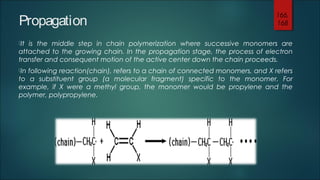
It is the middle step in chain polymerization where successive monomers are
attached to the growing chain. In the propagation stage, the process of electron
transfer and consequent motion of the active center down the chain proceeds.
In following reaction(chain), refers to a chain of connected monomers, and X refers
to a substituent group (a molecular fragment) specific to the monomer. For
example, if X were a methyl group, the monomer would be propylene and the
polymer, polypropylene.
166,
168
Modesof Propagation
1. Head to Tail
2. Head to Head
3. Tail to Head
4. Tail to Tail
166,
168
Termination
 Termination of reaction is nothing but stop the further propagation of chain.
 In theory, the propagation reaction could continue until the supply of monomers is
exhausted. Most often the growth of a polymer chain is halted by the termination
reaction. Termination typically occurs in two ways:
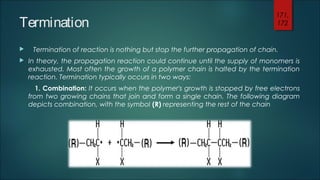
1. Combination: It occurs when the polymer's growth is stopped by free electrons
from two growing chains that join and form a single chain. The following diagram
depicts combination, with the symbol (R) representing the rest of the chain
171,
172
171,
172
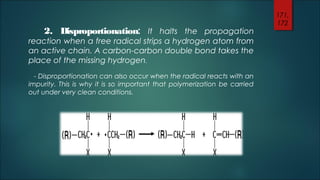
2. Disproportionation: It halts the propagation
reaction when a free radical strips a hydrogen atom from
an active chain. A carbon-carbon double bond takes the
place of the missing hydrogen.
- Disproportionation can also occur when the radical reacts with an
impurity. This is why it is so important that polymerization be carried
out under very clean conditions.
Chain Transfer Reaction
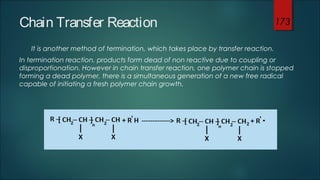
It is another method of termination, which takes place by transfer reaction.
In termination reaction, products form dead of non reactive due to coupling or
disproportionation. However in chain transfer reaction, one polymer chain is stopped
forming a dead polymer, there is a simultaneous generation of a new free radical
capable of initiating a fresh polymer chain growth.
173
Telomerisation
A solvent of high chain transfer ability and having a chemical structure similar to
that of a monomer to form polymer is known as telomerisation. The solvent used in
such cases is known as telogen.
175
Thank you for your time…

Polymerisation Mechanism ( chain growth )

  • 1.
    Polymer Science Submitted By… 1st Year2nd Semester Group: C1 Roll: 151-175
  • 2.
    Polymerisation  The processby which the monomer molecules are linked to form a big polymer molecule is called Polymerisation.  Polymerisation is a process of bonding monomer, or “single units” together through a variety of reaction mechanisms to form longer chains named Polymer  As important as polymers are, they exist with monomers, which are small, single molecules such as hydrocarbons and amino acids. 151
  • 3.
  • 4.
    Functionality of Monomers 1.The number of reactive functional Group Represent in a monomer. CH3 – COOH ; Functionality = 1 HO – CH2 -- CH2 – OH ; Functionality = 2 1. The number of Hydrogenation that can be added to a monomer. CH2 = CH2 ----------------> CH3 – CH3 ; Functionality = 2 CH ≡ CH -------> CH2 = CH2 ------> CH3 – CH3 ; Functionality = 4 1. The number of replaceable atom present in a monomer. 153, 154
  • 5.
  • 6.
  • 7.
    155, 156Functionality effects online structure of polymer - In order to form a polymer, the monomer must be at least bi functional. When it is bi functional monomer, polymer chain is always linear. - Branched polymer contains molecules having a linear backbone with branches emanating randomly from it. In order to form this class of material, the monomer must have a capability of growing in more than two directions, which implies that the starting monomer must have a functionality greater than 2 .
  • 8.
    155, 156 For example, Consider thepolymerisation of phthalic anhydride with glycerol where functionality of monomer is 3 .
  • 9.
    155, 156 So, FUNCTIONALITY of MONOMER= 2 LINEAR CHAIN POLYMER FUNCTIONALITY of MONOMER > 2 BRANCHED CHAIN POLYMER
  • 10.
    Characteristics of chain-growth polymerisation Growth by addition of monomer only at one end or both ends of chain  Some monomer remains even at long reaction times  Different steps operate at different stages of mechanism (i.e. Initiation, propagation, termination, and chain transfer)  Molar mass of backbone chain increases rapidly at early stage and remains approximately the same throughout the polymerisation  Chains not active after termination  Initiator required 157, 158
  • 11.
    157, 158 Examplesof monomers, capableofundergoing chain polymerisation
  • 12.
    FreeRadical Polymerisation This Polymerisationis divided into 3 parts.  Initiation  Propagation  Termination. 161- 165
  • 13.
    Initiation The first stepin chain polymerization, Initiation involves the formation of a free radical. This free radicals are produced by the decomposition of initiators. 161- 165
  • 14.
    161- 165 Initiator: A relativelyunstablemoleculethat decomposesinto afree radical. Used to initiateapolymer growth reaction Freeradicals: An especially reactiveatom or group of atomsthat has oneor moreunpaired electrons
  • 15.
  • 16.
  • 17.
  • 18.
  • 19.
  • 20.
  • 21.
    Propagation It is themiddle step in chain polymerization where successive monomers are attached to the growing chain. In the propagation stage, the process of electron transfer and consequent motion of the active center down the chain proceeds. In following reaction(chain), refers to a chain of connected monomers, and X refers to a substituent group (a molecular fragment) specific to the monomer. For example, if X were a methyl group, the monomer would be propylene and the polymer, polypropylene. 166, 168
  • 22.
    Modesof Propagation 1. Headto Tail 2. Head to Head 3. Tail to Head 4. Tail to Tail 166, 168
  • 23.
    Termination  Termination ofreaction is nothing but stop the further propagation of chain.  In theory, the propagation reaction could continue until the supply of monomers is exhausted. Most often the growth of a polymer chain is halted by the termination reaction. Termination typically occurs in two ways: 1. Combination: It occurs when the polymer's growth is stopped by free electrons from two growing chains that join and form a single chain. The following diagram depicts combination, with the symbol (R) representing the rest of the chain 171, 172
  • 24.
    171, 172 2. Disproportionation: Ithalts the propagation reaction when a free radical strips a hydrogen atom from an active chain. A carbon-carbon double bond takes the place of the missing hydrogen. - Disproportionation can also occur when the radical reacts with an impurity. This is why it is so important that polymerization be carried out under very clean conditions.
  • 25.
    Chain Transfer Reaction Itis another method of termination, which takes place by transfer reaction. In termination reaction, products form dead of non reactive due to coupling or disproportionation. However in chain transfer reaction, one polymer chain is stopped forming a dead polymer, there is a simultaneous generation of a new free radical capable of initiating a fresh polymer chain growth. 173
  • 26.
    Telomerisation A solvent ofhigh chain transfer ability and having a chemical structure similar to that of a monomer to form polymer is known as telomerisation. The solvent used in such cases is known as telogen. 175
  • 27.
    Thank you foryour time…

Editor's Notes

  • #4 Chain-Growth: is characterized by a self-addition of the monomer molecules, to each other very rapidly through a chain reaction. No by-product is formed. Free Radical Polyn: The Initiation of the polymer chain growth is brought about by free radicals produced by the decomposition of compounds called initiators. Ionic Polyn: The ionic mechanism of also involves an attack on the pie electron pair of the monomer. Co-ordination Polyn: Polymerization reaction by organo-metallic compounds fall under the category of coordination polyn. Step Growth Polyn : In step polymerization reaction takes place in a step-wise manner.