DEFENCE ENGINEERING COLLEGE
Metallurgical And Materials Engineering
1
Present By:
Weldebrhan Hadush (Maj.)
Date March 06 , 2019
2
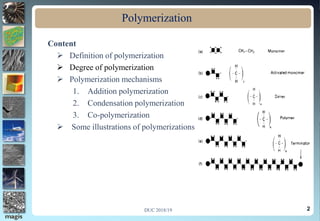
Content
 Definition of polymerization
 Degree of polymerization
 Polymerization mechanisms
1. Addition polymerization
2. Condensation polymerization
3. Co-polymerization
 Some illustrations of polymerizations
Polymerization
DUC 2018/19
3
Polymerization
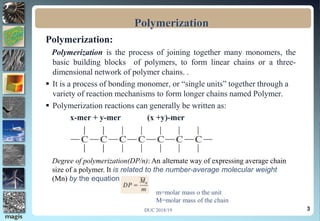
Polymerization:
Polymerization is the process of joining together many monomers, the
basic building blocks of polymers, to form linear chains or a three-
dimensional network of polymer chains. .
 It is a process of bonding monomer, or “single units” together through a
variety of reaction mechanisms to form longer chains named Polymer.
 Polymerization reactions can generally be written as:
x-mer + y-mer (x +y)-mer
DUC 2018/19
Degree of polymerization(DP/n): An alternate way of expressing average chain
size of a polymer. It is related to the number-average molecular weight
(Mn) by the equation
m=molar mass o the unit
M=molar mass of the chain
4
Polymerization
Cont’d
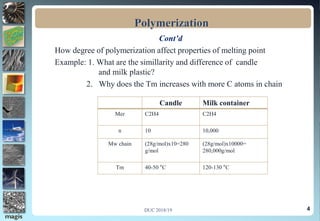
How degree of polymerization affect properties of melting point
Example: 1. What are the simillarity and difference of candle
and milk plastic?
2. Why does the Tm increases with more C atoms in chain
DUC 2018/19
Candle Milk container
Mer C2H4 C2H4
n 10 10,000
Mw chain (28g/mol)x10=280
g/mol
(28g/mol)x10000=
280,000g/mol
Tm 40-50 °C 120-130 °C
5
Polymerization
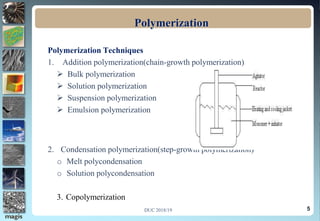
Polymerization Techniques
1. Addition polymerization(chain-growth polymerization)
 Bulk polymerization
 Solution polymerization
 Suspension polymerization
 Emulsion polymerization
2. Condensation polymerization(step-growth polymerization)
o Melt polycondensation
o Solution polycondensation
3. Copolymerization
DUC 2018/19
6
Polymerization
Cont’d
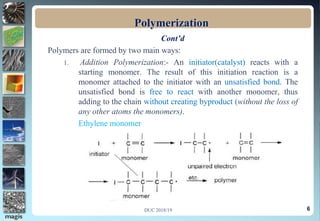
Polymers are formed by two main ways:
1. Addition Polymerization:- An initiator(catalyst) reacts with a
starting monomer. The result of this initiation reaction is a
monomer attached to the initiator with an unsatisfied bond. The
unsatisfied bond is free to react with another monomer, thus
adding to the chain without creating byproduct (without the loss of
any other atoms the monomers).
Ethylene monomer
DUC 2018/19
Polymerization
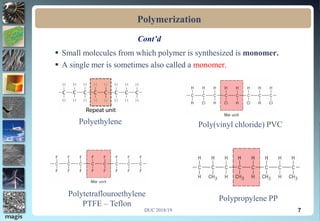
 Small molecules from which polymer is synthesized is monomer.
 A single mer is sometimes also called a monomer.
7
Polyethylene Poly(vinyl chloride) PVC
Polytetraflouroethylene
PTFE – Teflon
Polypropylene PP
Cont’d
DUC 2018/19
Polymerization
Anatomy of Addition Polymerizations
a. Initiation
 Generation of active initiator.
 Reaction with monomer to form growing chains.
b. Propagation
 Chain extension by incremental monomer addition.
c. Termination
 Conversion of active growing chains to inert polymer.
8
DUC 2018/19
Polymerization
9
Example :
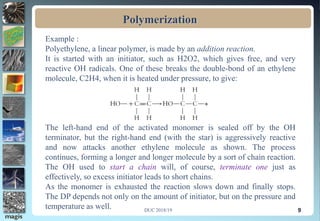
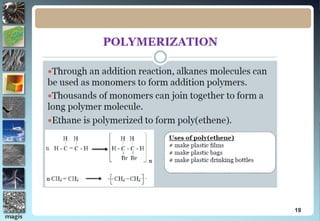
Polyethylene, a linear polymer, is made by an addition reaction.
It is started with an initiator, such as H2O2, which gives free, and very
reactive OH radicals. One of these breaks the double-bond of an ethylene
molecule, C2H4, when it is heated under pressure, to give:
The left-hand end of the activated monomer is sealed off by the OH
terminator, but the right-hand end (with the star) is aggressively reactive
and now attacks another ethylene molecule as shown. The process
continues, forming a longer and longer molecule by a sort of chain reaction.
The OH used to start a chain will, of course, terminate one just as
effectively, so excess initiator leads to short chains.
As the monomer is exhausted the reaction slows down and finally stops.
The DP depends not only on the amount of initiator, but on the pressure and
temperature as well. DUC 2018/19
Polymerization
10
Cont’d
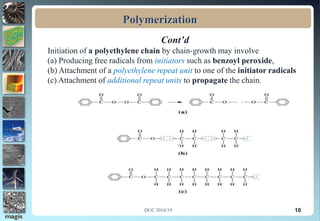
Initiation of a polyethylene chain by chain-growth may involve
(a) Producing free radicals from initiators such as benzoyl peroxide,
(b) Attachment of a polyethylene repeat unit to one of the initiator radicals
(c) Attachment of additional repeat units to propagate the chain.
DUC 2018/19
11
Polymerization
Cont’d
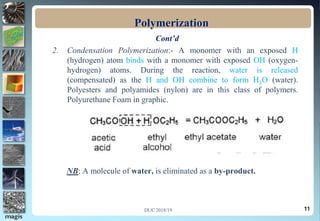
2. Condensation Polymerization:- A monomer with an exposed H
(hydrogen) atom binds with a monomer with exposed OH (oxygen-
hydrogen) atoms. During the reaction, water is released
(compensated) as the H and OH combine to form H2O (water).
Polyesters and polyamides (nylon) are in this class of polymers.
Polyurethane Foam in graphic.
NB: A molecule of water, is eliminated as a by-product.
DUC 2018/19
Polymerization
12
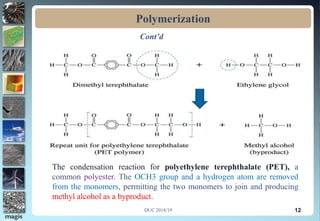
The condensation reaction for polyethylene terephthalate (PET), a
common polyester. The OCH3 group and a hydrogen atom are removed
from the monomers, permitting the two monomers to join and producing
methyl alcohol as a byproduct.
Cont’d
DUC 2018/19
Polymerization
13
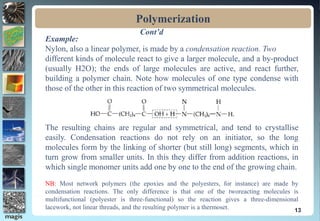
Example:
Nylon, also a linear polymer, is made by a condensation reaction. Two
different kinds of molecule react to give a larger molecule, and a by-product
(usually H2O); the ends of large molecules are active, and react further,
building a polymer chain. Note how molecules of one type condense with
those of the other in this reaction of two symmetrical molecules.
The resulting chains are regular and symmetrical, and tend to crystallise
easily. Condensation reactions do not rely on an initiator, so the long
molecules form by the linking of shorter (but still long) segments, which in
turn grow from smaller units. In this they differ from addition reactions, in
which single monomer units add one by one to the end of the growing chain.
NB: Most network polymers (the epoxies and the polyesters, for instance) are made by
condensation reactions. The only difference is that one of the tworeacting molecules is
multifunctional (polyester is three-functional) so the reaction gives a three-dimensional
lacework, not linear threads, and the resulting polymer is a thermoset.
Cont’d
Polymerization
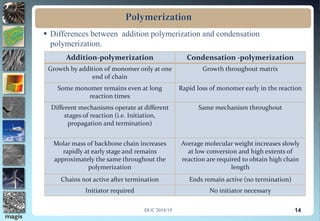
 Differences between addition polymerization and condensation
polymerization.
14
Addition-polymerization Condensation -polymerization
Growth by addition of monomer only at one
end of chain
Growth throughout matrix
Some monomer remains even at long
reaction times
Rapid loss of monomer early in the reaction
Different mechanisms operate at different
stages of reaction (i.e. Initiation,
propagation and termination)
Same mechanism throughout
Molar mass of backbone chain increases
rapidly at early stage and remains
approximately the same throughout the
polymerization
Average molecular weight increases slowly
at low conversion and high extents of
reaction are required to obtain high chain
length
Chains not active after termination Ends remain active (no termination)
Initiator required No initiator necessary
DUC 2018/19
15
Polymerization
Cont’d
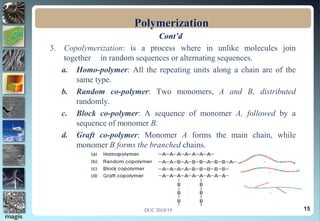
3. Copolymerization: is a process where in unlike molecules join
together in random sequences or alternating sequences.
a. Homo-polymer: All the repeating units along a chain are of the
same type.
b. Random co-polymer: Two monomers, A and B, distributed
randomly.
c. Block co-polymer: A sequence of monomer A, followed by a
sequence of monomer B.
d. Graft co-polymer: Monomer A forms the main chain, while
monomer B forms the branched chains.
DUC 2018/19
16
“The future can not be predicted,
but it can
be made !”
17
“The future can not be predicted,
but it can
be made !”
18
“The future can not be predicted,
but it can
be made !”
19
20
Polymerization
Cont…
Mass or block polymerization: Polymerization of the undiluted monomer.
• Carried out by adding a soluble initiator to pure monomer (in liquid
state).
• The mixture is constantly agitated & heated to polymerization
temperature.
• Once the reaction starts, heating is stopped as the reaction is
exothermic.
• The heat generated is dissipated by circulating water jacket.
• Viscosity increases dramatically during conversion.
DUC 2018/19
The IUPAC name(std) for Teflon is poly(tetrafluoroethene),
PTFE.
21
Polymerization
DUC 2018/19
Degree of pollymerization(n)
n=molecular weihght poly molcule/molecular weihght of mer
n is 100 to 10000 may go higher than 100000
• How molecular weight (Wm) afect the melting point of a polymer ?
• Number of carbon atom=2n=2Xdegree of polymerization
• Because high degree of polymerization have high number of vander
waals so it has high m.p
Polyethylene molecule view from top
Polymer molecules view from side pts
22
Polymerization
Cont…
Solution polymerization:
 Monomer along with initiator dissolved in solvent, formed polymer
stays dissolved.
 The mixture is kept at polymerizaion temperature & constantly
agitated.
 Depending on concentration of monomer the viscosity of solution
does not increase.
 After the reaction is over, the polymer is used as such in the form of
polymer solution or the polymer is isolated by evaporating the solvent.
 Polymer so formed can be used for surface coating.
 It is used for the production of PVC, Polyacrylic acid,
Polyacrylamide, Polyvinyl alcohol, PMMA, Polybutadiene, etc
DUC 2018/19
Polymerization
SUSPENSION POLYMERIZATION
 Liquid or dissolved monomer suspended in liquid phase like water.
 Initiators used are monomer soluble e.g. dibenzoyl peroxide.
 Thus, polymer is produced in heterogeneous medium.
 The dispersion is maintained by continuous agitation and the droplets
are prevented to coalesce (unite or merge) by adding small quantity
of stabilizers.
 The stabilizers used are PVA, gelatin, cellulose are used along with
inorganic stabilizers such as kaolin, magnesium silicate, aluminum
hydroxide, calcium/magnesium phosphate, etc if necessary.
23
Polymerization
SUSPENSION POLYMERIZATION
 As it concerns with droplets, each droplet is tiny bulk reactor. The
polymerization takes place inside the droplet & product formed
being insoluble in water.
 The product separated out in the form of spherical pearls or beads
of polymer.
 The products are small uniform spheres. They can be used directly
for some applications as precursors of ion exchange resins otherwise
they can be extruded & chopped to form larger, easily moulded
pallets.
 They can be dissolved in a suitable medium for use as adhesives &
coatings.
 This technique is used to form PVC, Polyvinylacetate, Polystyrene,
Styrene-divinyl benzenecopolymer beads (used for ion exchange)
etc
24
25
Polymerization
Cont…
SOLUTION POLYMERIZATION
 Some disadvantages of bulk polymerization are eliminated in solution
polymerization.
 Monomer along with initiator dissolved in solvent, formed polymer
stays dissolved.
 The mixture is kept at polymerizaion temperature & constantly
agitated.
 Depending on concentration of monomer the viscosity of solution
does not increase.
 After the reaction is over, the polymer is used as such in the form of
polymer solution or the polymer is isolated by evaporating the solvent.
 Polymer so formed can be used for surface coating.
 It is used for the production of PVC, Polyacrylic acid,
Polyacrylamide, Polyvinyl alcohol, PMMA, Polybutadiene, etc
DUC 2018/19

CHAPTER 3 POLYMERIZATION.ppt

  • 1.
    DEFENCE ENGINEERING COLLEGE MetallurgicalAnd Materials Engineering 1 Present By: Weldebrhan Hadush (Maj.) Date March 06 , 2019
  • 2.
    2 Content  Definition ofpolymerization  Degree of polymerization  Polymerization mechanisms 1. Addition polymerization 2. Condensation polymerization 3. Co-polymerization  Some illustrations of polymerizations Polymerization DUC 2018/19
  • 3.
    3 Polymerization Polymerization: Polymerization is theprocess of joining together many monomers, the basic building blocks of polymers, to form linear chains or a three- dimensional network of polymer chains. .  It is a process of bonding monomer, or “single units” together through a variety of reaction mechanisms to form longer chains named Polymer.  Polymerization reactions can generally be written as: x-mer + y-mer (x +y)-mer DUC 2018/19 Degree of polymerization(DP/n): An alternate way of expressing average chain size of a polymer. It is related to the number-average molecular weight (Mn) by the equation m=molar mass o the unit M=molar mass of the chain
  • 4.
    4 Polymerization Cont’d How degree ofpolymerization affect properties of melting point Example: 1. What are the simillarity and difference of candle and milk plastic? 2. Why does the Tm increases with more C atoms in chain DUC 2018/19 Candle Milk container Mer C2H4 C2H4 n 10 10,000 Mw chain (28g/mol)x10=280 g/mol (28g/mol)x10000= 280,000g/mol Tm 40-50 °C 120-130 °C
  • 5.
    5 Polymerization Polymerization Techniques 1. Additionpolymerization(chain-growth polymerization)  Bulk polymerization  Solution polymerization  Suspension polymerization  Emulsion polymerization 2. Condensation polymerization(step-growth polymerization) o Melt polycondensation o Solution polycondensation 3. Copolymerization DUC 2018/19
  • 6.
    6 Polymerization Cont’d Polymers are formedby two main ways: 1. Addition Polymerization:- An initiator(catalyst) reacts with a starting monomer. The result of this initiation reaction is a monomer attached to the initiator with an unsatisfied bond. The unsatisfied bond is free to react with another monomer, thus adding to the chain without creating byproduct (without the loss of any other atoms the monomers). Ethylene monomer DUC 2018/19
  • 7.
    Polymerization  Small moleculesfrom which polymer is synthesized is monomer.  A single mer is sometimes also called a monomer. 7 Polyethylene Poly(vinyl chloride) PVC Polytetraflouroethylene PTFE – Teflon Polypropylene PP Cont’d DUC 2018/19
  • 8.
    Polymerization Anatomy of AdditionPolymerizations a. Initiation  Generation of active initiator.  Reaction with monomer to form growing chains. b. Propagation  Chain extension by incremental monomer addition. c. Termination  Conversion of active growing chains to inert polymer. 8 DUC 2018/19
  • 9.
    Polymerization 9 Example : Polyethylene, alinear polymer, is made by an addition reaction. It is started with an initiator, such as H2O2, which gives free, and very reactive OH radicals. One of these breaks the double-bond of an ethylene molecule, C2H4, when it is heated under pressure, to give: The left-hand end of the activated monomer is sealed off by the OH terminator, but the right-hand end (with the star) is aggressively reactive and now attacks another ethylene molecule as shown. The process continues, forming a longer and longer molecule by a sort of chain reaction. The OH used to start a chain will, of course, terminate one just as effectively, so excess initiator leads to short chains. As the monomer is exhausted the reaction slows down and finally stops. The DP depends not only on the amount of initiator, but on the pressure and temperature as well. DUC 2018/19
  • 10.
    Polymerization 10 Cont’d Initiation of apolyethylene chain by chain-growth may involve (a) Producing free radicals from initiators such as benzoyl peroxide, (b) Attachment of a polyethylene repeat unit to one of the initiator radicals (c) Attachment of additional repeat units to propagate the chain. DUC 2018/19
  • 11.
    11 Polymerization Cont’d 2. Condensation Polymerization:-A monomer with an exposed H (hydrogen) atom binds with a monomer with exposed OH (oxygen- hydrogen) atoms. During the reaction, water is released (compensated) as the H and OH combine to form H2O (water). Polyesters and polyamides (nylon) are in this class of polymers. Polyurethane Foam in graphic. NB: A molecule of water, is eliminated as a by-product. DUC 2018/19
  • 12.
    Polymerization 12 The condensation reactionfor polyethylene terephthalate (PET), a common polyester. The OCH3 group and a hydrogen atom are removed from the monomers, permitting the two monomers to join and producing methyl alcohol as a byproduct. Cont’d DUC 2018/19
  • 13.
    Polymerization 13 Example: Nylon, also alinear polymer, is made by a condensation reaction. Two different kinds of molecule react to give a larger molecule, and a by-product (usually H2O); the ends of large molecules are active, and react further, building a polymer chain. Note how molecules of one type condense with those of the other in this reaction of two symmetrical molecules. The resulting chains are regular and symmetrical, and tend to crystallise easily. Condensation reactions do not rely on an initiator, so the long molecules form by the linking of shorter (but still long) segments, which in turn grow from smaller units. In this they differ from addition reactions, in which single monomer units add one by one to the end of the growing chain. NB: Most network polymers (the epoxies and the polyesters, for instance) are made by condensation reactions. The only difference is that one of the tworeacting molecules is multifunctional (polyester is three-functional) so the reaction gives a three-dimensional lacework, not linear threads, and the resulting polymer is a thermoset. Cont’d
  • 14.
    Polymerization  Differences betweenaddition polymerization and condensation polymerization. 14 Addition-polymerization Condensation -polymerization Growth by addition of monomer only at one end of chain Growth throughout matrix Some monomer remains even at long reaction times Rapid loss of monomer early in the reaction Different mechanisms operate at different stages of reaction (i.e. Initiation, propagation and termination) Same mechanism throughout Molar mass of backbone chain increases rapidly at early stage and remains approximately the same throughout the polymerization Average molecular weight increases slowly at low conversion and high extents of reaction are required to obtain high chain length Chains not active after termination Ends remain active (no termination) Initiator required No initiator necessary DUC 2018/19
  • 15.
    15 Polymerization Cont’d 3. Copolymerization: isa process where in unlike molecules join together in random sequences or alternating sequences. a. Homo-polymer: All the repeating units along a chain are of the same type. b. Random co-polymer: Two monomers, A and B, distributed randomly. c. Block co-polymer: A sequence of monomer A, followed by a sequence of monomer B. d. Graft co-polymer: Monomer A forms the main chain, while monomer B forms the branched chains. DUC 2018/19
  • 16.
    16 “The future cannot be predicted, but it can be made !”
  • 17.
    17 “The future cannot be predicted, but it can be made !”
  • 18.
    18 “The future cannot be predicted, but it can be made !”
  • 19.
  • 20.
    20 Polymerization Cont… Mass or blockpolymerization: Polymerization of the undiluted monomer. • Carried out by adding a soluble initiator to pure monomer (in liquid state). • The mixture is constantly agitated & heated to polymerization temperature. • Once the reaction starts, heating is stopped as the reaction is exothermic. • The heat generated is dissipated by circulating water jacket. • Viscosity increases dramatically during conversion. DUC 2018/19 The IUPAC name(std) for Teflon is poly(tetrafluoroethene), PTFE.
  • 21.
    21 Polymerization DUC 2018/19 Degree ofpollymerization(n) n=molecular weihght poly molcule/molecular weihght of mer n is 100 to 10000 may go higher than 100000 • How molecular weight (Wm) afect the melting point of a polymer ? • Number of carbon atom=2n=2Xdegree of polymerization • Because high degree of polymerization have high number of vander waals so it has high m.p Polyethylene molecule view from top Polymer molecules view from side pts
  • 22.
    22 Polymerization Cont… Solution polymerization:  Monomeralong with initiator dissolved in solvent, formed polymer stays dissolved.  The mixture is kept at polymerizaion temperature & constantly agitated.  Depending on concentration of monomer the viscosity of solution does not increase.  After the reaction is over, the polymer is used as such in the form of polymer solution or the polymer is isolated by evaporating the solvent.  Polymer so formed can be used for surface coating.  It is used for the production of PVC, Polyacrylic acid, Polyacrylamide, Polyvinyl alcohol, PMMA, Polybutadiene, etc DUC 2018/19
  • 23.
    Polymerization SUSPENSION POLYMERIZATION  Liquidor dissolved monomer suspended in liquid phase like water.  Initiators used are monomer soluble e.g. dibenzoyl peroxide.  Thus, polymer is produced in heterogeneous medium.  The dispersion is maintained by continuous agitation and the droplets are prevented to coalesce (unite or merge) by adding small quantity of stabilizers.  The stabilizers used are PVA, gelatin, cellulose are used along with inorganic stabilizers such as kaolin, magnesium silicate, aluminum hydroxide, calcium/magnesium phosphate, etc if necessary. 23
  • 24.
    Polymerization SUSPENSION POLYMERIZATION  Asit concerns with droplets, each droplet is tiny bulk reactor. The polymerization takes place inside the droplet & product formed being insoluble in water.  The product separated out in the form of spherical pearls or beads of polymer.  The products are small uniform spheres. They can be used directly for some applications as precursors of ion exchange resins otherwise they can be extruded & chopped to form larger, easily moulded pallets.  They can be dissolved in a suitable medium for use as adhesives & coatings.  This technique is used to form PVC, Polyvinylacetate, Polystyrene, Styrene-divinyl benzenecopolymer beads (used for ion exchange) etc 24
  • 25.
    25 Polymerization Cont… SOLUTION POLYMERIZATION  Somedisadvantages of bulk polymerization are eliminated in solution polymerization.  Monomer along with initiator dissolved in solvent, formed polymer stays dissolved.  The mixture is kept at polymerizaion temperature & constantly agitated.  Depending on concentration of monomer the viscosity of solution does not increase.  After the reaction is over, the polymer is used as such in the form of polymer solution or the polymer is isolated by evaporating the solvent.  Polymer so formed can be used for surface coating.  It is used for the production of PVC, Polyacrylic acid, Polyacrylamide, Polyvinyl alcohol, PMMA, Polybutadiene, etc DUC 2018/19