COVID19, epidemiology , case definition, signs andsymptoms
and situation analysis (world/india/manipur
care of health care workers in frontline
Prepared by Phijam Sanathoi
Msc cardio thoracic nursing
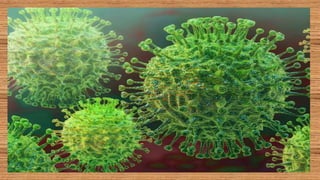
Corona virus
• It is a large family of viruses which may cause illness in animals
or human.
• The noval corona virus, name as SARS-CoV-2 Causes COVID - 19
infection in human as per recent discovery – WHO
• In humans it is known to cause respiratory infections ranging
from common cold to more severe MERS & SARS •
• Other six corona virus are HCoV-299E, HCoV-OC43, SARS-CoV,
HCoV-NL63, HCoV-HKU1 and MERS-CoV.
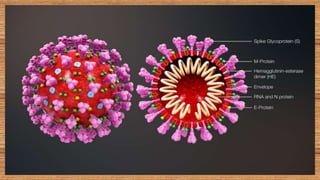
STRUCTURAL CHARACTERISTICS
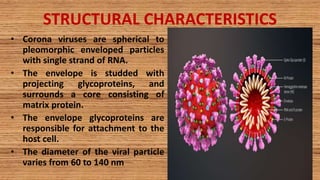
• Corona viruses are spherical to
pleomorphic enveloped particles
with single strand of RNA.
• The envelope is studded with
projecting glycoproteins, and
surrounds a core consisting of
matrix protein.
• The envelope glycoproteins are
responsible for attachment to the
host cell.
• The diameter of the viral particle
varies from 60 to 140 nm
• “NOVAL” CORONA VIRUS: It is a
new coronavirus that has not been
previously identify in humans
COVID 19 MEANS
• CORONAVIRUS DISEASE OF 2019
What is COVID – 19 ?
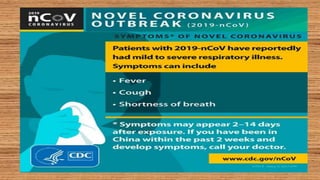
• A respiratory infection caused by a newly
discovered Corona virus (2019 novel Corona
Virus) •
• Infected individuals will experience mild to
moderate respiratory illness and may recover
without requiring special treatment. •
• A few proportion may develop severe
respiratory illness which result in death. •
Incubation period : 1-14 days
Myths vs facts
• Covid 19 virus cannot be transmited in areas with hot
and humid climate
no it can be transmitted.
• Taking a hot bath prevents the new corona virus
no it does not prevents
Eating garlic helps to prevent the infection. no, it does
not.
Epidemiology
• First reported to the WHO Country Office in China
on 31 December 2019 as a Pneumonia of unknown
cause detected in Wuhan.
• Identify the corona virus on 7th jan
• The outbreak was declared a Public Health
Emergency of International Concern on 30 January
2020.
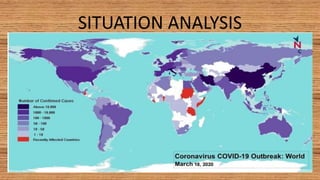
• 213 countries and territories around the world are
presently affected by the disease.
CASE DEFINITION
SUSPECT
• A patient with acuterespiratoryillness {fever and at leastone
sign/symptomof respiratory disease(e.g., cough, shortnessof breath)},
ANDa historyof travel to or residence in a country/area or territory
reporting local transmission of COVID-19disease duringthe 14 daysprior
to onset of symptoms;
• A patient with any acute respiratoryillnessAND havingbeen in contact
with a confirmed or probableCOVID-19 case in the last 14 daysprior to
symptomonset
• A patient with severe acute respiratory illness (fever and at least one
sign/symptomof respiratory disease, e.g., cough, shortnessof breath;
AND requiringhospitalization) AND in the absence of an alternative
diagnosisthat fully explainsthe clinical presentation
Who is a confirmed case?
• Person with lab
confirmation of
COVID – 19,
irrespective of
clinical signs &
symptom
Diagnosis: Collection of Specimen
Upper respiratory specimens:
• Nasopharyngeal and oropharyngeal swab in
ambulatory patients
Lower respiratory specimens:
• Sputum (if produced) and/or Endotracheal aspirate
or bronchoalveolar lavage in patients with more
severe respiratory disease. (Note high risk of
aerosolization; adhere strictly to infection prevention
and control procedures).
Additional clinical specimens
• Virus has been detected in blood and stoo
SPECIMEN DESPATCH
• Label specimen correctly and endorse in
dispatch book.
• Specimens for virus detection should reach the
laboratory as soon as possible after collection.
• Correct handling of specimens during
transportation is essential.
• Specimens that can be delivered promptly to the
laboratory can be stored and shipped at 2-8°C
CONFIRMED BY
• RT- PCR- :
REVERSE TRANSCRIPTION
POLYMERASE CHAIN
REACTION
•Source : unknown
human to human transmission
DEFINITION OF CONTACT
A person who experienced any one of the following exposures
during the 2 days before and the 14 days after the onset of
symptoms of a probable or confirmed case:
• Face-to-face contact with a probable or confirmed case within
1 meter and for more than 15 minutes
• Direct physical contact with a probable or confirmed case.
Direct care for a patient with probable or confirmed
COVID-19 disease without using proper personal protective
equipment
Health Care Workers caring for probable or confirmed
COVID19 patients without adequate PPE are contact cases.
CONTACT TRACING
SYMPTOMATIC CASE:
• ISOLATION
• TEST
• APPROPRIATE MEDICAL TREATMENT
CONTD….
ASYMTOMATIC CASE
•HOME QUARENTINE
•SELF HELP MONITORRING
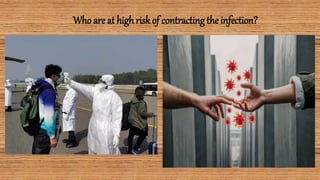
Who are at high riskof contracting the infection?
Age groups affected
• All age groups are at risk of contracting the
disease.
• At High risk :
1. Older persons
2. Persons with pre-existing medical conditions
(High blood pressure, Heart disease, Lung
disease, Cancer or Diabetes)
Mode of transmission
Direct close contact
• Throughairborne droplets
fromone person to other.
• Possibleaerosolized
transmission .
Indirect contact
• Contact with the surfaces
where virus is settled in
active form.
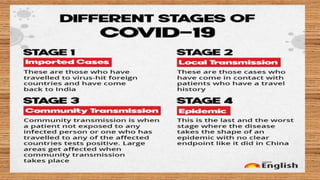
Stages of COVID 19
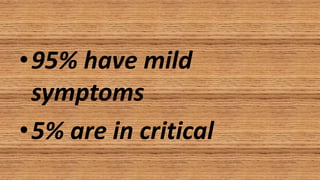
•95% have mild
symptoms
•5% are in critical
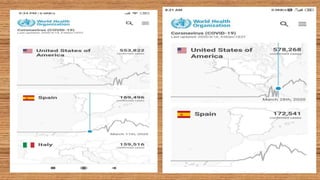
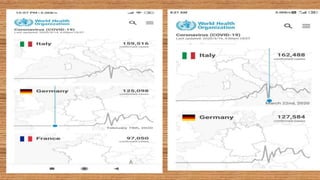
SITUATION ANALYSIS
globally
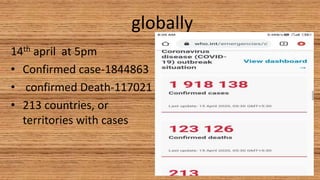
14th april at 5pm
• Confirmed case-1844863
• confirmed Death-117021
• 213 countries, or
territories with cases
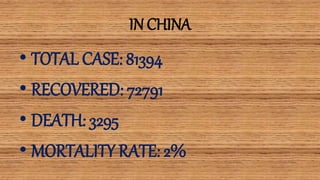
IN CHINA
• TOTAL CASE: 81394
• RECOVERED: 72791
• DEATH: 3295
• MORTALITY RATE: 2%
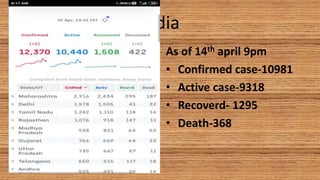
India
As of 14th april 9pm
• Confirmed case-10981
• Active case-9318
• Recoverd- 1295
• Death-368
OUR STATE MANIPUR
• TOTAL CASE: 2
• RECOVERED: 1
• DEATH: 0
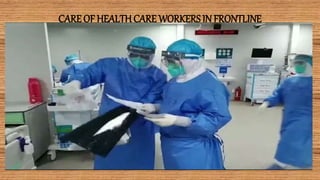
CARE OF HEALTHCARE WORKERSIN FRONTLINE
Health Care Teamagainst COVID19
• HCWare an integral part who are at the frontline 24x7 fighting
against COVID19 .
• All healthcareteammembers must receive the highest level of
protection
Role of HCW
The HCWwithright knowledge andskill can contributeto:
• Earlyidentification of illness.

• Prevention of communityspread & Containment of disease.
• Care of patients withsymptomsassociated withCoronavirus Disease (COVID-19) to
prevent spreadwithin the facility.
• Protection of self and other HCWs.
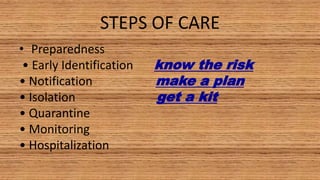
STEPS OF CARE
• Preparedness
• Early Identification know the risk
• Notification make a plan
• Isolation get a kit
• Quarantine
• Monitoring
• Hospitalization
Preparedness, EarlyIdentification & Notification
• Follow hospital policy & SOPs for care of inpatient
and ambulatory patients
• Ensure training to all personnel working in the ward
on screening and isolation procedures
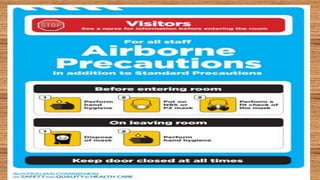
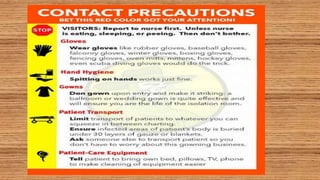
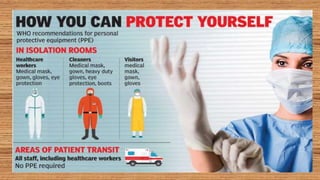
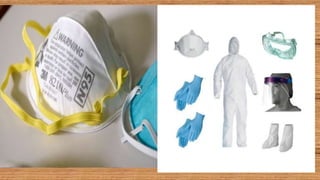
• Use of PPE, including N-95 respirators.
• Display clear signage with instructions for access and
use of PPE.
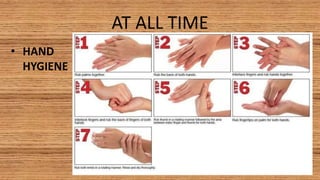
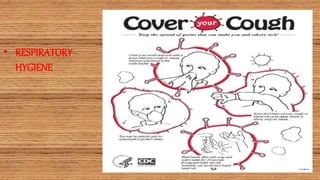
AT ALL TIME
• HAND
HYGIENE
• RESPIRATORY
HYGIENE
Standard Precautions for Health Care Workers
• DO NOT smoke,drinkor eat duringNursing Care hours.
• DO NOT touch youreyes,mouth or nose. Observe strict personal hygiene.
• Handhygiene: washhands with liquidsoap andwater or properuse of alcohol-based
handrub.
• Avoid sharps injury,both in the course of examinationof deadbody andafterwards in
dealingwith waste disposal anddecontamination.
Standard precaution for the care of all patient
Patients and his environment
contain blood, body fluids,
secretions, excretion and
contaminated items
1. Wash hand before and after patient care
and immediately after gloves are
removed.
2. Wear gloves when touching blood, body
fluid, contaminated items.
3. If indicated, wear mask, gown, eye
protection or face shield to protect mucus
membrane of the eyes, nose, mouth
when performing tasks.
NURSES CARING TODAY FOR A HEALTHIER TOMORROW.........51

Covid

  • 1.
    COVID19, epidemiology ,case definition, signs andsymptoms and situation analysis (world/india/manipur care of health care workers in frontline Prepared by Phijam Sanathoi Msc cardio thoracic nursing
  • 2.
    Corona virus • Itis a large family of viruses which may cause illness in animals or human. • The noval corona virus, name as SARS-CoV-2 Causes COVID - 19 infection in human as per recent discovery – WHO • In humans it is known to cause respiratory infections ranging from common cold to more severe MERS & SARS • • Other six corona virus are HCoV-299E, HCoV-OC43, SARS-CoV, HCoV-NL63, HCoV-HKU1 and MERS-CoV.
  • 4.
    STRUCTURAL CHARACTERISTICS • Coronaviruses are spherical to pleomorphic enveloped particles with single strand of RNA. • The envelope is studded with projecting glycoproteins, and surrounds a core consisting of matrix protein. • The envelope glycoproteins are responsible for attachment to the host cell. • The diameter of the viral particle varies from 60 to 140 nm
  • 6.
    • “NOVAL” CORONAVIRUS: It is a new coronavirus that has not been previously identify in humans COVID 19 MEANS • CORONAVIRUS DISEASE OF 2019
  • 7.
    What is COVID– 19 ? • A respiratory infection caused by a newly discovered Corona virus (2019 novel Corona Virus) • • Infected individuals will experience mild to moderate respiratory illness and may recover without requiring special treatment. • • A few proportion may develop severe respiratory illness which result in death. • Incubation period : 1-14 days
  • 8.
    Myths vs facts •Covid 19 virus cannot be transmited in areas with hot and humid climate no it can be transmitted. • Taking a hot bath prevents the new corona virus no it does not prevents Eating garlic helps to prevent the infection. no, it does not.
  • 9.
    Epidemiology • First reportedto the WHO Country Office in China on 31 December 2019 as a Pneumonia of unknown cause detected in Wuhan. • Identify the corona virus on 7th jan • The outbreak was declared a Public Health Emergency of International Concern on 30 January 2020. • 213 countries and territories around the world are presently affected by the disease.
  • 10.
    CASE DEFINITION SUSPECT • Apatient with acuterespiratoryillness {fever and at leastone sign/symptomof respiratory disease(e.g., cough, shortnessof breath)}, ANDa historyof travel to or residence in a country/area or territory reporting local transmission of COVID-19disease duringthe 14 daysprior to onset of symptoms;
  • 11.
    • A patientwith any acute respiratoryillnessAND havingbeen in contact with a confirmed or probableCOVID-19 case in the last 14 daysprior to symptomonset • A patient with severe acute respiratory illness (fever and at least one sign/symptomof respiratory disease, e.g., cough, shortnessof breath; AND requiringhospitalization) AND in the absence of an alternative diagnosisthat fully explainsthe clinical presentation
  • 12.
    Who is aconfirmed case? • Person with lab confirmation of COVID – 19, irrespective of clinical signs & symptom
  • 13.
    Diagnosis: Collection ofSpecimen Upper respiratory specimens: • Nasopharyngeal and oropharyngeal swab in ambulatory patients Lower respiratory specimens: • Sputum (if produced) and/or Endotracheal aspirate or bronchoalveolar lavage in patients with more severe respiratory disease. (Note high risk of aerosolization; adhere strictly to infection prevention and control procedures). Additional clinical specimens • Virus has been detected in blood and stoo
  • 14.
    SPECIMEN DESPATCH • Labelspecimen correctly and endorse in dispatch book. • Specimens for virus detection should reach the laboratory as soon as possible after collection. • Correct handling of specimens during transportation is essential. • Specimens that can be delivered promptly to the laboratory can be stored and shipped at 2-8°C
  • 15.
    CONFIRMED BY • RT-PCR- : REVERSE TRANSCRIPTION POLYMERASE CHAIN REACTION
  • 16.
    •Source : unknown humanto human transmission
  • 17.
    DEFINITION OF CONTACT Aperson who experienced any one of the following exposures during the 2 days before and the 14 days after the onset of symptoms of a probable or confirmed case: • Face-to-face contact with a probable or confirmed case within 1 meter and for more than 15 minutes • Direct physical contact with a probable or confirmed case. Direct care for a patient with probable or confirmed COVID-19 disease without using proper personal protective equipment Health Care Workers caring for probable or confirmed COVID19 patients without adequate PPE are contact cases.
  • 18.
    CONTACT TRACING SYMPTOMATIC CASE: •ISOLATION • TEST • APPROPRIATE MEDICAL TREATMENT
  • 19.
  • 20.
    Who are athigh riskof contracting the infection?
  • 22.
    Age groups affected •All age groups are at risk of contracting the disease. • At High risk : 1. Older persons 2. Persons with pre-existing medical conditions (High blood pressure, Heart disease, Lung disease, Cancer or Diabetes)
  • 23.
    Mode of transmission Directclose contact • Throughairborne droplets fromone person to other. • Possibleaerosolized transmission . Indirect contact • Contact with the surfaces where virus is settled in active form.
  • 27.
  • 28.
  • 29.
  • 30.
    globally 14th april at5pm • Confirmed case-1844863 • confirmed Death-117021 • 213 countries, or territories with cases
  • 34.
    IN CHINA • TOTALCASE: 81394 • RECOVERED: 72791 • DEATH: 3295 • MORTALITY RATE: 2%
  • 35.
    India As of 14thapril 9pm • Confirmed case-10981 • Active case-9318 • Recoverd- 1295 • Death-368
  • 36.
    OUR STATE MANIPUR •TOTAL CASE: 2 • RECOVERED: 1 • DEATH: 0
  • 37.
    CARE OF HEALTHCAREWORKERSIN FRONTLINE
  • 38.
    Health Care TeamagainstCOVID19 • HCWare an integral part who are at the frontline 24x7 fighting against COVID19 . • All healthcareteammembers must receive the highest level of protection
  • 39.
    Role of HCW TheHCWwithright knowledge andskill can contributeto: • Earlyidentification of illness. • Prevention of communityspread & Containment of disease. • Care of patients withsymptomsassociated withCoronavirus Disease (COVID-19) to prevent spreadwithin the facility. • Protection of self and other HCWs.
  • 40.
    STEPS OF CARE •Preparedness • Early Identification know the risk • Notification make a plan • Isolation get a kit • Quarantine • Monitoring • Hospitalization
  • 41.
    Preparedness, EarlyIdentification &Notification • Follow hospital policy & SOPs for care of inpatient and ambulatory patients • Ensure training to all personnel working in the ward on screening and isolation procedures • Use of PPE, including N-95 respirators. • Display clear signage with instructions for access and use of PPE.
  • 42.
    AT ALL TIME •HAND HYGIENE
  • 43.
  • 48.
    Standard Precautions forHealth Care Workers • DO NOT smoke,drinkor eat duringNursing Care hours. • DO NOT touch youreyes,mouth or nose. Observe strict personal hygiene. • Handhygiene: washhands with liquidsoap andwater or properuse of alcohol-based handrub. • Avoid sharps injury,both in the course of examinationof deadbody andafterwards in dealingwith waste disposal anddecontamination.
  • 49.
    Standard precaution forthe care of all patient Patients and his environment contain blood, body fluids, secretions, excretion and contaminated items
  • 50.
    1. Wash handbefore and after patient care and immediately after gloves are removed. 2. Wear gloves when touching blood, body fluid, contaminated items. 3. If indicated, wear mask, gown, eye protection or face shield to protect mucus membrane of the eyes, nose, mouth when performing tasks.
  • 51.
    NURSES CARING TODAYFOR A HEALTHIER TOMORROW.........51