SPEAKERS ARE NOT BORN,
THEY ARE MADE
TOPIC - DEBATE
DIVISION OF AGRICULTURE EXTENSION
AEXT-311
WHAT IS DEBATE ????
o Debating is a more formal way of communicating.
oDebate is a method of interactive and representational
argument.
o Debate is a series of lectures for and against on a given
topic by knowledgeable persons.
oA Debate is a contest where two teams present their
arguments intent on persuading one another.
RULES OF DEBATE
ļ‚§A debate has two teams: an Affirmative and a Negative.
ļ‚§Each side consists of Three Speakers.
ļ‚§The First Affirmative speaker begins the debate, and is
then followed by the First Negative speaker.
ļ‚§This pattern is maintained for the second and third
speakers of each team.
ļ‚§Each speaker speaks for a set time, with a warning bell, to
give them a little time to sum up and finish, then a final
bell.
ļ‚§ There will be a Chair Or Moderator who presides over the
discussion.
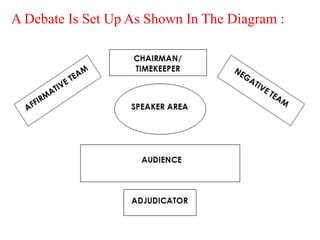
A Debate Is Set Up As Shown In The Diagram :
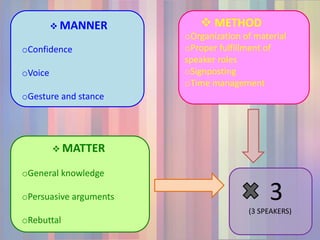
WHAT MAKES A DEBATE ???
What you say (MATTER)
How you say it (MANNER)
How you structure it (METHOD)
 MANNER
oConfidence
oVoice
oGesture and stance
 METHOD
oOrganization of material
oProper fulfillment of
speaker roles
oSignposting
oTime management
 MATTER
oGeneral knowledge
oPersuasive arguments
oRebuttal
(3 SPEAKERS)
3
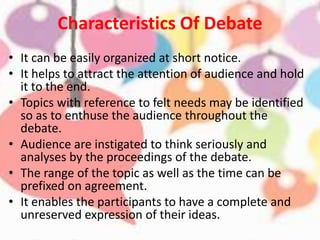
Characteristics Of Debate
• It can be easily organized at short notice.
• It helps to attract the attention of audience and hold
it to the end.
• Topics with reference to felt needs may be identified
so as to enthuse the audience throughout the
debate.
• Audience are instigated to think seriously and
analyses by the proceedings of the debate.
• The range of the topic as well as the time can be
prefixed on agreement.
• It enables the participants to have a complete and
unreserved expression of their ideas.
PURPOSES OF DEBATE
ļ‚§Topics of controversial nature are dealt with.
ļ‚§When the group needs to be exposed to the pros
and cons of the topic or decision.
ļ‚§When the participants have the capacity to
present their side in a meaningful and interesting
manner.
ļ‚§There is favorable atmosphere in the group to
accept ideas presented by logical arguments of the
participants.
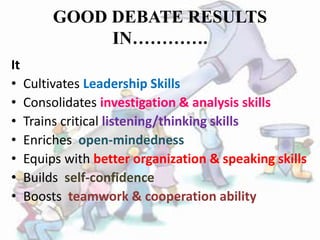
GOOD DEBATE RESULTS
IN………….
It
• Cultivates Leadership Skills
• Consolidates investigation & analysis skills
• Trains critical listening/thinking skills
• Enriches open-mindedness
• Equips with better organization & speaking skills
• Builds self-confidence
• Boosts teamwork & cooperation ability
CAUTIONS
•The range of subject should not be out of the purview of and
interest of the group.
•Emotional debate may become highly antagonistic and lead to
conflict between groups.
•Motive to win a debate may lead to distortion of information
leading to ignoring the primary need of the audience.
•It is useful only under certain purposes and under certain
conditions.
•The moderator and participants should be knowledgeable and
should not be over enthusiastic and carried away by emotions.
Debate

Debate

  • 1.
    SPEAKERS ARE NOTBORN, THEY ARE MADE
  • 2.
    TOPIC - DEBATE DIVISIONOF AGRICULTURE EXTENSION AEXT-311
  • 3.
    WHAT IS DEBATE???? o Debating is a more formal way of communicating. oDebate is a method of interactive and representational argument. o Debate is a series of lectures for and against on a given topic by knowledgeable persons. oA Debate is a contest where two teams present their arguments intent on persuading one another.
  • 5.
    RULES OF DEBATE ļ‚§Adebate has two teams: an Affirmative and a Negative. ļ‚§Each side consists of Three Speakers. ļ‚§The First Affirmative speaker begins the debate, and is then followed by the First Negative speaker. ļ‚§This pattern is maintained for the second and third speakers of each team. ļ‚§Each speaker speaks for a set time, with a warning bell, to give them a little time to sum up and finish, then a final bell. ļ‚§ There will be a Chair Or Moderator who presides over the discussion.
  • 6.
    A Debate IsSet Up As Shown In The Diagram :
  • 7.
    WHAT MAKES ADEBATE ??? What you say (MATTER) How you say it (MANNER) How you structure it (METHOD)
  • 8.
     MANNER oConfidence oVoice oGesture andstance  METHOD oOrganization of material oProper fulfillment of speaker roles oSignposting oTime management  MATTER oGeneral knowledge oPersuasive arguments oRebuttal (3 SPEAKERS) 3
  • 9.
    Characteristics Of Debate •It can be easily organized at short notice. • It helps to attract the attention of audience and hold it to the end. • Topics with reference to felt needs may be identified so as to enthuse the audience throughout the debate. • Audience are instigated to think seriously and analyses by the proceedings of the debate. • The range of the topic as well as the time can be prefixed on agreement. • It enables the participants to have a complete and unreserved expression of their ideas.
  • 10.
    PURPOSES OF DEBATE ļ‚§Topicsof controversial nature are dealt with. ļ‚§When the group needs to be exposed to the pros and cons of the topic or decision. ļ‚§When the participants have the capacity to present their side in a meaningful and interesting manner. ļ‚§There is favorable atmosphere in the group to accept ideas presented by logical arguments of the participants.
  • 11.
    GOOD DEBATE RESULTS IN…………. It •Cultivates Leadership Skills • Consolidates investigation & analysis skills • Trains critical listening/thinking skills • Enriches open-mindedness • Equips with better organization & speaking skills • Builds self-confidence • Boosts teamwork & cooperation ability
  • 12.
    CAUTIONS •The range ofsubject should not be out of the purview of and interest of the group. •Emotional debate may become highly antagonistic and lead to conflict between groups. •Motive to win a debate may lead to distortion of information leading to ignoring the primary need of the audience. •It is useful only under certain purposes and under certain conditions. •The moderator and participants should be knowledgeable and should not be over enthusiastic and carried away by emotions.