The document discusses genetically engineered biopesticides, outlining various types such as fungi, bacteria, protozoa, and viruses. It highlights the use of genetic engineering to improve the efficacy and stability of biopesticides like Bacillus thuringiensis and recombinant baculoviruses. Additionally, the potential and limitations of genetic engineering in enhancing biopesticide properties, including host range and insecticidal activity, are explored.
GENETIC ENGINEERING:
• Geneticengineering is defined as direct
manipulation of an organism’s genome using
biotechnology.
• It is a set of technologies used to change the
genetic makeup of cells including transfer of
geneswithin and across species to produce
improved and novel organisms
3.
BIOPESTICIDES
• Biopesticides arecertain types of pesticides
derived from such natural materials as plant,
animal ,bacteria ,and certain minerals
• Biopesticides are inherently less toxic than
conventional pesticides
• Biopesticides generally affect only target pest
• Biopesticides are effective in very small
quantity and often decompose quickly
FUNGI
• Various fungisuch as Beauveria bassiana and
Metarhizium anisoplie have attractive
characteristic for insect control
• One major limitation of use of
entomopathogenic fungi is that their
effectiveness depends on relative humidity
• Need for genetic engineering arises to
overcome this and increase their insecticidal
efficacy
6.
• M. anisoplienormally takes 5 to 10 days to kill
insect .in order to increase its insecticidal
efficacy, multiple copies of pr 1 gene were
introduced
• This gene encodes subtilisin like protease
which helps in host cuticle penetration
7.
• Pr 1was produced by recombinant fungus in the
hoemocoel of lepidopterous larva
• Infection resulted in partial hydrolysis of
haemolymph protiens and extensive melanisation
of larva
• Larva died from these effects 25% sooner than
wild types
• Feeding damage was reduced by 40%
8.
BACTERIA
• There arenumerous entomopathogenic
bacteria but few have been engineered for
enhanced insecticidal properties for use in
biocontrol
• Most attention has been given for increasing
insecticidal property of Bacillus thurengenesis
and bt toxins
• Bacillus thurengenesis is gram positive spore
forming bacteria
9.
• The insecticidalproperty of Bacillus
thurengenesis is due to insectecidal cry
protiens[ICP]
• ICPs are encoded by cry genes located on
extrachromosomal plasmid
• The genes are classified according to their
specificity into cryІ to cry ѵґ
10.
–Two limitations ofBT are
• relatively lower persistance under field
conditions
• the dessemination of large no. of spores
which is percieved to be problem in some
countries in which products with viable bt
spores are not authorized
11.
–To over comethese problems
following strategies were
adopted:
1. ICPs were introduced into nonpathogenic strain of
Pseudomonas flourescence
Bacteria were killed resulting in encapsulated ICPs
that has enhanced residual property in field and no
bt spores
2. Bt δ endotoxins have been engineered into
chromosome of pseudomonas flourescens .This was
helpful for increasing the range of habitats that can
be exploited for bt based insect pest control
12.
3.The gene encodingcry 1Ac has been engineered
into clavibacter xyli
The engineered bacterium was introduced into
corn seedlings by wound or seed inoculation
Tunneling damage caused by European corn
borer ostrinia nubinalis was reduced by 55 to
65%
• Therefore for bt, genetic engineering can be
used to increase the activity of particular strain
against target pest species,extend host range
,increase field stability,and provide alternative
constructs to facilitate management of
resistance
13.
Protozoa
• The majorityof protozoa for insect pest
control are in phylum microspora
• In theory genetic engineering could be
applied to microsporidia to enhance host
range and pathogenecity
• In practice ,the fact that the microsporidia
infect all vertebrate classes in addition to
invertebrate classes raises concerns over
genetic manipulation
14.
VIRUSES
• The onlyinsect viruses that have been
engineered are the baculoviruses
• Genetic engineering has been applied to
enhancement of baculo virus since 1980 and
has resulted in products that approach the
efficacy of chemical insecticides
15.
CONSTRUCTION OF RECOMBINANT
BACULOVIRUS
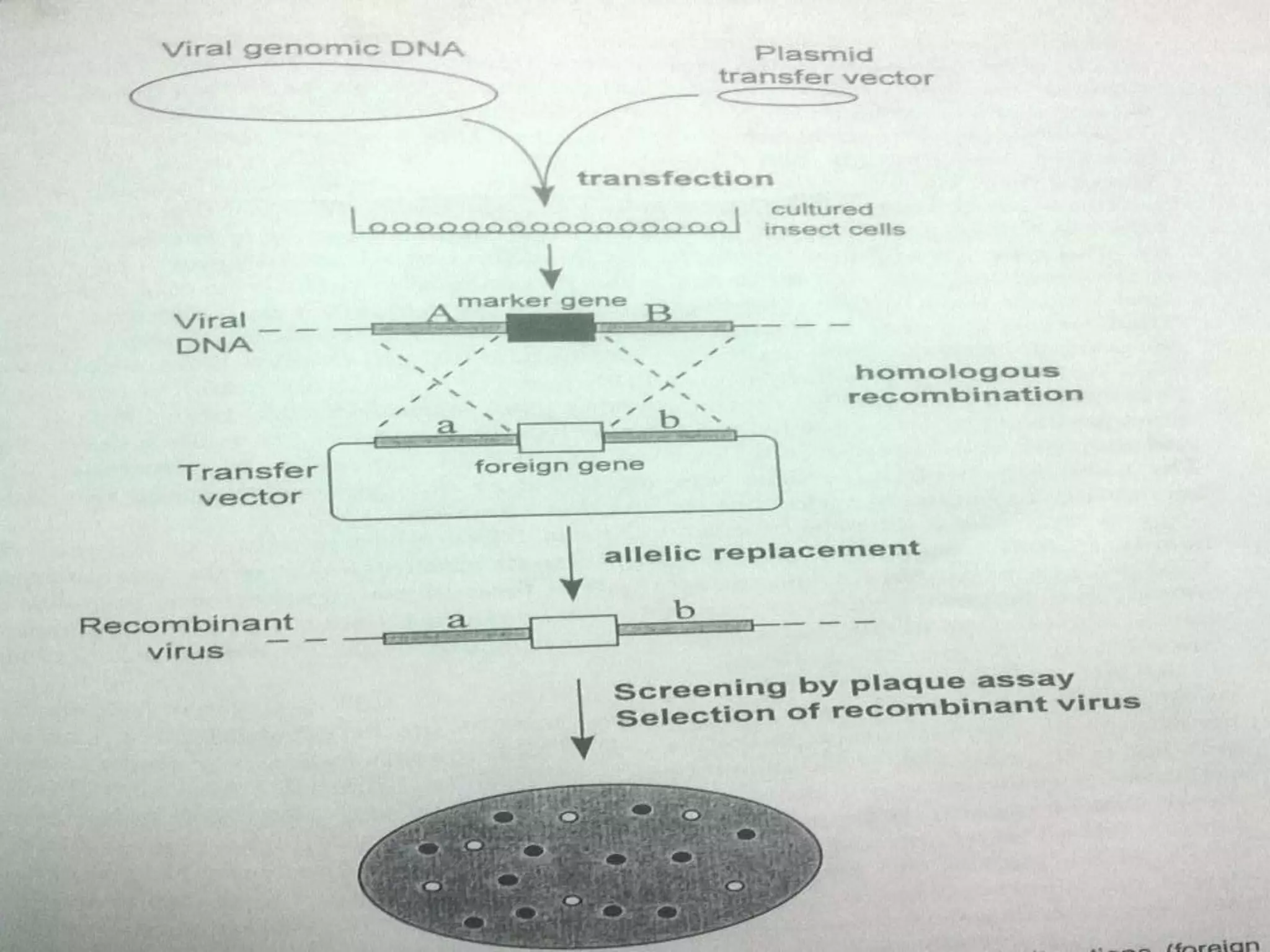
•The most common approach for construction
of recombinant baculovirus involves
cotransfection of an insect cell line that
supports viral replication with naked viral
genome DNA And a plasmid transfer vector
• The transfer vector consists of viral genomic
restriction fragment containing the desired
alteration
16.
• Homologous recombinationbetween the parental
virus genome and the transfer vector on either side
of alteration (a double crossover event) results in
the incorporation of the alteration into viral
genome
• Because naked baculovirus DNA Is infectious when
introduced into a permissive cell line,the
transfection leads to production of progeny virus
• Clonal isolates of recombinant virus are identified
and isolated in a plaque assay
18.
RECOMBINANT BACULOVIRUS
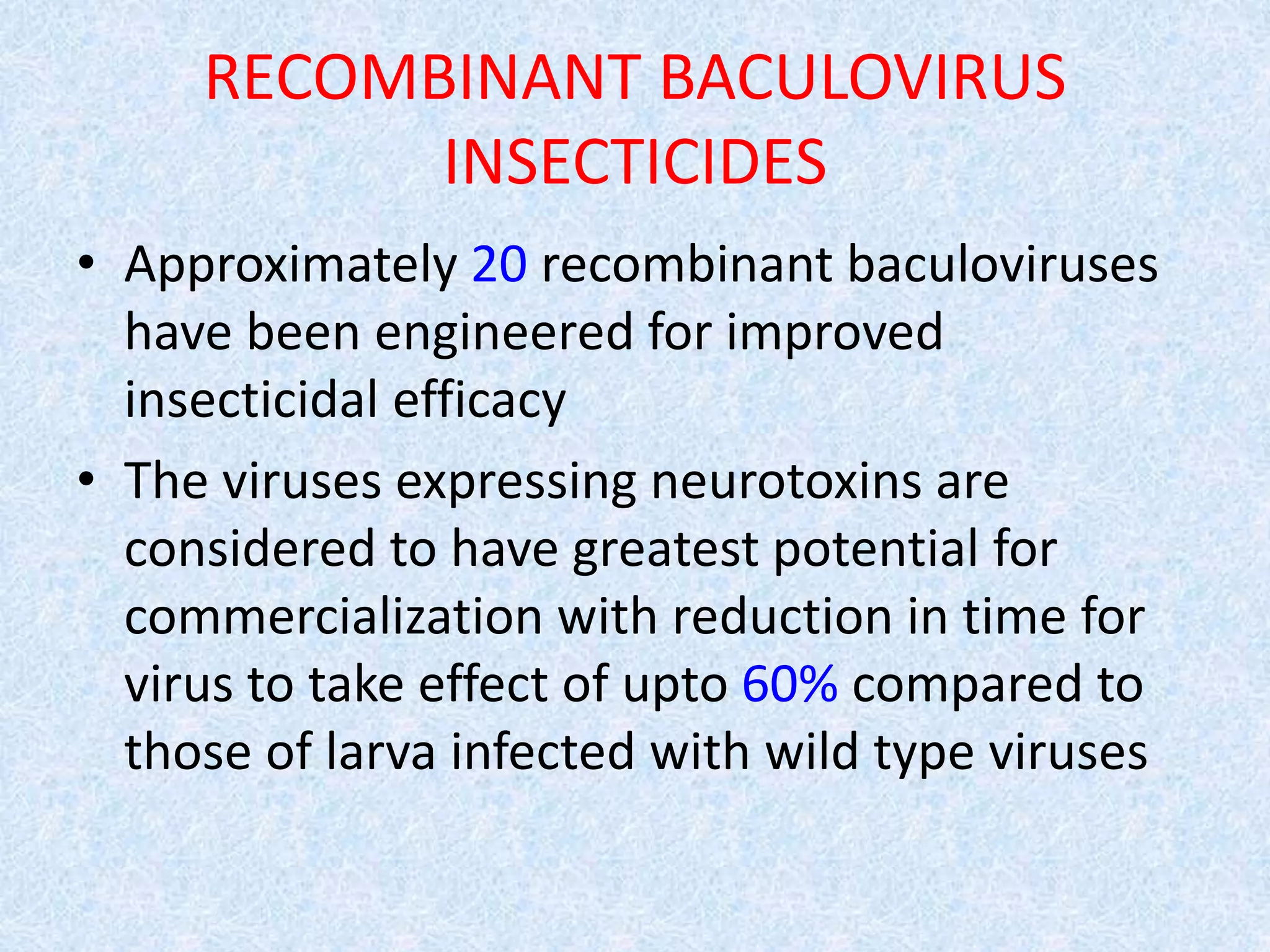
INSECTICIDES
• Approximately20 recombinant baculoviruses
have been engineered for improved
insecticidal efficacy
• The viruses expressing neurotoxins are
considered to have greatest potential for
commercialization with reduction in time for
virus to take effect of upto 60% compared to
those of larva infected with wild type viruses
19.
The requirements forinsecticidal peptides or
protiens expressed in recombinant
baculovirus include
1. The protein should have no effect on the
ability of virus to infect or replicate in host
insect cells before death of host.
2. The protein should be insect specific.
3. Protein should be active at low dosage.
4. Protein should have rapid effect on host .
20.
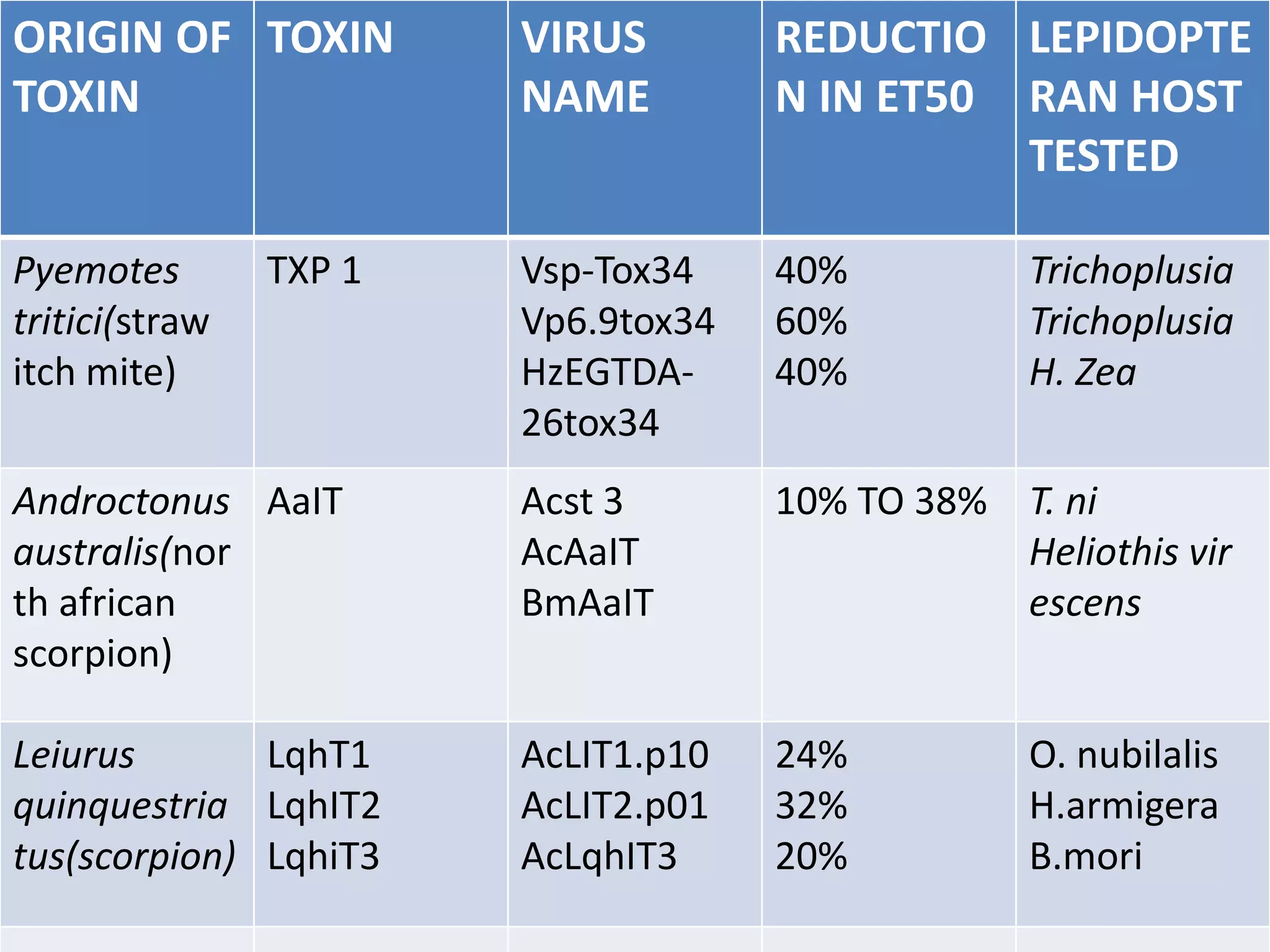
ORIGIN OF
TOXIN
TOXIN VIRUS
NAME
REDUCTIO
NIN ET50
LEPIDOPTE
RAN HOST
TESTED
Pyemotes
tritici(straw
itch mite)
TXP 1 Vsp-Tox34
Vp6.9tox34
HzEGTDA-
26tox34
40%
60%
40%
Trichoplusia
Trichoplusia
H. Zea
Androctonus
australis(nor
th african
scorpion)
AaIT Acst 3
AcAaIT
BmAaIT
10% TO 38% T. ni
Heliothis vir
escens
Leiurus
quinquestria
tus(scorpion)
LqhT1
LqhIT2
LqhiT3
AcLIT1.p10
AcLIT2.p01
AcLqhIT3
24%
32%
20%
O. nubilalis
H.armigera
B.mori
21.
ORIGIN OF
TOXIN
TOXIN VIRUS
NAME
REDUCTI
ONIN
ET5O
LEPIDOPTE
RAN HOST
TESTED
Anemonia
sulcata(sea
anemone)
As II vSAt2p+ 38% T.ni
Agelenopsis
sulcata(amer
ican funnel
web spiner)
µ-Aga-ґѵ vMAg4p+ 37% Spodoptera
frugipera
T. ni
Diguetia
canites(primi
tive weaving
spider
DTX9.2 vAcDTX9.2 9 TO 24% T.ni
H.virescens




![• The insecticidal property of Bacillus
thurengenesis is due to insectecidal cry
protiens[ICP]
• ICPs are encoded by cry genes located on
extrachromosomal plasmid
• The genes are classified according to their
specificity into cryІ to cry ѵґ](https://image.slidesharecdn.com/geneticallymodifiedbiopesticides-161203110742/75/Genetically-modified-biopesticides-9-2048.jpg)