1/20
AUTOMATIC EMERGENCY BRAKING
Seminar on
Presented by
MOHAMMED BASITH .A
S6 AUTOMOBILE
ENGINEERING
OBJECTIVE
 TO UNDERSTAND THE WORKING OF AUTOMATIC
EMERGENCY BRAKING SYSTEM USED IN VEHICLES.
 TO KNOW THE IMPORTANCE AND ADVANTAGES OF
AUTOMATIC EMERGENCY BRAKING SYSTEM IN
REDUCING THE ACCIDENTS.
2/20
CONTENT
 INTRODUCTION
 AEB
 PARTS OF AEB
 WORKING PRINCIPLE
 WORKING OF AEB
 TYPES OF AEB
 APPLICATIONS OF AEB
 ADVANTAGES/DISADVANTAGES
 CONCLUSION
 REFERENCES
 ACKNOWLEDGEMENT 3/20
INTRODUCTION
 Many accidents are caused by late braking and/or braking with
insufficient force.
 A driver may brake too late for several reasons:
1) He is distracted or inattentive
2) Situation may be very difficult to predict because the
driver ahead is braking unexpectedly or a pedestrian crosses
the street without paying attention.
 AEB is a system which handles the vehicle automatically in
case of emergency.
 AEB is an emerging form of Advanced Driver Assisted Systems.
4/20
AEB
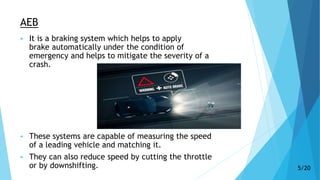
 It is a braking system which helps to apply
brake automatically under the condition of
emergency and helps to mitigate the severity of a
crash.
 These systems are capable of measuring the speed
of a leading vehicle and matching it.
 They can also reduce speed by cutting the throttle
or by downshifting. 5/20
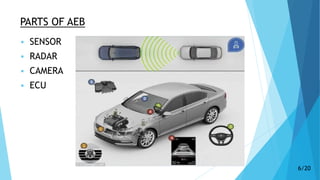
PARTS OF AEB
 SENSOR
 RADAR
 CAMERA
 ECU
6/20
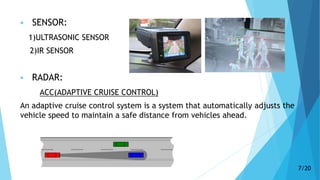
 SENSOR:
1)ULTRASONIC SENSOR
2)IR SENSOR
 RADAR:
ACC(ADAPTIVE CRUISE CONTROL)
An adaptive cruise control system is a system that automatically adjusts the
vehicle speed to maintain a safe distance from vehicles ahead.
7/20
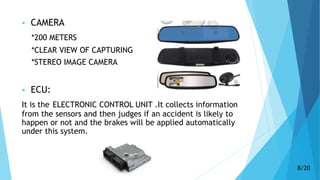
 CAMERA
*200 METERS
*CLEAR VIEW OF CAPTURING
*STEREO IMAGE CAMERA
 ECU:
It is the ELECTRONIC CONTROL UNIT .It collects information
from the sensors and then judges if an accident is likely to
happen or not and the brakes will be applied automatically
under this system.
8/20
WORKING PRINCIPLE
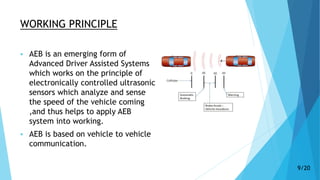
 AEB is an emerging form of
Advanced Driver Assisted Systems
which works on the principle of
electronically controlled ultrasonic
sensors which analyze and sense
the speed of the vehicle coming
,and thus helps to apply AEB
system into working.
 AEB is based on vehicle to vehicle
communication.
9/20
WORKING OF AEB
 The system will engages the
brakes automatically when
there is no assistance by the
driver for an action to take
place under the condition of an
emergency.
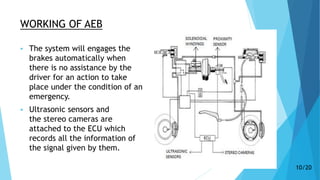
 Ultrasonic sensors and
the stereo cameras are
attached to the ECU which
records all the information of
the signal given by them.
10/20
 The ultrasonic sensors consist of two basic components :Transmitter and
Receiver.
 There will be two working regions of the system.
 In the first region ,the ultrasonic transmitters will transmit the
ultrasonic waves to find the distance of an obstacle towards the road surface.
If the sensor detects any kind of physical obstacle ,it will produce a reflected
wave.
 The ultrasonic receiver will then receive the reflected signals to measure
the accurate distance of the obstacle.
 The use of stereo cameras is basically for the detection of vehicles ,pedestrian
and objects .This camera helps to identify the moving objects and it reduces
the effect of false recognitions of object from a far distance.
11/20
 This system will then detect the relative distance of the obstacle and also
the relative speed of that obstacle.
 If the system judges that an accident is likely to happen, it will first
warn the driver with the help of audio signals, alert messages on the
display, tightening of the seat belt or even using red lights inside the
vehicle.
 In the second region, the sensor attached to the lower side of the
brake pedal comes into play.
 After the alert signals, if the brake pedal is pushed to avoid the
collision then AEB system will get disengaged, if pedal is not pushed, the
AEB system will get engaged.
12/20
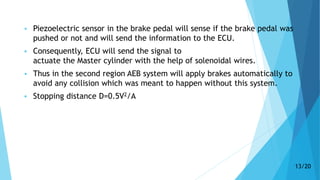
 Piezoelectric sensor in the brake pedal will sense if the brake pedal was
pushed or not and will send the information to the ECU.
 Consequently, ECU will send the signal to
actuate the Master cylinder with the help of solenoidal wires.
 Thus in the second region AEB system will apply brakes automatically to
avoid any collision which was meant to happen without this system.
 Stopping distance D=0.5V2/A
13/20
TYPES OF AEB
 FORWARD COLLISION WARNING OR REAR END COLLISION
 COLLISION MITIGATION BRAKING SYSTEM
 COLLISION AVOIDANCE
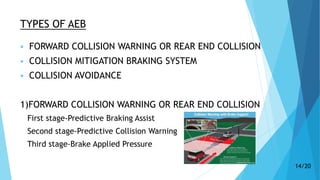
1)FORWARD COLLISION WARNING OR REAR END COLLISION
First stage-Predictive Braking Assist
Second stage-Predictive Collision Warning
Third stage-Brake Applied Pressure
14/20
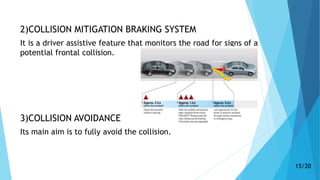
2)COLLISION MITIGATION BRAKING SYSTEM
It is a driver assistive feature that monitors the road for signs of a
potential frontal collision.
3)COLLISION AVOIDANCE
Its main aim is to fully avoid the collision.
15/20
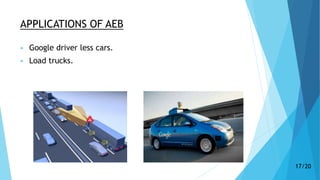
APPLICATIONS OF AEB
 Google driver less cars.
 Load trucks.
17/20
ADVANTAGES AND DISADVANTAGES
ADVANTAGES
 Crashes can be reduced.
 Allows the driver to
maintain the
directional stability and
control over steering
during braking.
 With AEB installed in cars,
the car insurance
premiums are reduced.
DISADVANTAGES
 Driver should know the
full software.
 Cost is more.
 It cannot be fitted
during assembly.
 It take out the total
control of the vehicle.
16/20
CONCLUSION
 AEB system eliminates or mitigates the severity of various
types of crashes like head on collision, pedestrian crashes.
 In the present work, the use of ultrasonic sensors with the
use of stereo cameras helps to
determine the distance between the vehicle and the
obstacle.
 An ultrasonic sensor can detect any kind of obstacle thus
it also prevents collision of vehicle with pedestrians or it
can at least mitigate the effect of the crash.
 It is emerging as the safest technology presently for
the prevention of accidents.
18/20
REFERENCES
[1]Wei Yang1,Jiajun Liu1,Kaixia Zhou1,Zhiwei Zhang1,Xiaolei
Qu2,3.Research article on: An Automatic Emergency Braking
Model considering Drivers Intention Recognition of the Front
Vehicle.
[2]Sumeet Bhardwaj1*,Ashwani Gulati1,Kashish Goyal1,Vivek
Vij1.Conference paper on: AUTOMATIC EMERGENCY BRAKING
SYSTEM(A SYSTEM FOR DECREASED HUMAN EFFORT) January
2022.
[3]Dineshkumar C, Sonya A, Roshan D. Automatic Emergency
Braking System using Hydraulic Actuator for Preventing Road
Accidents. International Journal of Engineering and
Advanced Technology,Volume-8 Issue-6, August 2019
19/20
ACKNOWLEDGEMENT
 I heartfully expressing my thanks to the professors who
are present at the time of presentation.
 I would like to thank the colleagues who are presented
here during the seminar session.
 I hope everyone understood this session.
 Thank you all.
20/20

presentation211-221102153651-b1da7fce.pdf

  • 1.
    1/20 AUTOMATIC EMERGENCY BRAKING Seminaron Presented by MOHAMMED BASITH .A S6 AUTOMOBILE ENGINEERING
  • 2.
    OBJECTIVE  TO UNDERSTANDTHE WORKING OF AUTOMATIC EMERGENCY BRAKING SYSTEM USED IN VEHICLES.  TO KNOW THE IMPORTANCE AND ADVANTAGES OF AUTOMATIC EMERGENCY BRAKING SYSTEM IN REDUCING THE ACCIDENTS. 2/20
  • 3.
    CONTENT  INTRODUCTION  AEB PARTS OF AEB  WORKING PRINCIPLE  WORKING OF AEB  TYPES OF AEB  APPLICATIONS OF AEB  ADVANTAGES/DISADVANTAGES  CONCLUSION  REFERENCES  ACKNOWLEDGEMENT 3/20
  • 4.
    INTRODUCTION  Many accidentsare caused by late braking and/or braking with insufficient force.  A driver may brake too late for several reasons: 1) He is distracted or inattentive 2) Situation may be very difficult to predict because the driver ahead is braking unexpectedly or a pedestrian crosses the street without paying attention.  AEB is a system which handles the vehicle automatically in case of emergency.  AEB is an emerging form of Advanced Driver Assisted Systems. 4/20
  • 5.
    AEB  It isa braking system which helps to apply brake automatically under the condition of emergency and helps to mitigate the severity of a crash.  These systems are capable of measuring the speed of a leading vehicle and matching it.  They can also reduce speed by cutting the throttle or by downshifting. 5/20
  • 6.
    PARTS OF AEB SENSOR  RADAR  CAMERA  ECU 6/20
  • 7.
     SENSOR: 1)ULTRASONIC SENSOR 2)IRSENSOR  RADAR: ACC(ADAPTIVE CRUISE CONTROL) An adaptive cruise control system is a system that automatically adjusts the vehicle speed to maintain a safe distance from vehicles ahead. 7/20
  • 8.
     CAMERA *200 METERS *CLEARVIEW OF CAPTURING *STEREO IMAGE CAMERA  ECU: It is the ELECTRONIC CONTROL UNIT .It collects information from the sensors and then judges if an accident is likely to happen or not and the brakes will be applied automatically under this system. 8/20
  • 9.
    WORKING PRINCIPLE  AEBis an emerging form of Advanced Driver Assisted Systems which works on the principle of electronically controlled ultrasonic sensors which analyze and sense the speed of the vehicle coming ,and thus helps to apply AEB system into working.  AEB is based on vehicle to vehicle communication. 9/20
  • 10.
    WORKING OF AEB The system will engages the brakes automatically when there is no assistance by the driver for an action to take place under the condition of an emergency.  Ultrasonic sensors and the stereo cameras are attached to the ECU which records all the information of the signal given by them. 10/20
  • 11.
     The ultrasonicsensors consist of two basic components :Transmitter and Receiver.  There will be two working regions of the system.  In the first region ,the ultrasonic transmitters will transmit the ultrasonic waves to find the distance of an obstacle towards the road surface. If the sensor detects any kind of physical obstacle ,it will produce a reflected wave.  The ultrasonic receiver will then receive the reflected signals to measure the accurate distance of the obstacle.  The use of stereo cameras is basically for the detection of vehicles ,pedestrian and objects .This camera helps to identify the moving objects and it reduces the effect of false recognitions of object from a far distance. 11/20
  • 12.
     This systemwill then detect the relative distance of the obstacle and also the relative speed of that obstacle.  If the system judges that an accident is likely to happen, it will first warn the driver with the help of audio signals, alert messages on the display, tightening of the seat belt or even using red lights inside the vehicle.  In the second region, the sensor attached to the lower side of the brake pedal comes into play.  After the alert signals, if the brake pedal is pushed to avoid the collision then AEB system will get disengaged, if pedal is not pushed, the AEB system will get engaged. 12/20
  • 13.
     Piezoelectric sensorin the brake pedal will sense if the brake pedal was pushed or not and will send the information to the ECU.  Consequently, ECU will send the signal to actuate the Master cylinder with the help of solenoidal wires.  Thus in the second region AEB system will apply brakes automatically to avoid any collision which was meant to happen without this system.  Stopping distance D=0.5V2/A 13/20
  • 14.
    TYPES OF AEB FORWARD COLLISION WARNING OR REAR END COLLISION  COLLISION MITIGATION BRAKING SYSTEM  COLLISION AVOIDANCE 1)FORWARD COLLISION WARNING OR REAR END COLLISION First stage-Predictive Braking Assist Second stage-Predictive Collision Warning Third stage-Brake Applied Pressure 14/20
  • 15.
    2)COLLISION MITIGATION BRAKINGSYSTEM It is a driver assistive feature that monitors the road for signs of a potential frontal collision. 3)COLLISION AVOIDANCE Its main aim is to fully avoid the collision. 15/20
  • 16.
    APPLICATIONS OF AEB Google driver less cars.  Load trucks. 17/20
  • 17.
    ADVANTAGES AND DISADVANTAGES ADVANTAGES Crashes can be reduced.  Allows the driver to maintain the directional stability and control over steering during braking.  With AEB installed in cars, the car insurance premiums are reduced. DISADVANTAGES  Driver should know the full software.  Cost is more.  It cannot be fitted during assembly.  It take out the total control of the vehicle. 16/20
  • 18.
    CONCLUSION  AEB systemeliminates or mitigates the severity of various types of crashes like head on collision, pedestrian crashes.  In the present work, the use of ultrasonic sensors with the use of stereo cameras helps to determine the distance between the vehicle and the obstacle.  An ultrasonic sensor can detect any kind of obstacle thus it also prevents collision of vehicle with pedestrians or it can at least mitigate the effect of the crash.  It is emerging as the safest technology presently for the prevention of accidents. 18/20
  • 19.
    REFERENCES [1]Wei Yang1,Jiajun Liu1,KaixiaZhou1,Zhiwei Zhang1,Xiaolei Qu2,3.Research article on: An Automatic Emergency Braking Model considering Drivers Intention Recognition of the Front Vehicle. [2]Sumeet Bhardwaj1*,Ashwani Gulati1,Kashish Goyal1,Vivek Vij1.Conference paper on: AUTOMATIC EMERGENCY BRAKING SYSTEM(A SYSTEM FOR DECREASED HUMAN EFFORT) January 2022. [3]Dineshkumar C, Sonya A, Roshan D. Automatic Emergency Braking System using Hydraulic Actuator for Preventing Road Accidents. International Journal of Engineering and Advanced Technology,Volume-8 Issue-6, August 2019 19/20
  • 20.
    ACKNOWLEDGEMENT  I heartfullyexpressing my thanks to the professors who are present at the time of presentation.  I would like to thank the colleagues who are presented here during the seminar session.  I hope everyone understood this session.  Thank you all. 20/20