Introduction
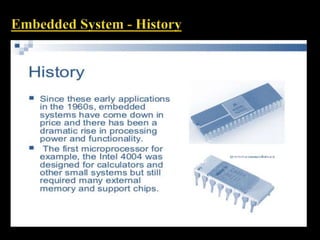
History
Types of Embedded
System
Characteristics
Features
Advantages
An embedded system is a computer system with a dedicated function within a larger
mechanical or electrical system, often with real-time computing constraints. It is embedded
as part of a complete device often including hardware and mechanical parts. Embedded
systems control many devices in common use today.
Definition
Hard to Define
Computing Systems embedded within electronic
devices
Nearly any computing system other than a desktop
computer
An Embedded system is a specific to a application, whereas a computer system is
generic.
Though the components are same there is substantial difference in them.
A personal computer is not designed to perform a specific function, rhather it is able to
do many things.
The essential difference is that a computer when manufactured is in blank state, the
manufacturer does not know what the customer will do with it, while an Embedded
system is application specific.
An Embedded system is a component within some large systems
If required each of the embedded systems are connected by a sort of a communication
network.
Numerous embedded systems make up the computer system.
It is designed to do some particular task.
Embedded systems are not always standalone devices.
The program instructions written for embedded systems are referred to as firmware
and are stored in ROM or flash memory chips.
Timeliness - Even infinitely fast computer embedded software needs to deal with time
because the physical processes with which it interacts evolves over time.
Concurrency - Engage with the physical world where multiple things happen at once.
Liveliness - Program must not terminate or block waiting for events that will never occur.
Heterogeneity - Different computational styles and implementation technologies
interact with events occurring.
Reactivity - React continuously to the environment at the speed of the environment.
Reliability and security - The system must be reliable and secure against errors.
Interaction with physical devices - The communication of embedded systems is
performed through unusual i/o devices that sometimes require signal conditioning.
Robustness - The conditions of the embedded systems operation may be adverse, so
they must be as robust as possible.
Low cost
Small size
High reliability
Fast operations
Easy to manufacture
Fewer interconnections
Portable, such as digital watches, mp3 player, etc
Real time response
No user interface
Not much data storage
C has been the language of the embedded programmers. It is fairly simple to learn,
compilers are available for almost every processor in use today.
C which is considered as a middle level language having both the constructs of the low-
level as well as high-level, has all the rich features in it that makes it the choice of the
embedded programmers.
C is not the only language used by embedded programmers there are other languages like
Assembly language
C++
Ada
These languages though exists did not gain popularity as C.
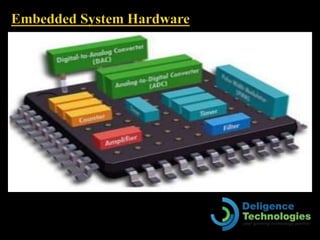
Hardware products for National Instruments embedded
systems share a common architecture that includes three
components: an embedded controller for communication and
processing; an FPGA for advanced control, timing, signal
processing, filtering, and custom protocols; and industrial I/O
modules for connectivity to any sensor or device. All of the
components are reconfigurable through a single software
toolchain.
https://en.wikipedia.org/wiki/Embedded_system
http://www.deligence.com/services/embedded-software-development
http://www.slideshare.net/kondalarao7/embedded-systems-9301887
Deligence Technologies - your growing technology partner!
www.deligence.com/contact-us
Email : info@deligence.com
Phone : +91 9910130340
Embedded Software Development

Embedded Software Development

  • 2.
  • 4.
    An embedded systemis a computer system with a dedicated function within a larger mechanical or electrical system, often with real-time computing constraints. It is embedded as part of a complete device often including hardware and mechanical parts. Embedded systems control many devices in common use today. Definition Hard to Define Computing Systems embedded within electronic devices Nearly any computing system other than a desktop computer
  • 6.
    An Embedded systemis a specific to a application, whereas a computer system is generic. Though the components are same there is substantial difference in them. A personal computer is not designed to perform a specific function, rhather it is able to do many things. The essential difference is that a computer when manufactured is in blank state, the manufacturer does not know what the customer will do with it, while an Embedded system is application specific. An Embedded system is a component within some large systems If required each of the embedded systems are connected by a sort of a communication network. Numerous embedded systems make up the computer system.
  • 13.
    It is designedto do some particular task. Embedded systems are not always standalone devices. The program instructions written for embedded systems are referred to as firmware and are stored in ROM or flash memory chips.
  • 15.
    Timeliness - Eveninfinitely fast computer embedded software needs to deal with time because the physical processes with which it interacts evolves over time. Concurrency - Engage with the physical world where multiple things happen at once. Liveliness - Program must not terminate or block waiting for events that will never occur. Heterogeneity - Different computational styles and implementation technologies interact with events occurring. Reactivity - React continuously to the environment at the speed of the environment. Reliability and security - The system must be reliable and secure against errors. Interaction with physical devices - The communication of embedded systems is performed through unusual i/o devices that sometimes require signal conditioning. Robustness - The conditions of the embedded systems operation may be adverse, so they must be as robust as possible.
  • 17.
    Low cost Small size Highreliability Fast operations Easy to manufacture Fewer interconnections Portable, such as digital watches, mp3 player, etc Real time response No user interface Not much data storage
  • 19.
    C has beenthe language of the embedded programmers. It is fairly simple to learn, compilers are available for almost every processor in use today. C which is considered as a middle level language having both the constructs of the low- level as well as high-level, has all the rich features in it that makes it the choice of the embedded programmers. C is not the only language used by embedded programmers there are other languages like Assembly language C++ Ada These languages though exists did not gain popularity as C.
  • 21.
    Hardware products forNational Instruments embedded systems share a common architecture that includes three components: an embedded controller for communication and processing; an FPGA for advanced control, timing, signal processing, filtering, and custom protocols; and industrial I/O modules for connectivity to any sensor or device. All of the components are reconfigurable through a single software toolchain.
  • 24.
  • 25.
    Deligence Technologies -your growing technology partner! www.deligence.com/contact-us Email : info@deligence.com Phone : +91 9910130340