Arduino to Control Bulbs using Web App
By Deligence Technologies
www.deligence.com
Project Description
Hardware Used
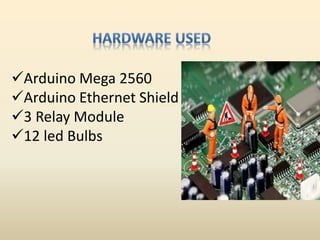
• Arduino Mega 2560
•Arduino Ethernet Shield
•3 Relay Module
•12 led Bulbs
Video Presentation
In this project we are going to
light the bulb from remote
location using web services. In
this we are going to use one
Arduino interfacing with 12 bulb
using 3 relay module with low
level trigger. We can trigger the
relay from anywhere in the world
using a website in which we’ll
have GUI Button. In each trigger
of relay the correspondence Bulb
or group of bulb will glow.
Controlling LED Bulbs from Web App using Arduino
Arduino Mega 2560
Arduino Ethernet Shield
3 Relay Module
12 led Bulbs
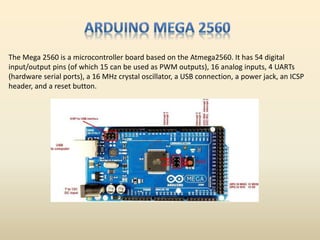
The Mega 2560 is a microcontroller board based on the Atmega2560. It has 54 digital
input/output pins (of which 15 can be used as PWM outputs), 16 analog inputs, 4 UARTs
(hardware serial ports), a 16 MHz crystal oscillator, a USB connection, a power jack, an ICSP
header, and a reset button.
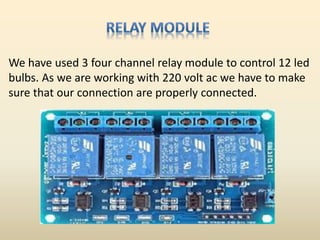
We have used 3 four channel relay module to control 12 led
bulbs. As we are working with 220 volt ac we have to make
sure that our connection are properly connected.
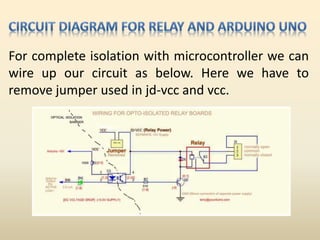
For complete isolation with microcontroller we can
wire up our circuit as below. Here we have to
remove jumper used in jd-vcc and vcc.
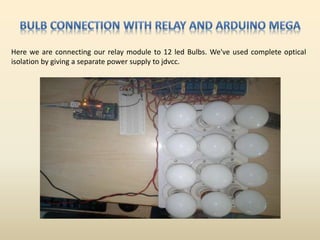
Here we are connecting our relay module to 12 led Bulbs. We've used complete optical
isolation by giving a separate power supply to jdvcc.
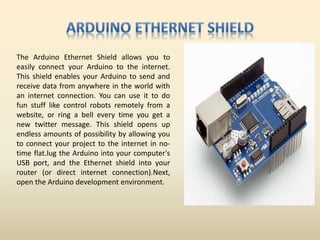
The Arduino Ethernet Shield allows you to
easily connect your Arduino to the internet.
This shield enables your Arduino to send and
receive data from anywhere in the world with
an internet connection. You can use it to do
fun stuff like control robots remotely from a
website, or ring a bell every time you get a
new twitter message. This shield opens up
endless amounts of possibility by allowing you
to connect your project to the internet in no-
time flat.lug the Arduino into your computer's
USB port, and the Ethernet shield into your
router (or direct internet connection).Next,
open the Arduino development environment.
I highly recommend upgrading to Arduino 1.0 or later (if you have not done so
already). This version of the software has built in DHCP support, and does not
require manually configuring an IP address.To figure out what IP address has been
assigned to your board, open the DhcpAddressPrinter sketch. This can be found
at:
File --> Examples --> Ethernet --> DhcpAddressPrinter
Once open, you may need to change the Mac address. On newer versions of the
Ethernet shield, you should see this address on a sticker attached to the board. If
you are missing a sticker, simply making up a unique mac address should work. If
you are using multiple shields, make sure each has a unique mac address.
Once the mac address is properly configured, upload the sketch to your Arduino,
and open the serial monitor. It should print out the IP address in use.
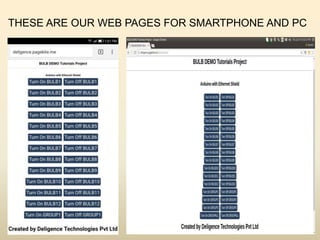
THESE ARE OUR WEB PAGES FOR SMARTPHONE AND PC
We at Deligence Technologies, offer a range of Arduino Software Development Services
to turn your design into a fully functional system.
Deligence Technologies - your growing technology partner!
www.deligence.com/contact-us
Email : info@deligence.com
Phone : +91 9910130340
Arduino to Control Bulbs using Web App

Arduino to Control Bulbs using Web App

  • 1.
    Arduino to ControlBulbs using Web App By Deligence Technologies www.deligence.com
  • 2.
    Project Description Hardware Used •Arduino Mega 2560 •Arduino Ethernet Shield •3 Relay Module •12 led Bulbs Video Presentation
  • 3.
    In this projectwe are going to light the bulb from remote location using web services. In this we are going to use one Arduino interfacing with 12 bulb using 3 relay module with low level trigger. We can trigger the relay from anywhere in the world using a website in which we’ll have GUI Button. In each trigger of relay the correspondence Bulb or group of bulb will glow. Controlling LED Bulbs from Web App using Arduino
  • 4.
    Arduino Mega 2560 ArduinoEthernet Shield 3 Relay Module 12 led Bulbs
  • 5.
    The Mega 2560is a microcontroller board based on the Atmega2560. It has 54 digital input/output pins (of which 15 can be used as PWM outputs), 16 analog inputs, 4 UARTs (hardware serial ports), a 16 MHz crystal oscillator, a USB connection, a power jack, an ICSP header, and a reset button.
  • 6.
    We have used3 four channel relay module to control 12 led bulbs. As we are working with 220 volt ac we have to make sure that our connection are properly connected.
  • 7.
    For complete isolationwith microcontroller we can wire up our circuit as below. Here we have to remove jumper used in jd-vcc and vcc.
  • 8.
    Here we areconnecting our relay module to 12 led Bulbs. We've used complete optical isolation by giving a separate power supply to jdvcc.
  • 9.
    The Arduino EthernetShield allows you to easily connect your Arduino to the internet. This shield enables your Arduino to send and receive data from anywhere in the world with an internet connection. You can use it to do fun stuff like control robots remotely from a website, or ring a bell every time you get a new twitter message. This shield opens up endless amounts of possibility by allowing you to connect your project to the internet in no- time flat.lug the Arduino into your computer's USB port, and the Ethernet shield into your router (or direct internet connection).Next, open the Arduino development environment.
  • 10.
    I highly recommendupgrading to Arduino 1.0 or later (if you have not done so already). This version of the software has built in DHCP support, and does not require manually configuring an IP address.To figure out what IP address has been assigned to your board, open the DhcpAddressPrinter sketch. This can be found at: File --> Examples --> Ethernet --> DhcpAddressPrinter Once open, you may need to change the Mac address. On newer versions of the Ethernet shield, you should see this address on a sticker attached to the board. If you are missing a sticker, simply making up a unique mac address should work. If you are using multiple shields, make sure each has a unique mac address. Once the mac address is properly configured, upload the sketch to your Arduino, and open the serial monitor. It should print out the IP address in use.
  • 11.
    THESE ARE OURWEB PAGES FOR SMARTPHONE AND PC
  • 12.
    We at DeligenceTechnologies, offer a range of Arduino Software Development Services to turn your design into a fully functional system. Deligence Technologies - your growing technology partner! www.deligence.com/contact-us Email : info@deligence.com Phone : +91 9910130340