NCCT Centre for Advanced Technology ------------------------------------------------------------------------------------------------------------------------------------------------------------------------    SOFTWARE DEVELOPMENT * EMBEDDED SYSTEMS #109, 2nd Floor, Bombay Flats, Nungambakkam High Road,  Nungambakkam, Chennai - 600 034.  Phone - 044 - 2823 5816, 98412 32310 E-Mail: ncct@eth.net, esskayn@eth.net, URL: ncctchennai.com   Dedicated to Commitments, Committed to Technologies
EMBEDDED SYSTEMS NCCT Where Technology and Solutions Meet
INTRODUCTION The purpose is to make a technical presentation on  EMBEDDED SYSTEMS & ITS APPLICATIONS   NCCT
About NCCT NCCT is a leading IT organization backed by a  strong R & D, concentrating on Electronics product development.  The major activities of NCCT include Hardware Design, Development, Implementation and related activities   NCCT
WHAT WILL WE DISCUSS About Embedded System Definition  of Embedded System Types of Embedded System Micro processor Micro Controller DSP RTOS VLSI
INTRODUCTION Embedded system is a combination of software and hardware. An Embedded system is a system, that has a computing device embedded into it. Embedded systems are designed around a  µ C which integrates memory & peripherals .
WHY ‘EMBEDDED’? It is embedded because the processor is ‘inside’ some other system. For Example a microprocessor is ‘embedded’ into your TV, car, or appliance. The consumer need not think about how to make it perform or process
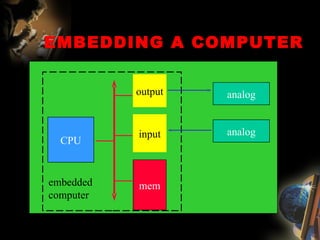
EMBEDDING A COMPUTER CPU mem input output analog analog embedded computer
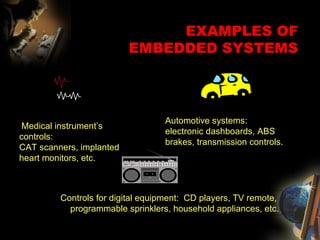
EXAMPLES OF EMBEDDED SYSTEMS Automotive systems:  electronic dashboards, ABS brakes, transmission controls. Medical instrument’s controls: CAT scanners, implanted heart monitors, etc. Controls for digital equipment:  CD players, TV remote,  programmable sprinklers, household appliances, etc.
CHARACTERISTICS OF EMBEDDED SYSTEMS Sophisticated functionality. Real-time operation. Low manufacturing cost. Low power. Designed to tight deadlines by small teams.
EMBEDDED SYSTEMS - EARLY HISTORY Late 1940’s: MIT Whirlwind computer was designed for real-time operations. Originally designed to control an aircraft simulator. First microprocessor was Intel 4004 in early 1970’s. HP-35 calculator used several chips to implement a microprocessor in 1972. Automobiles used microprocessor-based engine controllers starting in 1970’s. Control fuel/air mixture, engine timing, etc. Multiple modes of operation: warm-up, cruise,  hill climbing, etc. Provides lower emissions, better fuel efficiency.
Some history… The first Embedded System: Apollo Guidance Computer
Difference between a Micro Processor and a Micro Controller Peripherals Speed Bitwise Instruction Set
Types of Micro Controller 70 TYPES OF MICRO CONTROLLERS Some of the examples are Microchip  Intel Texas Philips Samsung etc …
What  is  PIC PIC stands for Peripheral Interfacing Controller  developed by MICROCHIP technology INC, USA PIC is a very popular Microcontroller world wide. Microchip is the first manufacture of 8 pin RISC MCU.
PIC ARCHITECTURE BACKGROUND Microcontroller Very little external support hardware. Most RAM, ROM and peripherals on chip. “ Computer on a chip”, or “System on chip” (SOC) E.g., PIC = Peripheral Interface Controller
PIC Architecture: Background We’re used to the  Von-Neuman Architecture Used in: 80X86 (PCs), 8051, 68HC11, etc.) Only one bus between CPU and memory RAM and program memory share the same bus and the same memory, and so must have the same bit width Bottleneck: Getting instructions interferes with accessing RAM CPU 8 Memory (Program & Data)
PIC Architecture: Background PICS USE THE  HARVARD ARCHITECTURE Used mostly in RISC CPUs (we’ll get there) Separate program bus and data bus: can be different widths! For example, PICs use: Data memory (RAM): a small number of  8bit  registers Program memory (ROM): 12bit, 14bit or 16bit wide  (in EPROM, FLASH, or ROM) CPU 12 14 16 Memory (Data) 8 Memory (Program)
Use the PIC micro ®  Micro Controller Technology You Need...! FLASH  for your re-programmable applications OTP  for you production line configured applications ROM  for your stable code applications Need to migrate from one part to another? Microchip makes it easy... even across different  technologies
PIC  µC  SPEED COMPARISON
DEVELOPMENT PHASES Designing such systems requires a  combination of hardware and software. Development phases include Understanding the electronic design Designing & developing the software Developing the hardware
DEVELOPMENT PHASES... Debugging and simulation Embedding Process Testing
UNDERSTANDING THE  ELECTRONIC DESIGN What kind of external circuitry? Requirement of external circuitry Architecture of  µ C Which  µ C  ?
DESIGNING THE SOFTWARE Choosing the computer language Deciding the flow of operation Determining the modules in the system
Software: Instruction Set Let’s see what makes PICs tick! See handout:   “PIC 16CXX Instruction Set Summary” Program counter increments once each Tcyc to “grab” the next instruction Remember, instructions are stored in program memory and are completely separate from RAM (“File registers”).
Software -  Programmers Model Program Memory “ Burned” in by programmer (can’t change during execution). Stored instructions, addresses and “literals” (numbers). <-  12/14/16 bits  -> Hardware Stack Stores addresses for subroutines Program Counter-PCL (PCH) Status  Special Purpose Registers I/O pin states, peripheral registers, etc. General Purpose Registers RAM or “data memory”. Variables are stored here. W “Register” <-  8 bits  ->
TESTING The  µ C  is placed in the appropriate electronic circuitry. Test result at various points in the circuit are taken and compared with expected output. External factors that may affect the electronic circuitry should be taken care of.
DEVELOPING THE SOFTWARE Coding is done in an Integrated  Development Environment (IDE)- MPLAB Different compilers available are HITECH C
DEBUGGING AND SIMULATION Simulation is done by giving test  inputs,which is called stimulus input. Debugging can be done manually or using an IN-CIRCUIT DEBUGGER. Simulation tool used is MPLAB-SIM
EMBEDDING PROCESS Fusing of the compiled code into the  µC is termed as Embedding Process Embedding process is executed by using a device – PICSTART  PLUS  Programmer It gives a summary of how many addresses are programmed & success or failure of the embedding process
ROUTINES Software development Product architecture & development. Hardware circuit design. Coding in Assembly and C Language. PICmicro Training. Design consultation .
Field of Embedded Industrial  Power Automotive Telecommunication Consumer Biomedical Biotech Agricultural Toys RF
Today/Tomorrow
Embedded Systems in today’s world Signal processing systems Real-time video, set-top boxes, DVD players, medical equipment, residential gateways Distributed control Network routers, switches, firewalls, mass transit systems, elevators “ Small” systems Mobile phones, pagers, home appliances, toys, smartcards, MP3 players, PDAs, digital cameras, sensors, smart badges
RECENT INDUSTRIAL PRODUCT DESIGNS Two Digit Universal and Custom Timers Six Digit Preset, Up/Down Counters Water  Level Controller Length counter Temperature control RECENT AUTOMOTIVE PRODUCT DESIGNS Car central locking and alarm system with RF  remote and keypad access Smart wiper controller Power window controller Smart flasher for two wheelers Auto dipper
Recent Telecommunication Product Designs Telephone caller ID with LCD and memory Telephone controller switch for home automation Private telephone exchange Local call metering system Recent Biomedical Product Designs Blood pressure monitor ECG monitor using a computer monitor for display and settable alarms Heart rate monitor
Recent Agriculture Product Designs Irrigation pump controller Irrigation timer Irrigation motor protector Motor phase reversal and failure protector Drip irrigation controller Soil RH monitor Soil pH meter
Recent Consumer Product Designs Four zone burglar alarm system Code key access system Refrigerator temperature controller  Air-Conditioner controller with remote Water level controller
PROJECT SAMPLES Industrial Timer Four digit Timer. Automotive Car Alarm with  remote control
BENEFITS OF EMBEDDED CONTROL DESIGN Eliminates necessity of complex circuitry. Smarter products. Smaller size. Lower cost. User friendly. State of the art technology.
FUTURE OF EMBEDDED CONTROL Intelligent products are used everyday - mobile phones, printers, washing machines, microwave ovens, water purifier, air conditioners etc. New generation embedded control will include internet connectivity and RF controls.
The Job Opportunities in the areas of  Software Design Engineer Device Driver Developer Kernel Developer Network Engineer RTOS Programmer Software Engineer in Research & Development
Companies are working on Embedded Systems and Applications AXES technologies CG Smith Converge Labs Future Software IBM LUCENT MASCON Sundaram Telematics Visteon WIPRO TCS Infosys Robert Bosch Kshema Technologies
CONCLUSION Embedded systems is THE  happening thing in the engineering industry…. Advantages: Enhances marketability of the product Lowers development cost / product cost Enhances product quality Optimum utilization of advanced chip features.
Projects @ NCCT Redefining the Learning Specialization, Design, Development and Implementation with Projects Experience the learning with the latest new tools and technologies…
Projects @ NCCT Project Specialization Concept NCCT , in consultation with Export-Software Division, offers Live  Electronics related Projects, to experience the learning with the latest new tools and technologies NCCT  believes in specialized Hardware Design, development training and implementation with an emphasis on development principles and standards NCCT  plays a dual  positive  role by satisfying your academic requirements as well as giving the necessary training in electronics and embedded product development
Projects @ NCCT WE ARE OFFERING PROJECTS FOR THE FOLLOWING DISCIPLINES   COMPUTER SCIENCE AND ENGINEERING INFORMATION TECHNOLOGY ELECTRONICS AND COMMUNICATION ENGINEERING ELECTRICAL AND ELECTRONICS ENGINEERING  ELECTRONICS AND INSTRUMENTATION MECHANICAL AND MECHATRONICS
Projects @ NCCT PROJECTS IN THE AREAS OF Embedded Systems VLSI Design and Implementation DSP, RTOS Design & Implementation PLC, Power Electronics AI, ES and ROBOTICS Remote Computing, Communication, RF, Bluetooth technologies related
Projects @ NCCT SAMPLE PROJECTS @ NCCT BIOMEDICAL AND WIRELESS COMMUNICATION TECHNOLOGY WIRELSS HEART BEAT RATE MONITOR WITH WAP MESSENGER
Projects @ NCCT BRIEF IDEA CONSTANT MONITORING OF HEART BEAT FINGER SENSOR FEATURES EASY TOOL GRAPHICAL OUTPUT PLOTTED WAP ENABLED AUTOMATIC PACE MAKER ON
Projects @ NCCT SAMPLE PROJECTS @ NCCT SECURITY WITH WIRELESS  COMMUNICATION TECHNOLOGY INDUSTRIAL SAFETY MEASURES SYSTEM WITH WEB CAM
Projects @ NCCT BRIEF IDEA INDUSTRIAL SECURITY SYSTEM USING SENSORS AND WEB CAMERA OUTPUT- OF SENSORS IS FED INTO THE PC THROUGH A PIC µC USING PIC RS 232 INTERFACE FEATURES INTRUDER DETECTION WITH WEB CAMERA AND AUTO DIALER, FLAME DETECTION, ATTENDANCE , SECURITY ALERT DOOR TAMPERING, METAL DETECTION
Placements @ NCCT NCCT has an enormous placement wing, which enrolls all candidates in its placement bank, and will keep in constant touch with various IT related industries in India / Abroad, who are in need of computer trained quality manpower Each candidate goes through complete pre-placement session before  placement made by NCCT  The placement division also helps students in getting projects and organize guest lectures, group discussions, soft learning skills, mock interviews, personality development skills, easy learning skills, technical discussions, student meetings, etc.,   For every student we communicate the IT organizations, with the following documents *  Curriculum highlighting the skills *  A brief write up of the software knowledge acquired at NCCT, syllabus    taught at NCCT *  Projects and Specialization work done at NCCT *  Additional skills learnt
  NCCT THE FOLLOWING SKILL SET IS SECURE
NCCT Quality is Our Responsibility Dedicated to Commitments and Committed to Technology

Emb Sys Rev Ver1

  • 1.
    NCCT Centre forAdvanced Technology ------------------------------------------------------------------------------------------------------------------------------------------------------------------------ SOFTWARE DEVELOPMENT * EMBEDDED SYSTEMS #109, 2nd Floor, Bombay Flats, Nungambakkam High Road, Nungambakkam, Chennai - 600 034. Phone - 044 - 2823 5816, 98412 32310 E-Mail: ncct@eth.net, esskayn@eth.net, URL: ncctchennai.com Dedicated to Commitments, Committed to Technologies
  • 2.
    EMBEDDED SYSTEMS NCCTWhere Technology and Solutions Meet
  • 3.
    INTRODUCTION The purposeis to make a technical presentation on EMBEDDED SYSTEMS & ITS APPLICATIONS NCCT
  • 4.
    About NCCT NCCTis a leading IT organization backed by a strong R & D, concentrating on Electronics product development. The major activities of NCCT include Hardware Design, Development, Implementation and related activities NCCT
  • 5.
    WHAT WILL WEDISCUSS About Embedded System Definition of Embedded System Types of Embedded System Micro processor Micro Controller DSP RTOS VLSI
  • 6.
    INTRODUCTION Embedded systemis a combination of software and hardware. An Embedded system is a system, that has a computing device embedded into it. Embedded systems are designed around a µ C which integrates memory & peripherals .
  • 7.
    WHY ‘EMBEDDED’? Itis embedded because the processor is ‘inside’ some other system. For Example a microprocessor is ‘embedded’ into your TV, car, or appliance. The consumer need not think about how to make it perform or process
  • 8.
    EMBEDDING A COMPUTERCPU mem input output analog analog embedded computer
  • 9.
    EXAMPLES OF EMBEDDEDSYSTEMS Automotive systems: electronic dashboards, ABS brakes, transmission controls. Medical instrument’s controls: CAT scanners, implanted heart monitors, etc. Controls for digital equipment: CD players, TV remote, programmable sprinklers, household appliances, etc.
  • 10.
    CHARACTERISTICS OF EMBEDDEDSYSTEMS Sophisticated functionality. Real-time operation. Low manufacturing cost. Low power. Designed to tight deadlines by small teams.
  • 11.
    EMBEDDED SYSTEMS -EARLY HISTORY Late 1940’s: MIT Whirlwind computer was designed for real-time operations. Originally designed to control an aircraft simulator. First microprocessor was Intel 4004 in early 1970’s. HP-35 calculator used several chips to implement a microprocessor in 1972. Automobiles used microprocessor-based engine controllers starting in 1970’s. Control fuel/air mixture, engine timing, etc. Multiple modes of operation: warm-up, cruise, hill climbing, etc. Provides lower emissions, better fuel efficiency.
  • 12.
    Some history… Thefirst Embedded System: Apollo Guidance Computer
  • 13.
    Difference between aMicro Processor and a Micro Controller Peripherals Speed Bitwise Instruction Set
  • 14.
    Types of MicroController 70 TYPES OF MICRO CONTROLLERS Some of the examples are Microchip Intel Texas Philips Samsung etc …
  • 15.
    What is PIC PIC stands for Peripheral Interfacing Controller developed by MICROCHIP technology INC, USA PIC is a very popular Microcontroller world wide. Microchip is the first manufacture of 8 pin RISC MCU.
  • 16.
    PIC ARCHITECTURE BACKGROUNDMicrocontroller Very little external support hardware. Most RAM, ROM and peripherals on chip. “ Computer on a chip”, or “System on chip” (SOC) E.g., PIC = Peripheral Interface Controller
  • 17.
    PIC Architecture: BackgroundWe’re used to the Von-Neuman Architecture Used in: 80X86 (PCs), 8051, 68HC11, etc.) Only one bus between CPU and memory RAM and program memory share the same bus and the same memory, and so must have the same bit width Bottleneck: Getting instructions interferes with accessing RAM CPU 8 Memory (Program & Data)
  • 18.
    PIC Architecture: BackgroundPICS USE THE HARVARD ARCHITECTURE Used mostly in RISC CPUs (we’ll get there) Separate program bus and data bus: can be different widths! For example, PICs use: Data memory (RAM): a small number of 8bit registers Program memory (ROM): 12bit, 14bit or 16bit wide (in EPROM, FLASH, or ROM) CPU 12 14 16 Memory (Data) 8 Memory (Program)
  • 19.
    Use the PICmicro ® Micro Controller Technology You Need...! FLASH for your re-programmable applications OTP for you production line configured applications ROM for your stable code applications Need to migrate from one part to another? Microchip makes it easy... even across different technologies
  • 20.
    PIC µC SPEED COMPARISON
  • 21.
    DEVELOPMENT PHASES Designingsuch systems requires a combination of hardware and software. Development phases include Understanding the electronic design Designing & developing the software Developing the hardware
  • 22.
    DEVELOPMENT PHASES... Debuggingand simulation Embedding Process Testing
  • 23.
    UNDERSTANDING THE ELECTRONIC DESIGN What kind of external circuitry? Requirement of external circuitry Architecture of µ C Which µ C ?
  • 24.
    DESIGNING THE SOFTWAREChoosing the computer language Deciding the flow of operation Determining the modules in the system
  • 25.
    Software: Instruction SetLet’s see what makes PICs tick! See handout: “PIC 16CXX Instruction Set Summary” Program counter increments once each Tcyc to “grab” the next instruction Remember, instructions are stored in program memory and are completely separate from RAM (“File registers”).
  • 26.
    Software - Programmers Model Program Memory “ Burned” in by programmer (can’t change during execution). Stored instructions, addresses and “literals” (numbers). <- 12/14/16 bits -> Hardware Stack Stores addresses for subroutines Program Counter-PCL (PCH) Status Special Purpose Registers I/O pin states, peripheral registers, etc. General Purpose Registers RAM or “data memory”. Variables are stored here. W “Register” <- 8 bits ->
  • 27.
    TESTING The µ C is placed in the appropriate electronic circuitry. Test result at various points in the circuit are taken and compared with expected output. External factors that may affect the electronic circuitry should be taken care of.
  • 28.
    DEVELOPING THE SOFTWARECoding is done in an Integrated Development Environment (IDE)- MPLAB Different compilers available are HITECH C
  • 29.
    DEBUGGING AND SIMULATIONSimulation is done by giving test inputs,which is called stimulus input. Debugging can be done manually or using an IN-CIRCUIT DEBUGGER. Simulation tool used is MPLAB-SIM
  • 30.
    EMBEDDING PROCESS Fusingof the compiled code into the µC is termed as Embedding Process Embedding process is executed by using a device – PICSTART PLUS Programmer It gives a summary of how many addresses are programmed & success or failure of the embedding process
  • 31.
    ROUTINES Software developmentProduct architecture & development. Hardware circuit design. Coding in Assembly and C Language. PICmicro Training. Design consultation .
  • 32.
    Field of EmbeddedIndustrial Power Automotive Telecommunication Consumer Biomedical Biotech Agricultural Toys RF
  • 33.
  • 34.
    Embedded Systems intoday’s world Signal processing systems Real-time video, set-top boxes, DVD players, medical equipment, residential gateways Distributed control Network routers, switches, firewalls, mass transit systems, elevators “ Small” systems Mobile phones, pagers, home appliances, toys, smartcards, MP3 players, PDAs, digital cameras, sensors, smart badges
  • 35.
    RECENT INDUSTRIAL PRODUCTDESIGNS Two Digit Universal and Custom Timers Six Digit Preset, Up/Down Counters Water Level Controller Length counter Temperature control RECENT AUTOMOTIVE PRODUCT DESIGNS Car central locking and alarm system with RF remote and keypad access Smart wiper controller Power window controller Smart flasher for two wheelers Auto dipper
  • 36.
    Recent Telecommunication ProductDesigns Telephone caller ID with LCD and memory Telephone controller switch for home automation Private telephone exchange Local call metering system Recent Biomedical Product Designs Blood pressure monitor ECG monitor using a computer monitor for display and settable alarms Heart rate monitor
  • 37.
    Recent Agriculture ProductDesigns Irrigation pump controller Irrigation timer Irrigation motor protector Motor phase reversal and failure protector Drip irrigation controller Soil RH monitor Soil pH meter
  • 38.
    Recent Consumer ProductDesigns Four zone burglar alarm system Code key access system Refrigerator temperature controller Air-Conditioner controller with remote Water level controller
  • 39.
    PROJECT SAMPLES IndustrialTimer Four digit Timer. Automotive Car Alarm with remote control
  • 40.
    BENEFITS OF EMBEDDEDCONTROL DESIGN Eliminates necessity of complex circuitry. Smarter products. Smaller size. Lower cost. User friendly. State of the art technology.
  • 41.
    FUTURE OF EMBEDDEDCONTROL Intelligent products are used everyday - mobile phones, printers, washing machines, microwave ovens, water purifier, air conditioners etc. New generation embedded control will include internet connectivity and RF controls.
  • 42.
    The Job Opportunitiesin the areas of Software Design Engineer Device Driver Developer Kernel Developer Network Engineer RTOS Programmer Software Engineer in Research & Development
  • 43.
    Companies are workingon Embedded Systems and Applications AXES technologies CG Smith Converge Labs Future Software IBM LUCENT MASCON Sundaram Telematics Visteon WIPRO TCS Infosys Robert Bosch Kshema Technologies
  • 44.
    CONCLUSION Embedded systemsis THE happening thing in the engineering industry…. Advantages: Enhances marketability of the product Lowers development cost / product cost Enhances product quality Optimum utilization of advanced chip features.
  • 45.
    Projects @ NCCTRedefining the Learning Specialization, Design, Development and Implementation with Projects Experience the learning with the latest new tools and technologies…
  • 46.
    Projects @ NCCTProject Specialization Concept NCCT , in consultation with Export-Software Division, offers Live Electronics related Projects, to experience the learning with the latest new tools and technologies NCCT believes in specialized Hardware Design, development training and implementation with an emphasis on development principles and standards NCCT plays a dual positive role by satisfying your academic requirements as well as giving the necessary training in electronics and embedded product development
  • 47.
    Projects @ NCCTWE ARE OFFERING PROJECTS FOR THE FOLLOWING DISCIPLINES COMPUTER SCIENCE AND ENGINEERING INFORMATION TECHNOLOGY ELECTRONICS AND COMMUNICATION ENGINEERING ELECTRICAL AND ELECTRONICS ENGINEERING ELECTRONICS AND INSTRUMENTATION MECHANICAL AND MECHATRONICS
  • 48.
    Projects @ NCCTPROJECTS IN THE AREAS OF Embedded Systems VLSI Design and Implementation DSP, RTOS Design & Implementation PLC, Power Electronics AI, ES and ROBOTICS Remote Computing, Communication, RF, Bluetooth technologies related
  • 49.
    Projects @ NCCTSAMPLE PROJECTS @ NCCT BIOMEDICAL AND WIRELESS COMMUNICATION TECHNOLOGY WIRELSS HEART BEAT RATE MONITOR WITH WAP MESSENGER
  • 50.
    Projects @ NCCTBRIEF IDEA CONSTANT MONITORING OF HEART BEAT FINGER SENSOR FEATURES EASY TOOL GRAPHICAL OUTPUT PLOTTED WAP ENABLED AUTOMATIC PACE MAKER ON
  • 51.
    Projects @ NCCTSAMPLE PROJECTS @ NCCT SECURITY WITH WIRELESS COMMUNICATION TECHNOLOGY INDUSTRIAL SAFETY MEASURES SYSTEM WITH WEB CAM
  • 52.
    Projects @ NCCTBRIEF IDEA INDUSTRIAL SECURITY SYSTEM USING SENSORS AND WEB CAMERA OUTPUT- OF SENSORS IS FED INTO THE PC THROUGH A PIC µC USING PIC RS 232 INTERFACE FEATURES INTRUDER DETECTION WITH WEB CAMERA AND AUTO DIALER, FLAME DETECTION, ATTENDANCE , SECURITY ALERT DOOR TAMPERING, METAL DETECTION
  • 53.
    Placements @ NCCTNCCT has an enormous placement wing, which enrolls all candidates in its placement bank, and will keep in constant touch with various IT related industries in India / Abroad, who are in need of computer trained quality manpower Each candidate goes through complete pre-placement session before placement made by NCCT The placement division also helps students in getting projects and organize guest lectures, group discussions, soft learning skills, mock interviews, personality development skills, easy learning skills, technical discussions, student meetings, etc., For every student we communicate the IT organizations, with the following documents * Curriculum highlighting the skills * A brief write up of the software knowledge acquired at NCCT, syllabus taught at NCCT * Projects and Specialization work done at NCCT * Additional skills learnt
  • 54.
    NCCTTHE FOLLOWING SKILL SET IS SECURE
  • 55.
    NCCT Quality isOur Responsibility Dedicated to Commitments and Committed to Technology

Editor's Notes

  • #13 4000 ICs The first to use Ics Each IC had 2 NAND gates
  • #21 Based on 4 typical tasks; packing BCD, loop control, bit test and branch, serial data xmit… 2 factors; Harvard architecture; 14 bit instruction bus hold 8 bit operand….code is also a lot simpler, almost all instructions Execute in ONE cycle. RISC -&gt; 33 instructions [half that of comparable uCs.]