Email 101
Do you ever feel like the only person who doesn't use email? You
don't have to feel left out. More than ever, email is easy to
understand and use.
In this lesson, you will learn what email is, how it compares to
traditional mail, and how email addresses are written. We'll also
discuss various types of email providers and the features and
tools they include with an email account.
Getting to Know Email
• You may know that email (electronic mail) is a
way to send and receive messages across the
Internet, but do you know how individual
emails are sent, or what they cost, or how
email compares to traditional "snail" mail? To
get a better idea of what email is all about,
review the following infographic and consider
how you might benefit from its use.
Understanding email addresses
• To receive emails, you will need an email
account and an email address. Also, if you
want to send emails to other people, you will
need to obtain their email addresses. It's
important to learn how to write email
addresses correctly, because if you do not
enter them exactly right your emails will not
be delivered or might be delivered to the
wrong person.
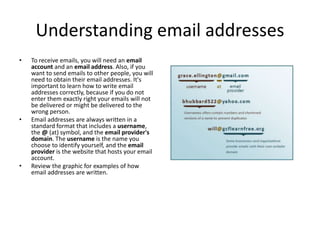
• Email addresses are always written in a
standard format that includes a username,
the @ (at) symbol, and the email provider's
domain. The username is the name you
choose to identify yourself, and the email
provider is the website that hosts your email
account.
• Review the graphic for examples of how
email addresses are written.
About email providers
• In the past, people usually received an email
account from the same companies that
provided their Internet access. For example, if
AOL provided your Internet connection, you'd
have an AOL email address. While this is still
true for some people, today it's increasingly
common to use a free web-based email
service, also known as webmail. Anyone can
use these services, no matter who provides
their Internet access.
Webmail Providers
• Today, the top three
webmail providers are
Yahoo!, Microsoft's
Outlook.com (previously
Hotmail), and Google's
Gmail. These providers are
popular because they allow
you to access your email
account from anywhere
with an Internet
connection. You can also
access webmail on your
mobile device @icloud.com
Email Basics
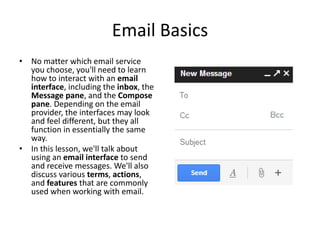
• No matter which email service
you choose, you'll need to learn
how to interact with an email
interface, including the inbox, the
Message pane, and the Compose
pane. Depending on the email
provider, the interfaces may look
and feel different, but they all
function in essentially the same
way.
• In this lesson, we'll talk about
using an email interface to send
and receive messages. We'll also
discuss various terms, actions,
and features that are commonly
used when working with email.
Inbox
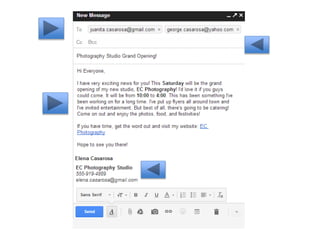
• The inbox is where
you'll view and manage
emails you receive.
Emails are listed with
the name of the sender,
the subject of the
message, and the date
received.
Message Pane
• When you select an
email in the inbox, it
will open in the
Message pane. From
here, you can read the
message and choose
how to respond with a
variety of commands.
Compose Pane
• You can click the Compose
or New button from your
inbox to open the Compose
pane to create your own
email message. From here,
you'll need to enter the
recipient's email address
and a subject. You'll also
have the option to upload
files (photos, documents,
etc.) as attachments and
add formatting to the
message.
To: Field and Recipients
• Whenever you send an email, you'll add
recipients to the To: field.
• Recipients are the people you are sending the
email to. You will need to type the email
address for each recipient.
• Most of the time, you'll add recipients to the
To: field but you can also add recipients to the
Cc: or Bcc: fields.
Cc & Bcc
• Cc stands for "carbon copy." This is used when
you want to send an email to someone who is not
the main recipient. This helps to keep that person
"in the loop" while letting them know that they
probably don't need to reply to your message.
• Bcc stands for "blind carbon copy." It works
almost the same way as Cc, except all of the
email address in the Bcc fields are hidden,
making it ideal when emailing a very large
number of recipients or when privacy is needed.
Body
• The body is the actual text of the email.
• Generally, you'll write this just like a normal
letter, with a greeting, one or more
paragraphs, and closing with your name.
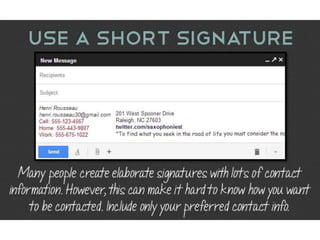
Signature
• You can choose to create a signature that will
appear at the end of every email you send.
• Signatures often include a name and contact
information, like a phone number, website, or
professional title.
Email
Email
Email
Email
Email
Email
Email
Email
Email

Email

  • 1.
    Email 101 Do youever feel like the only person who doesn't use email? You don't have to feel left out. More than ever, email is easy to understand and use. In this lesson, you will learn what email is, how it compares to traditional mail, and how email addresses are written. We'll also discuss various types of email providers and the features and tools they include with an email account.
  • 2.
    Getting to KnowEmail • You may know that email (electronic mail) is a way to send and receive messages across the Internet, but do you know how individual emails are sent, or what they cost, or how email compares to traditional "snail" mail? To get a better idea of what email is all about, review the following infographic and consider how you might benefit from its use.
  • 4.
    Understanding email addresses •To receive emails, you will need an email account and an email address. Also, if you want to send emails to other people, you will need to obtain their email addresses. It's important to learn how to write email addresses correctly, because if you do not enter them exactly right your emails will not be delivered or might be delivered to the wrong person. • Email addresses are always written in a standard format that includes a username, the @ (at) symbol, and the email provider's domain. The username is the name you choose to identify yourself, and the email provider is the website that hosts your email account. • Review the graphic for examples of how email addresses are written.
  • 5.
    About email providers •In the past, people usually received an email account from the same companies that provided their Internet access. For example, if AOL provided your Internet connection, you'd have an AOL email address. While this is still true for some people, today it's increasingly common to use a free web-based email service, also known as webmail. Anyone can use these services, no matter who provides their Internet access.
  • 6.
    Webmail Providers • Today,the top three webmail providers are Yahoo!, Microsoft's Outlook.com (previously Hotmail), and Google's Gmail. These providers are popular because they allow you to access your email account from anywhere with an Internet connection. You can also access webmail on your mobile device @icloud.com
  • 7.
    Email Basics • Nomatter which email service you choose, you'll need to learn how to interact with an email interface, including the inbox, the Message pane, and the Compose pane. Depending on the email provider, the interfaces may look and feel different, but they all function in essentially the same way. • In this lesson, we'll talk about using an email interface to send and receive messages. We'll also discuss various terms, actions, and features that are commonly used when working with email.
  • 8.
    Inbox • The inboxis where you'll view and manage emails you receive. Emails are listed with the name of the sender, the subject of the message, and the date received.
  • 9.
    Message Pane • Whenyou select an email in the inbox, it will open in the Message pane. From here, you can read the message and choose how to respond with a variety of commands.
  • 10.
    Compose Pane • Youcan click the Compose or New button from your inbox to open the Compose pane to create your own email message. From here, you'll need to enter the recipient's email address and a subject. You'll also have the option to upload files (photos, documents, etc.) as attachments and add formatting to the message.
  • 12.
    To: Field andRecipients • Whenever you send an email, you'll add recipients to the To: field. • Recipients are the people you are sending the email to. You will need to type the email address for each recipient. • Most of the time, you'll add recipients to the To: field but you can also add recipients to the Cc: or Bcc: fields.
  • 13.
    Cc & Bcc •Cc stands for "carbon copy." This is used when you want to send an email to someone who is not the main recipient. This helps to keep that person "in the loop" while letting them know that they probably don't need to reply to your message. • Bcc stands for "blind carbon copy." It works almost the same way as Cc, except all of the email address in the Bcc fields are hidden, making it ideal when emailing a very large number of recipients or when privacy is needed.
  • 14.
    Body • The bodyis the actual text of the email. • Generally, you'll write this just like a normal letter, with a greeting, one or more paragraphs, and closing with your name.
  • 15.
    Signature • You canchoose to create a signature that will appear at the end of every email you send. • Signatures often include a name and contact information, like a phone number, website, or professional title.