Email

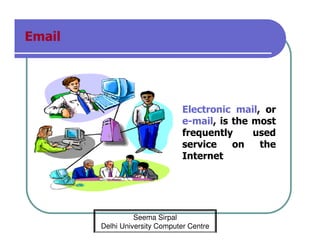
Electronic mail, or
e-mail, is the most
frequently
used
service
on
the
Internet

Seema Sirpal
Delhi University Computer Centre
Why use Email

You can send a message any time, any
where.
You can send the same message to several
people at the same time.
You can forward information to co-workers
without retyping it.
Why use Email

You can save time. E-mail is fast, usually
taking no more than a few minutes to be
received.
You can e-mail electronic documents and the
recipients can then edit and return revised
versions.
You can send messages around the world
as easily as to co-workers in the next office.
How Email works on the Internet
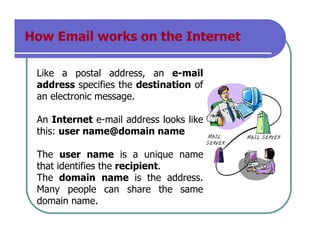
Like a postal address, an e-mail
address specifies the destination of
an electronic message.
An Internet e-mail address looks like
this: user name@domain name
The user name is a unique name
that identifies the recipient.
The domain name is the address.
Many people can share the same
domain name.
How Email works on the Internet

E-mail is sent and received through electronic "post
offices" known as mail servers.
To read your e-mail, you must retrieve it from the
mail server.
Once you enter the address of the recipient,
compose your message, and click Send, your e-mail
software handles the delivery.
How Reliable is Email
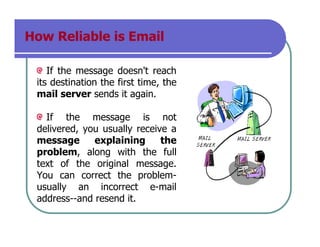
If the message doesn't reach
its destination the first time, the
mail server sends it again.
If the message is not
delivered, you usually receive a
message
explaining
the
problem, along with the full
text of the original message.
You can correct the problemusually an incorrect e-mail
address--and resend it.
Anatomy of an Email message
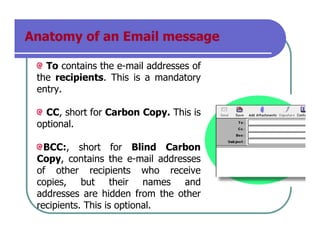
To contains the e-mail addresses of
the recipients. This is a mandatory
entry.
CC, short for Carbon Copy. This is
optional.
BCC:, short for Blind Carbon
Copy, contains the e-mail addresses
of other recipients who receive
copies, but their names and
addresses are hidden from the other
recipients. This is optional.
Anatomy of an Email message
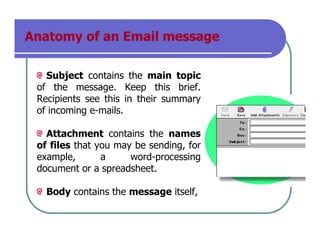
Subject contains the main topic
of the message. Keep this brief.
Recipients see this in their summary
of incoming e-mails.
Attachment contains the names
of files that you may be sending, for
example,
a
word-processing
document or a spreadsheet.
Body contains the message itself,
Signatures
E-mail can include a signature at the
end of the message. An e-mail signature
is not your hand-written signature.
Like a business card, an e-mail signature
can include your name, title, telephone and
fax numbers, street address, and e-mail
address.
It saves time, you don’t have to retype
the information each time you send a
message. Clicking the feature automatically
adds it to the message.
Reading Email messages
Messages are organized in folders
or boxes. Received mail is kept in an
Inbox; outgoing mail is stored in an
Outbox; sent mail is filed in a Sent
box.
To read an e-mail, double-click on
the envelope icon or the Subject
line of the message. This opens a new
window containing the header and
body of the message.
Replying to Email messages
The window with the e-mail you are
reading has a Reply or Re button. Click on
this button to open a new window. The To
and Subject lines are automatically filled
in with the e-mail address of the sender
and the subject of the message.
the text of the original e-mail appears in
the body of the reply, usually marked in a
different font or color, or with a special
character, such as the greater than sign
(>) at the beginning of each line.
Sending files as attachment
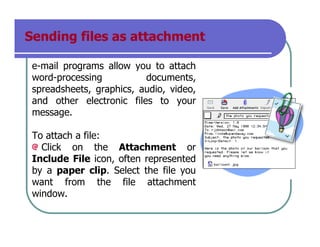
e-mail programs allow you to attach
word-processing
documents,
spreadsheets, graphics, audio, video,
and other electronic files to your
message.
To attach a file:
Click on the Attachment or
Include File icon, often represented
by a paper clip. Select the file you
want from the file attachment
window.
Opening attachment

Open or save an attached file by
double-clicking on the icon
for the file.

Caution: Your computer can contract a virus when you open an
attached file. If you do not know or trust the person who sent the
e-mail, delete the attachment to avoid infection
Managing your Messages
You may create folders so you can
file your messages.
You can drag a message from the
Inbox or Sent Mail box to another
folder.
When you delete a message, it is
moved to your Trash or Deleted
Mail folder. The message still exists,
however. You may want to delete all
the files from the Trash periodically.
Managing your Addresses
E-mail programs have an address
book feature where you can record
the e-mail addresses and other
information of people you contact
frequently.
By using the address book, you
won't have to retype an e-mail
address each time you want to send a
message. This saves time and
avoids returned mail due to typing
mistakes.
Managing your Addresses
• With most software, you can create
a set of e-mail addresses called a
group. When you address a message
with a group, the message is
automatically addressed to all the
people in the group. This is
sometimes referred to as a mailing
list.
•As your list grows, use the Search
or Find function in the address book
to locate an e-mail address based on
a person's first or last name.

Another one on Email...

  • 1.
    Email Electronic mail, or e-mail,is the most frequently used service on the Internet Seema Sirpal Delhi University Computer Centre
  • 2.
    Why use Email Youcan send a message any time, any where. You can send the same message to several people at the same time. You can forward information to co-workers without retyping it.
  • 3.
    Why use Email Youcan save time. E-mail is fast, usually taking no more than a few minutes to be received. You can e-mail electronic documents and the recipients can then edit and return revised versions. You can send messages around the world as easily as to co-workers in the next office.
  • 4.
    How Email workson the Internet Like a postal address, an e-mail address specifies the destination of an electronic message. An Internet e-mail address looks like this: user name@domain name The user name is a unique name that identifies the recipient. The domain name is the address. Many people can share the same domain name.
  • 5.
    How Email workson the Internet E-mail is sent and received through electronic "post offices" known as mail servers. To read your e-mail, you must retrieve it from the mail server. Once you enter the address of the recipient, compose your message, and click Send, your e-mail software handles the delivery.
  • 6.
    How Reliable isEmail If the message doesn't reach its destination the first time, the mail server sends it again. If the message is not delivered, you usually receive a message explaining the problem, along with the full text of the original message. You can correct the problemusually an incorrect e-mail address--and resend it.
  • 7.
    Anatomy of anEmail message To contains the e-mail addresses of the recipients. This is a mandatory entry. CC, short for Carbon Copy. This is optional. BCC:, short for Blind Carbon Copy, contains the e-mail addresses of other recipients who receive copies, but their names and addresses are hidden from the other recipients. This is optional.
  • 8.
    Anatomy of anEmail message Subject contains the main topic of the message. Keep this brief. Recipients see this in their summary of incoming e-mails. Attachment contains the names of files that you may be sending, for example, a word-processing document or a spreadsheet. Body contains the message itself,
  • 9.
    Signatures E-mail can includea signature at the end of the message. An e-mail signature is not your hand-written signature. Like a business card, an e-mail signature can include your name, title, telephone and fax numbers, street address, and e-mail address. It saves time, you don’t have to retype the information each time you send a message. Clicking the feature automatically adds it to the message.
  • 10.
    Reading Email messages Messagesare organized in folders or boxes. Received mail is kept in an Inbox; outgoing mail is stored in an Outbox; sent mail is filed in a Sent box. To read an e-mail, double-click on the envelope icon or the Subject line of the message. This opens a new window containing the header and body of the message.
  • 11.
    Replying to Emailmessages The window with the e-mail you are reading has a Reply or Re button. Click on this button to open a new window. The To and Subject lines are automatically filled in with the e-mail address of the sender and the subject of the message. the text of the original e-mail appears in the body of the reply, usually marked in a different font or color, or with a special character, such as the greater than sign (>) at the beginning of each line.
  • 12.
    Sending files asattachment e-mail programs allow you to attach word-processing documents, spreadsheets, graphics, audio, video, and other electronic files to your message. To attach a file: Click on the Attachment or Include File icon, often represented by a paper clip. Select the file you want from the file attachment window.
  • 13.
    Opening attachment Open orsave an attached file by double-clicking on the icon for the file. Caution: Your computer can contract a virus when you open an attached file. If you do not know or trust the person who sent the e-mail, delete the attachment to avoid infection
  • 14.
    Managing your Messages Youmay create folders so you can file your messages. You can drag a message from the Inbox or Sent Mail box to another folder. When you delete a message, it is moved to your Trash or Deleted Mail folder. The message still exists, however. You may want to delete all the files from the Trash periodically.
  • 15.
    Managing your Addresses E-mailprograms have an address book feature where you can record the e-mail addresses and other information of people you contact frequently. By using the address book, you won't have to retype an e-mail address each time you want to send a message. This saves time and avoids returned mail due to typing mistakes.
  • 16.
    Managing your Addresses •With most software, you can create a set of e-mail addresses called a group. When you address a message with a group, the message is automatically addressed to all the people in the group. This is sometimes referred to as a mailing list. •As your list grows, use the Search or Find function in the address book to locate an e-mail address based on a person's first or last name.