RIMSHA FAROOQ (BBS153009)
Course Instructor : DR. SHAUKAT IQBAL
Contents
• Definition
• History
• Origin of blood vessels
• Types of angiogenesis
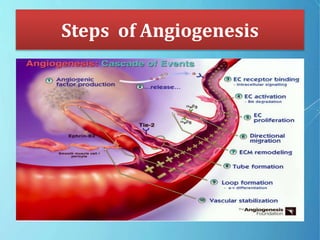
• Steps in angiogenesis
• Application in medicine
• Angiogenesis inhibitor work
• Ongoing research on angiogenesis
• References
Definition
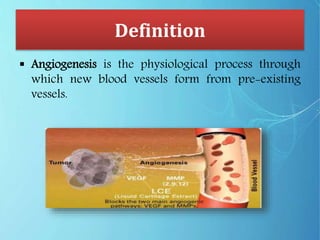
 Angiogenesis is the physiological process through
which new blood vessels form from pre-existing
vessels.
History
 Scottish anatomist and surgeon John Hunter
 The modern history of angiogenesis began with the
work of Judah Folkman, who hypothesized (and
published in 1971) that tumor growth is
angiogenesis-dependent.
Origin of Blood Vessels
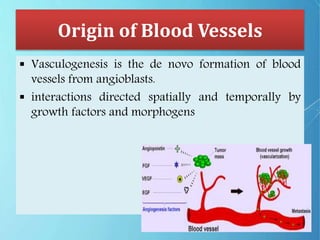
 Vasculogenesis is the de novo formation of blood
vessels from angioblasts.
 interactions directed spatially and temporally by
growth factors and morphogens
Types of Angiogenesis
 Sprouting Angiogenesis
 Intussusceptive Angiogenesis
Sprouting Angiogenesis
 Sprouting angiogenesis is initiated in poorly
perfused tissues when oxygen sensing mechanisms
detect a level of hypoxia that demands the formation
of new blood vessels to satisfy the metabolic
requirements of parenchymal cells.
Intussusceptive Angiogenesis
• Intussusceptive angiogenesis is also called
splitting angiogenesis because the vessel wall
extends into the lumen causing a single vessel to
split in two.
Steps of Angiogenesis
Application in Medicine
• Angiogenesis as a therapeutic target
• Tumor angiogenesis
• Formation of tumor blood vessels
Angiogenesis as a Therapeutic Target
• Angiogenesis may be a target for combating diseases
characterized by either poor vascularization or
abnormal vasculature
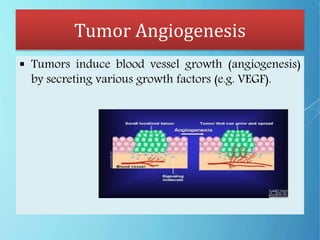
Tumor Angiogenesis
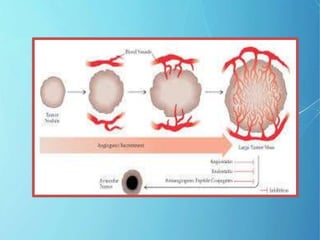
 Tumors induce blood vessel growth (angiogenesis)
by secreting various growth factors (e.g. VEGF).
Formation of Tumor Blood Vessels
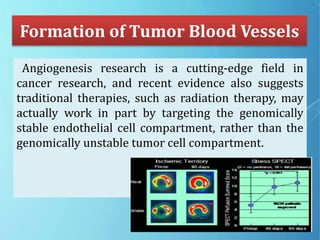
Angiogenesis research is a cutting-edge field in
cancer research, and recent evidence also suggests
traditional therapies, such as radiation therapy, may
actually work in part by targeting the genomically
stable endothelial cell compartment, rather than the
genomically unstable tumor cell compartment.
Angiogenesis Importance in
Cancer
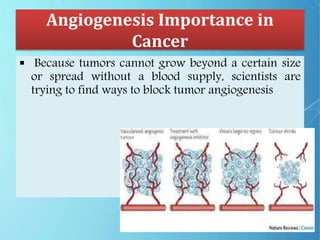
 Because tumors cannot grow beyond a certain size
or spread without a blood supply, scientists are
trying to find ways to block tumor angiogenesis
Angiogenesis Inhibitors Work
 Angiogenesis inhibitors interfere with various steps
in this process. For example, bevacizumab is a
monoclonal antibody that specifically recognizes
and binds to VEGF. When VEGF is attached to
bevacizumab, it is unable to activate the VEGF
receptor
Ongoing Research on
Angiogenesis Inhibitors
 If the angiogenesis inhibitors prove to be both safe
and effective in treating human cancer, they may be
approved by the FDA and made available for
widespread use.
References
• Retrieved from: https://www.cancer.gov/about-
cancer/treatment/types/immunotherapy/angiogenesis-inhibitors-
fact-sheet
• Retrieved from: http://www.angioworld.com/angiogenesis.htm
• Retrieved from: www.cancer.gov/.../ANGIOGEN.PDF
• Retrieved from: https://www.news-medical.net/health/What-is-
Angiogenesis.aspx
• Retrieved from: http://www.cancer.net/navigating-cancer-
care/how-cancer-treated/personalized-and-targeted-
therapies/angiogenesis-and-angiogenesis-inhibitors-treat-cancer
• Retrieved from: https://www.ncbi.nlm.nih.gov/books/NBK53238/
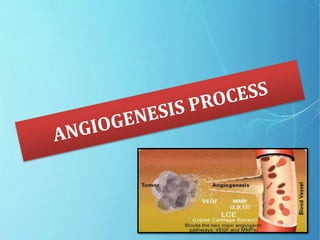
Angiogenesis

Angiogenesis

  • 2.
    RIMSHA FAROOQ (BBS153009) CourseInstructor : DR. SHAUKAT IQBAL
  • 4.
    Contents • Definition • History •Origin of blood vessels • Types of angiogenesis • Steps in angiogenesis • Application in medicine • Angiogenesis inhibitor work • Ongoing research on angiogenesis • References
  • 5.
    Definition  Angiogenesis isthe physiological process through which new blood vessels form from pre-existing vessels.
  • 6.
    History  Scottish anatomistand surgeon John Hunter  The modern history of angiogenesis began with the work of Judah Folkman, who hypothesized (and published in 1971) that tumor growth is angiogenesis-dependent.
  • 7.
    Origin of BloodVessels  Vasculogenesis is the de novo formation of blood vessels from angioblasts.  interactions directed spatially and temporally by growth factors and morphogens
  • 8.
    Types of Angiogenesis Sprouting Angiogenesis  Intussusceptive Angiogenesis
  • 9.
    Sprouting Angiogenesis  Sproutingangiogenesis is initiated in poorly perfused tissues when oxygen sensing mechanisms detect a level of hypoxia that demands the formation of new blood vessels to satisfy the metabolic requirements of parenchymal cells.
  • 10.
    Intussusceptive Angiogenesis • Intussusceptiveangiogenesis is also called splitting angiogenesis because the vessel wall extends into the lumen causing a single vessel to split in two.
  • 11.
  • 12.
    Application in Medicine •Angiogenesis as a therapeutic target • Tumor angiogenesis • Formation of tumor blood vessels
  • 13.
    Angiogenesis as aTherapeutic Target • Angiogenesis may be a target for combating diseases characterized by either poor vascularization or abnormal vasculature
  • 14.
    Tumor Angiogenesis  Tumorsinduce blood vessel growth (angiogenesis) by secreting various growth factors (e.g. VEGF).
  • 15.
    Formation of TumorBlood Vessels Angiogenesis research is a cutting-edge field in cancer research, and recent evidence also suggests traditional therapies, such as radiation therapy, may actually work in part by targeting the genomically stable endothelial cell compartment, rather than the genomically unstable tumor cell compartment.
  • 16.
    Angiogenesis Importance in Cancer Because tumors cannot grow beyond a certain size or spread without a blood supply, scientists are trying to find ways to block tumor angiogenesis
  • 18.
    Angiogenesis Inhibitors Work Angiogenesis inhibitors interfere with various steps in this process. For example, bevacizumab is a monoclonal antibody that specifically recognizes and binds to VEGF. When VEGF is attached to bevacizumab, it is unable to activate the VEGF receptor
  • 19.
    Ongoing Research on AngiogenesisInhibitors  If the angiogenesis inhibitors prove to be both safe and effective in treating human cancer, they may be approved by the FDA and made available for widespread use.
  • 20.
    References • Retrieved from:https://www.cancer.gov/about- cancer/treatment/types/immunotherapy/angiogenesis-inhibitors- fact-sheet • Retrieved from: http://www.angioworld.com/angiogenesis.htm • Retrieved from: www.cancer.gov/.../ANGIOGEN.PDF • Retrieved from: https://www.news-medical.net/health/What-is- Angiogenesis.aspx • Retrieved from: http://www.cancer.net/navigating-cancer- care/how-cancer-treated/personalized-and-targeted- therapies/angiogenesis-and-angiogenesis-inhibitors-treat-cancer • Retrieved from: https://www.ncbi.nlm.nih.gov/books/NBK53238/