ELEMENTS VITAL IN
CURRICULUM DEVELOPMENT
 Foundations of the Curriculum
 Imperative needs of the Learners
 Analysis of Education Outputs
 Rationale for Curriculum Development
Jerralyn Cortez-Alva
CPE
20 December 2015
Our Lady of Fatima University
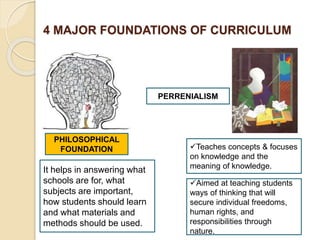
4 MAJOR FOUNDATIONS OF CURRICULUM
PHILOSOPHICAL
FOUNDATION
It helps in answering what
schools are for, what
subjects are important,
how students should learn
and what materials and
methods should be used.
PERRENIALISM
Teaches concepts & focuses
on knowledge and the
meaning of knowledge.
Aimed at teaching students
ways of thinking that will
secure individual freedoms,
human rights, and
responsibilities through
nature.
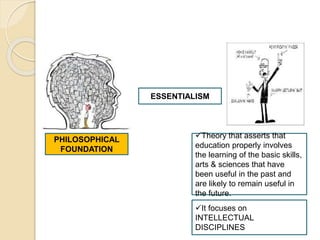
PHILOSOPHICAL
FOUNDATION
ESSENTIALISM
Theory that asserts that
education properly involves
the learning of the basic skills,
arts & sciences that have
been useful in the past and
are likely to remain useful in
the future.
It focuses on
INTELLECTUAL
DISCIPLINES
PHILOSOPHICAL
FOUNDATION
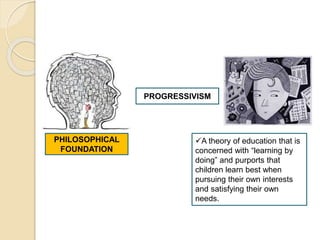
PROGRESSIVISM
A theory of education that is
concerned with “learning by
doing” and purports that
children learn best when
pursuing their own interests
and satisfying their own
needs.
PHILOSOPHICAL
FOUNDATION
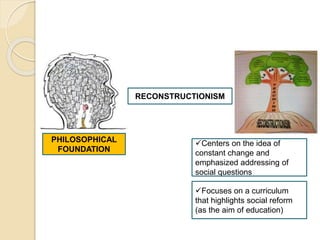
RECONSTRUCTIONISM
Centers on the idea of
constant change and
emphasized addressing of
social questions
Focuses on a curriculum
that highlights social reform
(as the aim of education)
4 MAJOR FOUNDATIONS OF CURRICULUM
HISTORICAL
FOUNDATION
The historical development
shows the different
changes in the purposes,
principles and content of
the curriculum
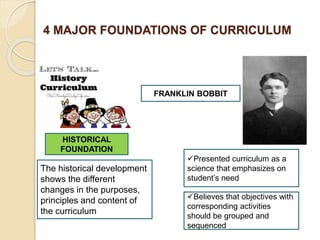
FRANKLIN BOBBIT
Presented curriculum as a
science that emphasizes on
student’s need
Believes that objectives with
corresponding activities
should be grouped and
sequenced
HISTORICAL
FOUNDATION
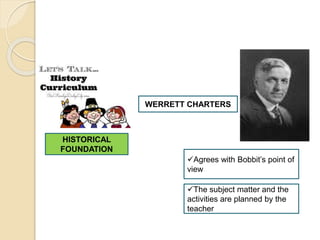
WERRETT CHARTERS
Agrees with Bobbit’s point of
view
The subject matter and the
activities are planned by the
teacher
HISTORICAL
FOUNDATION
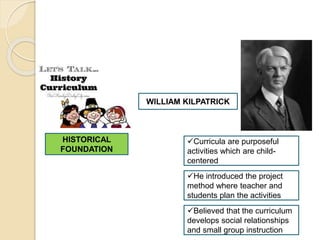
WILLIAM KILPATRICK
Curricula are purposeful
activities which are child-
centered
He introduced the project
method where teacher and
students plan the activities
Believed that the curriculum
develops social relationships
and small group instruction
HISTORICAL
FOUNDATION
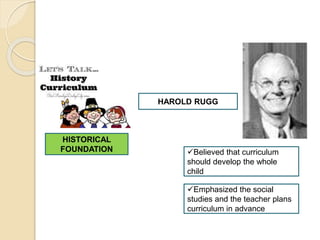
HAROLD RUGG
Believed that curriculum
should develop the whole
child
Emphasized the social
studies and the teacher plans
curriculum in advance
HISTORICAL
FOUNDATION
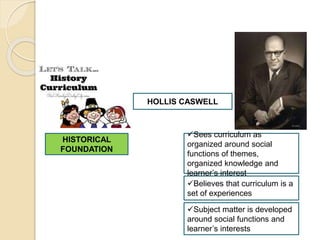
HOLLIS CASWELL
Sees curriculum as
organized around social
functions of themes,
organized knowledge and
learner’s interest
Believes that curriculum is a
set of experiences
Subject matter is developed
around social functions and
learner’s interests
HISTORICAL
FOUNDATION
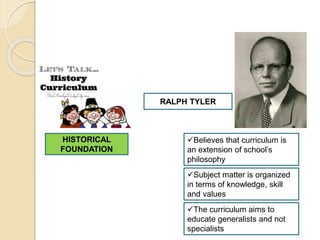
RALPH TYLER
Believes that curriculum is
an extension of school’s
philosophy
Subject matter is organized
in terms of knowledge, skill
and values
The curriculum aims to
educate generalists and not
specialists
4 MAJOR FOUNDATIONS OF CURRICULUM
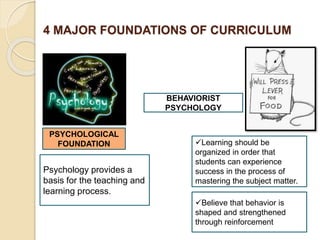
PSYCHOLOGICAL
FOUNDATION
Psychology provides a
basis for the teaching and
learning process.
BEHAVIORIST
PSYCHOLOGY
Learning should be
organized in order that
students can experience
success in the process of
mastering the subject matter.
Believe that behavior is
shaped and strengthened
through reinforcement
PSYCHOLOGICAL
FOUNDATION
COGNITIVE
PSYCHOLOGY
Learning constitutes a
logical method for organizing
and interpreting learning.
Learning is an internal brain
process
PSYCHOLOGICAL
FOUNDATION
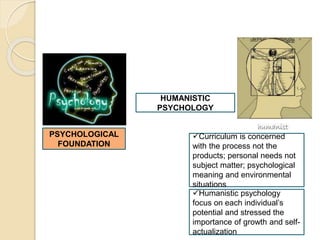
HUMANISTIC
PSYCHOLOGY
Curriculum is concerned
with the process not the
products; personal needs not
subject matter; psychological
meaning and environmental
situations
Humanistic psychology
focus on each individual’s
potential and stressed the
importance of growth and self-
actualization
4 MAJOR FOUNDATIONS OF CURRICULUM
SOCIAL
FOUNDATION
Societal culture affects
and shapes the schools
and their curricula.
Schools are not the only institution
that educate the society
School curricula should address
diversity, explosion of knowledge,
school reforms and education for all
Curricula should preserve the
culture of the society and its
aspirations
Society should also imbibe the
changes brought about by the
formal institutions called schools
Elements vital in curriculum development jerralyn alva

Elements vital in curriculum development jerralyn alva

  • 1.
    ELEMENTS VITAL IN CURRICULUMDEVELOPMENT  Foundations of the Curriculum  Imperative needs of the Learners  Analysis of Education Outputs  Rationale for Curriculum Development Jerralyn Cortez-Alva CPE 20 December 2015 Our Lady of Fatima University
  • 2.
    4 MAJOR FOUNDATIONSOF CURRICULUM PHILOSOPHICAL FOUNDATION It helps in answering what schools are for, what subjects are important, how students should learn and what materials and methods should be used. PERRENIALISM Teaches concepts & focuses on knowledge and the meaning of knowledge. Aimed at teaching students ways of thinking that will secure individual freedoms, human rights, and responsibilities through nature.
  • 3.
    PHILOSOPHICAL FOUNDATION ESSENTIALISM Theory that assertsthat education properly involves the learning of the basic skills, arts & sciences that have been useful in the past and are likely to remain useful in the future. It focuses on INTELLECTUAL DISCIPLINES
  • 4.
    PHILOSOPHICAL FOUNDATION PROGRESSIVISM A theory ofeducation that is concerned with “learning by doing” and purports that children learn best when pursuing their own interests and satisfying their own needs.
  • 5.
    PHILOSOPHICAL FOUNDATION RECONSTRUCTIONISM Centers on theidea of constant change and emphasized addressing of social questions Focuses on a curriculum that highlights social reform (as the aim of education)
  • 6.
    4 MAJOR FOUNDATIONSOF CURRICULUM HISTORICAL FOUNDATION The historical development shows the different changes in the purposes, principles and content of the curriculum FRANKLIN BOBBIT Presented curriculum as a science that emphasizes on student’s need Believes that objectives with corresponding activities should be grouped and sequenced
  • 7.
    HISTORICAL FOUNDATION WERRETT CHARTERS Agrees withBobbit’s point of view The subject matter and the activities are planned by the teacher
  • 8.
    HISTORICAL FOUNDATION WILLIAM KILPATRICK Curricula arepurposeful activities which are child- centered He introduced the project method where teacher and students plan the activities Believed that the curriculum develops social relationships and small group instruction
  • 9.
    HISTORICAL FOUNDATION HAROLD RUGG Believed thatcurriculum should develop the whole child Emphasized the social studies and the teacher plans curriculum in advance
  • 10.
    HISTORICAL FOUNDATION HOLLIS CASWELL Sees curriculumas organized around social functions of themes, organized knowledge and learner’s interest Believes that curriculum is a set of experiences Subject matter is developed around social functions and learner’s interests
  • 11.
    HISTORICAL FOUNDATION RALPH TYLER Believes thatcurriculum is an extension of school’s philosophy Subject matter is organized in terms of knowledge, skill and values The curriculum aims to educate generalists and not specialists
  • 12.
    4 MAJOR FOUNDATIONSOF CURRICULUM PSYCHOLOGICAL FOUNDATION Psychology provides a basis for the teaching and learning process. BEHAVIORIST PSYCHOLOGY Learning should be organized in order that students can experience success in the process of mastering the subject matter. Believe that behavior is shaped and strengthened through reinforcement
  • 13.
    PSYCHOLOGICAL FOUNDATION COGNITIVE PSYCHOLOGY Learning constitutes a logicalmethod for organizing and interpreting learning. Learning is an internal brain process
  • 14.
    PSYCHOLOGICAL FOUNDATION HUMANISTIC PSYCHOLOGY Curriculum is concerned withthe process not the products; personal needs not subject matter; psychological meaning and environmental situations Humanistic psychology focus on each individual’s potential and stressed the importance of growth and self- actualization
  • 15.
    4 MAJOR FOUNDATIONSOF CURRICULUM SOCIAL FOUNDATION Societal culture affects and shapes the schools and their curricula. Schools are not the only institution that educate the society School curricula should address diversity, explosion of knowledge, school reforms and education for all Curricula should preserve the culture of the society and its aspirations Society should also imbibe the changes brought about by the formal institutions called schools