Curriculum Approaches in Language
Teaching: Forward, Central, and
Backward Design
Jack C. Richards
 The term curriculum is used here to refer to the overall plan
or design for a course and how the content for a course is
transformed into a blueprint for teaching and learning which
enables the desired learning outcomes to be achieved.
INPUT / OUTPUT
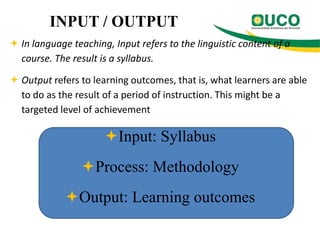
 In language teaching, Input refers to the linguistic content of a
course. The result is a syllabus.
 Output refers to learning outcomes, that is, what learners are able
to do as the result of a period of instruction. This might be a
targeted level of achievement

Input: Syllabus

Process: Methodology
Output: Learning outcomes
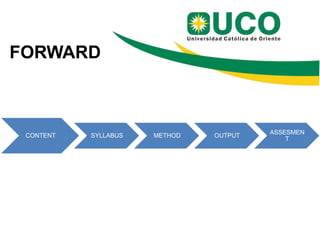
FORWARD DESIGN:
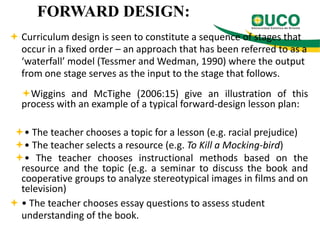
 Curriculum design is seen to constitute a sequence of stages that
occur in a fixed order – an approach that has been referred to as a
‘waterfall’ model (Tessmer and Wedman, 1990) where the output
from one stage serves as the input to the stage that follows.
Wiggins and McTighe (2006:15) give an illustration of this
process with an example of a typical forward-design lesson plan:

• The teacher chooses a topic for a lesson (e.g. racial prejudice)
• The teacher selects a resource (e.g. To Kill a Mocking-bird)
• The teacher chooses instructional methods based on the
resource and the topic (e.g. a seminar to discuss the book and
cooperative groups to analyze stereotypical images in films and on
television)
 • The teacher chooses essay questions to assess student
understanding of the book.
FORWARD

CONTENT

SYLLABUS

METHOD

OUTPUT

ASSESMEN
T
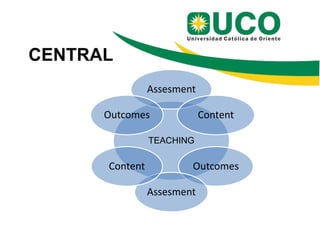
CENTRAL DESIGN:
 curriculum development starts with the selection of teaching
activities, techniques and methods rather than with the elaboration
of a detailed language syllabus or specification of learning
outcomes.
Clark’s description of the features of ‘progressivism’ captures the
essence of central design:
• It places less emphasis on syllabus specification and more on
methodological principles and procedures.
• It is more concerned with learning processes than predetermined
objectives.
• It emphasizes methodology and the need for principles to guide the
teaching learning process.
• It is learner-centered and seeks to provide learning experiences
that enable learn-ers to learn by their own efforts.
• It regards learners as active participants in shaping their own
learning.
CENTRAL
Assesment
Outcomes

Content

TEACHING

Content

Outcomes
Assesment
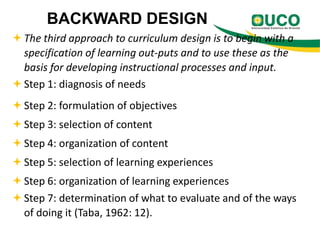
BACKWARD DESIGN
 The third approach to curriculum design is to begin with a
specification of learning out-puts and to use these as the
basis for developing instructional processes and input.
 Step 1: diagnosis of needs
 Step 2: formulation of objectives

 Step 3: selection of content
 Step 4: organization of content
 Step 5: selection of learning experiences

 Step 6: organization of learning experiences
 Step 7: determination of what to evaluate and of the ways
of doing it (Taba, 1962: 12).
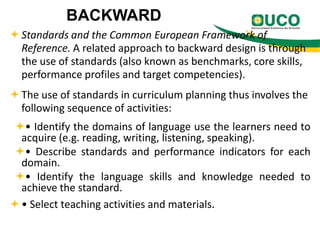
BACKWARD
 Standards and the Common European Framework of
Reference. A related approach to backward design is through
the use of standards (also known as benchmarks, core skills,
performance profiles and target competencies).
 The use of standards in curriculum planning thus involves the
following sequence of activities:
• Identify the domains of language use the learners need to
acquire (e.g. reading, writing, listening, speaking).
• Describe standards and performance indicators for each
domain.
• Identify the language skills and knowledge needed to
achieve the standard.
 • Select teaching activities and materials.
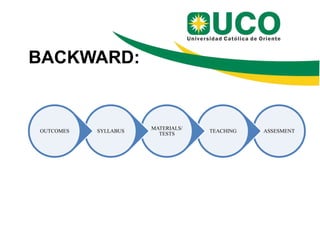
BACKWARD:

OUTCOMES

SYLLABUS

MATERIALS/
TESTS

TEACHING

ASSESMENT

November 8 class

  • 1.
    Curriculum Approaches inLanguage Teaching: Forward, Central, and Backward Design Jack C. Richards  The term curriculum is used here to refer to the overall plan or design for a course and how the content for a course is transformed into a blueprint for teaching and learning which enables the desired learning outcomes to be achieved.
  • 2.
    INPUT / OUTPUT In language teaching, Input refers to the linguistic content of a course. The result is a syllabus.  Output refers to learning outcomes, that is, what learners are able to do as the result of a period of instruction. This might be a targeted level of achievement Input: Syllabus Process: Methodology Output: Learning outcomes
  • 3.
    FORWARD DESIGN:  Curriculumdesign is seen to constitute a sequence of stages that occur in a fixed order – an approach that has been referred to as a ‘waterfall’ model (Tessmer and Wedman, 1990) where the output from one stage serves as the input to the stage that follows. Wiggins and McTighe (2006:15) give an illustration of this process with an example of a typical forward-design lesson plan: • The teacher chooses a topic for a lesson (e.g. racial prejudice) • The teacher selects a resource (e.g. To Kill a Mocking-bird) • The teacher chooses instructional methods based on the resource and the topic (e.g. a seminar to discuss the book and cooperative groups to analyze stereotypical images in films and on television)  • The teacher chooses essay questions to assess student understanding of the book.
  • 4.
  • 5.
    CENTRAL DESIGN:  curriculumdevelopment starts with the selection of teaching activities, techniques and methods rather than with the elaboration of a detailed language syllabus or specification of learning outcomes. Clark’s description of the features of ‘progressivism’ captures the essence of central design: • It places less emphasis on syllabus specification and more on methodological principles and procedures. • It is more concerned with learning processes than predetermined objectives. • It emphasizes methodology and the need for principles to guide the teaching learning process. • It is learner-centered and seeks to provide learning experiences that enable learn-ers to learn by their own efforts. • It regards learners as active participants in shaping their own learning.
  • 6.
  • 7.
    BACKWARD DESIGN  Thethird approach to curriculum design is to begin with a specification of learning out-puts and to use these as the basis for developing instructional processes and input.  Step 1: diagnosis of needs  Step 2: formulation of objectives  Step 3: selection of content  Step 4: organization of content  Step 5: selection of learning experiences  Step 6: organization of learning experiences  Step 7: determination of what to evaluate and of the ways of doing it (Taba, 1962: 12).
  • 8.
    BACKWARD  Standards andthe Common European Framework of Reference. A related approach to backward design is through the use of standards (also known as benchmarks, core skills, performance profiles and target competencies).  The use of standards in curriculum planning thus involves the following sequence of activities: • Identify the domains of language use the learners need to acquire (e.g. reading, writing, listening, speaking). • Describe standards and performance indicators for each domain. • Identify the language skills and knowledge needed to achieve the standard.  • Select teaching activities and materials.
  • 9.