Electronics Industry Brief
September 2002
© 2002 IBM Corporation Electronics Industry Brief
Executive Summary
Definition
There are subsegments of electrical and electronic manufacturing companies that provide a variety of
products and services:
w Microelectronics
w Technology Systems
w Telecommunication Systems
w Hi-Tech Equipment
w Electrical
w Consumer Electronics
w Home Appliances
w Industrial Equipment
w Energy Equipment and Machinery
w Contract Electronic Manufacturing
Industry Description
The electric and electronics manufacturing industries have several business drivers that need to be
considered:
w Customer demand for choices is increasing. Electronics manufacturers must shift to a
consumer-driven model.
w Mergers and acquisitions are increasing to address diverse markets and reduce costs.
w Divestitures are on the rise. Many companies are selling portions of their business to focus on
core competencies.
w Global supply chains are commonplace in the industry. This has increased the scope of
competition and emphasized focus on reducing production costs and increase efficiencies.
w Time to market is imperative to electronics manufacturers. The commercialization of research
and outsourcing of pieces of the production are increasing manufacturing efficiencies for electric
and electronic industries.
Industry Trends
The electronics industry has seen similar trends in the Americas, Europe/Middle East/Africa and Asia
Pacific :
w The largest growth region in the world is the Americas region. The industry in North America is $11.9
billion in 1998, growing to $16.3 billion in 2001 (11.1% CGR). Deregulation is complete. $21.5B is the IT
opportunity for 2002.
w Europe is a diverse market with diverse issues causing variation in pricing, warranty, and language
issues. The industry in Europe is $8.7 billion in 1998, growing to $10.9 billion in 2001 (7.8% CGR).
There has also been market consolidation around large players. Deregulation has been completed in
Europe, increasing competition.
© 2002 IBM Corporation Electronics Industry Brief
1
1
w Similar to Europe, Asia Pacific is composed of a diverse market causing pricing, warranty, and
language issues. The industry is $7.8 billion in 1998, growing to $9.4 billion in 2001 (6.4% CGR). Asia
has also seen market consolidation around large players.
Solutions
Electronics manufacturers need to leverage technology to provide better service to their customers.
w e-business solutions integrate knowledge across the supply chain. Easy access to information
on customers, products and trends can be a competitive advantage by offering better customer
service, accurate product data and up to date forecasts.
w e-Procurement solutions provide electronics companies with access to parts catalogs and to
place orders at anytime with contracted distributors. With the information collected from these
systems, companies can provide the value-added services of manufacturer negotiation, rebate
management, inventory planning and reporting. Purchasing volume can be leveraged and more
emphasis can be placed on product negotiation and selection.
w Product Lifecycle Management (PLM): end to end services from strategy to integration which
enables manufacturers to consider the entire lifecycle of product during design phase, and allows
for planning of post sale maintenance and telematics enabled problem diagnosis all of which
increase after sales revenue.
w Warehouse Management Systems are software packages that help distributors optimize their
use of warehouse space and warehouse labor. In addition, warehouse systems dramatically
reduce mispicks.
w Wireless computing is evolving in the electric and electronics industry. Radio Frequency (RF)
systems and UPC barcoding allow for non-contact reading and are effective in manufacturing.
w Contract Outsourcing is slated to grow from 23% today to 40% by 2004 in the electronics
industry according to IBM. Companies are interested in creating efficiencies in their processes,
and outsourcing processes where they lack expertise.
© 2002 IBM Corporation Electronics Industry Brief
2
2
Key Themes in Electronics and Electrical Manufacturing
w Customer service is evolving to a new level of responsiveness. Manufacturers need to react
quickly to customers’ wants and needs. A sales force in the field needs to have quick and easy
access to ordering data and inventory levels via wireless hand-helds. At the warehouse, these
devices can be used to supplement Warehouse Management Systems’ inventory functions and
picking capabilities.
w Time to market is extremely important to electronics manufacturers. Better management of the
engineering and supply chains assure less time for product development and reduced costs.
w A global supply chain is necessary to remain competitive. Through mergers and acquisitions,
competition has no borders. Creating efficiencies in the supply chain is critical to an electronic or
electronics manufacturer’s success.
w Use of design resources to effectively minimize redundancy and maximize productivity and
collaboration with business partners to resolve design issues quickly improves the product life
cycle.
w In order to reduce operation costs, electronic and electrical manufacturers are looking to
optimize warehouse operations. Installing a Warehouse Management System (WMS) would
reduce mispicks and improve warehouse operations through space and labor efficiencies.
w Outsourcing pieces of the manufacturing process increases efficiencies and reduces costs.
© 2002 IBM Corporation Electronics Industry Brief
3
3
TABLE OF CONTENTS
6912.0 Acknowledgements . . . . . . . . . . . . . . . . . . . . . . . . . . . . . . . . . . . . . . . . . . . . . . . . .
6811.0 Associations and Organizations . . . . . . . . . . . . . . . . . . . . . . . . . . . . . . . .
6710.0 White Papers for Review . . . . . . . . . . . . . . . . . . . . . . . . . . . . . . . . . . . . . . . . . .
569.0 Vendors . . . . . . . . . . . . . . . . . . . . . . . . . . . . . . . . . . . . . . . . . . . . . . . . . . . . . . . . . . . . . . . . . . .
518.0 Recent Initiatives . . . . . . . . . . . . . . . . . . . . . . . . . . . . . . . . . . . . . . . . . . . . . . . . . . . . . . .
7.0 IT Spending . . . . . . . . . . . . . . . . . . . . . . . . . . . . . . . . . . . . . . . . . . . . . . . . . . . . . . . . . . . . . . . . .
366.0 e-business in Electronics . . . . . . . . . . . . . . . . . . . . . . . . . . . . . . . . . . . . . . . . . . .
275.0 Business Drivers . . . . . . . . . . . . . . . . . . . . . . . . . . . . . . . . . . . . . . . . . . . . . . . . . . . . . . .
264.0 Suppliers . . . . . . . . . . . . . . . . . . . . . . . . . . . . . . . . . . . . . . . . . . . . . . . . . . . . . . . . . . . . . . . . . .
253.0 Customers . . . . . . . . . . . . . . . . . . . . . . . . . . . . . . . . . . . . . . . . . . . . . . . . . . . . . . . . . . . . . . .
202.0 Electronics Manufacturers . . . . . . . . . . . . . . . . . . . . . . . . . . . . . . . . . . . . . . . . .
61.0 An Introduction to Electronics . . . . . . . . . . . . . . . . . . . . . . . . . . . . . . . . . . . . .
4Key Themes in Electronics . . . . . . . . . . . . . . . . . . . . . . . . . . . . . . . . . . . . . . . . . . . . . . .
2Executive Summary . . . . . . . . . . . . . . . . . . . . . . . . . . . . . . . . . . . . . . . . . . . . . . . . . . . . . . . . .
© 2002 IBM Corporation Electronics Industry Brief
4
4
1.0 An Introduction to Electronics Manufacturing
1.1 Value Statement for Electronics Manufacturing
Bringing the right products to market at the right time and price requires the enterprise to have an intimate
relationship with its customers, supplies, and partners. Electronics manufacturing companies are respond-
ing to the business drivers with the following strategies:
Ÿ Better understand customers and their wants and needs
Ÿ Offer more configurable product platforms to increase design and manufacturing commonality
Ÿ Execute end-to-end supply chain management to effectively manage supply and demand
Ÿ Drive component parts reuse in product design
Ÿ Use design resources effectively to minimize redundancy and maximize productivity
Ÿ Collaborate with business partners to resolve design issues quickly
Ÿ Evaluate manufacturing outsourcing options to reduce costs
Ÿ Resolve manufacturability issues quickly
Electronics manufacturing companies deal with many issues. Business problems that CEOs and senior
management are concerned with include:
Ÿ Speed to market
Ÿ Market share
Ÿ Product innovation
Ÿ Cost and quality
Ÿ Competitive position and industry leadership
Ÿ Emerging technologies that may render obsolete significant parts of existing product portfolios
Ÿ Services which complement products to provide total solutions Shareholder value
Ÿ Customer satisfaction, customer service, and customer loyalty
Ÿ Internet influences on current business model
Ÿ New and emerging competitors
The functional executives and managers of electronics manufacturers are concerned with:
Ÿ Providing competitive products continuously
Ÿ Integrating hardware and software product components
Ÿ Reducing complexity in product design and manufacturing
Ÿ Controlling yields and costs
Ÿ Understanding customer wants and needs, and consumer wants and needs
Ÿ Keeping pace with technological changes
Ÿ Coping with business model complexity and change
© 2002 IBM Corporation Electronics Industry Brief
5
5
1.2 Types of Electronics Manufacturing Companies
There are sub segments of electrical and electronic manufacturing companies that provide a variety of
products and services.
Companies that perform manufacturing or assembly of electronics products for
other electronic companies
Contract Electronic
Manufacturing
Power generation and distribution, high- and low-voltage equipment, and
transportation
Energy Equipment and
Machinery
Detection, navigation, measurement, and medical systemsIndustrial Equipment
“White products” such as refrigerators, washing machines and other home
appliances
Home Appliances
"Brown products:" home entertainment components and gadgetsConsumer Electronics
Lamps, circuit breakers, etc.
Electrical
PCs, semiconductors, disk drives, etc.
Hi-Tech Equipment
PABX, mobiles, and switches
Telecommunication
Systems
CPU, DASD, and peripheralsTechnology Systems
Chips, microprocessors, electronic, and optical componentsMicroelectronics
Major ProductsSegments
The subcategories can be further divided according to the established SIC codes. IBM uses industry codes
LA for electrical manufacturing companies and LB for electronic manufacturing companies. Some
companies in this industry may be code MC (Fabrication and Assembly) based on other products and
services provided by the company. Some examples are:
Electronic computers3571
LBResidential lighting fixtures3645
LAElectric lamps3641
LAHousehold appliances3630
LAMotors and generators3621
LAOffice, computing and accounting3500
IBM
Industry
Code
DescriptionSIC Code
The growth rate in this industry is not consistent from one segment to the next, and, even within a segment,
there can be variations in growth rates across different types of products. These market segments do not
exist in isolation from one another. The price of semiconductors obviously has a significant effect across all
© 2002 IBM Corporation Electronics Industry Brief
6
6
segments. Moreover, companies have more than one kind of relationship to each other. One technology
systems company can be both a competitor and a business partner with another company, while both are
customers of a company producing microprocessors. IBM is one of the best examples of this kind of dual or
triple role within the industry.
Microelectronics
The microelectronics segment is divided into semiconductors (chips and microprocessors), passive devices
(capacitors, resistors, and inductors), electromechanical devices (electronic and optical components), and
packaging (laminates and wire boards). Typically, customers of microelectronics companies are other
manufacturers.
Included in the microelectronics segment is the semiconductor industry, which is composed of the manufac-
turers of a variety of semiconductors including microprocessors; programmable logic devices (PLDs);
application-specific integrated circuits (ASIC); memory products such as static random access memory
(SRAM), dynamic random access memory (DRAM), and flash memory; digital signal processors (DSP);
chip sets; and semiconductor equipment manufacturers.
Companies in the microelectronics segment are asset intensive, which requires expensive capacity to
manufacture their products. Typically, they manufacture value-added products that have long production
cycle times, requiring complex manufacturing.
Industry composition
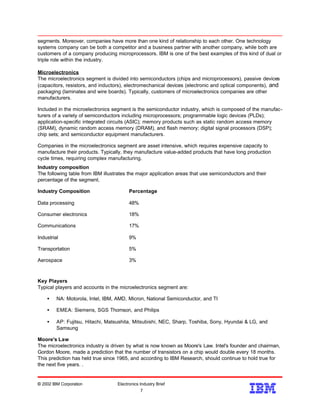
The following table from IBM illustrates the major application areas that use semiconductors and their
percentage of the segment.
3%Aerospace
5%Transportation
9%Industrial
17%Communications
18%Consumer electronics
48%Data processing
PercentageIndustry Composition
Key Players
Typical players and accounts in the microelectronics segment are:
• NA: Motorola, Intel, IBM, AMD, Micron, National Semiconductor, and TI
• EMEA: Siemens, SGS Thomson, and Philips
• AP: Fujitsu, Hitachi, Matsushita, Mitsubishi, NEC, Sharp, Toshiba, Sony, Hyundai & LG, and
Samsung
Moore's Law
The microelectronics industry is driven by what is now known as Moore's Law. Intel's founder and chairman,
Gordon Moore, made a prediction that the number of transistors on a chip would double every 18 months.
This prediction has held true since 1965, and according to IBM Research, should continue to hold true for
the next five years. .
© 2002 IBM Corporation Electronics Industry Brief
7
7
In a related prediction in 1997, Andy Grove, Intel's CEO, predicted that by the year 2011 clock speeds
would increase by 50 fold from the current 200 Mhz to 10,000 MHz. Already in 2002, 2,000 MHz (2 Ghz)
microprocessor chips are common in new desktops.
As a result, the product life cycle is becoming shorter due to newer and better technology available.
Consumers want the best available product at the beginning of a life cycle.
Fabless
Companies in the fabless segment, which is composed of companies that do not fabricate their own
products, have a high growth rate. It is more cost-effective for these companies to rely on outside foundries
to fabricate their products so that they can concentrate on developing new ideas and new products. The
fabless semiconductor industry had sales of $11 billion in 1998 and is expected to grow to $80 billion in
2003, an average annual growth rate of 30%. The average fabless company's gross margin is 50%. It is
expected that 150 new fabless companies will open for business in the next five years. In the fabless
segment, the primary competency is R&D. Some fabless companies spend 20% of revenue on R&D.
Although the fabless companies have a high growth rate, there are drawbacks to being a fabless company.
A fabless company can have a difficult time getting capacity because there are so many other fabless
companies trying to get their products manufactured. Because fabless companies do not control the
manufacturing process, they run the risk of marketing inferior products.
The microprocessor industry operates within a predictable process cycle that follows these steps:
ŸMicroprocessor manufacturers anticipate these new requirements, and they develop faster and more power-
ful chips.
ŸUsing state-of-the-art processing facilities, chip makers that are first to the market can earn huge profits.
These profits are then used to build new manufacturing plants (fabs), which can cost in excess of $2 billion
each.
In today's semiconductor manufacturing environment, manufacturers must perform under intense competitive
pressures, while achieving higher productivity levels, better quality, lower cost, faster response to market
dynamics, and better integration of advanced technologies for the plant floor.
The microelectronics industry has been experiencing continuous price decreases. The consumer is
demanding cheaper prices, smaller products, and lighter products. Supporting these demands is important
or the industry loses business.
Challenges require more sophisticated tools, processes, and standards for the design and manufacture of
electronic products. Business challenges and opportunities in the microelectronics segment include the
following points:
• Integrated Product Development (IPD), Enterprise Resource Planning (ERP) and Supply Chain
Management (SCM) solutions are common.
• Fabless companies are primarily concerned with time to market issues and foundries are concerned
with cost issues. For fabless companies, the primary e-business opportunities are IPD
e-collaboration, hosted systems, and data storage and mining while for foundries the primary oppor-
tunities are establishing trading communities, e-procurement, and manufacturing equipment
integration.
• Challenges include satisfying new business management processes, such as foundry business
operations, intercompany operations, fabless business operations, and manufacturing relations
around the world.
© 2002 IBM Corporation Electronics Industry Brief
8
8
• There has been a need to upgrade fabrication facilities and equipment to new technologies faster,
such as submicron technology, 300 mm wafer fabrication, and automated material handling
systems.
• It is more challenging to sell supply chain solutions to an engineering-oriented firm. The senior
management of a microelectronics company is engineering oriented because of their product devel-
opment background. Their major concern is to develop advanced technology, such as being the first
to market with a 2.5 micron DRAM chip that supports 500 MB.
• The need for higher performance, lower power, pocket-sized designs is being driven primarily by the
PC and communications industries.
• The semiconductor manufacturing community is focusing on the ability to manufacture new
products more cost-effectively and with higher degrees of product mix. Manufacturers that leverage
new, higher revenue process technologies (SOC, SOI, SiGe, copper interconnect, and deep submi-
cron) to maximize production profits must be willing to improve levels of automation and yield
management techniques to ensure rapid yield and production ramp up.
“Time to market has been a big issue throughout the electronics industry. One of the challenges that the
industry has is deciding which products should be manufactured on a continuous basis and which on a
discrete scheduled basis to handle market changes and shortened product life cycles. The ability to tie
customer point of sale data, via a company's advanced planning and scheduling system and ERP system to
the plant floor, is providing significant competitive advantage to leading-edge companies.”
Don Ponge, Solutions Manager, IBM Electronics Competency Center
Technology Segment
Companies in the technology systems segment manufacture CPUs, DASD, and peripherals. Their custom-
ers are both businesses and consumers. These companies deal with complex supply channels, including
suppliers, manufacturers, distributors, and retailers, as well as direct channels, such as consumers.
Decreasing the time for receiving parts from other manufacturers becomes a challenging issue in response
to time to market.
Technology systems companies use two manufacturing processes: assemble-to-order and assemble-to-
stock. Assemble-to-order is a manufacturing approach that emphasizes final assembly of products only for
immediate delivery. Inventory consists of parts, not products. Assemble-to-stock is a manufacturing
approach that completes the assembly of products and holds them as inventory until they are needed to
fulfill orders. The components, or parts, are assembled in fairly simple manufacturing processes. Raw
materials, component parts, and even subassemblies are often outsourced to contract equipment
manufacturers.
Key Players
Typical players and accounts in the technology systems segment are:
• NA: HP, Dell, Compaq, and IBM
• EMEA: Siemens, Bull, and Olivetti
• AP: Sony and Samsung
Challenges and Opportunities
Many companies in the technology systems segment are facing a transition to mass customization. The
term mass customization was first coined by Stan Davis in his book Future Perfect. It is the production,
marketing, and delivery of goods and services according to customer specifications. Consumers' require-
ments will increase, as will the available options and functions to satisfy those requirements. Yet the prices
© 2002 IBM Corporation Electronics Industry Brief
9
9
of computers and peripherals will likely continue to decrease while the product life cycle is getting shorter
because of Moore’s Law, rapid technological change and rising customer demands. Challenges and oppor-
tunities in the technology systems segment include:
• Use of market-based innovations (platform, portfolio, pipeline, project management) is common. IPD
solutions are driven by market-based innovations. The primary business drivers in technology
systems companies are to minimize inventory on the one hand, while maintaining sufficient inven-
tory of the "right" product to maximize market share.
• Anticipating levels of inventory is challenging because of the difficulty of balancing inventory with
unpredictable product life cycle and distributor demand.
Telecommunications Systems Segment
Companies in the telecommunication systems segment manufacture telecommunication equipment; mobile
equipment, including cell phones; new media equipment, including broadcasting equipment, CATV, radio
wave, scale, and measure equipment; telecommunication switching units; and telecommunication wiring.
Their customers are both businesses and consumers.
The industry is segmented into infrastructure and hand-held devices. Proprietary equipment has allowed
telecommunication infrastructure manufacturers to have high market power over the carriers. Carriers have
historically exerted market power over the hand-held manufacturers by controlling access to the market.
The telecommunication systems industry is driven by deregulation. The telecommunication industry in the
U.S. has been fully deregulated for years, but other countries are only beginning to deregulate their national-
ized monopolies. For example, in 1999, French telecommunications users became able to buy from other
carriers as well as from Alcatel, previously the only legal source. This allowed companies to participate in
the domestic market and increased the power of consumers. The wireless industry in Europe and Asia is
more advanced than in the United States. Markets such as Japan and Finland are leaders in the wireless
industry.
Key Players
Typical players and accounts are:
• NA: Motorola
• EMEA: Nokia, Philips, Alcatel, Ericsson and Bosch
• AP: Sony and Samsung
Challenges and Opportunities
The telecommunication systems segment is in a dramatic transition, facing major challenges: deregulation,
technology advances, increased user demand for mobile telephony, and new services mainly based on the
Internet. As of 2001-2002, the segment is in a major slump due to overcapacity, lower consumer demand,
corporate malfeasance, and uncertain technology directions. Companies are also facing cost pressures and
fierce competition in home markets as well as in emerging markets. Challenges and opportunities in the
telecommunication systems segment include:
• Primary market entry through e-business uses of CRM, ERP, and SCM solutions.
• The business issue for telecommunication infrastructure manufacturers is the ability to produce
what the market demands at the right time and at the right cost. Typically, they don't fully under-
stand their cost of production.
© 2002 IBM Corporation Electronics Industry Brief
10
10
• Hand-held wireless device manufacturers are making e-commerce moves to capture more contol of
the market.
• Both infrastructure and handheld device businesses are candidates for consulting services on
continuous flow manufacturing.
• Carriers who provide services are now experiencing a significant shift in strategy, evolving from
handling a physical network to delivering a wide range of technically and financially attractive
services to build new revenue streams.
• This shift from network issues to business issues has a significant impact on the role of telecom-
munication equipment manufacturers (TEM) suppliers such as Lucent, Nortel, Alcatel, Ericsson,
Nokia, and others. Operators and their customers are increasingly requesting advanced technology
systems, of which software is now the most significant element, as part of cost-effective end-to-end
business solutions.
• TEMs must increase their technology leadership, but also they must focus attention on their
business processes. Information technology must be considered not only as support but also as
strategic leverage for business transformation and competitive advantage. The mobile phone
divisions are key for their growth in a global market (including emerging countries) and are sensitive
to time to market and to the supply chain performance issues.
• Demand for mobile and wireless solutions and communications with Internet access is growing at
50% per year.
• TEMs have to move from traditional technologies and offerings to Internet and high-speed wireless
technologies mostly by developing their own solutions or by working with the new Internet Solution
Providers (ISPs).
Hi-Tech Equipment Segment
The Electronics Hi Tech Industry includes manufacturers of products such as PCs, disk drives and routers.
Hi Tech is the fastest growth sub segment industry within the industrial sector with worldwide IT spending
projected to grow from $22.1B in 2000 to $34.6B by 2004 representing a compound annual growth rate of
12%.
Electronics Hi Tech Industry IT Spending
12.5%11.7%11.7%% Growth
27.8B24.8B22.1BIndustry
200220012000Year
Stock Price Decline - According to IBM experts, most Electronics Hi Tech companies have seen a signifi-
cant erosion in stock prices over the past 9 months. This has been driven by weakened forward earnings
outlooks, adjustments of industry PE ratios, and slowing economic forecasts. Capital spending within the
industry is down >25%. All key electronics segments growth forecasts have trended significantly down for
the past 6 months. IBM estimates 2001 growth ranges for Semiconductors +7-9%, Communications +7-9%,
Consumer +6-8%, Manufacturing services +20-25%. Most companies are forecasting their IT budgets flat to
slightly down but increasing e-business/solutions specific spending.
© 2002 IBM Corporation Electronics Industry Brief
11
11
Semiconductors are growing at a constant rate. In 1999, there was $149 B revenue for the segment. In
2004, revenue is predicted to be $355 B. That is a growth rate of 20%.
The High-Tech segment is focused on cost savings, increasing productivity and efficiency and improving
forecasting, inventory levels and reducing lead times.
Electrical Segment
The electrical segment includes companies that manufacture such electrical equipment as electric relays
and control devices, generators, commercial and specialty batteries, power supplies, and other electrical
products. Customers are typically other companies, who utilize these components in their products.
Key Players
Key players in this area include:
Ÿ Square D
Ÿ Emerson Electric
Ÿ GE
Ÿ AMP
Ÿ Exide
Ÿ Schneider Electric
Ÿ Siemens
Ÿ Hitachi
Ÿ Sanyo
Challenges and Opportunities
This segment is dominated by companies and products which have been in the market for long periods of
time. However, product innovation is a constant challenge for these companies to enable their products to
be more efficient, smaller, less expensive and more profitable. IT support for order management, customer
service and product development are typical requirements.
Consumer Electronics Segment
Companies in the consumer electronics segment manufacture audio-visual equipment and game and hobby
equipment. Customers of the companies in the consumer electronics segment are retailers and consumers.
These companies also deal with complex supply channels, including suppliers, manufacturers, distributors,
and retailers, as well as direct channels, such as consumers. Distribution and transportation are also
challenging issues. Brand management becomes an issue too, because these companies sell directly to
retailers and consumers.
As consumers have more choices available to them, they demand better quality and more features and
functions. They also demand fast delivery of low-cost products. Companies in the segment are faced with
high volumes, low profit margins, seasonal demand, and changing buying patterns.
Consumers are looking for ways to purchase products from a wider set of choices at more competitive
pricing. The consumer is more educated and is more astute about available choices. Balanced with
decreasing time to shop, consumers still have a desire for a certain level of entertainment and hands-on
interaction. Consumers demand shorter time frames and differentiated identity as they shop. They don't
want to be considered as part of the masses, but as individuals.
Technology is used by younger generations to both educate and entertain. The Internet tools are not foreign
to the young, and e-commerce is a perceived requirement of many stores to keep up with the changing
times. They expect gratification to be convenient and immediate. Convenience is a key. Consumers are
looking for anytime and anywhere shopping.
© 2002 IBM Corporation Electronics Industry Brief
12
12
Another key element for consumer electronics is the evolution of standards. Video casettes are becoming
outdated as more and more consumers use DVDs for their main media. The market needs to be aware of
these changing trends and keep up with them. The industry also needs to be aware of standards and
changes to these standards. According to Joe Wilcox of c/Net news, this is a similar battle to VHS versus
Beta. The players are even similar. Philips and Sony support the DVD+RW and Hitachi, Panasonic and
Toshiba support DVD-RAM. “DVD+RW writes disks that most DVD drives and players can read. DVD-RAM
stores optical disks in caddies that won't work in older DVD devices. Neither standard has achieved that
capacity, stuck in the 3GB range. Both camps pledge support for 4.7GB by next year. “ according to the
web site. Only time will tell how this battle will be settled.
Key Players
Key players in this segment are:
• NA: Bose, GE,and Kodak
• EMEA: Thomson and Philips
• AP: Sony, Sharp, Toshiba, Matsushita, Panasonic, Canon and Samsung
Major issues for Consumer Electronics:
Ÿ Sales and distribution sub-optimization is causing retailer compliance chargebacks and inventory
misallocations
Ÿ Communication/information flows, both intra-and inter-enterprise, need improvement to keep pace with
rapid shifts in the Consumer Electronics landscape
Challenges and Opportunities
The consumer electronics industry is facing a dramatic evolution: After several years of flat growth, the
market is now moving again as a consequence of the advent of digital technologies. The consumer electron-
ics industry is gaining ground in emerging countries, such as those in Asia. Challenges and opportunities in
the consumer electronics segment include:
• This industry is further along the adoption path for e-business. They are familiar with CRM, ERP and
SCM solutions.
• Although Integrated Product Development (IPD) has not typically been an effective entry point for
this segment, industry players in this segment are considering adopting IPD solutions as a way to
innovate their product development processes and introduce new products faster.
• Channel conflict is a major issue slowing e-business deployment.
• Only Sony is ready to make a direct e-commerce move because of its strong brand identity;
however, others are expected to follow.
• Solutions strategy needs to move from point solutions to life cycle management. For example, the
Asian market would like to develop remote diagnostics capability to support products, such as
copiers and printers, after they are installed.
• This industry has to deal with large volumes and low margins; therefore, it focuses on drastic cost
reductions. Significant business process reengineering efforts are engaged to improve the fabrica-
tion and assembly processes, especially for supply chain optimization.
© 2002 IBM Corporation Electronics Industry Brief
13
13
• Electronics systems, such as monitors, set-top boxes, and tuners, and the Application Specific
Integrated Circuits (ASICs) that are at the heart of many of these devices are key to maintaining and
consolidating leadership, and they have a fundamental influence on time-to-market performance.
• The growth area with high added value is in multimedia applications with Internet access and related
services (for example, pay TV, program navigators, Internet applications, and satellite TV). This new
business is a strategy area for this segment.
• Major players are investing significantly in research and development and are seeking technological
and industrial alliances. One example is Thomson Multimedia, which is developing the new genera-
tion of interactive Internet TV though alliances with Microsoft, NEC (ASICs and flat panels), Direct
TV (satellites), and Alcatel (TEM).
Home Appliances Segment
Companies in the home electronics segment manufacture home appliances and related equipment. They
not only have electrical components, but have mechanical components as well. These products are also
known as “white products”. Similar to the consumer electronics segment, customers of the companies in
the consumer electronics segment are retailers and consumers. These companies also deal with complex
supply channels, including suppliers, manufacturers, distributors, and retailers, as well as direct channels,
such as consumers. Distribution and transportation are also challenging issues. Brand management
becomes an issue too, because these companies sell directly to retailers and consumers.
As consumers have more choices available to them, they demand a better ratio of quality. They also
demand fast delivery of high-quality and low-cost products. Companies in the segment are faced with high
volumes, low profit margins, seasonal demand, and changing buying patterns.
Key Players
Key players in this segment are:
• NA: Whirlpool and GE
• EMEA: Thomson and Philips
• AP: Toshiba and Samsung
Major issues for Home Electronics:
Ÿ Sales and Distribution sub-optimization is causing retailer compliance charge backs and inventory
misallocations
Ÿ Communication/information flows, both intra and inter enterprise, need improvement to keep pace with
rapid shifts in the marketplace
Challenges and Opportunities
Challenges and opportunities are similar in home electronics, as in consumer electronics:
• Solutions strategy needs to move from point solutions to life cycle management. For example, the
Asian market would like to develop remote diagnostics capability to support products, such as
copiers and printers, after they are installed.
• This industry has to deal with large volumes and low margins; therefore, it focuses on drastic cost
reductions. Significant business process reengineering efforts are engaged to improve the fabrica-
tion and assembly processes, especially for supply chain optimization.
© 2002 IBM Corporation Electronics Industry Brief
14
14
Industrial Equipment Segment
Companies in the industrial equipment segment manufacture electrical office equipment (copy and fax);
communication equipment; medical equipment; and related electrical equipment; and electrical parts,
including amps, condensers, coils, switch heads, and connectors. They also manufacture micro and
regular-sized motors, magnetic media (such as tapes and disks), electrical tubes, and dry cell batteries.
Their customers are businesses and other manufacturers.
This segment is significantly material intensive and requires high mix, low to medium volumes. They
manufacture highly customized products that requires a complex network of machinery and routings.
Companies in this industry have to determine quickly the building capacities that they can apply and the
specifications that they can change to meet the customer's requirements. For example, if a customer wants
to buy a particular type of motor that must be customized to meet specifications (engineering to order), the
company must provide the customer with a rough estimate of cost, schedule the engineering, and estimate
the recurring cost of manufacturing for the particular component.
Key Players
Typical players and accounts are:
• NA: Xerox, Black & Decker, and GE
• EMEA: Thomson, Philips, Matra, Sagem, Cie des Signaux, and Dassault Electronique
Challenges and Opportunities
Challenges and opportunities in the industrial equipment segment are in the following areas:
• Reducing costs
• Managing supply chain
• Enabling e-business
• Reengineering business processes
Energy Equipment and Machinery
Companies in the energy equipment and machinery segment manufacture heavy industrial electric equip-
ment, elevators and escalators, nuclear energy and power systems, transportation equipment, and
satellites. It also includes power plants' low-voltage equipment, lighting, cables, and wires. Customers of the
companies in the energy equipment and machinery industry are businesses.
This segment is significantly capital intensive and requires longer lead times. Privatization of utility compa-
nies is driving competition in the segment.
Key Players
Typical players and accounts are:
• NA: GE
• EMEA: ABB, Schneider Electronic, Siemens, and Legrand
• AP: Mitsubishi and Zenith
© 2002 IBM Corporation Electronics Industry Brief
15
15
Challenges and Opportunities
Challenges and opportunities in the energy equipment and machinery segment are in the following areas:
• Reducing costs
• Managing supply chain
• Enabling e-business
• Reengineering business processes
Contract Electronic Manufacturers
Many electronic companies have outsourced elements of their manufacturing in order to cut costs. These
manufacturers are an extension of the electric manufacturer supply chains. Companies are looking for
economies of scale and sharing R&D efforts across product lines. This enables electronics companies to
focus on its core competencies, and allows the contractor to keep up with engineering challenges and
maintain skilled workforce. For example, IBM has outsourced part of its manufacturing to Selectron and
Sanmina-SCI. IBM was able to cut costs by having fewer employees and reducing manufacturing space.
Key Players
Key players in this segment are:
• NA: Solectron, Celestica, Flextronics, Jabil Circuits and Sanmina-SCI
Challenges and Opportunities
Challenges and opportunities in the contract electronic segment are in the following areas:
• Reducing costs
• Managing supply chain
• Maintaining a skilled workforce.
1.3 Roles in the Electronics Manufacturing Industry
The electronics industry has a variety of roles. These roles vary across the supply chain starting with
material suppliers and ending with the customer. Roles for the consumer electronics sub-industry are very
distinct because of the interaction with retailers. Most consumer electronics manufacturing companies go
to market through large retailers; the retailers then sell directly to consumers. These retailers have tremen-
dous influence on manufacturers, and retailers use it to improve their own bottom line. Look at the following
roles and perspectives of the participants involved in the electronics business:
The consumer: This is the ultimate customer for all consumer electronics products.
Retailers: These are the businesses that sell to consumers. Retailers want inventory levels to be as low as
possible but still be able to guarantee product availability on the shelves.
Retail distribution network: This network is the heart of the retailer's ability to keep supplied with
products. In the future, the pressure will be on manufacturers to deliver small numbers of items directly to
the stores.
© 2002 IBM Corporation Electronics Industry Brief
16
16
Wholesale distributors: These businesses are between the retailer and the manufacturer. They provide
sales and merchandising services to the large number of small retailers.
Manufacturer distribution network: This network can be as simple as a single shipping warehouse or as
complex as a multilevel international network.
Manufacturing final assembly: A manufacturer's final assembly operation must become highly flexible to
support distribution challenges. Many manufacturers purchase products from the Far East that require only
minor assembly and packaging. Manufacturers also purchase major subassemblies from the Far East, such
as compressor units for refrigerators.
Manufacturer subassembly: Flexibility is the key to managing the inventory costs while replenishing final
assembly requirements.
Manufacturer fabrication (foundry): Foundries specialize in manufacture and assembly; their focus is on
producing a component or product as quickly and as cheaply as possible. Fabrication processes are totally
dependent on product design to minimize the expense of flexible tooling. It is possible to tightly tie fabrica-
tion processes to subassembly and final assembly processes when the products are properly designed.
Material suppliers (tier 1, tier 2, . . .): Material suppliers provide raw materials to other suppliers (tier 2) or
to manufacturers. The relationship between the manufacturer and its suppliers, and between the supplier
and its suppliers, must be properly functioning for the total supply chain to properly function.
Fabless: Fabless companies do not fabricate their products; their focus is on component or product design.
They outsource the manufacture and assembly to a foundry.
Transportation providers (carriers): Viewed by mode of transportation, goods transported between each
of the players in the supply chain are moved by one of these carriers: motor freight, rail, air, and maritime. In
recent years, these companies have additional responsibility in the supply chain by providing other logistics,
distribution, and some product assembly functions on an outsourced basis.
© 2002 IBM Corporation Electronics Industry Brief
17
17
1.4 Types of Manufacturing
Discrete Manufacturingis used by electrical and electronics companies. This manufacturing has the
following characteristics:
• Manufacturing processes are repetitive or job shop (built-to-order per customer specifications, configura-
tions or requirements)
• Products are fabricated and assembled and may have many intermediate subassemblies
• Products are defined by bills of material
• Product differentiation is typically by function and features, name (brand) recognition, packaging or price
- sometimes by quality
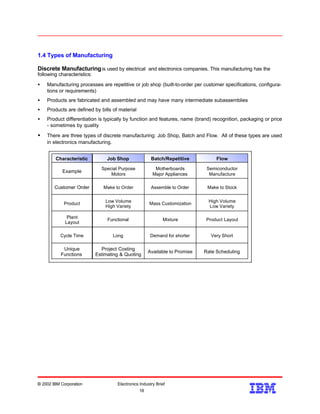
• There are three types of discrete manufacturing: Job Shop, Batch and Flow. All of these types are used
in electronics manufacturing.
© 2002 IBM Corporation Electronics Industry Brief
18
18
Characteristic Job Shop Batch/Repetitive Flow
Example
Special Purpose
Motors
Motherboards
Major Appliances
Semiconductor
Manufacture
Customer Order Make to Order Assemble to Order Make to Stock
Product
Low Volume
High Variety
Mass Customization
High Volume
Low Variety
Plant
Layout
Functional Mixture Product Layout
Cycle Time Long Demand for shorter Very Short
Unique
Functions
Project Costing
Estimating & Quoting
Available to Promise Rate Scheduling
2.0 Electronics Manufacturers
Top 20 IBM Customers - Electronics Industry
$17,580Sharp$37,580Motorola
$54,493Toshiba$71,118
Matsushita/
Panasonic
$13,532Electrolux$22,967ABB
$14,400Ricoh$31,748Philips
$30,275Nortel Networks$63,082Sony
$16,7243M$78,396Siemens
$24,185Canon$33,726Intel
$5,657Omron$129,953GE
$28,369Ericsson$13,994Eastman Kodak
$28,304Nokia$33,813Lucent
2000 Company
Revenue ($M)
Company Name
2000 Company
Revenue ($M)
Company Name
Source: Fortune, IBM Market Intelligence. Red-highlighted accounts have integrated coverage
Motorola
Motorola's cell phone line of business is a main competitor to Nokia. Motorola is the #2 global manufacturer
of mobile handsets and it gets about a third of sales from personal communications products such as cell
phones, pagers, two-way radios, as well as network products like servers and software. The company is a
leading supplier of communications infrastructure equipment including cellular transmission base stations,
amplifiers, and switching equipment. Motorola is also a top maker of embedded microprocessors. Motorola
generates 16% of sales through its semiconductor operations. Their largest customers include Nextel
Communications and Japan-based KDDI. The company continues to expand its broadband and cable
product lines. For additional information, please review: http://www.motorola.com
Nokia
Nokia is the world's #1 maker of mobile phones. It is also aiming for the top of the mobile Internet market.
Nokia's products are divided mainly between two divisions: mobile phones, which makes up about three-
quarters of sales and networks (wireless and Internet protocol infrastructure equipment); other products
include set-top boxes, software, and mobile displays. Nokia is one of Europe's largest companies by market
capitalization, Nokia is focusing on high-speed data networks through 3G wireless, DSL, and interactive TV.
For more information, please visit http://www.nokia.com
© 2002 IBM Corporation Electronics Industry Brief
19
19
Siemens
Siemens has operations worldwide in the automation and control, information and communications, lighting,
medical, power, and transportation sectors. It is also active in the semiconductor sector through a minority
stake in chip maker Infineon Technologies. Siemens is Europe's largest electronics and electrical engineer-
ing firm and one of the world's leading mobile phone handset makers. For more information, please visit:
http://www.siemens.de
Matsushita
Matsushita Electric Industrial is the world's #1 consumer electronics maker and sells under brand names
such as Panasonic, Quasar, Technics and JVC. Matsushita sells consumer products (which account for
40% of sales) such as VCRs, CD and DVD players, TVs, and home appliances. It also sells computers,
telephones, industrial equipment (welding and vending machines, medical equipment, car navigation equip-
ment), and components such as batteries, semiconductors, and electric motors. The Matsushita group
includes about 320 operating units in more than 45 countries. Its products are sold worldwide; Asia
accounts for more than 70% of sales. For more information, please review: http://www.mei.co.jp
LG Electronics
LG Electronics (LGE) owns 70-plus subsidiaries that design and manufacture display products (TVs,
monitors), home appliances (refrigerators, microwaves, air conditioners), and multimedia devices (VCRs,
DVD players, CD-ROM drives, MP3 players). LGE also owns Zenith Electronics and has a flat-panel display
joint venture with Philips Electronics (LG.Philips LCD). LGE has been increasing its sales to North America
and Europe; Asia provides 38% of sales. For additional information, please review: http://www.lge.co.kr
Lucent
Lucent Technologies, a global leader in telecom equipment, provides products used to build communica-
tions network infrastructure. Its core transmission and switching, wireless, and optical gear is used world-
wide. The company also makes software and provides a wide range of services; many of its products are
developed by Bell Laboratories. Most of Lucent's customers are telecom service carriers such as AT&T and
the local telephone companies, such as the “Baby Bells”. The company, itself a spin-off from AT&T, has
spun off non-core businesses to raise funds. Please review: http://www.lucent.com
Alcatel
Alcatel is one of France's largest industrial companies and a leading global supplier of high-tech equipment
for telecommunications. Core network switching and transmission systems for wireline and wireless
networks for carriers and enterprises account for most of its sales. The company also manufactures cell
phones, communications cable, and satellite equipment and provides network services including consulting,
integration, design, planning, operation, and maintenance. Clients include Orange and Deutsche Telekom.
Half of Alcatel's sales are made in Europe; the company continues to seek a larger share of the equipment
markets in North America and China. For more additional information, please visit:
http://www.alcatel.com
General Electric
General Electric (GE) is positioned as #1 or #2 in a variety of industries. The company produces aircraft
engines, locomotives and other transportation equipment, appliances (kitchen and laundry equipment), light-
ing, electric distribution and control equipment, generators and turbines, nuclear reactors, medical imaging
equipment, and plastics. Its financial arm, GE Capital Services, accounts for nearly half of the company's
© 2002 IBM Corporation Electronics Industry Brief
20
20
sales and is one of the largest financial services companies in the US. Other operations include the NBC
television network. For more information, visit: http://www.ge.com
Xerox
Xerox is known for its copiers, but it also makes printers, scanners, fax machines, software, and supplies,
and provides consulting and outsourcing services. The company designs its products for home users,
businesses, and high-volume publishers such as newspapers. Customers include Kinko’s and Southern
Company. The company generates most of its revenue from black-and-white products, although it is
continuing to develop its color products. Customers outside the US account for 40% of sales. Please check
http://www.xerox.com for more information.
Philips
Philips is the US arm of Dutch Koninklijke ("Royal") Philips Electronics, the company oversees Philips
operations in the US, Canada, and Mexico. Its products include TVs, CD/DVD/MP3 players/recorders,
VCRs, shavers, broadcast television systems, broadband network systems, medical imaging equipment,
and semiconductors. Its brands include Philips, Philips Magnavox, Norelco, and Marantz. Philips also
makes lighting products -- its parent is the world's largest lightbulb maker. For more information, visit
http://www.philips.com
Whirlpool
Whirlpool is the #1 US home appliance maker. It makes washers, dryers, dishwashers, microwave ovens,
ranges, refrigerators, and air conditioners and other appliances. In addition to Whirlpool, the company sells
its products under brand names such as Sears' Kenmore label, KitchenAid, Roper, Inglis, and Speed
Queen. Sears accounts for about 20% of the firm's sales. Whirlpool makes products in 13 countries and
sells them in more than 170. It gets nearly 65% of sales from North America. Please review
http://www.whirlpool.com for more information.
Sony
Sony, the world's #2 consumer electronics firm, also makes semiconductors, DVD players, batteries,
cameras, MiniDisc and Walkman stereo systems, computer monitors, and flat-screen TVs. Video games
systems account for 10% of sales. The company's TVs, VCRs, stereos, and other consumer electronics
account for about 70% of sales. Sony's entertainment assets include Columbia TriStar (movies and TV
shows) and record labels Columbia and Epic. The company also operates insurance and finance
businesses. Please visit http://www.sony.com for more information.
Ericsson
Ericsson has a way without wires. The company is the world's leading maker of wireless telecom infrastruc-
ture equipment. Network operators and service providers use Ericsson's antennas, transmitters, and other
wireless and optical infrastructure gear (nearly three-quarters of sales) to build and expand networks. The
company, which trails rivals Nokia, Motorola, and Siemens in mobile handset sales, has teamed up with
Sony in a cell phone joint venture. Ericsson's other products include corporate networking gear, cable,
defense electronics, and software for mobile messaging and commerce. The Wallenberg family and holding
company Industrivarden each control about 42% of Ericsson's voting power. http://www.ericsson.com
© 2002 IBM Corporation Electronics Industry Brief
21
21
Fujitsu
Don't judge Fujitsu Limited by its name -- with operations worldwide and products ranging from air condition-
ers to telephony, its reach seems almost limitless. Its computer products include PCs (it competes with
NEC for #1 in Japan), servers, peripherals, and software. Computer operations and information technology
services (consulting, systems integration, and support) account for more than 70% of sales. The company's
other lines include telecommunications network equipment, consumer electronics such as televisions and
car audio components, and semiconductors. Fujitsu also owns Japan's top Internet services provider, Nifty.
http://www.fujitsu.com
IBM
International Business Machines (IBM) is the world's top provider of computer hardware. The company
makes a broad range of computers and peripherals, including desktop and notebook PCs, servers,
mainframes, printing systems, and storage devices. Accounting for about 40% of IBM's sales, the
company's service arm is the largest in the world. IBM is also one of the largest providers of both software
(ranking #2, behind Microsoft) and semiconductors. The company continues to use acquisitions to augment
its software and service businesses, while streamlining its hardware operations with divestitures and organ-
izational shifts. About 60% of IBM's sales are to customers outside the US. http://www.ibm.com
HP
Hewlett-Packard, meet Compaq. Compaq, this is Hewlett-Packard. Now rivaling longtime market ruler IBM
in size, Hewlett-Packard (HP) provides computers, imaging and printing peripherals, software, and
computer-related services. The company has seen extensive restructuring under the leadership of CEO
Carly Fiorina, who spearheaded the largest deal in tech sector history: the acquisition of Compaq Computer
in a stock transaction valued at approximately $19 billion. The combined company boasts greatly improved
market share across a number of hardware lines, including UNIX and Windows-based servers, enterprise
storage, and personal computers. Its services unit, which has doubled in size, may help it weather a
flagging computer hardware market. http://www.hp.com
Lucent
It's tough at the top. Lucent Technologies, a global leader in telecom equipment, provides products used to
build communications network infrastructure. Its core transmission and switching, wireless, and optical gear
is used worldwide. The company also makes software and provides a wide range of services; many of its
products are developed by its Bell Laboratories unit. Most of Lucent's customers are telecom service carri-
ers such as AT&T. The company, itself a spinoff from AT&T, has spun off noncore businesses to raise
funds. Lucent has also cut costs through massive layoffs and restructured its sprawling organization around
two main segments, wireline and wireless, to focus on serving the largest service providers.
http://www.lucent.com
Bosch
Cooking and cleaning can be a big chore, but BSH Bosch und Siemens Hausgeräte is there to help. The
50-50 joint venture is one of Europe's largest appliance manufacturers. BSH's major appliances include
dishwashers, ovens, microwaves, washing machines, air conditioners, refrigerators, and vacuum cleaners. It
also makes small appliances such as coffee makers and hair dryers. The company's primary brands are
Bosch and Siemens, but it also produces a dozen regional brands, including Balay, Constructa, Gaggenau,
Neff, Thermador, and Coldex. BSH's appliances are sold in more than 30 countries; Germany accounts for
almost a third of sales. BSH has about 40 factories throughout Europe, North and South America, and Asia.
© 2002 IBM Corporation Electronics Industry Brief
22
22
http://www.bsh-group.com
NEC
NEC has three arms and plenty of muscle. The company's NEC Solutions group makes high-end computers
(servers and supercomputers) and peripherals (monitors and projectors), and it wrestles with Fujitsu for the
top spot among Japanese PC makers. Its NEC Electron Devices division makes electronics ranging from
transistors to display modules, and competes with Toshiba for the second spot among semiconductor
makers (both companies trail Intel). The company also sells broadband and wireless networking equipment
through its NEC Networks group. NEC, which has made the Internet the focus of each of its groups, runs
one of Japan's largest Internet service providers (BIGLOBE). The company generates about 15% of its sales
outside Japan. http://www.nec.com
Marconi
Marconi is a faint image of its former self. Once a military industrial conglomerate, the company now
provides telecom equipment. Its communications products (67% of sales) include wireless and broadband
transmission, network infrastructure, and enterprise networking equipment. It also makes network testing
products and industrial power equipment and provides application hosting and managed network services.
The company sells to communications service providers worldwide. Faced with mounting losses, Marconi
sold non-core businesses to focus on the telecom market. As part of a restructuring plan intended to relieve
massive debts, the company will liquidate its assets and reincorporate as Marconi Corp. by early 2003.
http://www.marconi.com
Growth Trends in the Industry
Americas Consumer Trends
The largest growth region in the world is the Americas region. The industry in North America is $11.9 billion
in 1998, growing to $16.3 billion in 2001 (11.1% CGR). There has been market consolidation around large
players. The electrical industry is completely deregulated.
European Consumer Trends
Europe is a diverse market with diverse issues causing variation in pricing, warranty, and language issues.
The industry in Europe is $8.7 billion in 1998, growing to $10.9 billion in 2001 (7.8% CGR). There has also
been market consolidation around large players. Deregulation has been completed in Europe, increasing
competition. The industry is more driven by technology than the bottom line. Sales tend to be driven by
product value rather than vendor relationship.
Asia Pacific Consumer Trends
Similar to Europe, Asia Pacific is composed of a diverse market causing pricing, warranty, and language
issues. The industry is $7.8 billion in 1998, growing to $9.4 billion in 2001 (6.4% CGR). Asia has also seen
market consolidation around large players. Asian electronic companies have felt the negative impact of a
slow economy. The industry has built long-term and close relationships between suppliers and companies.
There are stiffer requirements for channel support compared to Europe and the Americas.
© 2002 IBM Corporation Electronics Industry Brief
23
23
3.0 Customers
Customers vary across a wide variety of formats. Typical customers of electronics companies include:
w PC Manufacturers
w Appliance Manufacturers
w Warehouse stores - A store with more than 1,500 items, primarily dry grocery, with some
perishables. Characteristics include, small gross margin and workforce, limited service, most
have scanner checkouts, and tend to eliminate frills and concentrate on price appeal.
w Retail chains - An operator of 11 or more retail stores.
w Independent - An operator of up to 10 retail stores.
w Wholesalers - Acts as an agent between the manufacturer and the retailers.
© 2002 IBM Corporation Electronics Industry Brief
24
24
4.0 Suppliers
Suppliers to electronics equipment manufacturers range from very small to very large companies, providing
basic raw materials to a variety of components to sub-assemblies to complete products. Many supplier
parts are seen as commodities by their customers. Electrical manufacturers use a small number of
specialty suppliers that build parts directly for customer specifications. Many of the second and third tier
electronics industry suppliers are midsize manufacturers whose margins are more critical than volume.
Many suppliers have begun to use portals for placing orders. Many of these products can be reviewed on
http://www.globalspec.com
© 2002 IBM Corporation Electronics Industry Brief
25
25
5.0 Business Drivers
Electronics companies face changing consumer demands, retailer consolidation, increased alternative
channel competition and geographic expansion, in addition to the always present cost cutting pressures.
5.1 Meeting New Customer Demands
Changes in consumer demographics and lifestyles are driving an ongoing evolution in the electronics
industry. A retailer’s survival depends on meeting the needs of its customers. As a result, manufacturers
have increased their product offerings to meet retailers’ needs and will have to continue to do so.
It is becoming a matter of survival that electronics companies shift to a consumer-driven model. Consumers
are smarter and more demanding than ever. They spend less than 1% of their time shopping and plan to
spend even less in the future. They express frustration because retailers do not provide the products or
services desired.
Globalization and the proliferation of multiple supply channels have created an economy without borders and
have altered the way companies do business. Retailers recognize that they could no longer rely only on
price and merchandising to retain market share but that they must adopt a customer focus to succeed in
the next millennium.
Electronics companies must follow a consumer-driven model to retain their market share. In a recent market
perception survey of the global electronics industries conducted by IBM, raising customer satisfaction was
the most important business issue among managers in the electronics industry.
As a result, electronics companies are transforming from the merchandise-centric model of the 1980s and
1990s to a consumer-centric model where customers buy products anytime and anywhere they desire.
Value will migrate to high-performance business designs that enable intimate customer knowledge,
supported by flexible high-velocity supply chains.
Companies in the electronics industry are trying to use the Internet to better understand customer
requirements. In some cases, these requirements are filtered through retail channels. Whether or not a
company's customers are end-user consumers, becoming faster in customer response time is critical to
maintaining market share.
A Demand for More Choices
The movement from analog to digital technology in the electronics industry is substantially complete, result-
ing in less differentiation between products and brands. At the same time, the needs of consumers are
becoming more diverse. Customers want to individualize what they buy, without a difference in price. They
can select from a greater range of choices than ever before. Whether they are considering a VCR, a
computer, or a personal digital assistant (PDA), consumers are primarily interested in what value a product
can deliver and how well it meets their preferences. As a result, electronics companies are under pressure
to reduce time to market and increase options to meet their customers' requirements.
Demand from New Markets or Groups
The electronics industry must also find ways to respond to market demand from new markets and new
customer groups. New potential customers emerge as underdeveloped or economically depressed countries
or regions recover their prosperity or build up their economies. China and former Soviet-controlled countries,
such as Hungary, are good examples. Within existing markets, new subgroups also become potential
customers, as the Hispanic community in the United States has shown. To benefit from these new markets,
companies must manufacture the kinds of products these customers want and distribute the products
efficiently.
© 2002 IBM Corporation Electronics Industry Brief
26
26
A new challenge for product development is that electronics customers are changing their requirements
much faster than the normal life cycle for electronics products. This increased rate of customer change, in
turn, is driving electronics companies to form partnerships and alliances with their customers and with their
suppliers, so that rarely is one company responsible for designing and manufacturing all components of a
product. Concurrent design and manufacturing reduces product life cycles by extending the supply chain.
5.2 Mergers and Acquisitions
As in other industries, electronics companies are complementing their strengths and reducing their
weaknesses by acquiring other companies or by merging with other companies. Strategically, the consoli-
dated company is stronger. It can use its increased strength to:
• Address several diverse markets, often using technologies previously not available to it or available
only by paying royalties
• Extend its existing markets
• Increase public awareness and mind share
• Achieve cost reductions by reducing redundant facilities and staff.
Acquisition of new businesses can also help regulate economic fluctuations tied to single markets and
provide new sources of income. Acquiring new manufacturing or distribution facilities is not usually a priority
in mergers and acquisitions. When two companies combine their processes, they frequently find redundant
applications and systems. They must decide not only which applications, products, and projects will survive,
but also whether new systems and applications will be needed to meet the combined demands of the larger
company.
An example of a recent merger that increased mindshare and could offer economies of scale is the joining of
Hyundai Electronics and LG Semiconductor. The combined sales of DRAM chips at Hyundai and LG
outstripped sales at Samsung Electronics, making the new company the world's largest DRAM maker.
Recent acquisitions for entry into new markets include:
• Ericsson's purchase of U.S. firms Torrent Networking Technologies and TouchWave. Torrent
Networking Technologies specializes in high-capacity routing solutions for operators and service-
provider networks; Touchwave specializes in IP-based telephony. Together, they prepare Ericsson
to begin competing in data networking.
• Alcatel's purchase of Xylon Corporation and Internet Devices, Incorporated. Xylon Corporation adds
LAN network switching technology to Alcatel's networking portfolio, especially for voice products.
Internet Devices, Incorporated brings IP-based virtual private network (VPN) solutions that will
strengthen Alcatel's ability to offer a full range of secure network solutions to service providers and
enterprises.
5.3 Divestitures
© 2002 IBM Corporation Electronics Industry Brief
27
27
Competition has forced many electronics companies, such as Westinghouse, to sell off major portions of
their enterprises. Companies are seeking a more vertically integrated structure aligned with their core
competence areas and are spinning off secondary businesses to improve financial performance.
A significant recent divestiture is Motorola's sale of its chip unit to an investment group led by Texas Pacific
Group. This sale of a group that employs about 10,000 people and represents 25% of the company's
semiconductor revenues is one of the largest divestitures to date in the electronics industry. Motorola has
already eliminated a number of other operations related to electronics, including the production of DRAM
chips, optoelectronics, hybrid power modules, and smart card microcontrollers. This divestiture allows
Motorola to concentrate on increasing its sales in areas of strong demand, such as parts for cellular phone
handsets.
5.4 Global Expansion
The globalization of the electronics industry increases the level and scope of competition for electronics
manufacturers. More companies are going global to reduce production costs, especially by shifting product
manufacturing to developing nations. This trend can be intensified by currency fluctuations, which can make
remote manufacturing attractive in spite of increased delivery costs. As a result, companies potentially
increase their competitiveness by offering lower prices and by making their products available in emerging
markets that are stimulated in part by the presence of the new production facilities.
In addition, ongoing business consolidations promote global competition by creating corporations with facili-
ties around the world. As a result, manufacturers can take advantage of their worldwide presence to design
and manufacture around the clock, using design and production centers in different time zones.
Local companies can quickly become global competitors. A company in Southeast Asia that would not
seem to be a competitor when operating only in its own country can now use the Internet or a business
partnership to compete with more established companies. Each company tries to find a different way of
going to market that emphasizes its expertise and increases its apparent value to prospective customers.
Global Supply Chains
With the goal of reducing cost, most electronics companies are establishing their manufacturing facilities in
Asia to take advantage of lower labor rates, lower import and export taxes, and lower duties. This trend
creates for the electronics companies the challenge of procuring materials from geographically dispersed
suppliers and delivering their assembled products as quickly as possible to their customers, mainly
retailers. These customers might also be widely dispersed.
The need to lower inventory costs is also causing many companies to rethink their logistics pipelines, evalu-
ate their supply chains, and use demographic data to better understand their target customer segments.
Frequently, one-third of total product sales can be trapped in the logistics pipeline instead of being readily
available for purchase. With product life cycles as short as three to nine months in the electronics industry,
the cost burden for obsolete products can become quite high.
The power of retailers in relation to manufacturers is rising. Today, there are fewer and fewer retailers in the
marketplace; as a result, each retail customer is more important to a manufacturer. Further, some retailers
have also been able to block manufacturers from going directly to the consumer through the Internet by
threatening to change to other suppliers if the manufacturer uses the competing channel. At the same time,
manufacturers risk losing the business of these powerful customers unless they become faster and more
flexible in meeting the retailers' demands.
Accordingly, the manufacturers must shorten their product delivery cycle times to better manage their inven-
tory system while becoming more efficient in terms of forecasting demands and replenishing orders. These
© 2002 IBM Corporation Electronics Industry Brief
28
28
changes require attention to supply chains on a global scale, in addition to developing a relationship with
their business customers to maintain their loyalty.
Impact of Globalization
Globalization affects every aspect of an electronics company's ability to compete in the marketplace. From
product development, to supply chain, to operations, to sales and support, the enterprise now extends
beyond its physical boundaries.
Traditional, vertically integrated enterprises that do all of their own manufacturing and assembly are rare as
outsourcing to geographic areas with lower cost structures has become prevalent, particularly in the
electronics industry. A typical PC manufacturer, for example, might design the product in the U.S., obtain
motherboards and enclosures from Taiwan, develop value-added software applications in India, and integrate
the final system in Scotland. A wireless handset manufacturer will develop the product in Europe, source
handsets from Korea, develop localized software in China, and then partner with the Chinese government to
gain access to the Chinese market.
The successful electronics enterprise must adapt to the global model to turn these challenges into opportu-
nities by transforming its business model in ways that optimize the supply chain and integrate all elements
of the enterprise. The successful company must also take advantage of global labor and production costs,
which can vary widely because of varying regulatory enforcement policies for environmental and worker
safety standards.
Small companies that are the tier 1 and tier 2 suppliers to big companies are also facing globalization and
competition. They are part of the supply chain. As big companies go global, small supplier companies are
obliged to become global to retain their customers.
Exports to Mexican and Latin American markets
With the inception of the North American Free Trade Agreement, exports from the United States to Mexico
and Latin America have increased. According to U.S. Customs, the North American Free Trade Agreement
(NAFTA) is a comprehensive agreement that came into effect on January 1, 1994, creating the world's
largest free trade area. Among its main objectives is the liberalization of trade between Canada, Mexico and
the United States to stimulate economic growth and give the NAFTA countries equal access to each other’s
markets. For additional information on this agreement, please refer to: www.iafis.org
5.5 Time to Market
In the electronics industry, market value is awarded to those companies that continually offer the right
product, at the right time, and at the right price. Technological innovation puts increasing pressure on the life
cycle of products. As the life cycle of a product shortens, the need to respond quickly to market demands
increases. A company's agility and speed in getting to market are critical success factors in the electronics
industry, regardless of segment. Time to market as an industry measurement involves each of the three
business processes in the industry: design, build, and sell and support.
In the design phase, time to market pressure focuses on how efficiently a company creates its products.
Does the company have the technical skills in place to respond to market demands? Is it using the most
efficient processes in managing design? Can the company meet new challenges to its engineering
capabilities quickly?
In the build phase, time to market pressure focuses on how efficiently a company develops its products. For
a company whose core business is design, the most efficient solution might be to outsource some or all of
the product assembly to a foundry. Management of the enterprise's resources and supply chain becomes a
major focus.
© 2002 IBM Corporation Electronics Industry Brief
29
29
In the sell and support phase, time to market pressure focuses on how efficiently a company fosters
demand for its products. This includes how the company markets to and services its customers and how it
manages the distribution of its products.
Rapid Commercialization of New Technologies
The commercialization of research has become a high-leverage area for many companies. The new
technologies from laboratories offer the benefits of high-margin new products, differentiation from
competitors, and possible growth in market share. To achieve those benefits, electronics companies must
evolve to a market-driven research and development (R&D) structure, with an aggressive focus on time to
market.
In the past, U.S. firms have often failed to benefit from their own innovations. Although U.S. firms are
frequently first to introduce new product concepts, Japan and other countries have become proficient at refin-
ing processes and manufacturing large quantities of products at low cost. Decreasing the time to market
and to full production of new products is a continuing challenge for every company.
Reducing time to market is critical for electronics companies; and for most companies, the most important
business area affecting time to market is the product development cycle. This cycle includes not only
designing and manufacturing the product but also getting legal approvals and testing, packaging, and distrib-
uting the new offering. Key decisions, such as whether to build or to buy components, must be made early
in the cycle and communicated to all participants as quickly as possible.
The pace of technology innovation in the electronics industry is forcing the electronics industry to shorten
the life cycles of its products. Companies must introduce new products faster to survive in the competitive
marketplace. They must achieve that speed while still delivering their products on time and improving
product and price performance.
New customer demands for products that are tailored to each customer's preferences are creating new
challenges for production processes. In addition to reduced production time, the supply chain, design
system, and manufacturing procedures for electronics manufacturers must support more variations, deliv-
ered in smaller and smaller quantities. Integrated product development is essential in achieving these goals
because it brings efficient product improvement into daily business processes, closely linking business and
engineering processes.
5.6 Innovation
Given the compressed product life cycles for present and future electronics products, an enterprise needs to
constantly refresh its product lines in a cost-effective manner to remain competitive in the marketplace.
Innovation requires a combination of real-time supply chain collaboration, efficient product development, and
virtual product development management (VPDM) techniques, including such features as digital mockup,
product synthesis, and supply chain management.
The increased turns in new products is leading to increased R&D outlays. The constant flow of new products
and new product options forces electronics companies to find manufacturing processes that can be changed
frequently and quickly. The shorter life cycles create pressure from two directions:
• Introducing new products as previous products become outmoded
• Avoiding the accumulation of inventory that has become unsellable because of the new products.
Competition is heightened in the market right now because of the innovations. Time available to recover
their investments in new products before the products become outmoded has been decreased dramatically.
Also stimulated by globalization, this trend emphasizes each company's need to reduce the time required to
© 2002 IBM Corporation Electronics Industry Brief
30
30
get new products into production, to use the shortest possible time for production, and to avoid accumulat-
ing inventory in the supply chain or in warehouses.
5.7 Cost Reduction
To respond to a dynamic business environment, leading electronics companies are driving toward major
structural and process changes to reduce cost. Information technology (IT) is an instrumental part of that
strategy, but the real focus has been on the business problems of streamlining production, reducing
administrative overhead, and removing inefficiencies. The structural changes occurring in the electronics
industry have taken a variety of forms. These include outsourcing, mergers and acquisitions, alliances,
downsizing, and divestitures.
These structural changes have several goals. Companies are focusing in on their core businesses and trying
to enhance their key competencies. This could involve a shift from product production to providing systems
and value-added services. Companies are looking for economies of scale, sometimes by sharing R&D efforts
across a product line. In some cases, a company restructures to broaden its product range or expand its
market reach.
The process changes occurring in the electronics industry are designed to improve efficiency and
effectiveness of specific processes and linkages within the firm. Examples stated are concurrent
engineering, optimization of supply chain, quality management, and product portfolio rationalization (model
reuse or the use of standard parts). The goals are to increase internal efficiencies, reduce errors and rework,
and become more adaptive to the volatile marketplace.
5.8 Outsourcing and Partnering - Microelectronics Segment
Microelectronics companies are moving toward contract manufacturing and becoming design and assembly
companies. According to the IBM web site, “ten years ago, there were probably 25 to 30 semiconductor
giants that constituted 99% of the semiconductor production in the world. Today, many of those dominant
companies have disappeared; probably 10 to 15 companies dominate the market, constituting approxi-
mately 70% of the world market.” Therefore, a significant amount of the market is now being supported by
small, fast, flexible, technology-oriented companies.
These companies, in general, do not do their own manufacturing. Instead, they outsource some or all of their
manufacturing. This arrangement, called contract manufacturing or foundry manufacturing, gives them flexi-
bility to move production wherever they need it, such as to locations that can give them the lowest costs or
locations that can give them faster delivery of parts. The contract manufacturers or foundries are almost all
in Asia, and most of them are based in Taiwan. However, the labor costs in Taiwan, Malaysia, and other
previous foundry countries in Asia have been increasing. As a result, more and more foundry businesses are
based in China.
The benefits of contract manufacturing include lowered manufacturing costs and greater focus on design and
product innovation in the parent company. For example, for IBM ThinkPads, IBM sets the specifications for
each model and sends them to Mexico. There the new ThinkPads are assembled according to the specifica-
tions, packaged, and distributed to customers throughout the Western hemisphere.
Many electronics companies are also using contract manufacturing to reduce overall manufacturing time by
methods such as assigning components to a variety of specialized manufacturers for concurrent production.
Thus, the time to actually perform the manufacturing becomes very competitive because the shorter the
manufacturing time, the more responsive the company can be to customers' needs, the less subject they
are to market fluctuations, and the better competitive position they are in for increasing their market share.
© 2002 IBM Corporation Electronics Industry Brief
31
31
Joint ventures, such as contracting and outsourcing, are another common way to improve financial stability
and focus efforts. This transition is prompting strategic alliances with companies within and outside of the
industry. Benchmarking based on companies beyond the boundaries of traditional competitors has also
become commonplace as new companies set standards for customer expectations and satisfaction and
companies suddenly enter new markets as new competitors. For example, Kodak, HP, and Canon all
currently sell digital cameras and must compare themselves to each other, although Kodak's core business
previously seemed to have little overlap with HP and Canon.
Recent consolidations through joint ventures include Kodak and Intel®, which are collaborating on new
processors for advanced digital cameras.
5.9 Regulatory Issues
Deregulation is another factor that increases competition in the electronics industry, especially within the
telecommunications systems segment. The telecommunication market in the U.S. has been fully deregu-
lated for years, but other countries are only beginning to deregulate their nationalized monopolies.
For example, in 1999, French telecommunications users became able to buy from other carriers as well as
from Alcatel, previously the only legal source. This freedom enables other companies to enter the French
domestic market to win market share, providing competition to Alcatel and giving new power to French
consumers.
Similar developments are occurring in the Asia Pacific area. In Hong Kong, the telecommunications industry
is changing from one that used to be tightly regulated to one where competition is, as far as possible,
encouraged in all aspects of the market. For example, the local monopoly of Hong Kong Telephone (HKT)
ended in 1995, when three more fixed-line telecom network service (FTNS) operators were licensed and
began operating. Then, early in 1998, the Hong Kong government reached an agreement with HKT's interna-
tional subsidiary, Hong Kong Telecom International (HKTI), to end its exclusive franchise for international
services on 31 December 1998 and for international facilities on 31 December 1999. Both franchises origi-
nally extended until 2005. With the expiration of HKTI's exclusive facilities franchise in 1999, all segments of
Hong Kong's telecom industry will be open to some form of competition.
The electronics industry is regulated by different groups in the United States and Europe. Several
organizations establish and monitor the rules and regulations across the industry:
w OSHA
w U.S. Department of Transportation
w U.S. Customs Service
w U.S. International Trade Commission
w European Comisssion
w Asia Pacific Occupational Safety and Health Administration
w US - AEP Partnership
w Copyright Law
Occupational Safety and Health Administration (OSHA)
OSHA’s main mission is to ensure safe and healthful workplaces in America. According to their internet
site, since the agency was created in 1971, workplace fatalities have been cut in half and occupational
injury and illness rates have declined 40 percent. At the same time, U.S. employment has doubled from 56
million workers at 3.5 million work sites to 111 million workers at 7 million sites.
© 2002 IBM Corporation Electronics Industry Brief
32
32
United States Department of Transportation (DOT)
The DOT states in its mission that it is to “Serve the United States by ensuring a fast, safe, efficient,
accessible and convenient transportation system that meets our vital national interests and enhances the
quality of life of the American people, today and into the future.” The Office of the Secretary (OST) oversees
the creation of national transportation policy and promotes intermodal transportation. Other responsibilities
range from negotiation and implementation of international transportation agreements, assuring the fitness of
transportation systems, issuing regulations to prevent alcohol and illegal drug use in transportation systems
and preparing transportation legislation.
United States Customs Service
U.S. Customs is the primary enforcement agency patrolling the nation’s borders. To the importer, the
Customs Service provides advice, protection and control of products entering the United States. Their labs
continually check imports to ensure they comply with the laws involving public safety, health and intellectual
capital.
United States International Trade Commission (USITC)
The USITC regulates tariffs on imports by SIC code. The USITC is also responsible for maintaining normal
trade relations with foreign countries.
European Commission
The European Commission operates at the very heart of the European Union. The Commission proposes
new laws, represents the EU members and acts as the EU guardian of Treaties. Its main concern is to
defend the interests of Europe's citizens. The 20 members of the Commission are drawn from the 15 EU
countries, but they each swear an oath of independence, distancing themselves from partisan influence from
any source.
The Commission's job is to ensure that the European Union can attain its goal of an ever-closer union of its
members. One of its main goals is to secure the free movement of goods, services, capital and persons
throughout the territory of the Union. The Commission also regulates that the benefits of integration are
balanced between countries and regions, between business and consumers and between
different categories of citizens.
Asia Pacific Occupational Safety and Health Organization (APOSHO)
The objective of APOSHO is to promote mutual understanding and cooperation among the communities in
the Asia-Pacific region as well as to contribute to the enhancement of occupational safety and health in
these communities through the exchange of information and views. For a full list of its members and their
policies, please review:
http://www.aposho.org/about/about03.htm
United States - Asia Environmental Partnership
The U.S. has partnered with Asian organizations and agencies to identify areas for improved policies, laws
and enforcement through collaboration of ideas regarding the environment through reviewing policies and
organizing teleconferences.
© 2002 IBM Corporation Electronics Industry Brief
33
33
For additional information regarding Asian countries and their financial regulations, please review:
http://www.financewise.com/public/edit/asia/links/as-govt.htm
Copyright Laws
A growing concern in the electronics industry is copyright laws. According the the United States Copyright
Office, “Copyright is a form of protection provided by the laws of the United States (title 17, U.S. Code) to
the authors of “original works of authorship,” including literary, dramatic, musical, artistic, and certain other
intellectual works. This protection is available to both published and unpublished works. Section 106 of the
1976 Copyright Act generally gives the owner of copyright the exclusive right to do and to authorize others to
do the following:
• To reproduce the work in copies or phonorecords;
• To prepare derivative works based upon the work;
• To distribute copies or phonorecords of the work to the public by sale or other transfer of
ownership, or by rental, lease, or lending;
• To perform the work publicly, in the case of literary, musical, dramatic, and choreographic works,
pantomimes, and motion pictures and other audiovisual works;
• To display the copyrighted work publicly, in the case of literary, musical, dramatic, and choreo-
graphic works, pantomimes, and pictorial, graphic, or sculptural works, including the individual
images of a motion picture or other audiovisual work; and
• In the case of sound recordings, to perform the work publicly by means of a digital audio
transmission.
Intellectual property owners have lobbied for laws requiring manufacturers to incorporate anti copying protec-
tion in their products. For more information, please visit: http://www.loc.gov/copyright/
© 2002 IBM Corporation Electronics Industry Brief
34
34
6.0 e-business in Electronics Manufacturing
For many electronics companies the pressure for reengineering is also an opportunity to transform
themselves into e-businesses. This change from a traditional business to an e-business can impact multiple
key business processes within the company.
Electronic business is the secure and timely communication of business transactions and documents such
as purchase orders, invoices, advanced shipping notices and acknowledgments across trading partner
relationships. Most manufacturers equate electronic business applications with Electronic Data Interchange
(EDI), a standards-based mechanism for trading partners to electronically communicate with each other
despite disparate systems, software and architectures installed. In the past, EDI was considered expensive
and difficult to implement. Much of the expense was attributed directly to transaction fees charged by value
added networks (VANs). Today, EDI is growing in popularity because transaction fees can be avoided by
leveraging the Internet as the communications transport mechanism.
Additionally, the growth of the Internet has spawned a number of new application software solutions that are
designed to reduce transaction costs and increase communications efficiency. These new solutions can
connect trading partners through the Internet so companies can collaborate on design issues, provide
customer service in innovative ways, and communicate more effectively both up and down the supply chain.
Many of these new solutions simplify and insulate most, if not all, of the technical implementation
requirements from users.
Business to Business sites have been developed for the Electronics industry. Among them, e2Open has
been quite successful. It is an electronics component exchange made up of 10 founders and 300 buyers
Their first live auction was in September 2000. The solution is composed of i2, Ariba, Partminer and
MatrixOne. It offers: Open Markets - Auctions, Design Collaboration, Supply Chain and B2B Integration and
Infrastructure.
Three Logical Transaction Types of Electronic Commerce
Regardless of whether an organization elects to use EDI or XML, a VAN or the Internet, electronic
commerce has three logical aspects:
Ÿ Database Synchronization - the pre-sale transmission of item, price and promotion information,
i.e. from a manufacturer to a distributor or from a distributor to a customer. The goal of database
synchronization is to develop a common understanding about a given product. For example, the
product item number, item description and pack size can be electronically transmitted across the
supply chain to facilitate communications and downstream revenue cycle transactions. Without
database synchronization, most e-business and supply chain efforts will be significantly
hindered.
Ÿ Revenue Cycle Transactions - a set of transactions that take place during the sale or fulfillment
process. These transactions leverage standardized data from the database synchronization
transactions. Revenue cycle transactions usually include the transmission of purchase orders,
invoices, statements, advanced shipment notices and other transmission types.
Ÿ Electronic Funds Transfer (EFT) – the electronic acceptance of and payment of an electronic
invoice. This payment takes place via an EFT wire transfer, instead of paper-based checks.
Simple Questions, Complex Processes
A familiar e-commerce transaction suggests the potential impact of operating an e-business. For a
customer to buy a computer over the Internet, the transaction includes some simple questions that results
in complex business processes:
© 2002 IBM Corporation Electronics Industry Brief
35
35
• Configuration question: "What are the features that I can get and combine in the same computer?"
The answer requires a business process called configuration.
• Price question: "What is the price of the set of features?" The business process to determine the
price must include considerations like corporate agreements and special combinations of features,
in addition to per-feature pricing.
• Manufacturing and supply chain question: "Where can I get this configuration, and when can I get
it?" The business process for this question requires real-time access to up-to-date information from
manufacturing and supply chain activities.
The role of reengineering is to enable companies to work effectively in a new environment. Typically,
business processes have not been oriented toward the rapid pace of the sales processes that can occur on
the Internet. Reengineering one or more processes will probably be necessary for companies to compete in
the e-business environment.
e-business in Microelectronics
The microelectronics sub-segment has very specific considerations for e-business:
• Engineering to order
• Build to order
• Sell the stock
These three capabilities exist simultaneously. To be responsive to its customer, an electronics company
must determine quickly the building capacities that it can apply and the specifications that it can change to
meet the customer's requirements.
For example, if a customer wants to buy a particular type of chip that must be customized to meet specifi-
cations (engineering to order), the company must provide the customer with rough estimates both for the
cost and schedule for initial engineering and for the recurring cost of manufacturing the particular semicon-
ductor component. Therefore, reengineering those estimating processes is central for reducing the cycle
time or response time to meet the customer requirements. The ability of a company to respond more
quickly and to be more precise about the cost and the schedule when responding to a potential customer
can make the difference between a win and a loss in the competitive electronics marketplace.
© 2002 IBM Corporation Electronics Industry Brief
36
36
IBM has created this e-business roadmap for the Electronics segment. There are many potential
opportunities for Electronics companies to use in their organization. IBM’s goal is to help our customers
become e-businesses by implementing solutions that span across multiple business processes (Design,
Manufacturing, Marketing/Sales, and Customer Support). Our value proposition is to position IBM and IBM
Business Partners as the preferred partner for companies seeking to transform themselves into an
e-business, benefiting from IBM's e-business thought leadership, industry skills and expertise, and solution
offerings.
IBM and IBM Business Partners have a unique opportunity to establish leadership in this marketplace
because:
1. IBM has repositioned itself as a R&D and technology leader
2. The Internet is transforming this industry and creates opportunities for new partnerships.
3. IBM is a Global Electronics company which has successfully transformed itself and can be used as a
reference.
Major areas of e-business are: Product Design Management, Global Production, Supply Chain Management
and Customer Value Management. Many of these items are discussed in Section 8.0 Recent Initiatives.
© 2002 IBM Corporation Electronics Industry Brief
37
37
The Electronics e-BusinessThe Electronics e-Business
Design Manufacturing Customer SupportMarketing/Sales
Customer Value Management
Market Analysis
Channel Management
Sales Force Automation
Customer Care
Call Center
Spareparts Mangement
Warranty Management
Product Design Management
Intellectual Property Mgmt
PC Board Design
Integrated Curcuit Design
Application Specific Design
Innovation
Engineering Document Mgnt
Design Collabolation
Analysis and Simulation
Product Design Management
Global Production &
Supply Chain Mangement
Production Planning
Manufacturing Execution
Plant Operations
Procurement management
Supply Chain Optimization
Order- to - Delivery Management
Enterprise Resource Planning
Yield Management
Business Mangement & Support
Finance and Accounting
Human Resource
Legal
Decision Support
IT Infrastructure Web Technology & Common
Desktop
e-business framework
Security & Access Control
System Outsourcing
IGS consulting & SI
services, e-business
framework, RSD,PSG,
middleware(MQSeries),
Notes, Domino,DB2.
e-business,
e-commerce,
SCM,CRM
IBM can provide the
entire IT infrastructure
for our solutions from
Servers, Storage,
Network Management,
Database and Middle-
ware to help our
customers develop and
run their e-business in a
scalable, available, and
safe environment.
e-business enablement
- e-business
assessments
- SurfAid( Web stats)
RSD, BT Consulting,
services, Catia, Enovia
PDM, BISolutions, Consulting
and Services to improve
product design, innova-
tion and time to market.
Product Design
Management
Net.Commerce, IGS
services and consulting,
RSD,PSG,
middleware(MQSeries)
ERP, e-business appli-
cation framework,
e-commerce
ERP is now being
extended by web
enabling of the ERP
environment. Business
transformation services
web enables these
processes.
ERP Bolt On’s
Own and run by IBM.
Use IBM e-business
infrastructure. IGS
hosting support,
consulting and SI
services.
CRM, BIVCMS is an e-business
platform for Virtual
Communities which will
enable trusted business
to business
transactions.
Community Enablement
E-business portfolio;
RSD, PSG, middleware
(Tivoli, MQ Series), DB2
and Siebel SW.
CRM, BISolutions, Consulting
and Services. IBM’s key
offering provides CRM
functionality via hosting.
Move towards Siebel as
offerings emerge.
CRM
- CRM Assessment
- e-Care
RSD, PSG, i2, IGS,
Aspect
SCM, ERP,
e-commerce
Consulting designed to
streamline the supply
chain. IBM’s software
partners include i2, IMI
& Aspect. IBM will
provide implementation
services and
technology.
SCM Enablement
- Planning
- Scheduling
- Parts Management
- Warehousing
- Plan Automation
IBM Product
Conent
Multi-Industry
Linkages
Solution FocusSolution
© 2002 IBM Corporation Electronics Industry Brief
38
38
IGS consulting and
Systems Integration
services
BI,CRM,PDM,ERP,
e-business,SCM
Consulting and services
offering to manage
customers information
processing require-
ments.
Strategic Outsourcing
S/390,RSD,PSG,
middleware(MQSeries),
DB2, Datalink, BT
consulting and SI
services
BI,CRM,PDM,ERP,
e-business,SCM
Intelligent Miner family
helps customers identify
and extract high-value
business intelligence
from a company's data
assets. Customer,
Yields, IP, SCM..
Business Intelligence
- IP mgmt
- Yield Mgmt
- Customer Intelligence
- Market Data
- SCM performance
IBM Product
Conent
Multi-Industry
Linkages
Solution FocusSolution
© 2002 IBM Corporation Electronics Industry Brief
39
39
Copyright 1999 TJ Watson Research Center
This chart shows that the electronics industry uses e-business Yes not only internally, but with suppliers and
customers as well.
© 2002 IBM Corporation Electronics Industry Brief
40
40
Midmarket e-business Success Stories
For more information on these Midmarket success stories, review their respective Web sites:
AGFA Gevaert Argentina - Latin America
AGFA Gevaert is based in Argentina and is the Argentinian branch of Agfa Germany. The company is a
leader in cameras, film and electronic and medical imaging hardware and software. They own a
manufacturing plant for photo film, X-ray film and hardware accessories in Argentina. The sales force was
unable to get connected to the main sales and account system which runs on AS/400 servers. The
customer looked for a cheap and easy solution to connect its sales force (and their Thinkpads) to the core
AS/400 systems, regardless of location of the sales person. The long-term goals were to develop a full
e-business, to achieve a pervasive sales force and to improve supply chain management. Agfa needed to
achieve this to stay competitive, as competitors had already equipped their sales people with pervasive
computing technologies. They implemented a Host On-Demand solution to allow sales representatives for
an electronics company to access information and place orders in real time from the field. It allows the
sales representatives to access everything they would be able to access in the office from the field.
This improved sales force productivity, as well as, customer service. The sales process cycle has been
dramatically reduced. Previously, all orders were processed via fax or phone or the sales people typed them
into desktop PCs when arriving at the Agfa offices. The whole process consumed between one and two
days. Now, orders are processed immediately. The sales person can get real time information about prices,
stocks, delivery time, anything pertinent to the sale. The customer is pleased with the solution and is
planning to buy more Host On-Demand licenses to increase the number of remote workers with this access.
AU Optronics Corporation - Asia Pacific
AU Optronics is the world's number three producer of TFT LCD modules, and aims to double its revenue
and become world's number one within three years. TFT LCDs are flat panel displays used in notebook
PCs, computer monitors and video applications. The Company has several factories in Taiwan and the
People's Republic of China. Prior to this engagement, the customer had not developed a business process
for Order Fulfillment and did not have a Supply Chain Management strategy. Most planning and collaboration
functions were performed manually via phone, fax and e-mail. This was limiting the company's ability to
increase market share and maintain good customer service.
AU Optronics asked IBM to develop a blueprint for implementing the supply chain systems it needed to
meet its objectives of very rapid growth. IBM Global Services - Business Innovation Services provided a
team of three Consultants from the Buy & Supply practice working part time over a period of 6 weeks. The
Consultants used the IBM proprietary Supply Chain Opportunity Assessment tool to interview key functional
leaders and quickly assess the main issues for order fulfillment. The Consultants then applied the IBM
Value Chain Framework to analyze the issues and define a business model that would resolve them. The
Value Chain Framework also provided a high level IT architecture to support the business model. A fit/gap
analysis between the customer's "as-is" and "to-be" architectures formed the basis for the definition of
implementation initiatives and an overall Order Fulfillment implementation program. The final deliverable for
the project was a report and presentation delivered to the General Manager and CIO, defining the "to-be" IT
blueprint and implementation road map.
As a result of the engagement, the business functional leaders at AU Optronics understand the framework
for Supply Chain Management and how it can support their business goals for order fulfillment. The
company has a clear understanding of the priorities and time frames for implementing the necessary
technologies. The Customer is planning to nominate a Process Owner for Order Fulfillment and implement
nine IT initiatives including Site Planning, Master Planning, Supply Chain Data Management and
© 2002 IBM Corporation Electronics Industry Brief
41
41
Customer/Supplier/Internal collaboration. IBM has been invited to act as System Integrator for the Initiatives
and participate in the Program Management Office for Order Fulfillment.
Siemens AG - Europe
Siemens AG, a world leader in electronics and electro-technology, operates in more than 190 countries and
employs more than 440,000 workers. The ICN EN division of Siemens AG offers customized telecommuni-
cation and cable-supported communication solutions. Providing international support is a critical task for
Siemens ICN EN. More than 1000 employees process approximately 20,000 problem messages annually,
which pass through up to three different support levels. The company's more than 7000 technicians require
information for solutions to customer problems. Over 30 servers were migrated to a central web architecture
for ICN EN. An intranet-based application was developed to manage the support and reporting process. All
messages are passed on to workers through a continuous workflow. The new system and process offers
quality control of problem processing regarding costs, frequency and operating time. Siemens can now
control daily business and complete the escalation process with efficiency. The centrally-located reporting
tool results in lowering controlling cost. The ease of use associated with the application has lead to user
acceptance.
BC Components - Asia Pacific
BC Components (BCC) is a manufacturer of passive electronic components. BCC became an independent
organization in 1999 with annual sales amounting to US$500 million. The company has production facilities
and sales organizations located all over the world and employs over 4,000 people.
BCC developed its order processing and accounting application with Microsoft Visual Basic and SQL
database on a Windows NT server. The system was a streamlined and highly tailored design, covering BCC
operations in Asia. Having grown steadily over the past few years, BCC was in need of a full-suite enterprise
resource planning (ERP) solution. The company needed to manage distributed sales offices throughout the
Asia Pacific region. More and larger production plants have been built to cope with the booming market. As
such, BCC required more accurate forecasting and inventory control in order to keep costs low. BCC was
also looking for a higher service level than with its previous solution. BCC's goals were to implement an
enterprise-wide ERP solution to improve management efficiency and consolidate its IT infrastructure. This
ERP system would also serve as the starting point for a Supply Chain Management (SCM) solution for the
company.
BCC elected to use JDEdwards as its ERP solution. The IBM Brand and ERP Solutions Team worked with
the customer to decide on an AS/400e Model 720 as the platform for the OneWorld implementation. BCC
implemented the Distribution and Financial modules of JDE OneWorld as the first phase for its Hong Kong,
Singapore and China offices. This implementation will serve as a template for other locations, such as the
company's Taiwan offices. The JDE OneWorld Manufacturing module will be deployed in the last phase of
the project, after successful integration of the Distribution and Financial modules in all locations.
The JDE OneWorld modules were installed on an AS/400e Model 720 with DB2 UDB to provide the total
integrated solution. The choice of AS/400e is due to its incomparable stability and manageability. JDE on
AS/400 also has the more successful references in the Asia Pacific region than other available platforms.
The AS/400 provides BCC with a robust platform capable of supporting future enterprise growth and devel-
opment of Supply Chain Management opportunities. The JDE OneWorld-AS/400 solution has streamlined
the BCC enterprise by providing the capability to integrate its multi-geography plants in the Asia Pacific
region.
© 2002 IBM Corporation Electronics Industry Brief
42
42
This IBM ERP solution has helped BCC consolidate all resource critical operations in one single system.
Sales and production locations can now share information in real-time. Facilitating smoother and more
streamlined operations, the solution will improve cost efficiency and performance for the customer.
Winters Instruments - Canada
As an international industrial instrumentation manufacturer, Winters Instruments builds on its strength to
satisfy the diverse needs of the industrial marketplace. Since 1953, Winters Instruments has provided
pressure and temperature instruments utilizing its worldwide distribution network. Today, Winters is proud to
be distributing its products in over 60 countries throughout the world. The Winters Corporation consists of
four distinct divisions; Winters Canada, Winters USA, Winters International and Versa Gauge (formerly
Crosby Gauge). Winters prides itself in serving all industries that require pressure and temperature
measurement
Winters was looking to streamline operations in the areas of sales, new business development and produc-
tion. It had just implemented an enterprise resource planning (ERP) solution (Microsoft Great Plains) but
needed to create a solution for its sales people so they could gather real-time information on their custom-
ers, be able to access a centralized database and manage the sales pipeline. The company's goal was to
reduce the amount of process and paper that was needed to get access to information or perform a simple
task.
Winters Instruments turned to The Kenna Group, an IBM Business Partner, in order to implement a new
Lotus Notes based customer relationship management (CRM) application. The Kenna Group was able to
deliver sales force automation, contact management, production scheduling and order entry, all in one appli-
cation. Additionally, The Kenna Group was able to integrate it with the customer's Web site.
Users enter through Lotus Notes into three applications; order entry, quote management and contact
management. Winters used to use ACT!, which only had limited function and did not provide the multi-tiered
applications that Kenna provided. The Kenna Group connected to Microsoft Great Plains ERP systems
through either LEI or flat file transfers. Currently, there are 60 users of the application.
Although it is too early to quantify the results, Winters expects increased customer retention and
profitability, improved decision making and responsiveness to customer needs and cost savings through
streamlined processes. Lotus Notes provides rich functionality, and Winters' sales people traveling abroad
like the ability to work in disconnect mode, since many places do not have strong telecommunications.
Whirlpool - United States
A $10.5 billion corporation, Whirlpool has its home base in Benton Harbor, Michigan. Competing in a $70
billion global industry for major home appliances, the 61,000-employee company considers its distributors
and partners to be critical players in its continual quest to maintain industry leadership. This being the case,
it is in Whirlpool's best interests to operate with utmost efficiency while providing top-notch service to
members of its selling chain.
Until recently, providing outstanding service was no problem. But Whirlpool's other processing methods,
particularly for its middle-tier trade partners-- which comprise 25 percent of its total partner base-- were
inefficient and costly in time and money. These are the sellers who generate 10 percent of the company's
revenue, but aren't large enough to have dedicated, system-to-system connections with Whirlpool-- so they
typically submitted orders by phone or fax.
© 2002 IBM Corporation Electronics Industry Brief
43
43
Wanting to infuse greater efficiency into this process, Whirlpool turned to e-business, developing a
business-to-business (B2B) trading partner portal that enables these sellers to order online. To make the
portal work, the company needed to integrate it with its SAP R/3 inventory system and Tivoli systems
management tools. Whirlpool looked no further than the company with which it has collaborated on several
other projects over the years: IBM.
Following the guidelines of the IBM Application Framework for e-business, Whirlpool built its portal with IBM
Web Sphere Application Server, Advanced Edition, IBM Net.Commerce (now part of the IBM WebSphere
Commerce Suite family), IBM HTTP Server, IBM VisualAge for Java and IBM Commerce Integrator with IBM
MQSeries.
Working in concert, these technologies have enabled a fast, easy Web self-service ordering process that
has cut the cost per order to under $5--a saving of at least 80 percent. Whirlpool has also gained an
unexpected benefit-- an extendible e-business platform that it plans to leverage for other applications.
"IBM e-business solutions run on many different platforms that scale from the very small to the very large,"
says Jim Haney, vice president of architecture and planning at Whirlpool. "When you've got that level of
scalability as well as flexibility, that's pretty powerful."
Whirlpool's B2B portal is actually in its second generation. Its first-generation portal was developed with
low-level products, giving the company a chance to test the Web waters. "It took off faster than we had
expected," Haney recalls. "In its first 3 months, the amount of revenue that flowed through the portal was
what we thought we would generate in its first 12 months. We got a 100 percent return on our investment in
only 8 months.” The B2B portal returned 100% ROI within 8 months. The B2C site returned 100% ROI in 5
months. Overall, order processing savings increased in excess of 80%.
© 2002 IBM Corporation Electronics Industry Brief
44
44
7.0 IT Spending
This section will review typical IT Spending at Electronics companies. The electronics industry is historically
committed to large investments in technological innovation and to a high percentage of spending on IT.
Electronics industry IT spending, $28 billion worldwide in 1998 and growing at 10%, represents one third of
total manufacturing IT spending, not including an equivalent amount for embedded electronics. Coupled with
the rapid growth rate in the electronics sector, this industry commitment to IT spending represents a
substantial opportunity for IBM. The worldwide market opportunity in the electronics manufacturing has
grown by 8.6% compounded growth rate (CGR) in the past three years.
Electronics Industry Market Opportunity (IT Spending)
8.6%$36.4$33.2$30.3$28.4WW Total
6.4%$9.4$8.5$7.8$7.8AP
7.8%$10.9$10.1$9.4$8.7EMEA
11.1%$16.3$14.7$13.2$11.9*Americas
CGR2001200019991998Opportunity
*in U.S. Billions
Source: IBM Sales Compass
IBM’s Share of the Opportunity
15%$13.5%11.9%10.6%Market Share
(%)
22%$5.4$4.5$3.6$3.0*IBM Revenue
(est.)
CGR2001200019991998Opportunity
*in U.S. Billions
Source: IBM Sales Compass
The Electronics industry in the United States is:
Ÿ $21.5B IT opportunity for 2002
Ÿ 4.3% growth rate over 2001
IT Spending by Category in U.S.
(3%)7%Servers
4%3%Technology
(5%)19%Client
7%15%Software
9%55%Services
Growth% RevCategory
Source: GMV 2002
According to the Information Warehouse, the solution spend by category is as follows:
© 2002 IBM Corporation Electronics Industry Brief
45
45
Enterprise Resource Planning (ERP): 51.5%
e-business: 20.2%
Engineering: 13.1%
Supply Chain Management: 8.1%
Customer Relationship Management (CRM): 4.0%
Business Intelligence (BI): 3.0%
North American IT Spending Trends
Among IT spending in the United States, continuous replenishment programs and cross-business
activity-based-management programs are the most effective, but most difficult to implement. These
programs are supported by real time data sharing among business partners, from retail point-of-sale to
materials procurement by the manufacturer. For the most progressive companies/supply chains, the results
are significant. Leading manufacturers, distributors and retailers have integrated their operations to improve
service levels, reduce inventories and cut operating costs using bar-coding, point-of-sale data collection,
electronic commerce, warehouse management systems and decision support tools.
EMEA
Discrete Manufacturing - IT Spending $M
Please note that IDC describes Discrete Manufacturing as including electrical machinery and apparatus and
electronic engineering.
10,843.16,810.316,722.09,797.62005
7,826.14,448.012,001.66,919.52001
United
KingdomItalyGermanyFrance
Source: IDC, “Western European Information Technology Vertical Markets 2000-2005 Market Trends and Forecast”,
2001
Discrete Manufacturing - IT Spending Percentage Growth
9.8%13.3%11.8%10.8%2005
11.1%13.8%10.4%10.9%2004
9.0%12.4%8.9%8.8%2003
4.3%5.6%3.6%5.9%2002
3.7%5.3%3.4%5.8%2001
United
KingdomItalyGermanyFrance
Source: IDC, “Western European Information Technology Vertical Markets 2000-2005 Market Trends and Forecast”,
2001
Discrete Manufacturing - IT Spending by Product, 2000, $M
400.3235.6678.2489.6
Implementation
Services
236.9103.6419.2325.0
Consulting
Services
United
KingdomItalyGermanyFrance
Source: IDC, “Western European Information Technology Vertical Markets 2000-2005 Market Trends and Forecast”,
2001
© 2002 IBM Corporation Electronics Industry Brief
46
46
Discrete Manufacturing - IT Spending by Product, Percentage Growth 2000/2001
9.9%9.3%8.3%11.6%
Implementation
Services
11.2%8.8%10.1%11.4%
Consulting
Services
United
KingdomItalyGermanyFrance
Source: IDC, “Western European Information Technology Vertical Markets 2000-2005 Market Trends and Forecast”,
2001
EMEA IT Spending Trends
According to IDC, manufacturing was one of the first sectors to feel the impact of the global economic
slowdown. Overall IT spending growth reached only 4.4% in 2001. Being more exposed to exports,
manufacturing was one of the first sectors to feel the contraction. IDC also states that, “the situation
worsened during the course of the year as:
Ÿ Higher oil and food prices pushed up inflation and squeezed real incomes
Ÿ The downturn in the technology sector impacted industry, especially in Finland, Ireland, Sweden and
Germany
Ÿ The slowdown in the US has been felt more and more, with two main implications: a further falloff in
exports to the US, and a slowdown in inward investment from the US, and
Ÿ The rate of unemployment has stopped falling.”1
This all leads to higher inventory levels and reduced productivity. IDC also lists that in this difficult economy,
there are several challenges for European manufacturers, including:
Ÿ Protecting margins
Ÿ Increasing sales
Ÿ Improving relationships with customers and suppliers
Ÿ Emphasizing short-term ROI to satisfy shareholders and market expectations.
Due to the slow business environment, many IT investments were delayed. The total IT spend
grew by only 3.7% in 2001, claims IDC. IDC also describes that, “discrete manufacturing was more
impacted by the slowdown. Investments concentrate on:
Ÿ Brick-and-mortars’ e-business projects carried out both in the back-office and front-office areas
Ÿ In the back office, streamlining the relationship with suppliers is driving demand for SCM and
e-Procurement systems
Ÿ In the front office attention is shifting to CRM systems in the areas of marketing automation, sales force
automation, and order tracking
Ÿ Networking technologies to better manage internal processes and information
Ÿ EAI to exploit the benefits of all the applications implemented inside an organization
Ÿ Product management solutions
Ÿ Content management.
Germany
Many German businesses are moving away from customized software to software packages. This allows
for less cost for development and maintenance. Oftentimes, this leads to the application as part of the
business process. Wireless and pervasive applications are still requiring customization of applications. IDC
© 2002 IBM Corporation Electronics Industry Brief
47
47
1IDC, “Western European Information Technolgy Vertical Markets 2000-2005 Market Trends and Forecast”, 2001
states, “In the area of IT services, e-business, CRM and SCM-related services were the hot topics in the
market, in addition to strong growth in systems integration.”2
Another potential opportunity in Germany is
application outsourcing. It is growing at a fast pace in Germany. Companies look to third parties to deploy
and manage their applications.
German manufacturing industry has come upon hard times. IDC states that the industrial output for
Germany fell five times more than forecasted for July 2001. Germany also has strict labor laws which is not
helping the situation. According to IDC, “Germany has so far been spared US style job cuts in its
manufacturing industry, the backbone of Germany’s industrial might. However, a wave of restructuring
has started to hit Germany’s blue chips, led by electronics giant Siemens AG, which cut 6,100 jobs in its
mobile handset and fixed-network business, then an additional 7,000 cuts in October, followed by
announcements from Europe’s largest manufacturer, DaimlerChrysler, to cut 35,000 jobs worldwide.”3
Overall IT spending in the market grew below average. Many projects were Internet-based including
improvements to supply systems, CRM and eBI.
France
For the past three years, France’s GDP has been expanding. It was only 2% in 2001, compared to 3.4% in
2000. The downturn was a result of, “the global slowdown, a reduction in corporate demand, slowing
external demand from the US, Japan and Germany, as well as decelerated export growth. As a result of
weaker production, companies curtailed investment.”, as stated by IDC. GDP is expected to grow by only
1.6% in 2002.
CRM and supply chain automation applications were recent initiatives in the software market. The extension
of B2B e-commerce created greater need within larger organizations to coordinate product and customer
information via customer relationship management (CRM) applications. This has added importance to
application integration. IDC says that, “France has traditionally been an early-adopter country and
front-runner in Europe when it comes to use of business intelligence (BI). This trend was underlined by the
continuing growth in analytical applications in 2001 such as financial, CRM, operations and production
analytical applications/tools. Web site analytics is the fastest growing analytic application software
segment, as companies increasingly analyze data from Web-based interactions, for understanding
customer behavior.”4
Within IT services, IDC claims that, “the fastest growing segments were consulting and implementation
services, driven by projects centered on the Euro, e-business, supply chain management (SCM), enterprise
resource planning (ERP) and CRM. Operations management services are also showing good growth as
companies look for outsourcing to cut internal costs.”
IDC states that, “the French production outlook decreased 12 points in September from its July 2001 level to
-48, the lowest reading since July 1993. As a result, the sector in France started to postpone its
investments and total growth slowed to 6.1%, which is nevertheless the highest growth rate registered by
manufacturers among the top five countries.”5
Italy
The Italian economy slowed in 2001, reaching GDP growth of 1.8%. Indicators of employment and inflation
were stable. GDP is forecasted at 1.2% in 2002. On the whole the outlook for the Italian IT market is
positive. There are new government initiatives designed to assist companies to make IT investments which
© 2002 IBM Corporation Electronics Industry Brief
48
48
5Ibid.
4Ibid.
3Ibid.
2IDC, “Western European Information Technology Vertical Markets 2000-2005 Market Trends and Forecast”, 2001
are helping to aid the effects of the economic slowdown. Italy’s mobile adoption is mature, however, there is
low penetration for PCs and Internet access. Growth is expected in these areas.6
There is healthy growth in the software market in Italy. The key drivers in this segment were, “the adoption
of e-business, SCM and CRM software applications to maintain competitive advantage and extend market
reach. With regards to the IT services market, Italy witnessed strong growth in the outsourcing market, with
major deals being signed by some of Italy’s largest conglomerates. Systems integration and application
management also achieved solid growth rates.”7
Italy has many small and medium-sized enterprises in the manufacturing sector. IDC explains that, “despite
the global slowdown, the relative immaturity of this market has helped a 5.6% growth, with investments
concentrated both on internal reorganization and on suppliers’ relationships. An emerging area of investment
is that of e-Learning, for information technology and business skills training.”8
United Kingdom
GDP growth in the UK is forecast to reach 2.3% in 2001. The UK economy was sustained by an increase in
household spending, which was itself supported by the growth in employee compensation.
The UK market was driven by sales of web-enabled software and outsourcing services. Companies stopped
strategic spending and moved to tactical investments that would either help reduce costs or improve sales in
the short term. Unnecessary IT projects were put on hold. IDC states that, “the market continued to see
strong investment in CRM and SCM applications, as e-business continued to be a primary driving force
behind the adoption or upgrading of enterprise applications and CRM strategies. Packaged software
applications are playing an increasingly important role within UK organizations. Many UK organizations are
opting to outsource the management of their application environment.” Like other European countries, CRM
and SCM are important to the UK.
UK manufacturing is at its worst point in a decade. IDC also describes that, “UK manufacturing industry
saw demand for its goods in August, both at home and abroad, at its lowest level since early 1999;
according to the Confederation of British Industry, 41% of UK manufacturing firms said that their order books
were below normal, and 12% were above.” Output expectations, which have been broadly stable since
March 2002, also turned negative and are now at their lowest for the past two and a half years. “For
manufacturers operating in the UK the environment is particularly tough, with added pressure caused by
high labor costs, the strength of the sterling against the Euro, lack of investment and rising costs of raw
materials,”9
according to IDC.
Asia Pacific
The solutions with the most growth potential are Supply Chain Management (SCM), Enterprise Resource
Planning (ERP) and Customer Relationship Management (CRM).
© 2002 IBM Corporation Electronics Industry Brief
49
49
9Ibid.
8Ibid.
7Ibid.
6IDC, “Western European Information Technolgy Vertical Markets 2000-2005 Market Trends and Forecast”, 2001
8.0 Recent Initiatives
Beyond standard enterprise planning and transaction systems requirements – financials, customer service,
human resources, order management and inventory management – electronics companies require systems
support for warehouse management, electronic commerce (EDI and internet), and supply chain decision
support (demand and supply planning, transportation planning, and physical distribution strategy).
The most advanced firms in the industry have implemented supply chain planning systems and developed
relationships with business partners that allow them to track and automate the flow of goods from the
supplier, through their warehouses and onto outbound trucks. Increasingly, these leaders are implementing
cross-docking operations in which they coordinate inbound supplier shipments with outbound requirements
and literally move the product from one dock to another, without ever putting the inventory into stock.
Such efficient flow of goods requires both sophisticated technology and highly integrated business partner
relationships, and has taken years for the most progressive companies to implement. As the technology
becomes less expensive and grows simpler to implement, more medium and small firms will begin to
implement these types of solutions.
In the meantime, medium and small firms with a survival and growth strategy are implementing, and will
continue to implement, basic warehouse management systems, inventory planning systems and
transportation planning systems. These systems have in the past two years become more plentiful,
simpler to implement and less expensive.
Information systems for the electronics industry need accommodate most if not all of the following handling
and distribution characteristics:
Industry Trends / Directions
UPC Barcode Scanning
UPC stands for Universal Product Code. UPC bar codes were originally created to help grocery stores
speed up the checkout process and keep better track of inventory, but the system quickly spread to all
other retail products because it was so successful.
UPCs originate with a company called the Uniform Code Council (UCC). A manufacturer applies to the UCC
for permission to enter the UPC system. The manufacturer pays an annual fee for the privilege. In return, the
UCC issues the manufacturer a six-digit manufacturer identification number and provides guidelines on how
to use it. You can see the manufacturer identification number in any standard 12-digit UPC code. The UPC
symbol printed on a package has two parts:
w The machine-readable bar code
w The human-readable 12-digit UPC number
The manufacturer identification number is the first six digits of the UPC number. The next five digits are the
item number. A person employed by the manufacturer, called the UPC coordinator, is responsible for
assigning item numbers to products, making sure the same code is not used on more than one product,
retiring codes as products are removed from the product line, etc. In general, every item the manufacturer
sells, as well as every size package and every repackaging of the item, needs a different item code.
© 2002 IBM Corporation Electronics Industry Brief
50
50
Radio Frequency (RF) Systems
RF systems are closely related to bar coding. Using Radio Frequency Identification (RFID), RF systems
were created using wireless technology. The RF systems allow for non-contact reading and are effective in
manufacturing and other hostile environments where bar code labels could not survive. According to the
RFID.org Web site, there are key attributes and limitations to these systems that include:
w Growth area of automatic identification and data capture
w New generation, lower cost transponders offering multi-read capabilities
w Read/write electronic storage technology
w Wide range of products satisfying a range of data storage and data transfer needs
w Low to reasonably high (64Kbits) data storage capability
w Wide range of data transfer rates, depending on device and carrier frequency used. Generally
speaking, the higher the carrier frequency the higher the data transfer rates achievable
w Close proximity (inductive systems) to tens of meters (radiating systems), without the need for
line-of-sight interrogation, depending upon type of transponders and interrogation hardware
w Robust constructions available, allowing use in reasonably harsh conditions
Manufacturing Execution System
Manufacturing execution system (MES). An information and communications system that provides
real-time, action-oriented information needed to manage manufacturing activities. For more information on
MES, please visit:
http://houns54.clearlake.ibm.com/solutions/industrial/indpub.nsf/detailcontacts/Global_Production_and_Sup
ply_Solution
CPFR
According to http://www.cpfr.org, Collaborative Planning, Forecasting and Replenishment (CPFR) is a
concept that allows collaborative processes across the supply chain, using a set of process and technology
models that are:
w Open, yet allow secure communications
w Flexible across the industry
w Extensible to all Supply Chain processes
w Support a broad set of requirements (new data types, interoperability with different DBMSs, etc.)
The mission of the Collaborative Planning, Forecasting and Replenishment initiative is closely tied with
similar efforts that have preceded it - such as ECR, Quick Response and VMI. Its objectives are consistent
with the objectives of the Voluntary Inter-industry Commerce Standards Association (VICS), - a voluntary,
nonprofit organization, which takes a global leadership role in the ongoing improvement of the flow of product
and information (about the product) throughout the entire supply chain in the general merchandise retail
industry. The mission of VICS is to "improve the partnership between Retailers and Vendor Merchants
through shared information." The sub-committee hopes to achieve this by providing an environment for
dynamic information sharing integrating both "demand" and "supply" side processes (linking manufacturers,
retailers, and carriers), and effectively planning, forecasting, and replenishing customer needs through the
total supply chain.
Ÿ Panasonic recently completed a CPFR project. Their lead time was cut from 90 days to 45 days and
delivery from the factory was increased to weekly from monthly.
© 2002 IBM Corporation Electronics Industry Brief
51
51
Ÿ An electronics manufacturer in the middle of the supply chain, S3, a graphics chip manufacturer, has
started to manage critical information flow between its customers, the largest electronic manufacturers,
and its production line.
Ÿ Celestica, a fast-growing electronics contract manufacturer, has been able to accept orders and
guarantee deliveries anywhere in North America within 48 hours of notice from its customers, because
of web-based content management and collaboration project.
Electronic Data Interchange (EDI)
EDI streamlines payables and receivables electronically - including invoices, purchase orders, shipping
notices, proof of delivery, payment authorizations. Its benefits include:
w 24/7 integrated document delivery, payment, and tracking,
w Full purchasing cycle support,
w Form quotation, to fulfillment, to billing and settlement,
w Reduction of costly errors,
w Elimination of printing, paper, and mailing costs,
w Reduction of administrative time,
w Accurate transaction tracking,
w And, electronic payment options.
Transportation Management
Transportation Management Systems help control shipping processes by fully integrating logistics functions
beyond normal features. These systems help minimize delivery costs, and in turn, increase revenues. It has
been a trend that third party logistic providers hosted transportation management systems (TMS) via the
internet. Symbol states that, “the transportation operation of the business is a cost frontier where new
systems are providing tremendous savings while greatly improving operational control.” TMS provides
improved fleet visibility, driver and dispatch productivity, store communications and management reporting
through real-time data and decision making.
Engineering Chain Management
The engineering chain covers applications and professional services to improve product design and time to
market. The engineering chain solutions include mechanical and plastic design, electronics and software
design, technology, product data management, and engineering services. IBM offers an integrated portfolio
of engineering solutions and services for manufacturers of high value electronics products. IBM engineering
solutions use IP, knowledge, workflow and collaboration management to improve time to market, return on
development investment, and effect significant cost savings. Sample solutions include: Electronic Design
Automation (EDA) tools, Product Data Management (PDM) and Mechanical Design (CAD). For more
information on engineering solutions, please visit
http://houns54.clearlake.ibm.com/solutions/industrial/indpub.nsf/detailcontacts/Engineering_Solutions.
Product LifeCycle Management (PLM)
Product innovation solutions grew approximately 18-22% in 2001. Emerging trends are in design collabora-
tion and design outsourcing areas. PLM includes cross-company design collaboration and design
outsourcing designed to capitalize on increased design effectiveness, reduced engineering infrastructure,
and decreased time-to-volume production. Product Lifecycle Management solutions can streamline the
Integrated Product Design process and connect the entire value chain to facilitate real-time collaboration in
design and production, so our customers and their business partnerscan reduce the amount of parts in
products, speed new product development, and facilitate faster access to new markets all while reducing IT
budgets.
© 2002 IBM Corporation Electronics Industry Brief
52
52
Product Lifecycle Management is a set of software, services, and consulting that enables integration of a
company's product content across business processes (e.g. ERP, CRM, SCM). Product Lifecycle Manage-
ment manages development and support of complex physical products throughout the entire product lifecy-
cle. It includes mechanical computer aided design/computer aided manufacturing (MCAD/CAM), electrical
design & automation, virtual product innovation process design, product data management (PDM) applica-
tion software as well as Software "connectors" to other applications such as SCM, ERP and CRM.
Contract Outsourcing
IBM states that outsourcing will grow from 23% today to 40% by 2004 in the electronics industry. More and
more companies are looking to a third party to manage cross-enterprise functions. As part of this, the use of
Application Software Providers (ASPs) is more and more relevant in the electronics industry.
Customer Relationship Management
CRM is acquiring and retaining customers. It is critical to the success of any business by maximizing
customer intelligence, providing a single view of the customer, increasing the profitability of the “top”
customer and improving customer service and loyalty. CRM helps build profits and market share, as well
as, expand shareholder value.
e-CRM continues to grow. IBM has seen the demand driven to merge CRM, telesales, call center and web
commerce activities to provide more of a seamless experience for the customer. CRM leads the way for
combining both telecommunications and web requirements.
Warehouse Management Systems (WMS)
WMS are software packages that help distributors optimize their use of warehouse space and warehouse
labor. Many distributors who implement advanced warehousing and labor management systems can
quantify significant benefits above and beyond those attained through the implementation of the Business
Management System (BMS) / Enterprise Resource Planning (ERP) system. For example:
w Improved warehouse productivity by 10%-50%
w Reduced shrinkage/spoilage
w Reduced returns resulting from mispicks
w Improved space utilization
ERP systems only provide users with high-level inventory management. WMS provides real-time tracking of
warehouse inventory and in-turn optimizes warehouse operations.
Supply Chain Management
A large percentage of IBM customers are planning investments in the SCM arena with focus around collabo-
ration supply chain functions. Clear shift in public e-marketplace business models moving to providing
private transactions platforms, design collaboration and supply chain collaboration. e2open and Converge
are the largest industry marketplaces.
Ÿ Eastern Europe is trailing far behind Western Europe. Businesses in the East are generally local,
rather than regional or global, and still focused on improving their basic internal processes.
Ÿ France often appears at the forefront of supply chain development in Europe because of the extensive
work done there in operations research.
Ÿ European businesses are watching closely how supply chain adoption is playing out in North America.
In fact, multinational companies with divisions in the United States, for example, seem to serve as
vectors that carry supply chain back to Europe. Supply chain vendors could accelerate their penetration
into Europe by first making U.S.-based subsidiaries successful.
© 2002 IBM Corporation Electronics Industry Brief
53
53
Ÿ Europe is still largely at the level of missionary sales, and business from midsize and smaller compa-
nies in other regions is even harder to win.
Ÿ In Europe, communication costs play a role, particularly for small and midsize companies. In fact, the
Internet that is rapidly becoming a key enabling technology for supply chain in N.A. is still relatively
expensive to use in Europe.
Ÿ Wireless technology is far advanced in Europe. This should factor into a company’s supply chain
decision.
e-Procurement for Electronics
The ability to streamline a company’s procurement process will add tremendous value to the industry.
e-Procurement is acquiring direct and indirect products and services. e-Procurement uses the internet and
new technologies to facilitate a seamless end-to-end stream of strategic procurement activities by
connecting buyers with suppliers.
e-Procurement helps:
Ÿ Leverage purchasing volume
Ÿ Focus negotiation and selection
Ÿ Facilitate common process and internal application
Ÿ Control spend
It provides greatest opportunity to improve processes, increase productivity and reduce cost across the
supply chain and lays the foundation for real-time collaboration with suppliers, marketplaces, financial
providers, etc. e-Procurement solutions increase management’s control over rebates and maverick buying.
Industry Product Convergence/ Pervasive Computing
The explosion of new Internet access devices driven by movement of embedded electronics into new
products areas such as wireless, gaming/entertainment, industrial, and consumer appliances. Strategies
vary in terms of new client device types and new services but there is clearly an opportunity for new highly
scalable intelligent infrastructure and services. Infrastructure services are also an important part of the
increase in wireless computing.
e-Production
The e-Production solution addresses the production management process from sourcing to fulfillment
by connecting the plant floor, enterprise and supply chains through the use of collaborative
manufacturing infrastructure, MES/SCM/ERP and Product Lifecycle Management solutions and
systems integration. e-Production includes elements of business process design with lean
manufacturing techniques, ERP integration with Manufacturing Execution Systems (MES),
e-diagnostics/equipment engineering system, e-Procurement and strategic sourcing, and collaboration.
e-Production is a solution which effectively streamlines the process from sourcing to fulfillment by
connecting the plant floor, enterprise and supply chains through the use of collaborative manufacturing
infrastructure, MES/SCM/ERP and Product Lifecycle Management solutions, and systems integration by
expanding existing methodologies to include elements of business process design with lean manufacturing
techniques, ERP integration with MES, e-diagnostics/equipment engineering system
e-Procurement and strategic sourcing, and collaboration e-Production reduces time to market and faster
ramp-up will save millions driving immediate ROI, while greater customer-orientation and responsiveness to
customer requirements helps to build and solidify long term relationships.
© 2002 IBM Corporation Electronics Industry Brief
54
54
9.0 Vendors
9.1 ISVs
There are several ISVs that have packages and services for electronics companies. A few of these
companies and their products are highlighted in this section. Please review:
http://www-1.ibm.com/mediumbusiness/industries/electrical.jsp for more information.
Adonix
Adonix X3 is an integrated enterprise software (ERP) application that addresses companies' needs in
manufacturing, distribution, CRM, sales and accounting. It supports multiple languages, currencies, compa-
nies, sites and legislations. IT manages the entire production environment, from material requirements
analysis and production planning to shop floor control and costing. It operates in both single and multi-plant
environments, making it the ideal solution for growth-minded mid-sized manufacturers. Adonix X3 provides
full manufacturing systems support, including MRP, MPS, Capacity Requirements Planning, Bills of
Material, Routings, Shop Floor Control and Costing. Finite capacity planning and interactive drag-and-drop
shop floor scheduling tools are included. http://www.adonix.com
Adonix Data Collection provides for a seamless connection between automated data collection devices
used by shop floor and warehouse personnel and Adonix X3. It accepts data from any ANSI-compatible
terminal - from RF hand-held devices to hard-wired or RF fixed station devices - verifies its accuracy, and
passes the data to Adonix X3 for immediate update. It also takes care of all prompts on the collection
devices, manages the entire network of devices, and ensures that data is saved during system downtime.
Adonix Data collection supports production and labor tracking transactions on the shop floor as well as time
and attendance entry. For warehouse material movements, it supports receiving, put-away, cycle counting,
location changes, picking and production material issues. http://www.adonix.com
Ariba
Ariba pioneered the e-Procurement industry and now leads the Enterprise Spend Management (ESM)
market. Enterprise Spend Management is a new class of solutions that focus on delivering closed loop
control and leverage of a company's spend. Most large companies already know how to reduce their spend,
the challenge is to systematically control all key procurement interactions across the enterprise to deliver
deeper and more sustainable spend reductions. Ariba has several offerings: Analysis, Sourcing,
Procurement and Supplier Network. http://www.ariba.com
Baan
Baan is a division of Invensys. There are several offerings available:
• iBaanERP: a comprehensive suite of enterprise applications from engineering, design, through
manufacturing, sales, procurement, warehouse management and financial reporting. Offers fully
integrated, industry specific solutions to meet the most specialized requirements.
• BaanIV: a fully integrated solution that goes beyond ERP. Using DEM implemented via Orgware
capabilities, BaanIV extends supply chain support beyond the organization to support trading
partners.
• PROTEAN/Prism: modular ERP solutions that focus on chemical plant operations and
management.
• iBaan for Supply Chain Management: helps companies synchronize manufacturing and distribution
activities, collaborate across the enterprise, and across multiple trading partners in the value chain.
© 2002 IBM Corporation Electronics Industry Brief
55
55
• iBaan for CRM: combines demand chain technologies with supply chain efficiency and provides
cross-enterprise analytics.
• Invensys CRM: SalesPoint - a Web based solution for sales professionals
http://www.invensys.com
Clear Technologies
C2 Customer Centric Solutions: a comprehensive middle-market CRM solution designed to integrate sales,
marketing and customer service into one seamless, collaborative operation; C2 consists of five solutions
that combined provide a complete CRM system. The C2 program offers a rich graphical experience in a
simple to use Web browser interface that leverages the infrastructure and security model of Lotus
• Relationship Management: contains valuable customer information in a central, secure repository for
quick accessing and sharing by all customer-facing and support personnel
• Sales Management: provides seamless, efficient sales force automation to manage sales activity -
quotes, proposals, opportunities and contracts
• Customer Service Management: allows you to track post sales activities, specifically, help desk
support, time and material billing, and field service activity
• Marketing Management: provides automated, collaborative marketing communications via the
customer's preferred method of contact
• Analytics & Knowledge Management: increases customer value through uncovering the most profit-
able customers; determining what they want and how best to serve them; and what it costs to serve
them without IT assistance
http://www.cleartechnologies.com
Dasault
CATIA: is the leading product development solution for all manufacturing organizations, from OEMs, through
their supply chains, to small independent producers. The range of its capabilities allows CATIA V5 to be
applied in a wide variety of industries, such as aerospace, automotive, fabrication and assembly, and
consumer goods including design for such diverse products as jewelry and clothing. CATIA V5 is the only
solution capable of addressing the complete product development process, from product concept
specification through product-in-service, in a fully integrated and associative manner. It facilitates true
collaborative engineering across the multidisciplinary extended enterprise.
ENOVIA Solutions enable you to graphically define, share and manage product, process and resource
information throughout the whole product lifecycle across the extended enterprise. ENOVIA's leading edge
e-business Product Lifecycle Management Solutions give to enterprises of all sizes a broad range of
integrated applications that cover all aspects of: Product Lifecycle Support (from concept and definition to
production, service and retirement), Product, process and resource Information Management, B2B and
Extended Enterprise Collaboration, and Integration with SCM, ERP and CRM applications.
SMARTEAM's suite of market-leading Product Lifecycle Collaboration solutions provides enterprises of all
sizes a broad range of integrated, web-centric, business process solutions covering all aspects of product
lifecycle support, and integrating with supply chain management, enterprise resource planning, and other
business process management applications. Developed in conjunction with innovative industry-leading
customers, and integrating best-in-class business practices for product development management
© 2002 IBM Corporation Electronics Industry Brief
56
56
SMARTEAM's integrated solutions capture, promote, and support these best practices throughout the
extended enterprise. http://www.dasault.com
Exact Software
Exact Software markets an extensive range of software products for all types of customers, large and small.
Besides accounting software, Exact has software for human resource management (HRM), customer
relationship management (CRM), enterprise resource planning (ERP) and e-business.
http://www.exactsoftware.com
Glovia
Glovia is web-enabled B2B transaction applications. There are several modules:
• glovia.com - Glovia's manufacturing and services ERP solutions can provide a competitive edge to
companies utilizing software for mixed-mode manufacturing (Engineered-to-order through repetitive),
projects and contract management, service management and integrated financials.
• glovia.e - Glovia's global collaborative e-commerce framework includes a Global Order Manage-
ment system which is composed of eOrder, eStatus and eQuote all of which support the "ultimate
web experience". Our eConfigure solution is designed to allow the configuration and ordering of
complex engineered products. Using our eService product customer satisfaction is increased by
delivering instant access to vital customer and product information anytime, anywhere.
• glovia.ec - Glovia's closed-loop collaboration extends the "value chain" by enabling suppliers,
partners and customers to create a private, secure trading network across multiple, disparate
systems.
• glovia.hub - Glovia's private digital marketplace platform is designed to take the pain out of global
e-business by seamlessly linking market-makers to suppliers and customers regardless of
language, currency or operating system.
http://www.glovia.com
Hyperion
Hyperion produces business performance management applications which enable enterprise-wide
optimization of resources and profitability. It also helps identify opportunities for future growth. Their modules
include:
Ÿ Hyperion Performance Scorecard
Ÿ Hyperion Business Modeling
Ÿ Hyperion Planning
Ÿ Hyperion Financial Management
Hyperion can also tailor applications to fit a company’s needs.
http://www.hyperion.com
i2
Through the IBM and i2 alliance, i2 has been providing its solutions to IBM’s customers. The i2 5.2 family of
integrated solutions is built so that companies can concentrate on the part of the value chain that will give
them the highest return on investment. These solutions span supplier relationship management, supply
chain management, and demand chain management to enable end-to-end workflows for any industry.
Within these broad solution sets, i2 helps companies monitor, decide, and act on information to make
long-term strategic decisions down to the execution phase, when a company must react to last-minute
changes like the breakdown of a delivery truck or a last-minute order change. i2 solutions marry planning
© 2002 IBM Corporation Electronics Industry Brief
57
57
and decision-making to the execution phases of value chain management. Today's enterprise resource
planning (ERP) applications can still be leveraged to record what already happened in your value chain. But
businesses need forward-looking systems that can bring together the diverse systems of all business
partners and channels, to allow the entire value chain to react for maximum customer benefit and
profitability. http://www.i2.com
IFS
IFS applications are built on a foundation of open architecture. The components provide future-proof support
that allows companies to quickly and easily respond to new business opportunities. IFS Applications spans
the entire demand and supply chain, easily integrating your operations with customers, suppliers and
partners wherever they are located. Modules include: project delivery, collaboration portals, engineer to order
and quality management, supply chain management, project management, document management.
http://www.ifsworld.com
Ironside
The Ironside Solutions provide powerful B2B eCommerce solutions for manufacturers and distributors
enabling them to connect to their trading partners, ( in the supply chain and the demand chain) with real-
time transactions. These solutions leverage existing enterprise system business logic and information, and
they can even augment this information when necessary.
Ironside Solutions consist of the Ironside B2B Integration Platform and the Ironworks Solutions. Modules
include: Order Management, Vendor Management and Customer Service Solution. http://www.ironside.com
JD Edwards
The J.D. Edwards collaborative planning and fulfillment solution solves the dilemma of selecting a software
solution that must be significantly modified. Distributors no longer have to sacrifice scalability and flexibility
to realize distribution-specific functionality.
J.D. Edwards has been helping distribution organizations achieve the following business objectives for over
25 years:
w Control and optimize inventory levels
w Control and optimize warehouse and transportation costs
w Manage remote customer inventories
w Provide immediate, knowledgeable response to customer inquiries
w Enhance profitability through optimal pricing/promotion capabilities
w Focus employee activities on exception and high value-add activities
For more information, contact http://www.jdedwards.com
LANSACommerce Edition
LANSA Commerce Edition is a suite of business-to-business (B2B) and business-to-consumer (B2C)
components that are built upon LANSA's award-winning ‘LANSA for the Web’ tools. Commerce Edition
allows you to rapidly generate e-business applications that integrate existing IBM eServer iSeries and
xSeries Windows applications to the Web and wireless world.
LANSA Commerce Edition provides an easy, rapid and configurable solution to help extend core iSeries and
Windows applications to both customers and business partners alike. Commerce Edition is a
component-based solution that allows the selection of functionality for B2B or B2C Web site. The
components provide a core set of standard business rules and definitions that are common across multiple
© 2002 IBM Corporation Electronics Industry Brief
58
58
Web sites, including customer self-service, merchandising and administration. LANSA Commerce Edition
allows for configuration of the business rules and definitions through a set of simple questions and answers
to fit specific application needs. For more information, contact http://www.lansa.com
LANSAfor the Web
With LANSA for the Web, building business-to-business (B2B) and business-to-consumer (B2C) intranet
and wireless applications that securely access and update iSeries® and Windows NT® or Windows® 2000
data. With LANSA's 4GL it is easy to generate industry-standard graphical HTML, Java, XML, or Wireless
Markup Language (WML) output.
LANSA's e-business Frameworks allows adoption of Web-design standards used in many high profile Web
sites. The Frameworks contain Web components such as Order Transaction and Extended Search that
developers can use to quickly generate Web applications. LANSA creates HTML or XML documents stored
in IBM DB2® Universal Database for iSeries or Windows NT platform-based databases that can be edited
and graphically enriched by your Web-authoring tool of choice. For more information, contact
http://www.lansa.com
Lilly Software Associates
Lilly Software Associates provides end-to-end enterprise and supply chain software applications for
manufacturing, distribution and warehousing. Incorporating e-business solutions, Lilly Software is helping its
customers successfully compete in today’s global marketplace. In addition to expanding its offerings with
e-business and Customer Relationship Management (CRM) applications, Lilly Software's supply chain
product line also includes Enterprise Resource Planning (ERP), patented Advanced Planning and Schedul-
ing (APS), Manufacturing Execution Systems (MES), Quality Management, and Warehouse Management
System (WMS) capabilities. Complete integration between applications allows companies to create compre-
hensive business strategies that result in superior levels of customer service, on-time delivery, and profitabil-
ity. http://www.lillyassociates.com
Manugistics Enterprise Profit Optimization
Manugistics Group, Inc., the leading provider of Enterprise Profit Optimization (EPO), helps companies
lower operating costs, enhance profitability, and accelerate growth by optimizing the supply-demand
network from design and procurement through pricing and delivery. Enterprise Profit Optimization is an
emerging business discipline made possible through the combination of the proven cost-reducing power of
supply chain management (SCM) solutions, Supplier Relationship Management Solutions (SRM), and the
revenue-generating capacity of pricing and revenue optimization (PRO).
Manugistics solutions help solve critical business needs:
w Enterprise Profit Optimization (EPO) solutions tightly integrate pricing and marketing actions on
the demand side with the complex and ever changing conditions of the supply chain to help
enhance profitability across the enterprise
w Supply Chain Management (SCM) solutions address the manufacture, movement, storage and
service of products no matter how complex the business or how far-reaching the trading network
w Supplier Relationship Management (SRM) solutions facilitate multi-tier collaboration among
suppliers, outsource manufacturers, and distributors. Pricing and Revenue Optimization (PRO)
solutions help enable companies to optimize the prices they offer for all products, to all
customers, through all channels by balancing the trade-offs between expected contribution to
margin and such strategic objectives as market share.
© 2002 IBM Corporation Electronics Industry Brief
59
59
For more information, contact http://www.manugistics.com
Mapics
MAPICS is a visionary, global software company focused exclusively on delivering best value solutions to
leading mid-market manufacturers that enable them to compete better in today’s collaborative environment.
focus on providing flexible solutions for Complex and High Tech Manufacturers. http://www.mapics.com
Onyx
Onyx has several modules for electronics companies:
• Onyx Employee Portal: a powerful Web-based Customer Relationship Management (CRM) solution
that consolidates customer information gathered by sales, marketing and service organizations to
deliver a complete view of the customer.
• Onyx Partner Portal: a Web-based Partner Relationship Management (PRM) solution that empow-
ers your company to effectively collaborate with partners, suppliers or brokers to expand your
indirect business network and cultivate loyalty.
• Onyx Customer Portal: a Web-based portal solution that delivers tools to transform your Web site
into a sophisticated, intelligent interface for customers to research, purchase or self-assist, 24
hours a day, seven days a week.
• Onyx e-business Engine: the backbone for Onyx Enterprise CRM Solutions, it is built on an
advanced, enterprise-scalable Internet architecture; with three successive Internet-based versions
released in production at customer sites around the world, Onyx Internet technology is proven in
mission-critical enterprise environments. http://www.onyx.com
Peoplesoft
PeopleSoft EPM 8.3 is an extended ERP suite that embeds analytic capabilities directly into its enterprise
applications, including PeopleSoft CRM Analytics, Financial Analytics, Workforce Analytics and Supply
Chain Analytics. EPM 8.3 extends this value with Internet applications. Integrated, scalable and
browser-based,EPM 8.3 enables real-time connection among customers, suppliers and employees.
PeopleSoft 8 Supply Chain Management provides real-time information by means of fully integrated,
end-to-end solutions for collaborative enterprise. From order capture, collaborative planning and fulfillment to
service and measurement is available through a Web browser.
PeopleSoft 8 Customer Relationship Management is based on PeopleSoft Internet architecture (no code on
the client), PeopleSoft 8 CRM can be deployed on virtually any Internet-enabled device anywhere. Allows for
seamless integration with other PeopleSoft applications or applications from other vendors. PeopleSoft
Financials: a suite of Internet enabled applications allowing customers, employees and suppliers universal
access to relevant content including financial, project and treasury management. http://www.peoplesoft.com
QAD eQ
QAD eQ is an intelligent central order management suite of Sell-side, Buy-Side and Replenishment
applications that extends the back-office ERP systems to collaborate with customers, suppliers, and trading
partners to deliver a competitive advantage. For more information, contact http://www.qad.com
© 2002 IBM Corporation Electronics Industry Brief
60
60
Relavis
Relavis eBusinessStreams eSales (formerly OverQuota) enables teams to sell strategically through highly
collaborative and coordinated account plans that greatly improve interactions with customers and channel
partners; by understanding and sharing the customers' needs and preferences, the organization builds
customer loyalty by providing them a unified and focused experience.
Relavis eBusinessStreams eService is a customer service module that improves customer service by
enabling better communication, coordination and collaboration between customers and the teams
supporting them; areas of focus are Ticket Management and Problem Resolution, Customer Self-Service,
Workflow andEscalation, Querying, Reporting and Analysis, Chat and Text Analysis.
Relavis eBusinessStreams eMarketing automates targeted and personalized multi-channel marketing
campaigns, driving collaborative interaction between everyone in the marketing and relationship cycles,
including customers and channel partners; this collaborative approach allows an organization to address its
customers' specific needs, while focusing on the highest returns for the effort; the customers receive
continuous added value, thus ensuring higher revenues; areas of focus are Lead Management, Campaign
Management, Knowledge Management and Data Mining. http://www.relavis.com
mySAP
mySAP Customer Relationship Management (mySAP CRM) is a complete, customer-centric e-business
solution. With mySAP CRM, a company’s people, processes, and information are seamlessly connected
with customers -- throughout the entire value network.
mySAP Supply Chain Management (mySAP SCM) is the supply chain solution that delivers real business
value. By dramatically improving your ability to plan, respond, and execute, mySAP SCM enables a
company to adapt to the inevitable exceptions that occur in the race to meet market demands. This
includes portals that allow employees, partners, vendors, and customers to communicate and collaborate.
mySAP Product Lifecycle Management ties suppliers into the design process, increasing quality and
reducing time to market.
mySAP Supplier Relationship Management allows for location of the best suppliers and shorten sourcing
cycles.
mySAP Customer Relationship Management gives you visibility into the one demand signal that counts: the
end customer.
mySAP Exchanges, formerly mySAP Marketplace, fosters the efficiencies of virtual communities by
providing a collaborative platform that drives business processes across multiple software systems and
value-added services. http://www.sap.com
Siebel
• Siebel Field Sales and Service provides a holistic view of all customer touch points across all
channels: web, call center, field sales, and channel partners. Siebel Sales provides comprehensive
sales pipeline management including: Campaign Management, Lead Management, Contact
Management, Opportunity Management, Territory Management, Account Management, Proposing a
Solution, Forecasting, Closing the Deal, Incentive Compensation, and Professional Services. With
Siebel Field Sales and Field Service Applications, sales and service personnel can synchronize
with corporate databases, enabling them to better respond to time critical sales opportunities and
service requests.
© 2002 IBM Corporation Electronics Industry Brief
61
61
• Siebel Call Center Applications include Siebel Call Center, Siebel Service, and Siebel Telesales.
Siebel Call Center provides up-to-the-minute and in-depth customer and product information. It
enables agents to manage, synchronize, and coordinate all customer interactions over multiple
communication channels such as the Web, telephone, fax, e-mail, interactive voice response (IVR)
systems, and voice over IP. Siebel Service guides and assists customer service professionals
through the entire service process. It is used to track customer service requests, leverage prior
solutions, provide resolutions and immediately route customer inquiries to the most appropriate
agent based on the agent's training, expertise, and availability. Additionally, Siebel Service ensures
that each service request is resolved within the agreed upon time, using automated workflow and
escalations to route, monitor, and resolve each inquiry. Siebel Telesales providing essential sales
functions including opportunity and forecast management, account management, contact manage-
ment, campaign management, activity tracking, and quota and incentive management.
• Siebel Marketing enables the planning, management, and execution of multi-channel marketing
programs. Siebel Marketing applications support the entire closed-loop marketing process with
integrated analytic, campaign management, data quality, and personalization capabilities.
• Siebel Partner Relationship Management (PRM) f.k.a. eChannel, is an enterprise partner manage-
ment platform that automates the business processes between enterprises and their partners
• Siebel Employee Relationship Management (ERM) helps organizations attract, develop, manage,
and retain informed employees. Siebel ERM supports every stage of the employee life cycle, from
date of hire through training, performance management, and retention – all within a single applica-
tion.
• Universal Application Network represents an innovative new paradigm for multi-application integra-
tion. It is the first and only standards-based, best-in-class solution that fully meets the key objec-
tives of enabling organizations to deploy end-to-end industry-specific business processes while
reducing the cost, complexity, and time of cross-application integration. Universal Application
Network transforms application integration from a complex and expensive technical challenge into
the strategic ability to implement customer-facing business processes across and beyond the
enterprise.
• Siebel provides Industry Applications for financial institutions, healthcare, insurance, communica-
tions, consumer sector, life sciences, public sector, automotive, energy, and travel and transporta-
tion. These industry applications are solutions with out-of-the-box functionality designed specifically
for that industry.
Siebel Midmarket Edition provides an integrated set of multichannel sales, marketing and
customer service capabilities for the small to medium size business.
• Siebel Sales for MidMarket provides Opportunity Management & Sales Pipeline Analysis, Account
Management & Contact Management, Organizational Charting & Expense Reporting, Calendar &
Activity Management, and Extensive Reports.
• Siebel Contact Center for MidMarket provides Service Request and Solution Management, Asset
Tracking, Account Management & Contact Management.
• Siebel Service for MidMarket provides for Effective, Accurate and Quick Customer Service, Service
Request Management, and Solution Management.
• Siebel Channel for MidMarket provides Channel Partner Management, Personalized Partner Home
Page Capabilities, Opportunities, Accounts, Contacts, Activities Management, and an Automated
Quote to Order Process.
© 2002 IBM Corporation Electronics Industry Brief
62
62
• Siebel Customer for MidMarket provides Integrated Customer Home Page Capabilities, Rich
Personalization Options, Product Catalog, Searching and Comparison Tools, and 24x7 Customer
Self-Service over the Web.
http://www.siebel.com
Silvon
Silvon Software delivers focused, high-performance business intelligence solutions for manufacturers,
distributors, and retailers. Companies in this business segment, commonly referred to as the Supply Chain,
share a set of common characteristics and business intelligence requirements unlike those of other
business segments.
Supply chain businesses are usually typified by:
• High daily volumes of transactions
• Many customers
• A wide variety of products
• A multi-tiered selling organization
Because of the high daily volume of transactions spread across so many customers, products, and
channels, operational decisions must be made quickly to maximize opportunities and reduce the threat of
loss. Because this business environment can change so rapidly, decision-makers must be able to respond
quickly and to review easily the results of previous decisions.
While other decision-support vendors have attempted to adapt their offerings to fit your requirements,
Silvon's long-term focus on the Supply Chain ensures that our analytic solutions are inherently optimized for
our customers' real-world, fast-paced needs. http://www.silvon.com
Synquest
SynQuest, Inc. specializes in providing supply chain planning software that is designed to significantly
reduce manufacturing and logistics costs and, at the same time, enable companies to meet customer
requirements. SynQuest software uses financially focused technology to solve specific, high value supply
chain problems for target markets including automotive, consumer durables and industrial manufacturers.
Our supply chain planning solutions feature rapid implementation for a fast, compelling return on investment.
SynQuest is headquartered in Atlanta, Georgia with offices around the world. Business strategy planning,
profit margin planning, inbound logistics planning, complex order planning, manufacturing management
planning. http://www.synquest.com
Websphere Commerce Suite
IBM WebSphere Commerce software helps you sell goods and services online to a global and mobile
marketplace. Implement B2C, B2B, or private exchange business models using open, industry-accepted
standards. And confidently engage with IBM WebSphere's proven technologies in next-generation
e-commerce.
IBM WebSphere Commerce software helps you sell goods and services online to a global and mobile
marketplace. Implement B2C, B2B, or private exchange business models using open, industry-accepted
standards. And confidently engage with IBM WebSphere's proven technologies in next-generation
e-commerce.
© 2002 IBM Corporation Electronics Industry Brief
63
63
WebSphere Commerce solutions:
Ÿ B2B e-commerce: Make it easy for your customers and trading partners to do business with you today
and to continue to do business with you tomorrow.
Ÿ B2C e-commerce: Move to the forefront of online retailing to global and mobile consumer markets.
Ÿ Commerce-enabled portals: Allows businesses to address multiple constituencies with personalization
needs beneficial to both B2B and B2C commerce solutions.
Ÿ IBM WebSphere Commerce for Digital Media: Allows you to store, search, view, manage, collaborate,
sell and download digital assets, reaching customers online around the world.
Ÿ IBM WebSphere Commerce Analyzer: Make factual e-business decisions. Detect visitor trends and
preferences, manage Web site content and structure, and improve the overall effectiveness of Web
initiatives and marketing campaigns.
Ÿ KANA and IBM WebSphere Commerce: Integrate your e-commerce activities with your contact center
and CRM operations.
Ÿ Vignette, divine and Interwoven together with WebSphere Commerce: Combine IBM's WebSphere
Commerce software and expertise with our content management software partners, and better
streamline and personalize thedeployment of web content for your customers and partners.
http://www.ibm.com
9.2 Hardware Vendors
Symbol
Symbol Technologies is a world leader in mobile data management systems and services. The company
approaches the market with:
w Innovative, high-performance products, principally laser bar code scanners, hand-held computers
and wireless communications networks for voice and data; the company adds deep value with
complementary capabilities in ergonomics, ruggedization, miniaturization and power manage-
ment.
w Industry systems expertise, and business partnerships delivering value-added capabilities in
retailing, transportation/logistics, warehousing, manufacturing, healthcare, education,
government/military, hospitality and finance.
w Superior professional services, customer support, and education and training worldwide.
w Bar Code Scanning: Laser scanners ensure that data is captured quickly and accurately. A
variety of peripheral devices could be used.
w Wireless LAN: Using 802.11b standards, standardized wireless LANS for voice and data
exchange.
Automatic Data Capture (ADC) solutions from Symbol and its business partners keep manufacturers and
retailers in touch with every facet of the supply chain. For more information, contact
http://www.symbol.com/logistics
© 2002 IBM Corporation Electronics Industry Brief
64
64
10.0 White Papers for Review
IBM Global Electronics Web site
http://houns54.clearlake.ibm.com/solutions/industrial/indpub.nsf/detailcontacts/IND_Electronics?OpenDocu
ment
BM Electronics Case Studies
http://houns54.clearlake.ibm.com/solutions/industrial/indpub.nsf/detailcontacts/cs_electronics?OpenDocum
ent
IBM Electronics Solutions
http://houns54.clearlake.ibm.com/solutions/industrial/indpub.nsf/detailcontacts/Engineering_Solutions
Georgia Tech Logistics Institute - Cross-docking
http://www.tli.gatech.edu/cgi-bin/whitepapers/papers.cfm
© 2002 IBM Corporation Electronics Industry Brief
65
65
11.0 Associations and Organizations
Australian Electrical and Electronics Manufacturers Association
http://www.teema.org.tw/
Consumer Electronics Association
http://www.ce.org
Electronics Manufacturers
http://www.ema-oregon.org/
Electronic Business On-Line
http://www.e-insite.net/eb-mag/
Electronic News On-Line
http://www.e-insite.net/electronicnews/
Electric News
http://www.ebnews.com/
Global Engineering Documents
http://global.ihs.com/industry_stds.cfm?customer_id=%21%25K%2C%2B%0A&shopping_cart_id=%27%25
X%5B%2FJ0%2CH%5B0%20%24%0A&rid=NEMA&input_doc_number=NEMA%5FTrading%5FArea%5FM
aps&lang_code=ENGL&org_group=ELEC
Indian Electrical and Electronics Manufacturers Association
http://www.ieema.org/
Industry Source for Engineers and Technical Managers
http://www.eet.com/
Institute of Electrical and Electronics Engineers
http://www.ieee.org/portal/index.jsp
National Electrical Manufacturers Association
http://www.nema.org/
Symbol Technologies – Transportation Management Systems
http://www.symbol.com/products/whitepapers/whitepapers_transport_mgmt.html
Taiwan Electrical and Electronics Manufacturers Association
http://www.teema.org.tw/
© 2002 IBM Corporation Electronics Industry Brief
66
66
12.0 Acknowledgements
Melissa Angio
Ed Caldwell
Ed Park
Stephen Reid
Alex Ruskewich
© 2002 IBM Corporation Electronics Industry Brief
67
67

Electronics industry brief

  • 1.
    Electronics Industry Brief September2002 © 2002 IBM Corporation Electronics Industry Brief
  • 2.
    Executive Summary Definition There aresubsegments of electrical and electronic manufacturing companies that provide a variety of products and services: w Microelectronics w Technology Systems w Telecommunication Systems w Hi-Tech Equipment w Electrical w Consumer Electronics w Home Appliances w Industrial Equipment w Energy Equipment and Machinery w Contract Electronic Manufacturing Industry Description The electric and electronics manufacturing industries have several business drivers that need to be considered: w Customer demand for choices is increasing. Electronics manufacturers must shift to a consumer-driven model. w Mergers and acquisitions are increasing to address diverse markets and reduce costs. w Divestitures are on the rise. Many companies are selling portions of their business to focus on core competencies. w Global supply chains are commonplace in the industry. This has increased the scope of competition and emphasized focus on reducing production costs and increase efficiencies. w Time to market is imperative to electronics manufacturers. The commercialization of research and outsourcing of pieces of the production are increasing manufacturing efficiencies for electric and electronic industries. Industry Trends The electronics industry has seen similar trends in the Americas, Europe/Middle East/Africa and Asia Pacific : w The largest growth region in the world is the Americas region. The industry in North America is $11.9 billion in 1998, growing to $16.3 billion in 2001 (11.1% CGR). Deregulation is complete. $21.5B is the IT opportunity for 2002. w Europe is a diverse market with diverse issues causing variation in pricing, warranty, and language issues. The industry in Europe is $8.7 billion in 1998, growing to $10.9 billion in 2001 (7.8% CGR). There has also been market consolidation around large players. Deregulation has been completed in Europe, increasing competition. © 2002 IBM Corporation Electronics Industry Brief 1 1
  • 3.
    w Similar toEurope, Asia Pacific is composed of a diverse market causing pricing, warranty, and language issues. The industry is $7.8 billion in 1998, growing to $9.4 billion in 2001 (6.4% CGR). Asia has also seen market consolidation around large players. Solutions Electronics manufacturers need to leverage technology to provide better service to their customers. w e-business solutions integrate knowledge across the supply chain. Easy access to information on customers, products and trends can be a competitive advantage by offering better customer service, accurate product data and up to date forecasts. w e-Procurement solutions provide electronics companies with access to parts catalogs and to place orders at anytime with contracted distributors. With the information collected from these systems, companies can provide the value-added services of manufacturer negotiation, rebate management, inventory planning and reporting. Purchasing volume can be leveraged and more emphasis can be placed on product negotiation and selection. w Product Lifecycle Management (PLM): end to end services from strategy to integration which enables manufacturers to consider the entire lifecycle of product during design phase, and allows for planning of post sale maintenance and telematics enabled problem diagnosis all of which increase after sales revenue. w Warehouse Management Systems are software packages that help distributors optimize their use of warehouse space and warehouse labor. In addition, warehouse systems dramatically reduce mispicks. w Wireless computing is evolving in the electric and electronics industry. Radio Frequency (RF) systems and UPC barcoding allow for non-contact reading and are effective in manufacturing. w Contract Outsourcing is slated to grow from 23% today to 40% by 2004 in the electronics industry according to IBM. Companies are interested in creating efficiencies in their processes, and outsourcing processes where they lack expertise. © 2002 IBM Corporation Electronics Industry Brief 2 2
  • 4.
    Key Themes inElectronics and Electrical Manufacturing w Customer service is evolving to a new level of responsiveness. Manufacturers need to react quickly to customers’ wants and needs. A sales force in the field needs to have quick and easy access to ordering data and inventory levels via wireless hand-helds. At the warehouse, these devices can be used to supplement Warehouse Management Systems’ inventory functions and picking capabilities. w Time to market is extremely important to electronics manufacturers. Better management of the engineering and supply chains assure less time for product development and reduced costs. w A global supply chain is necessary to remain competitive. Through mergers and acquisitions, competition has no borders. Creating efficiencies in the supply chain is critical to an electronic or electronics manufacturer’s success. w Use of design resources to effectively minimize redundancy and maximize productivity and collaboration with business partners to resolve design issues quickly improves the product life cycle. w In order to reduce operation costs, electronic and electrical manufacturers are looking to optimize warehouse operations. Installing a Warehouse Management System (WMS) would reduce mispicks and improve warehouse operations through space and labor efficiencies. w Outsourcing pieces of the manufacturing process increases efficiencies and reduces costs. © 2002 IBM Corporation Electronics Industry Brief 3 3
  • 5.
    TABLE OF CONTENTS 6912.0Acknowledgements . . . . . . . . . . . . . . . . . . . . . . . . . . . . . . . . . . . . . . . . . . . . . . . . . 6811.0 Associations and Organizations . . . . . . . . . . . . . . . . . . . . . . . . . . . . . . . . 6710.0 White Papers for Review . . . . . . . . . . . . . . . . . . . . . . . . . . . . . . . . . . . . . . . . . . 569.0 Vendors . . . . . . . . . . . . . . . . . . . . . . . . . . . . . . . . . . . . . . . . . . . . . . . . . . . . . . . . . . . . . . . . . . . 518.0 Recent Initiatives . . . . . . . . . . . . . . . . . . . . . . . . . . . . . . . . . . . . . . . . . . . . . . . . . . . . . . . 7.0 IT Spending . . . . . . . . . . . . . . . . . . . . . . . . . . . . . . . . . . . . . . . . . . . . . . . . . . . . . . . . . . . . . . . . . 366.0 e-business in Electronics . . . . . . . . . . . . . . . . . . . . . . . . . . . . . . . . . . . . . . . . . . . 275.0 Business Drivers . . . . . . . . . . . . . . . . . . . . . . . . . . . . . . . . . . . . . . . . . . . . . . . . . . . . . . . 264.0 Suppliers . . . . . . . . . . . . . . . . . . . . . . . . . . . . . . . . . . . . . . . . . . . . . . . . . . . . . . . . . . . . . . . . . . 253.0 Customers . . . . . . . . . . . . . . . . . . . . . . . . . . . . . . . . . . . . . . . . . . . . . . . . . . . . . . . . . . . . . . . 202.0 Electronics Manufacturers . . . . . . . . . . . . . . . . . . . . . . . . . . . . . . . . . . . . . . . . . 61.0 An Introduction to Electronics . . . . . . . . . . . . . . . . . . . . . . . . . . . . . . . . . . . . . 4Key Themes in Electronics . . . . . . . . . . . . . . . . . . . . . . . . . . . . . . . . . . . . . . . . . . . . . . . 2Executive Summary . . . . . . . . . . . . . . . . . . . . . . . . . . . . . . . . . . . . . . . . . . . . . . . . . . . . . . . . . © 2002 IBM Corporation Electronics Industry Brief 4 4
  • 6.
    1.0 An Introductionto Electronics Manufacturing 1.1 Value Statement for Electronics Manufacturing Bringing the right products to market at the right time and price requires the enterprise to have an intimate relationship with its customers, supplies, and partners. Electronics manufacturing companies are respond- ing to the business drivers with the following strategies: Ÿ Better understand customers and their wants and needs Ÿ Offer more configurable product platforms to increase design and manufacturing commonality Ÿ Execute end-to-end supply chain management to effectively manage supply and demand Ÿ Drive component parts reuse in product design Ÿ Use design resources effectively to minimize redundancy and maximize productivity Ÿ Collaborate with business partners to resolve design issues quickly Ÿ Evaluate manufacturing outsourcing options to reduce costs Ÿ Resolve manufacturability issues quickly Electronics manufacturing companies deal with many issues. Business problems that CEOs and senior management are concerned with include: Ÿ Speed to market Ÿ Market share Ÿ Product innovation Ÿ Cost and quality Ÿ Competitive position and industry leadership Ÿ Emerging technologies that may render obsolete significant parts of existing product portfolios Ÿ Services which complement products to provide total solutions Shareholder value Ÿ Customer satisfaction, customer service, and customer loyalty Ÿ Internet influences on current business model Ÿ New and emerging competitors The functional executives and managers of electronics manufacturers are concerned with: Ÿ Providing competitive products continuously Ÿ Integrating hardware and software product components Ÿ Reducing complexity in product design and manufacturing Ÿ Controlling yields and costs Ÿ Understanding customer wants and needs, and consumer wants and needs Ÿ Keeping pace with technological changes Ÿ Coping with business model complexity and change © 2002 IBM Corporation Electronics Industry Brief 5 5
  • 7.
    1.2 Types ofElectronics Manufacturing Companies There are sub segments of electrical and electronic manufacturing companies that provide a variety of products and services. Companies that perform manufacturing or assembly of electronics products for other electronic companies Contract Electronic Manufacturing Power generation and distribution, high- and low-voltage equipment, and transportation Energy Equipment and Machinery Detection, navigation, measurement, and medical systemsIndustrial Equipment “White products” such as refrigerators, washing machines and other home appliances Home Appliances "Brown products:" home entertainment components and gadgetsConsumer Electronics Lamps, circuit breakers, etc. Electrical PCs, semiconductors, disk drives, etc. Hi-Tech Equipment PABX, mobiles, and switches Telecommunication Systems CPU, DASD, and peripheralsTechnology Systems Chips, microprocessors, electronic, and optical componentsMicroelectronics Major ProductsSegments The subcategories can be further divided according to the established SIC codes. IBM uses industry codes LA for electrical manufacturing companies and LB for electronic manufacturing companies. Some companies in this industry may be code MC (Fabrication and Assembly) based on other products and services provided by the company. Some examples are: Electronic computers3571 LBResidential lighting fixtures3645 LAElectric lamps3641 LAHousehold appliances3630 LAMotors and generators3621 LAOffice, computing and accounting3500 IBM Industry Code DescriptionSIC Code The growth rate in this industry is not consistent from one segment to the next, and, even within a segment, there can be variations in growth rates across different types of products. These market segments do not exist in isolation from one another. The price of semiconductors obviously has a significant effect across all © 2002 IBM Corporation Electronics Industry Brief 6 6
  • 8.
    segments. Moreover, companieshave more than one kind of relationship to each other. One technology systems company can be both a competitor and a business partner with another company, while both are customers of a company producing microprocessors. IBM is one of the best examples of this kind of dual or triple role within the industry. Microelectronics The microelectronics segment is divided into semiconductors (chips and microprocessors), passive devices (capacitors, resistors, and inductors), electromechanical devices (electronic and optical components), and packaging (laminates and wire boards). Typically, customers of microelectronics companies are other manufacturers. Included in the microelectronics segment is the semiconductor industry, which is composed of the manufac- turers of a variety of semiconductors including microprocessors; programmable logic devices (PLDs); application-specific integrated circuits (ASIC); memory products such as static random access memory (SRAM), dynamic random access memory (DRAM), and flash memory; digital signal processors (DSP); chip sets; and semiconductor equipment manufacturers. Companies in the microelectronics segment are asset intensive, which requires expensive capacity to manufacture their products. Typically, they manufacture value-added products that have long production cycle times, requiring complex manufacturing. Industry composition The following table from IBM illustrates the major application areas that use semiconductors and their percentage of the segment. 3%Aerospace 5%Transportation 9%Industrial 17%Communications 18%Consumer electronics 48%Data processing PercentageIndustry Composition Key Players Typical players and accounts in the microelectronics segment are: • NA: Motorola, Intel, IBM, AMD, Micron, National Semiconductor, and TI • EMEA: Siemens, SGS Thomson, and Philips • AP: Fujitsu, Hitachi, Matsushita, Mitsubishi, NEC, Sharp, Toshiba, Sony, Hyundai & LG, and Samsung Moore's Law The microelectronics industry is driven by what is now known as Moore's Law. Intel's founder and chairman, Gordon Moore, made a prediction that the number of transistors on a chip would double every 18 months. This prediction has held true since 1965, and according to IBM Research, should continue to hold true for the next five years. . © 2002 IBM Corporation Electronics Industry Brief 7 7
  • 9.
    In a relatedprediction in 1997, Andy Grove, Intel's CEO, predicted that by the year 2011 clock speeds would increase by 50 fold from the current 200 Mhz to 10,000 MHz. Already in 2002, 2,000 MHz (2 Ghz) microprocessor chips are common in new desktops. As a result, the product life cycle is becoming shorter due to newer and better technology available. Consumers want the best available product at the beginning of a life cycle. Fabless Companies in the fabless segment, which is composed of companies that do not fabricate their own products, have a high growth rate. It is more cost-effective for these companies to rely on outside foundries to fabricate their products so that they can concentrate on developing new ideas and new products. The fabless semiconductor industry had sales of $11 billion in 1998 and is expected to grow to $80 billion in 2003, an average annual growth rate of 30%. The average fabless company's gross margin is 50%. It is expected that 150 new fabless companies will open for business in the next five years. In the fabless segment, the primary competency is R&D. Some fabless companies spend 20% of revenue on R&D. Although the fabless companies have a high growth rate, there are drawbacks to being a fabless company. A fabless company can have a difficult time getting capacity because there are so many other fabless companies trying to get their products manufactured. Because fabless companies do not control the manufacturing process, they run the risk of marketing inferior products. The microprocessor industry operates within a predictable process cycle that follows these steps: ŸMicroprocessor manufacturers anticipate these new requirements, and they develop faster and more power- ful chips. ŸUsing state-of-the-art processing facilities, chip makers that are first to the market can earn huge profits. These profits are then used to build new manufacturing plants (fabs), which can cost in excess of $2 billion each. In today's semiconductor manufacturing environment, manufacturers must perform under intense competitive pressures, while achieving higher productivity levels, better quality, lower cost, faster response to market dynamics, and better integration of advanced technologies for the plant floor. The microelectronics industry has been experiencing continuous price decreases. The consumer is demanding cheaper prices, smaller products, and lighter products. Supporting these demands is important or the industry loses business. Challenges require more sophisticated tools, processes, and standards for the design and manufacture of electronic products. Business challenges and opportunities in the microelectronics segment include the following points: • Integrated Product Development (IPD), Enterprise Resource Planning (ERP) and Supply Chain Management (SCM) solutions are common. • Fabless companies are primarily concerned with time to market issues and foundries are concerned with cost issues. For fabless companies, the primary e-business opportunities are IPD e-collaboration, hosted systems, and data storage and mining while for foundries the primary oppor- tunities are establishing trading communities, e-procurement, and manufacturing equipment integration. • Challenges include satisfying new business management processes, such as foundry business operations, intercompany operations, fabless business operations, and manufacturing relations around the world. © 2002 IBM Corporation Electronics Industry Brief 8 8
  • 10.
    • There hasbeen a need to upgrade fabrication facilities and equipment to new technologies faster, such as submicron technology, 300 mm wafer fabrication, and automated material handling systems. • It is more challenging to sell supply chain solutions to an engineering-oriented firm. The senior management of a microelectronics company is engineering oriented because of their product devel- opment background. Their major concern is to develop advanced technology, such as being the first to market with a 2.5 micron DRAM chip that supports 500 MB. • The need for higher performance, lower power, pocket-sized designs is being driven primarily by the PC and communications industries. • The semiconductor manufacturing community is focusing on the ability to manufacture new products more cost-effectively and with higher degrees of product mix. Manufacturers that leverage new, higher revenue process technologies (SOC, SOI, SiGe, copper interconnect, and deep submi- cron) to maximize production profits must be willing to improve levels of automation and yield management techniques to ensure rapid yield and production ramp up. “Time to market has been a big issue throughout the electronics industry. One of the challenges that the industry has is deciding which products should be manufactured on a continuous basis and which on a discrete scheduled basis to handle market changes and shortened product life cycles. The ability to tie customer point of sale data, via a company's advanced planning and scheduling system and ERP system to the plant floor, is providing significant competitive advantage to leading-edge companies.” Don Ponge, Solutions Manager, IBM Electronics Competency Center Technology Segment Companies in the technology systems segment manufacture CPUs, DASD, and peripherals. Their custom- ers are both businesses and consumers. These companies deal with complex supply channels, including suppliers, manufacturers, distributors, and retailers, as well as direct channels, such as consumers. Decreasing the time for receiving parts from other manufacturers becomes a challenging issue in response to time to market. Technology systems companies use two manufacturing processes: assemble-to-order and assemble-to- stock. Assemble-to-order is a manufacturing approach that emphasizes final assembly of products only for immediate delivery. Inventory consists of parts, not products. Assemble-to-stock is a manufacturing approach that completes the assembly of products and holds them as inventory until they are needed to fulfill orders. The components, or parts, are assembled in fairly simple manufacturing processes. Raw materials, component parts, and even subassemblies are often outsourced to contract equipment manufacturers. Key Players Typical players and accounts in the technology systems segment are: • NA: HP, Dell, Compaq, and IBM • EMEA: Siemens, Bull, and Olivetti • AP: Sony and Samsung Challenges and Opportunities Many companies in the technology systems segment are facing a transition to mass customization. The term mass customization was first coined by Stan Davis in his book Future Perfect. It is the production, marketing, and delivery of goods and services according to customer specifications. Consumers' require- ments will increase, as will the available options and functions to satisfy those requirements. Yet the prices © 2002 IBM Corporation Electronics Industry Brief 9 9
  • 11.
    of computers andperipherals will likely continue to decrease while the product life cycle is getting shorter because of Moore’s Law, rapid technological change and rising customer demands. Challenges and oppor- tunities in the technology systems segment include: • Use of market-based innovations (platform, portfolio, pipeline, project management) is common. IPD solutions are driven by market-based innovations. The primary business drivers in technology systems companies are to minimize inventory on the one hand, while maintaining sufficient inven- tory of the "right" product to maximize market share. • Anticipating levels of inventory is challenging because of the difficulty of balancing inventory with unpredictable product life cycle and distributor demand. Telecommunications Systems Segment Companies in the telecommunication systems segment manufacture telecommunication equipment; mobile equipment, including cell phones; new media equipment, including broadcasting equipment, CATV, radio wave, scale, and measure equipment; telecommunication switching units; and telecommunication wiring. Their customers are both businesses and consumers. The industry is segmented into infrastructure and hand-held devices. Proprietary equipment has allowed telecommunication infrastructure manufacturers to have high market power over the carriers. Carriers have historically exerted market power over the hand-held manufacturers by controlling access to the market. The telecommunication systems industry is driven by deregulation. The telecommunication industry in the U.S. has been fully deregulated for years, but other countries are only beginning to deregulate their national- ized monopolies. For example, in 1999, French telecommunications users became able to buy from other carriers as well as from Alcatel, previously the only legal source. This allowed companies to participate in the domestic market and increased the power of consumers. The wireless industry in Europe and Asia is more advanced than in the United States. Markets such as Japan and Finland are leaders in the wireless industry. Key Players Typical players and accounts are: • NA: Motorola • EMEA: Nokia, Philips, Alcatel, Ericsson and Bosch • AP: Sony and Samsung Challenges and Opportunities The telecommunication systems segment is in a dramatic transition, facing major challenges: deregulation, technology advances, increased user demand for mobile telephony, and new services mainly based on the Internet. As of 2001-2002, the segment is in a major slump due to overcapacity, lower consumer demand, corporate malfeasance, and uncertain technology directions. Companies are also facing cost pressures and fierce competition in home markets as well as in emerging markets. Challenges and opportunities in the telecommunication systems segment include: • Primary market entry through e-business uses of CRM, ERP, and SCM solutions. • The business issue for telecommunication infrastructure manufacturers is the ability to produce what the market demands at the right time and at the right cost. Typically, they don't fully under- stand their cost of production. © 2002 IBM Corporation Electronics Industry Brief 10 10
  • 12.
    • Hand-held wirelessdevice manufacturers are making e-commerce moves to capture more contol of the market. • Both infrastructure and handheld device businesses are candidates for consulting services on continuous flow manufacturing. • Carriers who provide services are now experiencing a significant shift in strategy, evolving from handling a physical network to delivering a wide range of technically and financially attractive services to build new revenue streams. • This shift from network issues to business issues has a significant impact on the role of telecom- munication equipment manufacturers (TEM) suppliers such as Lucent, Nortel, Alcatel, Ericsson, Nokia, and others. Operators and their customers are increasingly requesting advanced technology systems, of which software is now the most significant element, as part of cost-effective end-to-end business solutions. • TEMs must increase their technology leadership, but also they must focus attention on their business processes. Information technology must be considered not only as support but also as strategic leverage for business transformation and competitive advantage. The mobile phone divisions are key for their growth in a global market (including emerging countries) and are sensitive to time to market and to the supply chain performance issues. • Demand for mobile and wireless solutions and communications with Internet access is growing at 50% per year. • TEMs have to move from traditional technologies and offerings to Internet and high-speed wireless technologies mostly by developing their own solutions or by working with the new Internet Solution Providers (ISPs). Hi-Tech Equipment Segment The Electronics Hi Tech Industry includes manufacturers of products such as PCs, disk drives and routers. Hi Tech is the fastest growth sub segment industry within the industrial sector with worldwide IT spending projected to grow from $22.1B in 2000 to $34.6B by 2004 representing a compound annual growth rate of 12%. Electronics Hi Tech Industry IT Spending 12.5%11.7%11.7%% Growth 27.8B24.8B22.1BIndustry 200220012000Year Stock Price Decline - According to IBM experts, most Electronics Hi Tech companies have seen a signifi- cant erosion in stock prices over the past 9 months. This has been driven by weakened forward earnings outlooks, adjustments of industry PE ratios, and slowing economic forecasts. Capital spending within the industry is down >25%. All key electronics segments growth forecasts have trended significantly down for the past 6 months. IBM estimates 2001 growth ranges for Semiconductors +7-9%, Communications +7-9%, Consumer +6-8%, Manufacturing services +20-25%. Most companies are forecasting their IT budgets flat to slightly down but increasing e-business/solutions specific spending. © 2002 IBM Corporation Electronics Industry Brief 11 11
  • 13.
    Semiconductors are growingat a constant rate. In 1999, there was $149 B revenue for the segment. In 2004, revenue is predicted to be $355 B. That is a growth rate of 20%. The High-Tech segment is focused on cost savings, increasing productivity and efficiency and improving forecasting, inventory levels and reducing lead times. Electrical Segment The electrical segment includes companies that manufacture such electrical equipment as electric relays and control devices, generators, commercial and specialty batteries, power supplies, and other electrical products. Customers are typically other companies, who utilize these components in their products. Key Players Key players in this area include: Ÿ Square D Ÿ Emerson Electric Ÿ GE Ÿ AMP Ÿ Exide Ÿ Schneider Electric Ÿ Siemens Ÿ Hitachi Ÿ Sanyo Challenges and Opportunities This segment is dominated by companies and products which have been in the market for long periods of time. However, product innovation is a constant challenge for these companies to enable their products to be more efficient, smaller, less expensive and more profitable. IT support for order management, customer service and product development are typical requirements. Consumer Electronics Segment Companies in the consumer electronics segment manufacture audio-visual equipment and game and hobby equipment. Customers of the companies in the consumer electronics segment are retailers and consumers. These companies also deal with complex supply channels, including suppliers, manufacturers, distributors, and retailers, as well as direct channels, such as consumers. Distribution and transportation are also challenging issues. Brand management becomes an issue too, because these companies sell directly to retailers and consumers. As consumers have more choices available to them, they demand better quality and more features and functions. They also demand fast delivery of low-cost products. Companies in the segment are faced with high volumes, low profit margins, seasonal demand, and changing buying patterns. Consumers are looking for ways to purchase products from a wider set of choices at more competitive pricing. The consumer is more educated and is more astute about available choices. Balanced with decreasing time to shop, consumers still have a desire for a certain level of entertainment and hands-on interaction. Consumers demand shorter time frames and differentiated identity as they shop. They don't want to be considered as part of the masses, but as individuals. Technology is used by younger generations to both educate and entertain. The Internet tools are not foreign to the young, and e-commerce is a perceived requirement of many stores to keep up with the changing times. They expect gratification to be convenient and immediate. Convenience is a key. Consumers are looking for anytime and anywhere shopping. © 2002 IBM Corporation Electronics Industry Brief 12 12
  • 14.
    Another key elementfor consumer electronics is the evolution of standards. Video casettes are becoming outdated as more and more consumers use DVDs for their main media. The market needs to be aware of these changing trends and keep up with them. The industry also needs to be aware of standards and changes to these standards. According to Joe Wilcox of c/Net news, this is a similar battle to VHS versus Beta. The players are even similar. Philips and Sony support the DVD+RW and Hitachi, Panasonic and Toshiba support DVD-RAM. “DVD+RW writes disks that most DVD drives and players can read. DVD-RAM stores optical disks in caddies that won't work in older DVD devices. Neither standard has achieved that capacity, stuck in the 3GB range. Both camps pledge support for 4.7GB by next year. “ according to the web site. Only time will tell how this battle will be settled. Key Players Key players in this segment are: • NA: Bose, GE,and Kodak • EMEA: Thomson and Philips • AP: Sony, Sharp, Toshiba, Matsushita, Panasonic, Canon and Samsung Major issues for Consumer Electronics: Ÿ Sales and distribution sub-optimization is causing retailer compliance chargebacks and inventory misallocations Ÿ Communication/information flows, both intra-and inter-enterprise, need improvement to keep pace with rapid shifts in the Consumer Electronics landscape Challenges and Opportunities The consumer electronics industry is facing a dramatic evolution: After several years of flat growth, the market is now moving again as a consequence of the advent of digital technologies. The consumer electron- ics industry is gaining ground in emerging countries, such as those in Asia. Challenges and opportunities in the consumer electronics segment include: • This industry is further along the adoption path for e-business. They are familiar with CRM, ERP and SCM solutions. • Although Integrated Product Development (IPD) has not typically been an effective entry point for this segment, industry players in this segment are considering adopting IPD solutions as a way to innovate their product development processes and introduce new products faster. • Channel conflict is a major issue slowing e-business deployment. • Only Sony is ready to make a direct e-commerce move because of its strong brand identity; however, others are expected to follow. • Solutions strategy needs to move from point solutions to life cycle management. For example, the Asian market would like to develop remote diagnostics capability to support products, such as copiers and printers, after they are installed. • This industry has to deal with large volumes and low margins; therefore, it focuses on drastic cost reductions. Significant business process reengineering efforts are engaged to improve the fabrica- tion and assembly processes, especially for supply chain optimization. © 2002 IBM Corporation Electronics Industry Brief 13 13
  • 15.
    • Electronics systems,such as monitors, set-top boxes, and tuners, and the Application Specific Integrated Circuits (ASICs) that are at the heart of many of these devices are key to maintaining and consolidating leadership, and they have a fundamental influence on time-to-market performance. • The growth area with high added value is in multimedia applications with Internet access and related services (for example, pay TV, program navigators, Internet applications, and satellite TV). This new business is a strategy area for this segment. • Major players are investing significantly in research and development and are seeking technological and industrial alliances. One example is Thomson Multimedia, which is developing the new genera- tion of interactive Internet TV though alliances with Microsoft, NEC (ASICs and flat panels), Direct TV (satellites), and Alcatel (TEM). Home Appliances Segment Companies in the home electronics segment manufacture home appliances and related equipment. They not only have electrical components, but have mechanical components as well. These products are also known as “white products”. Similar to the consumer electronics segment, customers of the companies in the consumer electronics segment are retailers and consumers. These companies also deal with complex supply channels, including suppliers, manufacturers, distributors, and retailers, as well as direct channels, such as consumers. Distribution and transportation are also challenging issues. Brand management becomes an issue too, because these companies sell directly to retailers and consumers. As consumers have more choices available to them, they demand a better ratio of quality. They also demand fast delivery of high-quality and low-cost products. Companies in the segment are faced with high volumes, low profit margins, seasonal demand, and changing buying patterns. Key Players Key players in this segment are: • NA: Whirlpool and GE • EMEA: Thomson and Philips • AP: Toshiba and Samsung Major issues for Home Electronics: Ÿ Sales and Distribution sub-optimization is causing retailer compliance charge backs and inventory misallocations Ÿ Communication/information flows, both intra and inter enterprise, need improvement to keep pace with rapid shifts in the marketplace Challenges and Opportunities Challenges and opportunities are similar in home electronics, as in consumer electronics: • Solutions strategy needs to move from point solutions to life cycle management. For example, the Asian market would like to develop remote diagnostics capability to support products, such as copiers and printers, after they are installed. • This industry has to deal with large volumes and low margins; therefore, it focuses on drastic cost reductions. Significant business process reengineering efforts are engaged to improve the fabrica- tion and assembly processes, especially for supply chain optimization. © 2002 IBM Corporation Electronics Industry Brief 14 14
  • 16.
    Industrial Equipment Segment Companiesin the industrial equipment segment manufacture electrical office equipment (copy and fax); communication equipment; medical equipment; and related electrical equipment; and electrical parts, including amps, condensers, coils, switch heads, and connectors. They also manufacture micro and regular-sized motors, magnetic media (such as tapes and disks), electrical tubes, and dry cell batteries. Their customers are businesses and other manufacturers. This segment is significantly material intensive and requires high mix, low to medium volumes. They manufacture highly customized products that requires a complex network of machinery and routings. Companies in this industry have to determine quickly the building capacities that they can apply and the specifications that they can change to meet the customer's requirements. For example, if a customer wants to buy a particular type of motor that must be customized to meet specifications (engineering to order), the company must provide the customer with a rough estimate of cost, schedule the engineering, and estimate the recurring cost of manufacturing for the particular component. Key Players Typical players and accounts are: • NA: Xerox, Black & Decker, and GE • EMEA: Thomson, Philips, Matra, Sagem, Cie des Signaux, and Dassault Electronique Challenges and Opportunities Challenges and opportunities in the industrial equipment segment are in the following areas: • Reducing costs • Managing supply chain • Enabling e-business • Reengineering business processes Energy Equipment and Machinery Companies in the energy equipment and machinery segment manufacture heavy industrial electric equip- ment, elevators and escalators, nuclear energy and power systems, transportation equipment, and satellites. It also includes power plants' low-voltage equipment, lighting, cables, and wires. Customers of the companies in the energy equipment and machinery industry are businesses. This segment is significantly capital intensive and requires longer lead times. Privatization of utility compa- nies is driving competition in the segment. Key Players Typical players and accounts are: • NA: GE • EMEA: ABB, Schneider Electronic, Siemens, and Legrand • AP: Mitsubishi and Zenith © 2002 IBM Corporation Electronics Industry Brief 15 15
  • 17.
    Challenges and Opportunities Challengesand opportunities in the energy equipment and machinery segment are in the following areas: • Reducing costs • Managing supply chain • Enabling e-business • Reengineering business processes Contract Electronic Manufacturers Many electronic companies have outsourced elements of their manufacturing in order to cut costs. These manufacturers are an extension of the electric manufacturer supply chains. Companies are looking for economies of scale and sharing R&D efforts across product lines. This enables electronics companies to focus on its core competencies, and allows the contractor to keep up with engineering challenges and maintain skilled workforce. For example, IBM has outsourced part of its manufacturing to Selectron and Sanmina-SCI. IBM was able to cut costs by having fewer employees and reducing manufacturing space. Key Players Key players in this segment are: • NA: Solectron, Celestica, Flextronics, Jabil Circuits and Sanmina-SCI Challenges and Opportunities Challenges and opportunities in the contract electronic segment are in the following areas: • Reducing costs • Managing supply chain • Maintaining a skilled workforce. 1.3 Roles in the Electronics Manufacturing Industry The electronics industry has a variety of roles. These roles vary across the supply chain starting with material suppliers and ending with the customer. Roles for the consumer electronics sub-industry are very distinct because of the interaction with retailers. Most consumer electronics manufacturing companies go to market through large retailers; the retailers then sell directly to consumers. These retailers have tremen- dous influence on manufacturers, and retailers use it to improve their own bottom line. Look at the following roles and perspectives of the participants involved in the electronics business: The consumer: This is the ultimate customer for all consumer electronics products. Retailers: These are the businesses that sell to consumers. Retailers want inventory levels to be as low as possible but still be able to guarantee product availability on the shelves. Retail distribution network: This network is the heart of the retailer's ability to keep supplied with products. In the future, the pressure will be on manufacturers to deliver small numbers of items directly to the stores. © 2002 IBM Corporation Electronics Industry Brief 16 16
  • 18.
    Wholesale distributors: Thesebusinesses are between the retailer and the manufacturer. They provide sales and merchandising services to the large number of small retailers. Manufacturer distribution network: This network can be as simple as a single shipping warehouse or as complex as a multilevel international network. Manufacturing final assembly: A manufacturer's final assembly operation must become highly flexible to support distribution challenges. Many manufacturers purchase products from the Far East that require only minor assembly and packaging. Manufacturers also purchase major subassemblies from the Far East, such as compressor units for refrigerators. Manufacturer subassembly: Flexibility is the key to managing the inventory costs while replenishing final assembly requirements. Manufacturer fabrication (foundry): Foundries specialize in manufacture and assembly; their focus is on producing a component or product as quickly and as cheaply as possible. Fabrication processes are totally dependent on product design to minimize the expense of flexible tooling. It is possible to tightly tie fabrica- tion processes to subassembly and final assembly processes when the products are properly designed. Material suppliers (tier 1, tier 2, . . .): Material suppliers provide raw materials to other suppliers (tier 2) or to manufacturers. The relationship between the manufacturer and its suppliers, and between the supplier and its suppliers, must be properly functioning for the total supply chain to properly function. Fabless: Fabless companies do not fabricate their products; their focus is on component or product design. They outsource the manufacture and assembly to a foundry. Transportation providers (carriers): Viewed by mode of transportation, goods transported between each of the players in the supply chain are moved by one of these carriers: motor freight, rail, air, and maritime. In recent years, these companies have additional responsibility in the supply chain by providing other logistics, distribution, and some product assembly functions on an outsourced basis. © 2002 IBM Corporation Electronics Industry Brief 17 17
  • 19.
    1.4 Types ofManufacturing Discrete Manufacturingis used by electrical and electronics companies. This manufacturing has the following characteristics: • Manufacturing processes are repetitive or job shop (built-to-order per customer specifications, configura- tions or requirements) • Products are fabricated and assembled and may have many intermediate subassemblies • Products are defined by bills of material • Product differentiation is typically by function and features, name (brand) recognition, packaging or price - sometimes by quality • There are three types of discrete manufacturing: Job Shop, Batch and Flow. All of these types are used in electronics manufacturing. © 2002 IBM Corporation Electronics Industry Brief 18 18 Characteristic Job Shop Batch/Repetitive Flow Example Special Purpose Motors Motherboards Major Appliances Semiconductor Manufacture Customer Order Make to Order Assemble to Order Make to Stock Product Low Volume High Variety Mass Customization High Volume Low Variety Plant Layout Functional Mixture Product Layout Cycle Time Long Demand for shorter Very Short Unique Functions Project Costing Estimating & Quoting Available to Promise Rate Scheduling
  • 20.
    2.0 Electronics Manufacturers Top20 IBM Customers - Electronics Industry $17,580Sharp$37,580Motorola $54,493Toshiba$71,118 Matsushita/ Panasonic $13,532Electrolux$22,967ABB $14,400Ricoh$31,748Philips $30,275Nortel Networks$63,082Sony $16,7243M$78,396Siemens $24,185Canon$33,726Intel $5,657Omron$129,953GE $28,369Ericsson$13,994Eastman Kodak $28,304Nokia$33,813Lucent 2000 Company Revenue ($M) Company Name 2000 Company Revenue ($M) Company Name Source: Fortune, IBM Market Intelligence. Red-highlighted accounts have integrated coverage Motorola Motorola's cell phone line of business is a main competitor to Nokia. Motorola is the #2 global manufacturer of mobile handsets and it gets about a third of sales from personal communications products such as cell phones, pagers, two-way radios, as well as network products like servers and software. The company is a leading supplier of communications infrastructure equipment including cellular transmission base stations, amplifiers, and switching equipment. Motorola is also a top maker of embedded microprocessors. Motorola generates 16% of sales through its semiconductor operations. Their largest customers include Nextel Communications and Japan-based KDDI. The company continues to expand its broadband and cable product lines. For additional information, please review: http://www.motorola.com Nokia Nokia is the world's #1 maker of mobile phones. It is also aiming for the top of the mobile Internet market. Nokia's products are divided mainly between two divisions: mobile phones, which makes up about three- quarters of sales and networks (wireless and Internet protocol infrastructure equipment); other products include set-top boxes, software, and mobile displays. Nokia is one of Europe's largest companies by market capitalization, Nokia is focusing on high-speed data networks through 3G wireless, DSL, and interactive TV. For more information, please visit http://www.nokia.com © 2002 IBM Corporation Electronics Industry Brief 19 19
  • 21.
    Siemens Siemens has operationsworldwide in the automation and control, information and communications, lighting, medical, power, and transportation sectors. It is also active in the semiconductor sector through a minority stake in chip maker Infineon Technologies. Siemens is Europe's largest electronics and electrical engineer- ing firm and one of the world's leading mobile phone handset makers. For more information, please visit: http://www.siemens.de Matsushita Matsushita Electric Industrial is the world's #1 consumer electronics maker and sells under brand names such as Panasonic, Quasar, Technics and JVC. Matsushita sells consumer products (which account for 40% of sales) such as VCRs, CD and DVD players, TVs, and home appliances. It also sells computers, telephones, industrial equipment (welding and vending machines, medical equipment, car navigation equip- ment), and components such as batteries, semiconductors, and electric motors. The Matsushita group includes about 320 operating units in more than 45 countries. Its products are sold worldwide; Asia accounts for more than 70% of sales. For more information, please review: http://www.mei.co.jp LG Electronics LG Electronics (LGE) owns 70-plus subsidiaries that design and manufacture display products (TVs, monitors), home appliances (refrigerators, microwaves, air conditioners), and multimedia devices (VCRs, DVD players, CD-ROM drives, MP3 players). LGE also owns Zenith Electronics and has a flat-panel display joint venture with Philips Electronics (LG.Philips LCD). LGE has been increasing its sales to North America and Europe; Asia provides 38% of sales. For additional information, please review: http://www.lge.co.kr Lucent Lucent Technologies, a global leader in telecom equipment, provides products used to build communica- tions network infrastructure. Its core transmission and switching, wireless, and optical gear is used world- wide. The company also makes software and provides a wide range of services; many of its products are developed by Bell Laboratories. Most of Lucent's customers are telecom service carriers such as AT&T and the local telephone companies, such as the “Baby Bells”. The company, itself a spin-off from AT&T, has spun off non-core businesses to raise funds. Please review: http://www.lucent.com Alcatel Alcatel is one of France's largest industrial companies and a leading global supplier of high-tech equipment for telecommunications. Core network switching and transmission systems for wireline and wireless networks for carriers and enterprises account for most of its sales. The company also manufactures cell phones, communications cable, and satellite equipment and provides network services including consulting, integration, design, planning, operation, and maintenance. Clients include Orange and Deutsche Telekom. Half of Alcatel's sales are made in Europe; the company continues to seek a larger share of the equipment markets in North America and China. For more additional information, please visit: http://www.alcatel.com General Electric General Electric (GE) is positioned as #1 or #2 in a variety of industries. The company produces aircraft engines, locomotives and other transportation equipment, appliances (kitchen and laundry equipment), light- ing, electric distribution and control equipment, generators and turbines, nuclear reactors, medical imaging equipment, and plastics. Its financial arm, GE Capital Services, accounts for nearly half of the company's © 2002 IBM Corporation Electronics Industry Brief 20 20
  • 22.
    sales and isone of the largest financial services companies in the US. Other operations include the NBC television network. For more information, visit: http://www.ge.com Xerox Xerox is known for its copiers, but it also makes printers, scanners, fax machines, software, and supplies, and provides consulting and outsourcing services. The company designs its products for home users, businesses, and high-volume publishers such as newspapers. Customers include Kinko’s and Southern Company. The company generates most of its revenue from black-and-white products, although it is continuing to develop its color products. Customers outside the US account for 40% of sales. Please check http://www.xerox.com for more information. Philips Philips is the US arm of Dutch Koninklijke ("Royal") Philips Electronics, the company oversees Philips operations in the US, Canada, and Mexico. Its products include TVs, CD/DVD/MP3 players/recorders, VCRs, shavers, broadcast television systems, broadband network systems, medical imaging equipment, and semiconductors. Its brands include Philips, Philips Magnavox, Norelco, and Marantz. Philips also makes lighting products -- its parent is the world's largest lightbulb maker. For more information, visit http://www.philips.com Whirlpool Whirlpool is the #1 US home appliance maker. It makes washers, dryers, dishwashers, microwave ovens, ranges, refrigerators, and air conditioners and other appliances. In addition to Whirlpool, the company sells its products under brand names such as Sears' Kenmore label, KitchenAid, Roper, Inglis, and Speed Queen. Sears accounts for about 20% of the firm's sales. Whirlpool makes products in 13 countries and sells them in more than 170. It gets nearly 65% of sales from North America. Please review http://www.whirlpool.com for more information. Sony Sony, the world's #2 consumer electronics firm, also makes semiconductors, DVD players, batteries, cameras, MiniDisc and Walkman stereo systems, computer monitors, and flat-screen TVs. Video games systems account for 10% of sales. The company's TVs, VCRs, stereos, and other consumer electronics account for about 70% of sales. Sony's entertainment assets include Columbia TriStar (movies and TV shows) and record labels Columbia and Epic. The company also operates insurance and finance businesses. Please visit http://www.sony.com for more information. Ericsson Ericsson has a way without wires. The company is the world's leading maker of wireless telecom infrastruc- ture equipment. Network operators and service providers use Ericsson's antennas, transmitters, and other wireless and optical infrastructure gear (nearly three-quarters of sales) to build and expand networks. The company, which trails rivals Nokia, Motorola, and Siemens in mobile handset sales, has teamed up with Sony in a cell phone joint venture. Ericsson's other products include corporate networking gear, cable, defense electronics, and software for mobile messaging and commerce. The Wallenberg family and holding company Industrivarden each control about 42% of Ericsson's voting power. http://www.ericsson.com © 2002 IBM Corporation Electronics Industry Brief 21 21
  • 23.
    Fujitsu Don't judge FujitsuLimited by its name -- with operations worldwide and products ranging from air condition- ers to telephony, its reach seems almost limitless. Its computer products include PCs (it competes with NEC for #1 in Japan), servers, peripherals, and software. Computer operations and information technology services (consulting, systems integration, and support) account for more than 70% of sales. The company's other lines include telecommunications network equipment, consumer electronics such as televisions and car audio components, and semiconductors. Fujitsu also owns Japan's top Internet services provider, Nifty. http://www.fujitsu.com IBM International Business Machines (IBM) is the world's top provider of computer hardware. The company makes a broad range of computers and peripherals, including desktop and notebook PCs, servers, mainframes, printing systems, and storage devices. Accounting for about 40% of IBM's sales, the company's service arm is the largest in the world. IBM is also one of the largest providers of both software (ranking #2, behind Microsoft) and semiconductors. The company continues to use acquisitions to augment its software and service businesses, while streamlining its hardware operations with divestitures and organ- izational shifts. About 60% of IBM's sales are to customers outside the US. http://www.ibm.com HP Hewlett-Packard, meet Compaq. Compaq, this is Hewlett-Packard. Now rivaling longtime market ruler IBM in size, Hewlett-Packard (HP) provides computers, imaging and printing peripherals, software, and computer-related services. The company has seen extensive restructuring under the leadership of CEO Carly Fiorina, who spearheaded the largest deal in tech sector history: the acquisition of Compaq Computer in a stock transaction valued at approximately $19 billion. The combined company boasts greatly improved market share across a number of hardware lines, including UNIX and Windows-based servers, enterprise storage, and personal computers. Its services unit, which has doubled in size, may help it weather a flagging computer hardware market. http://www.hp.com Lucent It's tough at the top. Lucent Technologies, a global leader in telecom equipment, provides products used to build communications network infrastructure. Its core transmission and switching, wireless, and optical gear is used worldwide. The company also makes software and provides a wide range of services; many of its products are developed by its Bell Laboratories unit. Most of Lucent's customers are telecom service carri- ers such as AT&T. The company, itself a spinoff from AT&T, has spun off noncore businesses to raise funds. Lucent has also cut costs through massive layoffs and restructured its sprawling organization around two main segments, wireline and wireless, to focus on serving the largest service providers. http://www.lucent.com Bosch Cooking and cleaning can be a big chore, but BSH Bosch und Siemens Hausgeräte is there to help. The 50-50 joint venture is one of Europe's largest appliance manufacturers. BSH's major appliances include dishwashers, ovens, microwaves, washing machines, air conditioners, refrigerators, and vacuum cleaners. It also makes small appliances such as coffee makers and hair dryers. The company's primary brands are Bosch and Siemens, but it also produces a dozen regional brands, including Balay, Constructa, Gaggenau, Neff, Thermador, and Coldex. BSH's appliances are sold in more than 30 countries; Germany accounts for almost a third of sales. BSH has about 40 factories throughout Europe, North and South America, and Asia. © 2002 IBM Corporation Electronics Industry Brief 22 22
  • 24.
    http://www.bsh-group.com NEC NEC has threearms and plenty of muscle. The company's NEC Solutions group makes high-end computers (servers and supercomputers) and peripherals (monitors and projectors), and it wrestles with Fujitsu for the top spot among Japanese PC makers. Its NEC Electron Devices division makes electronics ranging from transistors to display modules, and competes with Toshiba for the second spot among semiconductor makers (both companies trail Intel). The company also sells broadband and wireless networking equipment through its NEC Networks group. NEC, which has made the Internet the focus of each of its groups, runs one of Japan's largest Internet service providers (BIGLOBE). The company generates about 15% of its sales outside Japan. http://www.nec.com Marconi Marconi is a faint image of its former self. Once a military industrial conglomerate, the company now provides telecom equipment. Its communications products (67% of sales) include wireless and broadband transmission, network infrastructure, and enterprise networking equipment. It also makes network testing products and industrial power equipment and provides application hosting and managed network services. The company sells to communications service providers worldwide. Faced with mounting losses, Marconi sold non-core businesses to focus on the telecom market. As part of a restructuring plan intended to relieve massive debts, the company will liquidate its assets and reincorporate as Marconi Corp. by early 2003. http://www.marconi.com Growth Trends in the Industry Americas Consumer Trends The largest growth region in the world is the Americas region. The industry in North America is $11.9 billion in 1998, growing to $16.3 billion in 2001 (11.1% CGR). There has been market consolidation around large players. The electrical industry is completely deregulated. European Consumer Trends Europe is a diverse market with diverse issues causing variation in pricing, warranty, and language issues. The industry in Europe is $8.7 billion in 1998, growing to $10.9 billion in 2001 (7.8% CGR). There has also been market consolidation around large players. Deregulation has been completed in Europe, increasing competition. The industry is more driven by technology than the bottom line. Sales tend to be driven by product value rather than vendor relationship. Asia Pacific Consumer Trends Similar to Europe, Asia Pacific is composed of a diverse market causing pricing, warranty, and language issues. The industry is $7.8 billion in 1998, growing to $9.4 billion in 2001 (6.4% CGR). Asia has also seen market consolidation around large players. Asian electronic companies have felt the negative impact of a slow economy. The industry has built long-term and close relationships between suppliers and companies. There are stiffer requirements for channel support compared to Europe and the Americas. © 2002 IBM Corporation Electronics Industry Brief 23 23
  • 25.
    3.0 Customers Customers varyacross a wide variety of formats. Typical customers of electronics companies include: w PC Manufacturers w Appliance Manufacturers w Warehouse stores - A store with more than 1,500 items, primarily dry grocery, with some perishables. Characteristics include, small gross margin and workforce, limited service, most have scanner checkouts, and tend to eliminate frills and concentrate on price appeal. w Retail chains - An operator of 11 or more retail stores. w Independent - An operator of up to 10 retail stores. w Wholesalers - Acts as an agent between the manufacturer and the retailers. © 2002 IBM Corporation Electronics Industry Brief 24 24
  • 26.
    4.0 Suppliers Suppliers toelectronics equipment manufacturers range from very small to very large companies, providing basic raw materials to a variety of components to sub-assemblies to complete products. Many supplier parts are seen as commodities by their customers. Electrical manufacturers use a small number of specialty suppliers that build parts directly for customer specifications. Many of the second and third tier electronics industry suppliers are midsize manufacturers whose margins are more critical than volume. Many suppliers have begun to use portals for placing orders. Many of these products can be reviewed on http://www.globalspec.com © 2002 IBM Corporation Electronics Industry Brief 25 25
  • 27.
    5.0 Business Drivers Electronicscompanies face changing consumer demands, retailer consolidation, increased alternative channel competition and geographic expansion, in addition to the always present cost cutting pressures. 5.1 Meeting New Customer Demands Changes in consumer demographics and lifestyles are driving an ongoing evolution in the electronics industry. A retailer’s survival depends on meeting the needs of its customers. As a result, manufacturers have increased their product offerings to meet retailers’ needs and will have to continue to do so. It is becoming a matter of survival that electronics companies shift to a consumer-driven model. Consumers are smarter and more demanding than ever. They spend less than 1% of their time shopping and plan to spend even less in the future. They express frustration because retailers do not provide the products or services desired. Globalization and the proliferation of multiple supply channels have created an economy without borders and have altered the way companies do business. Retailers recognize that they could no longer rely only on price and merchandising to retain market share but that they must adopt a customer focus to succeed in the next millennium. Electronics companies must follow a consumer-driven model to retain their market share. In a recent market perception survey of the global electronics industries conducted by IBM, raising customer satisfaction was the most important business issue among managers in the electronics industry. As a result, electronics companies are transforming from the merchandise-centric model of the 1980s and 1990s to a consumer-centric model where customers buy products anytime and anywhere they desire. Value will migrate to high-performance business designs that enable intimate customer knowledge, supported by flexible high-velocity supply chains. Companies in the electronics industry are trying to use the Internet to better understand customer requirements. In some cases, these requirements are filtered through retail channels. Whether or not a company's customers are end-user consumers, becoming faster in customer response time is critical to maintaining market share. A Demand for More Choices The movement from analog to digital technology in the electronics industry is substantially complete, result- ing in less differentiation between products and brands. At the same time, the needs of consumers are becoming more diverse. Customers want to individualize what they buy, without a difference in price. They can select from a greater range of choices than ever before. Whether they are considering a VCR, a computer, or a personal digital assistant (PDA), consumers are primarily interested in what value a product can deliver and how well it meets their preferences. As a result, electronics companies are under pressure to reduce time to market and increase options to meet their customers' requirements. Demand from New Markets or Groups The electronics industry must also find ways to respond to market demand from new markets and new customer groups. New potential customers emerge as underdeveloped or economically depressed countries or regions recover their prosperity or build up their economies. China and former Soviet-controlled countries, such as Hungary, are good examples. Within existing markets, new subgroups also become potential customers, as the Hispanic community in the United States has shown. To benefit from these new markets, companies must manufacture the kinds of products these customers want and distribute the products efficiently. © 2002 IBM Corporation Electronics Industry Brief 26 26
  • 28.
    A new challengefor product development is that electronics customers are changing their requirements much faster than the normal life cycle for electronics products. This increased rate of customer change, in turn, is driving electronics companies to form partnerships and alliances with their customers and with their suppliers, so that rarely is one company responsible for designing and manufacturing all components of a product. Concurrent design and manufacturing reduces product life cycles by extending the supply chain. 5.2 Mergers and Acquisitions As in other industries, electronics companies are complementing their strengths and reducing their weaknesses by acquiring other companies or by merging with other companies. Strategically, the consoli- dated company is stronger. It can use its increased strength to: • Address several diverse markets, often using technologies previously not available to it or available only by paying royalties • Extend its existing markets • Increase public awareness and mind share • Achieve cost reductions by reducing redundant facilities and staff. Acquisition of new businesses can also help regulate economic fluctuations tied to single markets and provide new sources of income. Acquiring new manufacturing or distribution facilities is not usually a priority in mergers and acquisitions. When two companies combine their processes, they frequently find redundant applications and systems. They must decide not only which applications, products, and projects will survive, but also whether new systems and applications will be needed to meet the combined demands of the larger company. An example of a recent merger that increased mindshare and could offer economies of scale is the joining of Hyundai Electronics and LG Semiconductor. The combined sales of DRAM chips at Hyundai and LG outstripped sales at Samsung Electronics, making the new company the world's largest DRAM maker. Recent acquisitions for entry into new markets include: • Ericsson's purchase of U.S. firms Torrent Networking Technologies and TouchWave. Torrent Networking Technologies specializes in high-capacity routing solutions for operators and service- provider networks; Touchwave specializes in IP-based telephony. Together, they prepare Ericsson to begin competing in data networking. • Alcatel's purchase of Xylon Corporation and Internet Devices, Incorporated. Xylon Corporation adds LAN network switching technology to Alcatel's networking portfolio, especially for voice products. Internet Devices, Incorporated brings IP-based virtual private network (VPN) solutions that will strengthen Alcatel's ability to offer a full range of secure network solutions to service providers and enterprises. 5.3 Divestitures © 2002 IBM Corporation Electronics Industry Brief 27 27
  • 29.
    Competition has forcedmany electronics companies, such as Westinghouse, to sell off major portions of their enterprises. Companies are seeking a more vertically integrated structure aligned with their core competence areas and are spinning off secondary businesses to improve financial performance. A significant recent divestiture is Motorola's sale of its chip unit to an investment group led by Texas Pacific Group. This sale of a group that employs about 10,000 people and represents 25% of the company's semiconductor revenues is one of the largest divestitures to date in the electronics industry. Motorola has already eliminated a number of other operations related to electronics, including the production of DRAM chips, optoelectronics, hybrid power modules, and smart card microcontrollers. This divestiture allows Motorola to concentrate on increasing its sales in areas of strong demand, such as parts for cellular phone handsets. 5.4 Global Expansion The globalization of the electronics industry increases the level and scope of competition for electronics manufacturers. More companies are going global to reduce production costs, especially by shifting product manufacturing to developing nations. This trend can be intensified by currency fluctuations, which can make remote manufacturing attractive in spite of increased delivery costs. As a result, companies potentially increase their competitiveness by offering lower prices and by making their products available in emerging markets that are stimulated in part by the presence of the new production facilities. In addition, ongoing business consolidations promote global competition by creating corporations with facili- ties around the world. As a result, manufacturers can take advantage of their worldwide presence to design and manufacture around the clock, using design and production centers in different time zones. Local companies can quickly become global competitors. A company in Southeast Asia that would not seem to be a competitor when operating only in its own country can now use the Internet or a business partnership to compete with more established companies. Each company tries to find a different way of going to market that emphasizes its expertise and increases its apparent value to prospective customers. Global Supply Chains With the goal of reducing cost, most electronics companies are establishing their manufacturing facilities in Asia to take advantage of lower labor rates, lower import and export taxes, and lower duties. This trend creates for the electronics companies the challenge of procuring materials from geographically dispersed suppliers and delivering their assembled products as quickly as possible to their customers, mainly retailers. These customers might also be widely dispersed. The need to lower inventory costs is also causing many companies to rethink their logistics pipelines, evalu- ate their supply chains, and use demographic data to better understand their target customer segments. Frequently, one-third of total product sales can be trapped in the logistics pipeline instead of being readily available for purchase. With product life cycles as short as three to nine months in the electronics industry, the cost burden for obsolete products can become quite high. The power of retailers in relation to manufacturers is rising. Today, there are fewer and fewer retailers in the marketplace; as a result, each retail customer is more important to a manufacturer. Further, some retailers have also been able to block manufacturers from going directly to the consumer through the Internet by threatening to change to other suppliers if the manufacturer uses the competing channel. At the same time, manufacturers risk losing the business of these powerful customers unless they become faster and more flexible in meeting the retailers' demands. Accordingly, the manufacturers must shorten their product delivery cycle times to better manage their inven- tory system while becoming more efficient in terms of forecasting demands and replenishing orders. These © 2002 IBM Corporation Electronics Industry Brief 28 28
  • 30.
    changes require attentionto supply chains on a global scale, in addition to developing a relationship with their business customers to maintain their loyalty. Impact of Globalization Globalization affects every aspect of an electronics company's ability to compete in the marketplace. From product development, to supply chain, to operations, to sales and support, the enterprise now extends beyond its physical boundaries. Traditional, vertically integrated enterprises that do all of their own manufacturing and assembly are rare as outsourcing to geographic areas with lower cost structures has become prevalent, particularly in the electronics industry. A typical PC manufacturer, for example, might design the product in the U.S., obtain motherboards and enclosures from Taiwan, develop value-added software applications in India, and integrate the final system in Scotland. A wireless handset manufacturer will develop the product in Europe, source handsets from Korea, develop localized software in China, and then partner with the Chinese government to gain access to the Chinese market. The successful electronics enterprise must adapt to the global model to turn these challenges into opportu- nities by transforming its business model in ways that optimize the supply chain and integrate all elements of the enterprise. The successful company must also take advantage of global labor and production costs, which can vary widely because of varying regulatory enforcement policies for environmental and worker safety standards. Small companies that are the tier 1 and tier 2 suppliers to big companies are also facing globalization and competition. They are part of the supply chain. As big companies go global, small supplier companies are obliged to become global to retain their customers. Exports to Mexican and Latin American markets With the inception of the North American Free Trade Agreement, exports from the United States to Mexico and Latin America have increased. According to U.S. Customs, the North American Free Trade Agreement (NAFTA) is a comprehensive agreement that came into effect on January 1, 1994, creating the world's largest free trade area. Among its main objectives is the liberalization of trade between Canada, Mexico and the United States to stimulate economic growth and give the NAFTA countries equal access to each other’s markets. For additional information on this agreement, please refer to: www.iafis.org 5.5 Time to Market In the electronics industry, market value is awarded to those companies that continually offer the right product, at the right time, and at the right price. Technological innovation puts increasing pressure on the life cycle of products. As the life cycle of a product shortens, the need to respond quickly to market demands increases. A company's agility and speed in getting to market are critical success factors in the electronics industry, regardless of segment. Time to market as an industry measurement involves each of the three business processes in the industry: design, build, and sell and support. In the design phase, time to market pressure focuses on how efficiently a company creates its products. Does the company have the technical skills in place to respond to market demands? Is it using the most efficient processes in managing design? Can the company meet new challenges to its engineering capabilities quickly? In the build phase, time to market pressure focuses on how efficiently a company develops its products. For a company whose core business is design, the most efficient solution might be to outsource some or all of the product assembly to a foundry. Management of the enterprise's resources and supply chain becomes a major focus. © 2002 IBM Corporation Electronics Industry Brief 29 29
  • 31.
    In the selland support phase, time to market pressure focuses on how efficiently a company fosters demand for its products. This includes how the company markets to and services its customers and how it manages the distribution of its products. Rapid Commercialization of New Technologies The commercialization of research has become a high-leverage area for many companies. The new technologies from laboratories offer the benefits of high-margin new products, differentiation from competitors, and possible growth in market share. To achieve those benefits, electronics companies must evolve to a market-driven research and development (R&D) structure, with an aggressive focus on time to market. In the past, U.S. firms have often failed to benefit from their own innovations. Although U.S. firms are frequently first to introduce new product concepts, Japan and other countries have become proficient at refin- ing processes and manufacturing large quantities of products at low cost. Decreasing the time to market and to full production of new products is a continuing challenge for every company. Reducing time to market is critical for electronics companies; and for most companies, the most important business area affecting time to market is the product development cycle. This cycle includes not only designing and manufacturing the product but also getting legal approvals and testing, packaging, and distrib- uting the new offering. Key decisions, such as whether to build or to buy components, must be made early in the cycle and communicated to all participants as quickly as possible. The pace of technology innovation in the electronics industry is forcing the electronics industry to shorten the life cycles of its products. Companies must introduce new products faster to survive in the competitive marketplace. They must achieve that speed while still delivering their products on time and improving product and price performance. New customer demands for products that are tailored to each customer's preferences are creating new challenges for production processes. In addition to reduced production time, the supply chain, design system, and manufacturing procedures for electronics manufacturers must support more variations, deliv- ered in smaller and smaller quantities. Integrated product development is essential in achieving these goals because it brings efficient product improvement into daily business processes, closely linking business and engineering processes. 5.6 Innovation Given the compressed product life cycles for present and future electronics products, an enterprise needs to constantly refresh its product lines in a cost-effective manner to remain competitive in the marketplace. Innovation requires a combination of real-time supply chain collaboration, efficient product development, and virtual product development management (VPDM) techniques, including such features as digital mockup, product synthesis, and supply chain management. The increased turns in new products is leading to increased R&D outlays. The constant flow of new products and new product options forces electronics companies to find manufacturing processes that can be changed frequently and quickly. The shorter life cycles create pressure from two directions: • Introducing new products as previous products become outmoded • Avoiding the accumulation of inventory that has become unsellable because of the new products. Competition is heightened in the market right now because of the innovations. Time available to recover their investments in new products before the products become outmoded has been decreased dramatically. Also stimulated by globalization, this trend emphasizes each company's need to reduce the time required to © 2002 IBM Corporation Electronics Industry Brief 30 30
  • 32.
    get new productsinto production, to use the shortest possible time for production, and to avoid accumulat- ing inventory in the supply chain or in warehouses. 5.7 Cost Reduction To respond to a dynamic business environment, leading electronics companies are driving toward major structural and process changes to reduce cost. Information technology (IT) is an instrumental part of that strategy, but the real focus has been on the business problems of streamlining production, reducing administrative overhead, and removing inefficiencies. The structural changes occurring in the electronics industry have taken a variety of forms. These include outsourcing, mergers and acquisitions, alliances, downsizing, and divestitures. These structural changes have several goals. Companies are focusing in on their core businesses and trying to enhance their key competencies. This could involve a shift from product production to providing systems and value-added services. Companies are looking for economies of scale, sometimes by sharing R&D efforts across a product line. In some cases, a company restructures to broaden its product range or expand its market reach. The process changes occurring in the electronics industry are designed to improve efficiency and effectiveness of specific processes and linkages within the firm. Examples stated are concurrent engineering, optimization of supply chain, quality management, and product portfolio rationalization (model reuse or the use of standard parts). The goals are to increase internal efficiencies, reduce errors and rework, and become more adaptive to the volatile marketplace. 5.8 Outsourcing and Partnering - Microelectronics Segment Microelectronics companies are moving toward contract manufacturing and becoming design and assembly companies. According to the IBM web site, “ten years ago, there were probably 25 to 30 semiconductor giants that constituted 99% of the semiconductor production in the world. Today, many of those dominant companies have disappeared; probably 10 to 15 companies dominate the market, constituting approxi- mately 70% of the world market.” Therefore, a significant amount of the market is now being supported by small, fast, flexible, technology-oriented companies. These companies, in general, do not do their own manufacturing. Instead, they outsource some or all of their manufacturing. This arrangement, called contract manufacturing or foundry manufacturing, gives them flexi- bility to move production wherever they need it, such as to locations that can give them the lowest costs or locations that can give them faster delivery of parts. The contract manufacturers or foundries are almost all in Asia, and most of them are based in Taiwan. However, the labor costs in Taiwan, Malaysia, and other previous foundry countries in Asia have been increasing. As a result, more and more foundry businesses are based in China. The benefits of contract manufacturing include lowered manufacturing costs and greater focus on design and product innovation in the parent company. For example, for IBM ThinkPads, IBM sets the specifications for each model and sends them to Mexico. There the new ThinkPads are assembled according to the specifica- tions, packaged, and distributed to customers throughout the Western hemisphere. Many electronics companies are also using contract manufacturing to reduce overall manufacturing time by methods such as assigning components to a variety of specialized manufacturers for concurrent production. Thus, the time to actually perform the manufacturing becomes very competitive because the shorter the manufacturing time, the more responsive the company can be to customers' needs, the less subject they are to market fluctuations, and the better competitive position they are in for increasing their market share. © 2002 IBM Corporation Electronics Industry Brief 31 31
  • 33.
    Joint ventures, suchas contracting and outsourcing, are another common way to improve financial stability and focus efforts. This transition is prompting strategic alliances with companies within and outside of the industry. Benchmarking based on companies beyond the boundaries of traditional competitors has also become commonplace as new companies set standards for customer expectations and satisfaction and companies suddenly enter new markets as new competitors. For example, Kodak, HP, and Canon all currently sell digital cameras and must compare themselves to each other, although Kodak's core business previously seemed to have little overlap with HP and Canon. Recent consolidations through joint ventures include Kodak and Intel®, which are collaborating on new processors for advanced digital cameras. 5.9 Regulatory Issues Deregulation is another factor that increases competition in the electronics industry, especially within the telecommunications systems segment. The telecommunication market in the U.S. has been fully deregu- lated for years, but other countries are only beginning to deregulate their nationalized monopolies. For example, in 1999, French telecommunications users became able to buy from other carriers as well as from Alcatel, previously the only legal source. This freedom enables other companies to enter the French domestic market to win market share, providing competition to Alcatel and giving new power to French consumers. Similar developments are occurring in the Asia Pacific area. In Hong Kong, the telecommunications industry is changing from one that used to be tightly regulated to one where competition is, as far as possible, encouraged in all aspects of the market. For example, the local monopoly of Hong Kong Telephone (HKT) ended in 1995, when three more fixed-line telecom network service (FTNS) operators were licensed and began operating. Then, early in 1998, the Hong Kong government reached an agreement with HKT's interna- tional subsidiary, Hong Kong Telecom International (HKTI), to end its exclusive franchise for international services on 31 December 1998 and for international facilities on 31 December 1999. Both franchises origi- nally extended until 2005. With the expiration of HKTI's exclusive facilities franchise in 1999, all segments of Hong Kong's telecom industry will be open to some form of competition. The electronics industry is regulated by different groups in the United States and Europe. Several organizations establish and monitor the rules and regulations across the industry: w OSHA w U.S. Department of Transportation w U.S. Customs Service w U.S. International Trade Commission w European Comisssion w Asia Pacific Occupational Safety and Health Administration w US - AEP Partnership w Copyright Law Occupational Safety and Health Administration (OSHA) OSHA’s main mission is to ensure safe and healthful workplaces in America. According to their internet site, since the agency was created in 1971, workplace fatalities have been cut in half and occupational injury and illness rates have declined 40 percent. At the same time, U.S. employment has doubled from 56 million workers at 3.5 million work sites to 111 million workers at 7 million sites. © 2002 IBM Corporation Electronics Industry Brief 32 32
  • 34.
    United States Departmentof Transportation (DOT) The DOT states in its mission that it is to “Serve the United States by ensuring a fast, safe, efficient, accessible and convenient transportation system that meets our vital national interests and enhances the quality of life of the American people, today and into the future.” The Office of the Secretary (OST) oversees the creation of national transportation policy and promotes intermodal transportation. Other responsibilities range from negotiation and implementation of international transportation agreements, assuring the fitness of transportation systems, issuing regulations to prevent alcohol and illegal drug use in transportation systems and preparing transportation legislation. United States Customs Service U.S. Customs is the primary enforcement agency patrolling the nation’s borders. To the importer, the Customs Service provides advice, protection and control of products entering the United States. Their labs continually check imports to ensure they comply with the laws involving public safety, health and intellectual capital. United States International Trade Commission (USITC) The USITC regulates tariffs on imports by SIC code. The USITC is also responsible for maintaining normal trade relations with foreign countries. European Commission The European Commission operates at the very heart of the European Union. The Commission proposes new laws, represents the EU members and acts as the EU guardian of Treaties. Its main concern is to defend the interests of Europe's citizens. The 20 members of the Commission are drawn from the 15 EU countries, but they each swear an oath of independence, distancing themselves from partisan influence from any source. The Commission's job is to ensure that the European Union can attain its goal of an ever-closer union of its members. One of its main goals is to secure the free movement of goods, services, capital and persons throughout the territory of the Union. The Commission also regulates that the benefits of integration are balanced between countries and regions, between business and consumers and between different categories of citizens. Asia Pacific Occupational Safety and Health Organization (APOSHO) The objective of APOSHO is to promote mutual understanding and cooperation among the communities in the Asia-Pacific region as well as to contribute to the enhancement of occupational safety and health in these communities through the exchange of information and views. For a full list of its members and their policies, please review: http://www.aposho.org/about/about03.htm United States - Asia Environmental Partnership The U.S. has partnered with Asian organizations and agencies to identify areas for improved policies, laws and enforcement through collaboration of ideas regarding the environment through reviewing policies and organizing teleconferences. © 2002 IBM Corporation Electronics Industry Brief 33 33
  • 35.
    For additional informationregarding Asian countries and their financial regulations, please review: http://www.financewise.com/public/edit/asia/links/as-govt.htm Copyright Laws A growing concern in the electronics industry is copyright laws. According the the United States Copyright Office, “Copyright is a form of protection provided by the laws of the United States (title 17, U.S. Code) to the authors of “original works of authorship,” including literary, dramatic, musical, artistic, and certain other intellectual works. This protection is available to both published and unpublished works. Section 106 of the 1976 Copyright Act generally gives the owner of copyright the exclusive right to do and to authorize others to do the following: • To reproduce the work in copies or phonorecords; • To prepare derivative works based upon the work; • To distribute copies or phonorecords of the work to the public by sale or other transfer of ownership, or by rental, lease, or lending; • To perform the work publicly, in the case of literary, musical, dramatic, and choreographic works, pantomimes, and motion pictures and other audiovisual works; • To display the copyrighted work publicly, in the case of literary, musical, dramatic, and choreo- graphic works, pantomimes, and pictorial, graphic, or sculptural works, including the individual images of a motion picture or other audiovisual work; and • In the case of sound recordings, to perform the work publicly by means of a digital audio transmission. Intellectual property owners have lobbied for laws requiring manufacturers to incorporate anti copying protec- tion in their products. For more information, please visit: http://www.loc.gov/copyright/ © 2002 IBM Corporation Electronics Industry Brief 34 34
  • 36.
    6.0 e-business inElectronics Manufacturing For many electronics companies the pressure for reengineering is also an opportunity to transform themselves into e-businesses. This change from a traditional business to an e-business can impact multiple key business processes within the company. Electronic business is the secure and timely communication of business transactions and documents such as purchase orders, invoices, advanced shipping notices and acknowledgments across trading partner relationships. Most manufacturers equate electronic business applications with Electronic Data Interchange (EDI), a standards-based mechanism for trading partners to electronically communicate with each other despite disparate systems, software and architectures installed. In the past, EDI was considered expensive and difficult to implement. Much of the expense was attributed directly to transaction fees charged by value added networks (VANs). Today, EDI is growing in popularity because transaction fees can be avoided by leveraging the Internet as the communications transport mechanism. Additionally, the growth of the Internet has spawned a number of new application software solutions that are designed to reduce transaction costs and increase communications efficiency. These new solutions can connect trading partners through the Internet so companies can collaborate on design issues, provide customer service in innovative ways, and communicate more effectively both up and down the supply chain. Many of these new solutions simplify and insulate most, if not all, of the technical implementation requirements from users. Business to Business sites have been developed for the Electronics industry. Among them, e2Open has been quite successful. It is an electronics component exchange made up of 10 founders and 300 buyers Their first live auction was in September 2000. The solution is composed of i2, Ariba, Partminer and MatrixOne. It offers: Open Markets - Auctions, Design Collaboration, Supply Chain and B2B Integration and Infrastructure. Three Logical Transaction Types of Electronic Commerce Regardless of whether an organization elects to use EDI or XML, a VAN or the Internet, electronic commerce has three logical aspects: Ÿ Database Synchronization - the pre-sale transmission of item, price and promotion information, i.e. from a manufacturer to a distributor or from a distributor to a customer. The goal of database synchronization is to develop a common understanding about a given product. For example, the product item number, item description and pack size can be electronically transmitted across the supply chain to facilitate communications and downstream revenue cycle transactions. Without database synchronization, most e-business and supply chain efforts will be significantly hindered. Ÿ Revenue Cycle Transactions - a set of transactions that take place during the sale or fulfillment process. These transactions leverage standardized data from the database synchronization transactions. Revenue cycle transactions usually include the transmission of purchase orders, invoices, statements, advanced shipment notices and other transmission types. Ÿ Electronic Funds Transfer (EFT) – the electronic acceptance of and payment of an electronic invoice. This payment takes place via an EFT wire transfer, instead of paper-based checks. Simple Questions, Complex Processes A familiar e-commerce transaction suggests the potential impact of operating an e-business. For a customer to buy a computer over the Internet, the transaction includes some simple questions that results in complex business processes: © 2002 IBM Corporation Electronics Industry Brief 35 35
  • 37.
    • Configuration question:"What are the features that I can get and combine in the same computer?" The answer requires a business process called configuration. • Price question: "What is the price of the set of features?" The business process to determine the price must include considerations like corporate agreements and special combinations of features, in addition to per-feature pricing. • Manufacturing and supply chain question: "Where can I get this configuration, and when can I get it?" The business process for this question requires real-time access to up-to-date information from manufacturing and supply chain activities. The role of reengineering is to enable companies to work effectively in a new environment. Typically, business processes have not been oriented toward the rapid pace of the sales processes that can occur on the Internet. Reengineering one or more processes will probably be necessary for companies to compete in the e-business environment. e-business in Microelectronics The microelectronics sub-segment has very specific considerations for e-business: • Engineering to order • Build to order • Sell the stock These three capabilities exist simultaneously. To be responsive to its customer, an electronics company must determine quickly the building capacities that it can apply and the specifications that it can change to meet the customer's requirements. For example, if a customer wants to buy a particular type of chip that must be customized to meet specifi- cations (engineering to order), the company must provide the customer with rough estimates both for the cost and schedule for initial engineering and for the recurring cost of manufacturing the particular semicon- ductor component. Therefore, reengineering those estimating processes is central for reducing the cycle time or response time to meet the customer requirements. The ability of a company to respond more quickly and to be more precise about the cost and the schedule when responding to a potential customer can make the difference between a win and a loss in the competitive electronics marketplace. © 2002 IBM Corporation Electronics Industry Brief 36 36
  • 38.
    IBM has createdthis e-business roadmap for the Electronics segment. There are many potential opportunities for Electronics companies to use in their organization. IBM’s goal is to help our customers become e-businesses by implementing solutions that span across multiple business processes (Design, Manufacturing, Marketing/Sales, and Customer Support). Our value proposition is to position IBM and IBM Business Partners as the preferred partner for companies seeking to transform themselves into an e-business, benefiting from IBM's e-business thought leadership, industry skills and expertise, and solution offerings. IBM and IBM Business Partners have a unique opportunity to establish leadership in this marketplace because: 1. IBM has repositioned itself as a R&D and technology leader 2. The Internet is transforming this industry and creates opportunities for new partnerships. 3. IBM is a Global Electronics company which has successfully transformed itself and can be used as a reference. Major areas of e-business are: Product Design Management, Global Production, Supply Chain Management and Customer Value Management. Many of these items are discussed in Section 8.0 Recent Initiatives. © 2002 IBM Corporation Electronics Industry Brief 37 37 The Electronics e-BusinessThe Electronics e-Business Design Manufacturing Customer SupportMarketing/Sales Customer Value Management Market Analysis Channel Management Sales Force Automation Customer Care Call Center Spareparts Mangement Warranty Management Product Design Management Intellectual Property Mgmt PC Board Design Integrated Curcuit Design Application Specific Design Innovation Engineering Document Mgnt Design Collabolation Analysis and Simulation Product Design Management Global Production & Supply Chain Mangement Production Planning Manufacturing Execution Plant Operations Procurement management Supply Chain Optimization Order- to - Delivery Management Enterprise Resource Planning Yield Management Business Mangement & Support Finance and Accounting Human Resource Legal Decision Support IT Infrastructure Web Technology & Common Desktop e-business framework Security & Access Control System Outsourcing
  • 39.
    IGS consulting &SI services, e-business framework, RSD,PSG, middleware(MQSeries), Notes, Domino,DB2. e-business, e-commerce, SCM,CRM IBM can provide the entire IT infrastructure for our solutions from Servers, Storage, Network Management, Database and Middle- ware to help our customers develop and run their e-business in a scalable, available, and safe environment. e-business enablement - e-business assessments - SurfAid( Web stats) RSD, BT Consulting, services, Catia, Enovia PDM, BISolutions, Consulting and Services to improve product design, innova- tion and time to market. Product Design Management Net.Commerce, IGS services and consulting, RSD,PSG, middleware(MQSeries) ERP, e-business appli- cation framework, e-commerce ERP is now being extended by web enabling of the ERP environment. Business transformation services web enables these processes. ERP Bolt On’s Own and run by IBM. Use IBM e-business infrastructure. IGS hosting support, consulting and SI services. CRM, BIVCMS is an e-business platform for Virtual Communities which will enable trusted business to business transactions. Community Enablement E-business portfolio; RSD, PSG, middleware (Tivoli, MQ Series), DB2 and Siebel SW. CRM, BISolutions, Consulting and Services. IBM’s key offering provides CRM functionality via hosting. Move towards Siebel as offerings emerge. CRM - CRM Assessment - e-Care RSD, PSG, i2, IGS, Aspect SCM, ERP, e-commerce Consulting designed to streamline the supply chain. IBM’s software partners include i2, IMI & Aspect. IBM will provide implementation services and technology. SCM Enablement - Planning - Scheduling - Parts Management - Warehousing - Plan Automation IBM Product Conent Multi-Industry Linkages Solution FocusSolution © 2002 IBM Corporation Electronics Industry Brief 38 38
  • 40.
    IGS consulting and SystemsIntegration services BI,CRM,PDM,ERP, e-business,SCM Consulting and services offering to manage customers information processing require- ments. Strategic Outsourcing S/390,RSD,PSG, middleware(MQSeries), DB2, Datalink, BT consulting and SI services BI,CRM,PDM,ERP, e-business,SCM Intelligent Miner family helps customers identify and extract high-value business intelligence from a company's data assets. Customer, Yields, IP, SCM.. Business Intelligence - IP mgmt - Yield Mgmt - Customer Intelligence - Market Data - SCM performance IBM Product Conent Multi-Industry Linkages Solution FocusSolution © 2002 IBM Corporation Electronics Industry Brief 39 39
  • 41.
    Copyright 1999 TJWatson Research Center This chart shows that the electronics industry uses e-business Yes not only internally, but with suppliers and customers as well. © 2002 IBM Corporation Electronics Industry Brief 40 40
  • 42.
    Midmarket e-business SuccessStories For more information on these Midmarket success stories, review their respective Web sites: AGFA Gevaert Argentina - Latin America AGFA Gevaert is based in Argentina and is the Argentinian branch of Agfa Germany. The company is a leader in cameras, film and electronic and medical imaging hardware and software. They own a manufacturing plant for photo film, X-ray film and hardware accessories in Argentina. The sales force was unable to get connected to the main sales and account system which runs on AS/400 servers. The customer looked for a cheap and easy solution to connect its sales force (and their Thinkpads) to the core AS/400 systems, regardless of location of the sales person. The long-term goals were to develop a full e-business, to achieve a pervasive sales force and to improve supply chain management. Agfa needed to achieve this to stay competitive, as competitors had already equipped their sales people with pervasive computing technologies. They implemented a Host On-Demand solution to allow sales representatives for an electronics company to access information and place orders in real time from the field. It allows the sales representatives to access everything they would be able to access in the office from the field. This improved sales force productivity, as well as, customer service. The sales process cycle has been dramatically reduced. Previously, all orders were processed via fax or phone or the sales people typed them into desktop PCs when arriving at the Agfa offices. The whole process consumed between one and two days. Now, orders are processed immediately. The sales person can get real time information about prices, stocks, delivery time, anything pertinent to the sale. The customer is pleased with the solution and is planning to buy more Host On-Demand licenses to increase the number of remote workers with this access. AU Optronics Corporation - Asia Pacific AU Optronics is the world's number three producer of TFT LCD modules, and aims to double its revenue and become world's number one within three years. TFT LCDs are flat panel displays used in notebook PCs, computer monitors and video applications. The Company has several factories in Taiwan and the People's Republic of China. Prior to this engagement, the customer had not developed a business process for Order Fulfillment and did not have a Supply Chain Management strategy. Most planning and collaboration functions were performed manually via phone, fax and e-mail. This was limiting the company's ability to increase market share and maintain good customer service. AU Optronics asked IBM to develop a blueprint for implementing the supply chain systems it needed to meet its objectives of very rapid growth. IBM Global Services - Business Innovation Services provided a team of three Consultants from the Buy & Supply practice working part time over a period of 6 weeks. The Consultants used the IBM proprietary Supply Chain Opportunity Assessment tool to interview key functional leaders and quickly assess the main issues for order fulfillment. The Consultants then applied the IBM Value Chain Framework to analyze the issues and define a business model that would resolve them. The Value Chain Framework also provided a high level IT architecture to support the business model. A fit/gap analysis between the customer's "as-is" and "to-be" architectures formed the basis for the definition of implementation initiatives and an overall Order Fulfillment implementation program. The final deliverable for the project was a report and presentation delivered to the General Manager and CIO, defining the "to-be" IT blueprint and implementation road map. As a result of the engagement, the business functional leaders at AU Optronics understand the framework for Supply Chain Management and how it can support their business goals for order fulfillment. The company has a clear understanding of the priorities and time frames for implementing the necessary technologies. The Customer is planning to nominate a Process Owner for Order Fulfillment and implement nine IT initiatives including Site Planning, Master Planning, Supply Chain Data Management and © 2002 IBM Corporation Electronics Industry Brief 41 41
  • 43.
    Customer/Supplier/Internal collaboration. IBMhas been invited to act as System Integrator for the Initiatives and participate in the Program Management Office for Order Fulfillment. Siemens AG - Europe Siemens AG, a world leader in electronics and electro-technology, operates in more than 190 countries and employs more than 440,000 workers. The ICN EN division of Siemens AG offers customized telecommuni- cation and cable-supported communication solutions. Providing international support is a critical task for Siemens ICN EN. More than 1000 employees process approximately 20,000 problem messages annually, which pass through up to three different support levels. The company's more than 7000 technicians require information for solutions to customer problems. Over 30 servers were migrated to a central web architecture for ICN EN. An intranet-based application was developed to manage the support and reporting process. All messages are passed on to workers through a continuous workflow. The new system and process offers quality control of problem processing regarding costs, frequency and operating time. Siemens can now control daily business and complete the escalation process with efficiency. The centrally-located reporting tool results in lowering controlling cost. The ease of use associated with the application has lead to user acceptance. BC Components - Asia Pacific BC Components (BCC) is a manufacturer of passive electronic components. BCC became an independent organization in 1999 with annual sales amounting to US$500 million. The company has production facilities and sales organizations located all over the world and employs over 4,000 people. BCC developed its order processing and accounting application with Microsoft Visual Basic and SQL database on a Windows NT server. The system was a streamlined and highly tailored design, covering BCC operations in Asia. Having grown steadily over the past few years, BCC was in need of a full-suite enterprise resource planning (ERP) solution. The company needed to manage distributed sales offices throughout the Asia Pacific region. More and larger production plants have been built to cope with the booming market. As such, BCC required more accurate forecasting and inventory control in order to keep costs low. BCC was also looking for a higher service level than with its previous solution. BCC's goals were to implement an enterprise-wide ERP solution to improve management efficiency and consolidate its IT infrastructure. This ERP system would also serve as the starting point for a Supply Chain Management (SCM) solution for the company. BCC elected to use JDEdwards as its ERP solution. The IBM Brand and ERP Solutions Team worked with the customer to decide on an AS/400e Model 720 as the platform for the OneWorld implementation. BCC implemented the Distribution and Financial modules of JDE OneWorld as the first phase for its Hong Kong, Singapore and China offices. This implementation will serve as a template for other locations, such as the company's Taiwan offices. The JDE OneWorld Manufacturing module will be deployed in the last phase of the project, after successful integration of the Distribution and Financial modules in all locations. The JDE OneWorld modules were installed on an AS/400e Model 720 with DB2 UDB to provide the total integrated solution. The choice of AS/400e is due to its incomparable stability and manageability. JDE on AS/400 also has the more successful references in the Asia Pacific region than other available platforms. The AS/400 provides BCC with a robust platform capable of supporting future enterprise growth and devel- opment of Supply Chain Management opportunities. The JDE OneWorld-AS/400 solution has streamlined the BCC enterprise by providing the capability to integrate its multi-geography plants in the Asia Pacific region. © 2002 IBM Corporation Electronics Industry Brief 42 42
  • 44.
    This IBM ERPsolution has helped BCC consolidate all resource critical operations in one single system. Sales and production locations can now share information in real-time. Facilitating smoother and more streamlined operations, the solution will improve cost efficiency and performance for the customer. Winters Instruments - Canada As an international industrial instrumentation manufacturer, Winters Instruments builds on its strength to satisfy the diverse needs of the industrial marketplace. Since 1953, Winters Instruments has provided pressure and temperature instruments utilizing its worldwide distribution network. Today, Winters is proud to be distributing its products in over 60 countries throughout the world. The Winters Corporation consists of four distinct divisions; Winters Canada, Winters USA, Winters International and Versa Gauge (formerly Crosby Gauge). Winters prides itself in serving all industries that require pressure and temperature measurement Winters was looking to streamline operations in the areas of sales, new business development and produc- tion. It had just implemented an enterprise resource planning (ERP) solution (Microsoft Great Plains) but needed to create a solution for its sales people so they could gather real-time information on their custom- ers, be able to access a centralized database and manage the sales pipeline. The company's goal was to reduce the amount of process and paper that was needed to get access to information or perform a simple task. Winters Instruments turned to The Kenna Group, an IBM Business Partner, in order to implement a new Lotus Notes based customer relationship management (CRM) application. The Kenna Group was able to deliver sales force automation, contact management, production scheduling and order entry, all in one appli- cation. Additionally, The Kenna Group was able to integrate it with the customer's Web site. Users enter through Lotus Notes into three applications; order entry, quote management and contact management. Winters used to use ACT!, which only had limited function and did not provide the multi-tiered applications that Kenna provided. The Kenna Group connected to Microsoft Great Plains ERP systems through either LEI or flat file transfers. Currently, there are 60 users of the application. Although it is too early to quantify the results, Winters expects increased customer retention and profitability, improved decision making and responsiveness to customer needs and cost savings through streamlined processes. Lotus Notes provides rich functionality, and Winters' sales people traveling abroad like the ability to work in disconnect mode, since many places do not have strong telecommunications. Whirlpool - United States A $10.5 billion corporation, Whirlpool has its home base in Benton Harbor, Michigan. Competing in a $70 billion global industry for major home appliances, the 61,000-employee company considers its distributors and partners to be critical players in its continual quest to maintain industry leadership. This being the case, it is in Whirlpool's best interests to operate with utmost efficiency while providing top-notch service to members of its selling chain. Until recently, providing outstanding service was no problem. But Whirlpool's other processing methods, particularly for its middle-tier trade partners-- which comprise 25 percent of its total partner base-- were inefficient and costly in time and money. These are the sellers who generate 10 percent of the company's revenue, but aren't large enough to have dedicated, system-to-system connections with Whirlpool-- so they typically submitted orders by phone or fax. © 2002 IBM Corporation Electronics Industry Brief 43 43
  • 45.
    Wanting to infusegreater efficiency into this process, Whirlpool turned to e-business, developing a business-to-business (B2B) trading partner portal that enables these sellers to order online. To make the portal work, the company needed to integrate it with its SAP R/3 inventory system and Tivoli systems management tools. Whirlpool looked no further than the company with which it has collaborated on several other projects over the years: IBM. Following the guidelines of the IBM Application Framework for e-business, Whirlpool built its portal with IBM Web Sphere Application Server, Advanced Edition, IBM Net.Commerce (now part of the IBM WebSphere Commerce Suite family), IBM HTTP Server, IBM VisualAge for Java and IBM Commerce Integrator with IBM MQSeries. Working in concert, these technologies have enabled a fast, easy Web self-service ordering process that has cut the cost per order to under $5--a saving of at least 80 percent. Whirlpool has also gained an unexpected benefit-- an extendible e-business platform that it plans to leverage for other applications. "IBM e-business solutions run on many different platforms that scale from the very small to the very large," says Jim Haney, vice president of architecture and planning at Whirlpool. "When you've got that level of scalability as well as flexibility, that's pretty powerful." Whirlpool's B2B portal is actually in its second generation. Its first-generation portal was developed with low-level products, giving the company a chance to test the Web waters. "It took off faster than we had expected," Haney recalls. "In its first 3 months, the amount of revenue that flowed through the portal was what we thought we would generate in its first 12 months. We got a 100 percent return on our investment in only 8 months.” The B2B portal returned 100% ROI within 8 months. The B2C site returned 100% ROI in 5 months. Overall, order processing savings increased in excess of 80%. © 2002 IBM Corporation Electronics Industry Brief 44 44
  • 46.
    7.0 IT Spending Thissection will review typical IT Spending at Electronics companies. The electronics industry is historically committed to large investments in technological innovation and to a high percentage of spending on IT. Electronics industry IT spending, $28 billion worldwide in 1998 and growing at 10%, represents one third of total manufacturing IT spending, not including an equivalent amount for embedded electronics. Coupled with the rapid growth rate in the electronics sector, this industry commitment to IT spending represents a substantial opportunity for IBM. The worldwide market opportunity in the electronics manufacturing has grown by 8.6% compounded growth rate (CGR) in the past three years. Electronics Industry Market Opportunity (IT Spending) 8.6%$36.4$33.2$30.3$28.4WW Total 6.4%$9.4$8.5$7.8$7.8AP 7.8%$10.9$10.1$9.4$8.7EMEA 11.1%$16.3$14.7$13.2$11.9*Americas CGR2001200019991998Opportunity *in U.S. Billions Source: IBM Sales Compass IBM’s Share of the Opportunity 15%$13.5%11.9%10.6%Market Share (%) 22%$5.4$4.5$3.6$3.0*IBM Revenue (est.) CGR2001200019991998Opportunity *in U.S. Billions Source: IBM Sales Compass The Electronics industry in the United States is: Ÿ $21.5B IT opportunity for 2002 Ÿ 4.3% growth rate over 2001 IT Spending by Category in U.S. (3%)7%Servers 4%3%Technology (5%)19%Client 7%15%Software 9%55%Services Growth% RevCategory Source: GMV 2002 According to the Information Warehouse, the solution spend by category is as follows: © 2002 IBM Corporation Electronics Industry Brief 45 45
  • 47.
    Enterprise Resource Planning(ERP): 51.5% e-business: 20.2% Engineering: 13.1% Supply Chain Management: 8.1% Customer Relationship Management (CRM): 4.0% Business Intelligence (BI): 3.0% North American IT Spending Trends Among IT spending in the United States, continuous replenishment programs and cross-business activity-based-management programs are the most effective, but most difficult to implement. These programs are supported by real time data sharing among business partners, from retail point-of-sale to materials procurement by the manufacturer. For the most progressive companies/supply chains, the results are significant. Leading manufacturers, distributors and retailers have integrated their operations to improve service levels, reduce inventories and cut operating costs using bar-coding, point-of-sale data collection, electronic commerce, warehouse management systems and decision support tools. EMEA Discrete Manufacturing - IT Spending $M Please note that IDC describes Discrete Manufacturing as including electrical machinery and apparatus and electronic engineering. 10,843.16,810.316,722.09,797.62005 7,826.14,448.012,001.66,919.52001 United KingdomItalyGermanyFrance Source: IDC, “Western European Information Technology Vertical Markets 2000-2005 Market Trends and Forecast”, 2001 Discrete Manufacturing - IT Spending Percentage Growth 9.8%13.3%11.8%10.8%2005 11.1%13.8%10.4%10.9%2004 9.0%12.4%8.9%8.8%2003 4.3%5.6%3.6%5.9%2002 3.7%5.3%3.4%5.8%2001 United KingdomItalyGermanyFrance Source: IDC, “Western European Information Technology Vertical Markets 2000-2005 Market Trends and Forecast”, 2001 Discrete Manufacturing - IT Spending by Product, 2000, $M 400.3235.6678.2489.6 Implementation Services 236.9103.6419.2325.0 Consulting Services United KingdomItalyGermanyFrance Source: IDC, “Western European Information Technology Vertical Markets 2000-2005 Market Trends and Forecast”, 2001 © 2002 IBM Corporation Electronics Industry Brief 46 46
  • 48.
    Discrete Manufacturing -IT Spending by Product, Percentage Growth 2000/2001 9.9%9.3%8.3%11.6% Implementation Services 11.2%8.8%10.1%11.4% Consulting Services United KingdomItalyGermanyFrance Source: IDC, “Western European Information Technology Vertical Markets 2000-2005 Market Trends and Forecast”, 2001 EMEA IT Spending Trends According to IDC, manufacturing was one of the first sectors to feel the impact of the global economic slowdown. Overall IT spending growth reached only 4.4% in 2001. Being more exposed to exports, manufacturing was one of the first sectors to feel the contraction. IDC also states that, “the situation worsened during the course of the year as: Ÿ Higher oil and food prices pushed up inflation and squeezed real incomes Ÿ The downturn in the technology sector impacted industry, especially in Finland, Ireland, Sweden and Germany Ÿ The slowdown in the US has been felt more and more, with two main implications: a further falloff in exports to the US, and a slowdown in inward investment from the US, and Ÿ The rate of unemployment has stopped falling.”1 This all leads to higher inventory levels and reduced productivity. IDC also lists that in this difficult economy, there are several challenges for European manufacturers, including: Ÿ Protecting margins Ÿ Increasing sales Ÿ Improving relationships with customers and suppliers Ÿ Emphasizing short-term ROI to satisfy shareholders and market expectations. Due to the slow business environment, many IT investments were delayed. The total IT spend grew by only 3.7% in 2001, claims IDC. IDC also describes that, “discrete manufacturing was more impacted by the slowdown. Investments concentrate on: Ÿ Brick-and-mortars’ e-business projects carried out both in the back-office and front-office areas Ÿ In the back office, streamlining the relationship with suppliers is driving demand for SCM and e-Procurement systems Ÿ In the front office attention is shifting to CRM systems in the areas of marketing automation, sales force automation, and order tracking Ÿ Networking technologies to better manage internal processes and information Ÿ EAI to exploit the benefits of all the applications implemented inside an organization Ÿ Product management solutions Ÿ Content management. Germany Many German businesses are moving away from customized software to software packages. This allows for less cost for development and maintenance. Oftentimes, this leads to the application as part of the business process. Wireless and pervasive applications are still requiring customization of applications. IDC © 2002 IBM Corporation Electronics Industry Brief 47 47 1IDC, “Western European Information Technolgy Vertical Markets 2000-2005 Market Trends and Forecast”, 2001
  • 49.
    states, “In thearea of IT services, e-business, CRM and SCM-related services were the hot topics in the market, in addition to strong growth in systems integration.”2 Another potential opportunity in Germany is application outsourcing. It is growing at a fast pace in Germany. Companies look to third parties to deploy and manage their applications. German manufacturing industry has come upon hard times. IDC states that the industrial output for Germany fell five times more than forecasted for July 2001. Germany also has strict labor laws which is not helping the situation. According to IDC, “Germany has so far been spared US style job cuts in its manufacturing industry, the backbone of Germany’s industrial might. However, a wave of restructuring has started to hit Germany’s blue chips, led by electronics giant Siemens AG, which cut 6,100 jobs in its mobile handset and fixed-network business, then an additional 7,000 cuts in October, followed by announcements from Europe’s largest manufacturer, DaimlerChrysler, to cut 35,000 jobs worldwide.”3 Overall IT spending in the market grew below average. Many projects were Internet-based including improvements to supply systems, CRM and eBI. France For the past three years, France’s GDP has been expanding. It was only 2% in 2001, compared to 3.4% in 2000. The downturn was a result of, “the global slowdown, a reduction in corporate demand, slowing external demand from the US, Japan and Germany, as well as decelerated export growth. As a result of weaker production, companies curtailed investment.”, as stated by IDC. GDP is expected to grow by only 1.6% in 2002. CRM and supply chain automation applications were recent initiatives in the software market. The extension of B2B e-commerce created greater need within larger organizations to coordinate product and customer information via customer relationship management (CRM) applications. This has added importance to application integration. IDC says that, “France has traditionally been an early-adopter country and front-runner in Europe when it comes to use of business intelligence (BI). This trend was underlined by the continuing growth in analytical applications in 2001 such as financial, CRM, operations and production analytical applications/tools. Web site analytics is the fastest growing analytic application software segment, as companies increasingly analyze data from Web-based interactions, for understanding customer behavior.”4 Within IT services, IDC claims that, “the fastest growing segments were consulting and implementation services, driven by projects centered on the Euro, e-business, supply chain management (SCM), enterprise resource planning (ERP) and CRM. Operations management services are also showing good growth as companies look for outsourcing to cut internal costs.” IDC states that, “the French production outlook decreased 12 points in September from its July 2001 level to -48, the lowest reading since July 1993. As a result, the sector in France started to postpone its investments and total growth slowed to 6.1%, which is nevertheless the highest growth rate registered by manufacturers among the top five countries.”5 Italy The Italian economy slowed in 2001, reaching GDP growth of 1.8%. Indicators of employment and inflation were stable. GDP is forecasted at 1.2% in 2002. On the whole the outlook for the Italian IT market is positive. There are new government initiatives designed to assist companies to make IT investments which © 2002 IBM Corporation Electronics Industry Brief 48 48 5Ibid. 4Ibid. 3Ibid. 2IDC, “Western European Information Technology Vertical Markets 2000-2005 Market Trends and Forecast”, 2001
  • 50.
    are helping toaid the effects of the economic slowdown. Italy’s mobile adoption is mature, however, there is low penetration for PCs and Internet access. Growth is expected in these areas.6 There is healthy growth in the software market in Italy. The key drivers in this segment were, “the adoption of e-business, SCM and CRM software applications to maintain competitive advantage and extend market reach. With regards to the IT services market, Italy witnessed strong growth in the outsourcing market, with major deals being signed by some of Italy’s largest conglomerates. Systems integration and application management also achieved solid growth rates.”7 Italy has many small and medium-sized enterprises in the manufacturing sector. IDC explains that, “despite the global slowdown, the relative immaturity of this market has helped a 5.6% growth, with investments concentrated both on internal reorganization and on suppliers’ relationships. An emerging area of investment is that of e-Learning, for information technology and business skills training.”8 United Kingdom GDP growth in the UK is forecast to reach 2.3% in 2001. The UK economy was sustained by an increase in household spending, which was itself supported by the growth in employee compensation. The UK market was driven by sales of web-enabled software and outsourcing services. Companies stopped strategic spending and moved to tactical investments that would either help reduce costs or improve sales in the short term. Unnecessary IT projects were put on hold. IDC states that, “the market continued to see strong investment in CRM and SCM applications, as e-business continued to be a primary driving force behind the adoption or upgrading of enterprise applications and CRM strategies. Packaged software applications are playing an increasingly important role within UK organizations. Many UK organizations are opting to outsource the management of their application environment.” Like other European countries, CRM and SCM are important to the UK. UK manufacturing is at its worst point in a decade. IDC also describes that, “UK manufacturing industry saw demand for its goods in August, both at home and abroad, at its lowest level since early 1999; according to the Confederation of British Industry, 41% of UK manufacturing firms said that their order books were below normal, and 12% were above.” Output expectations, which have been broadly stable since March 2002, also turned negative and are now at their lowest for the past two and a half years. “For manufacturers operating in the UK the environment is particularly tough, with added pressure caused by high labor costs, the strength of the sterling against the Euro, lack of investment and rising costs of raw materials,”9 according to IDC. Asia Pacific The solutions with the most growth potential are Supply Chain Management (SCM), Enterprise Resource Planning (ERP) and Customer Relationship Management (CRM). © 2002 IBM Corporation Electronics Industry Brief 49 49 9Ibid. 8Ibid. 7Ibid. 6IDC, “Western European Information Technolgy Vertical Markets 2000-2005 Market Trends and Forecast”, 2001
  • 51.
    8.0 Recent Initiatives Beyondstandard enterprise planning and transaction systems requirements – financials, customer service, human resources, order management and inventory management – electronics companies require systems support for warehouse management, electronic commerce (EDI and internet), and supply chain decision support (demand and supply planning, transportation planning, and physical distribution strategy). The most advanced firms in the industry have implemented supply chain planning systems and developed relationships with business partners that allow them to track and automate the flow of goods from the supplier, through their warehouses and onto outbound trucks. Increasingly, these leaders are implementing cross-docking operations in which they coordinate inbound supplier shipments with outbound requirements and literally move the product from one dock to another, without ever putting the inventory into stock. Such efficient flow of goods requires both sophisticated technology and highly integrated business partner relationships, and has taken years for the most progressive companies to implement. As the technology becomes less expensive and grows simpler to implement, more medium and small firms will begin to implement these types of solutions. In the meantime, medium and small firms with a survival and growth strategy are implementing, and will continue to implement, basic warehouse management systems, inventory planning systems and transportation planning systems. These systems have in the past two years become more plentiful, simpler to implement and less expensive. Information systems for the electronics industry need accommodate most if not all of the following handling and distribution characteristics: Industry Trends / Directions UPC Barcode Scanning UPC stands for Universal Product Code. UPC bar codes were originally created to help grocery stores speed up the checkout process and keep better track of inventory, but the system quickly spread to all other retail products because it was so successful. UPCs originate with a company called the Uniform Code Council (UCC). A manufacturer applies to the UCC for permission to enter the UPC system. The manufacturer pays an annual fee for the privilege. In return, the UCC issues the manufacturer a six-digit manufacturer identification number and provides guidelines on how to use it. You can see the manufacturer identification number in any standard 12-digit UPC code. The UPC symbol printed on a package has two parts: w The machine-readable bar code w The human-readable 12-digit UPC number The manufacturer identification number is the first six digits of the UPC number. The next five digits are the item number. A person employed by the manufacturer, called the UPC coordinator, is responsible for assigning item numbers to products, making sure the same code is not used on more than one product, retiring codes as products are removed from the product line, etc. In general, every item the manufacturer sells, as well as every size package and every repackaging of the item, needs a different item code. © 2002 IBM Corporation Electronics Industry Brief 50 50
  • 52.
    Radio Frequency (RF)Systems RF systems are closely related to bar coding. Using Radio Frequency Identification (RFID), RF systems were created using wireless technology. The RF systems allow for non-contact reading and are effective in manufacturing and other hostile environments where bar code labels could not survive. According to the RFID.org Web site, there are key attributes and limitations to these systems that include: w Growth area of automatic identification and data capture w New generation, lower cost transponders offering multi-read capabilities w Read/write electronic storage technology w Wide range of products satisfying a range of data storage and data transfer needs w Low to reasonably high (64Kbits) data storage capability w Wide range of data transfer rates, depending on device and carrier frequency used. Generally speaking, the higher the carrier frequency the higher the data transfer rates achievable w Close proximity (inductive systems) to tens of meters (radiating systems), without the need for line-of-sight interrogation, depending upon type of transponders and interrogation hardware w Robust constructions available, allowing use in reasonably harsh conditions Manufacturing Execution System Manufacturing execution system (MES). An information and communications system that provides real-time, action-oriented information needed to manage manufacturing activities. For more information on MES, please visit: http://houns54.clearlake.ibm.com/solutions/industrial/indpub.nsf/detailcontacts/Global_Production_and_Sup ply_Solution CPFR According to http://www.cpfr.org, Collaborative Planning, Forecasting and Replenishment (CPFR) is a concept that allows collaborative processes across the supply chain, using a set of process and technology models that are: w Open, yet allow secure communications w Flexible across the industry w Extensible to all Supply Chain processes w Support a broad set of requirements (new data types, interoperability with different DBMSs, etc.) The mission of the Collaborative Planning, Forecasting and Replenishment initiative is closely tied with similar efforts that have preceded it - such as ECR, Quick Response and VMI. Its objectives are consistent with the objectives of the Voluntary Inter-industry Commerce Standards Association (VICS), - a voluntary, nonprofit organization, which takes a global leadership role in the ongoing improvement of the flow of product and information (about the product) throughout the entire supply chain in the general merchandise retail industry. The mission of VICS is to "improve the partnership between Retailers and Vendor Merchants through shared information." The sub-committee hopes to achieve this by providing an environment for dynamic information sharing integrating both "demand" and "supply" side processes (linking manufacturers, retailers, and carriers), and effectively planning, forecasting, and replenishing customer needs through the total supply chain. Ÿ Panasonic recently completed a CPFR project. Their lead time was cut from 90 days to 45 days and delivery from the factory was increased to weekly from monthly. © 2002 IBM Corporation Electronics Industry Brief 51 51
  • 53.
    Ÿ An electronicsmanufacturer in the middle of the supply chain, S3, a graphics chip manufacturer, has started to manage critical information flow between its customers, the largest electronic manufacturers, and its production line. Ÿ Celestica, a fast-growing electronics contract manufacturer, has been able to accept orders and guarantee deliveries anywhere in North America within 48 hours of notice from its customers, because of web-based content management and collaboration project. Electronic Data Interchange (EDI) EDI streamlines payables and receivables electronically - including invoices, purchase orders, shipping notices, proof of delivery, payment authorizations. Its benefits include: w 24/7 integrated document delivery, payment, and tracking, w Full purchasing cycle support, w Form quotation, to fulfillment, to billing and settlement, w Reduction of costly errors, w Elimination of printing, paper, and mailing costs, w Reduction of administrative time, w Accurate transaction tracking, w And, electronic payment options. Transportation Management Transportation Management Systems help control shipping processes by fully integrating logistics functions beyond normal features. These systems help minimize delivery costs, and in turn, increase revenues. It has been a trend that third party logistic providers hosted transportation management systems (TMS) via the internet. Symbol states that, “the transportation operation of the business is a cost frontier where new systems are providing tremendous savings while greatly improving operational control.” TMS provides improved fleet visibility, driver and dispatch productivity, store communications and management reporting through real-time data and decision making. Engineering Chain Management The engineering chain covers applications and professional services to improve product design and time to market. The engineering chain solutions include mechanical and plastic design, electronics and software design, technology, product data management, and engineering services. IBM offers an integrated portfolio of engineering solutions and services for manufacturers of high value electronics products. IBM engineering solutions use IP, knowledge, workflow and collaboration management to improve time to market, return on development investment, and effect significant cost savings. Sample solutions include: Electronic Design Automation (EDA) tools, Product Data Management (PDM) and Mechanical Design (CAD). For more information on engineering solutions, please visit http://houns54.clearlake.ibm.com/solutions/industrial/indpub.nsf/detailcontacts/Engineering_Solutions. Product LifeCycle Management (PLM) Product innovation solutions grew approximately 18-22% in 2001. Emerging trends are in design collabora- tion and design outsourcing areas. PLM includes cross-company design collaboration and design outsourcing designed to capitalize on increased design effectiveness, reduced engineering infrastructure, and decreased time-to-volume production. Product Lifecycle Management solutions can streamline the Integrated Product Design process and connect the entire value chain to facilitate real-time collaboration in design and production, so our customers and their business partnerscan reduce the amount of parts in products, speed new product development, and facilitate faster access to new markets all while reducing IT budgets. © 2002 IBM Corporation Electronics Industry Brief 52 52
  • 54.
    Product Lifecycle Managementis a set of software, services, and consulting that enables integration of a company's product content across business processes (e.g. ERP, CRM, SCM). Product Lifecycle Manage- ment manages development and support of complex physical products throughout the entire product lifecy- cle. It includes mechanical computer aided design/computer aided manufacturing (MCAD/CAM), electrical design & automation, virtual product innovation process design, product data management (PDM) applica- tion software as well as Software "connectors" to other applications such as SCM, ERP and CRM. Contract Outsourcing IBM states that outsourcing will grow from 23% today to 40% by 2004 in the electronics industry. More and more companies are looking to a third party to manage cross-enterprise functions. As part of this, the use of Application Software Providers (ASPs) is more and more relevant in the electronics industry. Customer Relationship Management CRM is acquiring and retaining customers. It is critical to the success of any business by maximizing customer intelligence, providing a single view of the customer, increasing the profitability of the “top” customer and improving customer service and loyalty. CRM helps build profits and market share, as well as, expand shareholder value. e-CRM continues to grow. IBM has seen the demand driven to merge CRM, telesales, call center and web commerce activities to provide more of a seamless experience for the customer. CRM leads the way for combining both telecommunications and web requirements. Warehouse Management Systems (WMS) WMS are software packages that help distributors optimize their use of warehouse space and warehouse labor. Many distributors who implement advanced warehousing and labor management systems can quantify significant benefits above and beyond those attained through the implementation of the Business Management System (BMS) / Enterprise Resource Planning (ERP) system. For example: w Improved warehouse productivity by 10%-50% w Reduced shrinkage/spoilage w Reduced returns resulting from mispicks w Improved space utilization ERP systems only provide users with high-level inventory management. WMS provides real-time tracking of warehouse inventory and in-turn optimizes warehouse operations. Supply Chain Management A large percentage of IBM customers are planning investments in the SCM arena with focus around collabo- ration supply chain functions. Clear shift in public e-marketplace business models moving to providing private transactions platforms, design collaboration and supply chain collaboration. e2open and Converge are the largest industry marketplaces. Ÿ Eastern Europe is trailing far behind Western Europe. Businesses in the East are generally local, rather than regional or global, and still focused on improving their basic internal processes. Ÿ France often appears at the forefront of supply chain development in Europe because of the extensive work done there in operations research. Ÿ European businesses are watching closely how supply chain adoption is playing out in North America. In fact, multinational companies with divisions in the United States, for example, seem to serve as vectors that carry supply chain back to Europe. Supply chain vendors could accelerate their penetration into Europe by first making U.S.-based subsidiaries successful. © 2002 IBM Corporation Electronics Industry Brief 53 53
  • 55.
    Ÿ Europe isstill largely at the level of missionary sales, and business from midsize and smaller compa- nies in other regions is even harder to win. Ÿ In Europe, communication costs play a role, particularly for small and midsize companies. In fact, the Internet that is rapidly becoming a key enabling technology for supply chain in N.A. is still relatively expensive to use in Europe. Ÿ Wireless technology is far advanced in Europe. This should factor into a company’s supply chain decision. e-Procurement for Electronics The ability to streamline a company’s procurement process will add tremendous value to the industry. e-Procurement is acquiring direct and indirect products and services. e-Procurement uses the internet and new technologies to facilitate a seamless end-to-end stream of strategic procurement activities by connecting buyers with suppliers. e-Procurement helps: Ÿ Leverage purchasing volume Ÿ Focus negotiation and selection Ÿ Facilitate common process and internal application Ÿ Control spend It provides greatest opportunity to improve processes, increase productivity and reduce cost across the supply chain and lays the foundation for real-time collaboration with suppliers, marketplaces, financial providers, etc. e-Procurement solutions increase management’s control over rebates and maverick buying. Industry Product Convergence/ Pervasive Computing The explosion of new Internet access devices driven by movement of embedded electronics into new products areas such as wireless, gaming/entertainment, industrial, and consumer appliances. Strategies vary in terms of new client device types and new services but there is clearly an opportunity for new highly scalable intelligent infrastructure and services. Infrastructure services are also an important part of the increase in wireless computing. e-Production The e-Production solution addresses the production management process from sourcing to fulfillment by connecting the plant floor, enterprise and supply chains through the use of collaborative manufacturing infrastructure, MES/SCM/ERP and Product Lifecycle Management solutions and systems integration. e-Production includes elements of business process design with lean manufacturing techniques, ERP integration with Manufacturing Execution Systems (MES), e-diagnostics/equipment engineering system, e-Procurement and strategic sourcing, and collaboration. e-Production is a solution which effectively streamlines the process from sourcing to fulfillment by connecting the plant floor, enterprise and supply chains through the use of collaborative manufacturing infrastructure, MES/SCM/ERP and Product Lifecycle Management solutions, and systems integration by expanding existing methodologies to include elements of business process design with lean manufacturing techniques, ERP integration with MES, e-diagnostics/equipment engineering system e-Procurement and strategic sourcing, and collaboration e-Production reduces time to market and faster ramp-up will save millions driving immediate ROI, while greater customer-orientation and responsiveness to customer requirements helps to build and solidify long term relationships. © 2002 IBM Corporation Electronics Industry Brief 54 54
  • 56.
    9.0 Vendors 9.1 ISVs Thereare several ISVs that have packages and services for electronics companies. A few of these companies and their products are highlighted in this section. Please review: http://www-1.ibm.com/mediumbusiness/industries/electrical.jsp for more information. Adonix Adonix X3 is an integrated enterprise software (ERP) application that addresses companies' needs in manufacturing, distribution, CRM, sales and accounting. It supports multiple languages, currencies, compa- nies, sites and legislations. IT manages the entire production environment, from material requirements analysis and production planning to shop floor control and costing. It operates in both single and multi-plant environments, making it the ideal solution for growth-minded mid-sized manufacturers. Adonix X3 provides full manufacturing systems support, including MRP, MPS, Capacity Requirements Planning, Bills of Material, Routings, Shop Floor Control and Costing. Finite capacity planning and interactive drag-and-drop shop floor scheduling tools are included. http://www.adonix.com Adonix Data Collection provides for a seamless connection between automated data collection devices used by shop floor and warehouse personnel and Adonix X3. It accepts data from any ANSI-compatible terminal - from RF hand-held devices to hard-wired or RF fixed station devices - verifies its accuracy, and passes the data to Adonix X3 for immediate update. It also takes care of all prompts on the collection devices, manages the entire network of devices, and ensures that data is saved during system downtime. Adonix Data collection supports production and labor tracking transactions on the shop floor as well as time and attendance entry. For warehouse material movements, it supports receiving, put-away, cycle counting, location changes, picking and production material issues. http://www.adonix.com Ariba Ariba pioneered the e-Procurement industry and now leads the Enterprise Spend Management (ESM) market. Enterprise Spend Management is a new class of solutions that focus on delivering closed loop control and leverage of a company's spend. Most large companies already know how to reduce their spend, the challenge is to systematically control all key procurement interactions across the enterprise to deliver deeper and more sustainable spend reductions. Ariba has several offerings: Analysis, Sourcing, Procurement and Supplier Network. http://www.ariba.com Baan Baan is a division of Invensys. There are several offerings available: • iBaanERP: a comprehensive suite of enterprise applications from engineering, design, through manufacturing, sales, procurement, warehouse management and financial reporting. Offers fully integrated, industry specific solutions to meet the most specialized requirements. • BaanIV: a fully integrated solution that goes beyond ERP. Using DEM implemented via Orgware capabilities, BaanIV extends supply chain support beyond the organization to support trading partners. • PROTEAN/Prism: modular ERP solutions that focus on chemical plant operations and management. • iBaan for Supply Chain Management: helps companies synchronize manufacturing and distribution activities, collaborate across the enterprise, and across multiple trading partners in the value chain. © 2002 IBM Corporation Electronics Industry Brief 55 55
  • 57.
    • iBaan forCRM: combines demand chain technologies with supply chain efficiency and provides cross-enterprise analytics. • Invensys CRM: SalesPoint - a Web based solution for sales professionals http://www.invensys.com Clear Technologies C2 Customer Centric Solutions: a comprehensive middle-market CRM solution designed to integrate sales, marketing and customer service into one seamless, collaborative operation; C2 consists of five solutions that combined provide a complete CRM system. The C2 program offers a rich graphical experience in a simple to use Web browser interface that leverages the infrastructure and security model of Lotus • Relationship Management: contains valuable customer information in a central, secure repository for quick accessing and sharing by all customer-facing and support personnel • Sales Management: provides seamless, efficient sales force automation to manage sales activity - quotes, proposals, opportunities and contracts • Customer Service Management: allows you to track post sales activities, specifically, help desk support, time and material billing, and field service activity • Marketing Management: provides automated, collaborative marketing communications via the customer's preferred method of contact • Analytics & Knowledge Management: increases customer value through uncovering the most profit- able customers; determining what they want and how best to serve them; and what it costs to serve them without IT assistance http://www.cleartechnologies.com Dasault CATIA: is the leading product development solution for all manufacturing organizations, from OEMs, through their supply chains, to small independent producers. The range of its capabilities allows CATIA V5 to be applied in a wide variety of industries, such as aerospace, automotive, fabrication and assembly, and consumer goods including design for such diverse products as jewelry and clothing. CATIA V5 is the only solution capable of addressing the complete product development process, from product concept specification through product-in-service, in a fully integrated and associative manner. It facilitates true collaborative engineering across the multidisciplinary extended enterprise. ENOVIA Solutions enable you to graphically define, share and manage product, process and resource information throughout the whole product lifecycle across the extended enterprise. ENOVIA's leading edge e-business Product Lifecycle Management Solutions give to enterprises of all sizes a broad range of integrated applications that cover all aspects of: Product Lifecycle Support (from concept and definition to production, service and retirement), Product, process and resource Information Management, B2B and Extended Enterprise Collaboration, and Integration with SCM, ERP and CRM applications. SMARTEAM's suite of market-leading Product Lifecycle Collaboration solutions provides enterprises of all sizes a broad range of integrated, web-centric, business process solutions covering all aspects of product lifecycle support, and integrating with supply chain management, enterprise resource planning, and other business process management applications. Developed in conjunction with innovative industry-leading customers, and integrating best-in-class business practices for product development management © 2002 IBM Corporation Electronics Industry Brief 56 56
  • 58.
    SMARTEAM's integrated solutionscapture, promote, and support these best practices throughout the extended enterprise. http://www.dasault.com Exact Software Exact Software markets an extensive range of software products for all types of customers, large and small. Besides accounting software, Exact has software for human resource management (HRM), customer relationship management (CRM), enterprise resource planning (ERP) and e-business. http://www.exactsoftware.com Glovia Glovia is web-enabled B2B transaction applications. There are several modules: • glovia.com - Glovia's manufacturing and services ERP solutions can provide a competitive edge to companies utilizing software for mixed-mode manufacturing (Engineered-to-order through repetitive), projects and contract management, service management and integrated financials. • glovia.e - Glovia's global collaborative e-commerce framework includes a Global Order Manage- ment system which is composed of eOrder, eStatus and eQuote all of which support the "ultimate web experience". Our eConfigure solution is designed to allow the configuration and ordering of complex engineered products. Using our eService product customer satisfaction is increased by delivering instant access to vital customer and product information anytime, anywhere. • glovia.ec - Glovia's closed-loop collaboration extends the "value chain" by enabling suppliers, partners and customers to create a private, secure trading network across multiple, disparate systems. • glovia.hub - Glovia's private digital marketplace platform is designed to take the pain out of global e-business by seamlessly linking market-makers to suppliers and customers regardless of language, currency or operating system. http://www.glovia.com Hyperion Hyperion produces business performance management applications which enable enterprise-wide optimization of resources and profitability. It also helps identify opportunities for future growth. Their modules include: Ÿ Hyperion Performance Scorecard Ÿ Hyperion Business Modeling Ÿ Hyperion Planning Ÿ Hyperion Financial Management Hyperion can also tailor applications to fit a company’s needs. http://www.hyperion.com i2 Through the IBM and i2 alliance, i2 has been providing its solutions to IBM’s customers. The i2 5.2 family of integrated solutions is built so that companies can concentrate on the part of the value chain that will give them the highest return on investment. These solutions span supplier relationship management, supply chain management, and demand chain management to enable end-to-end workflows for any industry. Within these broad solution sets, i2 helps companies monitor, decide, and act on information to make long-term strategic decisions down to the execution phase, when a company must react to last-minute changes like the breakdown of a delivery truck or a last-minute order change. i2 solutions marry planning © 2002 IBM Corporation Electronics Industry Brief 57 57
  • 59.
    and decision-making tothe execution phases of value chain management. Today's enterprise resource planning (ERP) applications can still be leveraged to record what already happened in your value chain. But businesses need forward-looking systems that can bring together the diverse systems of all business partners and channels, to allow the entire value chain to react for maximum customer benefit and profitability. http://www.i2.com IFS IFS applications are built on a foundation of open architecture. The components provide future-proof support that allows companies to quickly and easily respond to new business opportunities. IFS Applications spans the entire demand and supply chain, easily integrating your operations with customers, suppliers and partners wherever they are located. Modules include: project delivery, collaboration portals, engineer to order and quality management, supply chain management, project management, document management. http://www.ifsworld.com Ironside The Ironside Solutions provide powerful B2B eCommerce solutions for manufacturers and distributors enabling them to connect to their trading partners, ( in the supply chain and the demand chain) with real- time transactions. These solutions leverage existing enterprise system business logic and information, and they can even augment this information when necessary. Ironside Solutions consist of the Ironside B2B Integration Platform and the Ironworks Solutions. Modules include: Order Management, Vendor Management and Customer Service Solution. http://www.ironside.com JD Edwards The J.D. Edwards collaborative planning and fulfillment solution solves the dilemma of selecting a software solution that must be significantly modified. Distributors no longer have to sacrifice scalability and flexibility to realize distribution-specific functionality. J.D. Edwards has been helping distribution organizations achieve the following business objectives for over 25 years: w Control and optimize inventory levels w Control and optimize warehouse and transportation costs w Manage remote customer inventories w Provide immediate, knowledgeable response to customer inquiries w Enhance profitability through optimal pricing/promotion capabilities w Focus employee activities on exception and high value-add activities For more information, contact http://www.jdedwards.com LANSACommerce Edition LANSA Commerce Edition is a suite of business-to-business (B2B) and business-to-consumer (B2C) components that are built upon LANSA's award-winning ‘LANSA for the Web’ tools. Commerce Edition allows you to rapidly generate e-business applications that integrate existing IBM eServer iSeries and xSeries Windows applications to the Web and wireless world. LANSA Commerce Edition provides an easy, rapid and configurable solution to help extend core iSeries and Windows applications to both customers and business partners alike. Commerce Edition is a component-based solution that allows the selection of functionality for B2B or B2C Web site. The components provide a core set of standard business rules and definitions that are common across multiple © 2002 IBM Corporation Electronics Industry Brief 58 58
  • 60.
    Web sites, includingcustomer self-service, merchandising and administration. LANSA Commerce Edition allows for configuration of the business rules and definitions through a set of simple questions and answers to fit specific application needs. For more information, contact http://www.lansa.com LANSAfor the Web With LANSA for the Web, building business-to-business (B2B) and business-to-consumer (B2C) intranet and wireless applications that securely access and update iSeries® and Windows NT® or Windows® 2000 data. With LANSA's 4GL it is easy to generate industry-standard graphical HTML, Java, XML, or Wireless Markup Language (WML) output. LANSA's e-business Frameworks allows adoption of Web-design standards used in many high profile Web sites. The Frameworks contain Web components such as Order Transaction and Extended Search that developers can use to quickly generate Web applications. LANSA creates HTML or XML documents stored in IBM DB2® Universal Database for iSeries or Windows NT platform-based databases that can be edited and graphically enriched by your Web-authoring tool of choice. For more information, contact http://www.lansa.com Lilly Software Associates Lilly Software Associates provides end-to-end enterprise and supply chain software applications for manufacturing, distribution and warehousing. Incorporating e-business solutions, Lilly Software is helping its customers successfully compete in today’s global marketplace. In addition to expanding its offerings with e-business and Customer Relationship Management (CRM) applications, Lilly Software's supply chain product line also includes Enterprise Resource Planning (ERP), patented Advanced Planning and Schedul- ing (APS), Manufacturing Execution Systems (MES), Quality Management, and Warehouse Management System (WMS) capabilities. Complete integration between applications allows companies to create compre- hensive business strategies that result in superior levels of customer service, on-time delivery, and profitabil- ity. http://www.lillyassociates.com Manugistics Enterprise Profit Optimization Manugistics Group, Inc., the leading provider of Enterprise Profit Optimization (EPO), helps companies lower operating costs, enhance profitability, and accelerate growth by optimizing the supply-demand network from design and procurement through pricing and delivery. Enterprise Profit Optimization is an emerging business discipline made possible through the combination of the proven cost-reducing power of supply chain management (SCM) solutions, Supplier Relationship Management Solutions (SRM), and the revenue-generating capacity of pricing and revenue optimization (PRO). Manugistics solutions help solve critical business needs: w Enterprise Profit Optimization (EPO) solutions tightly integrate pricing and marketing actions on the demand side with the complex and ever changing conditions of the supply chain to help enhance profitability across the enterprise w Supply Chain Management (SCM) solutions address the manufacture, movement, storage and service of products no matter how complex the business or how far-reaching the trading network w Supplier Relationship Management (SRM) solutions facilitate multi-tier collaboration among suppliers, outsource manufacturers, and distributors. Pricing and Revenue Optimization (PRO) solutions help enable companies to optimize the prices they offer for all products, to all customers, through all channels by balancing the trade-offs between expected contribution to margin and such strategic objectives as market share. © 2002 IBM Corporation Electronics Industry Brief 59 59
  • 61.
    For more information,contact http://www.manugistics.com Mapics MAPICS is a visionary, global software company focused exclusively on delivering best value solutions to leading mid-market manufacturers that enable them to compete better in today’s collaborative environment. focus on providing flexible solutions for Complex and High Tech Manufacturers. http://www.mapics.com Onyx Onyx has several modules for electronics companies: • Onyx Employee Portal: a powerful Web-based Customer Relationship Management (CRM) solution that consolidates customer information gathered by sales, marketing and service organizations to deliver a complete view of the customer. • Onyx Partner Portal: a Web-based Partner Relationship Management (PRM) solution that empow- ers your company to effectively collaborate with partners, suppliers or brokers to expand your indirect business network and cultivate loyalty. • Onyx Customer Portal: a Web-based portal solution that delivers tools to transform your Web site into a sophisticated, intelligent interface for customers to research, purchase or self-assist, 24 hours a day, seven days a week. • Onyx e-business Engine: the backbone for Onyx Enterprise CRM Solutions, it is built on an advanced, enterprise-scalable Internet architecture; with three successive Internet-based versions released in production at customer sites around the world, Onyx Internet technology is proven in mission-critical enterprise environments. http://www.onyx.com Peoplesoft PeopleSoft EPM 8.3 is an extended ERP suite that embeds analytic capabilities directly into its enterprise applications, including PeopleSoft CRM Analytics, Financial Analytics, Workforce Analytics and Supply Chain Analytics. EPM 8.3 extends this value with Internet applications. Integrated, scalable and browser-based,EPM 8.3 enables real-time connection among customers, suppliers and employees. PeopleSoft 8 Supply Chain Management provides real-time information by means of fully integrated, end-to-end solutions for collaborative enterprise. From order capture, collaborative planning and fulfillment to service and measurement is available through a Web browser. PeopleSoft 8 Customer Relationship Management is based on PeopleSoft Internet architecture (no code on the client), PeopleSoft 8 CRM can be deployed on virtually any Internet-enabled device anywhere. Allows for seamless integration with other PeopleSoft applications or applications from other vendors. PeopleSoft Financials: a suite of Internet enabled applications allowing customers, employees and suppliers universal access to relevant content including financial, project and treasury management. http://www.peoplesoft.com QAD eQ QAD eQ is an intelligent central order management suite of Sell-side, Buy-Side and Replenishment applications that extends the back-office ERP systems to collaborate with customers, suppliers, and trading partners to deliver a competitive advantage. For more information, contact http://www.qad.com © 2002 IBM Corporation Electronics Industry Brief 60 60
  • 62.
    Relavis Relavis eBusinessStreams eSales(formerly OverQuota) enables teams to sell strategically through highly collaborative and coordinated account plans that greatly improve interactions with customers and channel partners; by understanding and sharing the customers' needs and preferences, the organization builds customer loyalty by providing them a unified and focused experience. Relavis eBusinessStreams eService is a customer service module that improves customer service by enabling better communication, coordination and collaboration between customers and the teams supporting them; areas of focus are Ticket Management and Problem Resolution, Customer Self-Service, Workflow andEscalation, Querying, Reporting and Analysis, Chat and Text Analysis. Relavis eBusinessStreams eMarketing automates targeted and personalized multi-channel marketing campaigns, driving collaborative interaction between everyone in the marketing and relationship cycles, including customers and channel partners; this collaborative approach allows an organization to address its customers' specific needs, while focusing on the highest returns for the effort; the customers receive continuous added value, thus ensuring higher revenues; areas of focus are Lead Management, Campaign Management, Knowledge Management and Data Mining. http://www.relavis.com mySAP mySAP Customer Relationship Management (mySAP CRM) is a complete, customer-centric e-business solution. With mySAP CRM, a company’s people, processes, and information are seamlessly connected with customers -- throughout the entire value network. mySAP Supply Chain Management (mySAP SCM) is the supply chain solution that delivers real business value. By dramatically improving your ability to plan, respond, and execute, mySAP SCM enables a company to adapt to the inevitable exceptions that occur in the race to meet market demands. This includes portals that allow employees, partners, vendors, and customers to communicate and collaborate. mySAP Product Lifecycle Management ties suppliers into the design process, increasing quality and reducing time to market. mySAP Supplier Relationship Management allows for location of the best suppliers and shorten sourcing cycles. mySAP Customer Relationship Management gives you visibility into the one demand signal that counts: the end customer. mySAP Exchanges, formerly mySAP Marketplace, fosters the efficiencies of virtual communities by providing a collaborative platform that drives business processes across multiple software systems and value-added services. http://www.sap.com Siebel • Siebel Field Sales and Service provides a holistic view of all customer touch points across all channels: web, call center, field sales, and channel partners. Siebel Sales provides comprehensive sales pipeline management including: Campaign Management, Lead Management, Contact Management, Opportunity Management, Territory Management, Account Management, Proposing a Solution, Forecasting, Closing the Deal, Incentive Compensation, and Professional Services. With Siebel Field Sales and Field Service Applications, sales and service personnel can synchronize with corporate databases, enabling them to better respond to time critical sales opportunities and service requests. © 2002 IBM Corporation Electronics Industry Brief 61 61
  • 63.
    • Siebel CallCenter Applications include Siebel Call Center, Siebel Service, and Siebel Telesales. Siebel Call Center provides up-to-the-minute and in-depth customer and product information. It enables agents to manage, synchronize, and coordinate all customer interactions over multiple communication channels such as the Web, telephone, fax, e-mail, interactive voice response (IVR) systems, and voice over IP. Siebel Service guides and assists customer service professionals through the entire service process. It is used to track customer service requests, leverage prior solutions, provide resolutions and immediately route customer inquiries to the most appropriate agent based on the agent's training, expertise, and availability. Additionally, Siebel Service ensures that each service request is resolved within the agreed upon time, using automated workflow and escalations to route, monitor, and resolve each inquiry. Siebel Telesales providing essential sales functions including opportunity and forecast management, account management, contact manage- ment, campaign management, activity tracking, and quota and incentive management. • Siebel Marketing enables the planning, management, and execution of multi-channel marketing programs. Siebel Marketing applications support the entire closed-loop marketing process with integrated analytic, campaign management, data quality, and personalization capabilities. • Siebel Partner Relationship Management (PRM) f.k.a. eChannel, is an enterprise partner manage- ment platform that automates the business processes between enterprises and their partners • Siebel Employee Relationship Management (ERM) helps organizations attract, develop, manage, and retain informed employees. Siebel ERM supports every stage of the employee life cycle, from date of hire through training, performance management, and retention – all within a single applica- tion. • Universal Application Network represents an innovative new paradigm for multi-application integra- tion. It is the first and only standards-based, best-in-class solution that fully meets the key objec- tives of enabling organizations to deploy end-to-end industry-specific business processes while reducing the cost, complexity, and time of cross-application integration. Universal Application Network transforms application integration from a complex and expensive technical challenge into the strategic ability to implement customer-facing business processes across and beyond the enterprise. • Siebel provides Industry Applications for financial institutions, healthcare, insurance, communica- tions, consumer sector, life sciences, public sector, automotive, energy, and travel and transporta- tion. These industry applications are solutions with out-of-the-box functionality designed specifically for that industry. Siebel Midmarket Edition provides an integrated set of multichannel sales, marketing and customer service capabilities for the small to medium size business. • Siebel Sales for MidMarket provides Opportunity Management & Sales Pipeline Analysis, Account Management & Contact Management, Organizational Charting & Expense Reporting, Calendar & Activity Management, and Extensive Reports. • Siebel Contact Center for MidMarket provides Service Request and Solution Management, Asset Tracking, Account Management & Contact Management. • Siebel Service for MidMarket provides for Effective, Accurate and Quick Customer Service, Service Request Management, and Solution Management. • Siebel Channel for MidMarket provides Channel Partner Management, Personalized Partner Home Page Capabilities, Opportunities, Accounts, Contacts, Activities Management, and an Automated Quote to Order Process. © 2002 IBM Corporation Electronics Industry Brief 62 62
  • 64.
    • Siebel Customerfor MidMarket provides Integrated Customer Home Page Capabilities, Rich Personalization Options, Product Catalog, Searching and Comparison Tools, and 24x7 Customer Self-Service over the Web. http://www.siebel.com Silvon Silvon Software delivers focused, high-performance business intelligence solutions for manufacturers, distributors, and retailers. Companies in this business segment, commonly referred to as the Supply Chain, share a set of common characteristics and business intelligence requirements unlike those of other business segments. Supply chain businesses are usually typified by: • High daily volumes of transactions • Many customers • A wide variety of products • A multi-tiered selling organization Because of the high daily volume of transactions spread across so many customers, products, and channels, operational decisions must be made quickly to maximize opportunities and reduce the threat of loss. Because this business environment can change so rapidly, decision-makers must be able to respond quickly and to review easily the results of previous decisions. While other decision-support vendors have attempted to adapt their offerings to fit your requirements, Silvon's long-term focus on the Supply Chain ensures that our analytic solutions are inherently optimized for our customers' real-world, fast-paced needs. http://www.silvon.com Synquest SynQuest, Inc. specializes in providing supply chain planning software that is designed to significantly reduce manufacturing and logistics costs and, at the same time, enable companies to meet customer requirements. SynQuest software uses financially focused technology to solve specific, high value supply chain problems for target markets including automotive, consumer durables and industrial manufacturers. Our supply chain planning solutions feature rapid implementation for a fast, compelling return on investment. SynQuest is headquartered in Atlanta, Georgia with offices around the world. Business strategy planning, profit margin planning, inbound logistics planning, complex order planning, manufacturing management planning. http://www.synquest.com Websphere Commerce Suite IBM WebSphere Commerce software helps you sell goods and services online to a global and mobile marketplace. Implement B2C, B2B, or private exchange business models using open, industry-accepted standards. And confidently engage with IBM WebSphere's proven technologies in next-generation e-commerce. IBM WebSphere Commerce software helps you sell goods and services online to a global and mobile marketplace. Implement B2C, B2B, or private exchange business models using open, industry-accepted standards. And confidently engage with IBM WebSphere's proven technologies in next-generation e-commerce. © 2002 IBM Corporation Electronics Industry Brief 63 63
  • 65.
    WebSphere Commerce solutions: ŸB2B e-commerce: Make it easy for your customers and trading partners to do business with you today and to continue to do business with you tomorrow. Ÿ B2C e-commerce: Move to the forefront of online retailing to global and mobile consumer markets. Ÿ Commerce-enabled portals: Allows businesses to address multiple constituencies with personalization needs beneficial to both B2B and B2C commerce solutions. Ÿ IBM WebSphere Commerce for Digital Media: Allows you to store, search, view, manage, collaborate, sell and download digital assets, reaching customers online around the world. Ÿ IBM WebSphere Commerce Analyzer: Make factual e-business decisions. Detect visitor trends and preferences, manage Web site content and structure, and improve the overall effectiveness of Web initiatives and marketing campaigns. Ÿ KANA and IBM WebSphere Commerce: Integrate your e-commerce activities with your contact center and CRM operations. Ÿ Vignette, divine and Interwoven together with WebSphere Commerce: Combine IBM's WebSphere Commerce software and expertise with our content management software partners, and better streamline and personalize thedeployment of web content for your customers and partners. http://www.ibm.com 9.2 Hardware Vendors Symbol Symbol Technologies is a world leader in mobile data management systems and services. The company approaches the market with: w Innovative, high-performance products, principally laser bar code scanners, hand-held computers and wireless communications networks for voice and data; the company adds deep value with complementary capabilities in ergonomics, ruggedization, miniaturization and power manage- ment. w Industry systems expertise, and business partnerships delivering value-added capabilities in retailing, transportation/logistics, warehousing, manufacturing, healthcare, education, government/military, hospitality and finance. w Superior professional services, customer support, and education and training worldwide. w Bar Code Scanning: Laser scanners ensure that data is captured quickly and accurately. A variety of peripheral devices could be used. w Wireless LAN: Using 802.11b standards, standardized wireless LANS for voice and data exchange. Automatic Data Capture (ADC) solutions from Symbol and its business partners keep manufacturers and retailers in touch with every facet of the supply chain. For more information, contact http://www.symbol.com/logistics © 2002 IBM Corporation Electronics Industry Brief 64 64
  • 66.
    10.0 White Papersfor Review IBM Global Electronics Web site http://houns54.clearlake.ibm.com/solutions/industrial/indpub.nsf/detailcontacts/IND_Electronics?OpenDocu ment BM Electronics Case Studies http://houns54.clearlake.ibm.com/solutions/industrial/indpub.nsf/detailcontacts/cs_electronics?OpenDocum ent IBM Electronics Solutions http://houns54.clearlake.ibm.com/solutions/industrial/indpub.nsf/detailcontacts/Engineering_Solutions Georgia Tech Logistics Institute - Cross-docking http://www.tli.gatech.edu/cgi-bin/whitepapers/papers.cfm © 2002 IBM Corporation Electronics Industry Brief 65 65
  • 67.
    11.0 Associations andOrganizations Australian Electrical and Electronics Manufacturers Association http://www.teema.org.tw/ Consumer Electronics Association http://www.ce.org Electronics Manufacturers http://www.ema-oregon.org/ Electronic Business On-Line http://www.e-insite.net/eb-mag/ Electronic News On-Line http://www.e-insite.net/electronicnews/ Electric News http://www.ebnews.com/ Global Engineering Documents http://global.ihs.com/industry_stds.cfm?customer_id=%21%25K%2C%2B%0A&shopping_cart_id=%27%25 X%5B%2FJ0%2CH%5B0%20%24%0A&rid=NEMA&input_doc_number=NEMA%5FTrading%5FArea%5FM aps&lang_code=ENGL&org_group=ELEC Indian Electrical and Electronics Manufacturers Association http://www.ieema.org/ Industry Source for Engineers and Technical Managers http://www.eet.com/ Institute of Electrical and Electronics Engineers http://www.ieee.org/portal/index.jsp National Electrical Manufacturers Association http://www.nema.org/ Symbol Technologies – Transportation Management Systems http://www.symbol.com/products/whitepapers/whitepapers_transport_mgmt.html Taiwan Electrical and Electronics Manufacturers Association http://www.teema.org.tw/ © 2002 IBM Corporation Electronics Industry Brief 66 66
  • 68.
    12.0 Acknowledgements Melissa Angio EdCaldwell Ed Park Stephen Reid Alex Ruskewich © 2002 IBM Corporation Electronics Industry Brief 67 67