PRESENTATION ON


 Chitkara Business School
Meaning Of Electronics Industry.

   Business of creating,designing,producing and selling
    devices
     such as :
               radios
               televisions
                cameras
                stereos
                computers
                semiconductors
                transistors etc.
EVOLUTION
   The electronics industry came in 1900s when the
    electron tube having two elements was invented by John
    Ambrose Flemming.
   till the 1950s the techniques developed were known as
    “radio techniques” as they were mainly used in the radio
    appliances
    It was the 1960s when the analog devices were
    invented that brought a revolution in the electronics
    industry
    In 1970s the consumer electronics were developed
   These years also saw the dominance of the United
    States of America coming to an end with many new
    economies showing their presence
IN INDIA
   The electronic industry in india took off around 1965
   Its was followed by consumer electronics mainly with
    transistor radios, black & white TV, calculators and other
    audio products
   In 1982 in the history of television in india the
    government allowed thousand of colour TV sets to be
    imported into the country
   And now growing at a brisk pace
   It is currently US$ 32 billion
   Constitute 0.7 per cent of global electronic industry
   The output of the electronic hardware industry in india is
    worth US$ 11.6 billion at present
   India is also an exporter of a vast range of electronic
    components and products for the following segments
                     a) Display technologies
                     b) Entertainment electronics
                     c) Optical Storage devices
                     d) Passive components
                     e) Electromechanical components
                     f) Telecom equipment
    The export performance of electronic goods is expected
    to touch US $ 15 billion by 2013-14.
   In the year 2005 India’s electronic consumption was
    around 1.8 %.
    It is likely to touch 5.5 % in 2010. According to a study
    conducted by ISA and Frost Sullivan, India’s semi-
    conductor market would grow by 2.5 times.
   The share of electronics production in India's GDP has
    been growing over the years 1.6% share in India's GDP
    in 2001-02, it has increased to 1.95% in 2009-10.
The market for electronic products in India has
witnessed significant growth in recent years due to
several factors, such as :-Manufacturing growth
     ICT penetration,
     growing disposable income
     retail boom
     and attractive finance schemes
Challanges
   Heavy taxation:- total tax around 25-30%
   65% of indian population still lives in villages
    increase in price wars due to the entry of new players in
    the market
   Poor distribution network in semi-urban and rural areas
    Low awareness of consumer electronics products in
    rural India
    Presence of gray market in consumer electronics
    products, especially in DVD player, music players.
    Companies need to increase focus on product
    differentiation to address various segmental specific
    needs.
Market Size


The electronic industry in India constitutes
 just 0.7 % of the global electronic industry
MAJOR PLAYERS
Market Share Of Major Players
   Sony               15 per cent

   Toshiba            13.2 per
    cent

   Samsung

   Apple

   Nokia              30.6 per
    cent
SONY
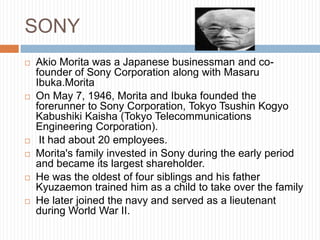
   Akio Morita was a Japanese businessman and co-
    founder of Sony Corporation along with Masaru
    Ibuka.Morita
   On May 7, 1946, Morita and Ibuka founded the
    forerunner to Sony Corporation, Tokyo Tsushin Kogyo
    Kabushiki Kaisha (Tokyo Telecommunications
    Engineering Corporation).
    It had about 20 employees.
   Morita's family invested in Sony during the early period
    and became its largest shareholder.
   He was the oldest of four siblings and his father
    Kyuzaemon trained him as a child to take over the family
   He later joined the navy and served as a lieutenant
    during World War II.
TOSHIBA
   Tanaka Hisashige was a Japanese engineer and inventor
    during the late Edo and Meiji period Japan.
   He is one of the founders of what later
    became Toshiba Corporation.
    He has been called the Thomas Edisonof Japan"
   Tanaka was born in Kurume, Chikugo province (present
    day Fukuoka prefecture) as the eldest son of a tortoise shell
    craftsman.
    A gifted artisan, at the age of 14, he had already invented a
    loom.
   At 20 he made made karakuri dolls, with hydraulic
    mechanism. capable of relatively complex movements, which
    were then much in demand by
    the aristocrats of Kyoto, daimyō in various feudal
    domains, and by the Shōgun’s court in Edo.
    At age 21, he was performing around the country at festivals
    with clockwork dolls he constructed himself.
SAMSUNG
   Byung-chull Lee He was the founder of Samsung Group
    was born February 12, 1910, died 19 November 1987.
    He was the son of a wealthy land owner and had attended
    lectures at the University of Tokyo Wesda though not until
    graduation.
    Lee Byung-chull use inheritance to open a rice mill for the
    first attempt. efforts were not going well.
    In 1938 Lee Byung-Chull export trading company
    established in Korea, selling fish, vegetables, and fruits to
    China.
    Lee moved its headquarters to Seoul in 1947.
   After the war, in 1954, Lee founded Cheil Mojik and build a
    woolen mill in Chimsan-dong, Daegu. And that is the largest
    woolen mill in the country, the company grew rapidly into
    large companies.
   After his death, his estate (Ho-Am) was opened to the public
    for tours.
APPLE
   Steve Jobs was born in San Francisco, California to Joanne
    Simpson and a Syrian father.
   In 1972, Jobs graduated from Homestead High School in
    Cupertino, California and enrolled in Reed College in
    Portland, Oregon
   One semester later, he had dropped out, later taking up the study of
    philosophy and foreign cultures.
   He was co-founder, chairman, and chief executive officer of Apple
    Inc. Jobs also co-founded and served as chief executive of Pixar
    Animation Studios
   he became a member of the board of directors of The Walt Disney
    Company in 2006, following the acquisition of Pixar by Disney.
    On medical leave for most of 2011, Jobs resigned as Apple CEO in
    August that year and was elected Chairman of the Board. He died
    of respiratory arrest related to his metastatic tumor on October
    5, 2011. He continues to receive honors and public recognition for
    his influence in the technology and music industries
NOKIA
   Knut Fredrik Idestam (October 28,1838– April
    8, 1916) was a Finnish mining
    engineer and businessman, best known as a founder of
    Nokia.
   In May 1865, Idestam obtained a permit to construct a
    groundwood paper millat Tampere,Finland. The mill
    began operations in 1866. In 1871, Idestam and Leo
    Mechelin founded Nokia Ltd. and moved the company's
    operations to the city of Nokia, Finland.
   Idestam retired from the management of the company in
    1896.
CURRENT SCENARIO
   India’s consumer electronics devices market,
    defined as the addressable market for computing
    devices, mobile handsets and AV products, is
    projected at about US$29.4bn in 2011.
    This is expected to increase to US$50.6bn by
    2015, driven by rising incomes and growing
    affordability. Only nine out of 1,000 people in India
    own a computer, one-fifth of the level in China,
    while Indian handset population penetration is
    about 57%.
   Spending on consumer electronics devices is
    projected to grow at an overall CAGR of 14%
    through 2015, with the key segments including
    low-cost mobile handsets, colour TVs, set-top
    boxes and notebook computers.
    In 2010 demand for LED TV sets grew
    strongly, and touchscreen phones were
    another growth area.
COMPUTERS
   Computers accounted for about 33% of Indian consumer
    electronics spending in 2010.
   BMI forecasts Indian domestic market computer
    hardware sales (including notebooks and accessories)
    of US$8.9bn in 2011, up from US$8.0bn in 2010.
    Sales were up by as much as one-third in H110
    compared with the same period of the previous year.
   With PC penetration at about 2%, the computer
    hardware compound annual growth rate (CAGR) for the
    2011- 2015 period will be about 18%.
AUDIO AND VIDEO
   India’s domestic video, audio and gaming device
    market is expected to grow to a value of
    US$21.1bn in 2015.
    TV will remain the core product in this
    category, with sports events such as India Premier
    League cricket and the 2010 Commonwealth
    Games in Delhi driving demand for TV set
    upgrades.
   LCD TV set sales were projected to pass 2.7mn in
    2010, while vendors also reported strong growth
    in the LED TV set segment.
MOBILES
   Mobile Handsets Indian mobile handset sales
    accounted for about 33% of Indian consumer
    electronics spending in 2009.
   Total Indian market handset sales are expected to
    approach 229mn units in 2015, as mobile
    subscriber penetration soars towards 145%.
   Vendors are likely to increase their focus on
    semiurban rural customers, with penetration in
    rural areas estimated at less than 15%, far below
    the national level.
   Smartphones and touchscreen models are a
    strong growth area
Electronics industry

Electronics industry

  • 1.
    PRESENTATION ON ChitkaraBusiness School
  • 2.
    Meaning Of ElectronicsIndustry.  Business of creating,designing,producing and selling devices such as : radios televisions cameras stereos computers semiconductors transistors etc.
  • 3.
    EVOLUTION  The electronics industry came in 1900s when the electron tube having two elements was invented by John Ambrose Flemming.  till the 1950s the techniques developed were known as “radio techniques” as they were mainly used in the radio appliances  It was the 1960s when the analog devices were invented that brought a revolution in the electronics industry  In 1970s the consumer electronics were developed  These years also saw the dominance of the United States of America coming to an end with many new economies showing their presence
  • 4.
    IN INDIA  The electronic industry in india took off around 1965  Its was followed by consumer electronics mainly with transistor radios, black & white TV, calculators and other audio products  In 1982 in the history of television in india the government allowed thousand of colour TV sets to be imported into the country  And now growing at a brisk pace  It is currently US$ 32 billion  Constitute 0.7 per cent of global electronic industry
  • 5.
    The output of the electronic hardware industry in india is worth US$ 11.6 billion at present  India is also an exporter of a vast range of electronic components and products for the following segments a) Display technologies b) Entertainment electronics c) Optical Storage devices d) Passive components e) Electromechanical components f) Telecom equipment
  • 6.
    The export performance of electronic goods is expected to touch US $ 15 billion by 2013-14.  In the year 2005 India’s electronic consumption was around 1.8 %.  It is likely to touch 5.5 % in 2010. According to a study conducted by ISA and Frost Sullivan, India’s semi- conductor market would grow by 2.5 times.  The share of electronics production in India's GDP has been growing over the years 1.6% share in India's GDP in 2001-02, it has increased to 1.95% in 2009-10.
  • 7.
    The market forelectronic products in India has witnessed significant growth in recent years due to several factors, such as :-Manufacturing growth ICT penetration, growing disposable income retail boom and attractive finance schemes
  • 8.
    Challanges  Heavy taxation:- total tax around 25-30%  65% of indian population still lives in villages  increase in price wars due to the entry of new players in the market  Poor distribution network in semi-urban and rural areas  Low awareness of consumer electronics products in rural India  Presence of gray market in consumer electronics products, especially in DVD player, music players. Companies need to increase focus on product differentiation to address various segmental specific needs.
  • 9.
    Market Size The electronicindustry in India constitutes just 0.7 % of the global electronic industry
  • 10.
  • 11.
    Market Share OfMajor Players  Sony 15 per cent  Toshiba 13.2 per cent  Samsung  Apple  Nokia 30.6 per cent
  • 12.
    SONY  Akio Morita was a Japanese businessman and co- founder of Sony Corporation along with Masaru Ibuka.Morita  On May 7, 1946, Morita and Ibuka founded the forerunner to Sony Corporation, Tokyo Tsushin Kogyo Kabushiki Kaisha (Tokyo Telecommunications Engineering Corporation).  It had about 20 employees.  Morita's family invested in Sony during the early period and became its largest shareholder.  He was the oldest of four siblings and his father Kyuzaemon trained him as a child to take over the family  He later joined the navy and served as a lieutenant during World War II.
  • 13.
    TOSHIBA  Tanaka Hisashige was a Japanese engineer and inventor during the late Edo and Meiji period Japan.  He is one of the founders of what later became Toshiba Corporation.  He has been called the Thomas Edisonof Japan"  Tanaka was born in Kurume, Chikugo province (present day Fukuoka prefecture) as the eldest son of a tortoise shell craftsman.  A gifted artisan, at the age of 14, he had already invented a loom.  At 20 he made made karakuri dolls, with hydraulic mechanism. capable of relatively complex movements, which were then much in demand by the aristocrats of Kyoto, daimyō in various feudal domains, and by the Shōgun’s court in Edo.  At age 21, he was performing around the country at festivals with clockwork dolls he constructed himself.
  • 14.
    SAMSUNG  Byung-chull Lee He was the founder of Samsung Group  was born February 12, 1910, died 19 November 1987.  He was the son of a wealthy land owner and had attended lectures at the University of Tokyo Wesda though not until graduation.  Lee Byung-chull use inheritance to open a rice mill for the first attempt. efforts were not going well.  In 1938 Lee Byung-Chull export trading company established in Korea, selling fish, vegetables, and fruits to China.  Lee moved its headquarters to Seoul in 1947.  After the war, in 1954, Lee founded Cheil Mojik and build a woolen mill in Chimsan-dong, Daegu. And that is the largest woolen mill in the country, the company grew rapidly into large companies.  After his death, his estate (Ho-Am) was opened to the public for tours.
  • 15.
    APPLE  Steve Jobs was born in San Francisco, California to Joanne Simpson and a Syrian father.  In 1972, Jobs graduated from Homestead High School in Cupertino, California and enrolled in Reed College in Portland, Oregon  One semester later, he had dropped out, later taking up the study of philosophy and foreign cultures.  He was co-founder, chairman, and chief executive officer of Apple Inc. Jobs also co-founded and served as chief executive of Pixar Animation Studios  he became a member of the board of directors of The Walt Disney Company in 2006, following the acquisition of Pixar by Disney.  On medical leave for most of 2011, Jobs resigned as Apple CEO in August that year and was elected Chairman of the Board. He died of respiratory arrest related to his metastatic tumor on October 5, 2011. He continues to receive honors and public recognition for his influence in the technology and music industries
  • 16.
    NOKIA  Knut Fredrik Idestam (October 28,1838– April 8, 1916) was a Finnish mining engineer and businessman, best known as a founder of Nokia.  In May 1865, Idestam obtained a permit to construct a groundwood paper millat Tampere,Finland. The mill began operations in 1866. In 1871, Idestam and Leo Mechelin founded Nokia Ltd. and moved the company's operations to the city of Nokia, Finland.  Idestam retired from the management of the company in 1896.
  • 17.
    CURRENT SCENARIO  India’s consumer electronics devices market, defined as the addressable market for computing devices, mobile handsets and AV products, is projected at about US$29.4bn in 2011.  This is expected to increase to US$50.6bn by 2015, driven by rising incomes and growing affordability. Only nine out of 1,000 people in India own a computer, one-fifth of the level in China, while Indian handset population penetration is about 57%.
  • 18.
    Spending on consumer electronics devices is projected to grow at an overall CAGR of 14% through 2015, with the key segments including low-cost mobile handsets, colour TVs, set-top boxes and notebook computers.  In 2010 demand for LED TV sets grew strongly, and touchscreen phones were another growth area.
  • 19.
    COMPUTERS  Computers accounted for about 33% of Indian consumer electronics spending in 2010.  BMI forecasts Indian domestic market computer hardware sales (including notebooks and accessories) of US$8.9bn in 2011, up from US$8.0bn in 2010.  Sales were up by as much as one-third in H110 compared with the same period of the previous year.  With PC penetration at about 2%, the computer hardware compound annual growth rate (CAGR) for the 2011- 2015 period will be about 18%.
  • 20.
    AUDIO AND VIDEO  India’s domestic video, audio and gaming device market is expected to grow to a value of US$21.1bn in 2015.  TV will remain the core product in this category, with sports events such as India Premier League cricket and the 2010 Commonwealth Games in Delhi driving demand for TV set upgrades.  LCD TV set sales were projected to pass 2.7mn in 2010, while vendors also reported strong growth in the LED TV set segment.
  • 21.
    MOBILES  Mobile Handsets Indian mobile handset sales accounted for about 33% of Indian consumer electronics spending in 2009.  Total Indian market handset sales are expected to approach 229mn units in 2015, as mobile subscriber penetration soars towards 145%.  Vendors are likely to increase their focus on semiurban rural customers, with penetration in rural areas estimated at less than 15%, far below the national level.  Smartphones and touchscreen models are a strong growth area