Fundamentals
 of Electronics
Electronic Circuit

     Is composed of different components
     that are classified as

     Passive and Active Components.
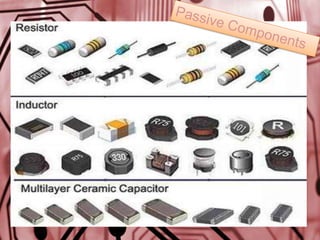
Are components that do not generate voltage but
controls the current in a circuit.

e.g.


        Resistors, Capacitors, Inductors etc.
Active Components


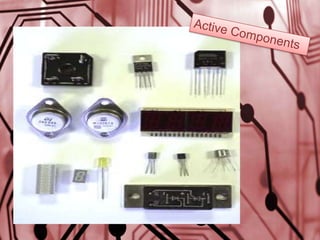
    Are components that can be generate
    amplify and even controls the current in a
    circuit

    e.g.

    Diode, Transistor, Integrated Circuits (IC)
A. Resistor Family

Resistor
  - An electrical component that is used to
  oppose the flow of current
(5 types of Resistor)
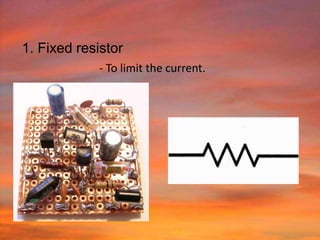
1. Fixed resistor
             - To limit the current.
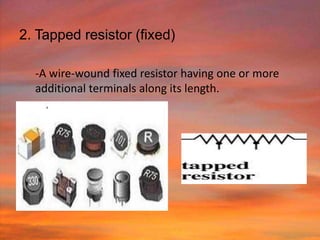
2. Tapped resistor (fixed)

  -A wire-wound fixed resistor having one or more
  additional terminals along its length.
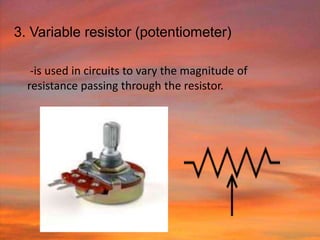
3. Variable resistor (potentiometer)

   -is used in circuits to vary the magnitude of
  resistance passing through the resistor.
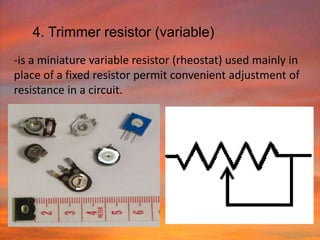
4. Trimmer resistor (variable)
-is a miniature variable resistor (rheostat) used mainly in
place of a fixed resistor permit convenient adjustment of
resistance in a circuit.
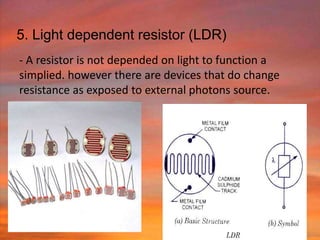
5. Light dependent resistor (LDR)
- A resistor is not depended on light to function a
simplied. however there are devices that do change
resistance as exposed to external photons source.
B. Capacitor Family


Capacitor


– An Electrical device consist of two plates
separated by an insulators called “Dielectric”
and has the capability to charge and discharge
voltage.
( 6 types of Capacitor)
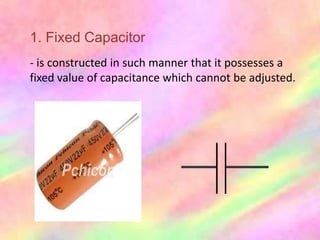
1. Fixed Capacitor
- is constructed in such manner that it possesses a
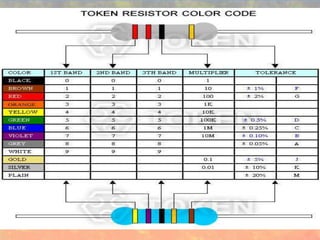
fixed value of capacitance which cannot be adjusted.
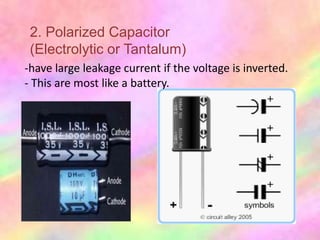
2. Polarized Capacitor
 (Electrolytic or Tantalum)
-have large leakage current if the voltage is inverted.
- This are most like a battery.
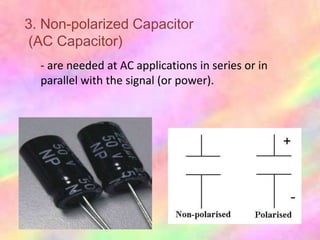
3. Non-polarized Capacitor
(AC Capacitor)
  - are needed at AC applications in series or in
  parallel with the signal (or power).
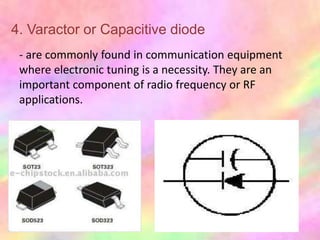
4. Varactor or Capacitive diode
 - are commonly found in communication equipment
 where electronic tuning is a necessity. They are an
 important component of radio frequency or RF
 applications.
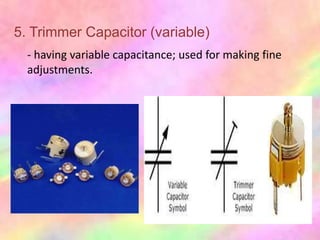
5. Trimmer Capacitor (variable)
  - having variable capacitance; used for making fine
  adjustments.
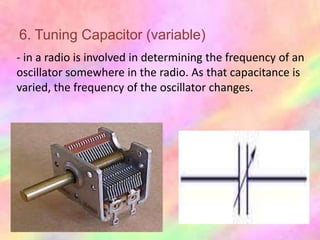
6. Tuning Capacitor (variable)
- in a radio is involved in determining the frequency of an
oscillator somewhere in the radio. As that capacitance is
varied, the frequency of the oscillator changes.
C. Coil Family
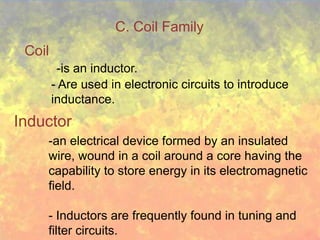
 Coil
         -is an inductor.
        - Are used in electronic circuits to introduce
        inductance.
Inductor
    -an electrical device formed by an insulated
    wire, wound in a coil around a core having the
    capability to store energy in its electromagnetic
    field.

    - Inductors are frequently found in tuning and
    filter circuits.
D. Semi-Conductor Family


Diode

   - an Electronic device that permits current
   to pass or to flow in only one direction.
Transistor
   -a semi conductor device use for amplification
   and switching application in electronic circuits.


Thyristor
   – a class of four layer semi-conductor device
   used to control AC voltage application
14 Types of semi- conductor Family
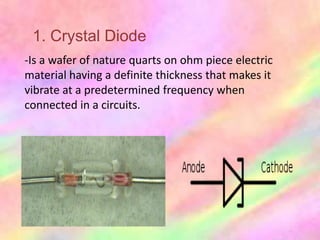
1. Crystal Diode
-Is a wafer of nature quarts on ohm piece electric
material having a definite thickness that makes it
vibrate at a predetermined frequency when
connected in a circuits.
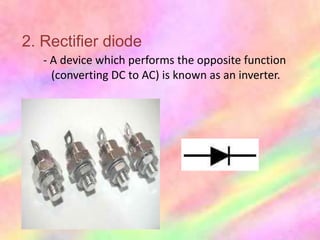
2. Rectifier diode
   - A device which performs the opposite function
     (converting DC to AC) is known as an inverter.
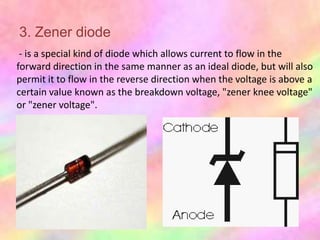
3. Zener diode
 - is a special kind of diode which allows current to flow in the
forward direction in the same manner as an ideal diode, but will also
permit it to flow in the reverse direction when the voltage is above a
certain value known as the breakdown voltage, "zener knee voltage"
or "zener voltage".
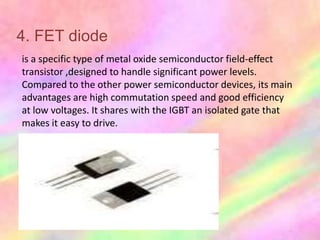
4. FET diode
is a specific type of metal oxide semiconductor field-effect
transistor ,designed to handle significant power levels.
Compared to the other power semiconductor devices, its main
advantages are high commutation speed and good efficiency
at low voltages. It shares with the IGBT an isolated gate that
makes it easy to drive.
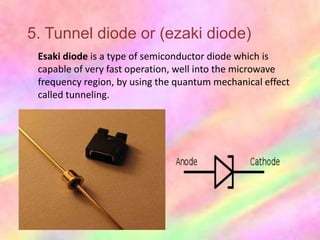
5. Tunnel diode or (ezaki diode)
 Esaki diode is a type of semiconductor diode which is
 capable of very fast operation, well into the microwave
 frequency region, by using the quantum mechanical effect
 called tunneling.
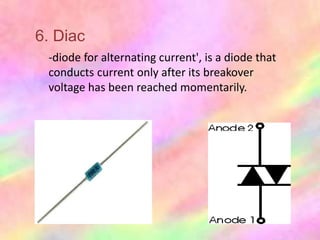
6. Diac
 -diode for alternating current', is a diode that
 conducts current only after its breakover
 voltage has been reached momentarily.
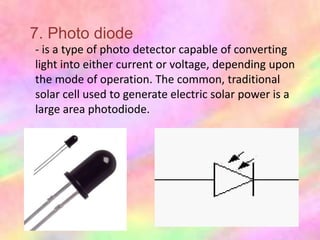
7. Photo diode
- is a type of photo detector capable of converting
light into either current or voltage, depending upon
the mode of operation. The common, traditional
solar cell used to generate electric solar power is a
large area photodiode.
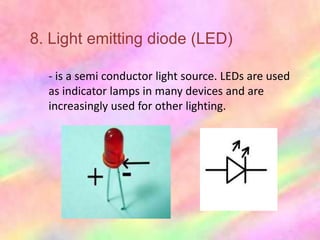
8. Light emitting diode (LED)

  - is a semi conductor light source. LEDs are used
  as indicator lamps in many devices and are
  increasingly used for other lighting.
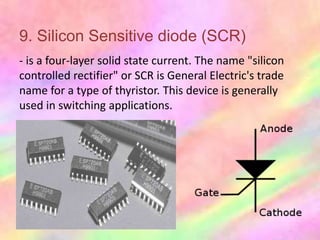
9. Silicon Sensitive diode (SCR)
- is a four-layer solid state current. The name "silicon
controlled rectifier" or SCR is General Electric's trade
name for a type of thyristor. This device is generally
used in switching applications.
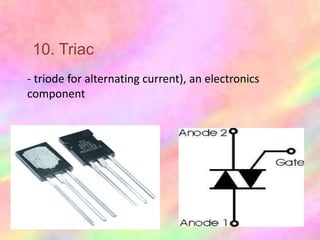
10. Triac
- triode for alternating current), an electronics
component
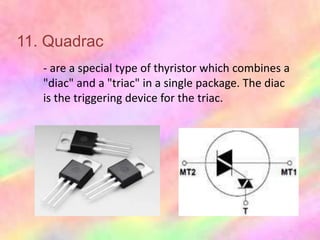
11. Quadrac
   - are a special type of thyristor which combines a
   "diac" and a "triac" in a single package. The diac
   is the triggering device for the triac.
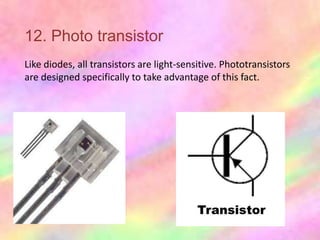
12. Photo transistor
Like diodes, all transistors are light-sensitive. Phototransistors
are designed specifically to take advantage of this fact.
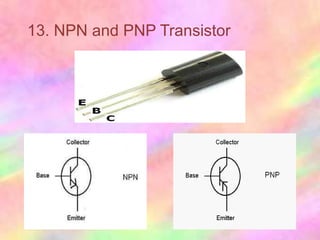
13. NPN and PNP Transistor
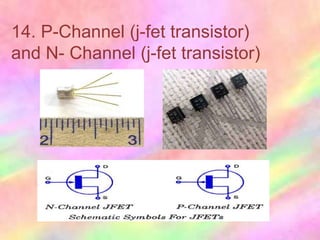
14. P-Channel (j-fet transistor)
and N- Channel (j-fet transistor)
E. Other Components


are components that are Commonly use
         in creating a device.
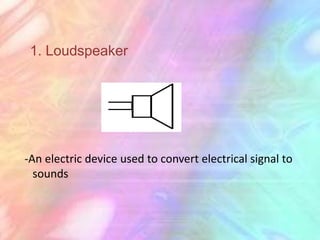
1. Loudspeaker


-An electric device used to convert electrical signal to
  sounds
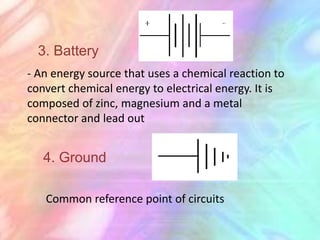
3. Battery
- An energy source that uses a chemical reaction to
convert chemical energy to electrical energy. It is
composed of zinc, magnesium and a metal
connector and lead out


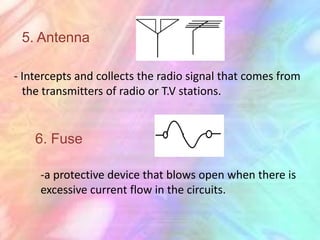
   4. Ground

   Common reference point of circuits
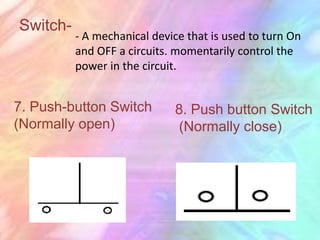
5. Antenna

- Intercepts and collects the radio signal that comes from
  the transmitters of radio or T.V stations.


    6. Fuse

     -a protective device that blows open when there is
     excessive current flow in the circuits.
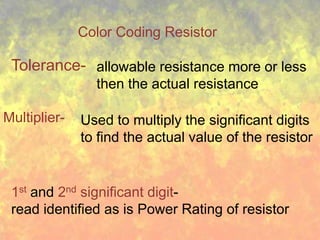
Switch-
          - A mechanical device that is used to turn On
          and OFF a circuits. momentarily control the
          power in the circuit.


7. Push-button Switch        8. Push button Switch
(Normally open)              (Normally close)
Color Coding Resistor

 Tolerance- allowable resistance more or less
                then the actual resistance

Multiplier-   Used to multiply the significant digits
              to find the actual value of the resistor


 1st and 2nd significant digit-
 read identified as is Power Rating of resistor
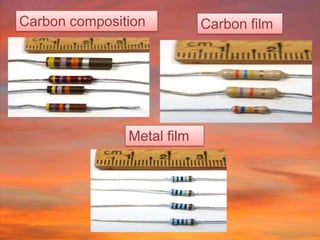
Carbon composition          Carbon film


               Metal film
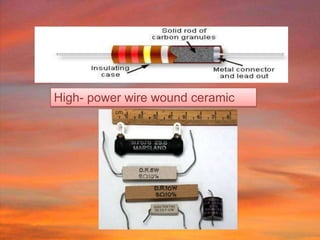
High- power wire wound ceramic
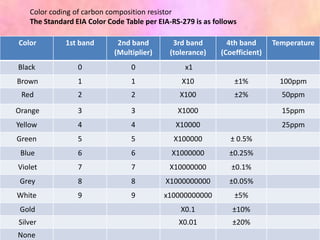
Color coding of carbon composition resistor
   The Standard EIA Color Code Table per EIA-RS-279 is as follows

Color        1st band        2nd band        3rd band         4th band      Temperature
                            (Multiplier)    (tolerance)     (Coefficient)
Black            0               0               x1
Brown            1               1              X10             ±1%           100ppm
 Red             2               2             X100             ±2%           50ppm

Orange           3               3             X1000                          15ppm
Yellow           4               4            X10000                          25ppm
Green            5               5            X100000          ± 0.5%
 Blue            6               6           X1000000         ±0.25%
Violet           7               7          X10000000          ±0.1%
 Grey            8               8         X1000000000        ±0.05%
White            9               9         x10000000000         ±5%
 Gold                                           X0.1           ±10%
Silver                                         X0.01           ±20%
None
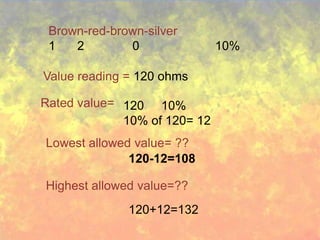
Brown-red-brown-silver
 1   2        0               10%

Value reading = 120 ohms

Rated value= 120 10%
             10% of 120= 12
Lowest allowed value= ??
              120-12=108

Highest allowed value=??
              120+12=132

Electronics ..

  • 1.
  • 2.
    Electronic Circuit Is composed of different components that are classified as Passive and Active Components.
  • 3.
    Are components thatdo not generate voltage but controls the current in a circuit. e.g. Resistors, Capacitors, Inductors etc.
  • 5.
    Active Components Are components that can be generate amplify and even controls the current in a circuit e.g. Diode, Transistor, Integrated Circuits (IC)
  • 7.
    A. Resistor Family Resistor - An electrical component that is used to oppose the flow of current
  • 8.
    (5 types ofResistor)
  • 9.
    1. Fixed resistor - To limit the current.
  • 10.
    2. Tapped resistor(fixed) -A wire-wound fixed resistor having one or more additional terminals along its length.
  • 11.
    3. Variable resistor(potentiometer) -is used in circuits to vary the magnitude of resistance passing through the resistor.
  • 12.
    4. Trimmer resistor(variable) -is a miniature variable resistor (rheostat) used mainly in place of a fixed resistor permit convenient adjustment of resistance in a circuit.
  • 13.
    5. Light dependentresistor (LDR) - A resistor is not depended on light to function a simplied. however there are devices that do change resistance as exposed to external photons source.
  • 14.
    B. Capacitor Family Capacitor –An Electrical device consist of two plates separated by an insulators called “Dielectric” and has the capability to charge and discharge voltage.
  • 15.
    ( 6 typesof Capacitor)
  • 16.
    1. Fixed Capacitor -is constructed in such manner that it possesses a fixed value of capacitance which cannot be adjusted.
  • 17.
    2. Polarized Capacitor (Electrolytic or Tantalum) -have large leakage current if the voltage is inverted. - This are most like a battery.
  • 18.
    3. Non-polarized Capacitor (ACCapacitor) - are needed at AC applications in series or in parallel with the signal (or power).
  • 19.
    4. Varactor orCapacitive diode - are commonly found in communication equipment where electronic tuning is a necessity. They are an important component of radio frequency or RF applications.
  • 20.
    5. Trimmer Capacitor(variable) - having variable capacitance; used for making fine adjustments.
  • 21.
    6. Tuning Capacitor(variable) - in a radio is involved in determining the frequency of an oscillator somewhere in the radio. As that capacitance is varied, the frequency of the oscillator changes.
  • 22.
    C. Coil Family Coil -is an inductor. - Are used in electronic circuits to introduce inductance. Inductor -an electrical device formed by an insulated wire, wound in a coil around a core having the capability to store energy in its electromagnetic field. - Inductors are frequently found in tuning and filter circuits.
  • 24.
    D. Semi-Conductor Family Diode - an Electronic device that permits current to pass or to flow in only one direction.
  • 25.
    Transistor -a semi conductor device use for amplification and switching application in electronic circuits. Thyristor – a class of four layer semi-conductor device used to control AC voltage application
  • 26.
    14 Types ofsemi- conductor Family
  • 27.
    1. Crystal Diode -Isa wafer of nature quarts on ohm piece electric material having a definite thickness that makes it vibrate at a predetermined frequency when connected in a circuits.
  • 28.
    2. Rectifier diode - A device which performs the opposite function (converting DC to AC) is known as an inverter.
  • 29.
    3. Zener diode - is a special kind of diode which allows current to flow in the forward direction in the same manner as an ideal diode, but will also permit it to flow in the reverse direction when the voltage is above a certain value known as the breakdown voltage, "zener knee voltage" or "zener voltage".
  • 30.
    4. FET diode isa specific type of metal oxide semiconductor field-effect transistor ,designed to handle significant power levels. Compared to the other power semiconductor devices, its main advantages are high commutation speed and good efficiency at low voltages. It shares with the IGBT an isolated gate that makes it easy to drive.
  • 31.
    5. Tunnel diodeor (ezaki diode) Esaki diode is a type of semiconductor diode which is capable of very fast operation, well into the microwave frequency region, by using the quantum mechanical effect called tunneling.
  • 32.
    6. Diac -diodefor alternating current', is a diode that conducts current only after its breakover voltage has been reached momentarily.
  • 33.
    7. Photo diode -is a type of photo detector capable of converting light into either current or voltage, depending upon the mode of operation. The common, traditional solar cell used to generate electric solar power is a large area photodiode.
  • 34.
    8. Light emittingdiode (LED) - is a semi conductor light source. LEDs are used as indicator lamps in many devices and are increasingly used for other lighting.
  • 35.
    9. Silicon Sensitivediode (SCR) - is a four-layer solid state current. The name "silicon controlled rectifier" or SCR is General Electric's trade name for a type of thyristor. This device is generally used in switching applications.
  • 36.
    10. Triac - triodefor alternating current), an electronics component
  • 37.
    11. Quadrac - are a special type of thyristor which combines a "diac" and a "triac" in a single package. The diac is the triggering device for the triac.
  • 38.
    12. Photo transistor Likediodes, all transistors are light-sensitive. Phototransistors are designed specifically to take advantage of this fact.
  • 39.
    13. NPN andPNP Transistor
  • 40.
    14. P-Channel (j-fettransistor) and N- Channel (j-fet transistor)
  • 41.
    E. Other Components arecomponents that are Commonly use in creating a device.
  • 42.
    1. Loudspeaker -An electricdevice used to convert electrical signal to sounds
  • 43.
    3. Battery - Anenergy source that uses a chemical reaction to convert chemical energy to electrical energy. It is composed of zinc, magnesium and a metal connector and lead out 4. Ground Common reference point of circuits
  • 44.
    5. Antenna - Interceptsand collects the radio signal that comes from the transmitters of radio or T.V stations. 6. Fuse -a protective device that blows open when there is excessive current flow in the circuits.
  • 45.
    Switch- - A mechanical device that is used to turn On and OFF a circuits. momentarily control the power in the circuit. 7. Push-button Switch 8. Push button Switch (Normally open) (Normally close)
  • 46.
    Color Coding Resistor Tolerance- allowable resistance more or less then the actual resistance Multiplier- Used to multiply the significant digits to find the actual value of the resistor 1st and 2nd significant digit- read identified as is Power Rating of resistor
  • 47.
    Carbon composition Carbon film Metal film
  • 48.
    High- power wirewound ceramic
  • 49.
    Color coding ofcarbon composition resistor The Standard EIA Color Code Table per EIA-RS-279 is as follows Color 1st band 2nd band 3rd band 4th band Temperature (Multiplier) (tolerance) (Coefficient) Black 0 0 x1 Brown 1 1 X10 ±1% 100ppm Red 2 2 X100 ±2% 50ppm Orange 3 3 X1000 15ppm Yellow 4 4 X10000 25ppm Green 5 5 X100000 ± 0.5% Blue 6 6 X1000000 ±0.25% Violet 7 7 X10000000 ±0.1% Grey 8 8 X1000000000 ±0.05% White 9 9 x10000000000 ±5% Gold X0.1 ±10% Silver X0.01 ±20% None
  • 51.
    Brown-red-brown-silver 1 2 0 10% Value reading = 120 ohms Rated value= 120 10% 10% of 120= 12 Lowest allowed value= ?? 120-12=108 Highest allowed value=?? 120+12=132

Editor's Notes

  • #2 Fundamentals of ElectronicsElectronics -
  • #3 Electronic Circuit is composed of different components that are classified as Passive and Active Components.
  • #4  Passive components or deviceAre components that do not generate voltage but controls the current in a circuit.e.g. Resistors, capacitors, induciors etc.
  • #6 Active ComponentsAre components that can be generate amplify and even controls the current in a circuit e.g. diode, transistor, integrated circuits (IC) and etc.
  • #8 Basic Electronic symbolsa. Resistor FamilyResistor- An electrical component that is used to oppose the flow of current(5 types of Resistor)
  • #10 2. Tapped resistor (fixed)3. Variable resistor (potentiometer) 4. Trimmer resistor (variable)5. Light dependent resistor (LDR) Fixed resistor- -To limit the current
  • #11 tapped resistor--A wire-wound fixed resistor having one or more additional terminals along its length, generally for voltage-divider applications.A variable resistor-- is used in circuits to vary the magnitude of resistance passing through the resistor. It is commonly used to change the value of current across a circuit to find relationships of current and voltage.light dependent resistor--A resistor is not depended on light to function a simplied. however there are devices that do change resistance as exposed to external photons source. This devices can be used for count parts as light gets interrupted as alarms of all sort. Detecting if a light is present or not as in intrusion alerts in buildings, homes as isolating devices from one source to another and many more application these are just a few examples.
  • #12 A variable resistor-- is used in circuits to vary the magnitude of resistance passing through the resistor. It is commonly used to change the value of current across a circuit to find relationships of current and voltage.
  • #13 -is a miniature variable resistor (rheostat) used mainly in place of a fixed resistor permit convenient adjustment of resistance in a curcuit.
  • #14 light dependent resistor--A resistor is not depended on light to function a simplied. however there are devices that do change resistance as exposed to external photons source. This devices can be used for count parts as light gets interrupted as alarms of all sort. Detecting if a light is present or not as in intrusion alerts in buildings, homes as isolating devices from one source to another and many more application these are just a few examples.
  • #15 B. Capacitor FamilyCapacitor – An Electrical device consist of two plates separated by an insulators called “ Dielectric” and has the capability to charge and discharge voltage.
  • #16 ( 6 types of Capacitor)
  • #17 1. Fixed Capacitor A fixed capacitor-- is constructed in such manner that it possesses a fixed value of capacitance which cannot be adjusted.
  • #18 2. Polarized Capacitor (Electrolytic or Tantalum)have large leakage current if the voltage is inverted.
  • #19 3. Non-polarized Capacitor (AC Capacitor)are needed at AC applications in series or in parallel with the signal (or power).
  • #20 4. Varactor or Capacitive diodeare commonly found in communication equipment where electronic tuning is a necessity. They are an important component of radio frequency or RF applications.
  • #21 5. Trimmer Capacitor (variable)having variable capacitance; used for making fine adjustments
  • #22 6. Tuning Capacitor (variable)- in a radio is involved in determining the frequency of an oscillator somewhere in the radio. As that capacitance is varied, the frequency of the oscillator changes.
  • #23  Coil, an electrical device formed by an insulated wire, wound in a coil around a core having the capability to store energy in its electromagnetic field.- Are used in electronic circuits to introduce inductance. Inductors are frequently found in tuning and filter circuits.
  • #24 C. Coil Family
  • #25 Diode- an Electronic device that permits current to pass or to flow in only one direction. Transistor – a semi conductor device use for amplification and switching application in electronic curcuits.
  • #26 Thyristor – a class of four layer semi-conductor device used to control AC voltage application
  • #28 Is a wafer of nature quarts on ohm piece electric material having a definite thickness that makes it vibrate at a predetermined frequency when connected in a circuits.
  • #29 - A device which performs the opposite function (converting DC to AC) is known as an inverter.
  • #30 3. Zener diode--- is a special kind of diode which allows current to flow in the forward direction in the same manner as an ideal diode, but will also permit it to flow in the reverse direction when the voltage is above a certain value known as the breakdown voltage, "zener knee voltage" or "zener voltage".
  • #32 Esaki diode is a type of semiconductor diode which is capable of very fast operation, well into the microwave frequency region, by using the quantum mechanical effect called tunneling.
  • #33 or 'diode for alternating current', is a diode that conducts current only after its breakover voltage has been reached momentarily.
  • #34 is a type of photodetector capable of converting light into either current or voltage, depending upon the mode of operation. The common, traditional solar cell used to generate electric solar power is a large area photodiode.
  • #35 is a semiconductor light source. LEDs are used as indicator lamps in many devices and are increasingly used for other lighting.
  • #36 - is a four-layer solid statecurrent. The name "silicon controlled rectifier" or SCR is General Electric's trade name for a type of thyristor. This device is generally used in switching applications.
  • #37 triode for alternating current), an electronics component
  • #38 are a special type of thyristorwhich combines a "diac" and a "triac" in a single package. The diac is the triggering device for the triac.
  • #39 Like diodes, all transistors are light-sensitive. Phototransistors are designed specifically to take advantage of this fact.
  • #41 15. P-Channel (j-fet transistor) and N- Channel (j-fet transistor)
  • #42 E. Other Componentsare components that are Commonly use in creating a device.
  • #43 1. Loudspeaker2. Electric Cell3. Battery-An electric device used to convert electrical signal to sounds
  • #44 An energy source that uses a chemical reaction to convert chemical energy to electrical energy.- Common reference point of circuts magnesium
  • #45 4. Ground5. Antenna6. FuseIntercepts and collects the radio signal that comes from the transmitters of radio or T.V stations.- a protective device that blows open when there is excessive current flow in the circuits.
  • #46 Switch- - A mechanical device that is used to momentarily control the power in the circuit.
  • #47 Color coding Resistor Tolerance- allowable resistance more or less then the actual resistance Multiplier- Used to multiply the significant digits to find the actual value of the resistor 1st and 2nd significant digit- read identified as is Power Rating of resistor
  • #48 Carbon compositionCarbon filmMetal film – having 5 bands
  • #49 High- power wire wound ceramic
  • #50  Color coding of carbon composition resistorThe Standard EIA Colour Code Table per EIA-RS-279 is as follows:-Colour 1st band 2nd band 3rd band 4th band Temperature (Multiplier) (tolerance) Coefficient Black 0 0 ×1 ±1% Brown 1 1 ×10 ±2% 100 ppm Red 2 2 ×100 50 ppm Orange 3 3 ×1000 15 ppm Yellow 4 4 ×100000 25 ppm Green 5 5 ×1000000 ±0.5% Blue 6 6 ×10000000 ±0.25% Violet 7 7 ×100000000 ±0.1% Grey 8 8 ×1000000000 ±0.05% White 9 9 ×10000000000 Gold ×0.1 ±5% Silver ×0.01 ±10% None ±20%
  • #52 Brown-red-brown-silver 2 0 ±10%Value reading = 120 ohmsRated value= 120 ± 10% 10% of 120= 12Lowest allowed value= ?? 120-12=108Highest allowed value=?? 120+12=132