Work experience
power point
Resistor colour coding
Resistor combinations
Electronic components
One decade of the E12 series (there are twelve
preferred values per decade of values) shown with their
electronic color codes on resistors
A 100 kΩ, 5% axial-lead resistor
A 0Ω resistor, marked with a
single black band
A 2260 ohm, 1% precision resistor with 5 color bands
(E96 series), from top 2-2-6-1-1; the last two brown
bands indicate the multiplier (x10), and the 1%
tolerance. The larger gap before the tolerance band is
somewhat difficult to distinguish.

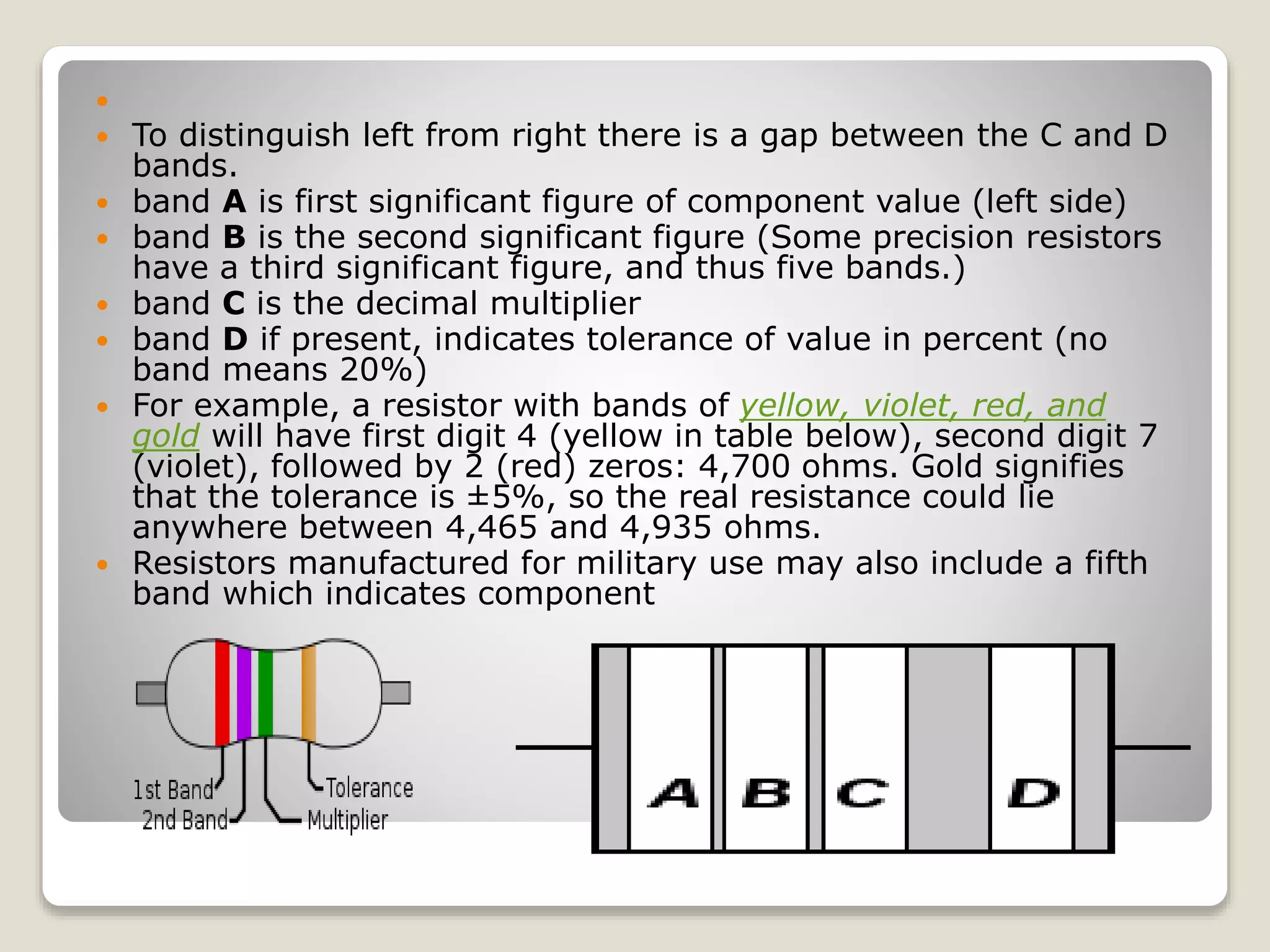
 To distinguish left from right there is a gap between the C and D
bands.
 band A is first significant figure of component value (left side)
 band B is the second significant figure (Some precision resistors
have a third significant figure, and thus five bands.)
 band C is the decimal multiplier
 band D if present, indicates tolerance of value in percent (no
band means 20%)
 For example, a resistor with bands of yellow, violet, red, and
gold will have first digit 4 (yellow in table below), second digit 7
(violet), followed by 2 (red) zeros: 4,700 ohms. Gold signifies
that the tolerance is ±5%, so the real resistance could lie
anywhere between 4,465 and 4,935 ohms.
 Resistors manufactured for military use may also include a fifth
band which indicates component
Color
Significant
figures
Multiplier Tolerance Temp. Coefficient (ppm/K)
Black 0 ×100 – 250 U
Brown 1 ×101 ±1% F 100 S
Red 2 ×10² ±2% G 50 R
Orange 3 ×10³ – 15 P
Yellow 4 ×10⁴ (±5%) – 25 Q
Green 5 ×10⁵ ±0.5% D 20 Z
Blue 6 ×10⁶ ±0.25% C 10 Z
Violet 7 ×10⁷ ±0.1% B 5 M
Gray 8 ×10⁸ ±0.05% (±10%) A 1 K
White 9 ×10⁹ – –
Gold – ×10-1 ±5% J –
Silver – ×10-2 ±10% K –
None – – ±20% M –
The standard color code per EN 60062:2005 is as follows:
 Resistors use preferred numbers for their
specific values, which are determined by
their tolerance. These values repeat for every
decade of magnitude: 6.8, 68, 680, and so
forth. In the E24 series the values are related
by the 24th root of 10, while E12 series are
related by the 12th root of 10, and E6
series by the 6th root of 10. The tolerance of
device values is arranged so that every value
corresponds to a preferred number, within
the required tolerance.
 Zero ohm resistors are made as lengths of wire wrapped in
a resistor-shaped body which can be substituted for
another resistor value in automatic insertion equipment.
They are marked with a single black band.[4]
 The 'body-end-dot' or 'body-tip-spot' system was used for
radial-lead (and other cylindrical) composition resistors
sometimes still found in very old equipment; the first band
was given by the body color, the second band by the color
of the end of the resistor, and the multiplier by a dot or
band around the middle of the resistor. The other end of
the resistor was colored gold or silver to give the tolerance,
otherwise it was 20%.[5]

Resistor in
Series and
Parallel
Combinations
 Resistor circuits that combine series and
parallel resistors networks together are
generally known as Resistor
Combination or mixed resistor circuits.
The method of calculating the circuits
equivalent resistance is the same as that
for any individual series or parallel circuit
and hopefully we now know that resistors
in series carry exactly the same current
and that resistors in parallel have exactly
the same voltage across them.
Electronic
components
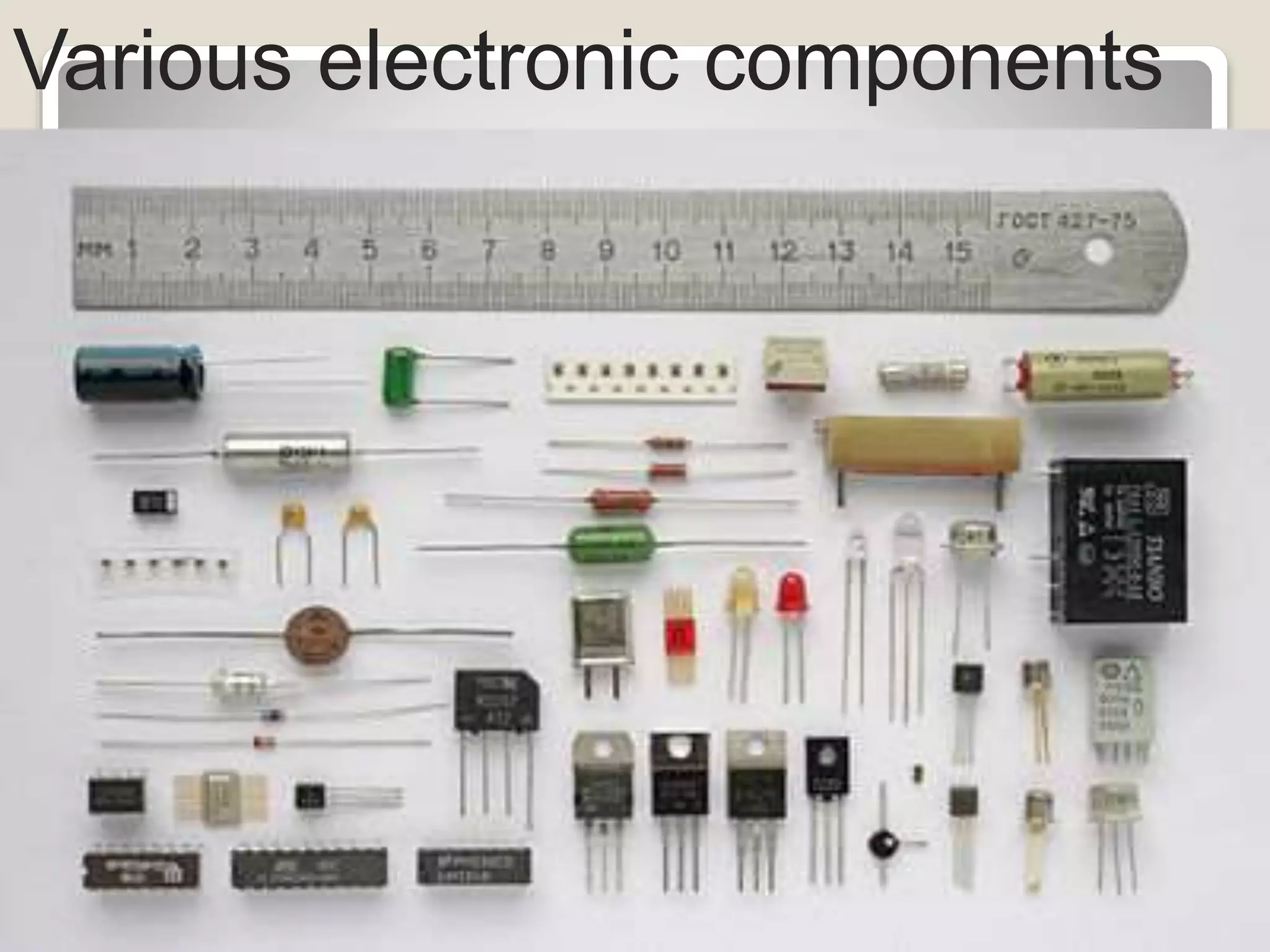
Various electronic components
 An electronic component is any
basic discrete device or physical entity
in an electronic system used to
affect electrons or their associated fields.
Electronic components are mostly
industrial products, available in a singular
form and are not to be confused
with electrical elements, which are
conceptual abstractions representing
idealized electronic components.
 Electronic components have two or more
electrical terminals (or leads) aside
from antennas which may only have one terminal.
These leads connect, usually soldered to a printed
circuit board, to create an electronic
circuit (a discrete circuit) with a particular function
(for example an amplifier, radio receiver,
or oscillator). Basic electronic components may be
packaged discretely, as arrays or networks of like
components, or integrated inside of packages such
as semiconductor integrated circuits, hybrid
integrated circuits, or thick film devices. The following
list of electronic components focuses on the discrete
version of these components, treating such packages
as components in their own right.
 Classification
 A component may be classified
as passive, active, or electromechanic.
The strict physics definition treats passive
components as ones that cannot supply
energy themselves, whereas
a battery would be seen as an active
component since it truly acts as a source
of energy.
 However, electronic engineers who perform circuit
analysis use a more restrictive definition of passivity. When
only concerned with the energy of signals, it is convenient
to ignore the so-called DC circuit and pretend that the
power supplying components such
as transistors or integrated circuits is absent (as if each
such component had its own battery built in), though it
may in reality be supplied by the DC circuit. Then, the
analysis only concerns the AC circuit, an abstraction that
ignores DC voltages and currents (and the power
associated with them) present in the real-life circuit. This
fiction, for instance, lets us view an oscillator as "producing
energy" even though in reality the oscillator consumes
even more energy from a DC power supply, which we have
chosen to ignore. Under that restriction, we define the
terms as used in circuit analysis as:
 Active components rely on a source of
energy (usually from the DC circuit, which
we have chosen to ignore) and usually
can inject power into a circuit, though this
is not part of the definition.[1] Active
components include amplifying
components such as transistors,
triode vacuum tubes (valves), and tunnel
diodes.
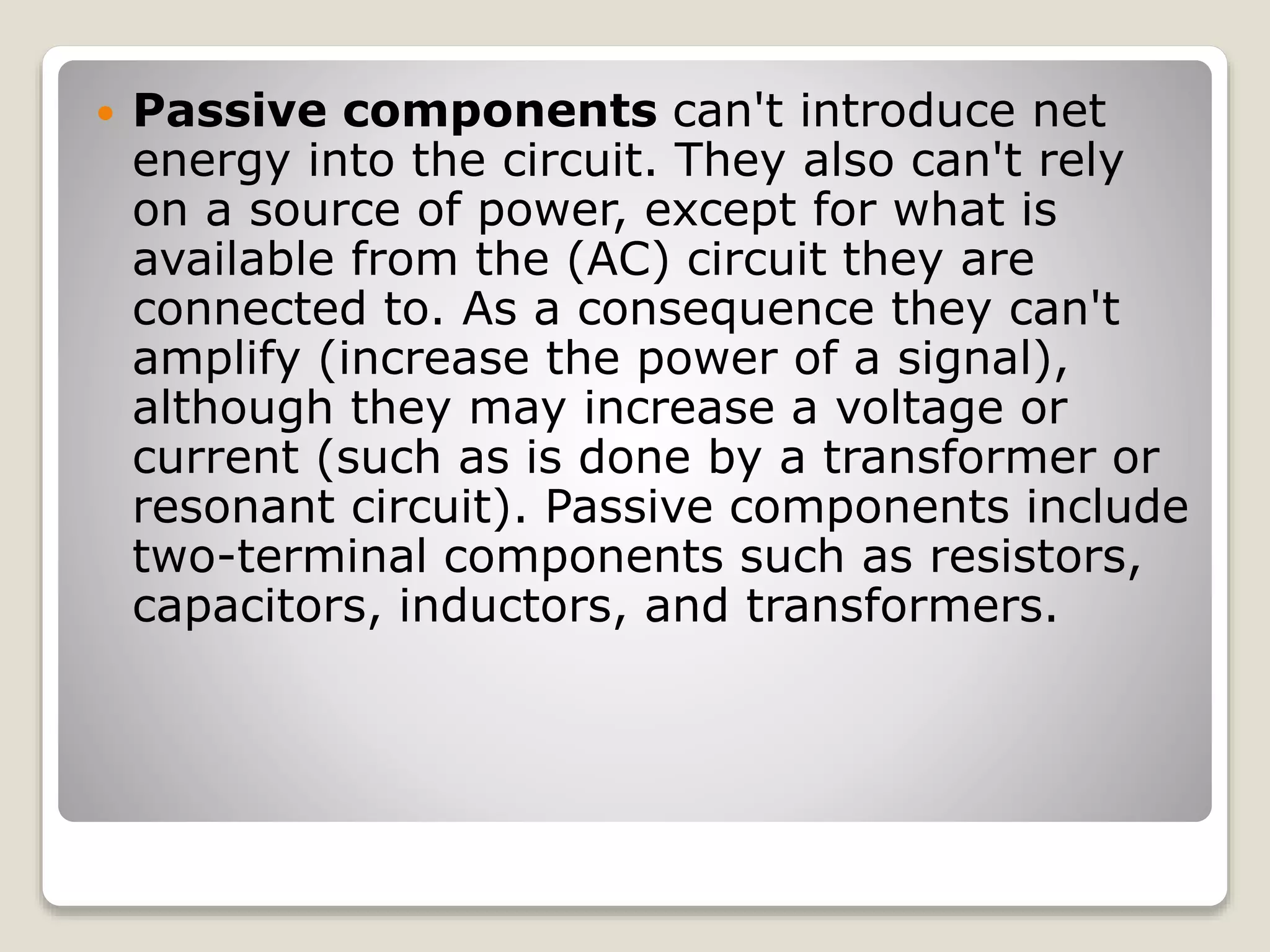
 Passive components can't introduce net
energy into the circuit. They also can't rely
on a source of power, except for what is
available from the (AC) circuit they are
connected to. As a consequence they can't
amplify (increase the power of a signal),
although they may increase a voltage or
current (such as is done by a transformer or
resonant circuit). Passive components include
two-terminal components such as resistors,
capacitors, inductors, and transformers.
 Electromechanical components can
carry out electrical operations by using
moving parts or by using electrical
connections
THANK YOU
DONE BY
VISHNU MADHAV K. N
IX B
KV II KSD

Work experience power point

  • 1.
    Work experience power point Resistorcolour coding Resistor combinations Electronic components
  • 2.
    One decade ofthe E12 series (there are twelve preferred values per decade of values) shown with their electronic color codes on resistors
  • 3.
    A 100 kΩ,5% axial-lead resistor
  • 4.
    A 0Ω resistor,marked with a single black band
  • 5.
    A 2260 ohm,1% precision resistor with 5 color bands (E96 series), from top 2-2-6-1-1; the last two brown bands indicate the multiplier (x10), and the 1% tolerance. The larger gap before the tolerance band is somewhat difficult to distinguish.
  • 6.
      To distinguishleft from right there is a gap between the C and D bands.  band A is first significant figure of component value (left side)  band B is the second significant figure (Some precision resistors have a third significant figure, and thus five bands.)  band C is the decimal multiplier  band D if present, indicates tolerance of value in percent (no band means 20%)  For example, a resistor with bands of yellow, violet, red, and gold will have first digit 4 (yellow in table below), second digit 7 (violet), followed by 2 (red) zeros: 4,700 ohms. Gold signifies that the tolerance is ±5%, so the real resistance could lie anywhere between 4,465 and 4,935 ohms.  Resistors manufactured for military use may also include a fifth band which indicates component
  • 7.
    Color Significant figures Multiplier Tolerance Temp.Coefficient (ppm/K) Black 0 ×100 – 250 U Brown 1 ×101 ±1% F 100 S Red 2 ×10² ±2% G 50 R Orange 3 ×10³ – 15 P Yellow 4 ×10⁴ (±5%) – 25 Q Green 5 ×10⁵ ±0.5% D 20 Z Blue 6 ×10⁶ ±0.25% C 10 Z Violet 7 ×10⁷ ±0.1% B 5 M Gray 8 ×10⁸ ±0.05% (±10%) A 1 K White 9 ×10⁹ – – Gold – ×10-1 ±5% J – Silver – ×10-2 ±10% K – None – – ±20% M – The standard color code per EN 60062:2005 is as follows:
  • 8.
     Resistors usepreferred numbers for their specific values, which are determined by their tolerance. These values repeat for every decade of magnitude: 6.8, 68, 680, and so forth. In the E24 series the values are related by the 24th root of 10, while E12 series are related by the 12th root of 10, and E6 series by the 6th root of 10. The tolerance of device values is arranged so that every value corresponds to a preferred number, within the required tolerance.
  • 9.
     Zero ohmresistors are made as lengths of wire wrapped in a resistor-shaped body which can be substituted for another resistor value in automatic insertion equipment. They are marked with a single black band.[4]  The 'body-end-dot' or 'body-tip-spot' system was used for radial-lead (and other cylindrical) composition resistors sometimes still found in very old equipment; the first band was given by the body color, the second band by the color of the end of the resistor, and the multiplier by a dot or band around the middle of the resistor. The other end of the resistor was colored gold or silver to give the tolerance, otherwise it was 20%.[5] 
  • 10.
  • 11.
     Resistor circuitsthat combine series and parallel resistors networks together are generally known as Resistor Combination or mixed resistor circuits. The method of calculating the circuits equivalent resistance is the same as that for any individual series or parallel circuit and hopefully we now know that resistors in series carry exactly the same current and that resistors in parallel have exactly the same voltage across them.
  • 12.
  • 13.
  • 14.
     An electroniccomponent is any basic discrete device or physical entity in an electronic system used to affect electrons or their associated fields. Electronic components are mostly industrial products, available in a singular form and are not to be confused with electrical elements, which are conceptual abstractions representing idealized electronic components.
  • 15.
     Electronic componentshave two or more electrical terminals (or leads) aside from antennas which may only have one terminal. These leads connect, usually soldered to a printed circuit board, to create an electronic circuit (a discrete circuit) with a particular function (for example an amplifier, radio receiver, or oscillator). Basic electronic components may be packaged discretely, as arrays or networks of like components, or integrated inside of packages such as semiconductor integrated circuits, hybrid integrated circuits, or thick film devices. The following list of electronic components focuses on the discrete version of these components, treating such packages as components in their own right.
  • 16.
     Classification  Acomponent may be classified as passive, active, or electromechanic. The strict physics definition treats passive components as ones that cannot supply energy themselves, whereas a battery would be seen as an active component since it truly acts as a source of energy.
  • 17.
     However, electronicengineers who perform circuit analysis use a more restrictive definition of passivity. When only concerned with the energy of signals, it is convenient to ignore the so-called DC circuit and pretend that the power supplying components such as transistors or integrated circuits is absent (as if each such component had its own battery built in), though it may in reality be supplied by the DC circuit. Then, the analysis only concerns the AC circuit, an abstraction that ignores DC voltages and currents (and the power associated with them) present in the real-life circuit. This fiction, for instance, lets us view an oscillator as "producing energy" even though in reality the oscillator consumes even more energy from a DC power supply, which we have chosen to ignore. Under that restriction, we define the terms as used in circuit analysis as:
  • 18.
     Active componentsrely on a source of energy (usually from the DC circuit, which we have chosen to ignore) and usually can inject power into a circuit, though this is not part of the definition.[1] Active components include amplifying components such as transistors, triode vacuum tubes (valves), and tunnel diodes.
  • 19.
     Passive componentscan't introduce net energy into the circuit. They also can't rely on a source of power, except for what is available from the (AC) circuit they are connected to. As a consequence they can't amplify (increase the power of a signal), although they may increase a voltage or current (such as is done by a transformer or resonant circuit). Passive components include two-terminal components such as resistors, capacitors, inductors, and transformers.
  • 20.
     Electromechanical componentscan carry out electrical operations by using moving parts or by using electrical connections
  • 21.
    THANK YOU DONE BY VISHNUMADHAV K. N IX B KV II KSD