Electronic Media
BS 3rd Semester Section B
Wednesday : 10:50 am – 12:05 pm , 12:20 pm – 1:35 pm
CoViD_19 Schedule: Friday, 1130 HRS to 1330 HRS
Course Code: MCCC 333
Credit Hours: 3
Lecture 1 : Overview
 What is Communication
 What is Media?
 Types of Media
 Electronic Media
 TV
 Radio
 New Media
Lecture 2
1. Objectives of Broadcasting
Information, Education, Entertainment, Islamic
Ideology, National Ideology, Cultural Promotion,
Promotion of Regional Languages, National Unity,
Boost up Nation’s Morale, News Coverage
2. Types of News Stories
 General Types, Simple, Complex, Special
 Political, Crime, National, International, Sports,
Weather, Special, Investigative, Follow Up
Lecture 3
 Radio
 Types of Radio
 Radio Waves: FM & AM
 Radio Bands: FM, MW, SW
 How Radio Works?
Lecture 4
 Radio Magazine Program
 Radio Interview
 Stages of Production
 Pre Production, Production, Post Production
 Editing in Radio
Lecture 5
 Radio New Bulletins
 Types of News
Today’s Class
Radio Documentary
Radio Feature
What is a Radio Documentary
• A radio documentary is a documentary
programme devoted to covering a particular
topic in some depth, usually with a mixture of
commentary and sound pictures.
• Some radio features, especially those
including specially composed music or other
pieces of audio art, resemble radio drama in
many ways, though non-fictional in subject
matter, while others consist principally of
more straightforward, journalistic-type
reporting – but at much greater length than
found in an ordinary news report.
Types of Radio Documentary
 Narrative:
Here a talent will describe the subject matter with facts, figures and articulate
the narration as to create interest about the topic.
For Example: If the documentary is about the Lahore Fort, it needs so many
facts to be told to the listeners to keep their interest intact. Listeners would
be keen in listening as when the Fort came into existence, how the people
lived there, and what type of artifacts have been recovered from that place.
Types of Radio Documentary
 Musical
A type of documentaries which explains the topic in a script frequently,
punctuated with musical insertions. This is done when a documentary is required
on a personality closely linked with music; secondly it is on birds, rivers, nature
and tourism. Your voice superimposed on musical notes enhances the value of
script and enthralls the listeners better than a dry description for long spells of
time.
Documentaries which are made about tourist resorts or fascinating places
otherwise are frequently marked with musical notes to highlight the points not
through words but by creating an atmosphere which makes the listeners
understand about those places in a rather lighter way
Types of Radio Documentary
 Dramatized
At times an impression of drama is essential to elaborate the theme of a
documentary, though this is done rarely.
Some documentaries on historical wars may carry some impressions in words or
sound effects to create a sense of excitement and to make the audience
understand the historical facts close as they might have happened.
Over doing dramatic effects may remove some of the gloss of a radio
documentary.
Types of Radio Documentary
 Imagination
In documentary production, the producer has to show his/her imagination in
giving treatment to the subject matter.
It is not as ordinary an approach as writing down a script and reading it to impart
information on the subject.
But putting in imagination does not mean that a producer takes the documentary
to an extent where the elements of objectivity are over shadowed by the
subjectivity.
In such a case a documentary may not be able to keep its essence as the piece of
broadcasting
Types of Radio Documentary
 Close to places
Like features, a producer is supposed to be visiting the place to get a real feel of
the surroundings to involve the listeners in this type of radio production.
It is always different if you are making a documentary on mighty River Ravi by
walking along the river and stopping where it is necessary to mention some very
particular thing about its surrounding.
The producers who believe in sitting in a studio and making the documentary by
having certain sound effects can't reach even a shade of a documentary which is
made by actually visiting the river.
This is a task not possible to be accomplished by sitting inside a studio of a radio
station
What is a Radio Feature
 Radio Feature resembles a documentary in its making approach, but differs
in its larger scope and subject/time variability.
 These are of four different types
1. Personality Features
2. Features on PLACES
3. Features on Events
4. Occasional Radio Features
Feature Story
 In a feature story you combine the rigors of factual reporting with the creative
freedom of short-story telling fiction devices.
 The feature story’s form must be more fluid than that of a news story; the
inverted pyramid style won’t work here because the story needs a definite
beginning, middle and end.
 Listeners won’t have to listen few conclusions; they will have to listen the whole
story to understand it.
 Feature stories place a greater emphasis on facts that have human interest.
 Features put people in the story; they make the reader think
 and care.
 You can make a feature story about anyone if you find an unusual angle that
captures the interest of your listeners.
Principles Of Composition
 Strunk and White's ‘Elements of Style’
has been read by the university students for
years, but in its pages are lessons that are
valuable to anyone at any age who compose
anything ranging from promo, package
to feature and documentary.
Principles Of Composition
 Choose a Suitable Design and Hold to It. Planning must be a deliberate
preface to gathering. Foresee or determine the shape of what is to come and
pursue that shape.
 Make chunks the Unit of Composition. Large blocks of recording can
look formidable to you at multi track-editing. But breaking them up too much
can look like ad-promo. Moderation and order are the main considerations.
 Use the Active Voice. It is generally more direct and vigorous than the
passive.
 Put Statements in Positive Form. Avoid tame colorless language. Use the
word "not" as a means of denial or in antithesis, not as a means of evasion.
 Use Definite, Specific, Concrete Language. The surest way to arouse a
listener's attention is by being specific. Use words that call pictures to mind.
Principles Of Composition
 Omit Needless Words. Vigorous narration is concise. A sentence should
contain no unnecessary words. A cue should contain no unnecessary
sentences.
 Avoid a Succession of Loose Sentences. In particular this means
sentences made up of two clauses. The style can become boring for the reader.
 Express Coordinate Ideas in Similar Form. Parallel construction
allows readers to more readily recognize likeness of content and function
 Keep Related Words Together. The position of words in a sentence in the
principle means of shoeing their relationship. Brings words together that are
related in thought.
 In narration, Keep One Tense. Don't switch back and forth. Choose one
and hold to it.
Types of Music Used in Production
 Theme Music
 Background Music
 Bridge /Transitional Music
 Fill/Pad Music
What is a RadioMagazine
 Radio magazine is a programme on a umbrella subject, which can have
several programmes- documentary, features, interviews, music etc.
 There has to be a content synergy in the programmes.
Tips of Producing Radio
Documentary/Feature/Magazine
 Be creative: Get ideas from other industries: advertising, technology, social
networking.
 Think out of the box
 Research: This is the back bone for a data based documentary/feature.
 Use data: Data provides credibility, Don’t overuse statistics
 Write a script: Writing a script gives a control over the subject.
 Provide need based information: People listen to programme that gives them
information-they need.
 Provide resources to the audience on a sustained basis:
 Focus on sound: Maximize use of ambience audio, music where appropriate
 Make it interactive: Involve the user
 Integrate Sources: Different Clips
Research
 When developing a documentary, especially on social
awareness project, doing the proper research is
mandatory! The information dispersed by such a show
must be accurate, reliable, and current.
 Research can be accessed via the Internet, library,
educational/research institute.
 Doing research for the radio documentary may also
involved finding people who have something to contribute
to the documentary, either by providing an interview, a
story, or any other bits of material that can give the show
some added substance.
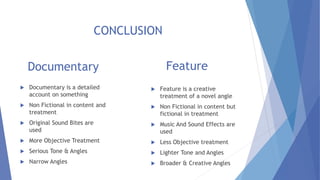
Documentary
 Documentary is a detailed
account on something
 Non Fictional in content and
treatment
 Original Sound Bites are
used
 More Objective Treatment
 Serious Tone & Angles
 Narrow Angles
Feature
 Feature is a creative
treatment of a novel angle
 Non Fictional in content but
fictional in treatment
 Music And Sound Effects are
used
 Less Objective treatment
 Lighter Tone and Angles
 Broader & Creative Angles
CONCLUSION
Questions?

Electronic media bs 3 b lecture 6

  • 1.
    Electronic Media BS 3rdSemester Section B Wednesday : 10:50 am – 12:05 pm , 12:20 pm – 1:35 pm CoViD_19 Schedule: Friday, 1130 HRS to 1330 HRS Course Code: MCCC 333 Credit Hours: 3
  • 2.
    Lecture 1 :Overview  What is Communication  What is Media?  Types of Media  Electronic Media  TV  Radio  New Media
  • 3.
    Lecture 2 1. Objectivesof Broadcasting Information, Education, Entertainment, Islamic Ideology, National Ideology, Cultural Promotion, Promotion of Regional Languages, National Unity, Boost up Nation’s Morale, News Coverage 2. Types of News Stories  General Types, Simple, Complex, Special  Political, Crime, National, International, Sports, Weather, Special, Investigative, Follow Up
  • 4.
    Lecture 3  Radio Types of Radio  Radio Waves: FM & AM  Radio Bands: FM, MW, SW  How Radio Works?
  • 5.
    Lecture 4  RadioMagazine Program  Radio Interview  Stages of Production  Pre Production, Production, Post Production  Editing in Radio
  • 6.
    Lecture 5  RadioNew Bulletins  Types of News
  • 7.
  • 8.
    What is aRadio Documentary • A radio documentary is a documentary programme devoted to covering a particular topic in some depth, usually with a mixture of commentary and sound pictures. • Some radio features, especially those including specially composed music or other pieces of audio art, resemble radio drama in many ways, though non-fictional in subject matter, while others consist principally of more straightforward, journalistic-type reporting – but at much greater length than found in an ordinary news report.
  • 9.
    Types of RadioDocumentary  Narrative: Here a talent will describe the subject matter with facts, figures and articulate the narration as to create interest about the topic. For Example: If the documentary is about the Lahore Fort, it needs so many facts to be told to the listeners to keep their interest intact. Listeners would be keen in listening as when the Fort came into existence, how the people lived there, and what type of artifacts have been recovered from that place.
  • 10.
    Types of RadioDocumentary  Musical A type of documentaries which explains the topic in a script frequently, punctuated with musical insertions. This is done when a documentary is required on a personality closely linked with music; secondly it is on birds, rivers, nature and tourism. Your voice superimposed on musical notes enhances the value of script and enthralls the listeners better than a dry description for long spells of time. Documentaries which are made about tourist resorts or fascinating places otherwise are frequently marked with musical notes to highlight the points not through words but by creating an atmosphere which makes the listeners understand about those places in a rather lighter way
  • 11.
    Types of RadioDocumentary  Dramatized At times an impression of drama is essential to elaborate the theme of a documentary, though this is done rarely. Some documentaries on historical wars may carry some impressions in words or sound effects to create a sense of excitement and to make the audience understand the historical facts close as they might have happened. Over doing dramatic effects may remove some of the gloss of a radio documentary.
  • 12.
    Types of RadioDocumentary  Imagination In documentary production, the producer has to show his/her imagination in giving treatment to the subject matter. It is not as ordinary an approach as writing down a script and reading it to impart information on the subject. But putting in imagination does not mean that a producer takes the documentary to an extent where the elements of objectivity are over shadowed by the subjectivity. In such a case a documentary may not be able to keep its essence as the piece of broadcasting
  • 13.
    Types of RadioDocumentary  Close to places Like features, a producer is supposed to be visiting the place to get a real feel of the surroundings to involve the listeners in this type of radio production. It is always different if you are making a documentary on mighty River Ravi by walking along the river and stopping where it is necessary to mention some very particular thing about its surrounding. The producers who believe in sitting in a studio and making the documentary by having certain sound effects can't reach even a shade of a documentary which is made by actually visiting the river. This is a task not possible to be accomplished by sitting inside a studio of a radio station
  • 14.
    What is aRadio Feature  Radio Feature resembles a documentary in its making approach, but differs in its larger scope and subject/time variability.  These are of four different types 1. Personality Features 2. Features on PLACES 3. Features on Events 4. Occasional Radio Features
  • 15.
    Feature Story  Ina feature story you combine the rigors of factual reporting with the creative freedom of short-story telling fiction devices.  The feature story’s form must be more fluid than that of a news story; the inverted pyramid style won’t work here because the story needs a definite beginning, middle and end.  Listeners won’t have to listen few conclusions; they will have to listen the whole story to understand it.  Feature stories place a greater emphasis on facts that have human interest.  Features put people in the story; they make the reader think  and care.  You can make a feature story about anyone if you find an unusual angle that captures the interest of your listeners.
  • 16.
    Principles Of Composition Strunk and White's ‘Elements of Style’ has been read by the university students for years, but in its pages are lessons that are valuable to anyone at any age who compose anything ranging from promo, package to feature and documentary.
  • 17.
    Principles Of Composition Choose a Suitable Design and Hold to It. Planning must be a deliberate preface to gathering. Foresee or determine the shape of what is to come and pursue that shape.  Make chunks the Unit of Composition. Large blocks of recording can look formidable to you at multi track-editing. But breaking them up too much can look like ad-promo. Moderation and order are the main considerations.  Use the Active Voice. It is generally more direct and vigorous than the passive.  Put Statements in Positive Form. Avoid tame colorless language. Use the word "not" as a means of denial or in antithesis, not as a means of evasion.  Use Definite, Specific, Concrete Language. The surest way to arouse a listener's attention is by being specific. Use words that call pictures to mind.
  • 18.
    Principles Of Composition Omit Needless Words. Vigorous narration is concise. A sentence should contain no unnecessary words. A cue should contain no unnecessary sentences.  Avoid a Succession of Loose Sentences. In particular this means sentences made up of two clauses. The style can become boring for the reader.  Express Coordinate Ideas in Similar Form. Parallel construction allows readers to more readily recognize likeness of content and function  Keep Related Words Together. The position of words in a sentence in the principle means of shoeing their relationship. Brings words together that are related in thought.  In narration, Keep One Tense. Don't switch back and forth. Choose one and hold to it.
  • 19.
    Types of MusicUsed in Production  Theme Music  Background Music  Bridge /Transitional Music  Fill/Pad Music
  • 20.
    What is aRadioMagazine  Radio magazine is a programme on a umbrella subject, which can have several programmes- documentary, features, interviews, music etc.  There has to be a content synergy in the programmes.
  • 21.
    Tips of ProducingRadio Documentary/Feature/Magazine  Be creative: Get ideas from other industries: advertising, technology, social networking.  Think out of the box  Research: This is the back bone for a data based documentary/feature.  Use data: Data provides credibility, Don’t overuse statistics  Write a script: Writing a script gives a control over the subject.  Provide need based information: People listen to programme that gives them information-they need.  Provide resources to the audience on a sustained basis:  Focus on sound: Maximize use of ambience audio, music where appropriate  Make it interactive: Involve the user  Integrate Sources: Different Clips
  • 22.
    Research  When developinga documentary, especially on social awareness project, doing the proper research is mandatory! The information dispersed by such a show must be accurate, reliable, and current.  Research can be accessed via the Internet, library, educational/research institute.  Doing research for the radio documentary may also involved finding people who have something to contribute to the documentary, either by providing an interview, a story, or any other bits of material that can give the show some added substance.
  • 23.
    Documentary  Documentary isa detailed account on something  Non Fictional in content and treatment  Original Sound Bites are used  More Objective Treatment  Serious Tone & Angles  Narrow Angles Feature  Feature is a creative treatment of a novel angle  Non Fictional in content but fictional in treatment  Music And Sound Effects are used  Less Objective treatment  Lighter Tone and Angles  Broader & Creative Angles CONCLUSION
  • 24.