Broadcast Media
Unit 6: Production For Radio
OBJECTIVES OF THE COURSE
• Discuss the production of radio program
• Discuss the role of broadcast media
• Appreciate the planning and management of broadcast media
• Identify the techniques of financing for broadcast media
• Discuss the role of educational T.V. particularly in the countries of
Pakistan, Singapore, China, Japan, UK and Thailand
• State the role of educational radio in the countries like Pakistan,
Mexico, Japan and India
• Specify the production process for T.V. programs
• Analyses the production process for radio programsspecify the
evaluation techniques of broadcast media
UNIT OBJECTIVES
1. Discuss the production of radio program.
2. Explain the procedure of preparation for radio script.
3. specifying the production methods and techniques.
RADIO
• Radio is a powerful medium of communication.
• Since its inception it changed and transformed the
world in every field of life.
• In development it has key role.
• “Development usually refers to the improvement in
the economic health of a country. It can be helped
by the use of radio for education and information”
(Chignell, 2009)
ADVANTAGES OF RADIO
• Radio has ability to reach more people than any
other medium
• It is much cheaper and more portable than TV
• Radio program production requires small budgets
• Target oriented communication
• Community involvement is easy through community
radio
DISADVANTAGES OF RADIO
• Radio is a sound medium
• No demonstration
• Needs big amount of concentration
• Interpersonal communication, lack of interactivity
• Depends of listener’s imagination
DEVELOPMENT OF RADIO
PROGRAM
• In educational broadcast radio program production
is an essential part of course designing .
• In AIOU media producer is a member of course
committee.
• Units are marked and recommended to make radio
and tv program
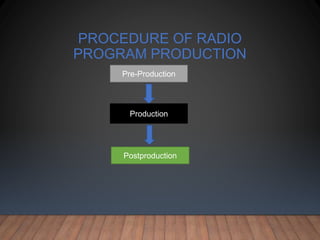
PROCEDURE OF RADIO
PROGRAM PRODUCTION
Pre-Production
Production
Postproduction
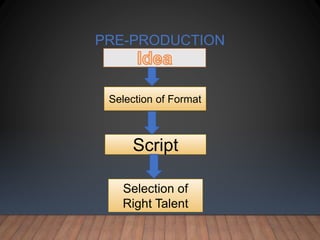
PRE-PRODUCTION
Selection of Format
Script
Selection of
Right Talent
PROGRAM FORMAT
• Radio Talk
Talk on radio as a specific form of public broadcast
speech.
In radio talk following elements are important
1 research and script , well constructed language,
vocabulary, duration not more than 5 mints.
2 Delivery
DISCUSSION PROGRAM
• Discussion programs are very important in radio broadcast. They are
good platform for exchange of ideas.
• In simplest form of talk is one moderator with two participants
representing opposing views.
• Participants ranges from 3 to 4. Three participants are excellent for
discussion.
• Male, female participants.
• discussion should be well planed, well moderated and interesting for
listeners.
FEATURE, DOCUMENTARY
• Both terms are used interchangeable
• “A documentary program is wholly fact, based on documentary evidence –
written records, attributable sources, contemporary interviews and the like.
Its purpose is essentially to inform, to present a story or situation with a
total regard for honest, balanced reporting.”
• “The feature program, on the other hand, need not be wholly true in the
factual sense, it may include folk song, poetry or fictional drama to help
illustrate its theme.” (McLeish, 2015)
RADIO DRAMA (PLAY)
• Drama is a radio genre which features the radio play. Radio drama includes
complete ‘one off’ plays and longer running serials.(Chignell, 2009)
• Types of Drama: serial, series or serialized series, single play docudrama.
• Dramas are important education format in Behavioral Change Communication
( Crime Fighter DW).
SCRIPT
• Here are some basic rules for script writing
• Define your listeners
• What do you want to say?
• Clearly define your objectives of communication
• Language: precise, crisp, daily life, avoid long sentences, no heavy and
rusty words, grammatically correct
• Create pictures with words,
• Sound play, sound effects.
PRODUCTION
• For a flawless program, a flawless pre-production is required.
• Production process comprises on following elements
• Requisition of studio( in cease of indoor recording ) equipment ( in case of
outdoor recording )
• liaison with talent and production team.
• Directing the talent, who to carry the script.
POSTPRODUCTION
• Removing flaws from the recorded program
• Sound effects
• Ready to on air copy
• Scheduling
REFERENCES
• Chignell, H. (2009). Key concepts in radio studies. Los
Angeles, Calif: Sage.
• McLeish, R., & Link, J. (2015). Radio production. CRC Press.

Broadcast media-Unit 6-Radio production

  • 1.
    Broadcast Media Unit 6:Production For Radio
  • 2.
    OBJECTIVES OF THECOURSE • Discuss the production of radio program • Discuss the role of broadcast media • Appreciate the planning and management of broadcast media • Identify the techniques of financing for broadcast media • Discuss the role of educational T.V. particularly in the countries of Pakistan, Singapore, China, Japan, UK and Thailand • State the role of educational radio in the countries like Pakistan, Mexico, Japan and India • Specify the production process for T.V. programs • Analyses the production process for radio programsspecify the evaluation techniques of broadcast media
  • 3.
    UNIT OBJECTIVES 1. Discussthe production of radio program. 2. Explain the procedure of preparation for radio script. 3. specifying the production methods and techniques.
  • 4.
    RADIO • Radio isa powerful medium of communication. • Since its inception it changed and transformed the world in every field of life. • In development it has key role. • “Development usually refers to the improvement in the economic health of a country. It can be helped by the use of radio for education and information” (Chignell, 2009)
  • 5.
    ADVANTAGES OF RADIO •Radio has ability to reach more people than any other medium • It is much cheaper and more portable than TV • Radio program production requires small budgets • Target oriented communication • Community involvement is easy through community radio
  • 6.
    DISADVANTAGES OF RADIO •Radio is a sound medium • No demonstration • Needs big amount of concentration • Interpersonal communication, lack of interactivity • Depends of listener’s imagination
  • 7.
    DEVELOPMENT OF RADIO PROGRAM •In educational broadcast radio program production is an essential part of course designing . • In AIOU media producer is a member of course committee. • Units are marked and recommended to make radio and tv program
  • 8.
    PROCEDURE OF RADIO PROGRAMPRODUCTION Pre-Production Production Postproduction
  • 9.
  • 10.
    PROGRAM FORMAT • RadioTalk Talk on radio as a specific form of public broadcast speech. In radio talk following elements are important 1 research and script , well constructed language, vocabulary, duration not more than 5 mints. 2 Delivery
  • 11.
    DISCUSSION PROGRAM • Discussionprograms are very important in radio broadcast. They are good platform for exchange of ideas. • In simplest form of talk is one moderator with two participants representing opposing views. • Participants ranges from 3 to 4. Three participants are excellent for discussion. • Male, female participants. • discussion should be well planed, well moderated and interesting for listeners.
  • 12.
    FEATURE, DOCUMENTARY • Bothterms are used interchangeable • “A documentary program is wholly fact, based on documentary evidence – written records, attributable sources, contemporary interviews and the like. Its purpose is essentially to inform, to present a story or situation with a total regard for honest, balanced reporting.” • “The feature program, on the other hand, need not be wholly true in the factual sense, it may include folk song, poetry or fictional drama to help illustrate its theme.” (McLeish, 2015)
  • 13.
    RADIO DRAMA (PLAY) •Drama is a radio genre which features the radio play. Radio drama includes complete ‘one off’ plays and longer running serials.(Chignell, 2009) • Types of Drama: serial, series or serialized series, single play docudrama. • Dramas are important education format in Behavioral Change Communication ( Crime Fighter DW).
  • 14.
    SCRIPT • Here aresome basic rules for script writing • Define your listeners • What do you want to say? • Clearly define your objectives of communication • Language: precise, crisp, daily life, avoid long sentences, no heavy and rusty words, grammatically correct • Create pictures with words, • Sound play, sound effects.
  • 15.
    PRODUCTION • For aflawless program, a flawless pre-production is required. • Production process comprises on following elements • Requisition of studio( in cease of indoor recording ) equipment ( in case of outdoor recording ) • liaison with talent and production team. • Directing the talent, who to carry the script.
  • 16.
    POSTPRODUCTION • Removing flawsfrom the recorded program • Sound effects • Ready to on air copy • Scheduling
  • 17.
    REFERENCES • Chignell, H.(2009). Key concepts in radio studies. Los Angeles, Calif: Sage. • McLeish, R., & Link, J. (2015). Radio production. CRC Press.