NAME OF SPEAKERS
Rohit Kumar
Dept. of Extension Education
Script
• The script is what makes sense of the
information you have gathered.
• It is the framework for your story
• It brings together the most important elements,
and helps your audience understand the
significance of the points the people you have
interviewed have made.
INTRODUCTION
• Scriptwriting, is the art and craft of
writing scripts for mass media such as feature
films, television productions or video games.
• Script writing is the process of writing stories in
the screenplay medium.
• Script writing is writing down the movement,
actions, expression and dialogue of the characters
in screenplay.
• In order to express yourself effectively, particular
formatting methods are required.
Points to keep in mind before
writing a Script
1. Types of audience
2. Objectives
3. Content
4. Resources
5. Limitations
6. Image perceptions
7. Script
SCRIPT WRITING FOR
RADIO
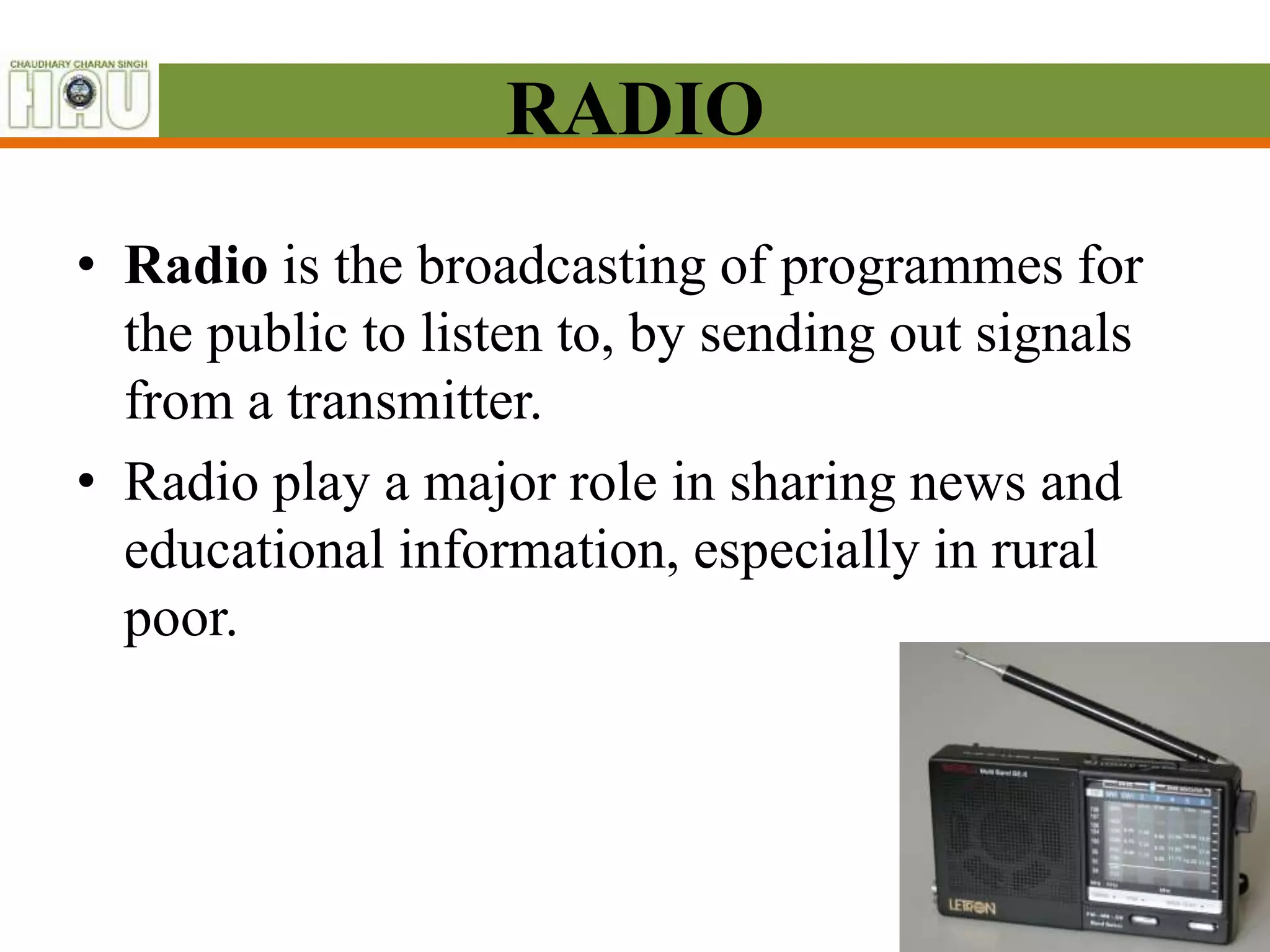
RADIO
• Radio is the broadcasting of programmes for
the public to listen to, by sending out signals
from a transmitter.
• Radio play a major role in sharing news and
educational information, especially in rural
poor.
Language, grammar and punctuation
These are some of the basic principles for writing
the radio script in respect of language, grammar
and punctuation to be used in the script.
 Write simple sentences, avoid using formal
grammar.
 Keep it short and simple.
 Test your script as you write.
 Use precise, clear language.
 Write for one listener.
 Write news thoughtfully.
 Avoid abstractions.
 Don't overload your text with too much
information.
 Avoid repetitions.
 No abbreviations should be used if you can
avoid them, unless you know that they are very
well known.
 Use the present tense where possible.
 Write short sentences using the "active" voice.
Key Principles for Radio Script
Writing
1. It is spoken
2. It is immediate
3. It is person to person
4. It is heard once
5. It is sound
Writing Radio Script
1. Develop a concept. The concept is the story
told in its most concise form revealing only
essential details.
2. Construct a clear, well defined concept before
developing the plot.
3. Write a summary of the story. This is a more
detailed telling of the story in narrative form.
4. Divide the summary into scenes. Make a list
of the scenes.
5. Describe the scenes that tell the story.
6. Insert the remaining sound effects, music, and
transition details in the appropriate format.
7. Compile all dialog scenes into a rough draft.
8. Read through the script. Search for problems
(illogical transitions, contradictions,
mechanics, etc.), fixing them as you go.
9. Make a final draft.
Script layout
Prepare your material so that the path between
your eyes, brain and mouth remains clear. For
instance:
• Write hard-to-pronounce words phonetically
• Write names or figures in full
• Use an easy-to-read font in a large size
• Double space all copy for easy reading
• Type on one side of the page only
• Use one inch margins
• Exaggerate where the paragraph begins by
spacing
• Mark your copy to guide your delivery.
Marking copy is important to ensure easy
reading
• If you want a word emphasized, underline it.
Also, put slash marks after the sentences
where pauses are required.
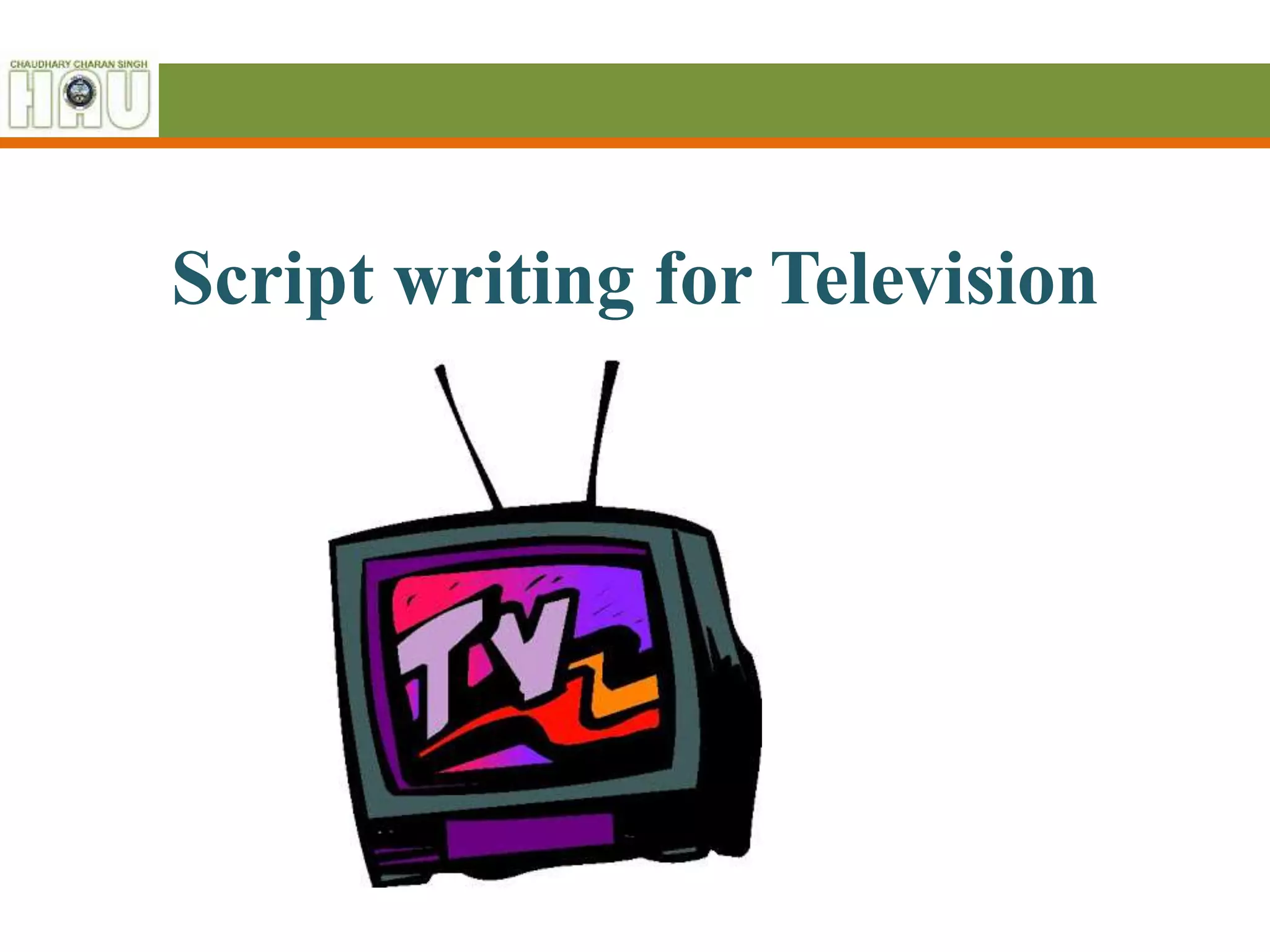
Script writing for Television
Television
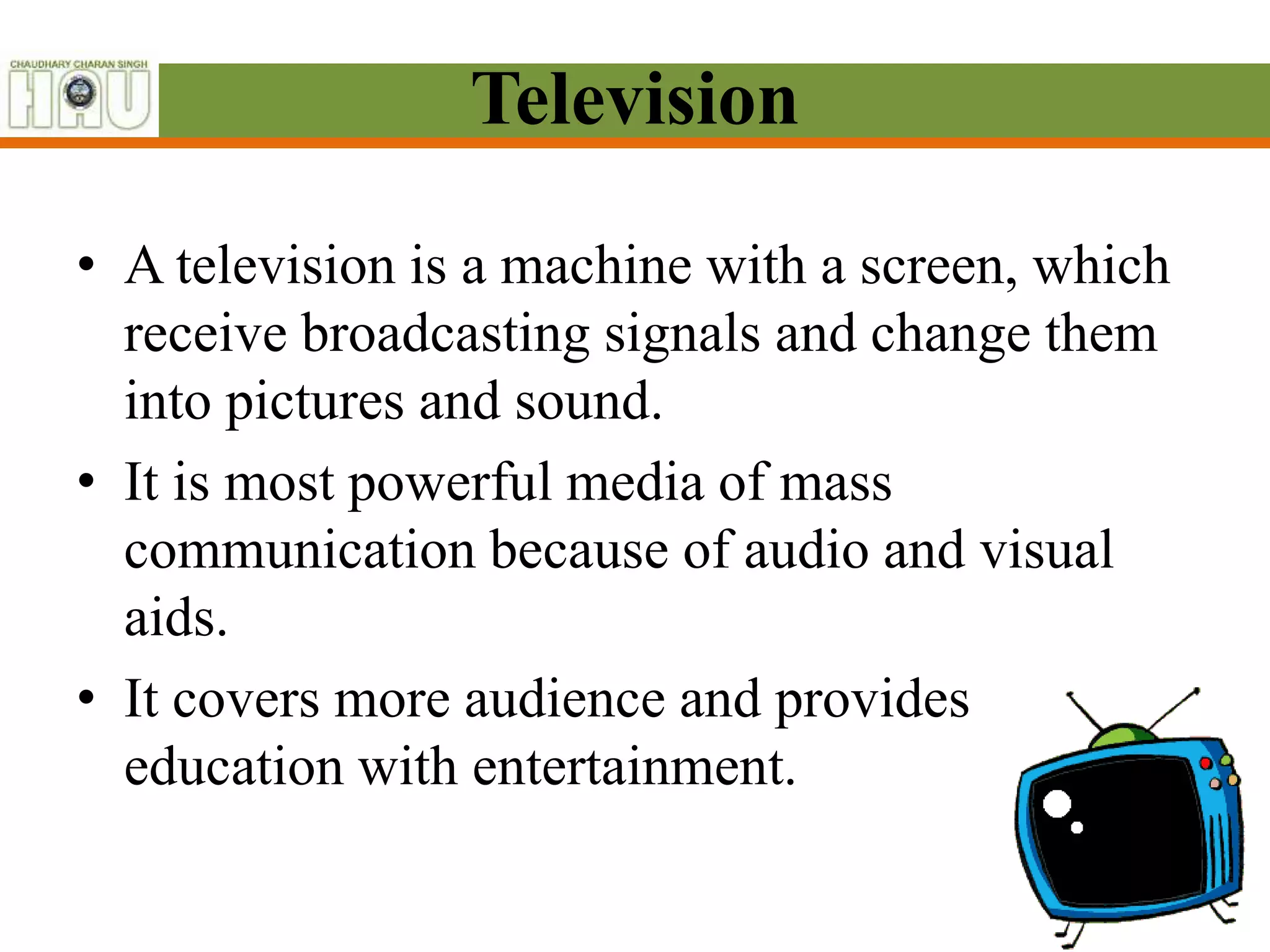
• A television is a machine with a screen, which
receive broadcasting signals and change them
into pictures and sound.
• It is most powerful media of mass
communication because of audio and visual
aids.
• It covers more audience and provides
education with entertainment.
Steps for preparing script for
T.V. programme
1. Selection of subject matter.
2. Select an Appropriate topic from selected
subject.
3. Determine main points of selected topic.
4. Get overall picture of programme in mind.
5. Divide into important steps and arrange in
logical order.
6. Consult resource person for advise.
7. Selection of format or method of presentation.
8. Determine the participants.
9. List out all the visual, equipment and material to be used.
10. Make an outline of programme.
11. Correct out line as per suggestion of programme
producer.
12. Prepare audio to each segment according to time
segment.
13. Rehearse programme and add or subtract materials to fit
the script into the desired time.
14. Decide time segment according to its important in
programme.
15. Decide background music or Falk dance for programme.
SYMBOL OF TRUST

Techniques of writing of script for radio and tv

  • 1.
    NAME OF SPEAKERS RohitKumar Dept. of Extension Education
  • 2.
    Script • The scriptis what makes sense of the information you have gathered. • It is the framework for your story • It brings together the most important elements, and helps your audience understand the significance of the points the people you have interviewed have made.
  • 3.
    INTRODUCTION • Scriptwriting, isthe art and craft of writing scripts for mass media such as feature films, television productions or video games. • Script writing is the process of writing stories in the screenplay medium. • Script writing is writing down the movement, actions, expression and dialogue of the characters in screenplay. • In order to express yourself effectively, particular formatting methods are required.
  • 4.
    Points to keepin mind before writing a Script 1. Types of audience 2. Objectives 3. Content 4. Resources 5. Limitations 6. Image perceptions 7. Script
  • 5.
  • 6.
    RADIO • Radio isthe broadcasting of programmes for the public to listen to, by sending out signals from a transmitter. • Radio play a major role in sharing news and educational information, especially in rural poor.
  • 7.
    Language, grammar andpunctuation These are some of the basic principles for writing the radio script in respect of language, grammar and punctuation to be used in the script.  Write simple sentences, avoid using formal grammar.  Keep it short and simple.  Test your script as you write.  Use precise, clear language.  Write for one listener.  Write news thoughtfully.
  • 8.
     Avoid abstractions. Don't overload your text with too much information.  Avoid repetitions.  No abbreviations should be used if you can avoid them, unless you know that they are very well known.  Use the present tense where possible.  Write short sentences using the "active" voice.
  • 9.
    Key Principles forRadio Script Writing 1. It is spoken 2. It is immediate 3. It is person to person 4. It is heard once 5. It is sound
  • 10.
    Writing Radio Script 1.Develop a concept. The concept is the story told in its most concise form revealing only essential details. 2. Construct a clear, well defined concept before developing the plot. 3. Write a summary of the story. This is a more detailed telling of the story in narrative form. 4. Divide the summary into scenes. Make a list of the scenes.
  • 11.
    5. Describe thescenes that tell the story. 6. Insert the remaining sound effects, music, and transition details in the appropriate format. 7. Compile all dialog scenes into a rough draft. 8. Read through the script. Search for problems (illogical transitions, contradictions, mechanics, etc.), fixing them as you go. 9. Make a final draft.
  • 12.
    Script layout Prepare yourmaterial so that the path between your eyes, brain and mouth remains clear. For instance: • Write hard-to-pronounce words phonetically • Write names or figures in full • Use an easy-to-read font in a large size • Double space all copy for easy reading
  • 13.
    • Type onone side of the page only • Use one inch margins • Exaggerate where the paragraph begins by spacing • Mark your copy to guide your delivery. Marking copy is important to ensure easy reading • If you want a word emphasized, underline it. Also, put slash marks after the sentences where pauses are required.
  • 14.
  • 15.
    Television • A televisionis a machine with a screen, which receive broadcasting signals and change them into pictures and sound. • It is most powerful media of mass communication because of audio and visual aids. • It covers more audience and provides education with entertainment.
  • 16.
    Steps for preparingscript for T.V. programme 1. Selection of subject matter. 2. Select an Appropriate topic from selected subject. 3. Determine main points of selected topic. 4. Get overall picture of programme in mind. 5. Divide into important steps and arrange in logical order. 6. Consult resource person for advise. 7. Selection of format or method of presentation.
  • 17.
    8. Determine theparticipants. 9. List out all the visual, equipment and material to be used. 10. Make an outline of programme. 11. Correct out line as per suggestion of programme producer. 12. Prepare audio to each segment according to time segment. 13. Rehearse programme and add or subtract materials to fit the script into the desired time. 14. Decide time segment according to its important in programme. 15. Decide background music or Falk dance for programme.
  • 18.