Radio On Making a Radio Documentary
Documentary,  adj Relating to or found in documents, (of films, TV Programmes, etc) aiming at presenting  reality , presenting  facts not fiction  –  n  a film or radio or TV programme about  real people  or  events without fictional colouring or professional actors Chambers Dictionary 2008
What is a Radio Documentary? A  radio documentary  or  feature  is a  radio  documentary programme devoted to covering a particular topic  in some depth , usually with a mixture of commentary, interview and sound pictures. It is  non-fictional  in subject matter, consisting principally of more straightforward, journalistic-type reporting – but at much  greater length  than found in an ordinary news report.
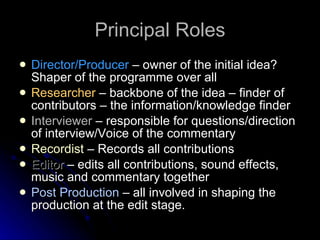
Principal Roles Director/Producer  – owner of the initial idea? Shaper of the programme over all Researcher  – backbone of the idea – finder of contributors – the information/knowledge finder Interviewer  – responsible for questions/direction of interview/Voice of the commentary Recordist  – Records all contributions Editor  – edits all contributions, sound effects, music and commentary together Post Production  – all involved in shaping the production at the edit stage.
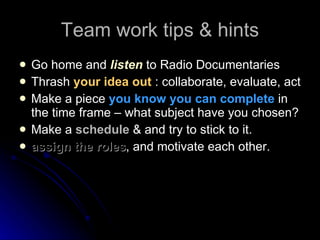
Team work tips & hints Go home and  listen  to Radio Documentaries Thrash  your idea out  : collaborate, evaluate, act Make a piece  you know you can complete  in the time frame – what subject have you chosen? Make a  schedule  & and try to stick to it. assign the roles , and motivate each other.
Schedule of work  Make one ASAP and send to Tutor for further guidance THERE IS A BLANK ONE ON BLACKBOARD.
Editing training & availability Soundtrack Pro with Aquiles training is timetabled  *DO NOT MISS THIS!!  Stations are then available for you use as timetabled or you can also pop in and use if available on day, but always check with Ian Collision (technician of room MLG05) and tutor if you wish to book a station in advance, outside of your timetabled time.
Contents Subject Matter  – What is your production about? Can you make it?? Research  – it all begins here Interviewees/ Public v Experts Documentary as  Experiment Journalism or Discussion? Commentary Sound Pictures Facts/Fiction The  need to describe  – painting a picture with sound
Research  It is vital you research as much as possible about your subject before you venture out into the world Internet  –  But are the facts correct?? Libraries –  Many and Varied, including sound archives, British Library, Imperial War Museum, Official Archives, Fan bases  Personal Archives –  sound  materials belonging to contributors Specialists & Experts –  Who’s who in the field Fact Checking –  Double your sources, get it right Ask Your Mum/Dad –  Because they might just know by firsthand experience!
Recording Notes Always check & test the  kit   before you go out Pack those spare  batteries ! Always wear  headphones  when recording Have your  microphone close  to the subject Be careful of  microphone handling  noise/wind Pick a  quiet   spot Avoid  “popping” Watch the  meters Make sure you are not  “paused”  – are you  in record Get a test voice/ Interviewee ID  “ Hi my name is  . . . . .” Always   record 2 minutes of  room tone or atmosphere
Structuring Questions Open Ended Questions “ What was your school like?” Be Specific “ When and where did that happen?” Looking for meaning “ How did you feel when you lost your job?” Elaboration & Clarification  “ Can you tell me more?” & “Is there anything else you would like to add?”
How to get a great interview! Questions should be  tailored  to the subject –  what do you want to get out of this encounter?? Think carefully –  Would you answer the question  you are asking? Is it ethical, legal, decent? Listen Closely  & look the subject in the eyes!  Be Polite! What is   interesting  –  stick with the good stuff Take  Notes! Be   descriptive  –  ask your subject to “paint a picture” with words Record again  – if the subject garbles, don’t be afraid to go again  Emotional Questioning  –  “How does it make you feel?” Be   curious Be   honest  in your approach Additional Info  –  is there anything else your subject would like to say? Nod   in reply – let your subject speak Keep the  tape running Say  Thank You !
Wrapping Up Obtain Permission –  Write a simple “consent” form up & get them to sign it Label all materials/Tapes Give the subject the last word Thank the interviewee Drop your material on to a personal hard drive/computer for safety before returning the equipment
Editing The Show Your Duration is 5 – 10 Minutes Total Get all your interviews cut down first Submit first cut to tutor Write Commentary around the interviews Send draft script to tutor Fill in with Sound Effects & Music which “paints a picture” Re – edit Re – edit Mix (levelling your sound)  Burn CD &  check it before the assessments
Your CD Your Duration is 5 – 10 Minutes Total on AUDIO CD  (they must play in a CD player) Label your CD case with a CD Pen (don’t use stickers, post-its or plasters!) Label your CD with the name of the documentary Check your CD on a CD player
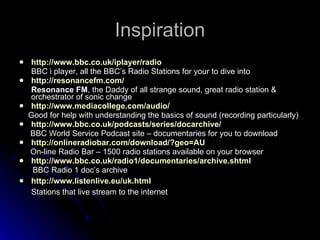
Inspiration http://www.bbc.co.uk/iplayer/radio BBC i player, all the BBC’s Radio Stations for your to dive into http://resonancefm.com/ Resonance FM , the Daddy of all strange sound, great radio station & orchestrator of sonic change http://www.mediacollege.com/audio/ Good for help with understanding the basics of sound (recording particularly) http://www.bbc.co.uk/podcasts/series/docarchive/ BBC World Service Podcast site – documentaries for you to download http://onlineradiobar.com/download/?geo=AU On-line Radio Bar – 1500 radio stations available on your browser http://www.bbc.co.uk/radio1/documentaries/archive.shtml BBC Radio 1 doc’s archive http://www.listenlive.eu/uk.html Stations that live stream to the internet

Making a radio documentary

  • 1.
    Radio On Makinga Radio Documentary
  • 2.
    Documentary, adjRelating to or found in documents, (of films, TV Programmes, etc) aiming at presenting reality , presenting facts not fiction – n a film or radio or TV programme about real people or events without fictional colouring or professional actors Chambers Dictionary 2008
  • 3.
    What is aRadio Documentary? A radio documentary or feature is a radio documentary programme devoted to covering a particular topic in some depth , usually with a mixture of commentary, interview and sound pictures. It is non-fictional in subject matter, consisting principally of more straightforward, journalistic-type reporting – but at much greater length than found in an ordinary news report.
  • 4.
    Principal Roles Director/Producer – owner of the initial idea? Shaper of the programme over all Researcher – backbone of the idea – finder of contributors – the information/knowledge finder Interviewer – responsible for questions/direction of interview/Voice of the commentary Recordist – Records all contributions Editor – edits all contributions, sound effects, music and commentary together Post Production – all involved in shaping the production at the edit stage.
  • 5.
    Team work tips& hints Go home and listen to Radio Documentaries Thrash your idea out : collaborate, evaluate, act Make a piece you know you can complete in the time frame – what subject have you chosen? Make a schedule & and try to stick to it. assign the roles , and motivate each other.
  • 6.
    Schedule of work Make one ASAP and send to Tutor for further guidance THERE IS A BLANK ONE ON BLACKBOARD.
  • 7.
    Editing training &availability Soundtrack Pro with Aquiles training is timetabled *DO NOT MISS THIS!! Stations are then available for you use as timetabled or you can also pop in and use if available on day, but always check with Ian Collision (technician of room MLG05) and tutor if you wish to book a station in advance, outside of your timetabled time.
  • 8.
    Contents Subject Matter – What is your production about? Can you make it?? Research – it all begins here Interviewees/ Public v Experts Documentary as Experiment Journalism or Discussion? Commentary Sound Pictures Facts/Fiction The need to describe – painting a picture with sound
  • 9.
    Research Itis vital you research as much as possible about your subject before you venture out into the world Internet – But are the facts correct?? Libraries – Many and Varied, including sound archives, British Library, Imperial War Museum, Official Archives, Fan bases Personal Archives – sound materials belonging to contributors Specialists & Experts – Who’s who in the field Fact Checking – Double your sources, get it right Ask Your Mum/Dad – Because they might just know by firsthand experience!
  • 10.
    Recording Notes Alwayscheck & test the kit before you go out Pack those spare batteries ! Always wear headphones when recording Have your microphone close to the subject Be careful of microphone handling noise/wind Pick a quiet spot Avoid “popping” Watch the meters Make sure you are not “paused” – are you in record Get a test voice/ Interviewee ID “ Hi my name is . . . . .” Always record 2 minutes of room tone or atmosphere
  • 11.
    Structuring Questions OpenEnded Questions “ What was your school like?” Be Specific “ When and where did that happen?” Looking for meaning “ How did you feel when you lost your job?” Elaboration & Clarification “ Can you tell me more?” & “Is there anything else you would like to add?”
  • 12.
    How to geta great interview! Questions should be tailored to the subject – what do you want to get out of this encounter?? Think carefully – Would you answer the question you are asking? Is it ethical, legal, decent? Listen Closely & look the subject in the eyes! Be Polite! What is interesting – stick with the good stuff Take Notes! Be descriptive – ask your subject to “paint a picture” with words Record again – if the subject garbles, don’t be afraid to go again Emotional Questioning – “How does it make you feel?” Be curious Be honest in your approach Additional Info – is there anything else your subject would like to say? Nod in reply – let your subject speak Keep the tape running Say Thank You !
  • 13.
    Wrapping Up ObtainPermission – Write a simple “consent” form up & get them to sign it Label all materials/Tapes Give the subject the last word Thank the interviewee Drop your material on to a personal hard drive/computer for safety before returning the equipment
  • 14.
    Editing The ShowYour Duration is 5 – 10 Minutes Total Get all your interviews cut down first Submit first cut to tutor Write Commentary around the interviews Send draft script to tutor Fill in with Sound Effects & Music which “paints a picture” Re – edit Re – edit Mix (levelling your sound) Burn CD & check it before the assessments
  • 15.
    Your CD YourDuration is 5 – 10 Minutes Total on AUDIO CD (they must play in a CD player) Label your CD case with a CD Pen (don’t use stickers, post-its or plasters!) Label your CD with the name of the documentary Check your CD on a CD player
  • 16.
    Inspiration http://www.bbc.co.uk/iplayer/radio BBCi player, all the BBC’s Radio Stations for your to dive into http://resonancefm.com/ Resonance FM , the Daddy of all strange sound, great radio station & orchestrator of sonic change http://www.mediacollege.com/audio/ Good for help with understanding the basics of sound (recording particularly) http://www.bbc.co.uk/podcasts/series/docarchive/ BBC World Service Podcast site – documentaries for you to download http://onlineradiobar.com/download/?geo=AU On-line Radio Bar – 1500 radio stations available on your browser http://www.bbc.co.uk/radio1/documentaries/archive.shtml BBC Radio 1 doc’s archive http://www.listenlive.eu/uk.html Stations that live stream to the internet