Scriptwriting for radio requires planning content, timing, and linguistic conventions to ensure a professional and engaging listening experience. Key elements include pre-writing features, announcements, and music to stay on schedule. Linguistic conventions like abbreviations, numbering, acronyms and punctuation are adapted based on the target audience. Style considers writing for the ear, house styles, signposting, natural speech rhythms, and continuity to keep listeners tuned in. Different genres like music, documentaries, packages and live features each have their own scripting needs.
Why it‟s important…
Manydifferent radio shows seem
spontaneous, however they do require
some pre-show scriptwriting to ensure that
the content is appropriate and the timing is
right and on schedule. This could include
different features, announcements, music
sequences and so on. Even the content
needs to be introduced so to inform the
audience what it is, so these need to be
written prior to going on air.
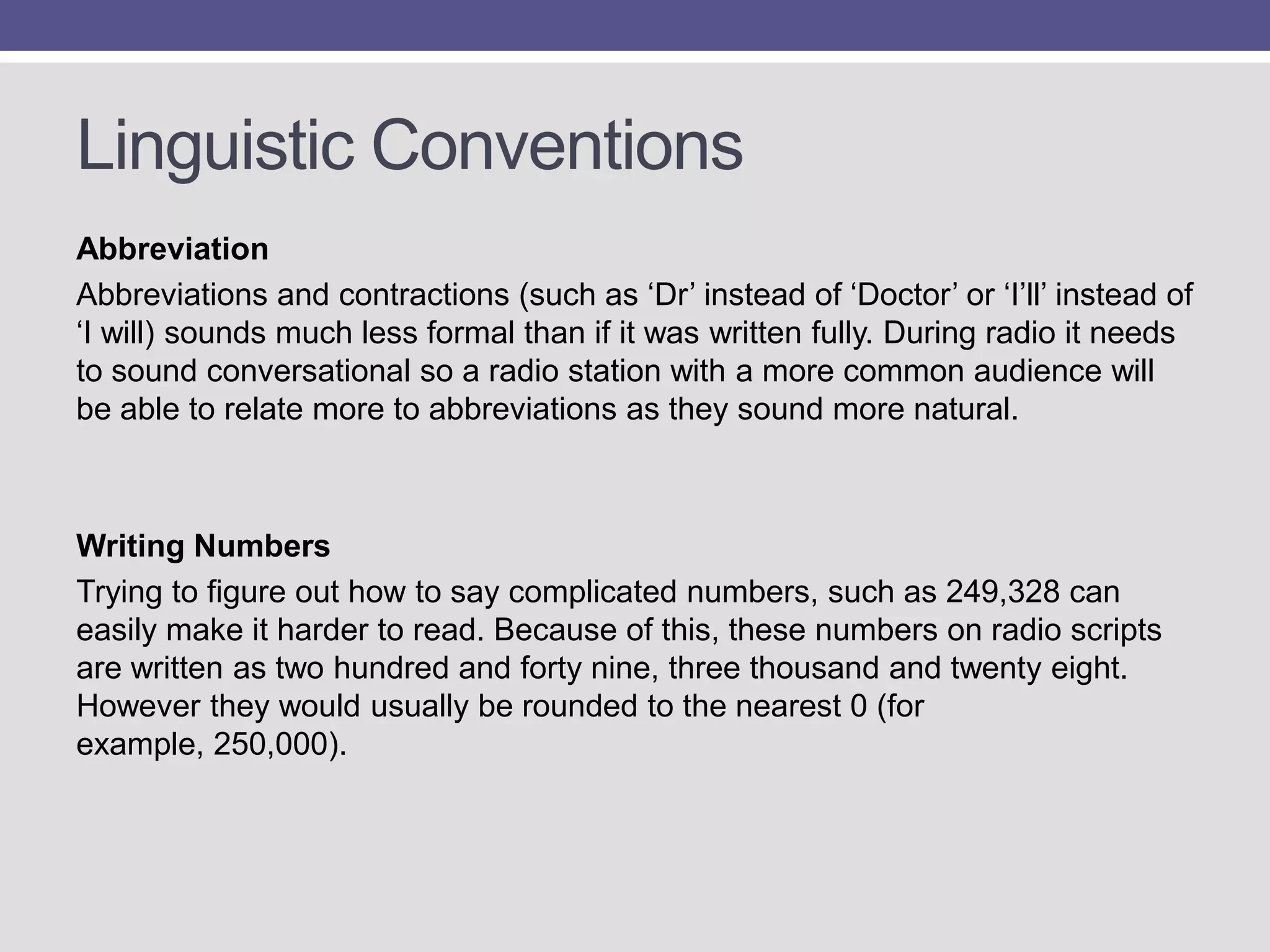
Linguistic Conventions
Abbreviation
Abbreviations andcontractions (such as „Dr‟ instead of „Doctor‟ or „I‟ll‟ instead of
„I will) sounds much less formal than if it was written fully. During radio it needs
to sound conversational so a radio station with a more common audience will
be able to relate more to abbreviations as they sound more natural.
Writing Numbers
Trying to figure out how to say complicated numbers, such as 249,328 can
easily make it harder to read. Because of this, these numbers on radio scripts
are written as two hundred and forty nine, three thousand and twenty eight.
However they would usually be rounded to the nearest 0 (for
example, 250,000).
5.
Linguistic Conventions
Expanding Acronyms
Ifan acronym is not well known, they have to be spelt out on radio so
that people will be able to know what is being talked about and help
them understand what the acronym means. However, in many cases
people are more familiar with the acronyms than the full version. For
example, companies such as the BBC (British Broadcasting
Corporation) is recognised more as an acronym, therefore it can be
shortened on air.
Punctuation
Without punctuation, the person reading a piece of text would end up
struggling to take breaths. Commas and full stops are needed to inform
the reader when the right time to breathe is, so that the text is read
without any problems.
6.
Linguistic Conventions
Formal andColloquial Language
Formal language will be used for a more educated, possibly older
audience. Colloquial language would be used for a local audience
only, otherwise other people may not understand some of the dialect
used. This means that the people listening would relate more once they
hear their own dialect. However, if there was a serious topic, colloquial
language should be avoided as it should be taken more seriously, in
contrast the Metro Radio presenters use Geordie dialect because the
show is so local.
Jargon
With most radio shows jargon should be avoided as the average
listener would not know what some of the words mean. However, in
some cases where a radio show is purely based on a specific subjects
such as sports, most listeners should be able to understand the jargon
that is being used.
7.
Linguistic Conventions
Phonetic Spellingof Difficult words
Much like spelling numbers out, when reading a piece of text with
difficult words in, the reader may struggle with the pronunciation. In
order to avoid this, they can also be written out to make the word easier
to say. For example, the country „Tajikistan‟ could be written out as „tahjih-kih-stan‟.
8.
STYLE
Writing for theear House styles Standard in-and-out
cues Signposting Language style Natural speech
rhythms Tone Continuity Links
9.
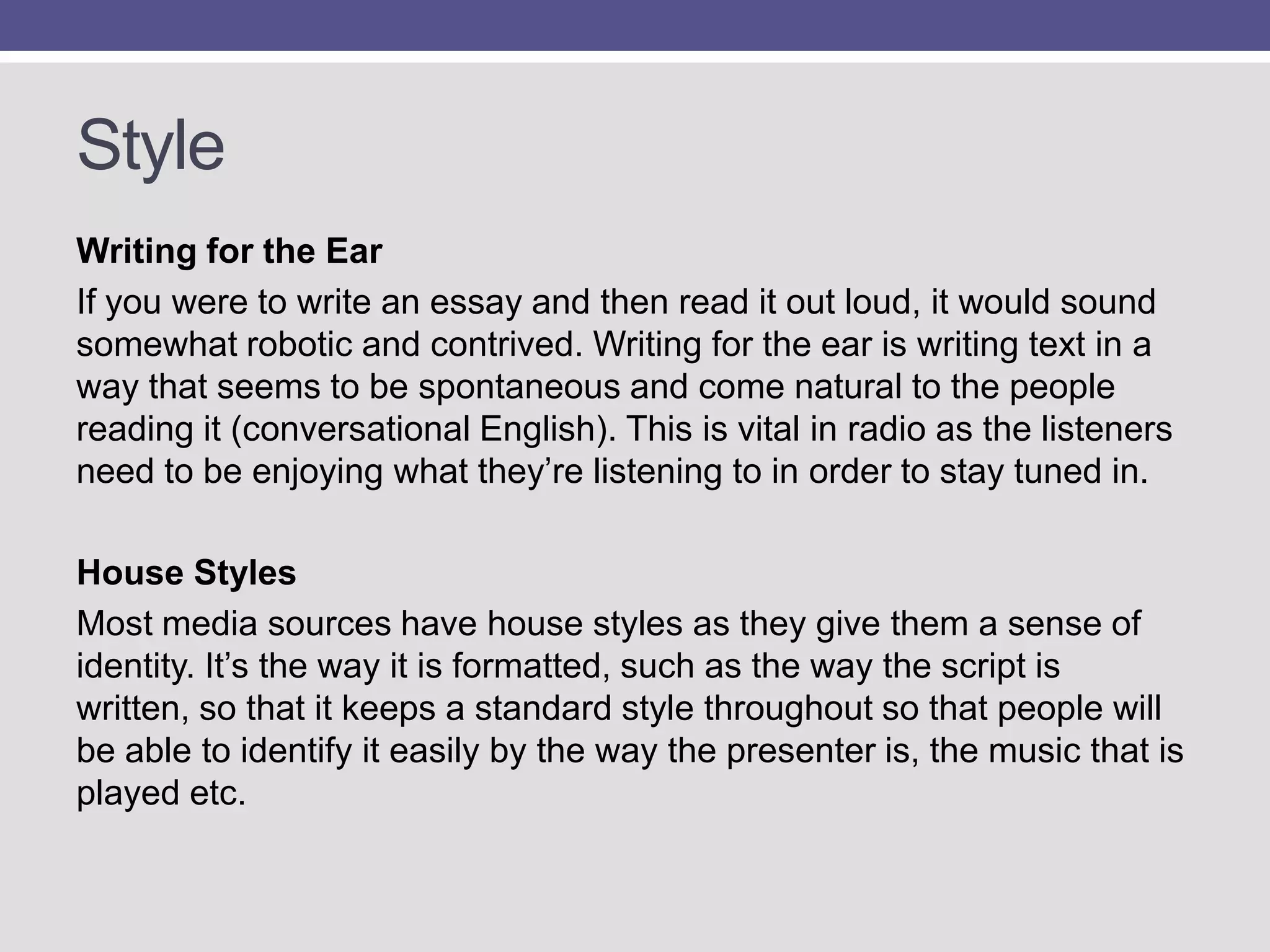
Style
Writing for theEar
If you were to write an essay and then read it out loud, it would sound
somewhat robotic and contrived. Writing for the ear is writing text in a
way that seems to be spontaneous and come natural to the people
reading it (conversational English). This is vital in radio as the listeners
need to be enjoying what they‟re listening to in order to stay tuned in.
House Styles
Most media sources have house styles as they give them a sense of
identity. It‟s the way it is formatted, such as the way the script is
written, so that it keeps a standard style throughout so that people will
be able to identify it easily by the way the presenter is, the music that is
played etc.
10.
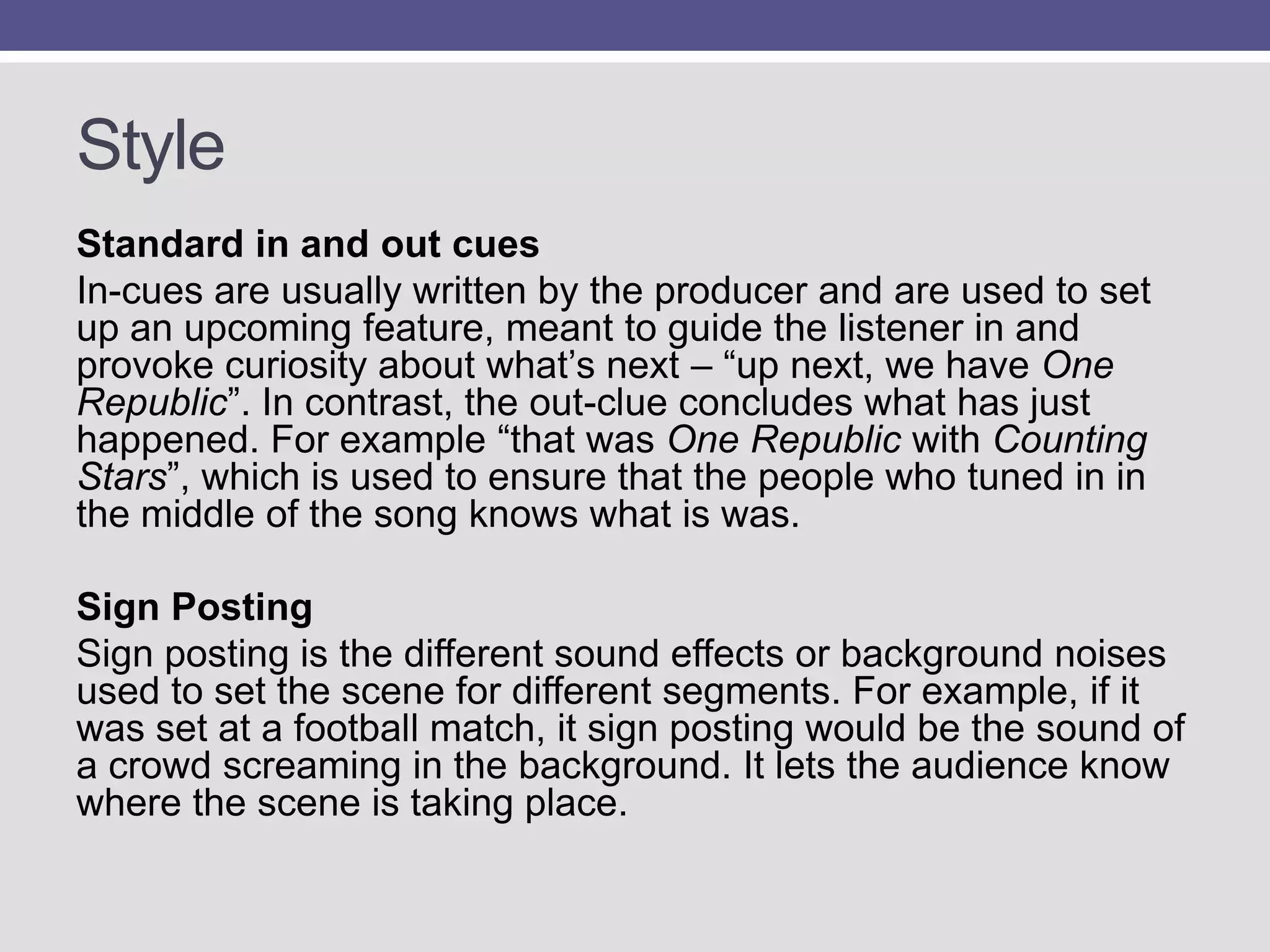
Style
Standard in andout cues
In-cues are usually written by the producer and are used to set
up an upcoming feature, meant to guide the listener in and
provoke curiosity about what‟s next – “up next, we have One
Republic”. In contrast, the out-clue concludes what has just
happened. For example “that was One Republic with Counting
Stars”, which is used to ensure that the people who tuned in in
the middle of the song knows what is was.
Sign Posting
Sign posting is the different sound effects or background noises
used to set the scene for different segments. For example, if it
was set at a football match, it sign posting would be the sound of
a crowd screaming in the background. It lets the audience know
where the scene is taking place.
11.
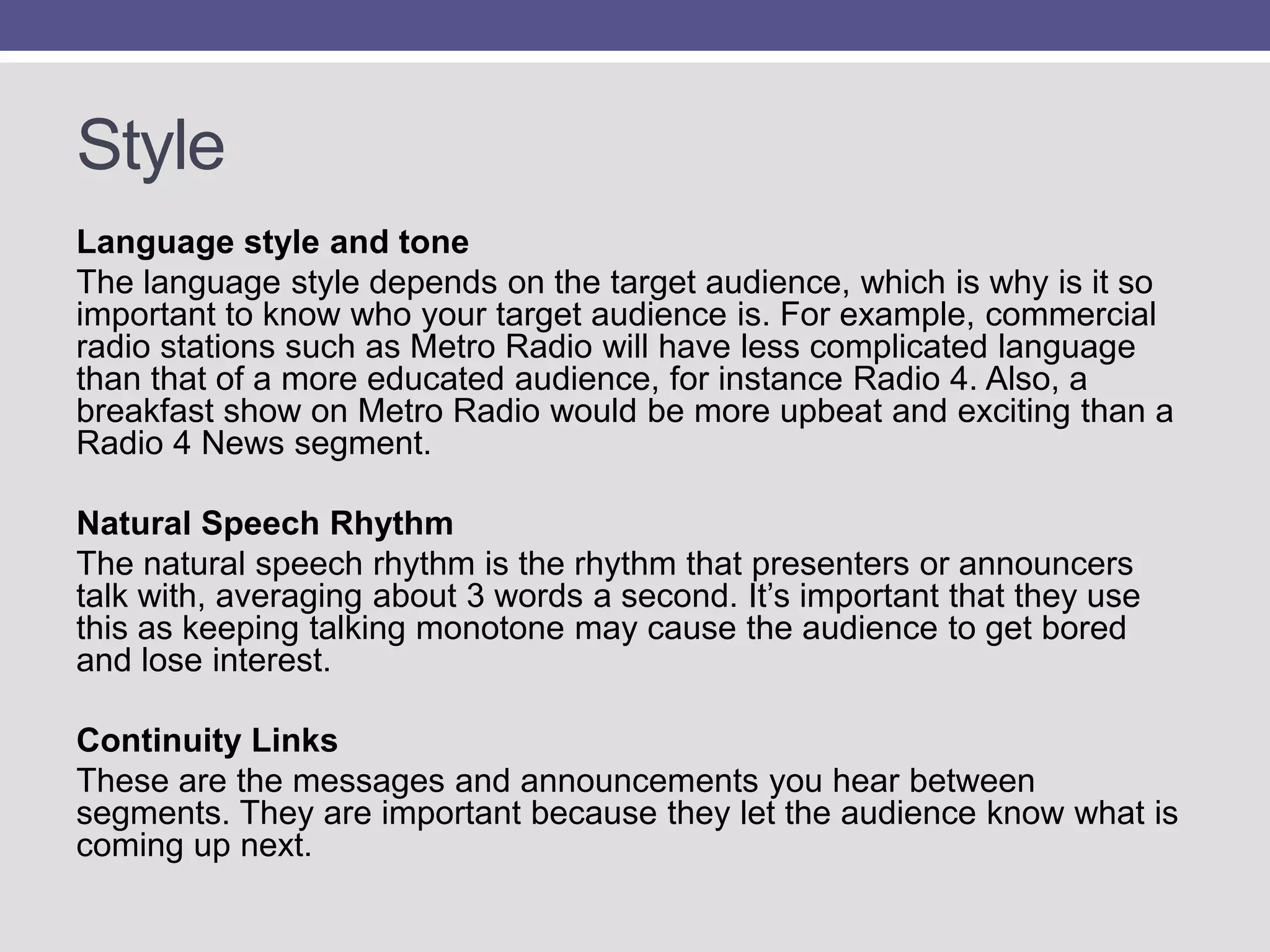
Style
Language style andtone
The language style depends on the target audience, which is why is it so
important to know who your target audience is. For example, commercial
radio stations such as Metro Radio will have less complicated language
than that of a more educated audience, for instance Radio 4. Also, a
breakfast show on Metro Radio would be more upbeat and exciting than a
Radio 4 News segment.
Natural Speech Rhythm
The natural speech rhythm is the rhythm that presenters or announcers
talk with, averaging about 3 words a second. It‟s important that they use
this as keeping talking monotone may cause the audience to get bored
and lose interest.
Continuity Links
These are the messages and announcements you hear between
segments. They are important because they let the audience know what is
coming up next.
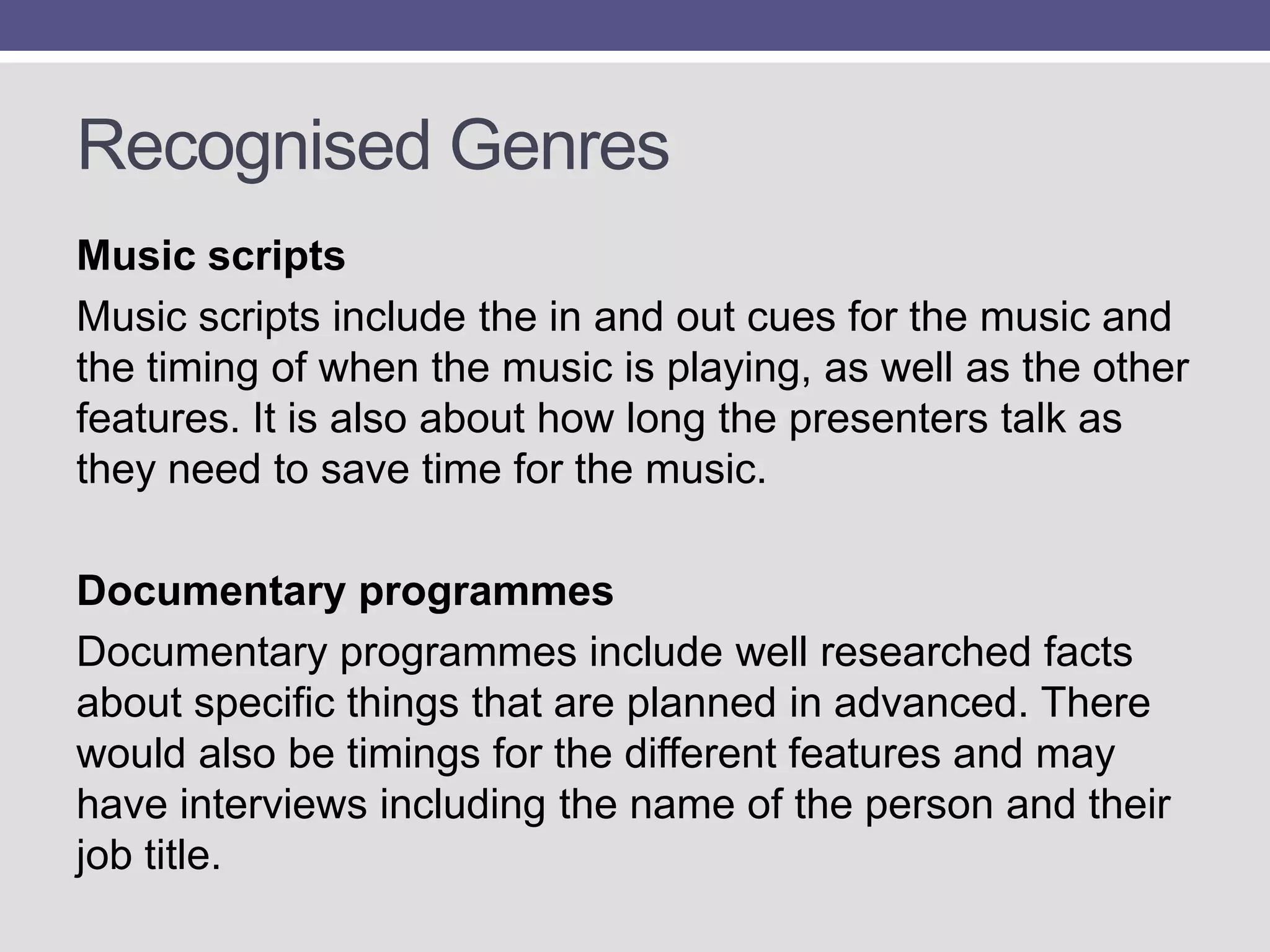
Recognised Genres
Music scripts
Musicscripts include the in and out cues for the music and
the timing of when the music is playing, as well as the other
features. It is also about how long the presenters talk as
they need to save time for the music.
Documentary programmes
Documentary programmes include well researched facts
about specific things that are planned in advanced. There
would also be timings for the different features and may
have interviews including the name of the person and their
job title.
14.
Recognised Genres
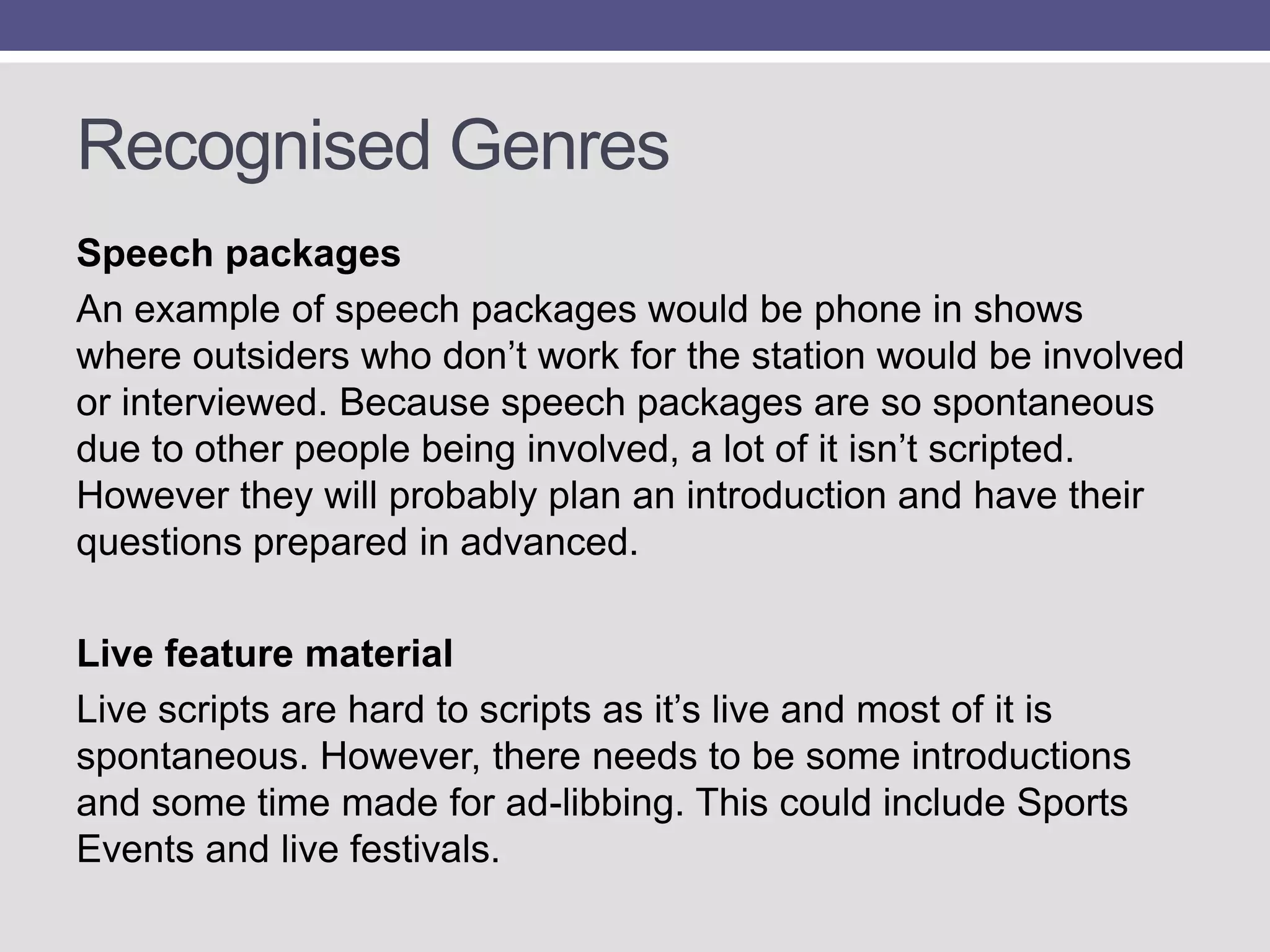
Speech packages
Anexample of speech packages would be phone in shows
where outsiders who don‟t work for the station would be involved
or interviewed. Because speech packages are so spontaneous
due to other people being involved, a lot of it isn‟t scripted.
However they will probably plan an introduction and have their
questions prepared in advanced.
Live feature material
Live scripts are hard to scripts as it‟s live and most of it is
spontaneous. However, there needs to be some introductions
and some time made for ad-libbing. This could include Sports
Events and live festivals.