Electronic Media
BS 3rd Semester Section B
Wednesday : 10:50 am – 12:05 pm , 12:20 pm – 1:35 pm
Course Code: MCCC 333
Credit Hours: 3
Lecture 1 : Overview
 What is Communication
 What is Media?
 Types of Media
 Electronic Media
 TV
 Radio
 New Media
Lecture 2
1. Objectives of Broadcasting
Information, Education, Entertainment, Islamic
Ideology, National Ideology, Cultural Promotion,
Promotion of Regional Languages, National Unity,
Boost up Nation’s Morale, News Coverage
2. Types of News Stories
 General Types, Simple, Complex, Special
 Political, Crime, National, International, Sports,
Weather, Special, Investigative, Follow Up
Lecture 3
 Radio
 Types of Radio
 Radio Waves: FM & AM
 Radio Bands: FM, MW, SW
 How Radio Works?
FM Radio Programming
Types of Programs (FORMAT)
 Entertainment
 Education
 Discussion (Awareness)
Content of Radio
Human Voice
Music
Sound Effects
Radio Formats
1. Announcements
2. Radio Talk
3. Radio Interviews
4. Radio Discussions
5. Documentaries
6. Features
7. Radio Drama
8. Commentaries
9. Magazines Programs
10.News
Radio Magazine Programs
 A broadcast at a particular time on a particular day of a week or a month.
That means it has periodicity. Similarly it has plenty of variety in contents.
Some or many formats of radio are included in a radio magazine.
 These may be talks, discussions, interviews, reviews, music etc. Likewise,
the duration of each programme or item in a magazine programme also vary.
 It has a signature tune. A signature tune is an attractive piece of music which
is specific to a programme. It can be like the masthead (title) of a magazine.
 It has a name and one or two presenters or anchor persons who link the whole
programme. In the beginning, the titles of the day’s programme will be given
by the presenters after the signature tune. They also give continuity and link
the whole magazine.
Designing an FM Program
Program Duration
Segments
Scripts
Break
Cue
Recording
Radio Interview
Radio Interviews
 There can be different types of interviews in terms of their
duration, content and purpose. Firstly, there are full fledged
interview programmes.
 Most of such interviews are personality based. You might have
heard of long interviews with well known people in the field of
public life, literature, science, sports, films etc.
 Secondly, there are interviews which are used in various radio
programmes like documentaries. Here the interviews are short,
questions specific and not many.
 Interview based programmes in news and current affairs
programmes.
 VOX POP: (Latin) Vox populi, Voices of People
Interviewing Tips
 Always double check your equipment before
heading out! Do a test recording and make sure
you are familiar with the equipment before
conducting the interview.
 -Always wear headphones! This will allow you to
hear the quality of the sound being recorded.
 -Always keep the microphone close to the sound
source you are trying to capture (interviewee or
distinct sound).
Interviewing Tips
 Make sure you are checking the recording levels (vu meter
on the front of the recorder) and that the levels are peaking
around -6db! You will need to adjust the levels for each
person you interview since everyone speaks with a different
strength and tone. Aim to have the levels no lower than -12
and no higher than -3db. You don’t want to go over 0db or
you’ll create digital distortion and clipping in the recording.
 Always record at least 2 to 3 minutes of background sound
for every environment you record in.
 Record the distinct sounds from the environment around you
for use in editing (dogs barking, children laughing, school
bell etc.). The detail sounds are invaluable for creating a
scene and sense of place.
Interviewing Tips
 Never give away control of the microphone. If you do, you
can lose control of the interview, of how questions are
asked and when they are answered. Recording quality can
also suffer since most people do not know how to position
a microphone correctly.
 Maintain good eye contact. If you are interested and alert
with your interviewee then it is possible they may forget
the microphone is there.
 Avoid sympathetic noises (uh huhs, laughs, etc.), simply
nod your head and maintain eye contact with your
interviewee. This will prevent any unwanted noises being
recorded with your interview and make editing easier.
Interviewing Tips
 Don’t worry about pauses or short silences. Sometimes the
interviewee is simply thinking of what to say and will
often come up with something better if you give them a
little time.
 Listen carefully to what the interviewee is saying.
Remember an interview is more than the questions you
have written down, it should be a conversation.
Sometimes an interviewee will answer a question before
you come to it or will say something that leads to other
questions you hadn’t thought of.
Three Stages of Production
a) Pre-production
b) Production
c) Post-production
Pre Production
(1) An idea is born
This phase includes how a programme is born as an idea and its
conceptualization. The topic or subject matter is decided.
(2) Plan of action
After the topic is decided, a plan of action is worked out .Here the format of the
progamme is determined i.e. whether the programme is a talk, discussion,
interview, drama, documentary etc. Once that is clear, the right person for
writing the script and the performers are decided. The plan of action would also
determine the equipment for outside recordings that are required. The time and
venue of the recording are also worked out.
Pre Production
(3) The script: is examined to make it suitable for broadcast. It is examined
according to the principles of writing for radio or in other words ‘for the ear’. We
will discuss this is detail in the next section.
(4) Paper work : If people who are not working in the radio station are involved
for writing or providing voice for the programmes, they have to be invited with
an agreement to accept the job or assignment. This type of agreement is
referred to as a contract. Similarly, permission is often required to interview
certain people if the programme is based on such interviews. Therefore, as you
can see, there is a lot of paper work at the pre-production
(5) Rehearsal of voices
Production
This is the actual process of
 recording
and
 editing a radio programme.
 Proper studios, microphones and computers are
required to record and edit the programme.
Post Production
 Writing to inform people involved in the production is a major activity during
this phase. The progamme has to be given publicity both on radio and in other
media. This is done to ensure that people know about the programmes and
also listen to them. The announcements for the presentation of the
programme are also written and provided for the actual broadcast of the
programme.
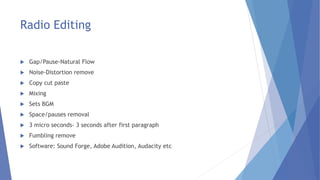
Radio Editing
 Gap/Pause-Natural Flow
 Noise-Distortion remove
 Copy cut paste
 Mixing
 Sets BGM
 Space/pauses removal
 3 micro seconds- 3 seconds after first paragraph
 Fumbling remove
 Software: Sound Forge, Adobe Audition, Audacity etc

Electronic media BS 3 Lecture 4

  • 1.
    Electronic Media BS 3rdSemester Section B Wednesday : 10:50 am – 12:05 pm , 12:20 pm – 1:35 pm Course Code: MCCC 333 Credit Hours: 3
  • 2.
    Lecture 1 :Overview  What is Communication  What is Media?  Types of Media  Electronic Media  TV  Radio  New Media
  • 3.
    Lecture 2 1. Objectivesof Broadcasting Information, Education, Entertainment, Islamic Ideology, National Ideology, Cultural Promotion, Promotion of Regional Languages, National Unity, Boost up Nation’s Morale, News Coverage 2. Types of News Stories  General Types, Simple, Complex, Special  Political, Crime, National, International, Sports, Weather, Special, Investigative, Follow Up
  • 4.
    Lecture 3  Radio Types of Radio  Radio Waves: FM & AM  Radio Bands: FM, MW, SW  How Radio Works?
  • 5.
    FM Radio Programming Typesof Programs (FORMAT)  Entertainment  Education  Discussion (Awareness)
  • 6.
    Content of Radio HumanVoice Music Sound Effects
  • 7.
    Radio Formats 1. Announcements 2.Radio Talk 3. Radio Interviews 4. Radio Discussions 5. Documentaries 6. Features 7. Radio Drama 8. Commentaries 9. Magazines Programs 10.News
  • 8.
    Radio Magazine Programs A broadcast at a particular time on a particular day of a week or a month. That means it has periodicity. Similarly it has plenty of variety in contents. Some or many formats of radio are included in a radio magazine.  These may be talks, discussions, interviews, reviews, music etc. Likewise, the duration of each programme or item in a magazine programme also vary.  It has a signature tune. A signature tune is an attractive piece of music which is specific to a programme. It can be like the masthead (title) of a magazine.  It has a name and one or two presenters or anchor persons who link the whole programme. In the beginning, the titles of the day’s programme will be given by the presenters after the signature tune. They also give continuity and link the whole magazine.
  • 9.
    Designing an FMProgram Program Duration Segments Scripts Break Cue Recording
  • 10.
  • 11.
    Radio Interviews  Therecan be different types of interviews in terms of their duration, content and purpose. Firstly, there are full fledged interview programmes.  Most of such interviews are personality based. You might have heard of long interviews with well known people in the field of public life, literature, science, sports, films etc.  Secondly, there are interviews which are used in various radio programmes like documentaries. Here the interviews are short, questions specific and not many.  Interview based programmes in news and current affairs programmes.  VOX POP: (Latin) Vox populi, Voices of People
  • 12.
    Interviewing Tips  Alwaysdouble check your equipment before heading out! Do a test recording and make sure you are familiar with the equipment before conducting the interview.  -Always wear headphones! This will allow you to hear the quality of the sound being recorded.  -Always keep the microphone close to the sound source you are trying to capture (interviewee or distinct sound).
  • 13.
    Interviewing Tips  Makesure you are checking the recording levels (vu meter on the front of the recorder) and that the levels are peaking around -6db! You will need to adjust the levels for each person you interview since everyone speaks with a different strength and tone. Aim to have the levels no lower than -12 and no higher than -3db. You don’t want to go over 0db or you’ll create digital distortion and clipping in the recording.  Always record at least 2 to 3 minutes of background sound for every environment you record in.  Record the distinct sounds from the environment around you for use in editing (dogs barking, children laughing, school bell etc.). The detail sounds are invaluable for creating a scene and sense of place.
  • 14.
    Interviewing Tips  Nevergive away control of the microphone. If you do, you can lose control of the interview, of how questions are asked and when they are answered. Recording quality can also suffer since most people do not know how to position a microphone correctly.  Maintain good eye contact. If you are interested and alert with your interviewee then it is possible they may forget the microphone is there.  Avoid sympathetic noises (uh huhs, laughs, etc.), simply nod your head and maintain eye contact with your interviewee. This will prevent any unwanted noises being recorded with your interview and make editing easier.
  • 15.
    Interviewing Tips  Don’tworry about pauses or short silences. Sometimes the interviewee is simply thinking of what to say and will often come up with something better if you give them a little time.  Listen carefully to what the interviewee is saying. Remember an interview is more than the questions you have written down, it should be a conversation. Sometimes an interviewee will answer a question before you come to it or will say something that leads to other questions you hadn’t thought of.
  • 16.
    Three Stages ofProduction a) Pre-production b) Production c) Post-production
  • 17.
    Pre Production (1) Anidea is born This phase includes how a programme is born as an idea and its conceptualization. The topic or subject matter is decided. (2) Plan of action After the topic is decided, a plan of action is worked out .Here the format of the progamme is determined i.e. whether the programme is a talk, discussion, interview, drama, documentary etc. Once that is clear, the right person for writing the script and the performers are decided. The plan of action would also determine the equipment for outside recordings that are required. The time and venue of the recording are also worked out.
  • 18.
    Pre Production (3) Thescript: is examined to make it suitable for broadcast. It is examined according to the principles of writing for radio or in other words ‘for the ear’. We will discuss this is detail in the next section. (4) Paper work : If people who are not working in the radio station are involved for writing or providing voice for the programmes, they have to be invited with an agreement to accept the job or assignment. This type of agreement is referred to as a contract. Similarly, permission is often required to interview certain people if the programme is based on such interviews. Therefore, as you can see, there is a lot of paper work at the pre-production (5) Rehearsal of voices
  • 19.
    Production This is theactual process of  recording and  editing a radio programme.  Proper studios, microphones and computers are required to record and edit the programme.
  • 20.
    Post Production  Writingto inform people involved in the production is a major activity during this phase. The progamme has to be given publicity both on radio and in other media. This is done to ensure that people know about the programmes and also listen to them. The announcements for the presentation of the programme are also written and provided for the actual broadcast of the programme.
  • 21.
    Radio Editing  Gap/Pause-NaturalFlow  Noise-Distortion remove  Copy cut paste  Mixing  Sets BGM  Space/pauses removal  3 micro seconds- 3 seconds after first paragraph  Fumbling remove  Software: Sound Forge, Adobe Audition, Audacity etc