由 NordriDesign™ 提供
www.nordridesign.com
E - COMMERCE
E - COMMERCE
LOGO INDEX
Meaning of E-Commerce.
History of E-Commerce.
Advantages of E-Commerce.
Disadvantages of E-Commerce.
Types of E-Commerce.
Some of E-Commerce Websites.
Page 2
LOGO
E-commerce consists of the buying and
selling of products or services over
electronic systems such as the Internet
and other computer networks.
Electronic commerce commonly known as
e-commerce.
Meaning of E-Commerce.
Page 3
History of E-Commerce
• One of the most popular activities on the Web is shopping. It
has much allure in it — you can shop at anytime, anywhere.
• Literally anyone can have their pages built to display their
specific goods and services.
History of ecommerce dates back to the invention of the
very old notion ( Imagination) of "sell and buy", electricity,
cables, computers, modems, and the Internet.
• Ecommerce became possible in 1991 when the Internet was
opened to commercial use. Since that date thousands of
businesses have taken up residence at web sites.
• At first, the term ecommerce meant the process of
execution of commercial transactions electronically
with the help of the leading technologies such as
Electronic Data Interchange (EDI) and Electronic
Funds Transfer (EFT) which gave an opportunity for
users to exchange business information and do
electronic transactions.
• The ability to use these technologies appeared in the
late 1970s and allowed business companies and
organizations to send commercial documentation
electronically.
• Although the Internet began to advance in popularity
among the general public in 1994, it took
approximately four years to develop the security
protocols (for example, HTTP) and DSL(Digital
Subscriber Line) which allowed rapid access and a
persistent ( Continuous ) connection to the Internet.
• In 2000 a great number of business companies in the
United States and Western Europe represented their
services in the World Wide Web. At this time the
meaning of the word ecommerce was changed.
• People began to define the term ecommerce as
the process of purchasing of available goods
and services over the Internet using secure
connections and electronic payment services.
• Although the dot-com collapse in 2000 led to
unfortunate results and many of ecommerce
companies disappeared, the "brick and mortar"
retailers recognized the advantages of
electronic commerce and began to add such
capabilities to their web sites
By the end of 2001, the largest form of
ecommerce, Business-to-Business (B2B)
model, had around $700 billion in
transactions.
According to all available data, ecommerce
sales continued to grow in the next few years
and, by the end of 2007, ecommerce sales
accounted for 3.4 percent of total sales.
History of ecommerce is unthinkable without
Amazon and Ebay which were among the first
Internet companies to allow electronic transactions.
Currently there are 5 largest and most famous
worldwide Internet retailers: Amazon, Dell, Staples,
Office Depot and Hewlett Packard. According to
statistics, the most popular categories of products
sold in the World Wide Web are music, books,
computers, office supplies and other consumer
electronics.
Amazon.com, Inc. is one of the most famous ecommerce
companies and is located in Seattle, Washington (USA).
It was founded in 1994 by Jeff Bezos and was one of the
first American ecommerce companies to sell products
over the Internet. After the dot-com collapse Amazon
lost its position as a successful business model,
however, in 2003 the company made its first annual
profit which was the first step to the further
development.
Amazon is one of the first ecommerce
businesses to establish an affiliate marketing
program, and nowadays the company gets
about 40% of its sales from affiliates and
third party sellers who list and sell goods on
the web site. In 2008 Amazon penetrated
into the cinema.
In 2007, Fortune magazine ranked Dell as the 34th-
largest company in the Fortune 500 list and 8th on its
annual Top 20 list of the most successful and admired
companies in the USA in recognition of the company's
business model.
History of ecommerce is a history of a new, virtual
world which is evolving according to the customer
advantage. It is a world which we are all building
together brick by brick, laying a secure foundation for
the future generations.
Brief History
1970s: Electronic Funds Transfer (EFT)
Used by the banking industry to exchange account information over
secured networks
Late 1970s and early 1980s: Electronic Data Interchange
(EDI) for e-commerce within companies
Used by businesses to transmit data from one business to another
1990s: the World Wide Web on the Internet provides easy-
to-use technology for information publishing and
dissemination
Cheaper to do business (economies of scale)
Enable diverse business activities (economies of scope)
E-commerce applications
• Supply chain management: supply chain
management, the management of the flow of
goods and services, money and information
between businesses and locations, and includes
the movement and storage of raw materials.
• Remote banking: service is a system of
services used by bank customers to
perform various banking operations in
a remote way. To do this, it is enough to
use a computer or a telephone; it is not
necessary to visit the bank branch.)
• Online marketing and advertisement
• Home shopping
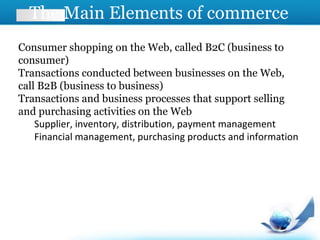
The Main Elements of commerce
Consumer shopping on the Web, called B2C (business to
consumer)
Transactions conducted between businesses on the Web,
call B2B (business to business)
Transactions and business processes that support selling
and purchasing activities on the Web
Supplier, inventory, distribution, payment management
Financial management, purchasing products and information
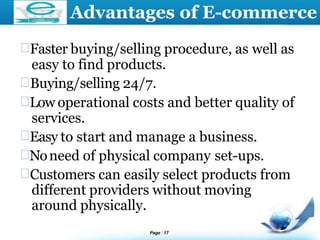
LOGO Advantages of E-commerce
Faster buying/selling procedure, as well as
easy to find products.
Buying/selling 24/7.
Low operational costs and better quality of
services.
Easy to start and manage a business.
Noneed of physical company set-ups.
Customers can easily select products from
different providers without moving
around physically.
Page 17
LOD
GO
Page 18
isadvantages of E-commerce
There is no guarantee of product quality.
E-commerce Delay goods.
Many goods can’t be purchase online.
Not everyone is connected to the internet.
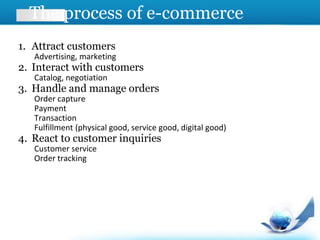
The process of e-commerce
1. Attract customers
Advertising, marketing
2. Interact with customers
Catalog, negotiation
3. Handle and manage orders
Order capture
Payment
Transaction
Fulfillment (physical good, service good, digital good)
4. React to customer inquiries
Customer service
Order tracking
LOGO Types of E-comerce
B2B (Business-to-Business)
B2C (Business-to-Consumer)
C2B (Consumer-to-Business)
C2C (Consumer-to-Consumer)
B2G ( Business-to- Government)
G2C ( G0vt.-to-Consumer)
Page 20
LOGO BUSINESS TO BUSINESS
B2B e-commerce is simply defined as e-
commerce between companies about 80%
of e-commerce is of the type.
Ex: Intell selling micro process or to
Dell.
Page 21
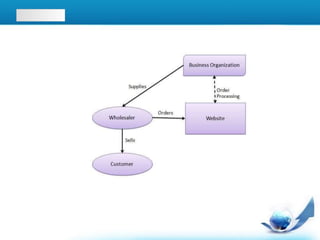
A website following the B2B business model
sells its products to an intermediate buyer
who then sells the product to the final
customer. As an example, a wholesaler
places an order from a company's website
and after receiving the consignment, sells the
end product to the final customer who comes
to buy the product at one of its retail outlets.
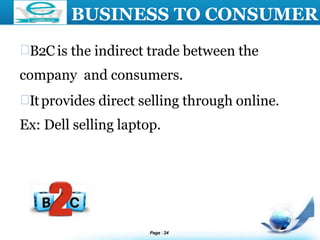
LOGO BUSINESS TO CONSUMER
B2C is the indirect trade between the
company and consumers.
Itprovides direct selling through online.
Ex: Dell selling laptop.
Page 24
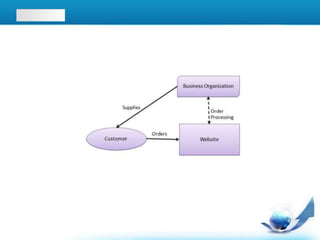
A website following the B2C business model
sells its products directly to a customer. A
customer can view the products shown on
the website. The customer can choose a
product and order the same. The website will
then send a notification to the business
organization via email and the organization
will dispatch the product/goods to the
customer.
LOGO
CONSUMER TO BUSINESS
A consumer posts his project with a set
budget online and within hours companies
review the consumer's requirements and bid
on the project.
The consumer reviews the bids and selects
the company that will complete the project.
Page 27
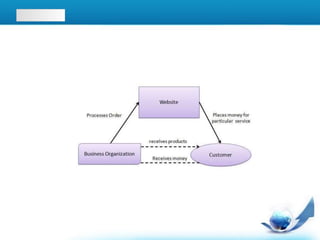
In this model, a consumer approaches a website
showing multiple business organizations for a
particular service. The consumer places an estimate
of amount he/she wants to spend for a particular
service. For example, the comparison of interest
rates of personal loan/car loan provided by various
banks via websites. A business organization who
fulfills the consumer's requirement within the
specified budget, approaches the customer and
provides its services.
LOGO
CONSUMER TO CONSUMER
Consumer to consumer is simply
commerce between private individuals or
consumers.
Itfacilitates the online transaction of
goods or services between two people.
Page 30
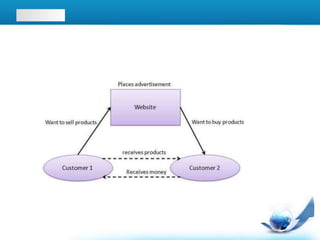
A website following the C2C business model
helps consumers to sell their assets like
residential property, cars, motorcycles, etc.,
or rent a room by publishing their
information on the website. Website may or
may not charge the consumer for its services.
Another consumer may opt to buy the
product of the first customer by viewing the
post/advertisement on the website.
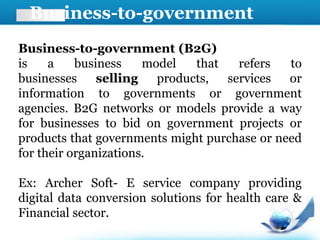
Business-to-government
(B2G)
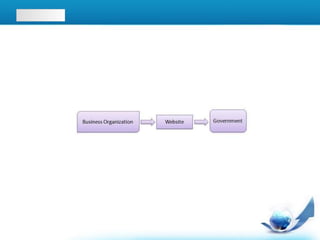
Business-to-government (B2G)
is a business model that refers to
businesses selling products, services or
information to governments or government
agencies. B2G networks or models provide a way
for businesses to bid on government projects or
products that governments might purchase or need
for their organizations.
Ex: Archer Soft- E service company providing
digital data conversion solutions for health care &
Financial sector.
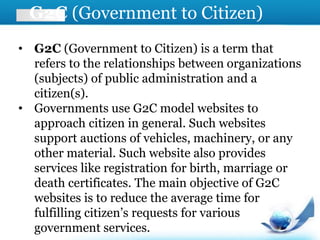
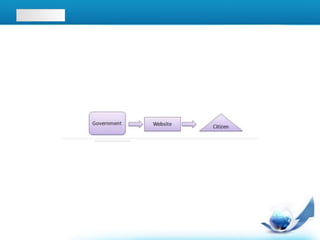
G2C (Government to Citizen)
• G2C (Government to Citizen) is a term that
refers to the relationships between organizations
(subjects) of public administration and a
citizen(s).
• Governments use G2C model websites to
approach citizen in general. Such websites
support auctions of vehicles, machinery, or any
other material. Such website also provides
services like registration for birth, marriage or
death certificates. The main objective of G2C
websites is to reduce the average time for
fulfilling citizen’s requests for various
government services.
Internet Concept & Technologies:
Internet:
The internet is a global connection of computer networks that are linked
together by devices called routers and use common set of protocols for
data transmit ion known as TCP ( Transfer Control Protocol) & IP.
Internet is defined as an information support highway to access
information over the web.
Internet Accounts:
Definitions:
1. Internet account means the Bank account from which you
will be conducting transactions using a Service;
2. Internet account means an account created within a
bounded system established by an Internet- based service
that requires a user to input or store access information in
an electronic device in order to view, create, use or edit the
user's account information, profile, display, communications
or stored data
3. Internet account means a Card Account approved,
opened by the Bank in the name of the Principal
Cardholder by the Bank for the settlement of Internet
Transactions and the relevant Charges.
A public network is a network to which anyone can connect. It is a
network that is accessible to the public. By participating in a public
network, you expose your conncted devices to the world. This requires
defensive computing whereby you consider the information security
risks involved. WAN, Global network is an example for Public network.
A private network is any network to which access is restricted. A
corporate network or a network in a school are examples of private
networks.
Private networks have security measures in place to prevent
unwanted or unauthorized connections. Private networks are often used
for home, business, or school Wi-Fi networks, or mobile hotspots for
security and to preserve bandwidth.( range of frequencies used to
transmit the signal)
The main difference between public and private
networks, apart from the fact that access to a
private network is tightly controlled and access to a
public network is not, is that the addressing of
devices on a public network must be considered
carefully, whereas addressing on a private network
has a little more freedom.
Applications of Internet
An Internet application does something for end users. It is
generally not concerned with how data is actually transmitted
between the hosts. Here are some distributed applications that
require well-defined application level protocols:
• Sending and receiving email
• Searching and browsing information archives
• Copying files between computers
• Conducting financial transactions
• Navigating (in your car, smart scooter, smart bike, or other)
• Playing interactive games
• Video and music streaming
• Chat or voice communication (direct messaging, video
conferencing)
13
Source: https://www.ecommerce-
land.com/history_ecommerce.html

E commerce unit 1

  • 1.
  • 2.
    LOGO INDEX Meaning ofE-Commerce. History of E-Commerce. Advantages of E-Commerce. Disadvantages of E-Commerce. Types of E-Commerce. Some of E-Commerce Websites. Page 2
  • 3.
    LOGO E-commerce consists ofthe buying and selling of products or services over electronic systems such as the Internet and other computer networks. Electronic commerce commonly known as e-commerce. Meaning of E-Commerce. Page 3
  • 4.
    History of E-Commerce •One of the most popular activities on the Web is shopping. It has much allure in it — you can shop at anytime, anywhere. • Literally anyone can have their pages built to display their specific goods and services. History of ecommerce dates back to the invention of the very old notion ( Imagination) of "sell and buy", electricity, cables, computers, modems, and the Internet. • Ecommerce became possible in 1991 when the Internet was opened to commercial use. Since that date thousands of businesses have taken up residence at web sites.
  • 5.
    • At first,the term ecommerce meant the process of execution of commercial transactions electronically with the help of the leading technologies such as Electronic Data Interchange (EDI) and Electronic Funds Transfer (EFT) which gave an opportunity for users to exchange business information and do electronic transactions. • The ability to use these technologies appeared in the late 1970s and allowed business companies and organizations to send commercial documentation electronically.
  • 6.
    • Although theInternet began to advance in popularity among the general public in 1994, it took approximately four years to develop the security protocols (for example, HTTP) and DSL(Digital Subscriber Line) which allowed rapid access and a persistent ( Continuous ) connection to the Internet. • In 2000 a great number of business companies in the United States and Western Europe represented their services in the World Wide Web. At this time the meaning of the word ecommerce was changed.
  • 7.
    • People beganto define the term ecommerce as the process of purchasing of available goods and services over the Internet using secure connections and electronic payment services. • Although the dot-com collapse in 2000 led to unfortunate results and many of ecommerce companies disappeared, the "brick and mortar" retailers recognized the advantages of electronic commerce and began to add such capabilities to their web sites
  • 8.
    By the endof 2001, the largest form of ecommerce, Business-to-Business (B2B) model, had around $700 billion in transactions. According to all available data, ecommerce sales continued to grow in the next few years and, by the end of 2007, ecommerce sales accounted for 3.4 percent of total sales.
  • 9.
    History of ecommerceis unthinkable without Amazon and Ebay which were among the first Internet companies to allow electronic transactions. Currently there are 5 largest and most famous worldwide Internet retailers: Amazon, Dell, Staples, Office Depot and Hewlett Packard. According to statistics, the most popular categories of products sold in the World Wide Web are music, books, computers, office supplies and other consumer electronics.
  • 10.
    Amazon.com, Inc. isone of the most famous ecommerce companies and is located in Seattle, Washington (USA). It was founded in 1994 by Jeff Bezos and was one of the first American ecommerce companies to sell products over the Internet. After the dot-com collapse Amazon lost its position as a successful business model, however, in 2003 the company made its first annual profit which was the first step to the further development.
  • 11.
    Amazon is oneof the first ecommerce businesses to establish an affiliate marketing program, and nowadays the company gets about 40% of its sales from affiliates and third party sellers who list and sell goods on the web site. In 2008 Amazon penetrated into the cinema.
  • 12.
    In 2007, Fortunemagazine ranked Dell as the 34th- largest company in the Fortune 500 list and 8th on its annual Top 20 list of the most successful and admired companies in the USA in recognition of the company's business model. History of ecommerce is a history of a new, virtual world which is evolving according to the customer advantage. It is a world which we are all building together brick by brick, laying a secure foundation for the future generations.
  • 13.
    Brief History 1970s: ElectronicFunds Transfer (EFT) Used by the banking industry to exchange account information over secured networks Late 1970s and early 1980s: Electronic Data Interchange (EDI) for e-commerce within companies Used by businesses to transmit data from one business to another 1990s: the World Wide Web on the Internet provides easy- to-use technology for information publishing and dissemination Cheaper to do business (economies of scale) Enable diverse business activities (economies of scope)
  • 14.
    E-commerce applications • Supplychain management: supply chain management, the management of the flow of goods and services, money and information between businesses and locations, and includes the movement and storage of raw materials.
  • 15.
    • Remote banking:service is a system of services used by bank customers to perform various banking operations in a remote way. To do this, it is enough to use a computer or a telephone; it is not necessary to visit the bank branch.) • Online marketing and advertisement • Home shopping
  • 16.
    The Main Elementsof commerce Consumer shopping on the Web, called B2C (business to consumer) Transactions conducted between businesses on the Web, call B2B (business to business) Transactions and business processes that support selling and purchasing activities on the Web Supplier, inventory, distribution, payment management Financial management, purchasing products and information
  • 17.
    LOGO Advantages ofE-commerce Faster buying/selling procedure, as well as easy to find products. Buying/selling 24/7. Low operational costs and better quality of services. Easy to start and manage a business. Noneed of physical company set-ups. Customers can easily select products from different providers without moving around physically. Page 17
  • 18.
    LOD GO Page 18 isadvantages ofE-commerce There is no guarantee of product quality. E-commerce Delay goods. Many goods can’t be purchase online. Not everyone is connected to the internet.
  • 19.
    The process ofe-commerce 1. Attract customers Advertising, marketing 2. Interact with customers Catalog, negotiation 3. Handle and manage orders Order capture Payment Transaction Fulfillment (physical good, service good, digital good) 4. React to customer inquiries Customer service Order tracking
  • 20.
    LOGO Types ofE-comerce B2B (Business-to-Business) B2C (Business-to-Consumer) C2B (Consumer-to-Business) C2C (Consumer-to-Consumer) B2G ( Business-to- Government) G2C ( G0vt.-to-Consumer) Page 20
  • 21.
    LOGO BUSINESS TOBUSINESS B2B e-commerce is simply defined as e- commerce between companies about 80% of e-commerce is of the type. Ex: Intell selling micro process or to Dell. Page 21
  • 22.
    A website followingthe B2B business model sells its products to an intermediate buyer who then sells the product to the final customer. As an example, a wholesaler places an order from a company's website and after receiving the consignment, sells the end product to the final customer who comes to buy the product at one of its retail outlets.
  • 24.
    LOGO BUSINESS TOCONSUMER B2C is the indirect trade between the company and consumers. Itprovides direct selling through online. Ex: Dell selling laptop. Page 24
  • 25.
    A website followingthe B2C business model sells its products directly to a customer. A customer can view the products shown on the website. The customer can choose a product and order the same. The website will then send a notification to the business organization via email and the organization will dispatch the product/goods to the customer.
  • 27.
    LOGO CONSUMER TO BUSINESS Aconsumer posts his project with a set budget online and within hours companies review the consumer's requirements and bid on the project. The consumer reviews the bids and selects the company that will complete the project. Page 27
  • 28.
    In this model,a consumer approaches a website showing multiple business organizations for a particular service. The consumer places an estimate of amount he/she wants to spend for a particular service. For example, the comparison of interest rates of personal loan/car loan provided by various banks via websites. A business organization who fulfills the consumer's requirement within the specified budget, approaches the customer and provides its services.
  • 30.
    LOGO CONSUMER TO CONSUMER Consumerto consumer is simply commerce between private individuals or consumers. Itfacilitates the online transaction of goods or services between two people. Page 30
  • 31.
    A website followingthe C2C business model helps consumers to sell their assets like residential property, cars, motorcycles, etc., or rent a room by publishing their information on the website. Website may or may not charge the consumer for its services. Another consumer may opt to buy the product of the first customer by viewing the post/advertisement on the website.
  • 33.
    Business-to-government (B2G) Business-to-government (B2G) is abusiness model that refers to businesses selling products, services or information to governments or government agencies. B2G networks or models provide a way for businesses to bid on government projects or products that governments might purchase or need for their organizations. Ex: Archer Soft- E service company providing digital data conversion solutions for health care & Financial sector.
  • 35.
    G2C (Government toCitizen) • G2C (Government to Citizen) is a term that refers to the relationships between organizations (subjects) of public administration and a citizen(s). • Governments use G2C model websites to approach citizen in general. Such websites support auctions of vehicles, machinery, or any other material. Such website also provides services like registration for birth, marriage or death certificates. The main objective of G2C websites is to reduce the average time for fulfilling citizen’s requests for various government services.
  • 37.
    Internet Concept &Technologies: Internet: The internet is a global connection of computer networks that are linked together by devices called routers and use common set of protocols for data transmit ion known as TCP ( Transfer Control Protocol) & IP. Internet is defined as an information support highway to access information over the web.
  • 38.
    Internet Accounts: Definitions: 1. Internetaccount means the Bank account from which you will be conducting transactions using a Service; 2. Internet account means an account created within a bounded system established by an Internet- based service that requires a user to input or store access information in an electronic device in order to view, create, use or edit the user's account information, profile, display, communications or stored data 3. Internet account means a Card Account approved, opened by the Bank in the name of the Principal Cardholder by the Bank for the settlement of Internet Transactions and the relevant Charges.
  • 39.
    A public networkis a network to which anyone can connect. It is a network that is accessible to the public. By participating in a public network, you expose your conncted devices to the world. This requires defensive computing whereby you consider the information security risks involved. WAN, Global network is an example for Public network. A private network is any network to which access is restricted. A corporate network or a network in a school are examples of private networks. Private networks have security measures in place to prevent unwanted or unauthorized connections. Private networks are often used for home, business, or school Wi-Fi networks, or mobile hotspots for security and to preserve bandwidth.( range of frequencies used to transmit the signal)
  • 40.
    The main differencebetween public and private networks, apart from the fact that access to a private network is tightly controlled and access to a public network is not, is that the addressing of devices on a public network must be considered carefully, whereas addressing on a private network has a little more freedom.
  • 41.
    Applications of Internet AnInternet application does something for end users. It is generally not concerned with how data is actually transmitted between the hosts. Here are some distributed applications that require well-defined application level protocols: • Sending and receiving email • Searching and browsing information archives • Copying files between computers • Conducting financial transactions • Navigating (in your car, smart scooter, smart bike, or other) • Playing interactive games • Video and music streaming • Chat or voice communication (direct messaging, video conferencing)
  • 42.