General Science Unit 3:
Electricity and Magnetism
Chapter 7
7.1 Standards
and
Objectives
Identify and describe the properties of magnets.
• 6.S.1A.3
• 6.S.1B.1
Identify
and
describe
Explain how magnetic poles interact.
• 6.S.1A.3
Explain
Develop and use models to exemplify how magnetic fields
produced by electrical energy flow in a circuit is interrelated in
electromagnets, generators, and simple electrical motors.
• 6.P.3A.4
Develop
and use
7.1 Untamed Science Video
Magnetism: What’s the Attraction?
https://classroom.google.com/c/ODU5NjI2NzA2MFpa/a/NTc3MjYwOD
ExMlpa/details
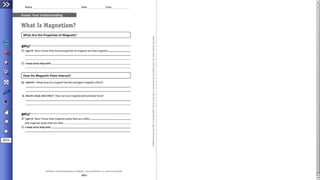
7.1 What is Magnetism?
In short, magnetism is the attraction or repulsion
of magnetic materials.
Any material that attracts iron and materials that
contain iron is considered a magnet.
Magnetic Pole Interaction
https://youtu.be/Mp0Bu75MSj8
https://youtu.be/xuO6okkyJ7c
Questions to consider
• What are some properties of magnets?
• Contain iron
• Has two poles
• Is attracted to other objects that contain iron.
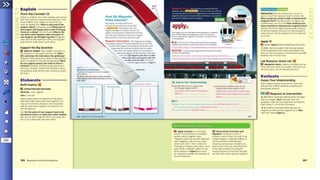
• How do magnetic poles interact?
• If poles are the same, they repel
• If poles are different, they attract
• Magnetic pole interactions cause a magnetic field
7.2 Standards and Objectives
Describe a
magnetic field.
6.S.1A.2
6.S.1A.3
6.S.1A.6
Describe Earth’s
magnetic field.
6.S.1A.2
6.S.1A.4
Magnetic Field
Lines
• https://youtu.be/00lqFyQI8CM
https://youtu.be/V-M07N4a6-Y
Page 272 What is Earth’s magnetic field like?
• Earth has two poles and a magnetic field around just like a bar
magnet.
• The magnetic field is generated from circulation of the liquid iron
core.
• The magnetic field is similar to that of a bar magnet.
Magnetic declination
• In layman’s terms, it is the difference between the location of the
physical north pole and the magnetic north pole of the earth.
7.3 Standards
and
Objectives
Explain how electric current is related to magnetism.
•6.S.1A.3
•6.P.3A.4Explain
Identify some characteristics of a magnetic field produced by a current.
•6.P.3A.4
•6.S.1A.2
•6.S.1A.6
Identify
Describe the characteristics of solenoids and electromagnets.
•6.P.3A.4
•6.S.1A.2
•6.S.1A.6
Describe
Things to ponder…
• How are electric currents and magnetic fields related?
• What is a magnetic field produced by a current like?
• What are the characteristics of solenoids and
electromagnets?
Hans Christian Oersted
• In 1820, he accidentally discovered that a magnetic field
could be produced by an electric current.
• He was a professor at the University of Copenhagen
Oersted's
Experiment
• https://youtu.be/RwilgsQ9xaM
Compass Deflection Page 275
• From the video, what happened to the compasses when the electric
current was removed?
• What about when the electric current was on?
• Explain the movement of the compass needles during the
experiment.
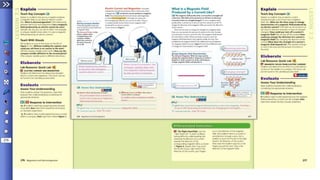
What is a magnetic field produced by a
current is like?
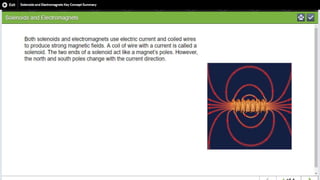
The magnetic field produced by a current has a strength and
direction. The field can be turned on and off, have it’s
direction reversed, or have its strength changed.
Page 277
Oersted’s Experiment
• What did Oersted conclude?
He concluded that an electric current does create a magnetic field
around the wire and in the direction of the current flow.
How does a current affect a compass?
The moving current deflects the compass needle based on its direction
of flow.
How do we change the strength of an
electromagnet?
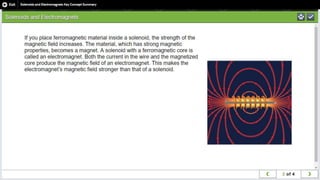
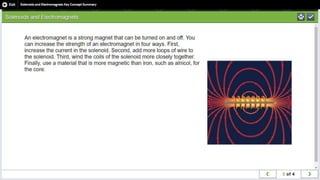
• Increase the electric current
• Increase the number of turns in the wire carrying the electric current.
Page 277
Poles of a solenoid
• How do we change the magnetic poles of a solenoid?
We change the magnetic poles by changing the direction of current
flow.
Page 278
7.4 Standards and Objectives
• 6.P.3A.4
• Explain how electrical energy can be transformed into mechanical
energy.
• Describe how galvanometers work.
• Describe how electric motors work.
How is electrical energy transformed into
mechanical energy?
• Electrical energy is transformed into mechanical energy through
devices called electric motors.
• Electric motors work on the principle of when a wire with a current is
placed in a magnetic field, electrical energy is transformed into
mechanical energy.
• Electric Motor Animation https://youtu.be/Xi7o8cMPI0E
Page 281
Electric Motors
• They operate by rotating a wire with an electric current within a
permanent magnetic field.
• The wire generates a magnetic field that tries to align with the
magnetic poles of the permanent magnet.
• A small switch called a commutator turns the current on and off
preventing the alignment of the magnetic field with the permanent
magnetic poles.
Page 284
Electric motor detailed operation
• https://youtu.be/wxG3cwugXgs
Galvanometer? What is this?
• Galvanometers are devices that measure small currents.
• They can be found in instruments like
• Automotive fuel gauges
• Volt meters
• Car speedometer
Page 282
Galvanometer operation principle
• Galvanometers operate on the principle of a suspended
electromagnet coil placed between opposite poles of a permanent
magnet.
• When a current is run into the electromagnetic coil, the magnetic
field created attempts to align with the poles of the permanent
magnet.
• The coil has a pointer attached, which is used to indicate a specific
purpose. (Amount of current going to the car’s battery)
Page 282
Galvanometer animation
• https://youtu.be/CqW5rmmqv_Y
7.5 Standards and Objectives
• 6.P.3A.4
• Explain how an electric current can be produced in a conductor.
• Describe how a generator works.
• Describe what a transformer does.
• Describe the similarities of motors and generators.
Electric current induction
• If a wire coil is moved through a magnetic field, a electric current is
generated within the wire.
• If a permanent magnet is moved through a wire coil, an electric
current is generated within the wire.
• Page 284, 288
Two types of electric current
• Direct Current (DC)
• The charges of the current flow in one direction.
• The charges move from one end of a battery to the other end.
• Alternating Current (AC)
• The charges in the current rapidly change directions
• This current if generated by either moving the coil or the magnet up and
down repeatedly.
• The major advantage of AC over DC is that AC voltage can be easily raised or
lowered.
• Page 289
Generators
• Generators function by rotating a coil of wire within a magnetic field
to produce a current.
• Generators use motion (mechanical energy) in a magnetic field to
produce current.
• They can be:
• Hand driven
• Water driven
• Wind powered
Page 290
Transformers
• Transformers are devices that increase or decrease voltage.
• They are found on light poles, in cell phones, on electric power
cables, etc.
• There are two types:
• Step up
• Step down
• Page 292
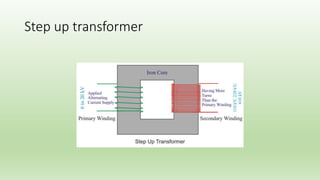
Step up transformer
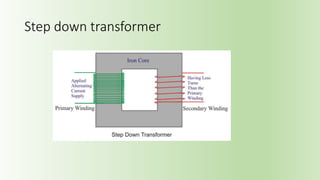
Step down transformer
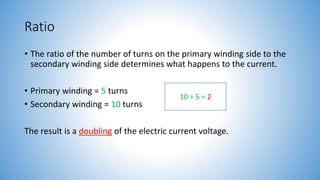
Ratio
• The ratio of the number of turns on the primary winding side to the
secondary winding side determines what happens to the current.
• Primary winding = 5 turns
• Secondary winding = 10 turns
The result is a doubling of the electric current voltage.
10 ÷ 5 = 2
Chapter test on Wednesday
Take textbooks and notes home to study.
Bonus points on the test will be added through a random process.
20 Multiple Choice Questions

General science unit 3 electricity and magnetism

  • 1.
    General Science Unit3: Electricity and Magnetism Chapter 7
  • 2.
    7.1 Standards and Objectives Identify anddescribe the properties of magnets. • 6.S.1A.3 • 6.S.1B.1 Identify and describe Explain how magnetic poles interact. • 6.S.1A.3 Explain Develop and use models to exemplify how magnetic fields produced by electrical energy flow in a circuit is interrelated in electromagnets, generators, and simple electrical motors. • 6.P.3A.4 Develop and use
  • 3.
    7.1 Untamed ScienceVideo Magnetism: What’s the Attraction? https://classroom.google.com/c/ODU5NjI2NzA2MFpa/a/NTc3MjYwOD ExMlpa/details
  • 4.
    7.1 What isMagnetism? In short, magnetism is the attraction or repulsion of magnetic materials. Any material that attracts iron and materials that contain iron is considered a magnet.
  • 8.
  • 10.
    Questions to consider •What are some properties of magnets? • Contain iron • Has two poles • Is attracted to other objects that contain iron. • How do magnetic poles interact? • If poles are the same, they repel • If poles are different, they attract • Magnetic pole interactions cause a magnetic field
  • 11.
    7.2 Standards andObjectives Describe a magnetic field. 6.S.1A.2 6.S.1A.3 6.S.1A.6 Describe Earth’s magnetic field. 6.S.1A.2 6.S.1A.4
  • 12.
  • 13.
    Page 272 Whatis Earth’s magnetic field like? • Earth has two poles and a magnetic field around just like a bar magnet. • The magnetic field is generated from circulation of the liquid iron core. • The magnetic field is similar to that of a bar magnet.
  • 14.
    Magnetic declination • Inlayman’s terms, it is the difference between the location of the physical north pole and the magnetic north pole of the earth.
  • 18.
    7.3 Standards and Objectives Explain howelectric current is related to magnetism. •6.S.1A.3 •6.P.3A.4Explain Identify some characteristics of a magnetic field produced by a current. •6.P.3A.4 •6.S.1A.2 •6.S.1A.6 Identify Describe the characteristics of solenoids and electromagnets. •6.P.3A.4 •6.S.1A.2 •6.S.1A.6 Describe
  • 19.
    Things to ponder… •How are electric currents and magnetic fields related? • What is a magnetic field produced by a current like? • What are the characteristics of solenoids and electromagnets?
  • 20.
    Hans Christian Oersted •In 1820, he accidentally discovered that a magnetic field could be produced by an electric current. • He was a professor at the University of Copenhagen
  • 21.
  • 22.
    Compass Deflection Page275 • From the video, what happened to the compasses when the electric current was removed? • What about when the electric current was on? • Explain the movement of the compass needles during the experiment.
  • 24.
    What is amagnetic field produced by a current is like? The magnetic field produced by a current has a strength and direction. The field can be turned on and off, have it’s direction reversed, or have its strength changed. Page 277
  • 28.
    Oersted’s Experiment • Whatdid Oersted conclude? He concluded that an electric current does create a magnetic field around the wire and in the direction of the current flow.
  • 29.
    How does acurrent affect a compass? The moving current deflects the compass needle based on its direction of flow.
  • 31.
    How do wechange the strength of an electromagnet? • Increase the electric current • Increase the number of turns in the wire carrying the electric current. Page 277
  • 32.
    Poles of asolenoid • How do we change the magnetic poles of a solenoid? We change the magnetic poles by changing the direction of current flow. Page 278
  • 33.
    7.4 Standards andObjectives • 6.P.3A.4 • Explain how electrical energy can be transformed into mechanical energy. • Describe how galvanometers work. • Describe how electric motors work.
  • 34.
    How is electricalenergy transformed into mechanical energy? • Electrical energy is transformed into mechanical energy through devices called electric motors. • Electric motors work on the principle of when a wire with a current is placed in a magnetic field, electrical energy is transformed into mechanical energy. • Electric Motor Animation https://youtu.be/Xi7o8cMPI0E Page 281
  • 35.
    Electric Motors • Theyoperate by rotating a wire with an electric current within a permanent magnetic field. • The wire generates a magnetic field that tries to align with the magnetic poles of the permanent magnet. • A small switch called a commutator turns the current on and off preventing the alignment of the magnetic field with the permanent magnetic poles. Page 284
  • 36.
    Electric motor detailedoperation • https://youtu.be/wxG3cwugXgs
  • 37.
    Galvanometer? What isthis? • Galvanometers are devices that measure small currents. • They can be found in instruments like • Automotive fuel gauges • Volt meters • Car speedometer Page 282
  • 38.
    Galvanometer operation principle •Galvanometers operate on the principle of a suspended electromagnet coil placed between opposite poles of a permanent magnet. • When a current is run into the electromagnetic coil, the magnetic field created attempts to align with the poles of the permanent magnet. • The coil has a pointer attached, which is used to indicate a specific purpose. (Amount of current going to the car’s battery) Page 282
  • 39.
  • 40.
    7.5 Standards andObjectives • 6.P.3A.4 • Explain how an electric current can be produced in a conductor. • Describe how a generator works. • Describe what a transformer does. • Describe the similarities of motors and generators.
  • 41.
    Electric current induction •If a wire coil is moved through a magnetic field, a electric current is generated within the wire. • If a permanent magnet is moved through a wire coil, an electric current is generated within the wire. • Page 284, 288
  • 42.
    Two types ofelectric current • Direct Current (DC) • The charges of the current flow in one direction. • The charges move from one end of a battery to the other end. • Alternating Current (AC) • The charges in the current rapidly change directions • This current if generated by either moving the coil or the magnet up and down repeatedly. • The major advantage of AC over DC is that AC voltage can be easily raised or lowered. • Page 289
  • 43.
    Generators • Generators functionby rotating a coil of wire within a magnetic field to produce a current. • Generators use motion (mechanical energy) in a magnetic field to produce current. • They can be: • Hand driven • Water driven • Wind powered Page 290
  • 44.
    Transformers • Transformers aredevices that increase or decrease voltage. • They are found on light poles, in cell phones, on electric power cables, etc. • There are two types: • Step up • Step down • Page 292
  • 45.
  • 46.
  • 47.
    Ratio • The ratioof the number of turns on the primary winding side to the secondary winding side determines what happens to the current. • Primary winding = 5 turns • Secondary winding = 10 turns The result is a doubling of the electric current voltage. 10 ÷ 5 = 2
  • 48.
    Chapter test onWednesday Take textbooks and notes home to study. Bonus points on the test will be added through a random process. 20 Multiple Choice Questions